

Tonality in Sales Calls: What the Data Actually Says About Your Voice
The first time you hear your own cold call recording, you cringe. Everyone does. Your voice sounds thinner, faster, and less confident than the version in your head, and there's no un-hearing it. Tonality in sales calls is one of those things every guide tells you to fix - "sound confident!" - without ever defining what confident actually sounds like in measurable terms.
Cold calling success rates hover at 2-5%. Your voice is one of the few levers that moves that number.
Three Benchmarks for Your Next Call Block
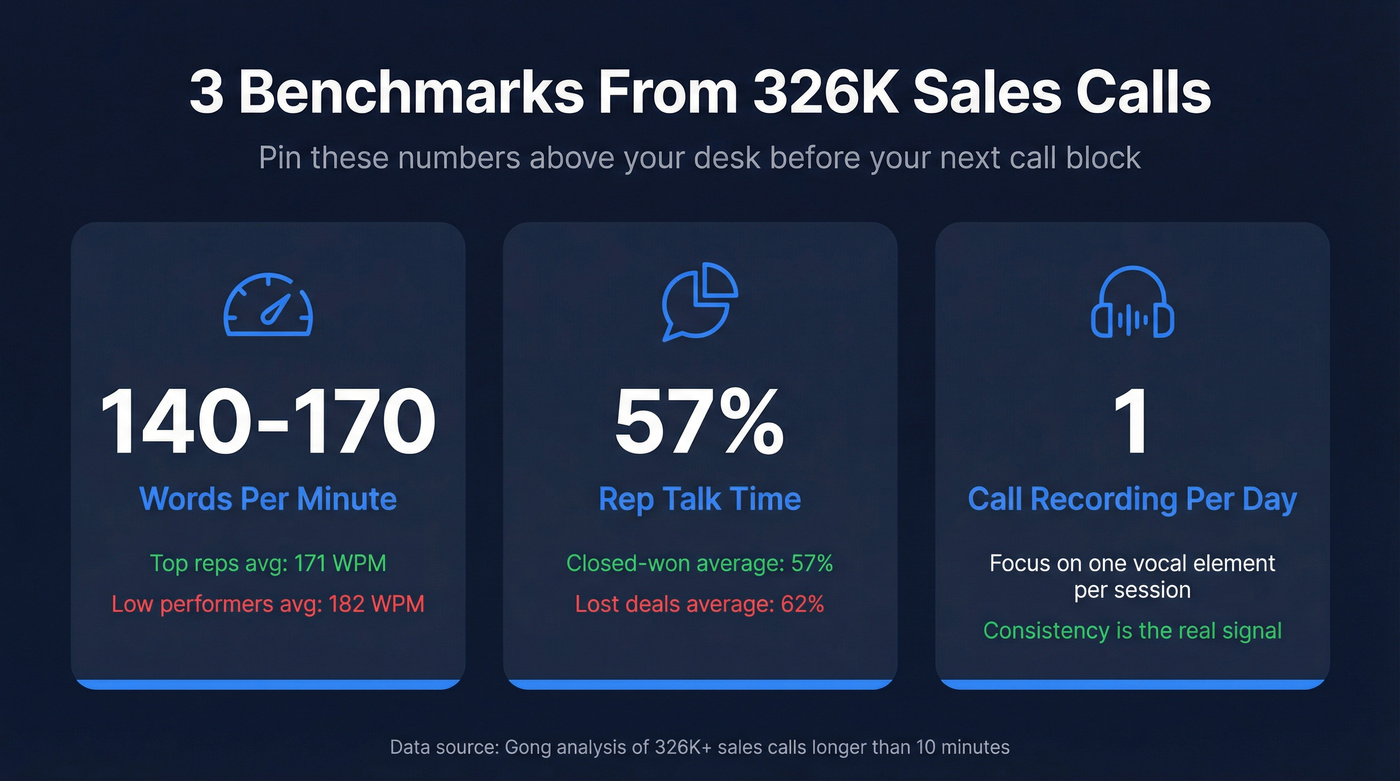
- Target 140-170 WPM. Top performers average 171 WPM; lower performers average 182 WPM. Nervous SDRs often hit 180-200. Slower is almost always better.
- Aim for 57% rep talk time. That's the closed-won average from 326K analyzed calls. The overall average across all calls is 60/40.
- Record one call per day and listen back focusing on a single vocal element. Not three. One.
The 93% Myth (and What We Actually Know)
You've seen the stat everywhere: "93% of communication is nonverbal." It comes from Albert Mehrabian's 1967 study, which tested how people interpret single words like "maybe" spoken in different tones. It was never designed for sales calls, multi-sentence conversations, or any real-world business context. Big Think calls it a "catchy number that got a scientific spit shine." Yet half the training industry still repeats it as gospel.
Here's what we actually have. Gong analyzed 326K sales calls longer than 10 minutes. Closed-won deals averaged 57% rep talk time versus 62% in lost deals. That five-point gap doesn't sound dramatic until you realize high performers stay consistent whether they win or lose - while low performers swing by roughly 10% between outcomes, jumping from 54% talk time in won deals to 64% in lost ones. Consistency in how you show up is the signal, not some magic ratio.
We've seen this play out across dozens of teams. The reps who improve fastest aren't the ones with the best scripts. They're the ones who actually listen to their own recordings.
Five Vocal Levers That Shape Tone
Pace. Top performers average 171 WPM; lower performers average 182 WPM. Nervous SDRs often hit 180-200. Cold-call pacing guidance commonly lands at 140-170 WPM, and comprehension drops hard once you push past 170. If you're looking to improve your vocal delivery, pace is the single easiest lever to adjust because you can measure it objectively - just record a 60-second clip and count.
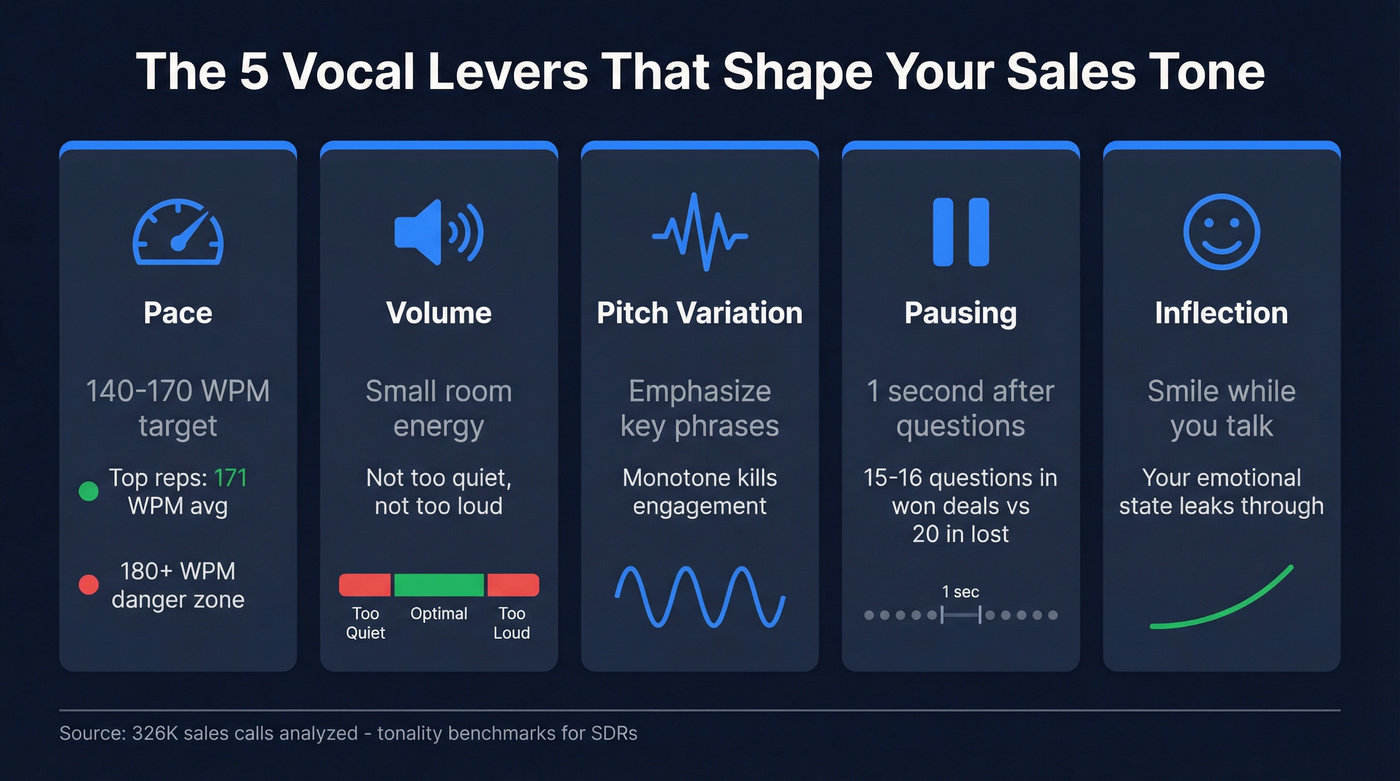
Volume. Slightly louder than your natural speaking voice signals authority. Too quiet reads as uncertain; too loud reads as aggressive. Aim for "presenting to a small room" volume.
Pitch variation. Monotone kills engagement. Vary your pitch to emphasize key phrases - your prospect's name, the problem you solve, the ask. Think about how you'd tell a friend about something genuinely interesting versus how you'd read a grocery list.
Pausing. A one-second pause after a question gives the prospect space to think. Won deals average 15-16 questions; lost deals average around 20. Pausing prevents the interrogation effect. (If you want a tighter questioning framework, use a set of discovery questions instead of improvising 20 in a row.)
Inflection. Your emotional state leaks through your voice. Smile while you talk - it physically changes your vocal tone. Stand up if you need more energy.
Calm vs. Enthusiastic: Which Wins?
This is one of the most active debates on r/sales. Some reps swear by a mellow tone - calm authority with a hint of concern, like a surgeon delivering a diagnosis. Others insist bottled enthusiasm is the only way to break through.
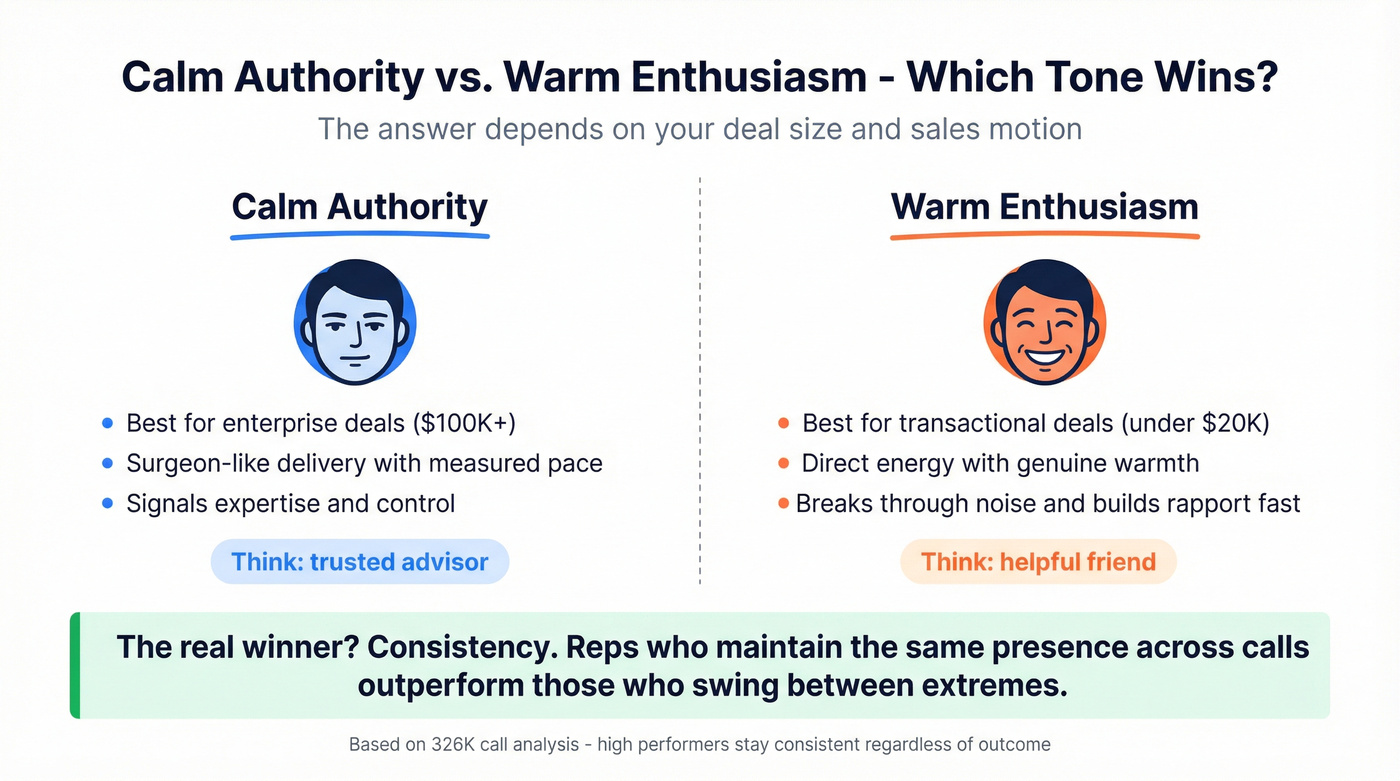
What the 326K-call dataset does settle: consistency beats volatility. Reps who keep roughly the same phone presence and pacing across calls outperform reps who swing between overhyped energy and deflated monotone.
Here's the thing - if your average deal size is under $20K, you almost certainly don't need the surgeon voice. Warm, direct energy wins in transactional sales. Save the gravitas for six-figure enterprise deals where every word carries weight. Empathy matters at every price point, though. Prospects can hear whether you genuinely care about their problem or you're just running a script.

You can nail pace, volume, and inflection - but none of it matters if you're dialing wrong numbers. By call 30 on a bad list, even elite reps sound defeated. Prospeo's 125M+ verified mobile numbers deliver a 30% pickup rate, so your vocal technique actually reaches a human.
Stop wasting your best tone on voicemail boxes and dead lines.
The First 10 Seconds
Do this: "Hi Bob, this is Sarah from Acme. I know you're busy - I'll be brief." Assumptive, calm, respectful. Your tone in this opener sets the frame for the entire call. (If you need more openers, pull from these talk track examples.)
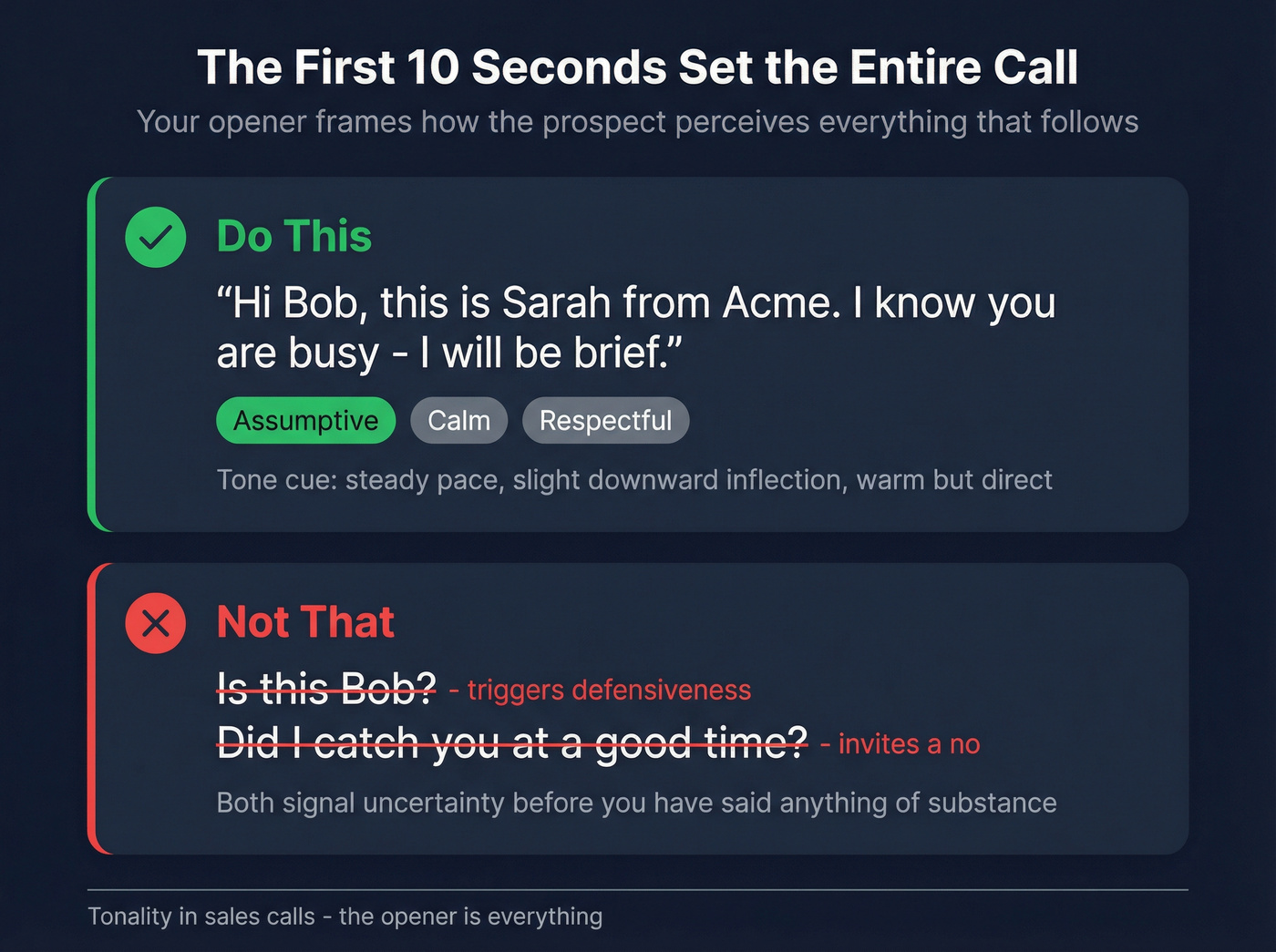
Not that: "Is this Bob?" triggers immediate defensiveness. "Did I catch you at a good time?" invites a no. Both signal uncertainty before you've said anything of substance.
Mistakes That Kill Your Call Tone
Racing through objections is the biggest killer, and it's a pattern reps consistently struggle to break. Uptalk turns every statement into a question and signals you don't believe what you're saying. Vocal fry - that creaky, low-register sound - reads as disengaged.
Monotone means no emphasis, which means your prospect tunes out within seconds. And racing at 180-200 WPM is the classic nervous SDR tell; if you're above 170, force yourself to slow down. Rapid-fire questions without breathing room create the interrogation effect. Pause between questions. Let silence work for you.
Skip the "power pose" advice you'll find in older sales training. Standing up and smiling are backed by real vocal changes; holding a superhero stance for two minutes before a call block isn't. (If you're building a repeatable routine, a full cold calling system helps you standardize prep and execution.)
A 10-Minute Coaching Drill
This is the most practical vocal coaching framework we've found, and it works in a weekly 1:1 or between call blocks:
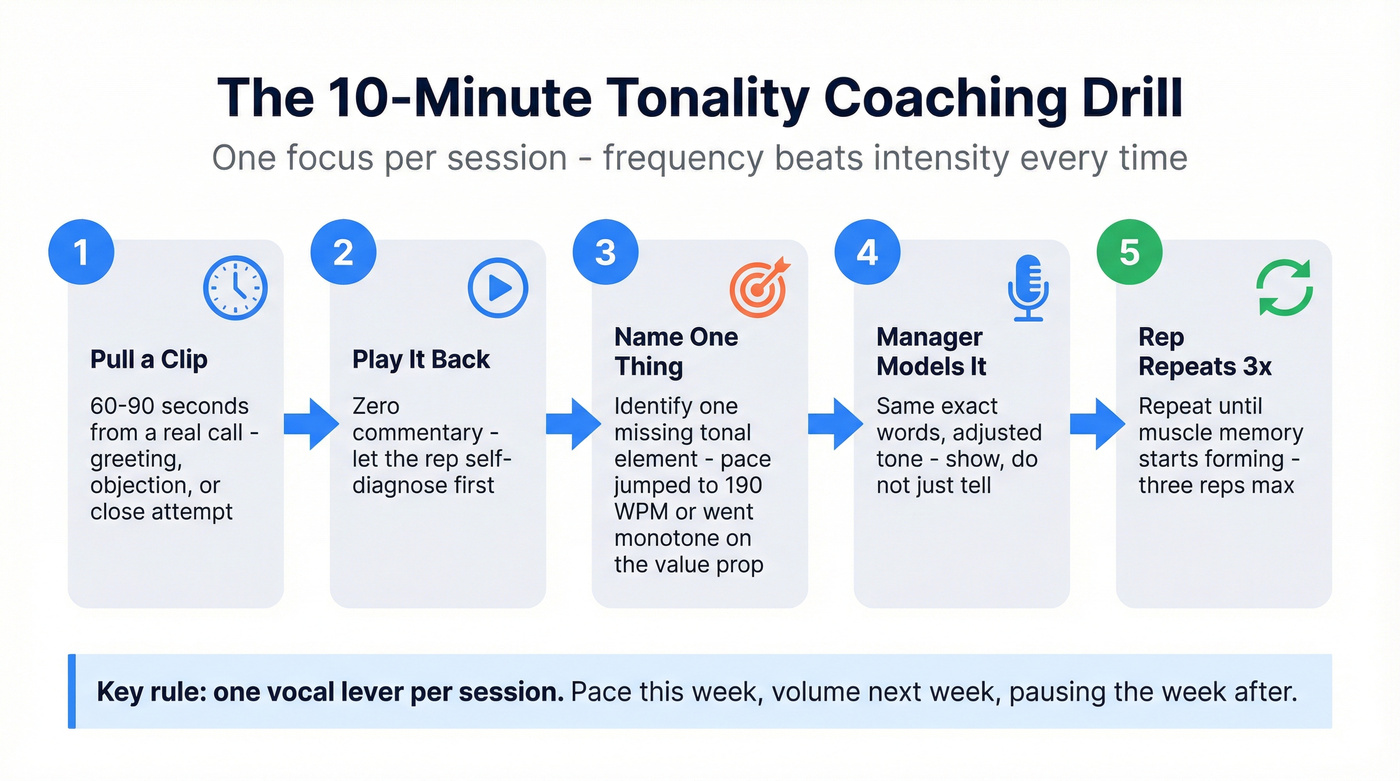
- Pull a 60-90 second clip from a real call - the greeting, first objection, or close attempt.
- Play it back with zero commentary. Let the rep self-diagnose.
- Name one missing tonal element. "Your pace jumped to 190 WPM on the objection" or "You went monotone during the value prop."
- Manager models the corrected phrase. Same words, adjusted tone.
- Rep repeats it up to three times until muscle memory starts forming.
One focus per session. Frequency beats intensity every time. (This pairs well with structured sales training tips if you're coaching a whole team.)
Measuring Tonality With AI
If you can't measure it, you can't coach it. Platforms like Gong, Chorus, and Salesken record calls and analyze talk ratios, sentiment shifts, monologue length, and question patterns. Some offer real-time alerts for long monologues or missed moments.
These tools commonly land around $1K-$2.5K per seat annually for mid-market teams; enterprise contracts often exceed $20K/year. For teams just starting out, even a free tool like Otter.ai for transcription plus a spreadsheet tracker can get you 80% of the way there. (If you're evaluating your stack, start with a shortlist of SDR tools and work backward from your workflow.)
Bad Data Kills Your Tone Before You Dial
Let's be honest about something most tonality guides ignore entirely. All the vocal technique in the world is useless if you're dialing dead numbers. By call 30 on a garbage list, even great reps sound defeated. Hesitation creeps in, pace drops, energy flatlines. The data-quality problem is a tone problem in disguise - it erodes your phone presence before you even get a chance to speak.
This is where Prospeo fits into the picture. With 125M+ verified mobile numbers and a 30% pickup rate, every dial has a real person on the other end. When you know the number is live and the prospect is real, your voice shifts: calmer, more certain, more in control. That confidence is audible from the first syllable. Teams using verified data report connect rates of 20-25%, compared to single digits on unverified lists - which means more live conversations per call block and less vocal fatigue dragging your tone down. (If you're cleaning and improving lists, data enrichment services can help fill gaps before you verify.)
The 326K-call data is clear: consistency wins deals. But consistency requires confidence, and confidence requires knowing someone will actually pick up. Prospeo refreshes mobile data every 7 days - not every 6 weeks - so you dial with the energy of a rep who expects a conversation.
Start every call block with data that keeps your tone sharp.
FAQ
What is tonality in sales?
Tonality is the combination of pace, pitch, volume, pausing, and inflection that shapes how prospects perceive your confidence and trustworthiness - independent of your actual words. Mastering it means controlling these five vocal levers deliberately rather than letting nerves dictate how you sound.
What's the ideal talk-to-listen ratio?
Closed-won deals average 57% rep talk time across 326K analyzed calls. Aim for roughly 57/43 - enough to guide the conversation without dominating it. High performers maintain this ratio consistently across wins and losses.
How fast should I speak on a cold call?
Target 140-170 words per minute. Nervous reps often hit 180-200 WPM, which tanks comprehension and signals anxiety. Record yourself and count - most reps overestimate how slow they sound.
How can I practice on my own?
Record one call per day and listen back focusing on a single element - pace, volume, or pausing. Read scripts aloud with different emotions to build range. Smile while you talk and warm up with humming or deep breathing before a call block.
Does contact data quality affect call tone?
Absolutely. Fewer dead numbers means your energy and tone stay strong across long call blocks. Verified mobile data with high pickup rates keeps reps in live conversations instead of battling voicemail fatigue that flattens their delivery over time.