


Traction Complete Pricing, Reviews, Pros and Cons
Traction Complete doesn't publish pricing on its website. You get a "book a demo" button and nothing else - a Salesforce-native routing tool in 2026 still hiding its cost structure feels unnecessary. So we pulled Vendr benchmarks, third-party directories, and 159 G2 reviews to give you real pricing anchors, honest pros and cons, and buyer context before you talk to their sales team.
What Does Traction Complete Cost?
Entry pricing lands around $39/user/month with a $10,000 minimum annual commitment. The real cost depends on which modules you need - they're all priced separately.
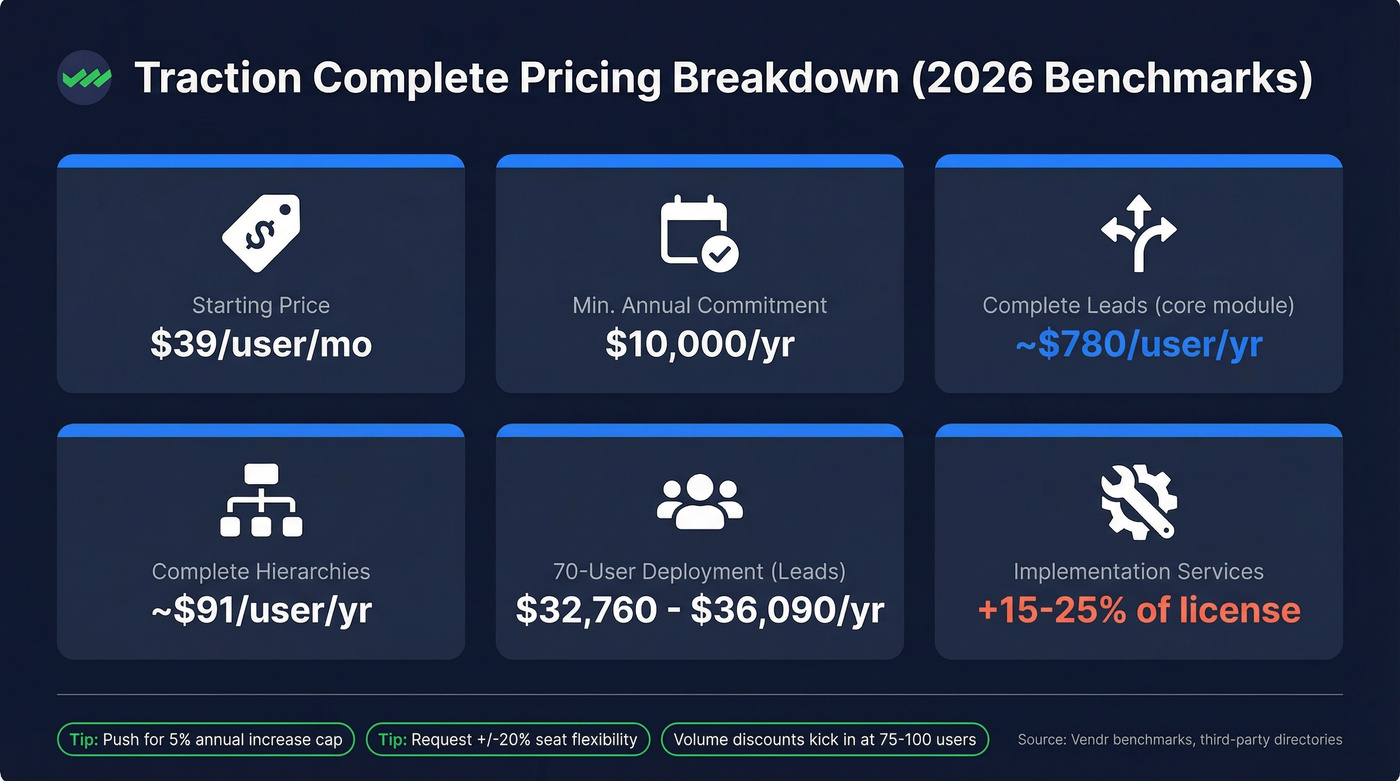
| Module / Metric | Cost |
|---|---|
| Starting price (benchmark) | $39/user/mo |
| Min. annual commitment (benchmark) | $10,000 |
| Complete Leads | ~$780/user/yr |
| Complete Hierarchies | ~$91/user/yr |
| 70-user deployment (Leads) | $32,760-$36,090/yr |
| Implementation services | +15-25% of license (typical) |
Complete Leads is the core module most teams buy. At ~$780/user/year, it's usually the bulk of your spend. Complete Hierarchies is comparatively cheap at ~$91/user/year, which makes bundling multiple modules a common negotiation lever.
Beyond those two, Traction Complete offers Complete Clean (deduplication), Complete Influence (attribution), Complete AI, and Complete Discover - each priced separately, so your total contract can swing wildly depending on scope.
When negotiating, push for a 5% annual increase cap, request +/-20% seat flexibility on multi-year deals, and know that volume discounts kick in meaningfully around 75-100 users. Below 50 users, that $10K minimum starts to sting. Budget an additional 15-25% on top of your license for implementation services too - that's standard in this category. (If you want a framework for this kind of pricing push, see negotiation anchors.)
Traction Complete vs. LeanData
LeanData is the obvious comparison. Here's how the numbers stack up.
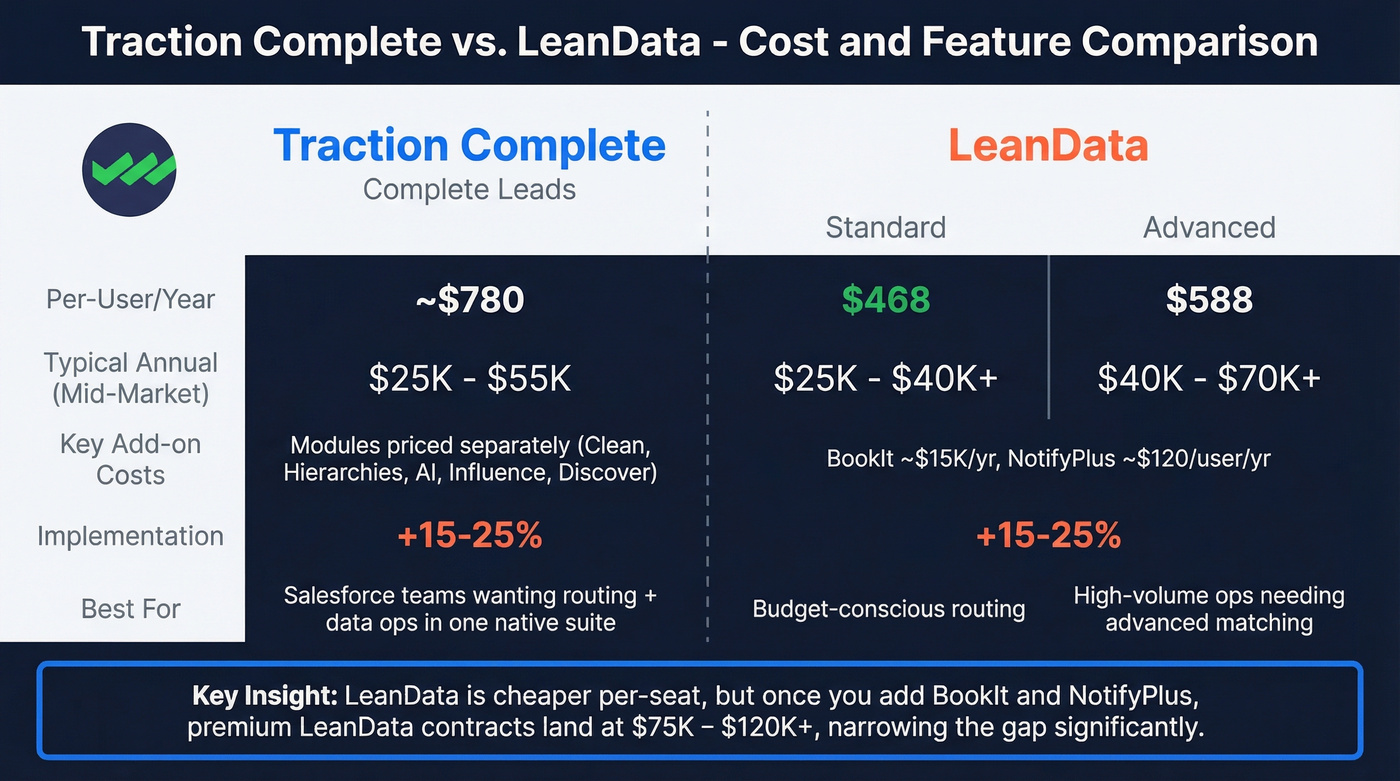
| Traction Complete (Leads) | LeanData Standard | LeanData Advanced | |
|---|---|---|---|
| Per-user/year (benchmark) | ~$780 | $468 | $588 |
| Typical annual (mid-market) | $25K-$55K | $25K-$40K+ | $40K-$70K+ |
| Key add-on costs | Modules priced separately | BookIt ~$15K/yr; NotifyPlus ~$120/user/yr | Same |
| Implementation | +15-25% | +15-25% | +15-25% |
| Best for | Salesforce teams wanting routing + data ops in one native suite | Budget-conscious routing | High-volume ops needing advanced matching |
On a pure per-user basis, LeanData is cheaper - Standard runs $468/user/year versus the ~$780 benchmark for Complete Leads. Both are Salesforce-native apps, meaning data stays within your Salesforce instance (and if you're sanity-checking your broader CRM spend, compare against Salesforce pricing).
Where Traction Complete can win on total stack simplicity is that it covers routing, hierarchy automation, and deduplication across its modules, which can reduce the need for separate point solutions. That consolidation argument resonates with ops teams already drowning in tool sprawl (especially if you're building a broader RevOps function).
LeanData's BookIt Handoff add-on lists at $15,000/year but often negotiates down to ~$9,060, and NotifyPlus adds another ~$120/user/year. Once you stack those add-ons, LeanData's cost advantage narrows fast. Premium-tier LeanData contracts commonly land in the $75K-$120K+ range.
On TrustRadius, LeanData shows 100% "would buy again" in its Community Pulse. Traction Complete also shows a "would buy again" widget on the comparison page with 47 answers.

Traction Complete routes leads. But routing stale data just burns rep time faster. Prospeo refreshes 300M+ profiles every 7 days - not every 6 weeks - so the contacts hitting your routing rules are real, reachable buyers. 98% email accuracy, native Salesforce integration, $0.01/email.
Fix the data before you optimize the plumbing.
Reviews: Pros and Cons
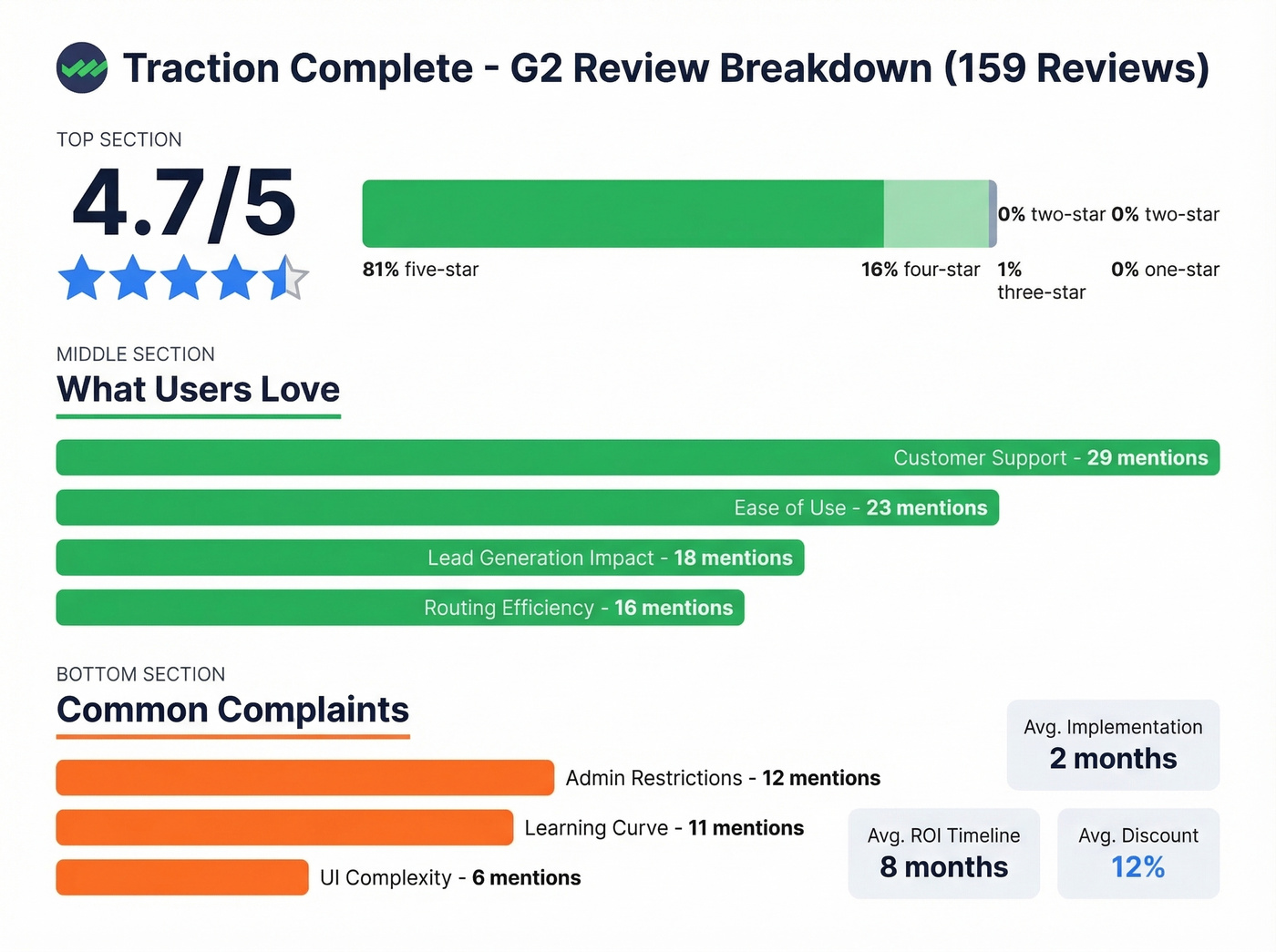
Traction Complete holds a 4.7/5 on G2 from 159 reviews. The distribution skews heavily positive: 81% five-star, 16% four-star, 1% three-star, with 0% one- or two-star reviews.
What Users Like
Customer support dominates the feedback with 29 mentions - the single most praised attribute. Ease of use follows with 23 mentions, often tied to the Salesforce-native experience feeling familiar rather than foreign. Lead generation impact drew 18 mentions, and routing efficiency rounded out the top themes at 16. The consensus on r/salesforce and G2 threads is consistent: the support team is genuinely responsive, which matters when you're debugging routing logic at quarter-end.
Traction Complete also claims it processes large volumes of data 80% faster than other revenue orchestration tools.
What Users Don't Like
Here's the thing - even with a 4.7 rating, the complaints follow a pattern. Administrative restrictions drew 12 mentions, with certain configuration options feeling locked down for power users who want granular control. The learning curve came up 11 times, and G2's "Value at a Glance" data shows an average implementation time of 2 months. UI complexity appeared in 6 reviews, mostly from occasional users who find the interface cumbersome when they aren't in the tool daily.
G2's pricing insights show an average ROI timeline of 8 months and a 12% average discount.
Who Should (and Shouldn't) Buy
Buy Traction Complete if you're an enterprise Salesforce team with 75+ users who need routing, hierarchy automation, and deduplication covered in one native suite. It's the right call when you want to avoid maintaining integrations between separate point solutions and your Salesforce admin team can dedicate roughly two months to proper implementation (use a sales POC to keep the evaluation tight).
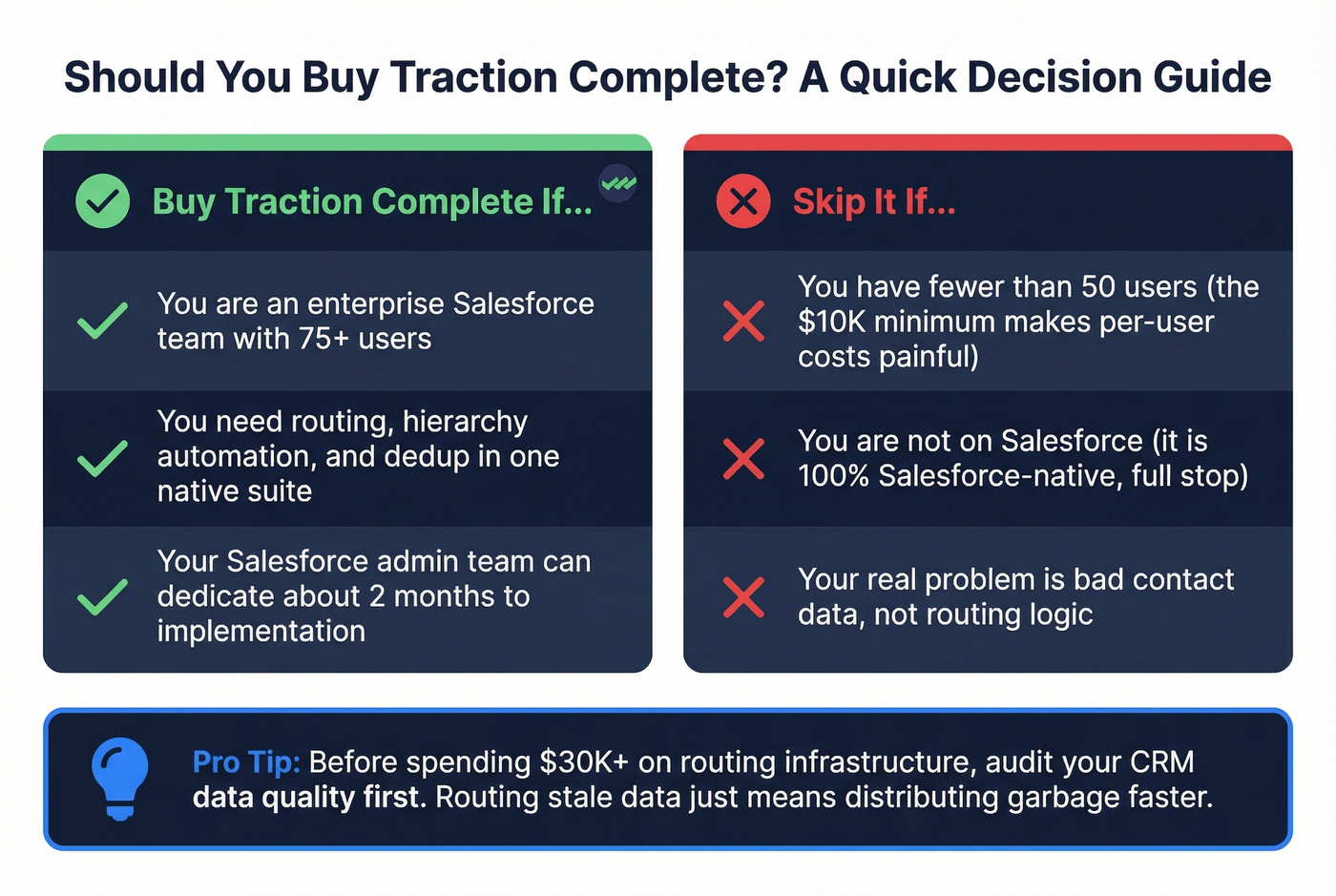
Skip it if you have fewer than 50 users (the $10K minimum makes per-user economics painful), you aren't on Salesforce (it's 100% Salesforce-native, full stop), or your real problem is bad contact data rather than routing logic.
Let's be honest about something we've seen repeatedly in our work with sales teams: most orgs shopping for lead routing tools are solving the wrong problem. Routing optimizes distribution, but if the underlying contact data in your CRM is stale or inaccurate, you're just routing garbage faster. Before committing $30K+ to routing infrastructure, audit your data quality (a quick lead enrichment pass can surface gaps fast). Prospeo verifies emails at 98% accuracy on a 7-day refresh cycle and integrates natively with Salesforce - the free tier lets you stress-test your CRM data before you invest in the plumbing that moves it around.
Spending $25K-$55K/year on routing infrastructure only pays off when reps actually connect with the leads being routed. Prospeo's 98% verified emails and 125M+ direct dials mean your routing investment converts to pipeline - not bounces. Free tier included, no contracts, no demo required.
Route leads that pick up the phone. Start with 75 free verifications.
FAQ
Does Traction Complete offer a free trial?
Traction Complete doesn't advertise a public self-serve free trial. Some third-party directories indicate one exists, but in practice expect a sales-led evaluation via demo request. Budget time for a 2-4 week guided POC.
How long does implementation take?
About 2 months on average based on G2 data. Budget 15-25% of your annual license for professional services - that's standard for Salesforce-native RevOps tools.
Is Traction Complete worth it vs. LeanData?
For pure lead routing, LeanData is cheaper at $468/user/year (Standard) versus ~$780/user/year for Complete Leads. Traction Complete wins when you want routing plus hierarchy automation and deduplication in one Salesforce-native suite, reducing the number of separate tools in your stack. If you're already running three or four point solutions for these functions, the consolidation math can tip in Traction Complete's favor even at the higher per-seat price.
What's a good way to test CRM data quality before buying a routing tool?
Start by spot-checking contact accuracy in your Salesforce instance. Tools like Prospeo offer free tiers that let you verify emails and surface stale records quickly - so you know whether your real bottleneck is data quality or distribution logic before writing a big check.