

Types of Sales Channels: The Complete 2026 Breakdown
Most guides on types of sales channels read like a glossary - 12 channel names, a sentence each, zero guidance on which ones to fund. That's useless if you're stuck in founder-led sales trying to build a repeatable pipeline. The average sales org uses 10 channels, but adding even one new channel can lift ecommerce revenue up to 38%. Two channels gets you 120%. Three pushes 190%. Those numbers only work if you pick the right selling channels and sequence them correctly.
What You Need (Quick Version)
You don't need 10 channels. Master two or three before adding a fourth.
B2B SMB (under $10M ARR): Outbound email/calling + content marketing + one partner or referral channel. That's predictable pipeline without enterprise budgets.
Ecommerce / DTC: Your own site + one marketplace like Amazon or Shopify Collective + one social commerce platform such as Instagram Shop or TikTok Shop. Own the customer relationship on your site; use marketplaces for volume.
Enterprise B2B: Field sales + channel partners/VARs + digital self-serve for smaller deals. Complex products need human touch at the top, but 70-80% of B2B buying happens before a prospect ever contacts your rep.
The Complete Channel Breakdown
Direct Channels
Direct channels mean you own the entire customer relationship - no middlemen, no margin sharing, full control.

Field sales is the heavyweight. A fully burdened enterprise tech direct rep costs $275K+ per year when you factor in base, commission, benefits, travel, and tools. That math only works for high-ACV deals, which is why direct sales is best reserved for the top ~4% of strategic accounts, with channel covering the remaining ~96%.
Inside sales / SDR teams cost less per head - $80-150K fully loaded - but remain the engine behind most B2B pipeline generation. DTC ecommerce gives you the best margins and full data ownership, though the cost is traffic acquisition: you're paying for every visitor through SEO, paid ads, or content. Company-owned retail and telesales still exist but are increasingly niche.
Indirect Channels
Indirect channels trade margin for reach. The data backs it up: 89% of sales teams now use partner sales, and 84% say partner selling has a bigger revenue impact than a year ago. One channel manager can oversee 40-60 active partners, making this the most efficient model for scaling mid-market and enterprise companies.
A strong sales channel example is Microsoft's partner ecosystem, where the vast majority of revenue flows through resellers and VARs rather than direct reps.
Wholesale and distribution works for physical products needing shelf space or logistics infrastructure - distributor/retailer take-rates often land around 20-40%, but you gain established supply chains. Resellers and VARs bundle your product with services or complementary tech; Forrester estimates 70%+ of enterprise tech purchases involve a partner. Referral and affiliate programs are the lowest-friction indirect channel - you pay per result, typically 10-30% of first-year revenue. Agents, brokers, and franchising round out the category for industries like real estate, insurance, and food service.
Online and Digital Channels
The B2B ecommerce market reached $32.1 trillion as of 2025 and is projected to hit $62.2T by 2030. Digital channels now account for 56% of B2B revenue, up from 32% in 2020. This isn't "emerging." It's the default.
Your own ecommerce site remains the highest-margin digital channel. For B2B, 83% of buyers prefer to self-serve orders online. Marketplaces like Amazon, Walmart, and Alibaba command 65% of B2B ecommerce and grow 18% annually. The tradeoff is brutal: you're renting someone else's audience, paying around 8-20% in marketplace fees depending on category, and competing on price. But for volume and discovery, nothing beats marketplace distribution.
Social commerce is the fastest-growing category. With 63.9% of the world's population on social media and average daily usage at 2 hours 21 minutes, platforms like Instagram Shop and TikTok Shop are projected to more than double from $683B to over $1T by 2029. Mobile apps deserve a mention too - 85% of sales reps who use mobile sales apps say they've closed deals faster.
Live commerce - livestreaming with real-time purchasing - is projected to account for 10-20% of ecommerce sales by 2026. Douglas saw a +40% conversion lift, Tommy Hilfiger pulled 14M viewers and sold 1,300 hoodies in two minutes, and Walmart grew TikTok followers 25% from a single live event. If you sell anything visual, this channel deserves a pilot.
B2B Outbound Channels
Here's the thing: most sales channel guides skip outbound entirely, treating it as a tactic rather than a channel. For B2B companies, outbound is often the primary revenue channel - especially before inbound and partnerships have time to compound.
Cold email remains the workhorse. Cheap, measurable, and the fastest path to pipeline. Coordinated outreach across email, phone, and professional networks can yield up to 250% higher conversion rates than single-channel outreach. Cold calling isn't dead - connect rates hover around 2-5%, but conversation quality is unmatched by any digital channel. Webinars and virtual events are an underrated outbound play: ON24 benchmarks show 57% registration-to-attendee conversion and 51-minute average engagement, numbers that dwarf most content formats.
Multi-touch sequences combining email, calls, and social touches over 2-4 weeks are the modern outbound standard. But the key variable isn't sequence design - it's the data underneath it. We've seen teams with beautiful sequences and double-digit bounce rates that burn their domain and kill the channel before it starts. Prospeo's 5-step verification and 7-day data refresh cycle keep your outbound list current and your sender reputation intact.

Channel Economics Comparison
| Channel Type | CAC Range | Margin Profile | Time to Revenue |
|---|---|---|---|
| Field sales | $5K-$50K+ | High | 6-18 months |
| Inside sales/SDR | $500-$5K | High | 2-6 months |
| Outbound email | $50-$500 | Very high | 2-8 weeks |
| Partner/reseller | $200-$2K | Medium | 3-12 months |
| Own ecommerce | $30-$150 | High | 1-3 months |
| Marketplace | $15-$80 | Low-medium | 1-4 weeks |
| Social commerce | $10-$60 | Medium | 2-8 weeks |
| Affiliate/referral | $20-$200 | Medium-high | 1-3 months |
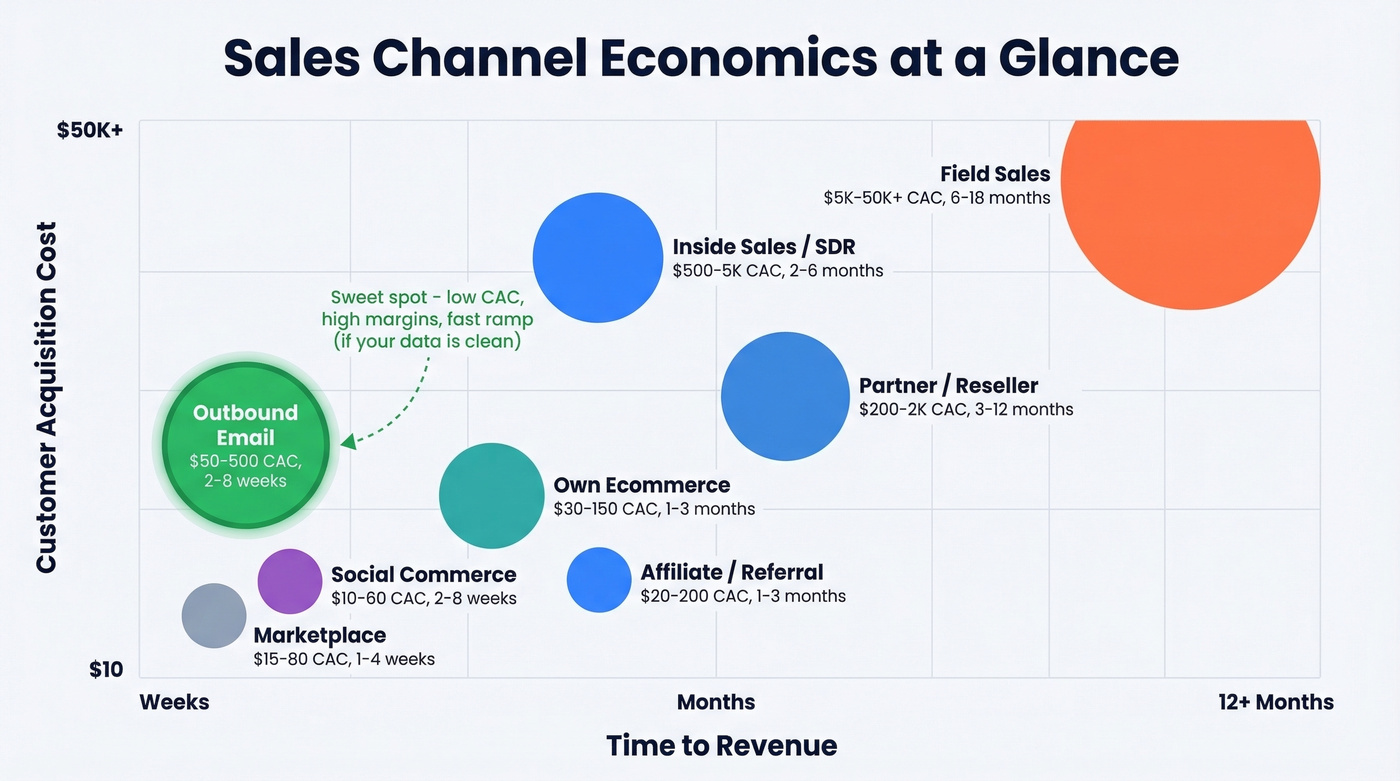
The pattern is clear: direct channels give you the best margins but the highest CAC and longest ramp. Digital and marketplace channels get you to revenue fast but compress margins. Outbound email sits in a sweet spot - low CAC, high margins, fast ramp - if your data is clean.

Outbound email is the fastest, cheapest sales channel on that table - $50-$500 CAC with revenue in weeks, not months. But double-digit bounce rates kill the channel before it starts. Prospeo's 5-step verification delivers 98% email accuracy on 300M+ profiles, refreshed every 7 days.
Don't let bad data sabotage your highest-ROI sales channel.
How to Choose the Right Mix
Don't pick channels based on what competitors use. Run every candidate through four filters.

Where do your buyers research without talking to a rep? B2B buyers use 10+ digital touchpoints before engaging sales. If your buyers research on G2 and Reddit, your channel mix needs to meet them there - not in a trade magazine.
What signals does the channel produce? Some channels generate clear intent data: demo requests, pricing page visits, content downloads. Others produce fuzzy signals that are hard to act on. Prioritize channels where you can identify who engaged and what they want.
Can quality hold as you scale 3-5x? Partner channels and digital self-serve grow without proportional headcount increases. Field sales scales linearly with reps. If your plan requires tripling headcount to triple revenue, the channel has a ceiling.
What's the unit economics floor? We've watched teams pour budget into channels that looked great at 50 deals per month and fell apart at 200. Model the economics at 3x your current volume before committing.
Companies that map their buyer journey see 54% greater ROI on marketing investment. And 86% of shoppers use two or more channels before purchasing. Your job isn't to be everywhere - it's to be excellent in the two or three places that matter most.
Multichannel vs. Omnichannel
These terms get used interchangeably, but they describe fundamentally different approaches. Multichannel means you sell through multiple channels that operate independently - your website team has its own goals, your partner team has its own pipeline, and your SDRs run their own sequences. Omnichannel means those channels share data and deliver a consistent, personalized experience regardless of where the buyer engages.
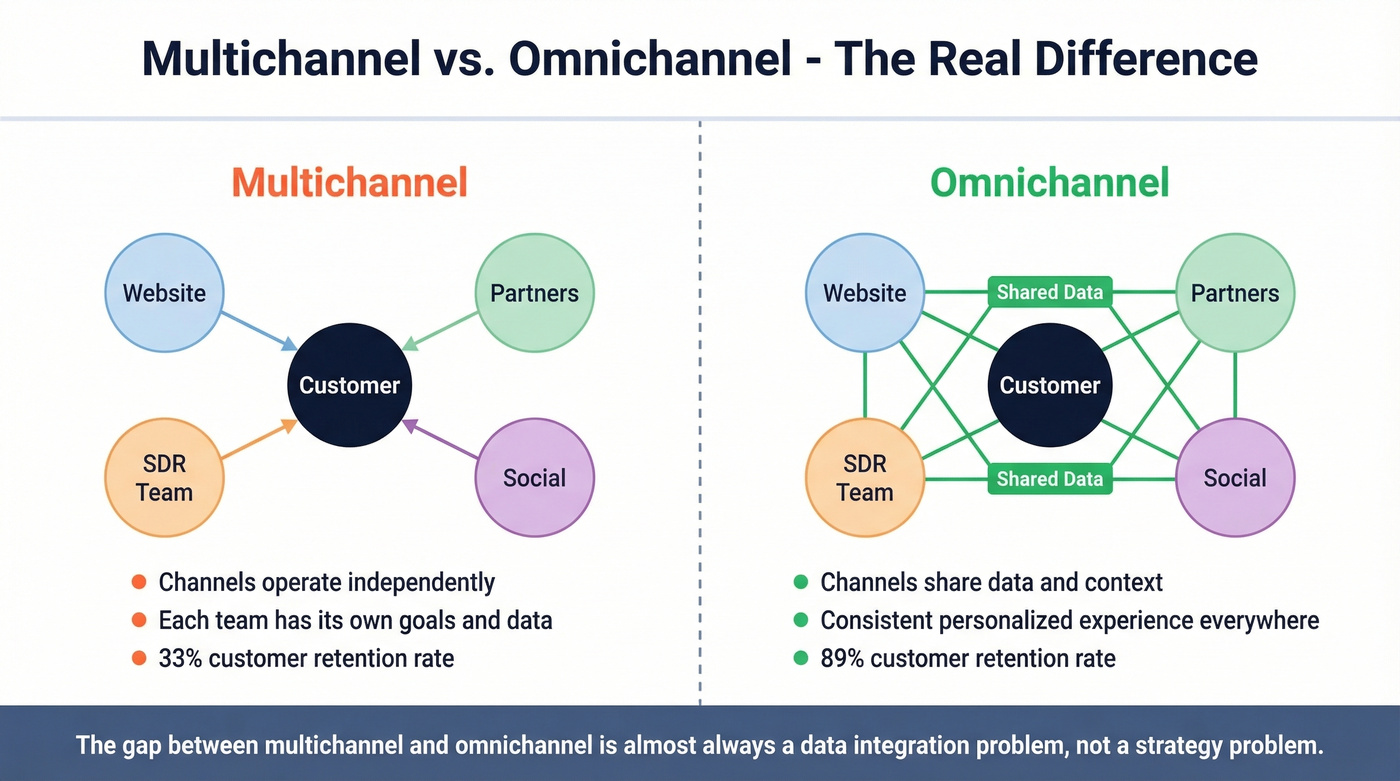
The performance gap is massive: companies with strong omnichannel engagement retain 89% of customers versus 33% for weak omnichannel, and omnichannel buyers deliver up to 30% higher lifetime value.
Let's be honest: most companies say "omnichannel" but operate multichannel. The gap between the two is almost always a data integration problem, not a strategy problem. If your CRM doesn't know that a prospect downloaded a whitepaper, got an outbound email, and visited your booth at a conference, you're multichannel with omnichannel branding.
Preventing Channel Conflict
When you sell through multiple channels, conflict is inevitable. The cost is real: roughly 15% of potential revenue is lost to data leakage and preventable channel conflict. Worse, 60% of solution providers will de-emphasize a vendor due to persistent conflict, and a third will drop the relationship entirely.
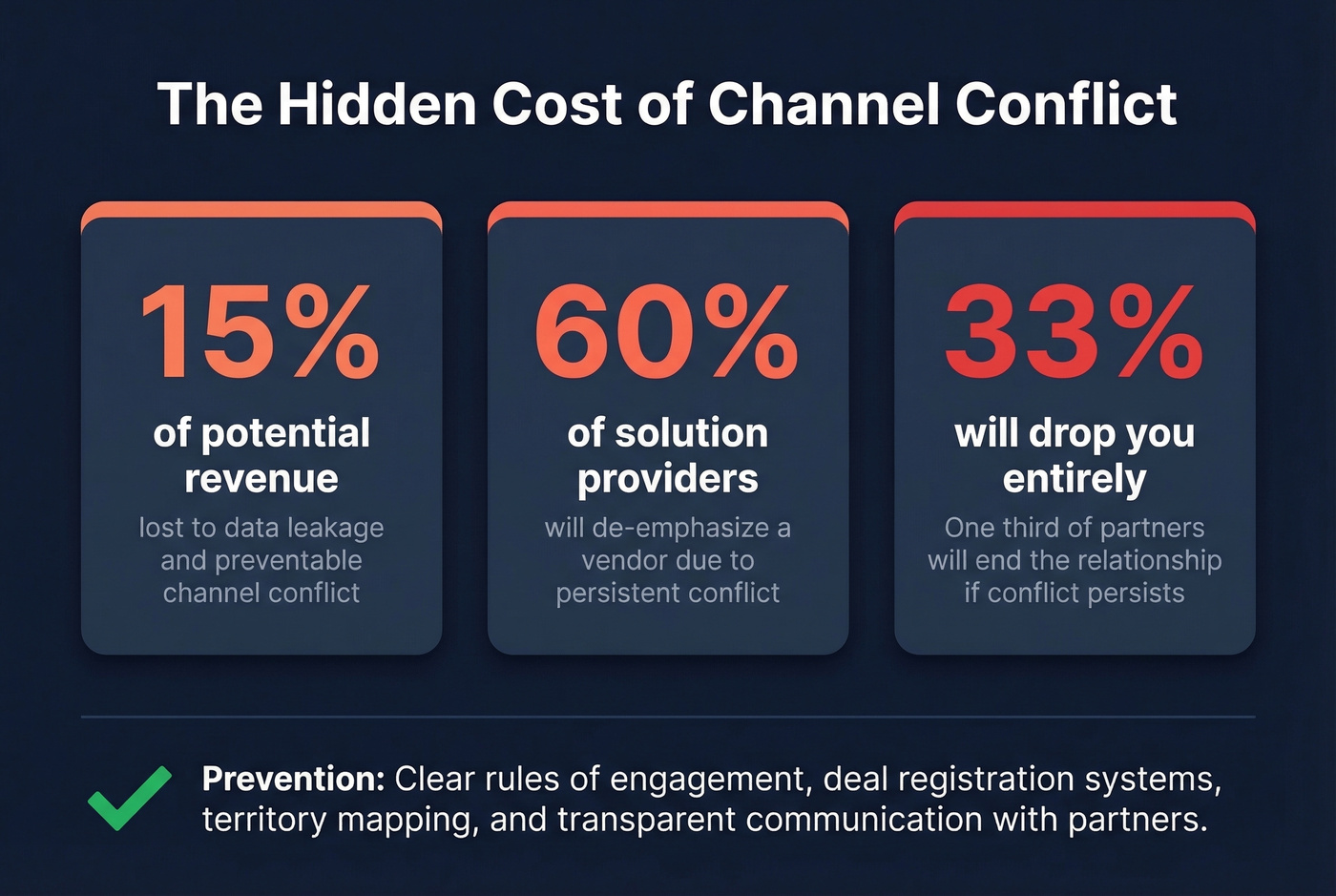
What actually prevents it: deal registration with clear SLAs (48-hour response, 90-day protection windows), rules of engagement defining who owns which accounts and territories, and pricing parity across channels. Undercutting your partners is the fastest way to lose them. Document the rules before the conflict happens, not after.
Mistakes That Kill Multi-Channel Strategies
Single-channel dependency. If 80%+ of revenue comes from one channel, you're one algorithm change away from a crisis. Diversify to at least three.
No documented strategy. 68% of businesses without a documented digital marketing strategy report declining ROI year over year. Write it down. Review it quarterly.
Ignoring data quality. Bad data is the silent killer of outbound channels. If your bounce rate is above 5%, your channel isn't underperforming - your data is. In our experience, teams that switch to 98% verified email data see bounce rates drop from 30-40% to under 5% almost overnight. (If you're diagnosing deliverability, start with bounce rate and a full email deliverability audit.)
Channel oversaturation. Adding a seventh channel when you haven't mastered the first three just spreads resources thin. Each new channel needs dedicated ownership, budget, and measurement. Skip this temptation until your core channels are profitable and predictable.
Poor attribution. If you can't tell which channel drove a deal, you can't allocate budget. Set up UTM tracking, CRM source fields, and partner deal registration from day one.
Multi-channel outbound drives 250% higher conversions - but only if you can actually reach the prospect. Prospeo gives you verified emails and 125M+ verified mobile numbers with a 30% pickup rate, so your sequences connect across email, phone, and social.
Stack every outbound channel with contacts that actually pick up.
FAQ
What are the main types of sales channels?
Four categories: direct (field sales, inside sales, DTC ecommerce), indirect (wholesale, resellers, affiliates, franchising), online/digital (ecommerce, marketplaces, social commerce, live commerce), and B2B outbound (cold email, cold calling, multi-touch sequences). Most companies need two or three channels working well before adding more.
How many channels should a small business use?
Start with two or three. Businesses sell across 3.2 channels on average, but the winners execute well on a focused set rather than spreading thin across many. Identify which channels align with your buyer's journey before committing budget.
What's the fastest B2B sales channel to launch?
Outbound email. You can go from zero to sending targeted sequences in under a week with verified contact data and a sequencing tool. Prospeo's free tier (75 emails/month) plus a tool like Instantly or Smartlead gets you live within days - no other channel puts you in front of decision-makers that fast.
How do you prevent conflict across multiple selling channels?
Implement deal registration with 48-hour response SLAs and 90-day protection windows. Define clear rules of engagement for account ownership and maintain pricing parity across all channels. Companies that document these rules before conflict arises retain significantly more partners long-term.