

The 7 Types of Sales Cycles (With Benchmarks for Each)
44% of sales leaders say opportunities lost to "no decision" are increasing - and a huge chunk of that comes from running the wrong type of sales cycle entirely. You're applying an enterprise playbook to a transactional product, or trying to close a $200K deal with a PLG motion that tops out at $5K ACV.
Most guides cover sales cycle stages - the steps inside a deal. This one covers the different types of sales cycles so you can match the right model to your product, deal size, and buyer complexity.
Quick-Reference Table
| Type | Cycle Length | ACV Range | Key Trait | Best For |
|---|---|---|---|---|
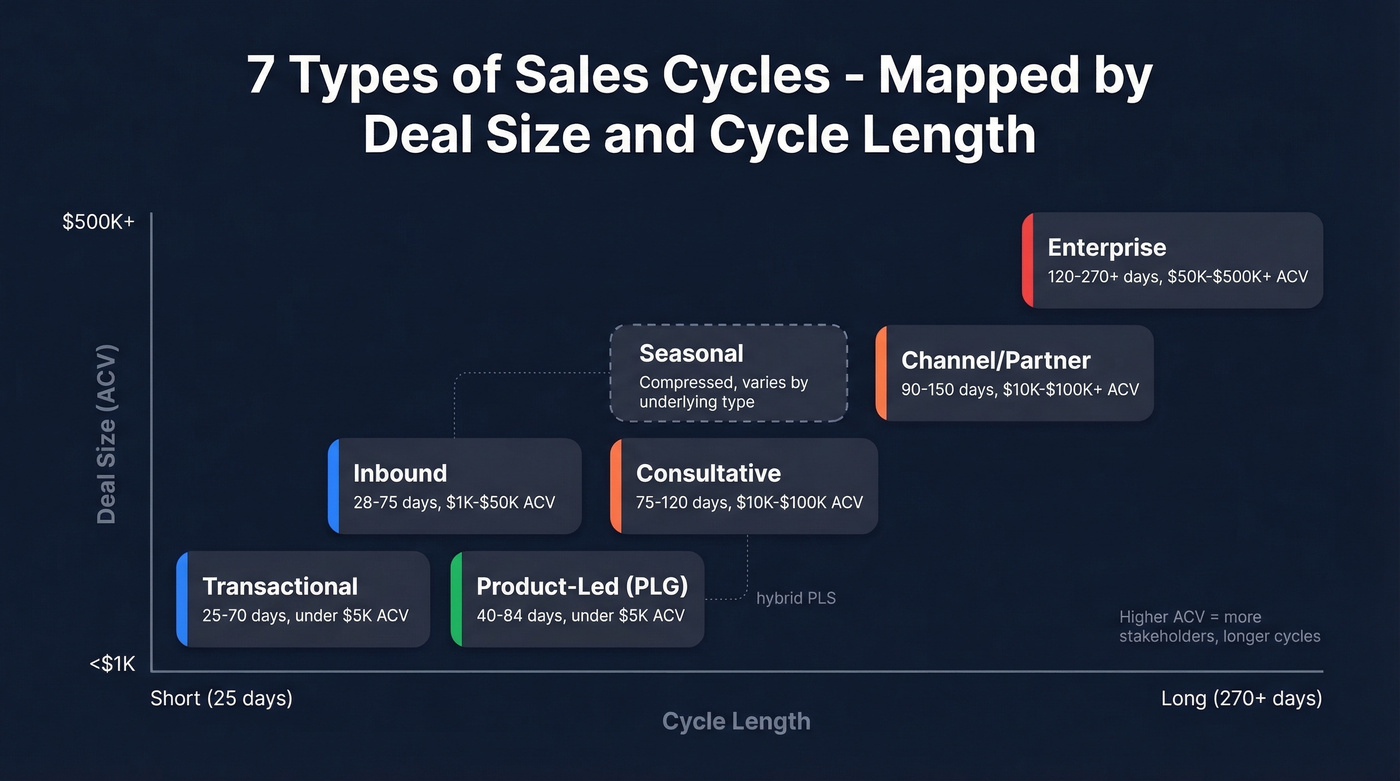
| Transactional | 25-70 days | <$5K | Speed, volume | SaaS, e-commerce |
| Consultative | 75-120 days | $10K-$100K | Advisory, trust | High-value B2B |
| Enterprise | 120-270+ days | $50K-$500K+ | Multi-threaded | Large orgs |
| Product-Led | 40-84 days | <$5K (hybrid PLS goes higher) | Self-serve trial | Dev tools, SMB SaaS |
| Channel/Partner | 90-150 days | $10K-$100K+ | Indirect reach | Scale without headcount |
| Inbound | 28-75 days | $1K-$50K | Buyer-initiated | Content-driven orgs |
| Seasonal | Compressed | Varies by underlying type | Time-bound demand | Retail, staffing |
The 7 Sales Cycle Models Explained
Transactional: The Short Sales Cycle
Use this if your product has standardized pricing, minimal customization, and buyers can evaluate it without a committee. SaaS with self-serve checkout, e-commerce, seasonal promotions - anything where the value proposition is clear and switching cost is low.
A common retail benchmark for end-to-end cycle length is 70 days. If your transactional cycle is creeping past that, something's broken in your qualification or pricing. This is the quintessential short sales cycle: high volume, low friction, fast close.
Skip this if your average deal requires more than one discovery call. The moment you need to "build a business case," you've left transactional territory.
Consultative
The consultative cycle is built on trust and deep needs understanding. You're diagnosing problems and co-creating solutions, not pitching features.
It takes an average of 8 touches just to generate a meeting, and the cycle often runs 75-120 days depending on deal size. Reps who shortcut the advisory phase lose to "no decision." Every time. We've watched teams try to compress consultative deals into 30-day sprints, and the close rate craters because the buyer never built enough confidence to sign.
Enterprise: The Complex Sales Cycle
Above $50K ACV, you're not buying a product - you're buying a system plus an implementation team plus a multi-year relationship. That's the structural reality of enterprise sales, and it's why these long sales cycles run 120-270+ days.
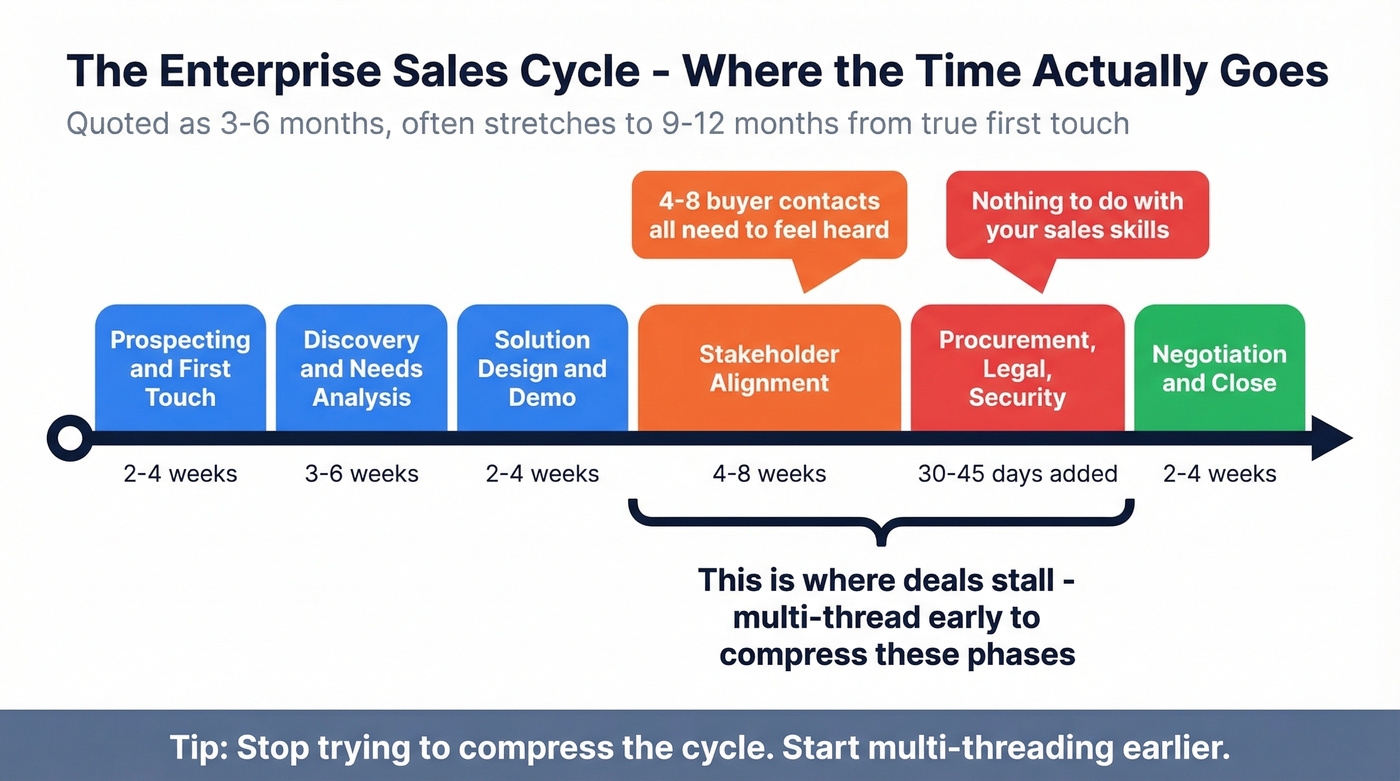
At $50K-$100K ACV, procurement, legal, and security reviews can add 30-45 days that have nothing to do with your sales skills. Once you cross $100K, expect 4-8 buyer-side contacts who all need to feel heard before anything moves forward. This is the textbook complex sales cycle - multiple stakeholders, layered approvals, and extended timelines that resist shortcuts.
The consensus on r/sales is telling: cycles quoted as "3-6 months" regularly stretch to 9-12 months from true first touch to signature. Stop trying to compress the cycle and start team selling earlier.
Product-Led (PLG)
PLG cycles run 40-84 days on average, with free trial-to-paid conversion rates of 2-25% depending on activation quality.
Here's the practitioner heuristic from r/SaaS: PLG works when your ACV is under ~$1.5K and time-to-value is under one day. The moment onboarding gets complex, you need humans in the loop.
The smartest teams run a hybrid Product-Led Sales model. PLG generates demand at the bottom, then routes product-qualified leads to AEs for expansion. This hybrid approach often produces shorter sales cycles than pure outbound because the buyer has already experienced value before talking to a rep. It's one of the few motions where the product genuinely does the selling - reps just close the gap between "I like this" and "my boss approved the PO."
Channel/Partner
9 out of 10 sales teams already use some form of indirect sales.
Channel cycles run longer than direct - in our experience, 90-150 days - because you're adding partner enablement and deal registration on top of the normal buyer journey. You're trading cycle speed for market coverage without headcount. Teams accustomed to a short sales cycle on direct deals often underestimate how much coordination a channel motion adds.
Inbound
Inbound cycles are materially shorter than outbound for comparable complexity. The numbers tell the story clearly:
| Channel | Low Complexity | Medium | High |
|---|---|---|---|
| SEO (inbound) | 28 days | 50 days | 75 days |
| Referrals | 20 days | 35 days | 60 days |
| Cold calling | 60 days | 85 days | 110 days |
| Trade shows | 80 days | 100 days | 150 days |
The buyer has already self-educated, which compresses discovery and qualification - stages that normally consume weeks in outbound motions. For high-velocity inbound, verify contact data before outreach. One bounced email in a fast-moving cycle can kill the deal while you're re-prospecting.

Seasonal
Seasonal cycles are compressed by definition. Holiday retail is the obvious example, but temp staffing, fiscal year-end budget flushes, and back-to-school B2B purchasing all follow the same pattern.
The underlying cycle type varies - it could be transactional or consultative. What makes it seasonal is the demand window. Miss it, and you're waiting another year. Front-load your prospecting 60-90 days before the window opens.

Every extra day in your sales cycle costs pipeline. Bounced emails and wrong numbers silently add 1-2 weeks to cycles that should close faster. Prospeo delivers 98% email accuracy and 125M+ verified mobiles so your reps connect on the first touch - not the fifth.
Stop adding days to your cycle with bad contact data.
Benchmarks by Cycle Type
If your cycle is significantly longer than these medians, you've either got a qualification problem or you're running the wrong cycle type.
Formula: Total days from first touch to close (won deals only) / number of won deals = average cycle length.
By Industry
| Industry | Avg Days |
|---|---|
| Retail | 70 |
| Software | 90 |
| Financial Services | 98 |
| Consulting | 103 |
| Technology | 121 |
| Healthcare | 125 |
| Education | 126 |
| Insurance | 127 |
| Manufacturing | 130 |
| Pharmaceuticals | 153 |
| Energy | 155 |
| Non-Profit | 162 |
Industries like pharmaceuticals and energy consistently show longer timelines because of regulatory hurdles and multi-department sign-offs that extend every stage of the deal. If you're selling into healthcare or education, don't benchmark yourself against software companies - you'll drive yourself crazy chasing a number that doesn't reflect your buyer's reality.
By Deal Size - with Drag Signals
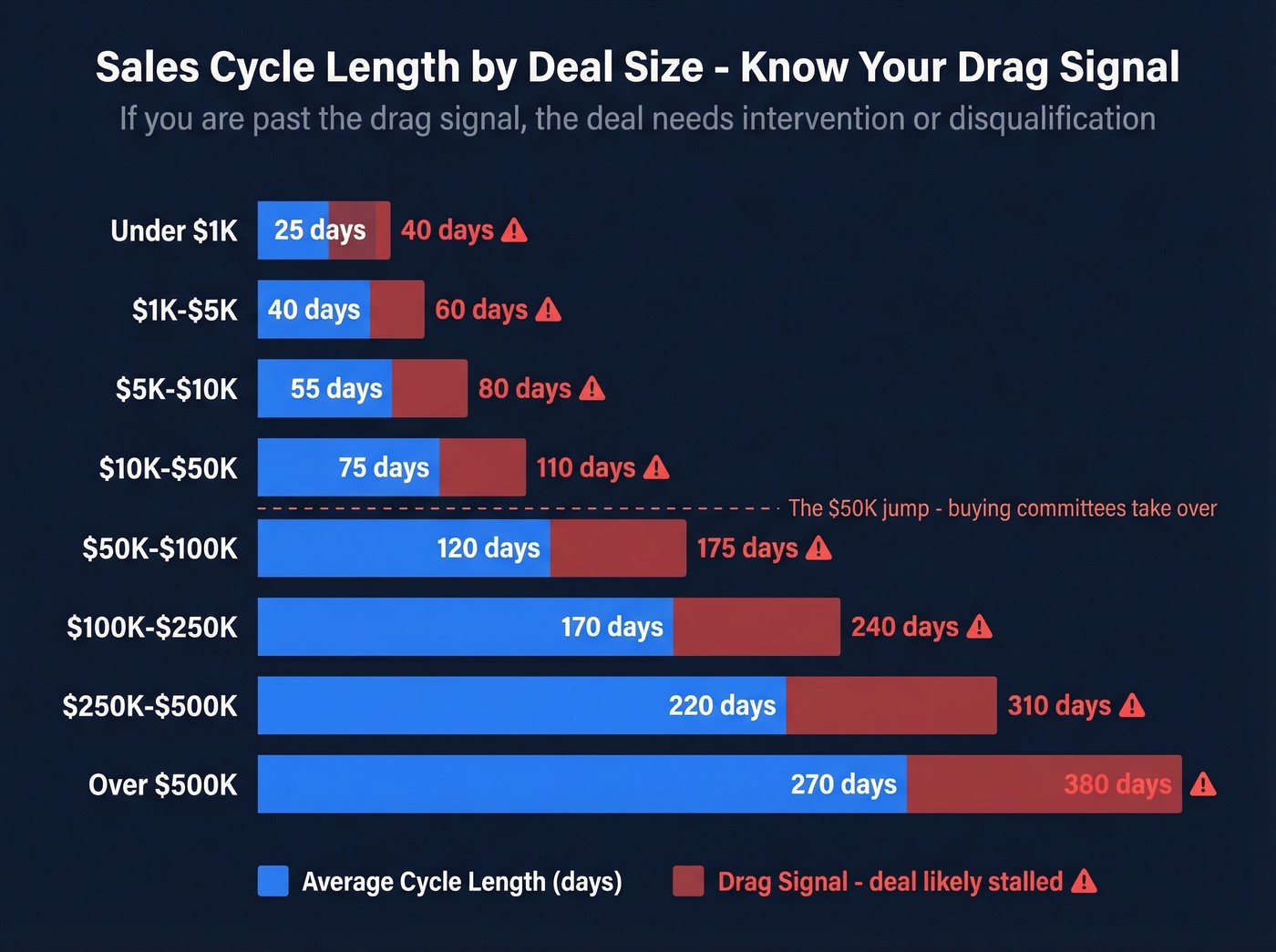
The "drag signal" column shows the threshold where your cycle is abnormally long and the deal is likely stalled. If you're past this number, it needs intervention or disqualification.
| ACV Band | Avg Days | Drag Signal |
|---|---|---|
| <$1K | 25 | 40+ |
| $1K-$5K | 40 | 60+ |
| $5K-$10K | 55 | 80+ |
| $10K-$50K | 75 | 110+ |
| $50K-$100K | 120 | 175+ |
| $100K-$250K | 170 | 240+ |
| $250K-$500K | 220 | 310+ |
| >$500K | 270 | 380+ |
Notice the jump once you cross $50K ACV. That's where you enter high-ticket territory, and the dynamics shift from individual decision-makers to buying committees with competing priorities.
Which Cycle Type Are You?
Most teams don't consciously choose a cycle type. They inherit one and never question it.
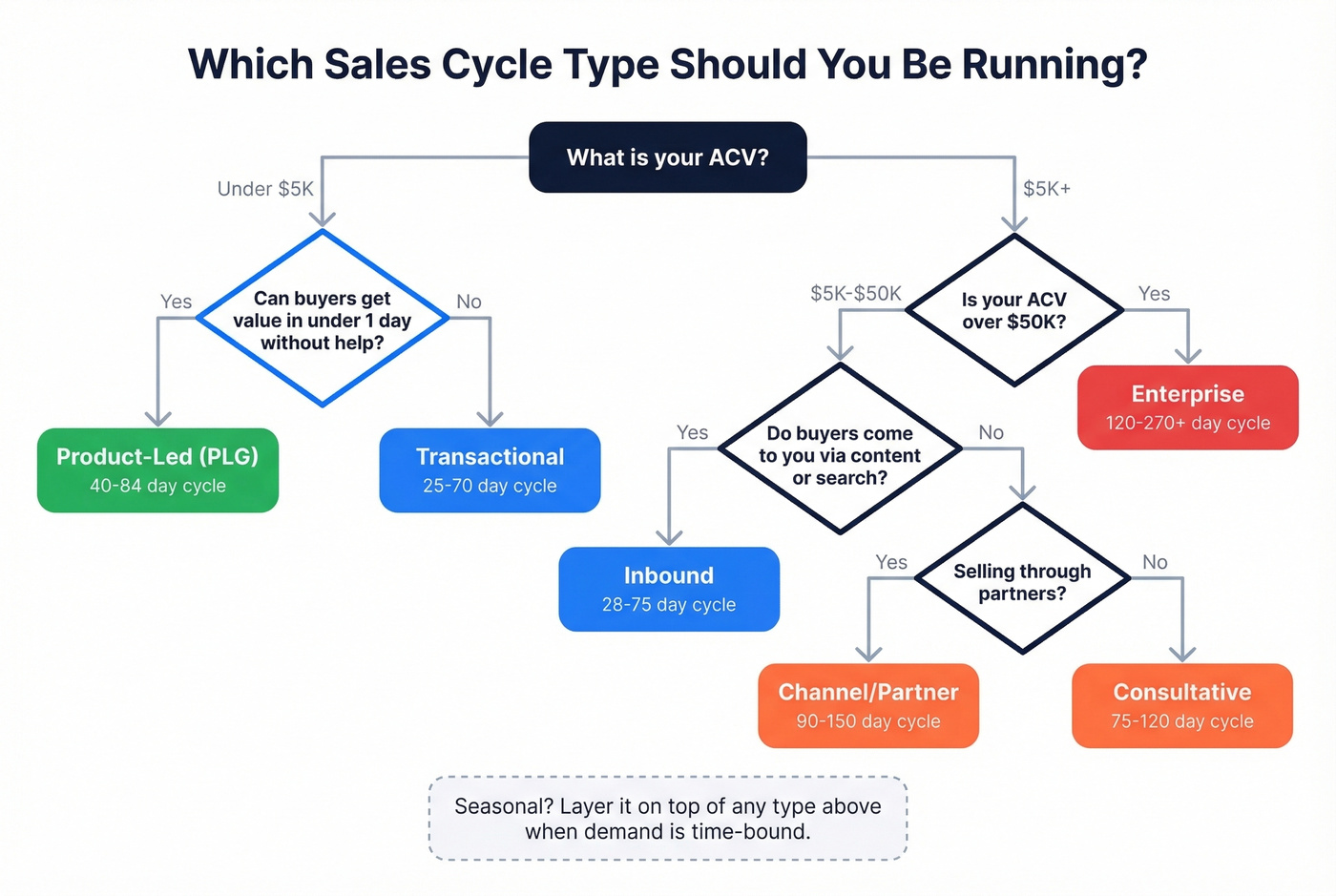
If your ACV is above ~$1.5K and buyers need onboarding, you're sales-led. When time-to-value is under one day and your product can demonstrate itself, PLG is viable. Once deals cross $30K ACV, multi-threading isn't optional - you'll have 3-8 stakeholders whether you plan for them or not, and you should plan for a long sales cycle from the start.
Let's be honest: if you're running a 90-day cycle on a $2K product, you don't have a "long sales cycle problem." You have a wrong-cycle-type problem. Fix the model before you optimize the stages.
How to Shorten Any Cycle
43% of sales leaders report cycles getting longer - but much of that "lengthening" is misdiagnosis. A 90-day enterprise cycle is normal. A 90-day transactional cycle is a disaster. Confirm you're in the right type first, then pull these three levers.
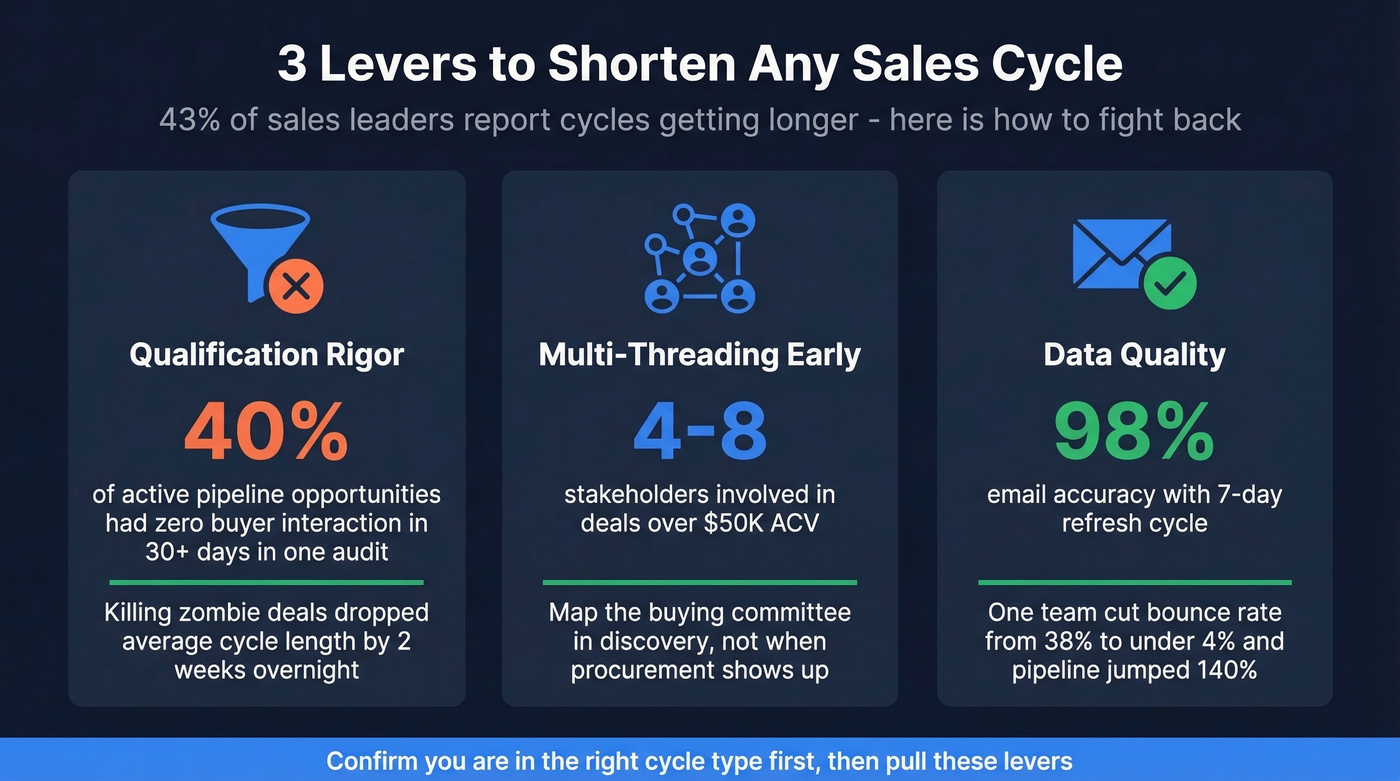
Qualification rigor. Disqualify faster. In our experience, the biggest cycle-length inflator isn't slow buyers - it's zombie deals that should've been killed in week two sitting in your pipeline for months. We ran an audit on one client's pipeline and found 40% of "active" opportunities hadn't had a buyer interaction in over 30 days. Killing those deals didn't just clean the pipeline; it dropped their reported average cycle length by two weeks overnight. (If you want a tighter framework, use MEDDIC sales qualification.)
Multi-threading early. Don't wait until procurement shows up to discover six stakeholders. Map the buying committee in discovery and engage them in parallel - this is the single most effective way to avoid a ballooning enterprise cycle. (A practical way to do this is to standardize your discovery questions.)
Data quality. Bad contact data means bounced emails, wrong numbers, and days wasted re-prospecting the same account. Prospeo covers 300M+ professional profiles with 98% email accuracy on a 7-day refresh cycle. GreyScout cut their bounce rate from 38% to under 4% after switching, and pipeline jumped 140%. When your data's clean, reps spend time selling instead of hunting for the right email address. (If you're diagnosing deliverability, start with email bounce rate benchmarks and fixes.)
Seasonal windows close fast. Enterprise deals need multi-threading from day one. Whatever your sales cycle type, stale data is the silent killer - and most providers refresh every 6 weeks. Prospeo refreshes every 7 days, so your contacts are current when the deal is live.
Fresh data every 7 days means fewer stalled deals and faster closes.
FAQ
What are the main types of sales cycles?
Seven models: transactional, consultative, enterprise, product-led, channel/partner, inbound, and seasonal. Transactional and PLG suit sub-$5K ACV with fast time-to-value; consultative and enterprise fit $10K-$500K+ deals requiring advisory selling and multi-stakeholder alignment.
What's the average B2B sales cycle length?
60-120 days is a common range for B2B teams, and 90-120 days is typical for mid-market SaaS. It ranges from 25 days at sub-$1K ACV to 270+ days above $500K. Compare your numbers against the drag-signal thresholds in the benchmarks table above.
What's the difference between a sales cycle and a sales process?
The cycle is the timeline from first contact to close. The process is the repeatable playbook your team runs within that timeline - stages, activities, and exit criteria. You can run different processes inside the same cycle type.
How do I know if my sales cycle is too long?
Compare your average days-to-close against the benchmarks by deal size above. If you're consistently past the "drag signal" threshold, stalled deals are inflating your numbers. Tightening qualification and multi-threading earlier are the fastest fixes.
Can you run multiple sales cycle types at once?
Yes - many companies run PLG for SMB alongside sales-led enterprise. The key is segmenting each motion so you aren't forcing a complex, multi-stakeholder playbook onto a $500 deal, or vice versa. Separate pipelines, separate metrics, separate enablement.