

Upsell and Cross-Sell Strategies: Benchmarks, Playbooks, and the 3 Tactics to Start With
Everyone cites Amazon's "35% of revenue comes from cross-sells" stat. Nobody tells you that 1 in 5 cross-buyers are actually unprofitable. You've installed three upsell apps, the only measurable result is a slower checkout page, and AOV hasn't moved in two quarters.
If you're building upsell and cross-sell strategies for 2026, the fix isn't more widgets - it's fewer, better-targeted offers backed by holdout tests.
Start Here: The Three That Actually Work
If you only implement three things, make it these - ranked by conversion benchmark:
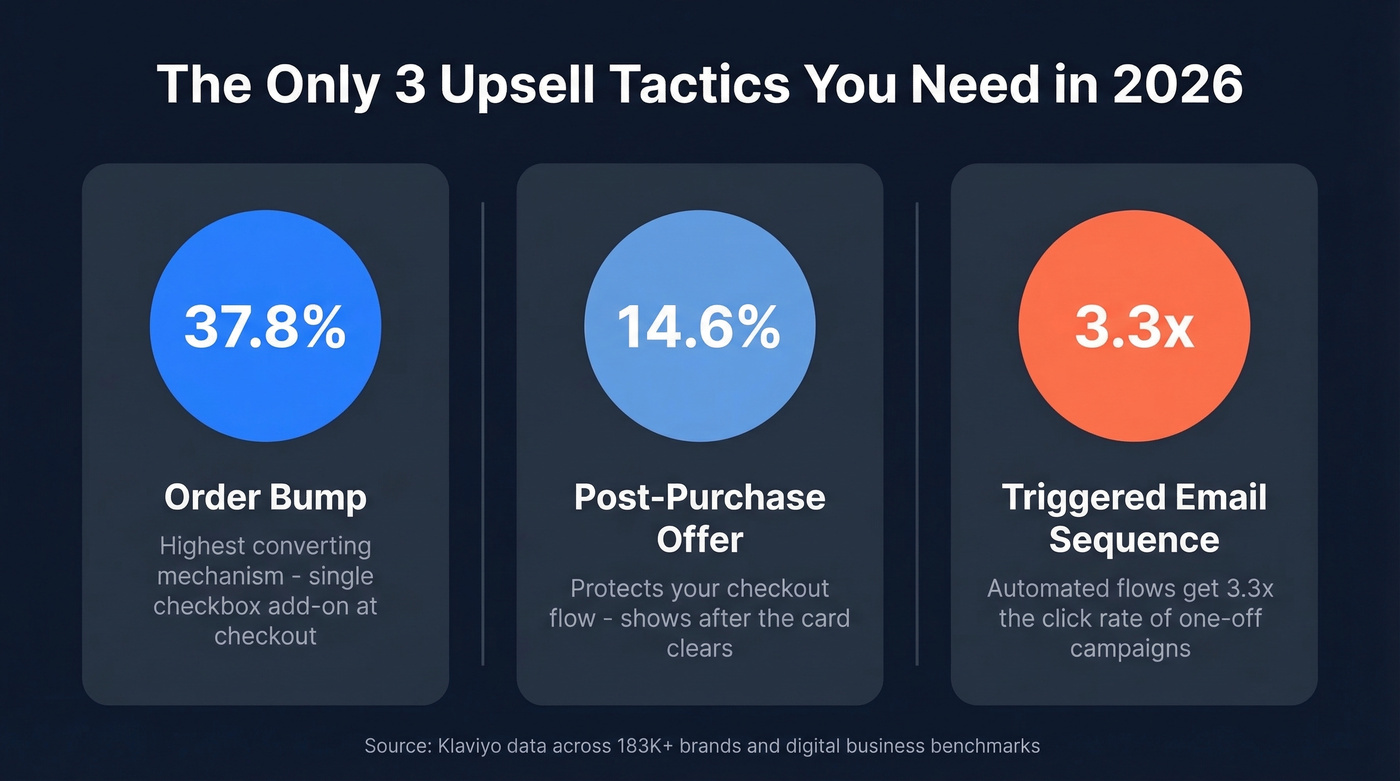
- Order bump - 37.8% average conversion, the highest of any mechanism
- Post-purchase offer - 14.6% average, and it protects your checkout flow from distraction
- Triggered email sequence - automated flows get 3.3x the click rate of one-off campaigns across 183K+ brands on Klaviyo
You don't need 10 upsell widgets. You need one obviously relevant offer and a holdout test to prove it's incremental.
Upsell vs Cross-Sell vs Bundling
| Strategy | Definition | Example | Best for |
|---|---|---|---|
| Upsell | Higher-tier version | Basic to Pro plan | Margin expansion |
| Cross-sell | Complementary add-on | Phone + case | AOV lift |
| Bundle | Products sold together | Console + games | Volume deals |
Mixed bundling - where customers can buy separately or together at a discount - consistently outperforms pure bundling, where items are only available as a package. A Harvard/CMU study of Nintendo found revenues dropped nearly 20% under pure bundling. Always give customers the option to buy items individually.
One more principle worth anchoring: display the premium option first. Anchoring, showing a higher price before the target offer, is one of the most reliable cognitive biases in pricing research (Tversky & Kahneman, 1974). The upsell target looks like a deal by comparison.
Benchmarks That Matter in 2026
A study across 1,847 digital businesses gives us real numbers to work with. These should inform any cross-selling and upselling strategy you build, regardless of industry.
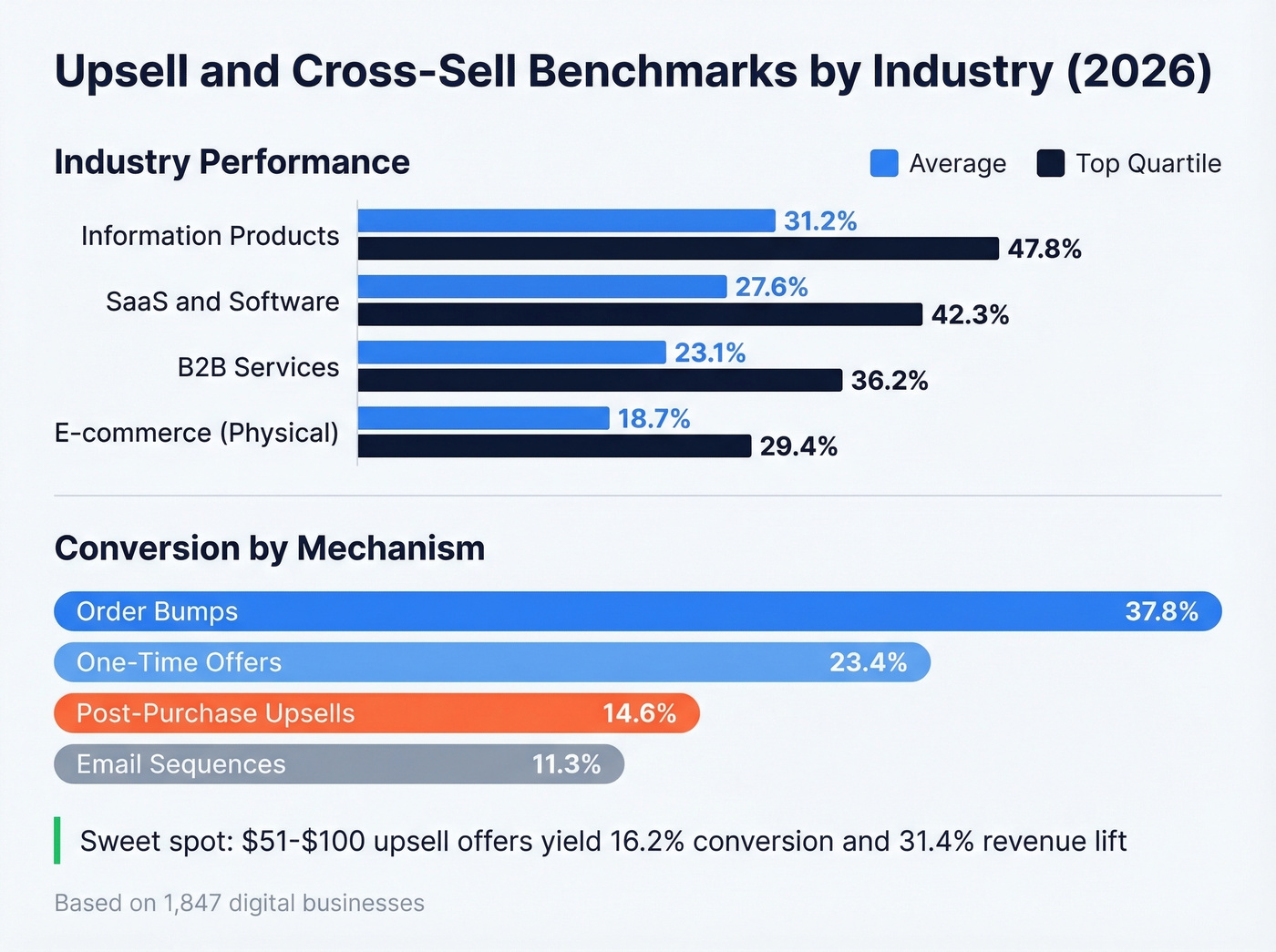
| Industry | Average | Top Quartile |
|---|---|---|
| SaaS & Software | 27.6% | 42.3% |
| E-commerce (physical) | 18.7% | 29.4% |
| Information products | 31.2% | 47.8% |
| B2B services | 23.1% | 36.2% |
Mechanism ranking:
| Mechanism | Avg Conversion |
|---|---|
| Order bumps | 37.8% |
| One-time offers (OTO) | 23.4% |
| Post-purchase upsells | 14.6% |
| Email sequences | 11.3% |
Above 20% is strong. Between 10-20% is moderate. Below 10% means something's broken - don't just accept it. We've seen teams treat 15% as "good enough" and leave it alone for quarters, which is a mistake when the top quartile is clearing 30%+. The pricing sweet spot for upsell offers sits in the $51-$100 range, yielding 16.2% conversion and a 31.4% revenue lift.
Desktop converts at 28.9% vs mobile web at 18.7% - a 54% gap. Don't copy your desktop upsell module to mobile and expect the same results. Mobile needs a different design entirely: fewer options, bigger tap targets, and a single clear action.

Expansion revenue starts with reaching the right buyer. Prospeo's 300M+ profiles with 30+ filters - including headcount growth, department size, and buyer intent - let you identify accounts ready for an upsell before your competitors do.
Target accounts showing growth signals and land your upsell offer with the right decision-maker.
Strategies by Channel
On-Site: Product Page, Cart, Checkout
Start with an order bump. A single checkbox add-on at checkout - "Add the conditioning kit for $29" - works because the buyer is already committed. Post-purchase offers come next: they protect your primary conversion rate by showing the upsell after the credit card clears.
A practical rule we've found reliable: upsells placed earlier in the flow, like add-to-cart or cart page, often outperform anything that interrupts checkout. Keep add-ons to one or two options max. Choice overload reduces conversions, and it shows up fast in real tests.
Email and Lifecycle
Triggered email sequences are where scalability lives. A well-designed cross-sell email strategy follows a simple 3-touch structure:
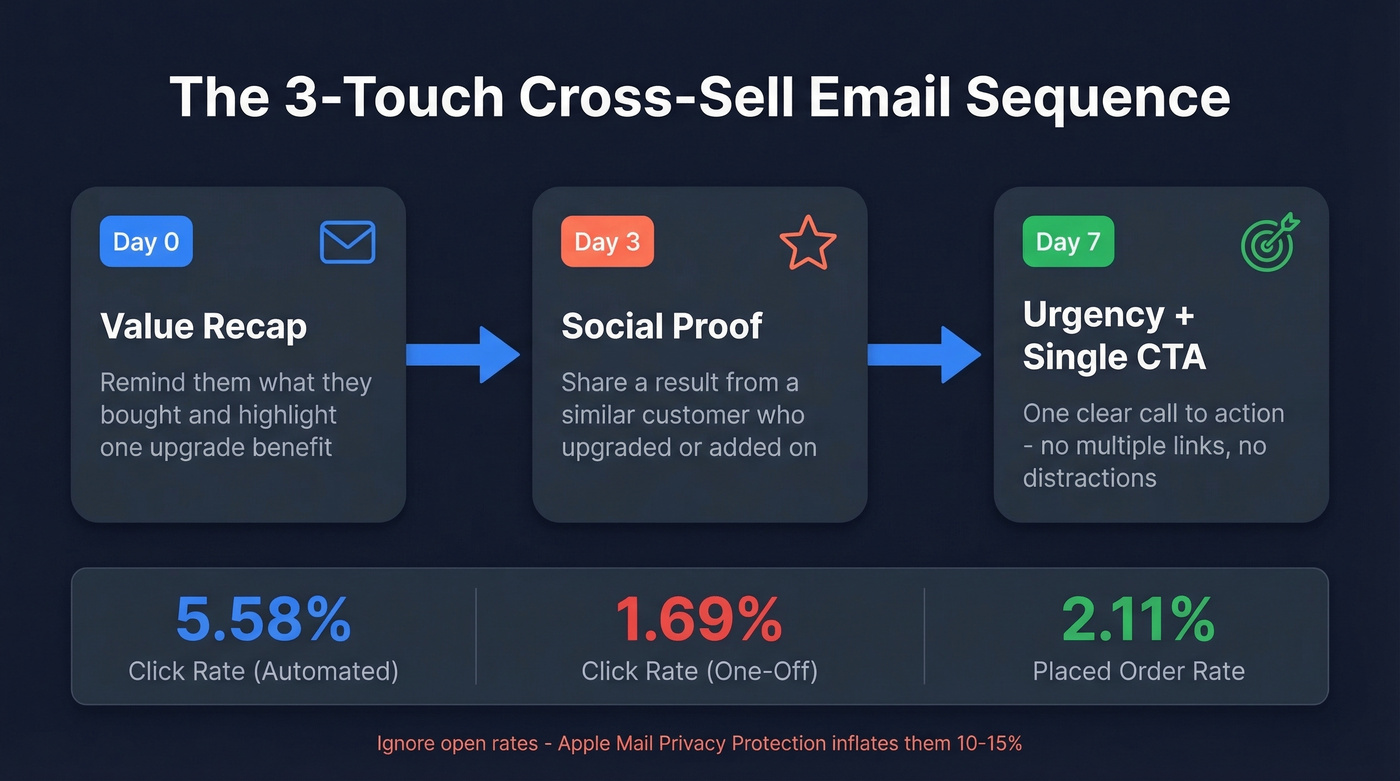
- Day 0: Value recap with one upgrade benefit
- Day 3: Social proof from similar customers
- Day 7: Urgency with a single CTA
Cross-sell emails sent within 24-72 hours post-purchase consistently outperform anything sent later. Automated flows crush one-off campaigns - 5.58% click rate vs 1.69%, with a 2.11% placed-order rate. Ignore open rates entirely. Apple Mail Privacy Protection inflates them by 10-15%, making them useless as a signal. Track clicks and placed orders instead (and keep an eye on email bounce rate as a deliverability guardrail).
SaaS and B2B Expansion
Here's the thing - B2B upsells aren't about widgets on a checkout page. They're about timing signals. The best triggers are usage milestones (customer hits 80% of their quota), renewal windows, and feedback signals like NPS scores or support ticket patterns.
Frame the upsell as service, not sales. "You've hit your allocated quota - let's make sure your growing team isn't bottlenecked" lands better than "Upgrade now for 20% off." Use account-specific data like order frequency, usage patterns, and department growth to make the offer feel inevitable rather than pushy. The most effective expansion strategy in B2B ties revenue directly to customer success metrics, and the consensus on r/sales backs this up - reps who lead with value data instead of discount pressure consistently report higher close rates on expansion deals.
Mistakes That Kill Conversion
Not every cross-sell customer is profitable. HBR research identified four toxic buyer types: service demanders, revenue reversers, promotion maximizers, and spending limiters. Promotion maximizers alone average $300 in annual losses each.
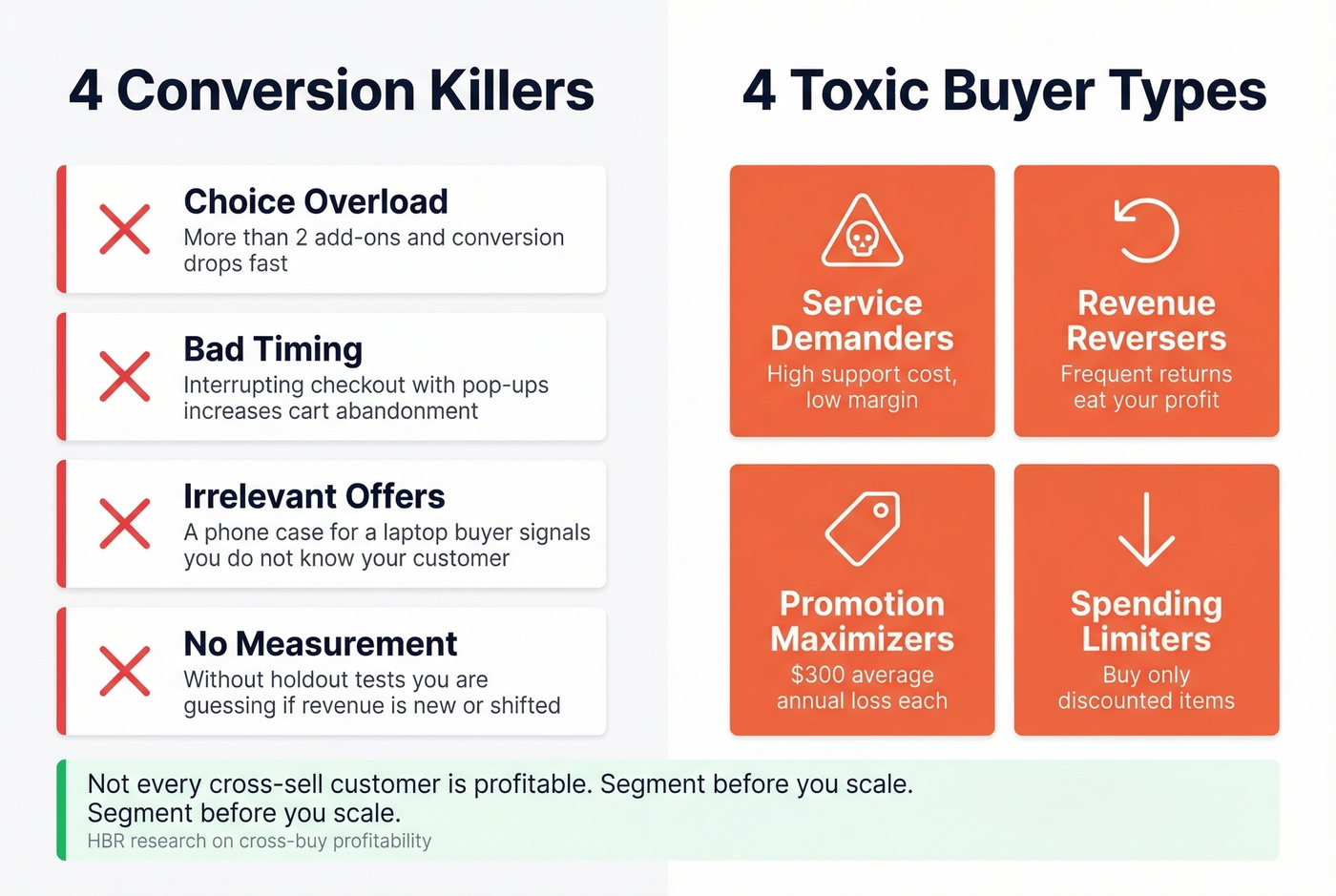
Even well-intentioned revenue expansion efforts fail when they ignore these conversion killers:
- Choice overload - more than two add-ons and conversion drops
- Bad timing - interrupting checkout with a cross-sell pop-up is the fastest way to increase cart abandonment
- Irrelevant offers - a phone case for a laptop buyer signals you don't know your customer
- No measurement - without holdout tests, you don't know if you're creating revenue or just shifting it
Skip the "spray every page with upsell modals" approach entirely. If your upsell acceptance rate is below 10% and you haven't run a single holdout test, you're likely cannibalizing existing revenue rather than creating new revenue.
How to Measure Incrementality
Track four KPIs: conversion rate on upsell offers, attach rate, AOV lift, and cohort CLV over 90+ days (tie this back to churn analysis so you don't "win" AOV and lose retention).
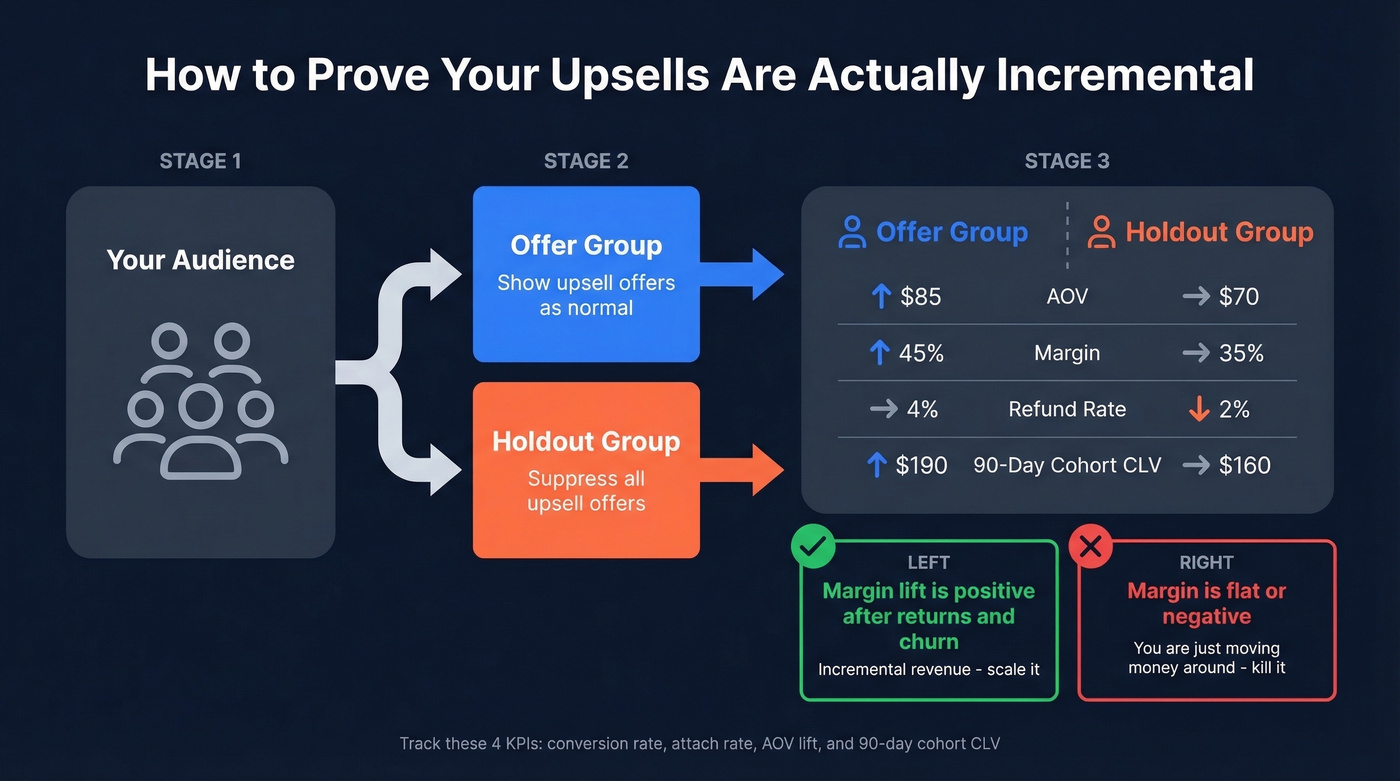
Let's be honest - if you're not running holdout tests, you're guessing. Show upsell offers to one group, suppress them for a control group. Compare AOV, margin, refund rate, and cohort CLV. If the offer group's margin lift is positive after accounting for returns and churn, it's incremental. If it's flat or negative, you've just been moving money around.
For recommendation engines, rules-based systems work fine when your catalog and merchandising logic are simple. As your catalog grows and behavior gets harder to model with static rules, AI-powered recommendations pull ahead - they adapt to behavior in real time and scale across categories. Whichever engine you choose, it should serve your broader expansion playbook rather than operate as a standalone feature.

Build Expansion Lists That Actually Reach People
B2B upsell and cross-sell campaigns die on bad data. You craft a perfect expansion sequence, send it to your installed base, and 20% bounces because the champion who bought your product changed jobs six months ago. We've watched this happen to teams with otherwise solid playbooks - the strategy was right, but the data underneath was stale.
Tools like Prospeo solve this at the data layer. With 98% email accuracy on a 7-day refresh cycle, your expansion lists actually reach the people you're targeting. CRM enrichment returns 50+ data points per contact at a 92% match rate, so you can segment offers by department headcount, tech stack, or buyer intent across 15,000 topics (more on what "enrichment" really includes in data enrichment services). The free tier gets you started with 75 verified emails per month - enough to test whether cleaner data moves your expansion numbers before committing budget.
Cross-sell emails with a 5.58% click rate mean nothing if 35% bounce. Prospeo's 98% email accuracy and 7-day data refresh keep your triggered sequences hitting real inboxes - not spam traps. At $0.01 per email, scaling your post-purchase flows costs less than one failed upsell.
Stop burning domain reputation on stale data. Get verified contacts for every expansion play.
FAQ
What's the difference between upselling and cross-selling?
Upselling offers a higher-tier version of what the customer is already buying - like upgrading from Basic to Pro. Cross-selling suggests complementary products, like a phone case with a phone. Upsells are easier to implement and convert higher, so start there and layer in cross-sells as your data matures.
Which upsell mechanism converts best?
Order bumps convert at 37.8% on average - the highest of any mechanism. One-time offers average 23.4%, post-purchase upsells 14.6%, and email sequences 11.3%. If you're only implementing one tactic, start with an order bump at checkout.
How do you measure if upsells are actually incremental?
Run a holdout test: show upsell offers to one group and suppress them for a control group. Compare AOV, margin, refund rate, and 90-day cohort CLV. If the offer group's margin lift is positive after accounting for returns and churn, it's incremental revenue - not just shifted spend.
How do I keep B2B expansion emails from bouncing?
Stale contact data is the top killer of B2B expansion campaigns. Use a data platform with a weekly refresh cycle and verify emails before every send. Aim for under 4% bounce rate to protect domain reputation - anything above that and inbox providers start throttling your sends.