

Valid Email Search: How to Find and Verify Emails That Actually Work
About 1 in 6 emails globally never reach the inbox. Bad data makes that worse, and most tools marketed as "valid email search" solutions only solve half the problem. They verify addresses you already have. If you don't have the email yet, a verifier is useless.
An email finder discovers an unknown address from a name and company. An email verifier checks whether an address you already have is deliverable. You probably need one or both - and confusing the two is how teams waste months on the wrong workflow.
What You Need (Quick Version)
- Finding valid emails you don't have yet: Prospeo finds and verifies in one workflow. 98% email accuracy, 75 free emails/month.
- Verifying emails you already have: ZeroBounce. 97.8% accuracy in benchmark testing, 100 free monthly verifications, solid catch-all detection.
- Budget bulk verification: MillionVerifier. $0.0003/email. You're trading catch-all accuracy for volume.
How Email Verification Works
Whether you're using a finder or a standalone verifier, the underlying process follows five steps:
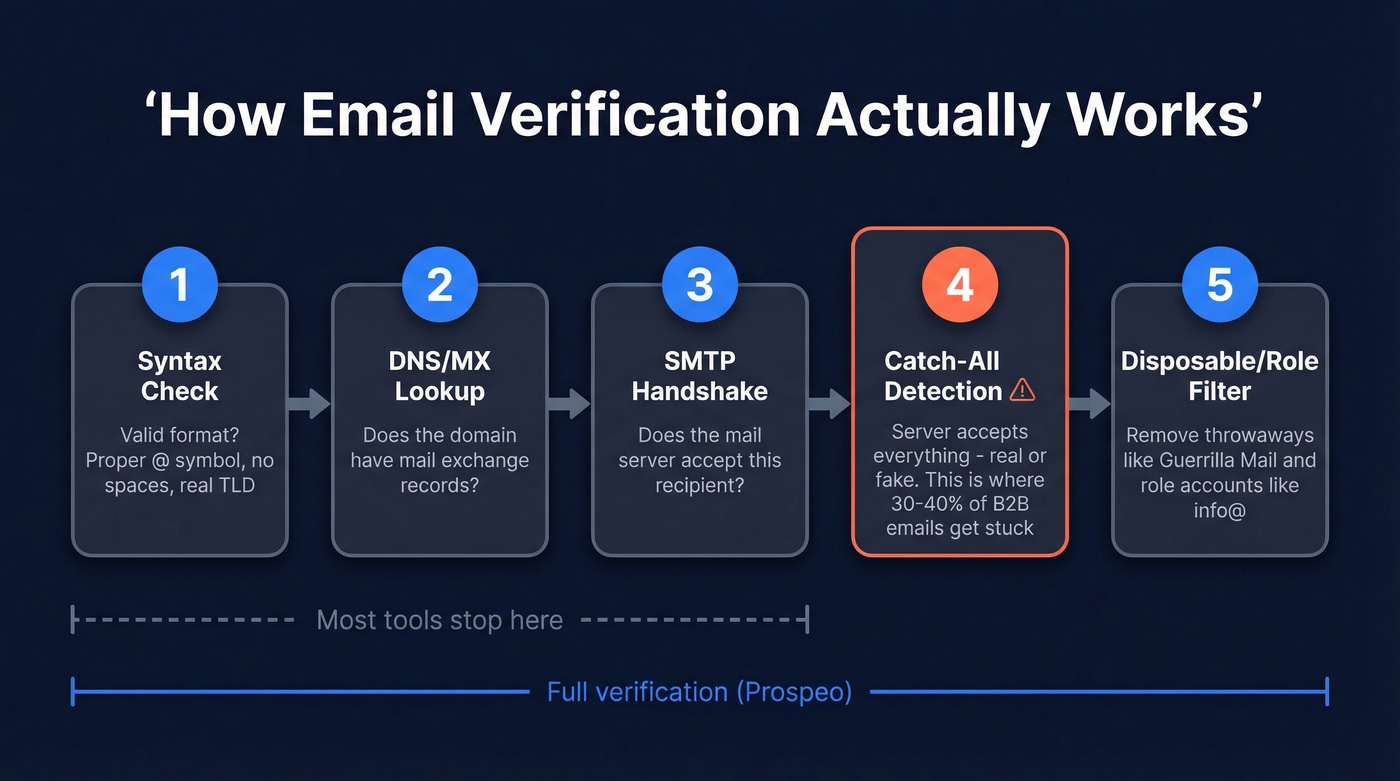
- Syntax check - is the format valid? No spaces, proper @ symbol, real TLD.
- DNS/MX lookup - does the domain have mail exchange records?
- SMTP handshake - does the mail server accept the recipient address?
- Catch-all detection - is the domain configured to accept all incoming mail regardless of recipient?
- Disposable/role-based filtering - is it a throwaway address like Guerrilla Mail, or a generic role account like info@ or sales@?
The catch-all step is where things get messy. 30-40% of B2B email addresses sit on catch-all domains, meaning the mail server accepts everything - real or fake. SMTP checks can't distinguish between a valid mailbox and a nonexistent one.
Enterprise security gateways from Proofpoint, Mimecast, and Barracuda make it worse by blocking SMTP probes entirely. Perfectly valid mailboxes come back as "unknown."
The Accuracy Gap
Every email verification tool claims 99%+ accuracy. The benchmarks tell a different story.
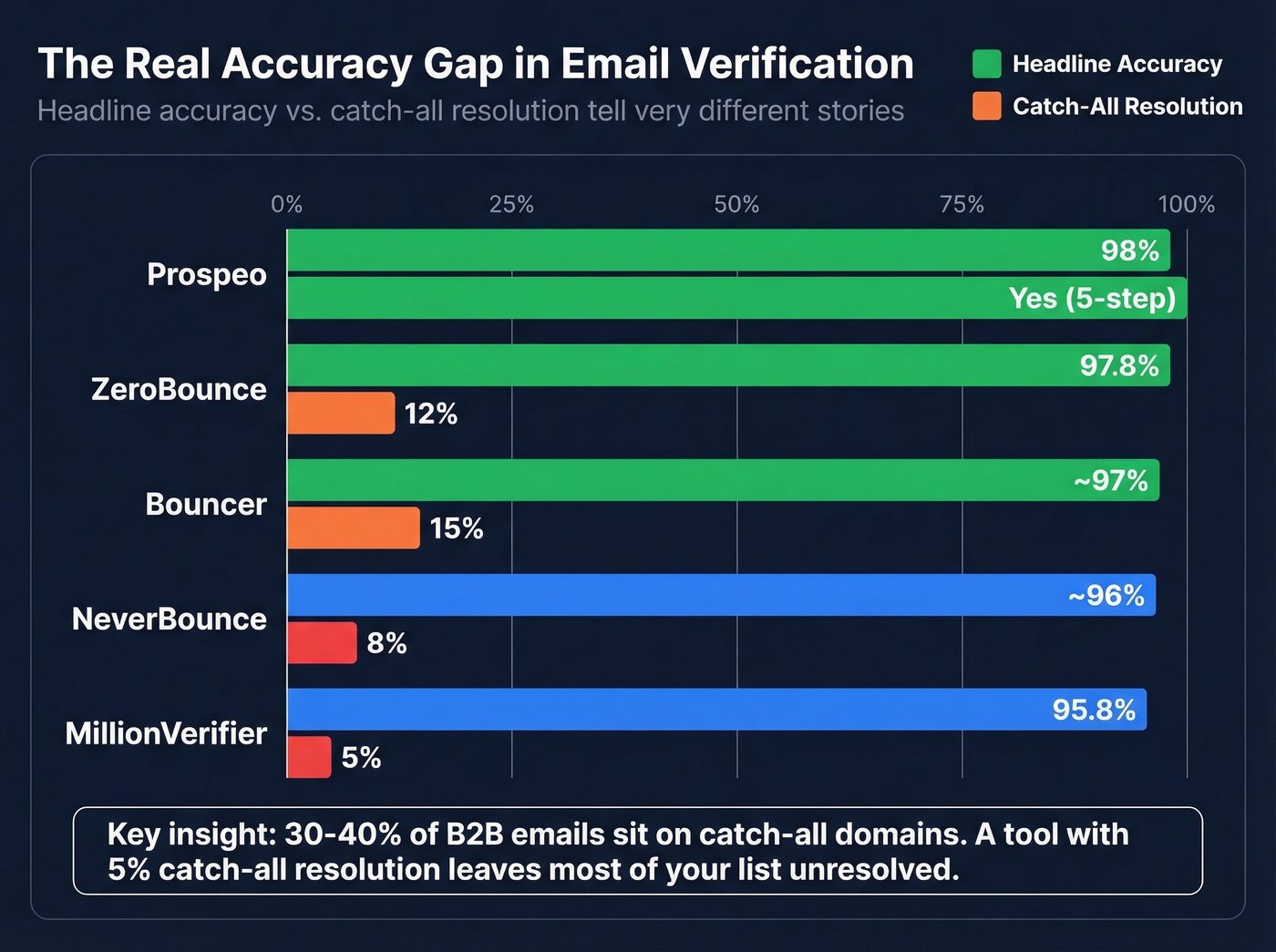
Hunter tested 15 verifiers against 3,000 real business emails and found top tools hitting only 65-70% overall accuracy. A separate 10,000-email benchmark showed higher headline numbers of 95.8-99.5%, but catch-all resolution ranged from 5% to 94% across tools. That gap is enormous.
Here's the thing: in our testing, the "unknown" and "accept-all" results are what drag real-world accuracy down. A tool that marks 28% of your list as "unknown" and calls the rest 99% accurate isn't lying, exactly. It's just not answering the question you asked. You're paying for certainty and getting a shrug on nearly a third of your list.
The consensus on r/coldemail is blunt - unverified leads are the fastest way to trash your domain and IP reputation. Over on r/agency, practitioners targeting 500-1,000 emails per day report that databases like Apollo "feel bad sometimes" with bounces on older contacts. That anxiety is well-founded. Stale data is the number one cause of preventable bounces.

Most "valid email search" tools force you to find emails in one tool, then verify in another - and you still get 30% unknowns on catch-all domains. Prospeo's proprietary 5-step verification resolves catch-alls, strips spam traps, and delivers 98% accuracy across 300M+ profiles. Data refreshes every 7 days, so you're never sending to stale addresses.
Stop paying twice. Find and verify in one workflow for $0.01/email.
How to Read Verification Results
| Status | Meaning | What to Do |
|---|---|---|
| Valid | Mailbox confirmed | Send |
| Invalid | Doesn't exist | Remove immediately |
| Risky/Accept-All | Catch-all domain | Send only if bounce rate is under 5% |
| Unknown | Can't determine | Don't send |
| Disposable | Temporary address | Remove |
| Role-based | Generic like info@ or sales@ | Avoid for cold outreach |
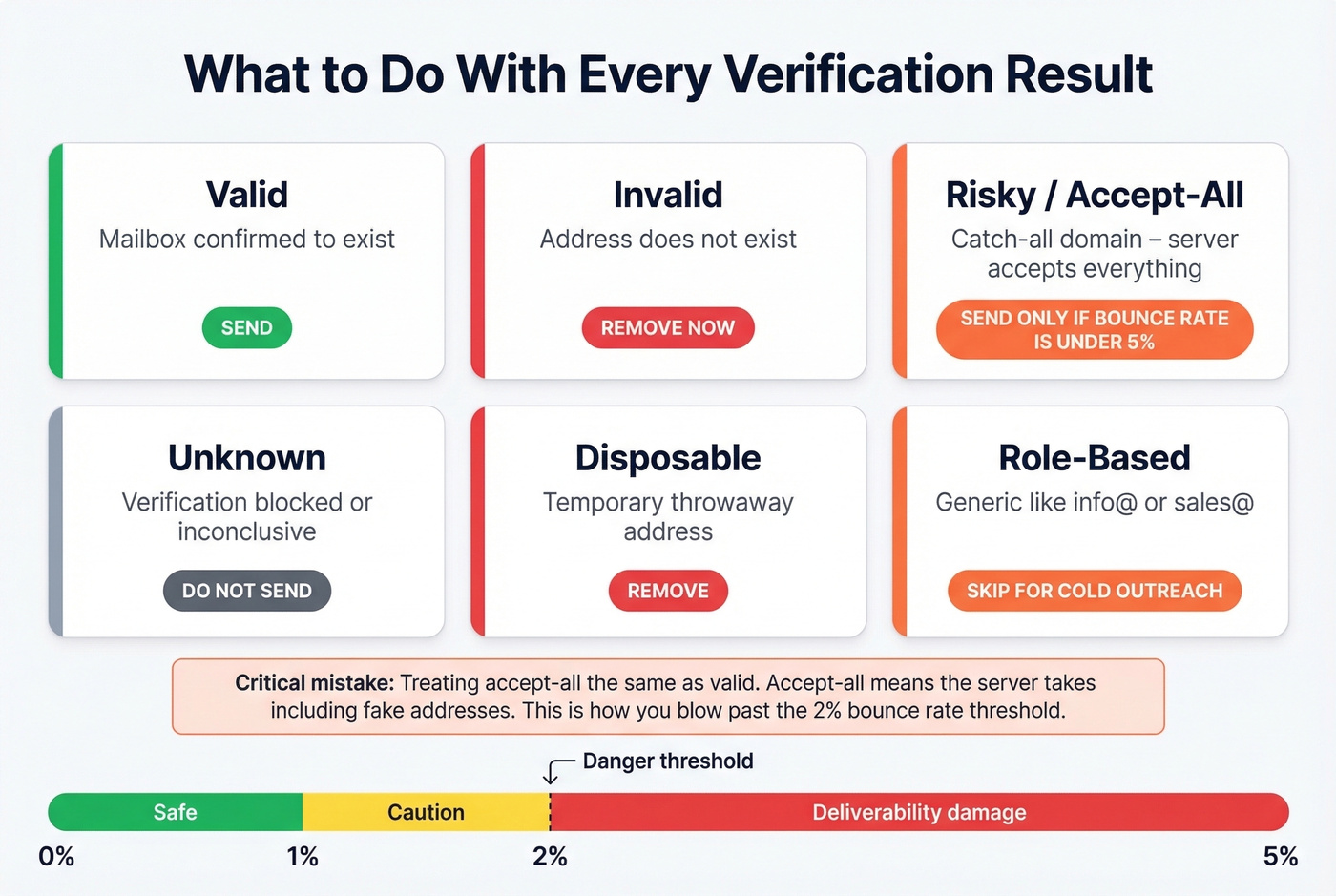
Most tools return fields like safe_to_send, accept_all, and mx_record. The critical mistake is treating "accept-all" the same as "valid." Accept-all means the server will take anything, including addresses that don't exist. Sending to them blindly is how you end up with a bounce rate above 2%, which is the threshold where deliverability starts degrading fast.
Best Tools for Finding Valid Emails
Prospeo
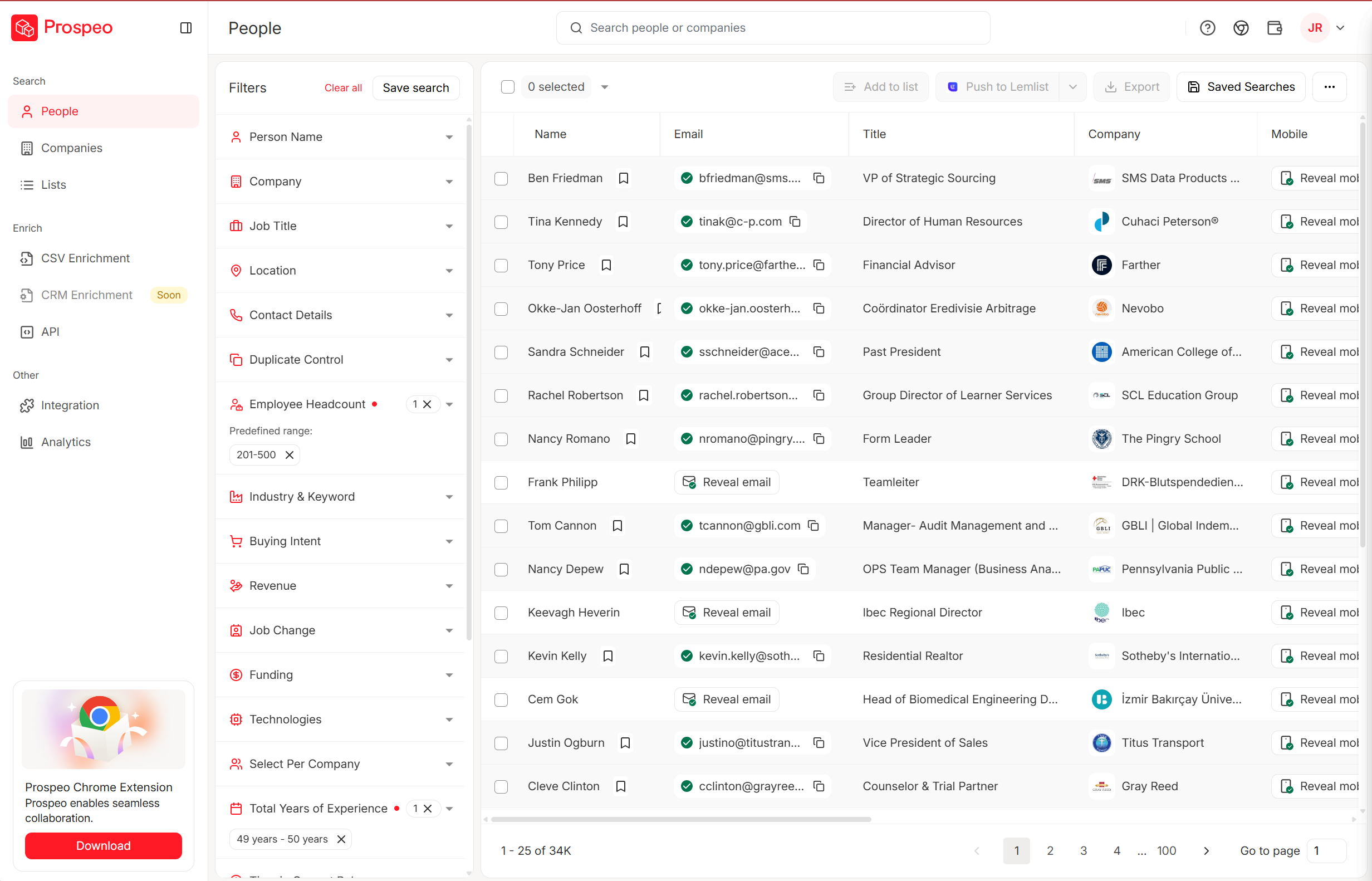
Use this if you need to find and verify emails in a single workflow - no chaining a finder into a separate verifier. Prospeo covers 300M+ professional profiles with 98% email accuracy, powered by a proprietary 5-step verification process that includes catch-all handling, spam-trap removal, and honeypot filtering. Data refreshes every 7 days, compared to the 6-week industry average.
The platform lets you filter prospect emails by job title, company, and domain before running verification, so you're only spending credits on contacts that match your ICP. Snyk's 50-person AE team dropped their bounce rate from 35-40% to under 5% after switching, and AE-sourced pipeline jumped 180%.
At ~$0.01/email with a free tier of 75 emails/month and no contracts, it's a fraction of what you'd pay chaining two separate tools together.
ZeroBounce
ZeroBounce hit 97.8% accuracy in the 10K-email benchmark with 12% catch-all resolved - not great on catch-alls, but solid on everything else. It's a verifier, not a finder, so it won't help you discover new addresses. Pricing starts at $15/mo for 2,000 emails, with 100 free monthly verifications. If you already have a list and just need to clean it, ZeroBounce is reliable.
MillionVerifier
The budget pick. At $0.0003/email it's roughly 27x cheaper than most competitors. But 95.8% accuracy and only 5% catch-all resolution means you're leaving a lot of risky addresses unresolved. Fine for massive lists where you can absorb some bounces. Skip this if your list is heavy on enterprise domains with catch-all configurations.
Hunter
Solid verification accuracy and a well-known brand. The finding database is smaller than competitors, so it works better as a verification layer than a primary prospecting tool. Free plan includes 100 verifications/month.
Pricing Comparison
| Tool | Best For | Cost/Email | Free Tier | Catch-All Resolution |
|---|---|---|---|---|
| Prospeo | Find + verify | ~$0.01 | 75 emails/mo | Yes (5-step) |
| ZeroBounce | Verification | $0.008 | 100/mo | 12% |
| NeverBounce | Verification | $0.008 | - | 8% |
| MillionVerifier | Budget bulk | $0.0003 | - | 5% |
| Bouncer | Verification | $0.008 | - | 15% |
| QuickEmailVerification | Small batches | ~$0.008 | 3,000 credits/mo | Not public |
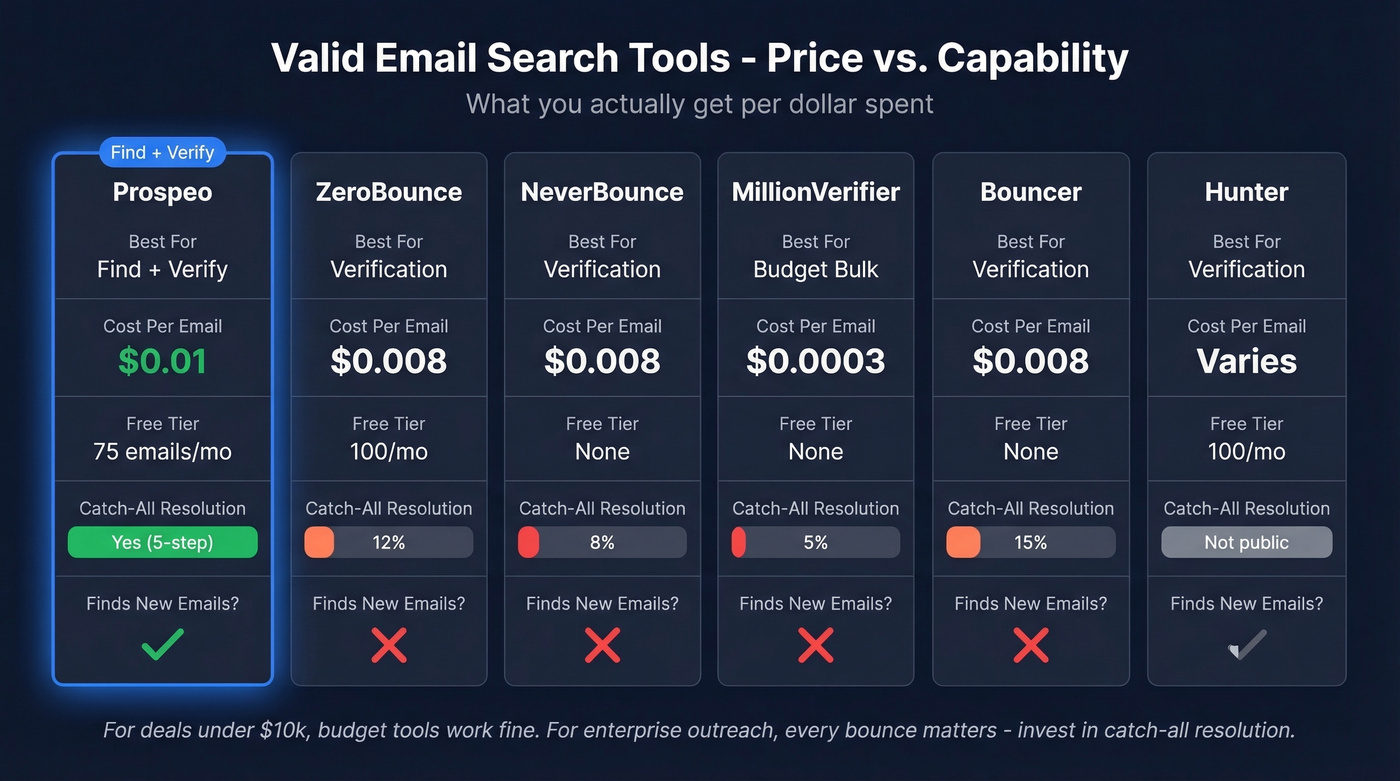
Let's be honest: if your deals average under $10k, you probably don't need a premium verifier at all. MillionVerifier's 5% catch-all resolution sounds terrible until you realize that at $0.0003/email, you can verify your entire list three times for the cost of one ZeroBounce run. For high-ACV enterprise deals, though, every bounce matters - and that's where the premium tools earn their keep.
Stale data is the #1 cause of preventable bounces - and most databases refresh every 6 weeks. Prospeo refreshes every 7 days, catches catch-all domains other tools mark as "unknown," and includes honeypot filtering. Snyk's 50 AEs dropped bounce rates from 35% to under 5% and grew pipeline 180%.
Get 75 free verified emails this month. No contract, no sales call.
Keeping Emails Valid Over Time
We've seen teams burn through sender domains in weeks by treating accept-all as valid. Don't be that team.
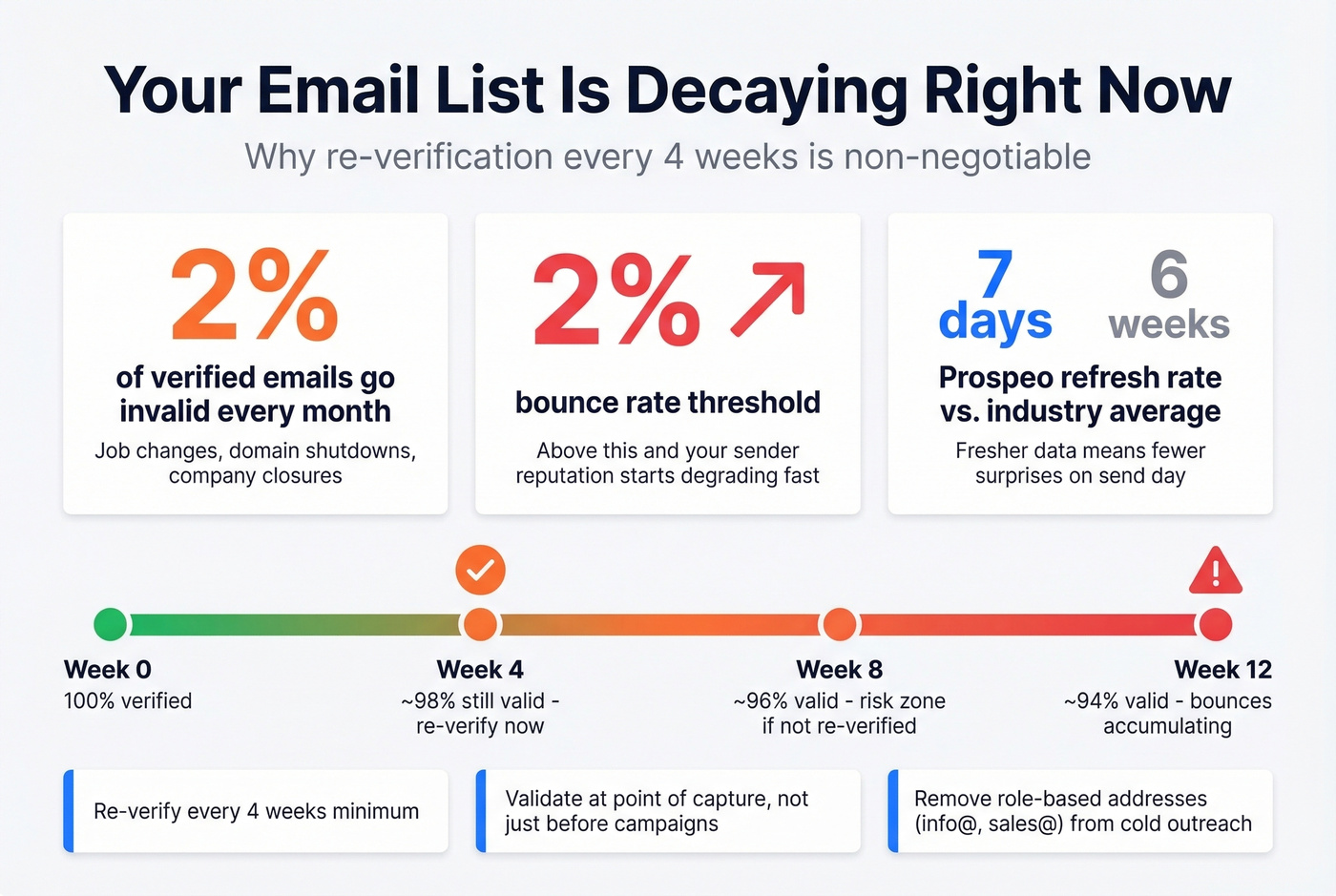
Re-verify every 4 weeks. Roughly 2% of verified emails go invalid each month due to job changes and domain shutdowns. Industry bounce rates vary - business and finance averages sit around 0.55%, while construction hits 1.28% - so your tolerance depends on your vertical.
Target under 2% bounce rate, ideally under 1%. Anything above 2% and you're risking sender reputation damage that takes months to repair. I've watched a team lose a 3-year-old sending domain over a single campaign with a 4.5% bounce rate. It wasn't worth it. If you want a deeper breakdown of bounce codes and fixes, see our guide to bounce rate.
Verify at point of capture. Run validation on signup forms, CSV imports, and CRM entries - not just before campaigns. Remove role-based addresses like info@, sales@, and support@ from cold outreach entirely. They rarely convert and often trigger spam filters. This is also where data enrichment helps keep records current.
When speed matters - say you're building a list for a time-sensitive campaign - a tool that combines finding and verification in one step saves hours compared to exporting from one platform and uploading to another. If you're building lists from scratch, our name to email workflow guide can help.
FAQ
What's the best tool for a valid email search?
For finding and verifying in one step, Prospeo handles both with 98% accuracy and 75 free emails/month. For pure verification of existing lists, ZeroBounce delivers 97.8% accuracy with 100 free monthly checks. For budget bulk verification under $0.001/email, MillionVerifier wins on price.
Why do email verifiers return "unknown" results?
Catch-all domains accept all incoming mail, so SMTP checks can't confirm whether a specific mailbox exists. Enterprise security gateways from Proofpoint and Mimecast also block verification probes entirely. About 30-40% of B2B emails sit on catch-all domains, which is why "unknown" results are so common in business lists.
How often should I re-verify my email list?
Every four weeks minimum. Roughly 2% of verified emails go invalid each month due to job changes and domain shutdowns. Always re-verify before a major campaign, even if the list was recently cleaned. The cost of re-verification is trivial compared to a trashed sender domain.