

Value Selling: The Complete Guide to Winning Deals on Outcomes
You just lost an $80,000 deal. Not to a competitor - to nothing. The prospect went dark, the champion stopped returning calls, and the deal moved to "Closed-Lost: No Decision" in your CRM. Corporate Visions research shows 60% of B2B pipeline dies this way - not because a rival outmaneuvered you, but because you never gave the economic buyer a compelling enough reason to act.
That's the problem value selling solves. Not "adding value in your follow-ups" or "leading with helpful content" - those are outreach tactics. Real value selling means building a quantified business case so airtight that doing nothing becomes the most expensive option on the table.
There's a persistent confusion in sales communities around this. Reps on r/sales regularly conflate "never prospect without adding value first" with the methodology itself. Value-first outreach is a good habit. Building a $200K business case with a CFO's own metrics is a different discipline entirely, and conflating the two is how teams end up "doing value selling" without ever quantifying a single dollar of impact.
What Is Value Selling?
Value selling is a sales methodology that centers every conversation on the measurable economic outcomes your buyer will achieve - revenue gained, costs eliminated, risk reduced, time saved - rather than on your product's features or capabilities. The approach replaces product-centric pitches with buyer-centric financial conversations.
The key word is quantified. You're not saying "we'll make your team more efficient." You're saying "based on your current headcount and process, we'll save your ops team 14 hours per week, which translates to $87,000 annually in recovered capacity."
What It's Not
It's not feature selling with better adjectives. It's not consultative selling, though they share DNA - IDC draws a clear line between the two. Consultative selling positions you as a trusted advisor focused on finding the best solution. Selling on value goes further: it demands you quantify the ROI of that solution in the buyer's own financial language.
And it's definitely not "value-first outreach." This confusion shows up constantly - reps treat "share a relevant article before your cold call" and "build a quantified business case for the CFO" as the same thing. They're not even in the same category.
Why This Methodology Works in B2B
The research isn't ambiguous. RAIN Group's sales research found that a seller's "focus on the value they can deliver" is the #1 most influential factor in purchase decisions - 96% of buyers find it influential. Sales winners are 3x more likely to bring new ideas and perspectives to buyers compared to second-place finishers. And 81% of top-performing sales organizations focus on driving maximum value, versus just 61% of the rest.
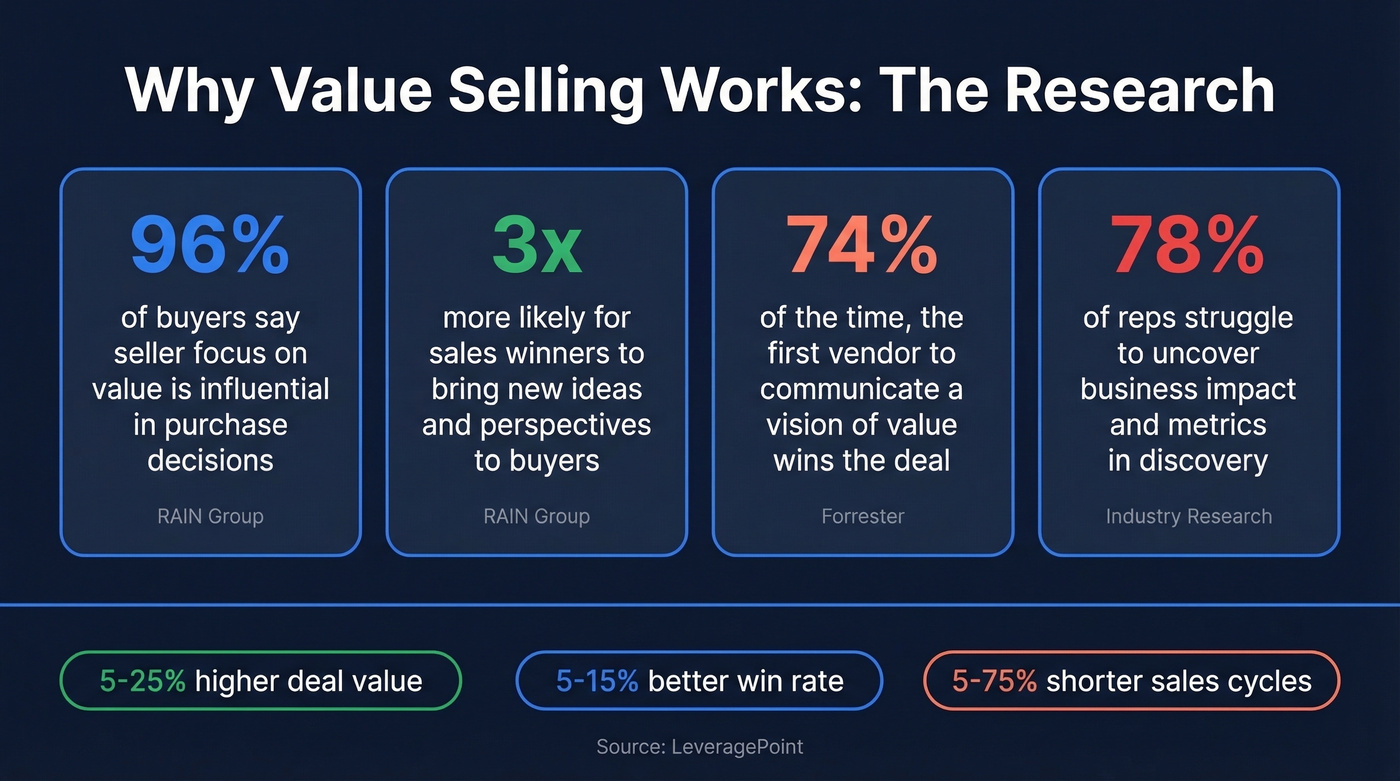
Here's the thing: top-performing sellers are 60% more likely to excel at presenting the overall value case persuasively and 63% more likely to make strong ROI and financial cases. Meanwhile, only 22% of buyers think vendor sales reps actually understand their issues. That gap between what buyers want and what sellers deliver is exactly where value-based selling lives.
The downstream impact is concrete. LeveragePoint reports that teams practicing this approach see 5-25% increases in average deal value, 5-15% improvements in win rate, and 5-75% reductions in sales cycle length. That last range is wide, but even the low end matters when you're running 200 opportunities a quarter. Forrester's data adds another layer: the first vendor to successfully communicate a vision of value to executives wins the business 74% of the time.
Sales Velocity = (# Qualified Opps x Avg Deal Value x Win Rate) / Cycle Length
All four levers of the sales velocity formula benefit from this methodology. It increases qualified opportunities because you're reaching economic buyers who can actually sign. It raises deal values because quantified ROI justifies larger investments. It improves win rates because you're competing against inaction, not just competitors. And it compresses cycles because urgency comes from the cost of doing nothing. No other methodology touches all four levers this directly.
Value Selling vs. Other Methodologies
This methodology doesn't exist in a vacuum. Here's where it sits relative to the approaches your team probably already uses.
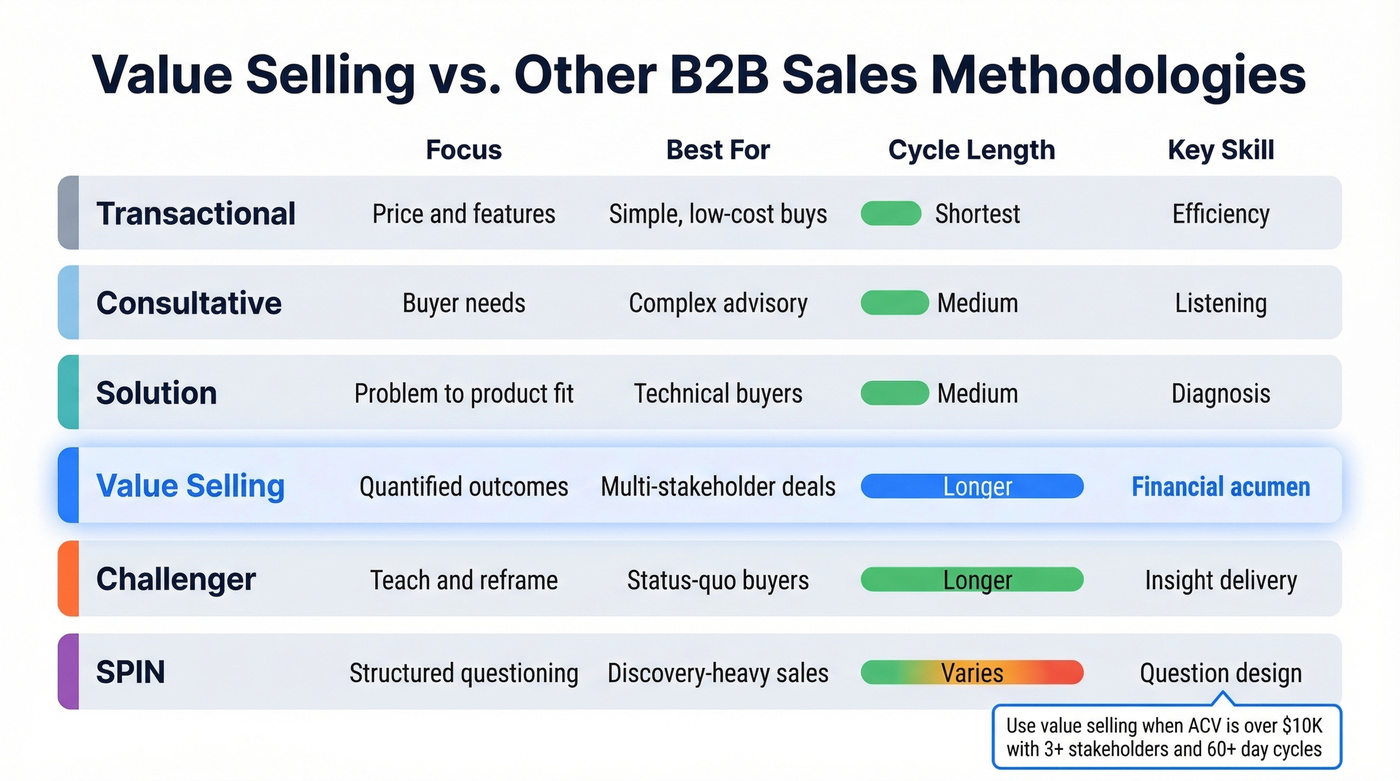
| Approach | Focus | Best For | Cycle Length | Key Skill |
|---|---|---|---|---|
| Transactional | Price & features | Low-cost, simple buys | Days-weeks | Efficiency |
| Consultative | Buyer's needs | Complex, advisory | Weeks-months | Listening |
| Solution | Problem to product fit | Technical buyers | Weeks-months | Diagnosis |
| Value | Quantified outcomes | Multi-stakeholder | Months-quarters | Financial acumen |
| Challenger | Teach & reframe | Status-quo buyers | Months-quarters | Insight delivery |
| SPIN | Structured questioning | Discovery-heavy | Varies | Question design |
SPIN came from Neil Rackham's study of 35,000+ sales calls across 20+ countries. Challenger was built on research into 6,000 reps across 90 companies. The value selling framework borrows from both - SPIN's structured discovery and Challenger's reframing - but adds the financial rigor that turns insights into signed contracts.
Skip this approach if your ACV is under $10K and you're selling to a single decision-maker. A solid consultative method will close those deals faster. Selling on quantified outcomes earns its keep on mid-market and enterprise deals with 3+ stakeholders and cycles longer than 60 days - that's where "no decision" kills your pipeline, and that's where a quantified business case changes the outcome.
Four Value Categories Buyers Care About
Before getting into the framework, it helps to know what "value" means to an executive. Buyers evaluate solutions through four lenses: make money (revenue growth, market expansion), save money (cost reduction, efficiency), differentiate (competitive advantage, innovation), and stabilize (risk mitigation, compliance).
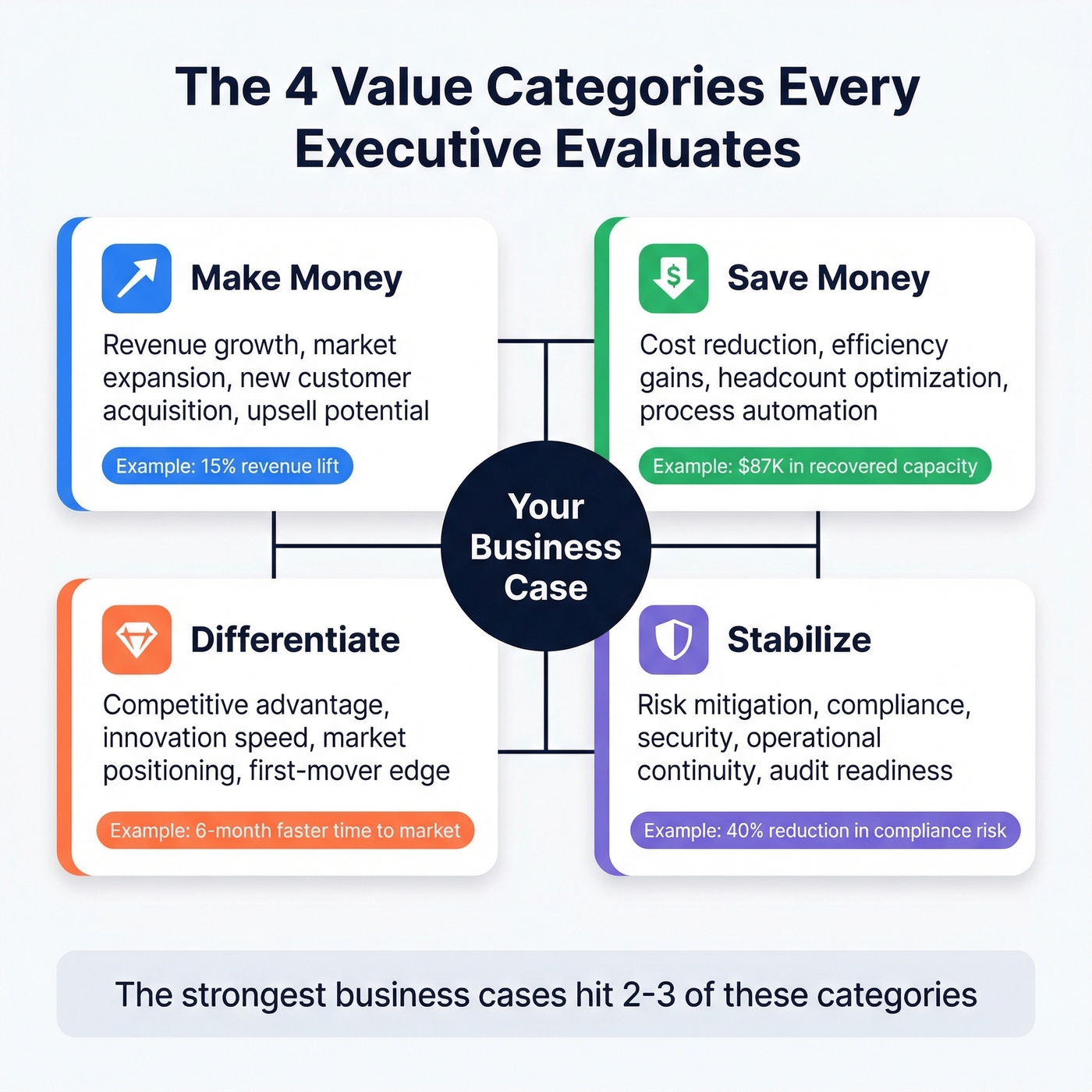
Every business case you build should map to at least one of these. The strongest cases hit two or three.
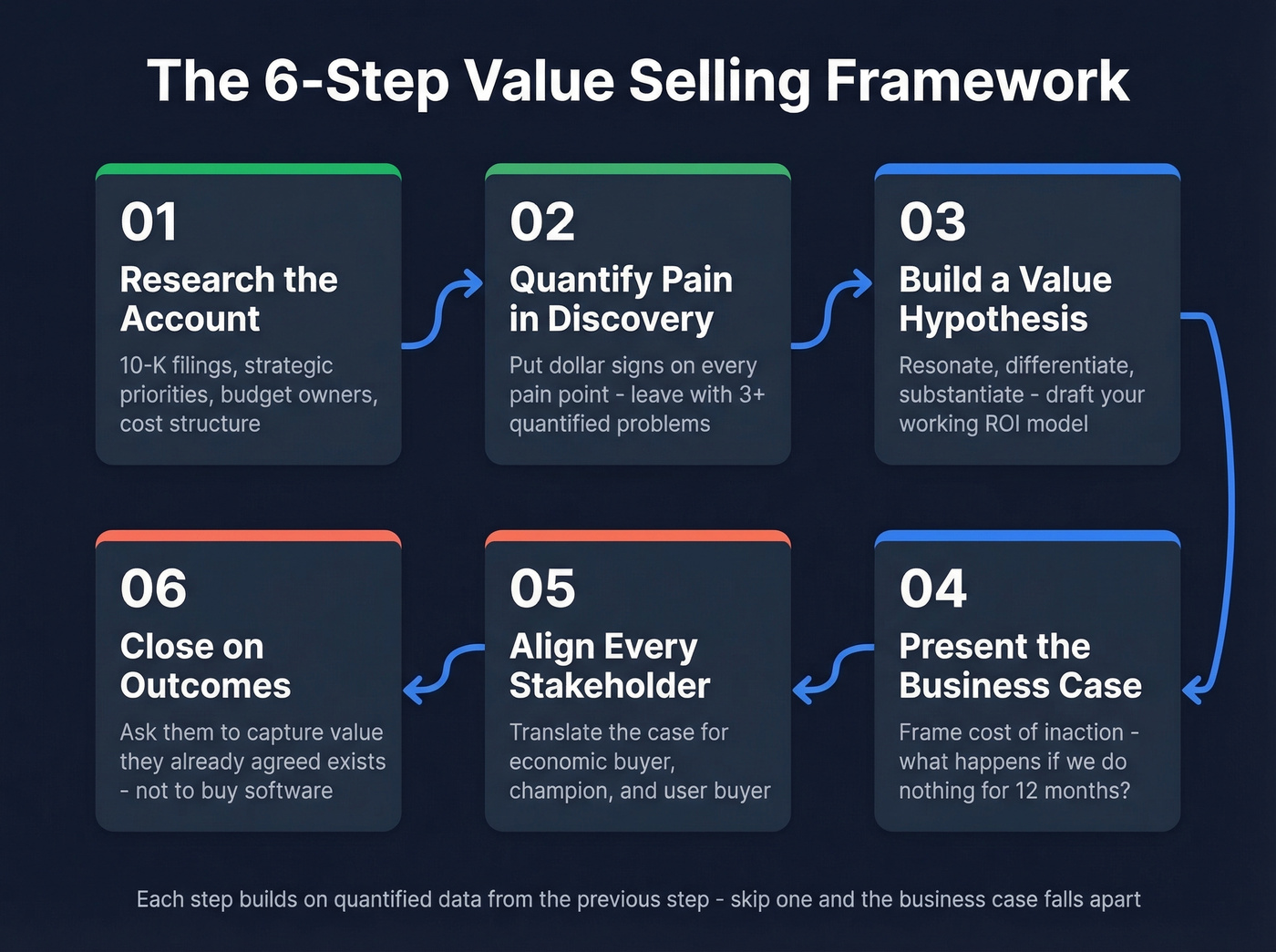
The 6-Step Framework
Step 1: Research the Account
Before you open a discovery call, you should know the account's recent earnings, strategic priorities, competitive pressures, and the specific person who owns the budget line your deal hits. Showing up having read the prospect's 10-K and knowing their cost structure signals a different caliber of preparation than "I saw on your website that you do X."
Reaching the economic buyer requires accurate contact data before the first call. A tool like Prospeo can surface verified emails and direct dials across 300M+ professional profiles with 98% email accuracy and a 7-day data refresh cycle, so your value story reaches the person who actually feels the pain - not a gatekeeper two levels removed.
Step 2: Run Discovery That Quantifies Pain
Good discovery doesn't just uncover problems - it puts dollar signs on them. "What's this challenge costing you in time, resources, or revenue?" is the question that separates value sellers from feature pitchers.
Every pain point needs a number attached to it before you leave the call. This is where the methodology begins - not in the pitch deck, but in the discovery conversation. If you walk out of discovery without at least three quantified pain points, you don't have enough material to build a business case that'll survive a CFO's scrutiny.
Step 3: Build a Value Hypothesis
Take what you learned in discovery and build a hypothesis: "Based on what you've shared, we believe we can reduce your [specific metric] by [X%], which translates to [$Y] annually." RAIN Group's Resonate/Differentiate/Substantiate model works well here - your hypothesis should resonate with what the buyer cares about, differentiate your approach from alternatives including doing nothing, and be substantiated with proof.
This isn't a polished deck yet. It's a working hypothesis you'll refine with the champion before it reaches the executive sponsor.
Step 4: Present a Quantified Business Case
This is where the "cost of inaction" becomes your most powerful tool. The business case should answer one question: "What happens if we do nothing for the next 12 months?"
If the answer is "we lose $400K in inefficiency and fall further behind competitors who've already solved this," the deal has gravity. Frame the investment against the cost of the status quo, not against your competitor's price. This moment is where the numbers either create urgency or they don't.
Think of this as story selling, not storytelling. You're not narrating your product's journey - you're narrating the buyer's future with and without the investment, backed by their own numbers.
Step 5: Align Every Stakeholder
Enterprise deals have economic buyers, champions, and user buyers - and they all care about different things. The economic buyer wants ROI and risk mitigation. The champion wants to look smart for bringing you in. The user buyer wants to know their daily workflow won't get worse.
Your business case needs a version for each persona, translated into their language. We've seen deals stall because the champion was sold but the economic buyer never saw the financial case. Multi-threading isn't optional here - it's structural. One deal we watched die at a 200-person SaaS company had a champion who loved the product, a VP who'd verbally committed, and a CFO who'd never been briefed. The PO sat unsigned for six weeks before the budget got reallocated. That doesn't happen when every stakeholder has seen the numbers in their own terms.
Step 6: Close on Outcomes
The close should feel like a natural conclusion, not a pivot. "Based on the business case we built together, here's the implementation timeline to capture that $400K in savings by Q3." You're not asking them to buy software. You're asking them to capture value they've already agreed exists.
Mature organizations extend this beyond the sales team. Product, marketing, and customer success all need to speak the same value language - otherwise the quantified story you told in the sales cycle falls apart at implementation.

Value selling only works when your quantified business case reaches the economic buyer who controls the budget. Prospeo gives you 98% accurate emails and verified direct dials across 300M+ profiles - refreshed every 7 days - so your $200K ROI story lands with the CFO, not a gatekeeper.
Stop losing value-selling deals to bad contact data.
Discovery Questions That Quantify Impact
78% of reps report difficulty uncovering business impact and metrics during discovery. These questions are designed to fix that - they force the conversation toward numbers, not feelings. Teams with strong open-ended questioning skills report 20-30% win rates on qualified opportunities, while script-heavy, closed-ended approaches convert in the low teens.
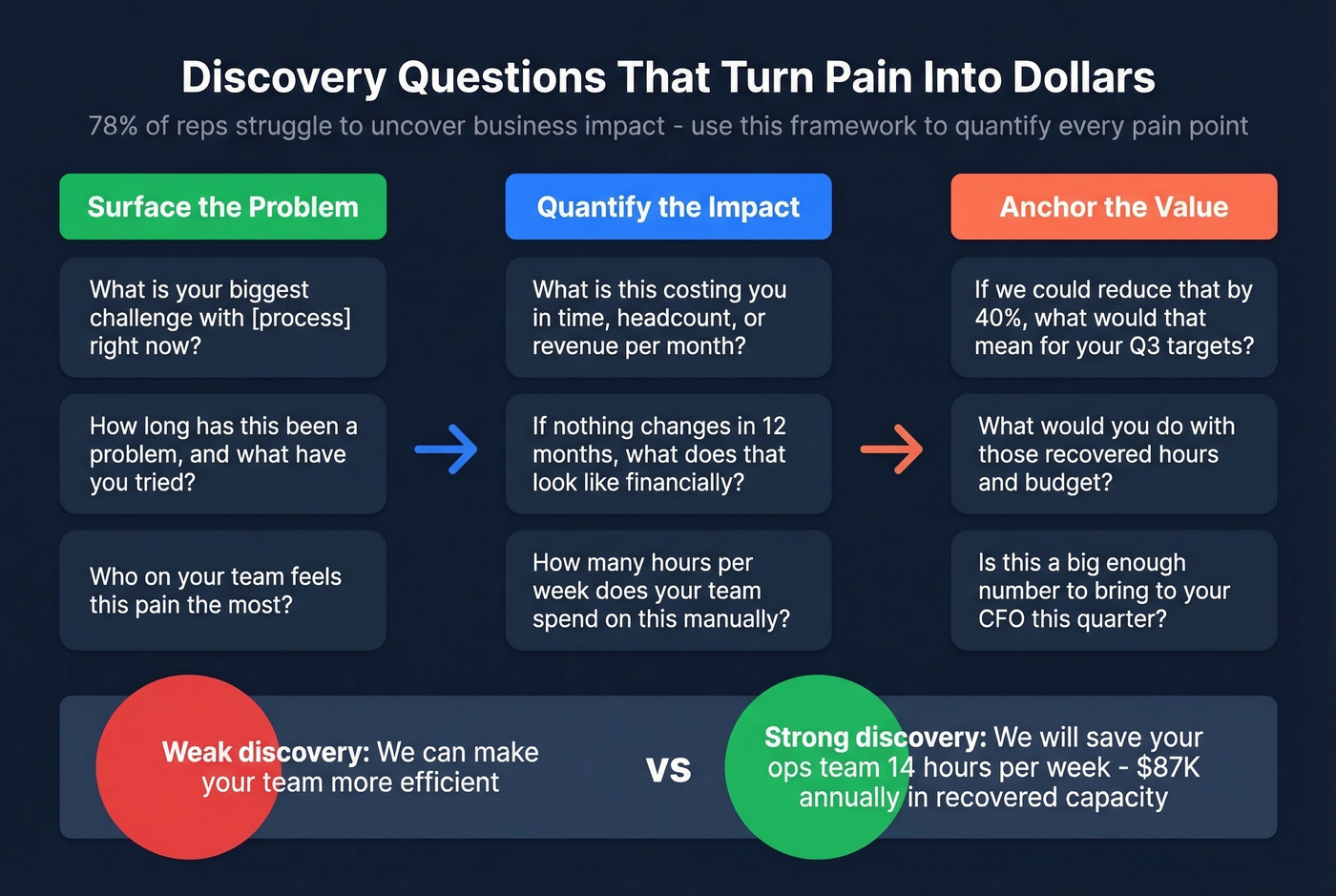
Use these as a framework, not a script. And never ask something you could've answered by reading the prospect's website or 10-K.
Situation Questions
- "What's prompting you to explore solutions like ours now - what changed?"
- "What tools and systems are you using today, and what's working versus not?"
- "Walk me through how your team currently handles [specific process]."
Pain Questions
- "What specific challenges are you facing in your current process?"
- "How do these challenges impact your overall business goals?"
- "Can you describe previous attempts to solve this and what happened?"
Quantify-the-Impact Questions
- "If you had to put a dollar figure on this problem - time, money, or missed opportunities - what would it be?"
- "What's this challenge costing you in resources or revenue per quarter?"
- "What happens if nothing changes in the next 6 months?"
- "How much time does your team spend on [manual process] each week?"
Decision Process Questions
- "Who else is involved in evaluating and approving a solution like this?"
- "What's your typical buying process for investments in this range?"
- "What criteria matter most when you're evaluating potential solutions?"
Success Vision Questions
- "If this project goes exactly as planned, what does success look like for you personally and for your team?"
- "What would need to be true 12 months from now for this to be considered a win?"
Real-World Case Studies
The theory is clean. Here's what it looks like in practice, drawn from ValueSelling Associates' case study library and field reports.
GHD Digital hit 450% ARR growth in two years after moving from pitching capabilities to presenting quantified digital transformation ROI. They also saw a 125% increase in average deal size and 140% improvement in year-over-year revenue growth from 2023 to 2025. The shift wasn't tactical - it was a fundamental change in how their team framed every conversation.
Trend Media tells a different story - one about contract stickiness. After adopting a value-based framework, their average contract length grew 400%, average deal size doubled across key accounts, and TV revenue climbed 15%. They stopped selling transactional media buys and started selling long-term business outcomes.
Weir Group rolled out the methodology across European and METCA teams and delivered results on both sides of the ledger: 25% faster sales cycles and a 21% increase in revenue, plus a 25% improvement in adjusted operating profit. Shorter cycles with bigger outcomes - that's the combination every CRO wants.
The pattern holds across company sizes. Readymode hit 40% annual revenue growth and a 72% win rate on sales-accepted opportunities. Nextiva saw closed-won rates jump from 12% to 19%, average deal size increase 14%, and revenue per rep climb 22% - all within 90 days of shifting to a value-quantified approach.
5 Mistakes That Kill Value Deals
Knowing the framework isn't enough. Here's where teams blow it.
1. Insufficient research - and you can't reach the economic buyer. Reps show up to discovery calls without understanding the account's financial context, then pitch to a champion who can't build the internal business case alone. The fix starts upstream: pre-load account intelligence before every call, and make sure you've got verified contact data for the person who actually controls the budget.
2. Overpromising on benefits. If your case study shows 20% efficiency gains and you promise 40%, you've destroyed credibility the moment the buyer checks with a reference. Use conservative estimates and let the math speak.
3. Reverting to feature-dumping under pressure. The moment a buyer pushes back, untrained reps default to "but we also have..." instead of returning to the quantified business case. In our experience, this is the hardest mistake to fix because it's instinctive. It's a coaching problem, not a methodology problem. Role-play the objection scenarios before they happen.
4. Never quantifying the value proposition with real math. Saying "we'll save you time and money" isn't selling on value. It's vague selling. If you can't put a dollar figure on the outcome, you haven't done the discovery work. Top performers spend 52% more time talking about value-related subjects than average performers.
5. Ignoring post-sale value validation. The methodology doesn't end at signature. If you promised $200K in annual savings and never measure whether the customer actually achieved it, you've lost your best renewal argument and your strongest case study. Close the loop.
Implementing the Methodology
Don't try to transform your entire sales org overnight. We've found that 60-day pilots with 3-5 reps produce the clearest signal. Give them a discovery question playbook and a value hypothesis template, then measure win rate and deal size changes. If the numbers move, scale. If they don't, diagnose whether it's the methodology or the execution.
One thing that kills adoption: static playbooks. Dynamic playbooks that surface contextual guidance inside the CRM get used. Static PDFs in a Google Drive folder don't.
Your tool stack doesn't need to be complicated. At minimum you need a CRM for pipeline tracking ($14-$150+/user/month depending on vendor and tier), an enrichment and prospecting tool for reaching verified decision-makers, and a value hypothesis template your reps fill in per deal. For enterprise teams, value management platforms typically run $30K-$100K+/year. Training programs cost $15K-$50K+ depending on team size and scope.
Let's be honest about sequencing: stop buying $50K training programs before fixing your data. If your reps can't reach the economic buyer with a verified email or direct dial, the best framework in the world won't help. Fix the data layer first, then invest in methodology training.
Step 1 of your value selling framework demands knowing the account cold before discovery. Prospeo's 30+ search filters - buyer intent, technographics, funding, headcount growth - let you build the financial context that turns a cold call into a boardroom-ready conversation. At $0.01 per email, the ROI case writes itself.
Research accounts in minutes, not hours. Start building real business cases.
Value Selling FAQ
How does it differ from solution selling?
Solution selling maps product features to a customer's stated problem. Value selling goes further - it quantifies the economic impact of solving that problem in dollars, time, or risk reduction, making the ROI undeniable to the economic buyer. Solution selling asks "does this fix your issue?" The value approach asks "what's this issue costing you, and what's the return on fixing it?"
Does this approach work for smaller deals?
It works best for mid-market and enterprise deals with multiple stakeholders and cycles longer than 60 days. For transactional sales under $15K with a single signer, the time investment of building a full quantified business case rarely pays off. Use a lighter consultative approach for those.
How long does implementation take?
Most teams see measurable results within 60-90 days of a focused pilot. Start with 3-5 reps, a discovery question playbook, and a value hypothesis template. Measure win rate and deal size changes before scaling to the full team.
What tools support a value selling motion?
At minimum you need a CRM for pipeline tracking, an enrichment tool to reach verified decision-makers, and a simple value hypothesis template completed per deal. Enterprise teams sometimes add a dedicated value management platform ($30K-$100K+/year).
How do I measure if it's working?
Track four metrics: win rate, average deal size, sales cycle length, and percentage of deals lost to "no decision." If the first three improve and the last one drops, your motion is working. Review these monthly during your pilot phase.