

VoIP.ms Alternatives: Better SIP Trunks & Business Phone Systems for 2026
A 2.0 out of 5 on Trustpilot across 539 reviews. A DDoS extortion attack in 2021 that knocked services offline for days - attackers initially demanded 1 BTC (~$45,000 at the time), then escalated to 100 BTC (~$4.3M). An account verification process that rejects users with zero explanation beyond "does not meet security requirements."
VoIP.ms still works for technical users who want granular control and low rates, but the trust has eroded. The alternatives have caught up.
Reddit threads in r/voipms flag recurring problems with DIDs not being reachable on certain carriers, with MSPs considering porting clients elsewhere. If you're here, you're probably past the tipping point. Let's find you something better.
Our Picks (TL;DR)
- Like-for-like metered SIP provider: Callcentric. Same pay-per-minute model, $0/mo base plan, most-recommended swap in user forums. For an API-first upgrade, go Telnyx.
- Full business phone system: Ooma starting at $19.95/user/mo. Plug-and-play, no SIP config required.
- Cheapest Canada calling: Fongo Home Phone at $4.95/mo with unlimited Canada/US.
SIP Trunk vs. UCaaS
Most listicles comparing VoIP.ms replacements throw metered SIP providers and UCaaS platforms into the same list without acknowledging they're fundamentally different products. VoIP.ms is best known for pay-as-you-go calling, but it also includes Cloud PBX features like voicemail, ring groups, IVR, queues, and call recording. That's a completely different buying motion than a per-seat UCaaS platform like RingCentral where you're paying per user for a managed phone system.
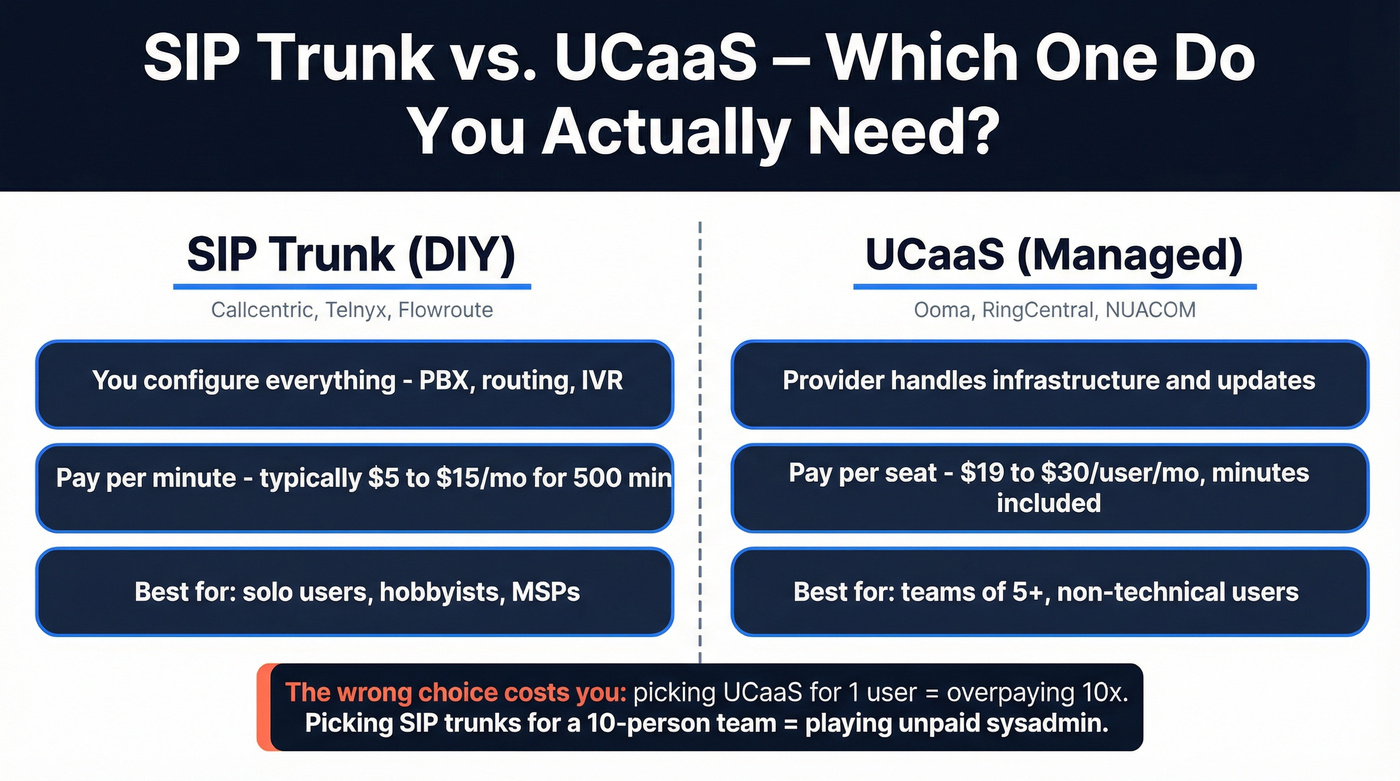
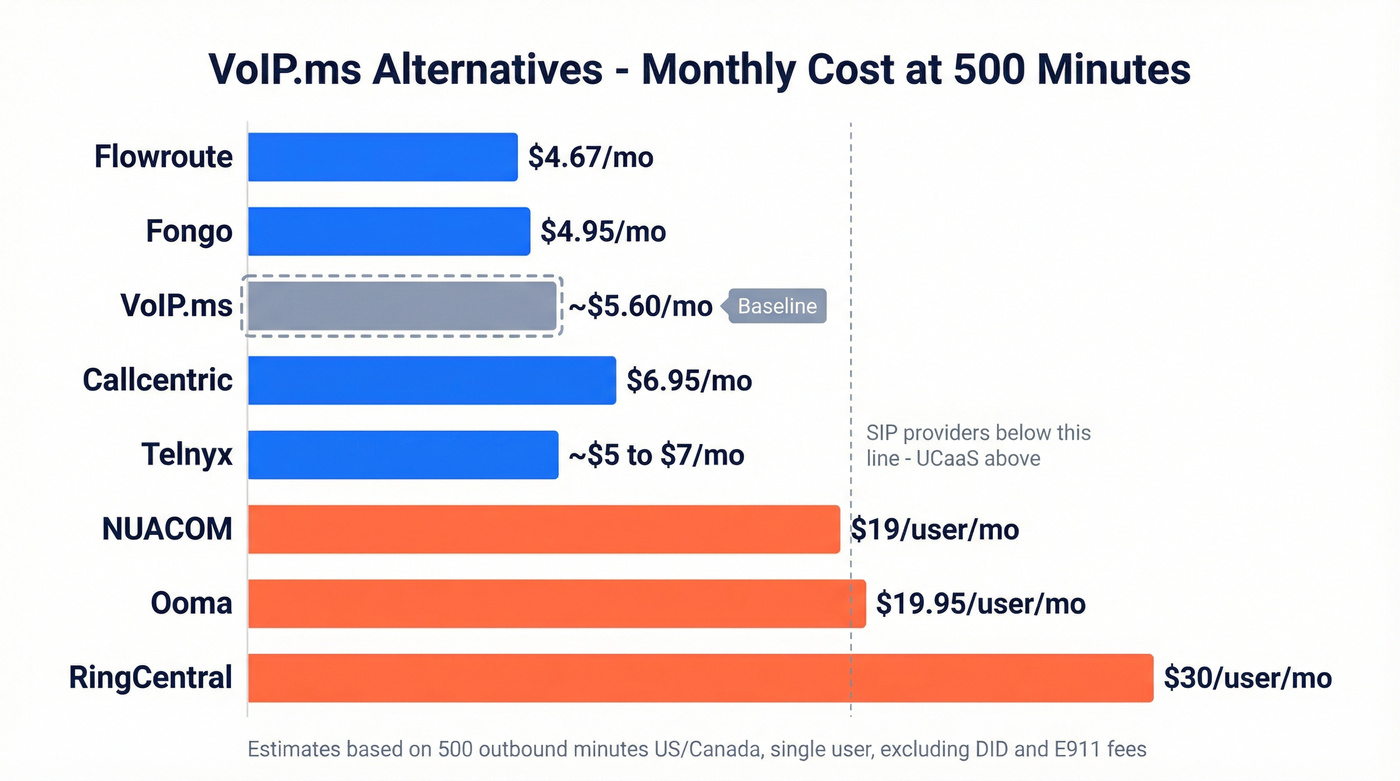
Here's the math: a solo user making 500 minutes of US/Canada outbound calls on VoIP.ms typically lands around ~$5-$15 for the minutes, plus your DID (~$1.10/mo) and any add-ons like E911. That same 500-minute usage on Callcentric's North America 500 outbound plan is $6.95/mo, which includes 500 minutes plus E911. After the included minutes, the rate is $0.0198/min.
If you want to keep the DIY metered model, look at Callcentric, Telnyx, or Flowroute. If you want someone else to handle the infrastructure, look at the UCaaS options. Mixing these categories is how people end up paying $30/user/mo when they just needed a $2/mo trunk.
Here's the thing: if your monthly call volume is under 1,000 minutes and you don't need programmable APIs, you don't need to overthink this. Callcentric is the answer. Move on and spend your time on something that actually grows your business.
The Best Replacements for VoIP.ms
Callcentric
Use this if: You want the closest thing to VoIP.ms without the headaches. Callcentric runs the same pay-per-minute SIP model with separate inbound and outbound plans. The Pay Per Call plan starts at $0/mo - you pay $0.0198/min for US/Canada calls. Bundled plans run from $1.95/mo (120 minutes) up to $29.95/mo (2,500 minutes).
The split inbound/outbound structure means you're not paying for outbound minutes you don't use, and you can mix-and-match based on your traffic. DID pricing typically falls around ~$1-$5/mo depending on number type and plan.
We've tested the porting process from VoIP.ms and it went smoothly - support actually responds, which is a refreshing change. The whole experience felt like dealing with a company that still cares about individual customers, not one that's scaled past the point of giving a damn.
Skip this if: You need a programmable API layer or want to build custom telephony workflows. Callcentric is a traditional SIP provider, not a CPaaS platform.
Telnyx
Telnyx is API-first - think CPaaS-style voice where you can programmatically control routing and workflows. Expect pricing in the sub-cent to ~1c/min range for US/Canada calling depending on volume and configuration, with DIDs commonly around ~$1/mo.
The real value is the developer experience. You get a proper API, SDKs, and the ability to build custom call routing, IVR, and messaging workflows. If VoIP.ms felt limiting because you couldn't programmatically control your telephony stack, Telnyx is the upgrade. G2 lists Telnyx among VoIP.ms alternatives, and the consensus in developer communities backs that up. But if you just want to plug in an ATA and make phone calls, Telnyx's power is wasted on you - stick with Callcentric.
If you're building an outbound motion alongside your new calling stack, pair it with sales prospecting techniques that actually work in 2026.
Flowroute
The cheapest published rates in the SIP trunk space: inbound starting at $0.005/min, outbound starting at $0.00833/min, and DIDs starting at $0.50/number.
The catch is messaging. SMS looks cheap at $0.004/message, but 10DLC/TCR registration fees add up fast - $4 for brand verification, $15 per campaign vetting, and up to $95 for enhanced vetting with a $40 standard vetting option. E911 runs $1.39 per number plus $1.50/mo per number. Budget for the extras before you commit.
If SMS is a core channel for you, it’s worth understanding cold texting compliance and risks before you scale.
Ooma
Ooma is for small teams who are done configuring SIP trunks. Plans start at $19.95/user/mo. You get a full PBX with auto-attendant, ring groups, and mobile apps out of the box.
Per-seat pricing makes zero sense for a solo user replacing a low-cost metered setup. But for a five-person team that wants to stop playing sysadmin, it's the right call. Our team has seen too many small businesses burn hours on FreePBX configs when a managed solution would've paid for itself in the first week.
If you’re standardizing your stack, make sure your contact management software can keep up with call + email workflows.
Fongo Home Phone
Canadian users who just need cheap calling: Fongo Home Phone runs $4.95/mo on annual billing or $5.95/mo monthly, with unlimited Canada/US calls. Grab the $25 ATA adapter and you're set. Number porting costs $5.95 at signup. Other niche Canadian options like les.net and FreePhoneLine.ca exist, but Fongo is the most straightforward package.
NUACOM
NUACOM starts at $19/user/mo and carries a 4.8/5 on G2 - but 234 of its 262 reviews come from Europe, with only 9 from North America. The product works, but the user base and support infrastructure skew heavily European. US/Canada users should test thoroughly before committing.
RingCentral
RingCentral Core runs $30/user/mo and is enterprise-grade UCaaS. A great platform for a 50-person company standardizing on one phone system. Overkill if you're a solo user or small team replacing a ~$1.10/mo VoIP.ms DID.
If you’re comparing other UCaaS options, see our Dialpad alternatives breakdown for 2026.

New phone system won't help if your reps are calling the wrong numbers. Prospeo gives you 125M+ verified mobile numbers with a 30% pickup rate - so when you finally get your SIP trunks sorted, every dial actually connects to a real buyer.
Stop optimizing per-minute rates and start optimizing conversations that close.
Pricing Comparison
| Provider (Type) | Monthly Base | Per-Min Rate | DID Cost | Best For |
|---|---|---|---|---|
| VoIP.ms (Pay-as-you-go) | $0 | $0.009-$0.03 | ~$1.10/mo | Baseline |
| Callcentric (SIP) | $0-$29.95 | $0.0198 | ~$1-$5/mo | Like-for-like swap |
| Telnyx (CPaaS) | Volume-based | Sub-cent to ~1c/min | ~$1/mo | Devs & MSPs |
| Flowroute (CPaaS) | $0 | $0.005 in / $0.00833 out | $0.50/mo | Lowest rates |
| Ooma (UCaaS) | $19.95/user | Included | Included | SMB teams |
| Fongo (Packaged) | $4.95 | Unlimited | Included | Canada budget |
| NUACOM (UCaaS) | $19/user | Included | Included | EU-focused teams |
| RingCentral (UCaaS) | $30/user | Included | Included | Enterprise |
If you need HIPAA or SOC 2 compliance, check provider certifications before signing - most pay-per-minute SIP providers don't offer them.
Hidden Costs to Watch
10DLC/TCR fees for SMS. Flowroute charges $4-$95 in registration fees before you send a single text. Every SIP provider with A2P messaging has similar costs now.
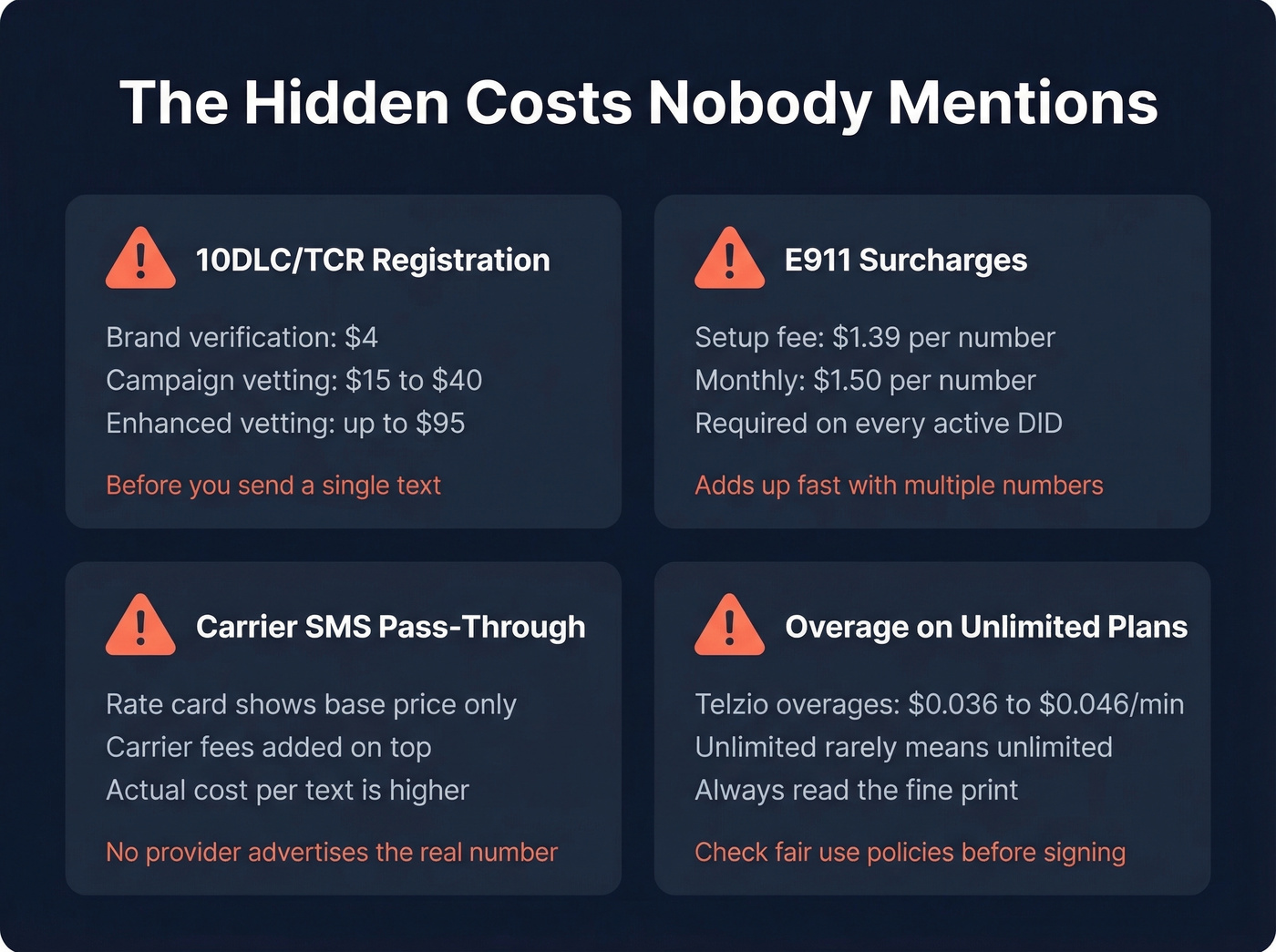
E911 surcharges. Flowroute is $1.39 per number plus $1.50/mo per number, and VoIP.ms is $1.50/mo per DID - so this isn't new. Just don't forget it.
Carrier surcharges on messaging. Per-message SMS rates are the base. Carrier pass-through fees get added on top. Your actual cost per text will be higher than the rate card shows.
Overage rates on "unlimited" plans. Telzio's overages run $0.036-$0.046/min once you exceed bundled minutes. Always check what "unlimited" actually means - because it rarely does.
If you’re doing outreach at scale, combine calling with cold email marketing benchmarks so you don’t over-index on one channel.
Migration Checklist
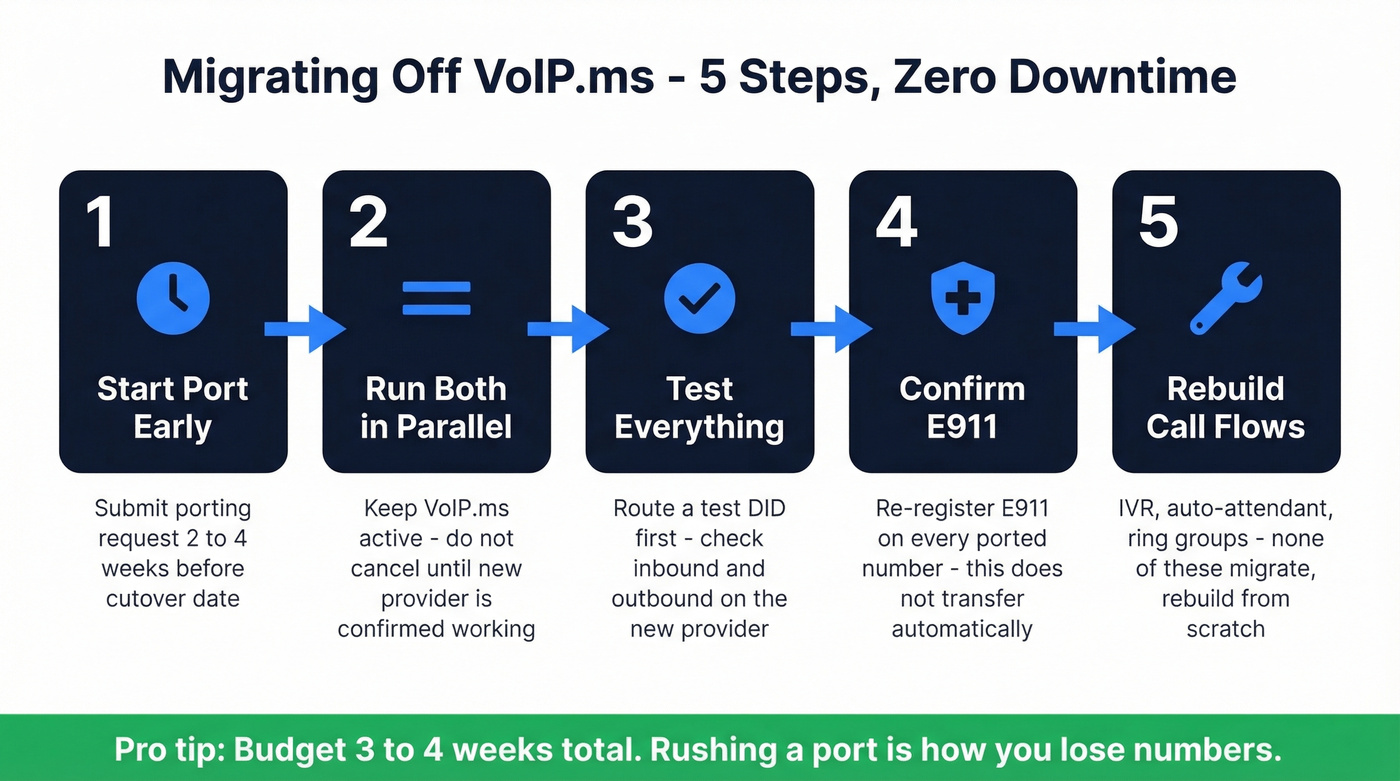
- Port your numbers early. Expect 2-4 weeks. Start before you're ready to cut over.
- Run both providers in parallel. Keep your VoIP.ms account active during the transition. Losing a number because you canceled too early is an unforced error.
- Test inbound and outbound on the new provider before making it primary. Route a test DID first.
- Confirm E911 provisioning on every number you port, and re-register if required.
- Update IVR and auto-attendant configs. Your call flows won't migrate - rebuild them on the new platform.
While you're rebuilding your outbound stack, make sure your contact data is solid too. Tools like Prospeo can find verified emails and direct dials across 300M+ profiles with 98% email accuracy, which matters when you're pairing a new phone system with outbound prospecting. If you need help choosing vendors, start with our guide to data enrichment services.
You're saving pennies per minute on calling costs. Meanwhile, bad contact data is costing you hours of wasted dials. Prospeo's 98% email accuracy and verified mobiles mean your outbound team reaches real prospects - at $0.01 per email, it's cheaper than a single wasted VoIP minute.
Cheaper calls mean nothing without the right people to call.
FAQ
What's the best VoIP.ms alternative for Canadian users?
Fongo Home Phone at $4.95/mo with unlimited Canada/US calling is the simplest option. For metered SIP-style calling, Callcentric's Pay Per Call plan starts at $0/mo with $0.0198/min rates - same DIY model, better uptime.
Can I port my VoIP.ms number to another provider?
Yes. Most SIP and UCaaS providers support number porting from VoIP.ms. Expect 2-4 weeks for the transfer to complete. Keep your VoIP.ms account active during the transition and test the new provider before canceling to avoid any gap in service.
Is Callcentric or Telnyx better for replacing VoIP.ms?
Callcentric is the closest drop-in replacement - same pay-per-minute model, $0/mo base, and straightforward ATA setup. Telnyx is better if you need API-driven call routing, programmable IVR, or CPaaS-level control. For under 1,000 minutes/month with no dev requirements, pick Callcentric.