

VP of Revenue Operations: What the Role Really Looks Like in 2026
A RevOps leader we know got hired as VP at a Series C company last year. Her first week, she discovered three dashboards reporting different pipeline numbers to the board - Sales, Marketing, and CS each had their own truth. That's the job in a nutshell. VP of revenue operations titles have grown 300%) in the past 18 months, and organizations running unified RevOps tools grow up to 19% faster. Yet most companies still don't understand what the role actually owns.
The VP of RevOps isn't a glorified Salesforce admin. They're the operational bridge between Sales, Marketing, and Customer Success - owning the data, processes, and systems that turn pipeline into revenue. If the CRO is the general, the VP of RevOps is the one making sure the supply lines actually work.
What You Need (Quick Version)
- What the role owns: Cross-functional revenue data, tech stack, forecasting accuracy, and process design across Sales, Marketing, and CS.
- What it pays: Median total comp lands between $277K-$316K, with top-end packages clearing $400K+ at enterprise companies.
- The biggest mistake new hires make: Optimizing processes before understanding the revenue model.
Jump to salary data, KPIs, or the 90-day plan if you want depth on a specific area.
Core Responsibilities
You own everything that connects revenue-generating teams to each other and to the data they need to make decisions. That breaks down into five areas:
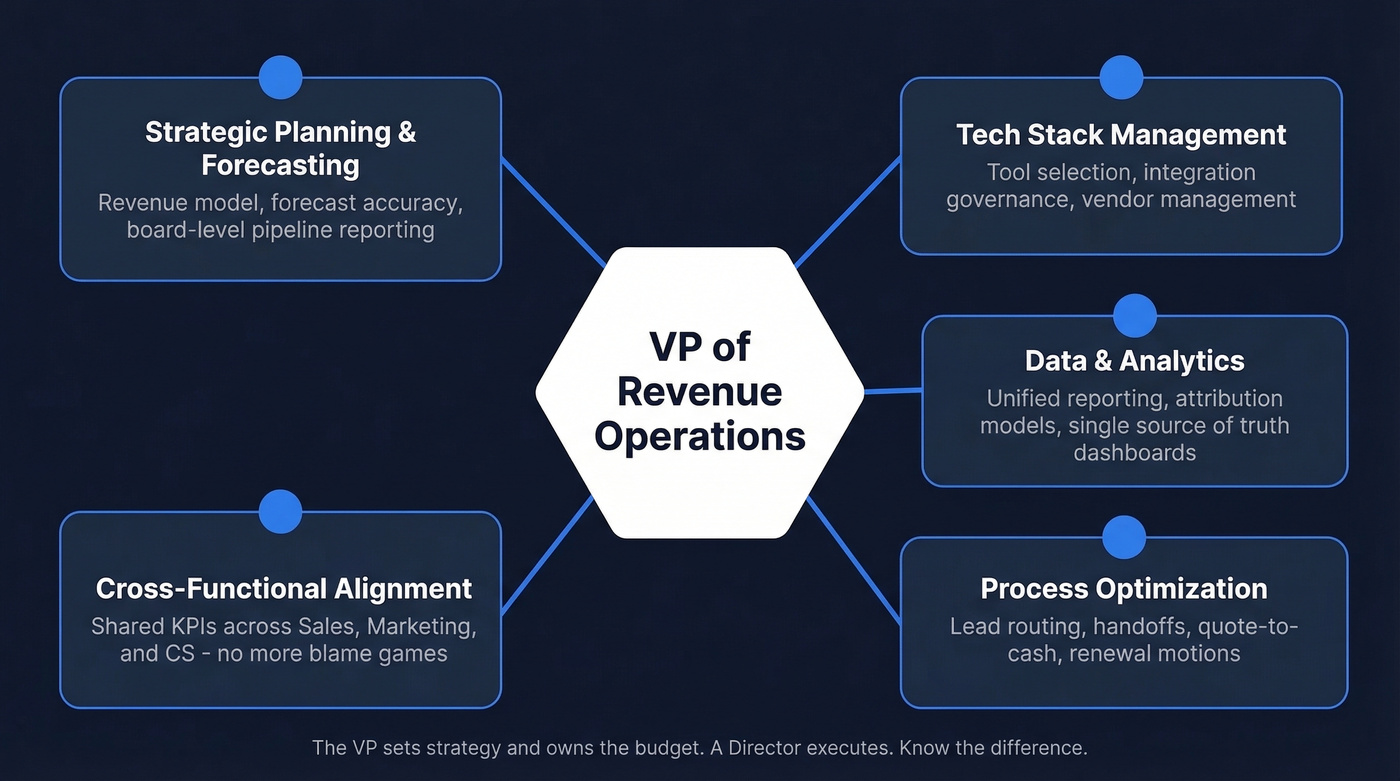
- Strategic planning and forecasting - building the revenue model, owning forecast accuracy, and presenting pipeline health to the board.
- Tech stack management - selecting, integrating, and governing every tool across the revenue org.
- Data and analytics - unified reporting, attribution models, and the dashboards that Sales, Marketing, and CS all trust.
- Process optimization - lead routing, handoff workflows, quote-to-cash, and renewal motions.
- Cross-functional alignment - the political work of getting three departments to share KPIs and stop blaming each other.
Here's the thing: ask any RevOps leader on r/RevOps or r/salesoperations what their biggest daily frustration is, and you'll hear the same answers. Data quality firefighting. Cross-functional politics. Being treated as a cost center instead of a growth driver. The VP role exists to fix all three - but only if it's scoped correctly.
A lot of people confuse this with "Head of RevOps" or "Director of RevOps." The distinction isn't seniority - it's scope. A Director typically runs the ops team and executes on strategy. The VP sets the strategy, owns the budget, and reports directly to the CRO, COO, or CEO. If your revenue operations leader reports to the VP of Sales, you don't actually have a cross-functional RevOps executive - you have a senior Sales Ops person with an inflated title. True revenue operations leadership requires a seat at the executive table and a direct line to the people making company-wide resource decisions.
What This Role Earns in 2026
The ranges are wider than most people expect.
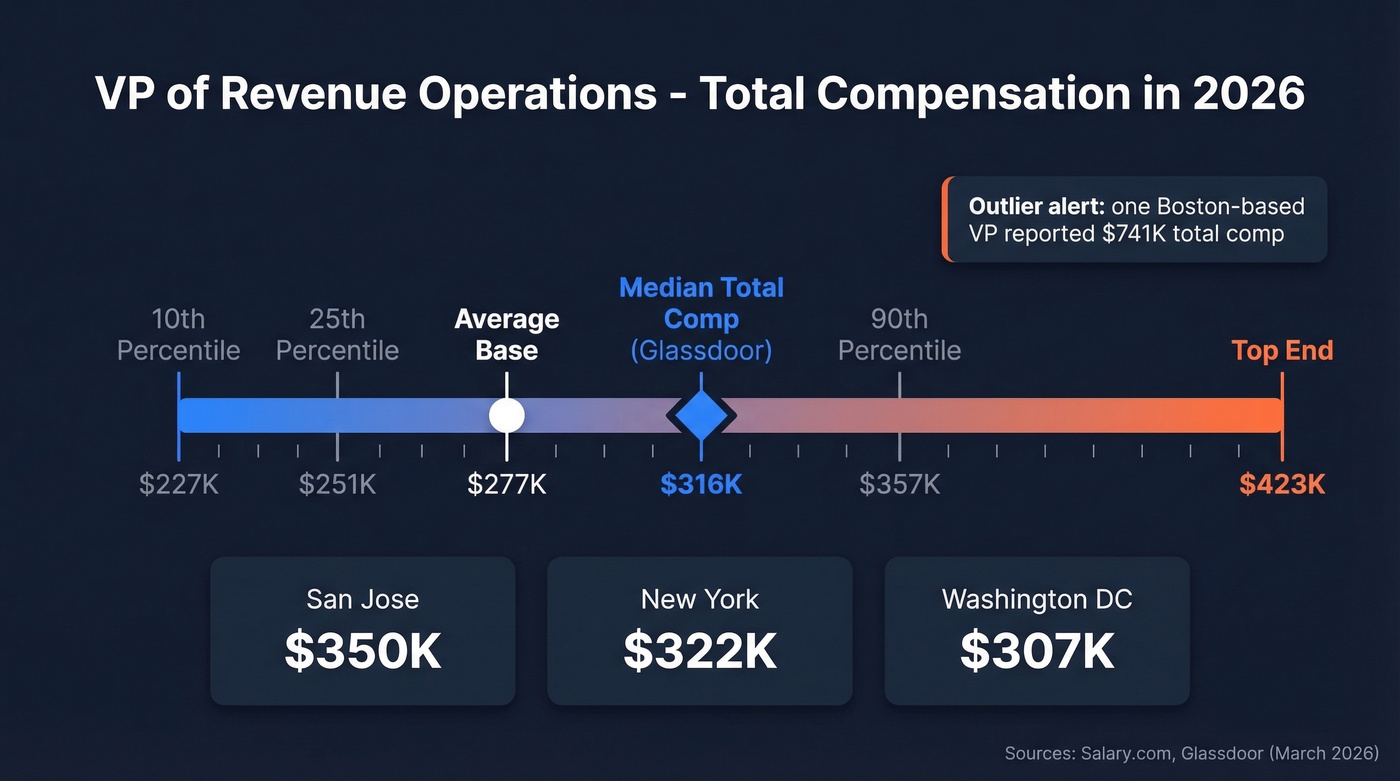
As of March 2026, Salary.com pegs the average VP of revenue operations salary at $277,486/year. Glassdoor's total comp picture is more generous - median total pay of $316K/year, with a range of $241K-$423K when you factor in bonuses and equity. That figure is based on a small sample of 12 reported salaries, so treat it as directional rather than definitive. It tracks with what we've seen in offer letters, though.
| Percentile | Base Salary |
|---|---|
| 10th | ~$227K |
| 25th | ~$251K |
| Average | ~$277K |
| 75th | ~$319K |
| 90th | ~$357K |
Glassdoor total pay range: $241K-$423K (median $316K).
One wrinkle worth knowing: Glassdoor has two separate pages for this role. "VP Revenue Operations" shows a $316K median. "Vice President of Revenue Operations" - the same job - shows $266K. The difference comes down to which companies use which title string. Don't let a recruiter anchor you to the lower number. And outliers exist: one Boston-based VP with 15+ years reported $741K total comp.
Bonus structures at the VP level typically run 20-30% of base. At venture-backed companies, equity can be a meaningful chunk on top of cash. As RevOps leadership roles become more common in the C-suite conversation, expect comp benchmarks to keep climbing - especially at companies where the VP has a direct line to the CEO.
Geography Still Matters
Major hubs like SF and NYC often pay 20-30% above national averages for comparable roles.
| City | Avg Total Comp |
|---|---|
| San Jose | ~$350K |
| San Francisco | ~$347K |
| Oakland | ~$339K |
| New York | ~$322K |
| Washington DC | ~$307K |
At specific companies, the ceiling goes higher. ZoomInfo's VP RevOps range runs $298K-$474K total comp. SentinelOne is similar at $293K-$468K. 6sense sits at $246K-$381K. These are enterprise-scale orgs with complex revenue motions - the comp reflects the complexity.
Team Structure by Stage
Your team size and reporting structure should scale with ARR, not headcount. Based on an analysis of 1,839 job postings as of March 2026, here's what healthy RevOps orgs look like at each stage:
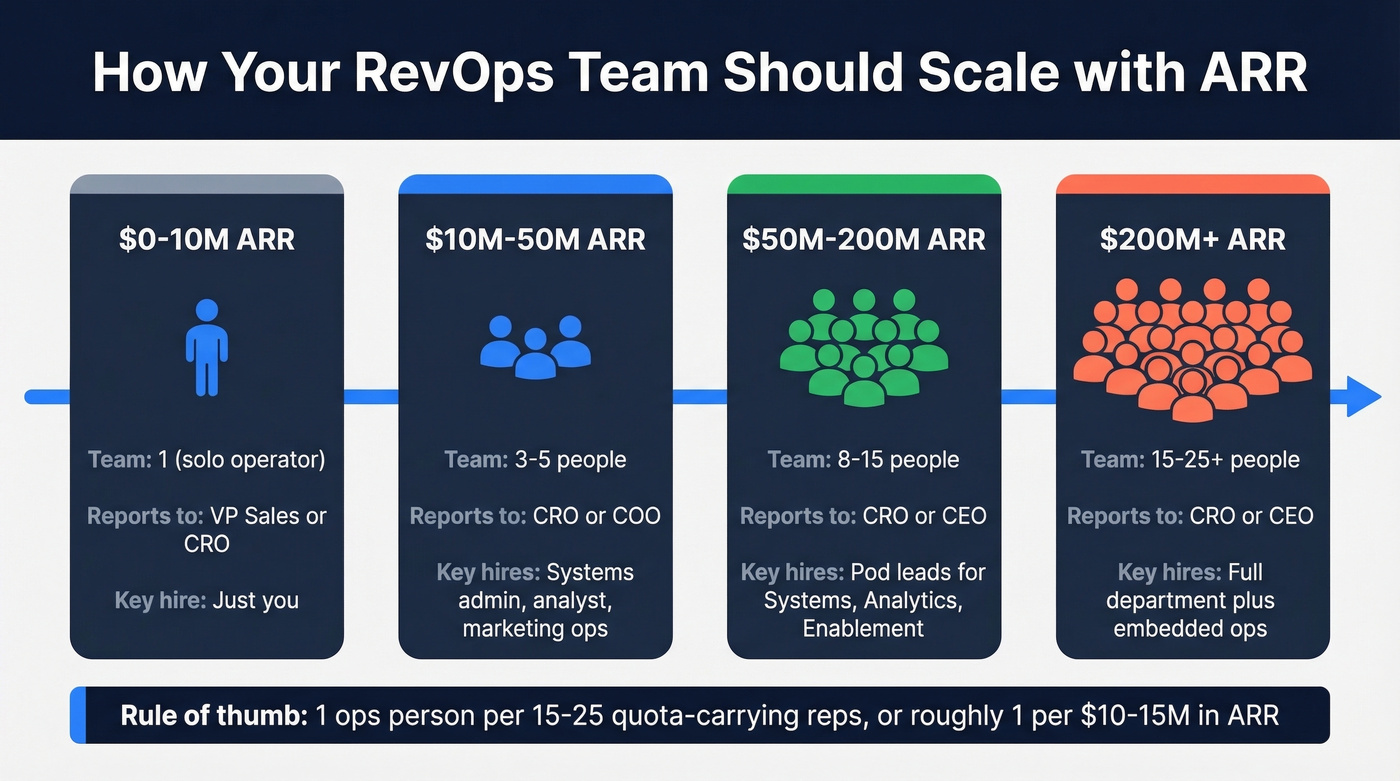
| ARR Range | Team Size | Reports To | Key Hires |
|---|---|---|---|
| $0-$10M | 1 (solo operator) | VP Sales or CRO | Just you |
| $10M-$50M | 3-5 | CRO or COO | Systems admin, analyst, marketing ops |
| $50M-$200M | 8-15 | CRO/CEO | Pod leads (Systems, Analytics, Enablement) |
| $200M+ | 15-25+ | CRO/CEO | Full department + embedded ops |
Two staffing ratios to keep in your back pocket: aim for 1 ops person per 15-25 quota-carrying reps, or roughly 1 per $10-15M in ARR. If you're running leaner than that, something's getting neglected - usually data quality or reporting accuracy.
At the $200M+ stage, you'll face a real structural decision: centralized RevOps versus embedded/hybrid models where ops people sit within Sales, Marketing, or CS but report up through the RevOps org. Centralized gives you consistency and control. Embedded gives you speed and functional context. Most mature orgs land on a hybrid - centralized strategy and tooling, embedded execution. The CRO needs a single operational backbone, but functional leaders need ops people who understand their day-to-day reality. Pick the model that matches your company's decision-making culture, not what looks cleanest on an org chart.

Data quality firefighting is the #1 frustration for RevOps leaders. Prospeo's 7-day refresh cycle and 98% email accuracy eliminate the stale records that break your forecasts and erode cross-functional trust.
Give your revenue org a single source of truth that actually stays current.
KPIs This Role Owns
51.3% of RevOps professionals rank ARR as the most important metric for engaging leadership. That tracks - if you can't tie your work back to revenue growth, you'll get treated like a cost center.
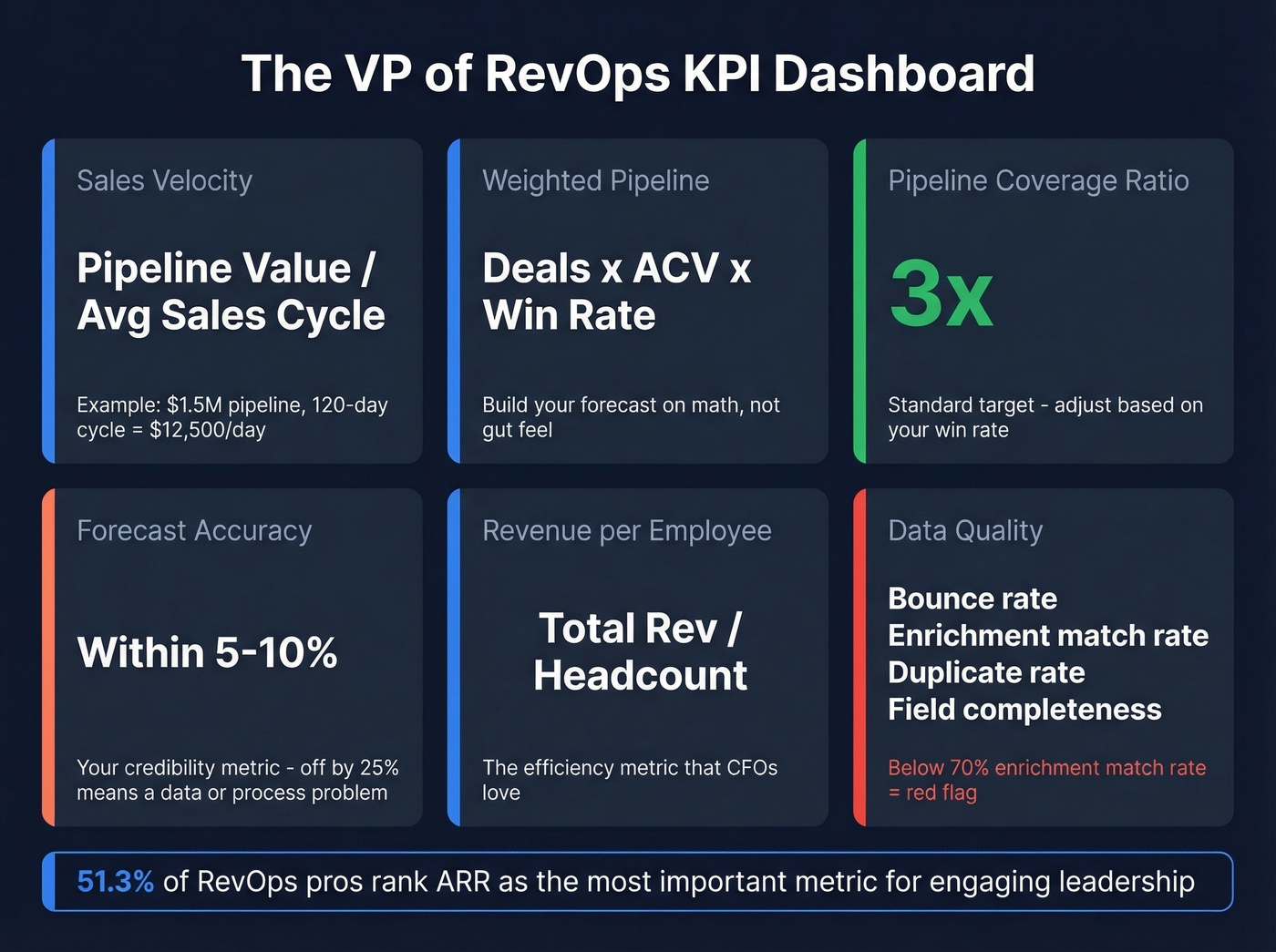
Here are the metrics that should be on your dashboard from day one.
Sales Velocity
This is the single most useful operational metric. The simplified formula: Pipeline Value / Average Sales Cycle Length = revenue per day. The full version factors in number of opportunities, average deal value, and win rate separately - use whichever version your team can actually maintain. If you've got $1.5M in pipeline and a 120-day cycle, you're generating roughly $12,500/day. Every process improvement you make should move that number.
Weighted Pipeline and Coverage
Weighted Pipeline Value accounts for stage probability: Number of Deals x ACV x Win Rate. This is what your forecast should be built on - not gut feel from sales managers. Pipeline Coverage Ratio tells you whether you have enough pipeline to hit quota. 3x is the standard target, but the right number depends on your win rate and deal velocity.
Forecast Accuracy
This is your credibility metric. If you're consistently within 5-10% of actual, the board trusts you. Off by 25%? You've got a data problem or a process problem. Probably both.
Efficiency and Data Quality
Revenue per Employee is the efficiency metric that CFOs love. Total revenue divided by headcount. Simple, but it keeps you honest about whether you're scaling efficiently.
Data quality metrics are leading indicators that predict everything else: bounce rate on outbound emails, enrichment match rate on CRM records, duplicate rate, and field completeness. In our experience, teams that track enrichment match rate as a KPI catch data decay weeks before it shows up in pipeline numbers. If your enrichment provider returns below 70%, that's a red flag - your downstream reporting, routing, and forecasting are built on sand.
The RevOps Tech Stack
Your tech stack is only as good as the data flowing through it. We've seen teams with $200K in annual tool spend still running sequences off stale email lists. Start with data quality, then build outward.
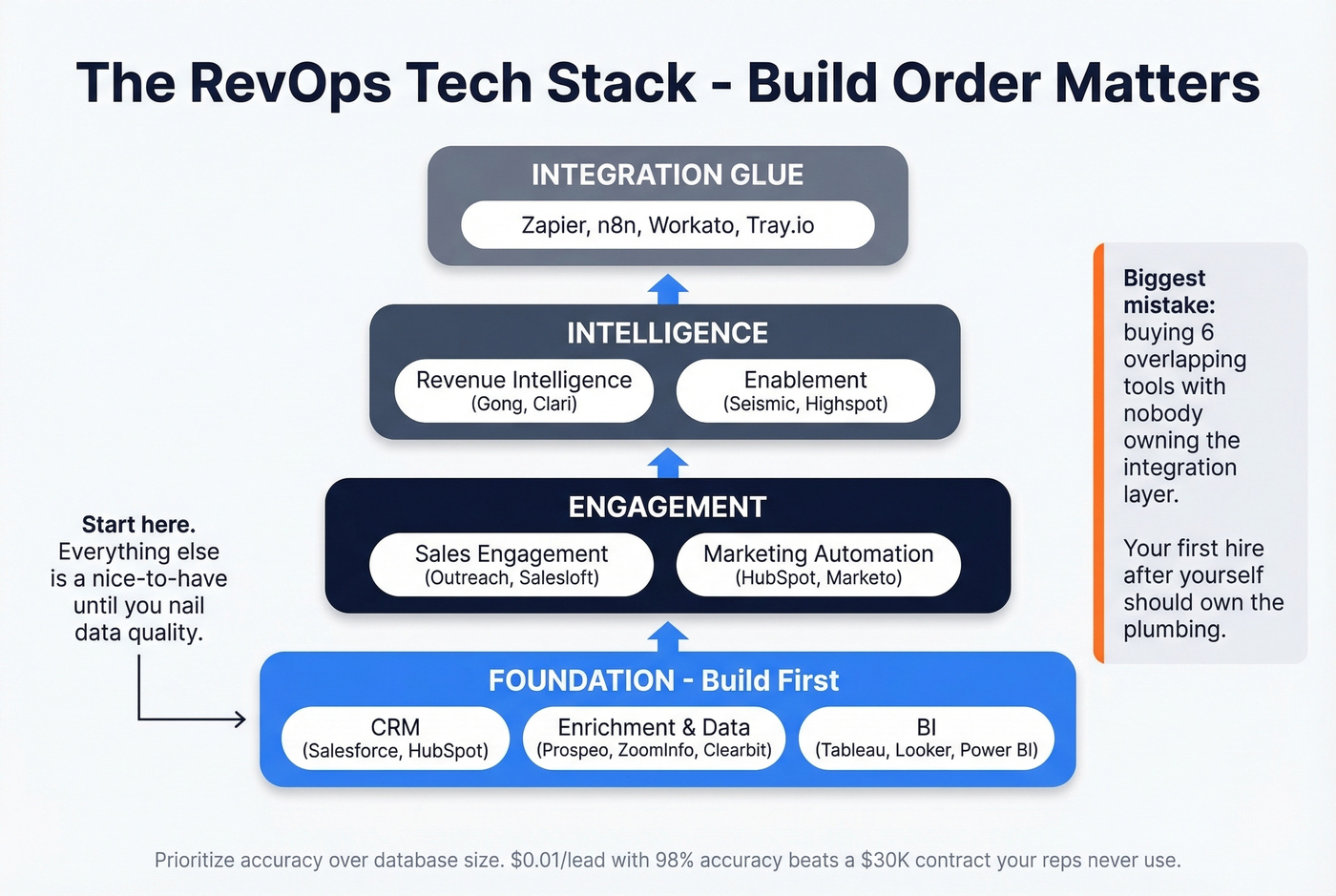
| Category | Tools | Notes |
|---|---|---|
| CRM | Salesforce, HubSpot | Non-negotiable foundation |
| Marketing Automation | HubSpot, Marketo | Match to CRM ecosystem |
| Sales Engagement | Outreach, Salesloft, Chili Piper | Pick one, commit |
| Enrichment & Data | Prospeo, ZoomInfo, Clearbit | Data accuracy > database size |
| Revenue Intelligence | Gong, Clari | Forecasting + call insights |
| BI | Tableau, Looker, Power BI | Unified reporting layer |
| Integrations | Zapier, n8n, Workato, Tray.io | Glue between systems |
| Enablement | Seismic, Highspot | Content + training delivery |
The build order matters. Start with CRM, enrichment, and BI - everything else is a nice-to-have until you nail data quality.
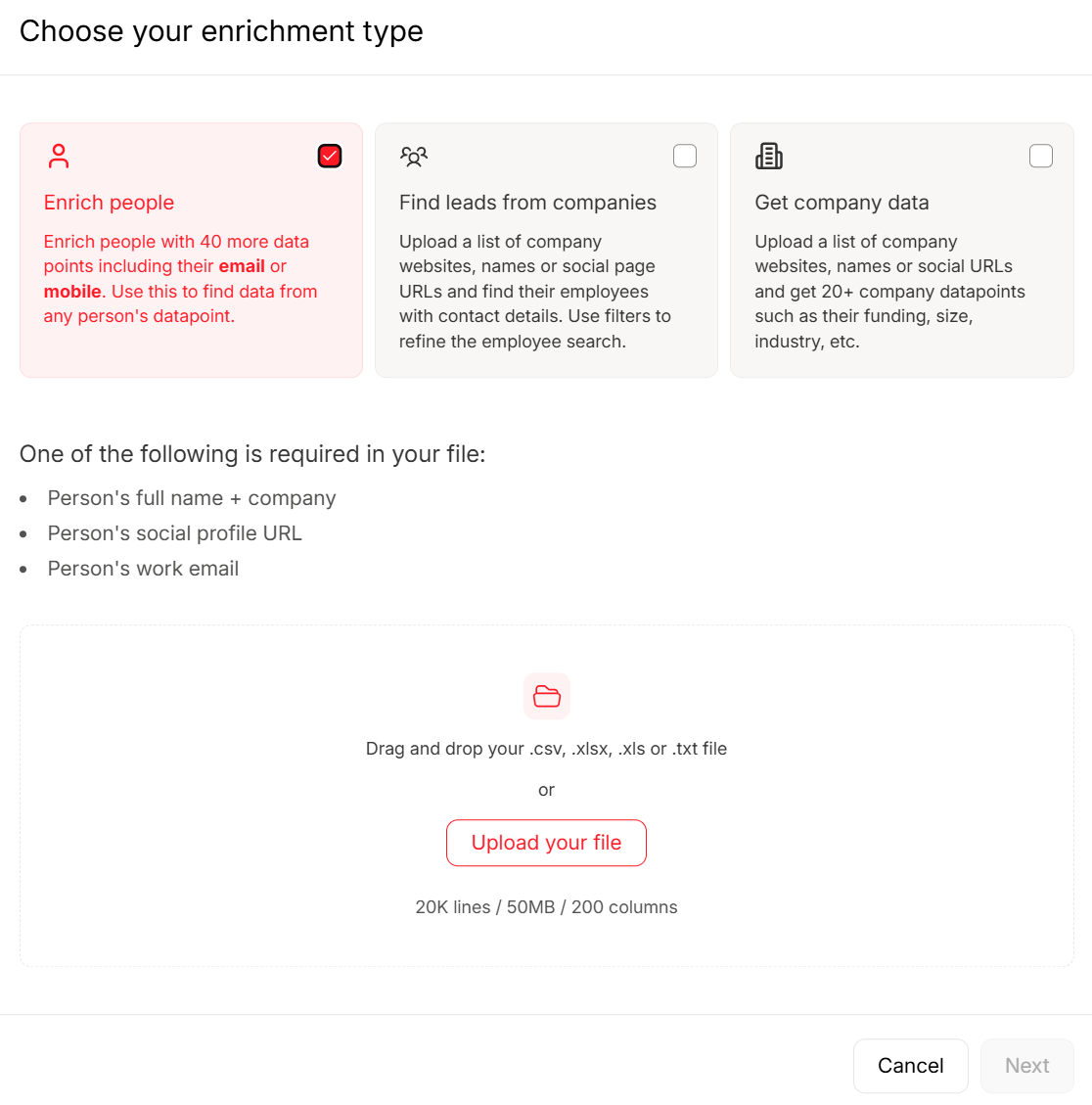
Let's be honest: most companies between $10M and $50M ARR don't need a $30K+ annual enrichment contract. A self-serve platform with high accuracy and a fast refresh cycle will outperform a bloated enterprise data provider that your reps barely log into. At that stage, you're better off spending $0.01/lead on a tool with 98% email accuracy and a 7-day refresh cycle, then redirecting the savings toward a BI tool or an extra analyst.
The biggest tech stack mistake isn't picking the wrong tool. It's buying six tools that overlap and having nobody own the integration layer. Your first hire after yourself should be someone who can build and maintain the plumbing between these systems.
The First 90 Days
Most 90-day plans fail because they list activities instead of outcomes. Here's a framework built around measurable results at each stage.
Days 1-30: Listen and Baseline
Objective: Understand the current revenue machine before trying to fix it.
Run a listening tour - 1:1s with every Sales, Marketing, and CS leader. Shadow at least 5 sales calls and 2 CS QBRs. You'll learn more in those conversations than in any dashboard. I've watched new VPs skip this step and spend months solving the wrong problems.
Audit the tech stack and every integration. Document what's connected, what's broken, and what nobody uses. Simultaneously, gather funnel baselines: conversion rates by stage, pipeline by source, win rate, average deal size, sales cycle length, churn rate. If these numbers don't exist in one place, that's your first finding.
Run your existing contact database through an enrichment audit to baseline data quality. It's common to find 30-40% of records are stale - now you have the numbers to justify a data hygiene initiative.
Deliverable: A single document showing current-state metrics, tech stack map, and the three biggest revenue leaks.
Days 31-60: Diagnose and Charter
Objective: Identify the highest-leverage fix and establish your mandate.
Find the biggest stage drop-off in your funnel. Is it MQL-to-SQL? SQL-to-opportunity? Opportunity-to-close? That's where you focus first. Write a RevOps charter that defines scope, ownership boundaries, and collaboration agreements with Sales, Marketing, and CS leadership. Get it signed off by the CRO or CEO.
Run a CRM data quality audit - field completeness, duplicate rate, record age. Present the results to leadership with a cost estimate of bad data: bounced emails, wasted rep time, inaccurate forecasts.
Outcome: RevOps charter approved. One funnel bottleneck identified with a proposed fix and projected impact.
Days 61-90: Deliver and Set the Rhythm
Objective: Ship a quick win and establish the operating rhythm.
Execute the fix you identified in month two. Measure the before/after impact on the specific metric you targeted. Present data-backed recommendations to leadership - not a slide deck of ideas, but results from the work you've already done.
Set quarterly OKRs for the RevOps team, tying every objective to a revenue outcome rather than an activity metric. The operating rhythm you establish here - weekly pipeline reviews, monthly forecast syncs, quarterly business reviews - becomes the heartbeat of the entire revenue organization. Get this right and you won't have to fight for budget next year; the numbers will speak for themselves.
Deliverable: One measurable improvement shipped. Quarterly OKRs published. Board-ready revenue dashboard live.
A VP of RevOps is only as effective as the data flowing through their tech stack. Prospeo enriches your CRM with 50+ data points per contact at a 92% match rate - so your pipeline numbers finally match reality across Sales, Marketing, and CS.
Stop reconciling three dashboards. Enrich your CRM with data you can trust.
How to Get (or Fill) This Role
Career Path
The fastest route to VP of revenue operations runs through Sales Ops Manager, then Director of RevOps, then VP. Most people who land the title have 8-12 years of experience across ops, analytics, and at least one go-to-market function.
For teams hiring at earlier stages, match the role to your company's maturity. Series A companies with 25-50 employees and 5+ sales reps should hire a RevOps Manager at $100K-$160K). Series B and beyond can justify a Director at $146K-$273K total comp. The VP title makes sense once you're past $50M ARR and the team is 8+ people. Skip this progression and you'll end up with an expensive hire who doesn't have the infrastructure to succeed.
One distinction worth making: RevOps and GTM Engineering are converging but aren't the same thing. A GTM Engineer is a technical automation builder - they wire systems together. A revenue operations VP is a strategic orchestrator who happens to understand the technical layer. You need both, but don't confuse them in your job description.
Hiring the Right Person
Interview questions that actually reveal capability, pulled from real Glassdoor submissions:
- "What have you done to make sure salespeople hit targets?"
- "Where would you start if you had to take the job tomorrow?"
- "Describe the steps you took to eliminate bottlenecks in quote-to-cash."
- "What did you enjoy most and least about building a RevOps department from scratch?"
Red flags in candidates: a perfect project history with no failures (they're either lying or haven't taken real risks), certification obsession over practical results, and defensive responses when you push back on their methodology. The best candidates can articulate what they got wrong and what they'd do differently.
FAQ
What's the difference between VP of RevOps and VP of Sales Ops?
VP of Sales Ops owns sales-specific processes - territories, comp plans, CRM hygiene, pipeline reporting. A VP of revenue operations orchestrates across Sales, Marketing, and Customer Success with unified data, shared KPIs, and cross-functional process design. The reporting line is higher (CRO or CEO), and the mandate is company-wide revenue growth rather than one department's efficiency.
When should a company hire its first RevOps VP?
Most companies hire once they pass ~$50M ARR, when cross-functional alignment becomes a genuine bottleneck and the function needs to operate as a department. Before that, a Director or RevOps Manager at $100K-$160K usually handles the scope - and you'll get better candidates because the role won't feel like all title and no team.
Does RevOps leadership belong in the C-suite?
Increasingly, yes - especially once the function owns the forecast, the tech stack budget, and cross-functional process design. More companies are creating a Chief Revenue Operations Officer title or giving the VP a direct seat at the executive table. The trigger is scale: when the scope is executive-level work, the reporting line should match.
What tools should a new RevOps leader evaluate first?
Start with three: a CRM you'll actually maintain (Salesforce or HubSpot), a data enrichment platform with high accuracy and a fast refresh cycle, and a BI layer like Looker or Tableau. Everything else comes after data quality is solved - bad data makes every other tool in your stack less effective.