

Website Visitor Tracking: Best Tools, Honest Match Rates & What Works in 2026
98% of your website visitors leave without filling out a form, clicking a demo button, or doing anything that tells you who they are. Your Google Analytics dashboard - running on 50.3% of the top million sites - shows you aggregate pageviews and bounce rates. It can't tell you that the VP of Engineering at a Series C fintech company just spent 11 minutes on your pricing page.
That's the gap. And it's where website visitor tracking splits into two distinct categories: behavior analytics (what people do on your site) and B2B identification (who those people actually are).
Our Picks (TL;DR)
| Use Case | Top Pick | Why |
|---|---|---|
| UX & behavior analytics | Microsoft Clarity | Free, unlimited, AI insights |
| B2B visitor ID (SMB) | Leadinfo | 35-40% EU match, cookieless, from €49/mo |
| Person-level ID (US) | RB2B | Names, titles, emails, free tier |
| Contact data & enrichment | Prospeo | 98% email accuracy, $0.01/email |
Clarity tells you what visitors do. Leadinfo or RB2B tells you which companies or people visited. Prospeo gives you verified emails and direct dials to actually reach the decision-makers at those companies. Most teams need one tool from each row - not all four.
How Visitor Tracking Works
Not all tracking is created equal. Four core methods exist, and each reveals different data at different compliance costs.
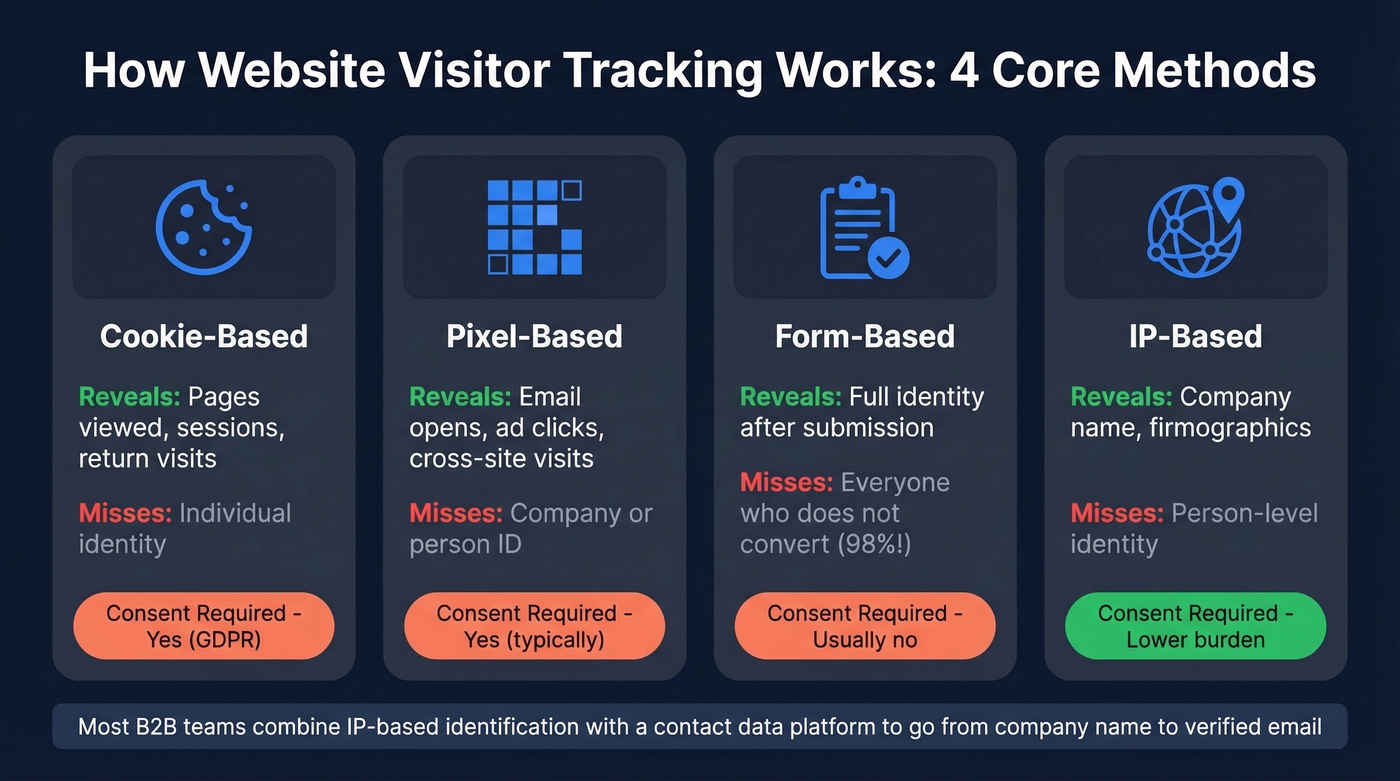
| Method | What It Reveals | What It Misses | Consent Required? |
|---|---|---|---|
| Cookie-based | Pages viewed, sessions, return visits | Individual identity | Yes (non-essential cookies under GDPR) |
| Pixel-based | Email opens, ad clicks, cross-site visits | Company/person ID | Yes (typically) |
| Form-based | Full identity after submission | Everyone who doesn't convert | Usually no cookie consent for the form itself |
| IP-based | Company name, firmographics | Person-level identity | Lower burden |
Cookie-based tools like GA4 and Hotjar give you the richest behavioral data, but they require consent banners and lose visitors who opt out or clear cookies. IP-based tracking matches visitor IP addresses against business databases to identify the company - no cookies needed, which means lower consent friction. The tradeoff: IP tracking can't tell you who at that company visited, just that someone from Acme Corp did.
Under ideal conditions with on-premise corporate networks, IP-based matching hits 70-80% accuracy for B2B traffic. That number drops fast with remote workers on residential ISPs. First-party tracking on your own domain carries significantly less regulatory risk than third-party tracking from ad networks following users across sites, which is why most B2B teams layer IP-based identification with a contact data platform to get from "Acme Corp visited" to "here's the VP of Sales's email."
Best UX & Behavior Analytics Tools
Microsoft Clarity
Use this if you want heatmaps, session recordings, and rage-click detection without paying a dime. Clarity is free - genuinely, permanently free - with AI summaries that surface patterns across thousands of sessions you'd never catch manually.
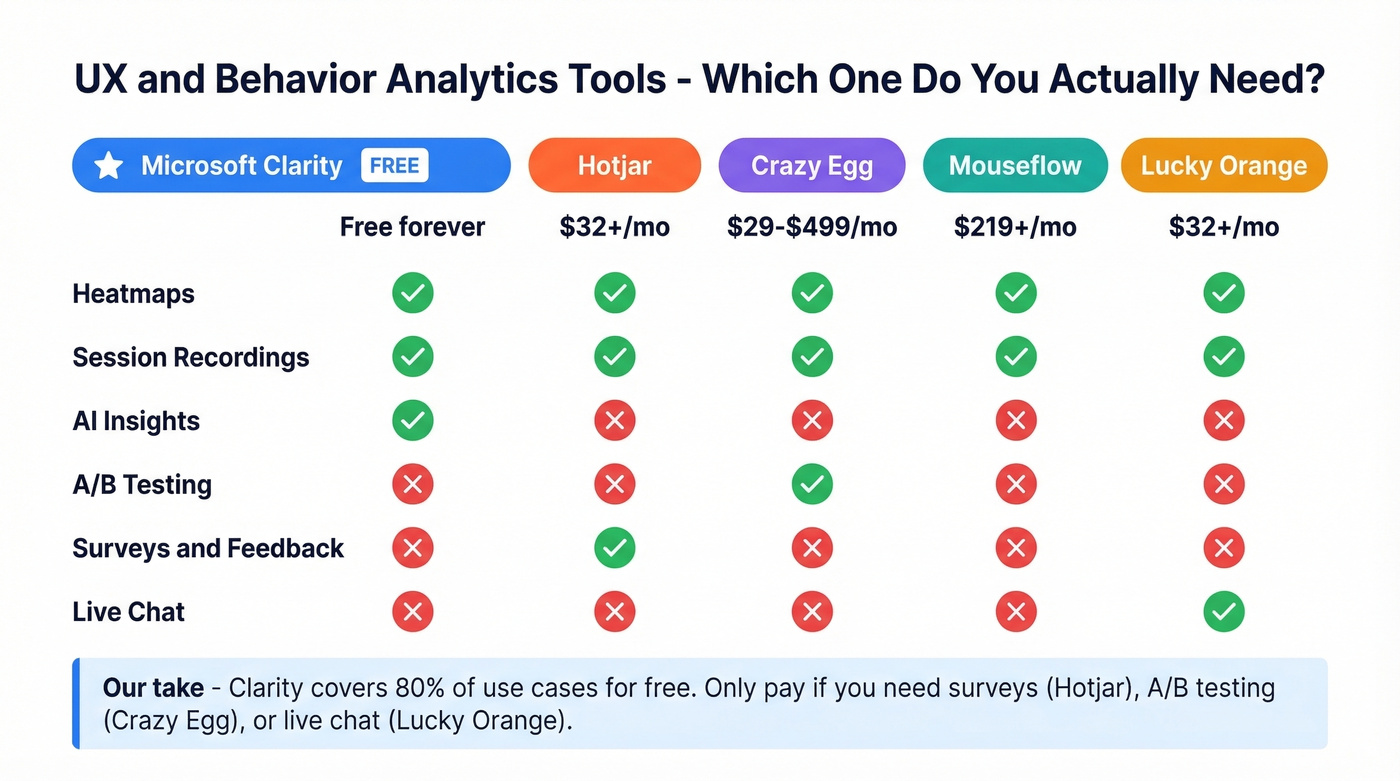
Skip this if you need long-term session recording retention or built-in A/B testing. Clarity retains session recordings for 30 days and heatmaps for up to 13 months. That's fine for ongoing optimization but not a replacement for a dedicated experimentation platform.
Here's the thing: Clarity killed the paid heatmap market for about 80% of use cases. Unless you specifically need A/B testing, surveys, or long-term retention, there's no reason to pay for a behavior analytics tool anymore. We've used it across multiple client sites and the AI-generated session summaries alone save hours of manual review.
Hotjar
Use this if you need qualitative feedback alongside heatmaps. Hotjar's surveys, feedback widgets, and user interviews are the real differentiator - not the heatmaps, which Clarity now matches for free. The free tier covers basic usage; paid plans start around $32/mo.
Skip this if you only need heatmaps and session recordings. You'd be paying for survey features you might not use.
Crazy Egg
Crazy Egg is the pick when you need built-in A/B testing with a visual editor. The WYSIWYG experiment builder lets non-developers run tests directly on live pages, which is a real advantage for marketing teams without engineering support. Plans run $29-$499+/mo depending on pageview volume, with unlimited retention on paid plans. If you already use a dedicated testing tool like VWO or Optimizely, Crazy Egg's main differentiator disappears.
Mouseflow & Lucky Orange
Mouseflow starts at $219/mo and targets mid-market teams that need deeper funnel analytics beyond what Clarity offers. Lucky Orange starts at $32/mo and bundles live chat with session recordings - a niche combo for e-commerce teams that want to watch visitors struggle and intervene in real time. Both are solid but situational.
| Tool | Price | A/B Testing | AI Insights | Best For |
|---|---|---|---|---|
| Clarity | Free | ✗ | ✓ | Most teams |
| Hotjar | Free-$100+/mo | ✗ | ✗ | Surveys + feedback |
| Crazy Egg | $29-$499+/mo | ✓ | ✗ | Native A/B testing |
| Mouseflow | From $219/mo | ✗ | ✗ | Funnel analytics |
| Lucky Orange | From $32/mo | ✗ | ✗ | E-commerce + chat |
Best B2B Visitor Identification Tools
This is where the real revenue impact lives. Behavior analytics tells you what happened. B2B identification tells you who it happened to.
RB2B
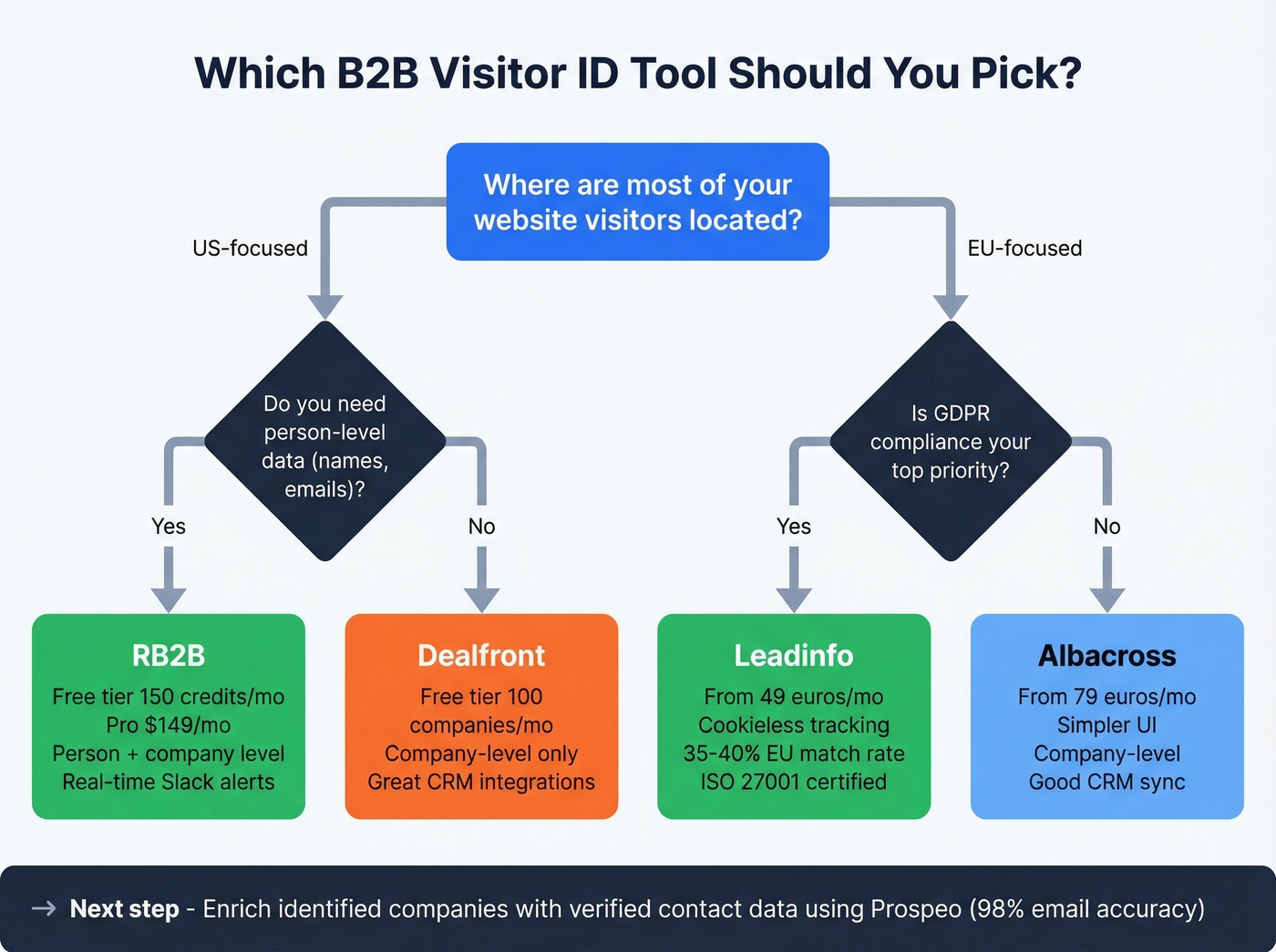
Use this if you sell primarily into the US and want person-level identification - actual names, job titles, and emails, not just company names. RB2B's real-time Slack alerts are addictive; your sales team sees "a buyer just viewed your pricing page" pop up in a channel, and they can act within minutes. The consensus on r/sales is that these Slack notifications alone justify the tool for high-ACV teams.

The free tier gives you 150 credits/month. Pro+ runs $149/mo for 300 credits. For global company-level identification, RB2B bundles Demandbase integration on paid plans, with 70-80% combined resolution.
Skip this if your market is primarily Europe or APAC. Person-level identification is US-only. International visitors get company-level data through the Demandbase layer, but you won't get individual names and emails outside the US.
Leadinfo
Use this if you're selling into European markets and need GDPR-compliant identification without cookie consent headaches. Leadinfo runs cookieless - no cookie banner required for the identification itself. They hit 35-40% identification rates in EU markets, which is strong for IP-based tracking.
EU-only hosting in Ireland and Frankfurt data centers, ISO 27001:2022 certification, 70+ integrations, and setup takes under 5 minutes. Pricing starts at €49-69/mo for 100 identified visitors, scaling to €499/mo for 10,000.
Skip this if your traffic is primarily US-based. American tools like RB2B will give you better domestic coverage.
Dealfront (Leadfeeder)
The free starting point. Dealfront's free plan covers 100 identified companies per month with 7-day data retention, which is enough to test whether visitor identification is worth investing in for your traffic volume. Paid plans run €99-€1,199/mo depending on volume, with deep Salesforce and HubSpot integrations.
Strong CRM sync and global coverage, but paid plans get expensive fast relative to what you get. You're still stuck at company-level data with no person-level identification.
Lead Forensics
Lead Forensics has been in the IP-matching space for years and has a large database. It's a fine enterprise tool. But the fact that they won't publish pricing in 2026 is a red flag - in our experience, that usually means the price is hard to justify once you see what competitors charge for similar IP matching. Expect €1,000+/mo with annual commitments and dedicated account management. For enterprise teams with budget to spare who need white-glove support, it works. Everyone else should look elsewhere.
Albacross vs. Leadinfo
Albacross is Leadinfo's closest competitor in Europe. The self-service tier runs €79/mo, with paid tiers from €199/mo. Decent CRM integrations and a clean interface, but company-level only. If you're choosing between the two, Leadinfo wins on match rates in EU markets and cookieless compliance. Albacross is the pick if you prefer a simpler UI and don't need the highest possible identification rate.
Breeze Intelligence, Apollo & Visitor Queue
Breeze Intelligence starts at $45/mo for 100 credits but requires a HubSpot subscription. If you're already in the HubSpot ecosystem, it's a natural add-on. Otherwise, skip it.
Apollo offers visitor tracking as part of its broader sales platform. Free tier available, paid plans $49-$119/user/mo. The visitor identification is a feature, not the product - useful if you're already on Apollo, not worth switching for.
Visitor Queue runs $31-$2,299/mo and targets SMBs that want simple, affordable company-level identification without enterprise complexity.
| Tool | Price | ID Type | Coverage | Best For |
|---|---|---|---|---|
| RB2B | Free-$149+/mo | Person + company | US (person) | US person-level |
| Leadinfo | €49-€499/mo | Company | EU-focused | EU compliance |
| Dealfront | Free-€1,199/mo | Company | Global | Free starting point |
| Lead Forensics | €1,000+/mo | Company | Global | Enterprise IP matching |
| Albacross | €79+/mo | Company | EU-focused | EU mid-market |
Realistic Match Rates
Let's be honest - vendors won't tell you these numbers, so we will.
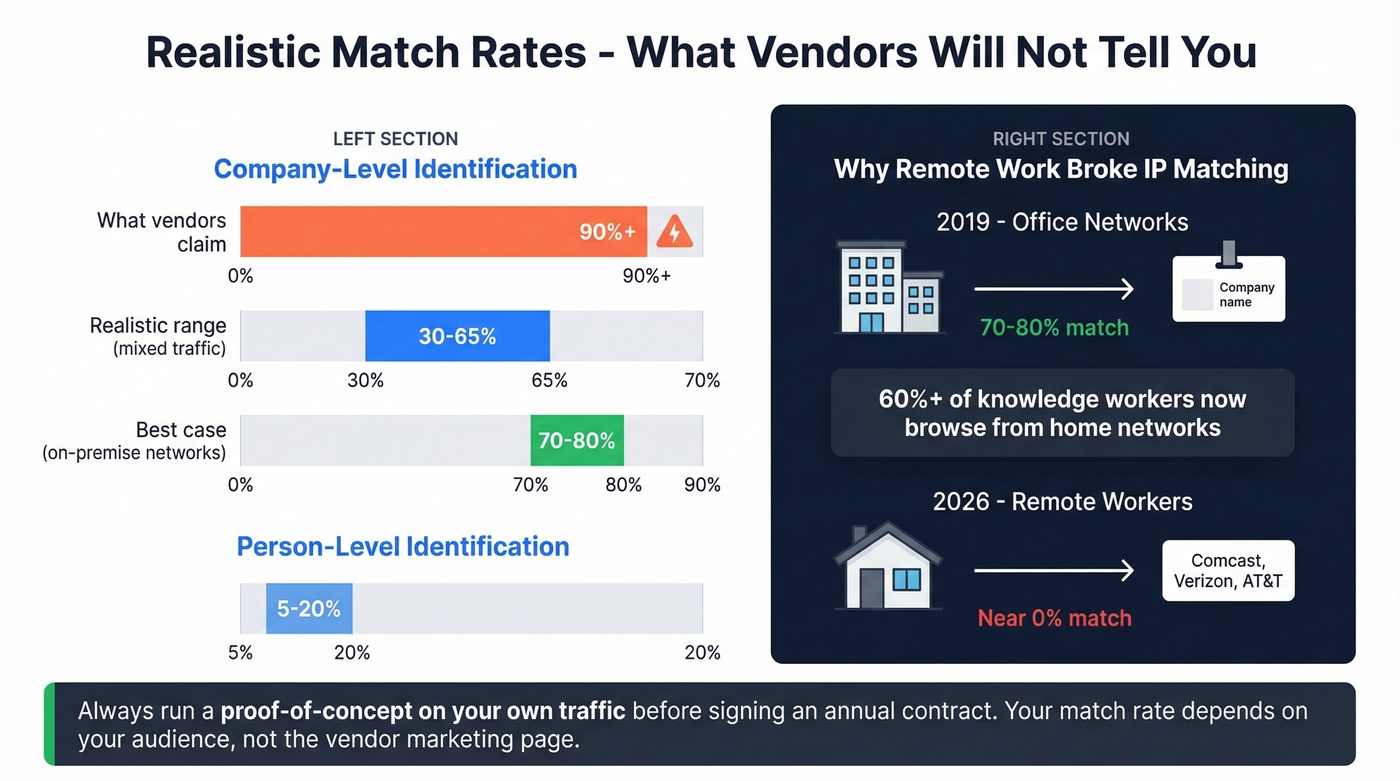
Company-level identification typically lands between 30-65% of your B2B traffic. Person-level identification runs 5-20%. Anyone claiming 90%+ match rates is inflating. The highest realistic company-level rates top out around 60-70%, and that requires combining multiple data sources.
Remote work has made this worse. Over 60% of knowledge workers browse from home networks, which means their IP address resolves to Comcast or Verizon instead of their employer. IP-based matching hits 70-80% accuracy under ideal conditions with on-premise corporate networks but drops to near-zero for remote workers on residential ISPs. That's why "clean" identification rates matter more than raw rates - you need to exclude ISP matches from AT&T, Verizon, and residential providers that tell you nothing useful.
EU-focused tools like Leadinfo hit 35-40% in European markets because European business IP databases are better maintained. US tools tend to perform better domestically. The takeaway: always run a proof-of-concept on your own traffic before signing an annual contract. Your match rate depends on your audience, not the vendor's marketing page.
One more thing: if your average deal size is under $5K, you probably don't need visitor identification at all. The math doesn't work - you'll spend more on identification credits and SDR time than you'll close. Focus on conversion rate optimization with Clarity instead, and save visitor ID for when your ACV justifies the outbound motion.

Knowing that Acme Corp visited your pricing page is step one. Reaching the VP who made that visit is step two. Prospeo turns company-level visitor data into 98% accurate emails and verified direct dials across 300M+ profiles - at $0.01 per email.
Stop tracking visitors. Start booking meetings with them.
Privacy-First & Self-Hosted Options
For teams that want analytics without sending data to a third party, the self-hosted space has come a long way. All of these are cookie-free and privacy-compliant out of the box.
Umami is the easiest to set up and collects the most complete data. Free to self-host, cloud plans from $9/mo. Plausible has a slicker UI and runs on ClickHouse under the hood - from €9/mo for cloud. Matomo offers the most features including goals, funnels, and A/B testing, but requires more setup effort; free self-hosted, cloud from ~$23/mo. Cloudflare Web Analytics is the zero-setup baseline - if your site's already on Cloudflare, it's free and requires no code changes.
None of these do B2B visitor identification. They're GA4 replacements for teams that want behavioral data without the privacy baggage.
Master Pricing Table
| Tool | Category | Starting Price | Free Tier? | Model |
|---|---|---|---|---|
| Microsoft Clarity | Behavior | $0 | Yes (full) | Free forever |
| Hotjar | Behavior | ~$32/mo | Yes (limited) | Per-session |
| Crazy Egg | Behavior | $29/mo | No | Per-pageview |
| Mouseflow | Behavior | $219/mo | Yes (limited) | Per-session |
| Lucky Orange | Behavior | $32/mo | No | Per-session |
| Umami | Behavior (self-hosted) | $0 / $9/mo cloud | Yes (self-hosted) | Per-instance |
| Plausible | Behavior (privacy) | €9/mo | No | Per-pageview |
| Matomo | Behavior (self-hosted) | $0 / ~$23/mo cloud | Yes (self-hosted) | Per-instance |
| Cloudflare Web Analytics | Behavior | $0 | Yes (full) | Free (Cloudflare users) |
| RB2B | Person-level ID | Free-$149+/mo | Yes (150 credits) | Per-credit |
| Leadinfo | Company-level ID | €49-€499/mo | No (14-day trial) | Per-visitor |
| Dealfront | Company-level ID | €99/mo | Yes (100 co./mo) | Per-company |
| Lead Forensics | Company-level ID | €1,000+/mo | No | Custom |
| Albacross | Company-level ID | €79/mo | No | Per-tier |
| Visitor Queue | Company-level ID | $31/mo | No | Per-visitor |
| Breeze Intelligence | Company-level ID | $45/mo (100 credits) | No | Per-credit + HubSpot |
| Apollo | Mixed | $49/user/mo | Yes (limited) | Per-user |
| Warmly | Enterprise ABM | $10,000-$25,000/yr | No | Annual contract |
| 6sense | Enterprise ABM | ~$60K-$120K/yr | No | Annual contract |
| Demandbase | Enterprise ABM | ~$25K-$50K/yr | No | Annual contract |
| ZoomInfo | Enterprise data | ~$15K-$40K+/yr | No | Annual contract |
Privacy & Compliance Checklist
GDPR requires explicit consent before setting non-essential cookies. That means analytics cookies, advertising pixels, and social widgets all need a "yes" before they fire. Your consent banner must include:
- Granular category choices (analytics, marketing, functional)
- No pre-ticked boxes
- Plain-language explanations of what each category does
- A visible "Reject All" button alongside "Accept All"
- An easy way to withdraw consent later via a persistent "Cookie Preferences" link
€6.6 billion in GDPR fines have been issued since 2018, averaging €2.5 million each. Regulators are increasingly targeting dark patterns - banners that make "Accept" bright green and "Reject" a tiny gray link. Your backend tracking must match your banner promises: if a visitor opts out of analytics cookies, your scripts can't fire anyway.
Cookieless IP-based tracking carries a lower consent burden because it doesn't store anything on the visitor's device. But "lower burden" doesn't mean "no burden" - check with legal counsel for your specific implementation and jurisdiction.
5 Mistakes That Break Your Tracking
Bot and spider traffic. If you're not excluding known crawlers, your identification tool is wasting credits on bots. This is the single most common source of inflated numbers we see when auditing client setups.
Ad blocker blindness. Ad blockers and privacy browsers block tracking scripts on 15-35% of sessions depending on your audience. Developer-heavy traffic skews higher. You're always undercounting.
Cookie deletion loops. When visitors clear cookies or switch devices, they appear as brand-new sessions. This inflates your "new visitor" count and breaks attribution.
Misconfigured subdomain tracking. If your cookie domain isn't set correctly, visitors moving between blog.yoursite.com and app.yoursite.com get split into separate sessions. This is one of the most common and most invisible tracking errors - I've seen teams run for months without realizing their cross-subdomain journeys were completely broken. If you're doing this, set up a dedicated tracking domain correctly from day one.
Vanity metrics without goals. If you can't answer "what will I do differently based on this data?" you're not ready for visitor tracking. Pageviews without conversion goals are just numbers on a dashboard.
Turning Visitor Insights Into Pipeline
You need a maximum of three tools. One for behavior - Clarity, it's free, just use it. One for identification - pick based on your market (RB2B for US, Leadinfo for EU, Dealfront for a free starting point). And one for contact data to bridge the gap between "Acme Corp visited" and an actual outbound sequence.
The gap between qualified and unqualified conversion rates is stark - 12% vs 2% in typical B2B scenarios. Visitor identification tools help you focus on the 12% bucket. Watch for "second chance" signals too: closed-lost accounts returning to your site, dropped pipeline re-engaging. Those are the highest-intent signals you'll find, and most teams miss them entirely - unless you build a real lead scoring model around those behaviors.
If you're turning those signals into outbound, your sequences matter as much as your data. Use proven sales follow-up templates and tighten your sales prospecting techniques so reps act fast without spamming.
Every visitor ID tool on this list stops at the same wall: a company name and maybe a job title. Prospeo picks up where they leave off - 143M+ verified emails, 125M+ mobile numbers with 30% pickup rates, refreshed every 7 days so you're never chasing stale data.
Turn anonymous traffic into pipeline for $0.01 per verified contact.
FAQ
Is website visitor tracking legal?
Yes - it's regulated, not illegal. First-party cookie tracking requires consent under GDPR before non-essential cookies fire. Cookieless IP-based tracking carries a lower consent burden since nothing is stored on the visitor's device. Match your implementation to your jurisdiction's requirements and make sure your consent mechanism actually works. €6.6 billion in GDPR fines since 2018 shows regulators are paying attention.
What's a realistic match rate for B2B visitor identification?
Company-level identification typically hits 30-65% of B2B traffic; person-level runs 5-20%. Anyone claiming 90%+ is inflating numbers - the realistic ceiling is around 60-70% using multiple data sources. Always run a proof-of-concept on your own traffic before committing to an annual contract.
When should I upgrade from free to paid tracking tools?
Start with Clarity for behavior analytics and a free-tier ID tool like Dealfront or RB2B. Upgrade when you're consistently acting on the data and need higher volume, deeper integrations, or person-level identification. If data sits in a dashboard untouched, paying more won't help.
How do I turn identified visitors into booked meetings?
Visitor ID tools give you company names - you need a contact data platform for verified emails and direct dials. The workflow: identification tool surfaces companies, you enrich with a platform like Prospeo (98% email accuracy, 125M+ verified mobiles), then route contacts into outbound sequences in Outreach, Lemlist, or Instantly.
Do I need cookie consent for IP-based tracking?
Generally no - IP-based company identification without cookies typically doesn't require a cookie banner because nothing is stored on the visitor's device. IP addresses do qualify as personal data under GDPR, though, so you still need a legal basis for processing. Consult legal counsel for your specific jurisdiction.