

What Does a BDR Do? The Data-Backed, No-BS Guide
A RevOps lead we know ran a hiring debrief last quarter. The top candidate asked, "So what does a BDR actually do all day?" The hiring manager paused for five full seconds. That pause tells you everything about how poorly this role gets explained - even by the people hiring for it.
What Is a BDR?
A BDR - business development representative - is the outbound prospecting engine that books meetings for closers. The role centers on identifying potential buyers, starting conversations through cold outreach, and handing qualified opportunities to account executives who run the deal. It's the most common entry point into B2B tech sales, and the Bureau of Labor Statistics projects steady demand for sales roles through the decade.
Here's the number nobody puts in the job posting: only 57.3% of BDRs actually hit quota. Median OTE sits around $85k, but with nearly half the field missing target, the real median take-home is closer to base plus partial variable - not the shiny number recruiters wave around.
Quick Version
A BDR initiates outbound contact - calls, emails, social touches - to book meetings for account executives. Expect roughly 21 touches per prospect spread across 53 days before you book or move on. Median OTE is ~$85k, but only 57.3% hit quota, so go in with realistic expectations about rejection volume and ramp time. It's still the best entry point into tech sales if you pick a company that actually invests in developing reps.
What Do BDRs Do All Day?
Forget the job description. Here's what the day actually looks like.
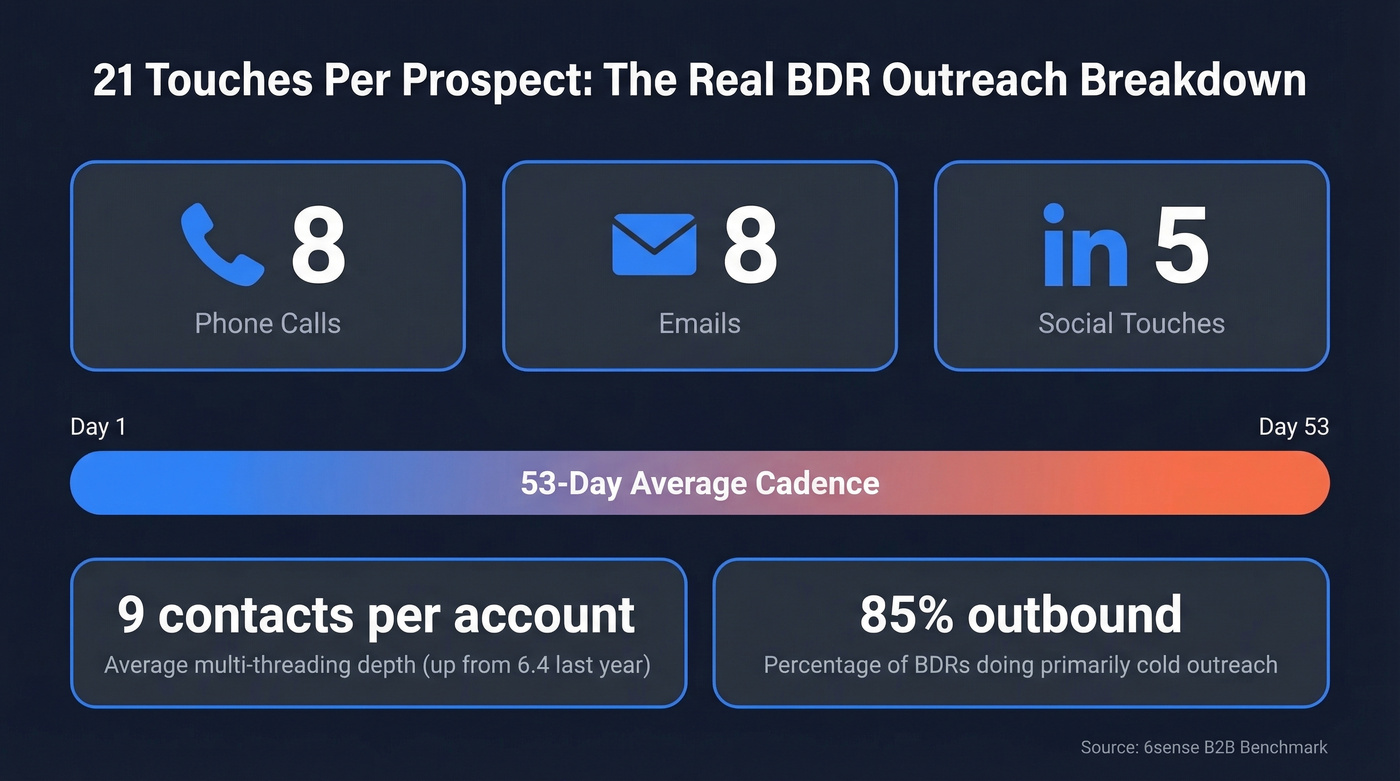
You show up, open your CRM, and start working a list. 85% of BDRs are primarily or exclusively outbound, which means you're the one initiating contact - not waiting for inbound leads to roll in. A typical day involves 30-80 calls, 30-120 emails, and a handful of social touches depending on your sales motion and industry.
The latest 6sense benchmark paints a clear picture: the average rep makes ~21 attempts per contact before either booking a meeting or moving on. That breaks down to roughly 5 social touches, 8 calls, and 8 emails per prospect, stretched across a 53-day cadence. And 90% of BDRs are multi-threading - reaching an average of 9 contacts per account, up from 6.4 the year before. If you're only emailing one person at a target company, you're already behind.
The reps who treat it like a pure numbers game without personalization burn out fast. The ones who personalize without volume starve their pipeline. The job is disciplined repetition with strategic thinking layered on top - and finding that balance is what separates reps who get promoted from those who flame out at month six.
BDR vs SDR: Does It Matter?
Short answer: not really.
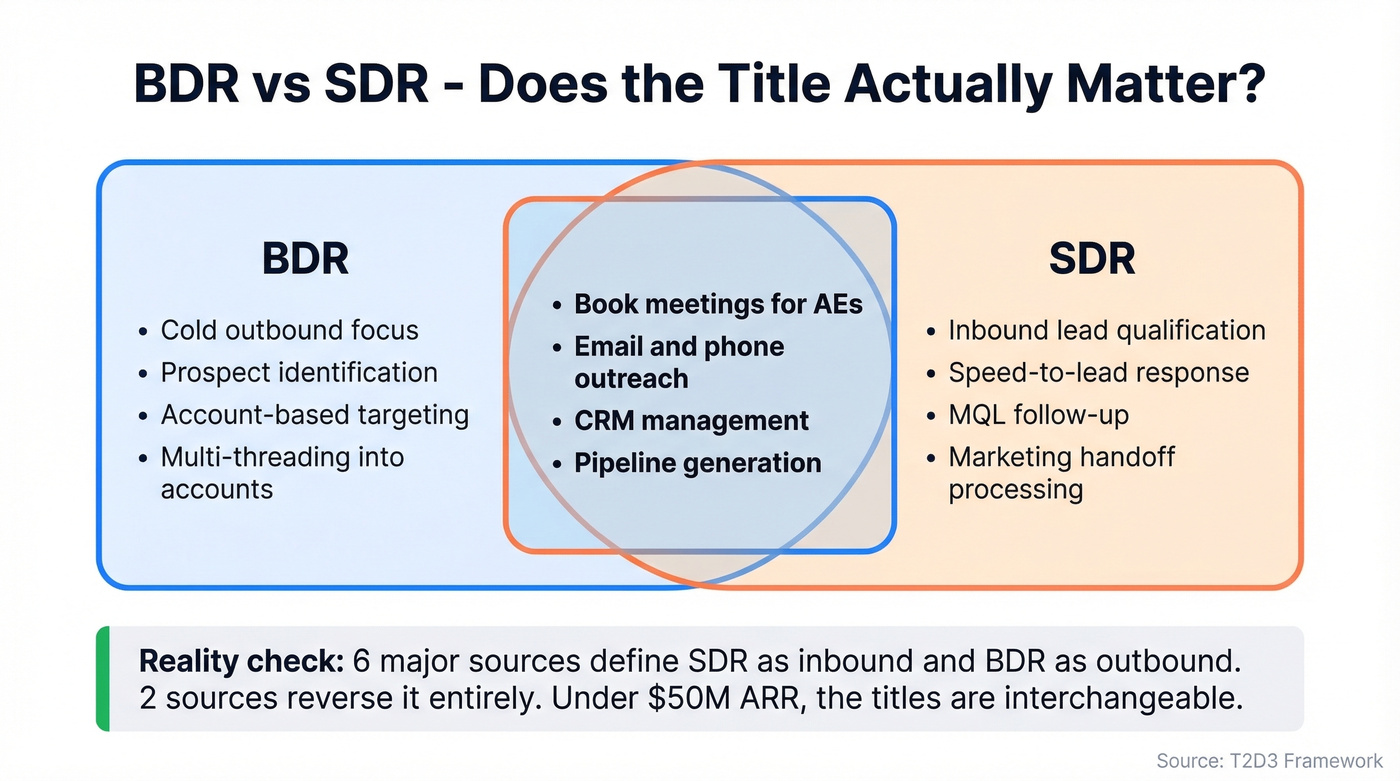
The T2D3 framework reviewed common definitions across major sales sources and found 6 defining SDR as inbound and BDR as outbound, while 2 reversed it entirely. That's the state of the industry's naming conventions - a mess.
Here's the practical rule: if your company is under ~$50M ARR, the titles are interchangeable. The person doing the job handles both inbound qualification and outbound prospecting. At larger orgs, you'll sometimes see a genuine split where SDRs qualify marketing leads and BDRs run cold outbound. Don't let a recruiter's title choice confuse you.
How Much Do BDRs Make?
OTE by Seniority
| Level | OTE Range | Base/Variable Split |
|---|---|---|
| Entry (0-1 yr) | $70k-$75k | 70/30 |
| Mid (1-3 yrs) | $80k-$90k | 65/35 |
| Senior (3-5+ yrs) | $90k-$100k+ | 60/40 |
TheQuota's RepVue-based data published here puts the median base at $60k and median OTE at $85k. Top performers clear $127,955. But remember: with only 57.3% hitting quota, the median rep earns closer to base plus partial variable.
Pay by City
| City | Annual Salary |
|---|---|
| San Jose, CA | $108,524 |
| San Francisco, CA | $108,091 |
| Washington, DC | $96,070 |
| New York, NY | $78,410 |
| Seattle, WA | $73,598 |
| Austin, TX | $57,115 |
Remote roles average $66,616 - competitive with mid-tier cities and increasingly common.
Commission Structures
Commission varies wildly by company. Activity-based plans pay $150-$200 per demo booked. Opportunity-based structures run ~$200 per sales-accepted opportunity. Revenue-based models, which are rarer for BDRs, pay 1-4% of contract value. Most entry-level reps start on activity-based comp and graduate to opportunity or revenue models as they prove out.
Here's the thing: if the comp plan is 100% activity-based with no tie to pipeline or revenue, the company doesn't trust its own product enough to bet on outcomes. That's a red flag worth walking away from.

21 touches per prospect across 53 days - that's the reality of BDR outreach. Every bounced email or wrong number resets the clock. Prospeo gives BDRs 98% verified emails and 125M+ direct dials so every touch actually reaches a real buyer, not a dead inbox.
Stop wasting touches on bad data. Hit quota with contacts that connect.
Core Responsibilities That Drive Quota
Five KPIs dominate every BDR scorecard. On average, reps hit ~88% of quota according to the latest 6sense benchmark - achievable, but not easy.
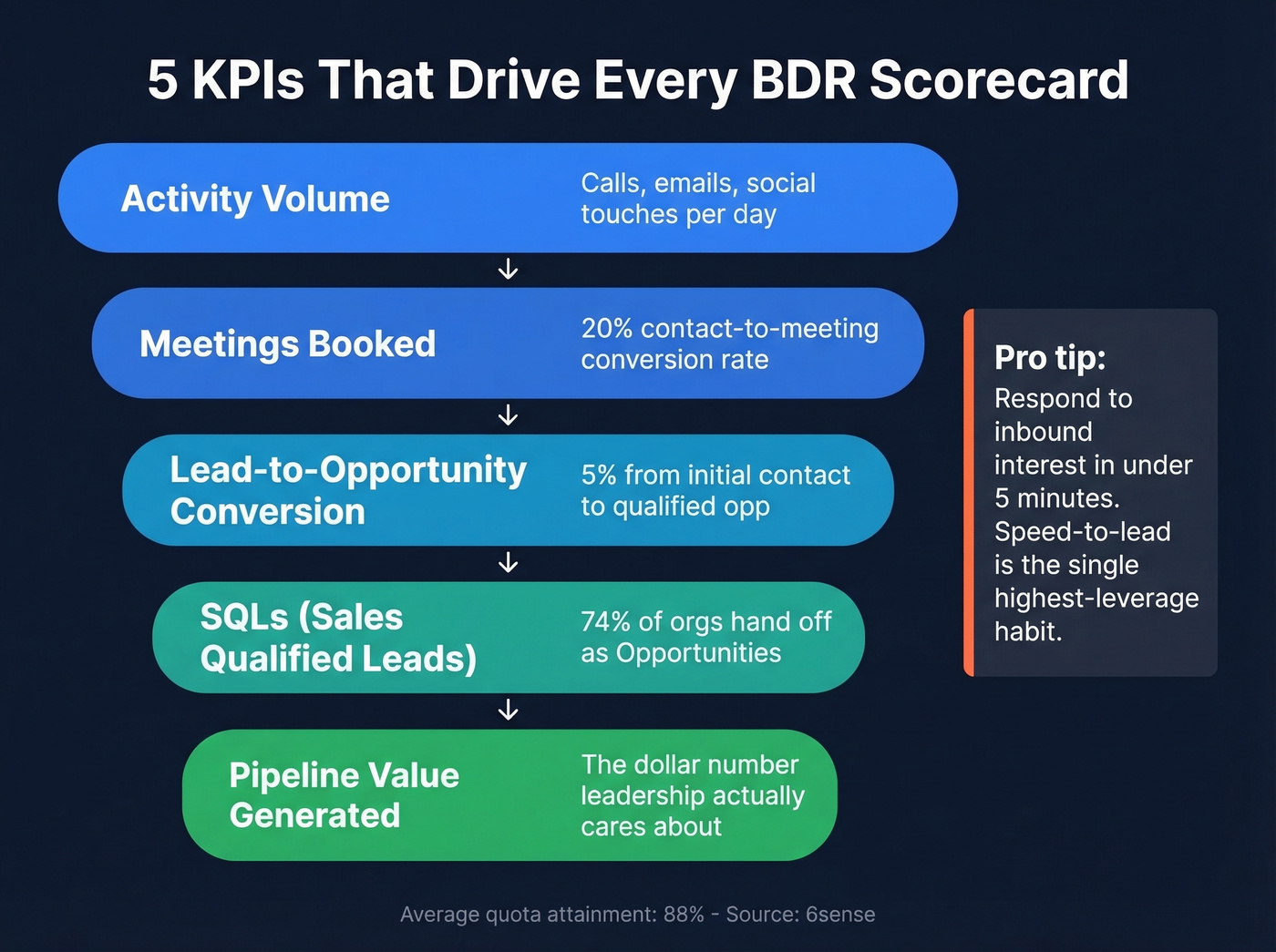
Activity volume is the leading indicator. Calls, emails, and social touches per day. In our audits of outbound teams, activity targets matter less than connect rate and meeting show rate - but if activity drops, everything downstream suffers.
Meetings booked is the core output metric. Contact-to-meeting conversion typically runs around 20% for quality conversations. Converting under 10%? The problem is usually targeting or messaging, not effort.
Lead-to-opportunity conversion measures how many of your leads become real pipeline. A 5% conversion rate from initial contact to qualified opportunity is a common benchmark, and it's the metric that separates reps who look busy from reps who actually produce.
Pipeline value generated is the dollar amount of pipeline your meetings create. This is what leadership actually cares about - and what separates reps who get promoted from those who get managed out.
SQLs are leads that pass muster with the AE team. About 74% of BDR orgs hand off prospects as Opportunities rather than raw leads. Expect to multithread - ~9 contacts per account on average - because single-threaded deals die.
One number worth knowing: responding to inbound interest in under 5 minutes dramatically increases conversion rates. The reps who treat speed-to-lead as sacred consistently outperform.
How AI Is Reshaping the Role in 2026
AI isn't replacing BDRs. It's replacing bad ones.
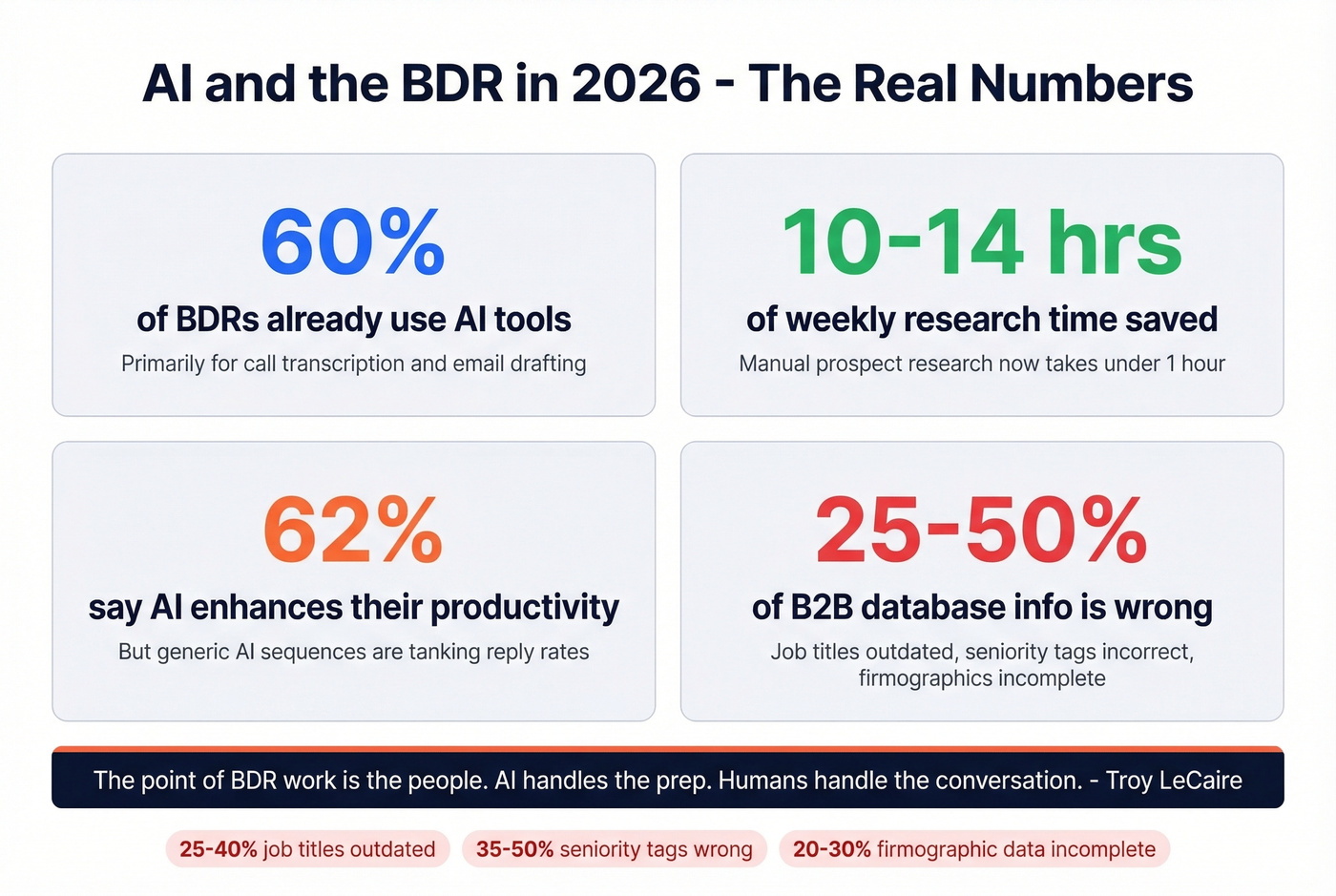
60% of BDRs already use AI tools, primarily for call transcription and email drafting. 62% say it enhances productivity. The time savings are real - manual prospect research that used to eat 10-14 hours per week now takes under an hour with the right stack.
But there's a dark side. Bain Capital Ventures calls it "AI slop" - declining email response rates driven by automation that blasts generic sequences at scale. One company they cited accidentally emailed existing customers as if they were cold leads. That's what happens when you automate without context.
The data quality problem compounds this. Estimates suggest that 25-40% of job titles in B2B databases are outdated, 35-50% of seniority tags are wrong, and 20-30% of firmographic data is incomplete. You can write the perfect AI-generated email, but if it goes to the wrong person at the wrong company, it's worthless.
As Troy LeCaire put it: "The point of BDR work is the people." AI handles the prep. Humans handle the conversation.
Tools Every BDR Needs
Your stack doesn't need to be expensive. It needs to be reliable.
| Category | Tools | Cost Range |
|---|---|---|
| CRM | HubSpot, Salesforce | Free (HubSpot); ~$25-$165+/user/mo (Salesforce) |
| Sales Engagement | Outreach, Salesloft | ~$100-$200/user/mo |
| Conversation Intel | Gong, Chorus | ~$100-$150/user/mo |
Skip ZoomInfo if you're at a startup or SMB - the $15k+ annual price tag doesn't make sense until you've got a team of 10+ reps. Apollo's free tier is generous but we've found its email accuracy (~79%) creates bounce problems that hurt your domain reputation over time.

Multi-threading 9 contacts per account means BDRs need accurate data at scale - fast. Prospeo's 300M+ profiles with 30+ filters let you build targeted lists in minutes, not the 10-14 hours reps used to spend on manual research. At $0.01 per email, even entry-level teams get enterprise-grade data.
Build your entire prospecting list before your first coffee gets cold.
Your First 30 Days on the Job
Most guides about what a BDR does skip the practical playbook. Let's fix that.
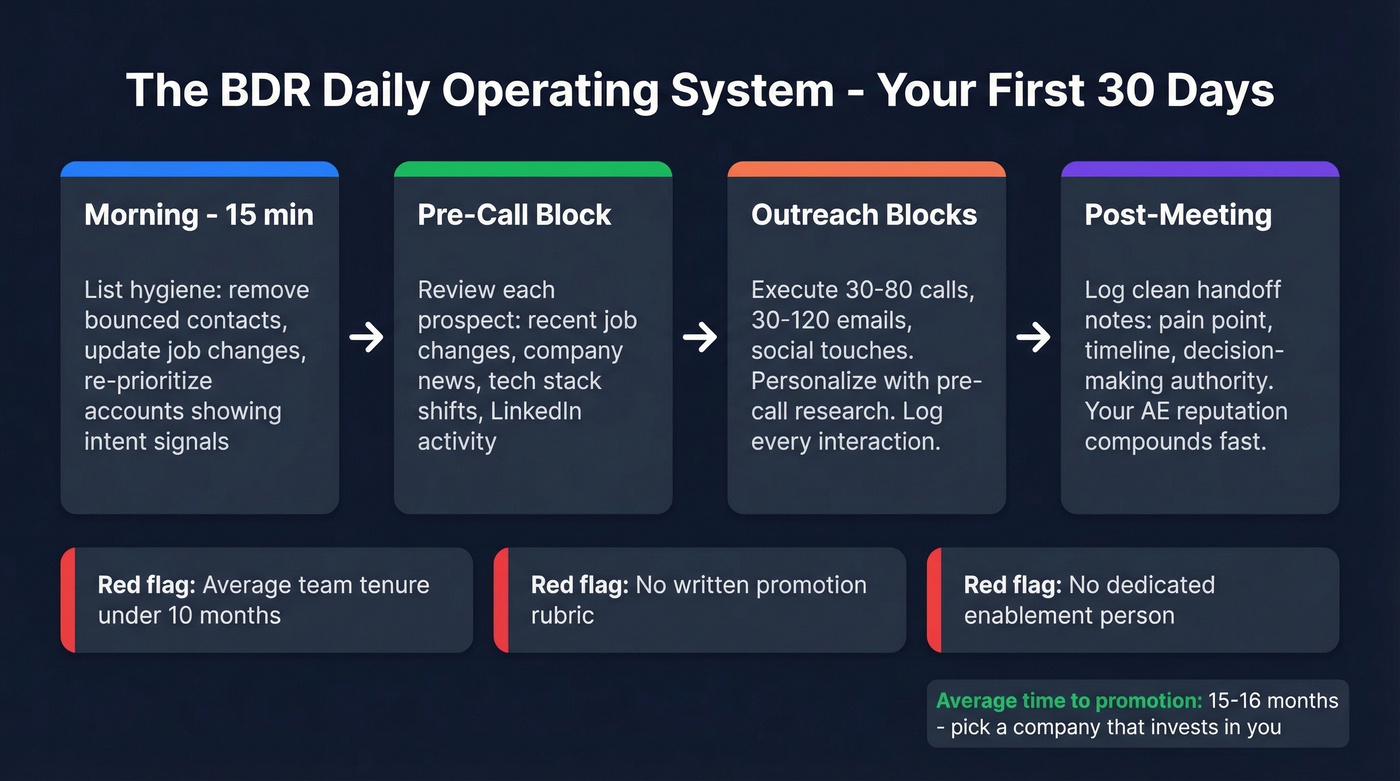
Questions to ask in your interview (to avoid churn teams):
- "What's the average tenure of your current team?" Under 10 months is a red flag.
- "What does the promotion rubric look like, and how many reps hit it last year?"
- "Who owns enablement - a dedicated person, or my manager on top of their quota?"
If the answers are vague, that company treats its outbound reps as disposable. Walk.
Daily operating system once you're in the seat:
Start each morning with 15 minutes of list hygiene - remove bounced contacts, update job changes, and re-prioritize accounts showing intent signals. Before every call block, review the prospect's recent activity: job changes, company news, tech stack shifts. After every meeting booked, log a clean handoff note in your CRM with the prospect's pain point, timeline, and decision-making authority. Your AE will remember who gives good handoffs and who doesn't. That reputation compounds faster than you'd think, and it's what gets you pulled into deals early when a promotion slot opens up.
Burnout is a real problem in this role, and promotion timelines have stretched to 15-16 months on average. Your best defense is picking a company with structured enablement and a written promotion rubric - then holding them to it.
The BDR Career Path
Let's be honest: 60% of BDRs leave within 18 months. The role has high attrition because it's high rejection, and promotion timelines have stretched 28% post-pandemic.
But the upside is significant. Supported BDRs - those with coaching, enablement, and a clear promotion path - hit 95% of quota versus 80% for unsupported reps. The ones who stick it out and get promoted to AE can realistically double their earnings within two years. A mid-market AE clearing $150k-$200k OTE isn't unusual for someone who was making $75k eighteen months earlier.
Should You Take the Job?
Take it if the company offers structured coaching, a written promotion rubric, and comp tied to pipeline - not just dials.
Avoid it if the comp plan is activity-only with no AE alignment, or if the average rep tenure is under 10 months. The consensus on r/sales is pretty clear: companies that churn through BDRs every 8 months aren't developing talent, they're grinding it up.
Choose a phone-heavy org if you want the fastest skill growth. Email-first shops teach you to write, but phone-first shops teach you to sell.
FAQ
Is BDR a good first job?
Yes - it's the best entry point into tech sales. Median OTE runs $85k with no degree requirement, and the skills transfer directly to account executive, customer success, and revenue operations roles. Expect high rejection and a 15-16 month promotion timeline. Companies with structured enablement produce dramatically better outcomes.
How many calls does a BDR make per day?
Typically 30-80 depending on the sales motion and whether you're running a phone-heavy or multi-channel cadence. The latest 6sense benchmark shows ~8 calls per contact across a 21-touch sequence. Inbound-heavy orgs skew lower; pure outbound shops push toward the higher end.
What are the main BDR responsibilities?
Prospecting into target accounts, running multi-channel outreach cadences, qualifying leads against your ICP, booking meetings for account executives, and logging clean handoff notes in the CRM. Strong reps also own their own list building, track intent signals, and collaborate with marketing on messaging.
What tools do BDRs use to find contacts?
Most teams use a data platform alongside a CRM and sales engagement tool. Prospeo offers a free tier with 75 verified emails per month and 98% accuracy - a strong starting point for new reps. ZoomInfo and Apollo are common alternatives, though ZoomInfo's ~$15k-$40k+/year price tag puts it out of reach for smaller teams and Apollo's data accuracy lags at ~79%.
Will AI replace BDRs?
No - but it's fundamentally changing the job. 60% of reps already use AI for research and email drafting, and the role is shifting from manual data gathering toward strategic conversations and relationship building. The reps most at risk are those doing purely mechanical work that automation handles better and cheaper.