

What Does C-Suite Mean? Definition, Roles, and Why It Matters
The term gets thrown around constantly in business media, job descriptions, and every other post on your feed. But what does C-suite actually mean? It's simpler than it sounds, and understanding it matters whether you're building a career, selling to executives, or just trying to decode corporate hierarchy. This is a common question on career forums and subreddits like r/NoStupidQuestions, and the answer is more interesting than a dictionary definition.
The Quick Definition
The "C" stands for "Chief." The "suite" refers to the executive suite - the company's top management group. Put them together and you get the C-suite: the group of Chief-titled executives who run an organization. Common roles include CEO, CFO, COO, CTO, CIO, CMO, CHRO, and CLO. The term originated in the 1970s and gained traction in the 1990s, though the concept of a "chief executive officer" dates back to roughly 1917.
Here's what's changed: the C-suite is expanding fast. Roles like Chief AI Officer and Chief Sustainability Officer didn't exist a decade ago and now carry real budget authority. What these executives care about in 2026 - cyberattacks, AI disruption, business model reinvention - looks nothing like the priorities of 2020.
Every C-Suite Role Explained
The composition of a company's executive team varies by industry and size, but these are the roles you'll encounter most often:
| Role | What They Own |
|---|---|
| CEO | Overall strategy, vision (reports to the Board of Directors) |
| CFO | Finance, capital allocation, risk |
| COO | Day-to-day operations |
| CTO | External-facing technology - the product, the platform |
| CIO | Internal IT systems, data architecture |
| CMO | Marketing, brand, demand generation |
| CHRO | People, culture, talent strategy |
| CLO | Legal, compliance, intellectual property |
In most companies, C-level executives report directly to the CEO. The CEO reports to the Board of Directors.
A distinction worth calling out: CTO and CIO aren't interchangeable. Per McKinsey's breakdown, the CTO owns external-facing technology - the product customers interact with. The CIO owns internal systems: enterprise software, IT infrastructure, data architecture. We've seen sales teams confuse these two roles and pitch the wrong person entirely. Some companies combine them. Most shouldn't.
One role that's quietly disappearing is the COO. In 2000, 48% of Fortune 500 companies had a COO. By 2018, that number dropped to 32%. The role isn't dying - it's being absorbed. CEOs are taking on more operational responsibility, and functional leaders like the CFO, CTO, and CHRO are picking up the slack. In many orgs, the COO title now signals "CEO-in-training" more than a permanent seat.
New C-Suite Titles in 2026
The traditional trio of CEO, CFO, and COO isn't enough anymore. As organizations get more complex, specialized leadership is moving from "nice to have" to "board mandate." Deloitte research suggests formalizing specialized C-suite ownership can improve governance agility by up to 30%. Here are the titles gaining real traction right now:
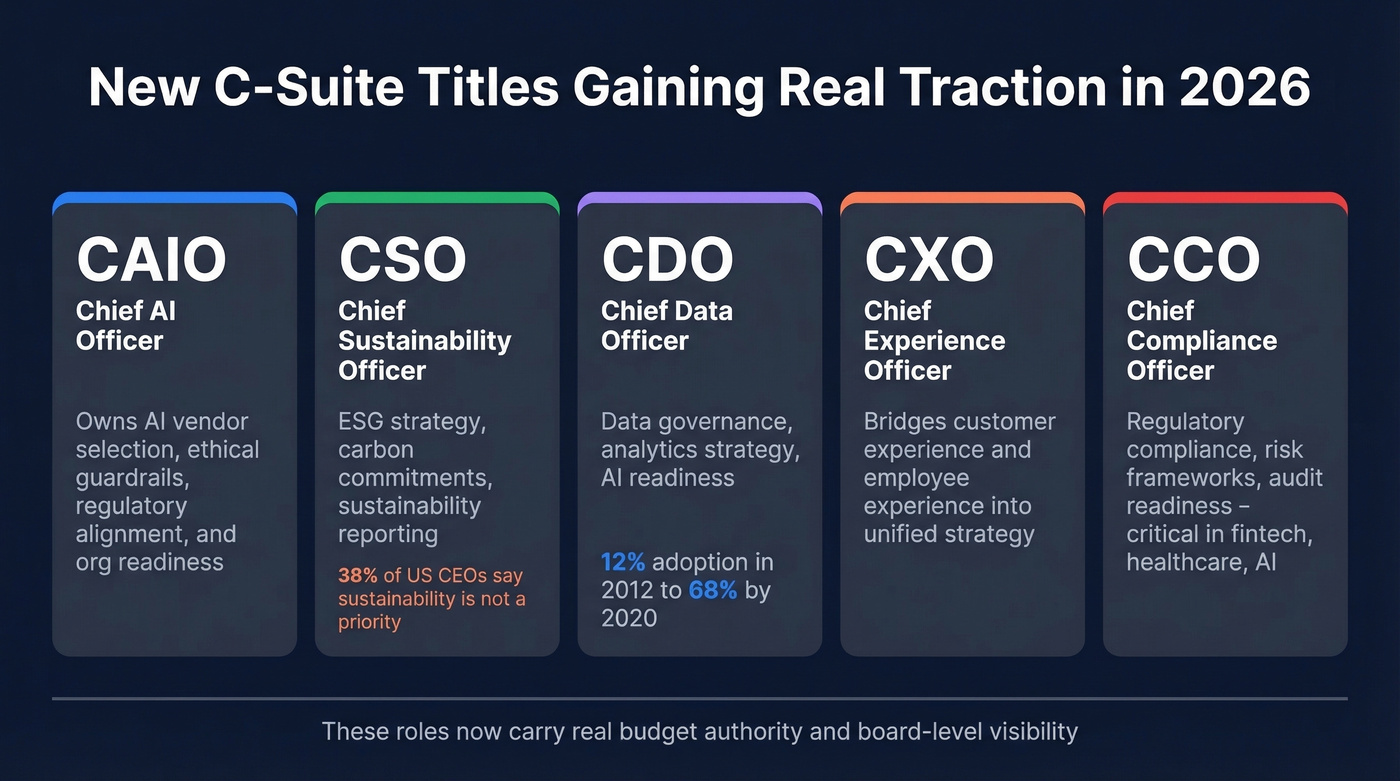
CAIO (Chief AI Officer) owns the AI agenda: vendor selection, ethical guardrails, regulatory alignment, and organizational readiness. Every c-level leader involved in digital transformation now needs to coordinate closely with this role, and the CAIO is quickly becoming the person who brokers internal consensus on where AI spending goes.
CSO (Chief Sustainability Officer) manages ESG strategy, carbon commitments, and sustainability reporting. Worth noting: 38% of US CEOs say sustainability investments aren't a priority in 2026, compared to 20% globally. The role is growing, but the mandate varies wildly by geography.
CDO (Chief Data Officer) grew from 12% adoption in 2012 to 68% by 2020. Data governance, analytics strategy, and AI-readiness all fall under this role.
CXO (Chief Experience Officer) bridges customer experience and employee experience into a unified strategy. Common in consumer-facing and SaaS companies.
CCO (Chief Compliance Officer) owns regulatory compliance, risk frameworks, and audit readiness - increasingly critical in fintech, healthcare, and AI-heavy industries.
C-Suite Org Chart Position
Corporate hierarchy can be confusing, especially when titles vary across industries. Here's the standard structure, top to bottom:
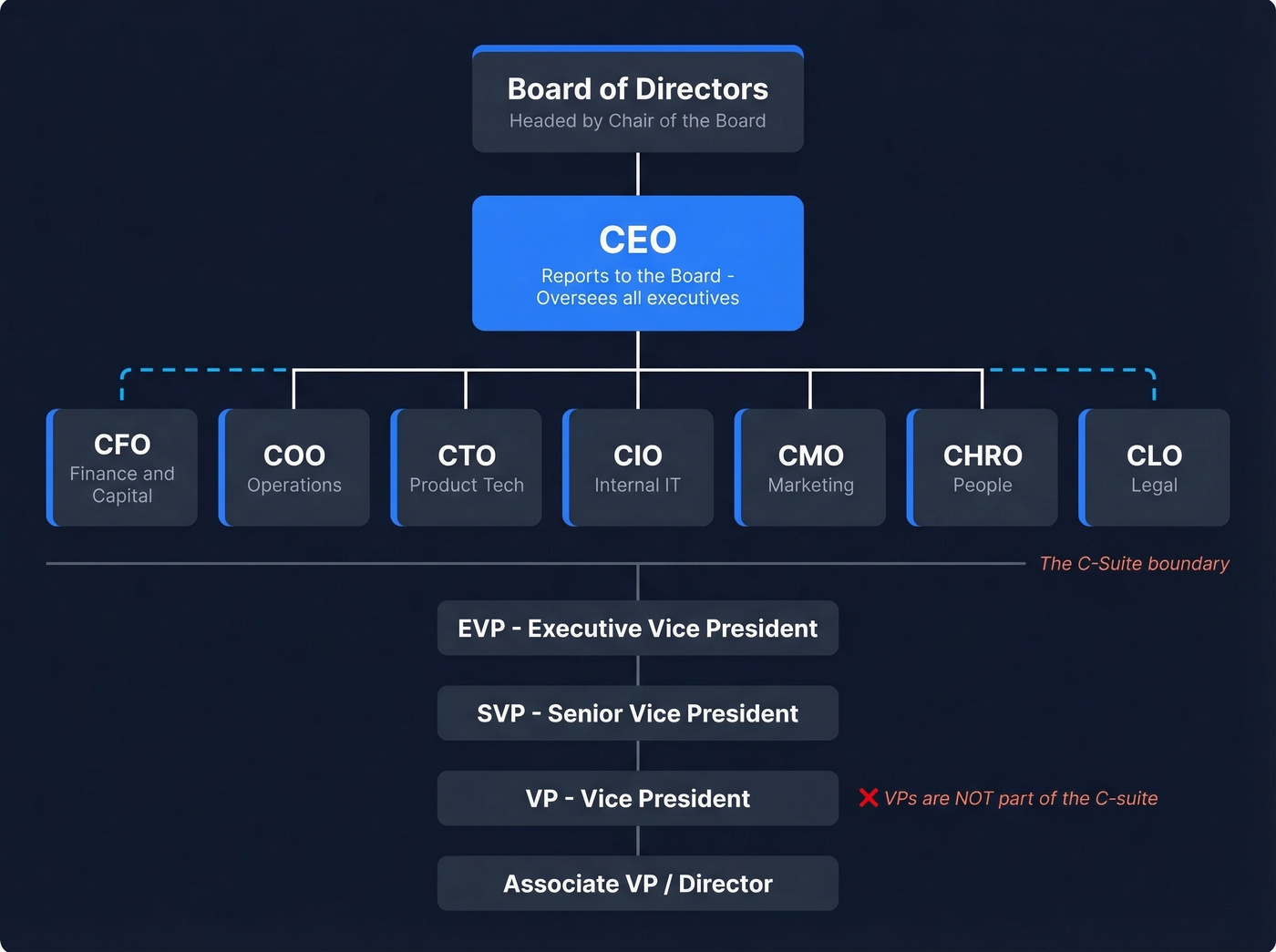
- Board of Directors (headed by the Chair of the Board)
- CEO (reports to the board, oversees the executive team)
- C-Suite Executives (CFO, COO, CTO, CIO, CMO, CHRO, CLO)
- EVP (Executive Vice President)
- SVP (Senior Vice President)
- VP (Vice President)
- Associate VP / Director
A common misconception: VPs aren't part of the C-suite. In many companies - especially banks and tech firms - VP is a mid-to-senior title, not an executive one. The executive suite is specifically reserved for Chief-titled officers who report to the CEO or the board. The gap between VP and C-level is real, and it's where most executive careers stall.

Understanding the C-suite hierarchy is step one. Step two is actually reaching them. Prospeo gives you verified emails and direct dials for 300M+ professionals - including CEOs, CFOs, CTOs, and every other chief officer on your target list. 98% email accuracy. 125M+ verified mobiles.
Stop mapping org charts you can't act on.
What the C-Suite Cares About in 2026
The Conference Board's C-Suite Outlook 2026 surveyed over 1,700 executives, including 750+ CEOs. The results paint a clear picture.
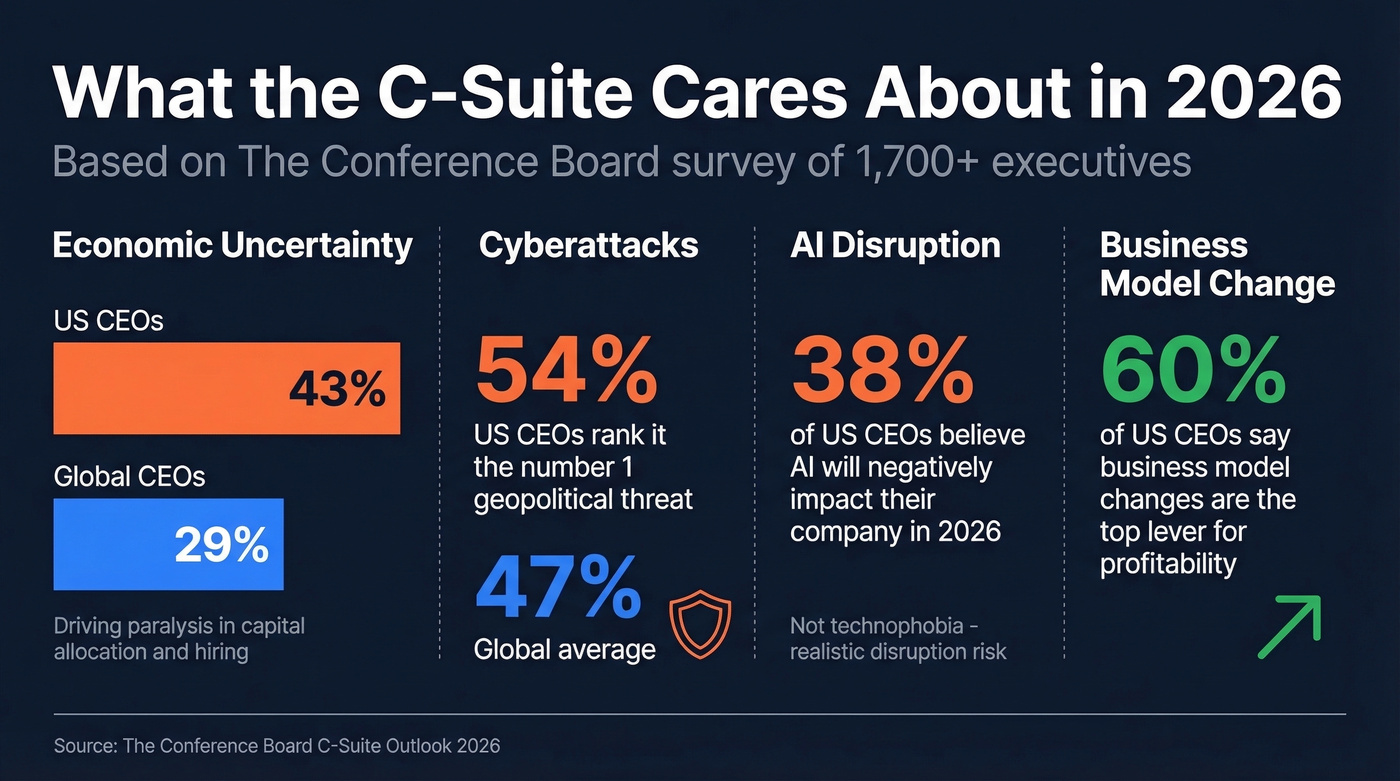
Uncertainty dominates. 43% of US CEOs rank it as their top economic threat - significantly higher than the 29% global average. This isn't abstract worry; it's driving real paralysis in capital allocation and hiring decisions. Globally, 36% of CEOs cite recession or downturn as a top concern.
On the geopolitical front, cyberattacks ranked as the #1 threat. 54% of US CEOs put it at the top, versus 47% globally.
AI is a double-edged sword. 38% of US CEOs believe AI will negatively impact their companies in 2026. That's not technophobia - it's a realistic assessment of disruption risk, talent displacement, and regulatory uncertainty all hitting at once.
The biggest lever for profitability? Business model changes. 60% of US CEOs cited it as their top strategy for protecting margins, ahead of cost-cutting or geographic expansion. Cross-functional collaboration between the CTO, CFO, and CMO is becoming the norm for executing these pivots - the days of siloed C-suite fiefdoms are ending fast.
C-Suite Compensation
These are average US salaries for C-suite roles:
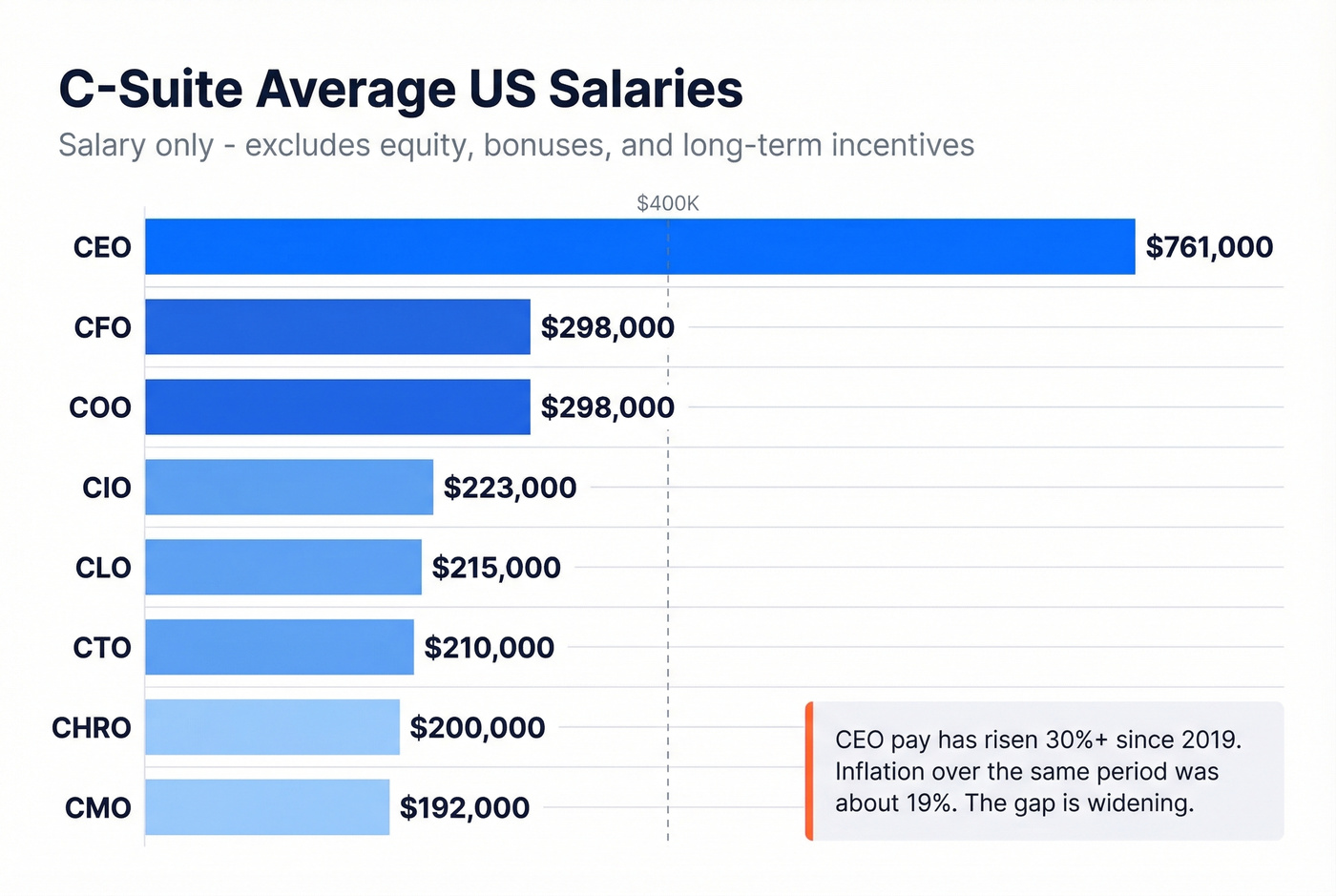
| Role | Avg. US Salary |
|---|---|
| CEO | ~$761,000 |
| CFO | ~$298,000 |
| COO | ~$298,000 |
| CIO | ~$223,000 |
| CLO | ~$215,000 |
| CTO | ~$210,000 |
| CHRO | ~$200,000 |
| CMO | ~$192,000 |
These are salary-only averages. At public companies, total compensation with equity, bonuses, and long-term incentives pushes CEO total comp into the tens of millions. The pay ratios are telling: CFOs earn roughly 34-39% of CEO compensation, while CMOs, CHROs, and CLOs land in the 22-33% range. CEO and executive pay has risen 30%+ since 2019, while inflation over the same period ran about 19%. Let's be honest - the gap between the top seat and everyone else is widening, not shrinking.
C-Suite Diversity Is Going Backward
This one's frustrating. C-suite diversity isn't just stalling - it's reversing. According to Altrata data reported by Forbes, women held 34.7% of S&P 500 board seats in Q1 2024. By Q2 2025, that number dropped to 33.6%. Women CEOs in the S&P 500 fell from 41 in 2023 to 39 in 2024.
The pipeline problem runs deeper than the boardroom. LeanIn's 2025 data shows the "broken rung" is still intact: for every 100 men promoted to manager, only 93 women make the same jump. For Black women, it's 60 per 100 men. DEI mentions in Fortune 100 reports dropped 72% between 2024 and 2025. The corporate commitment to representation is fading just as the numbers start slipping.
How to Reach C-Suite Executives
Understanding who sits in the C-suite is one thing. Getting their attention is a different challenge entirely. Generic info@ emails don't work. Gatekeepers exist for a reason. In our experience, the fastest path to a C-suite meeting is a verified direct line - not an InMail, not a forwarded introduction, not a cold call to the main switchboard.
If you're selling to executives, the data quality behind your outreach list matters more than your subject line. Prospeo's database covers 300M+ professional profiles with 98% email accuracy and 125M+ verified mobile numbers. You can filter by C-level title, company size, industry, and 30+ other criteria to build a targeted list of exactly the executives you need. There's a free tier to start - no contracts, no sales calls required.
If you're building lists at scale, it helps to understand firmographic filters and how they pair with firmographic and technographic data to avoid targeting the wrong accounts.
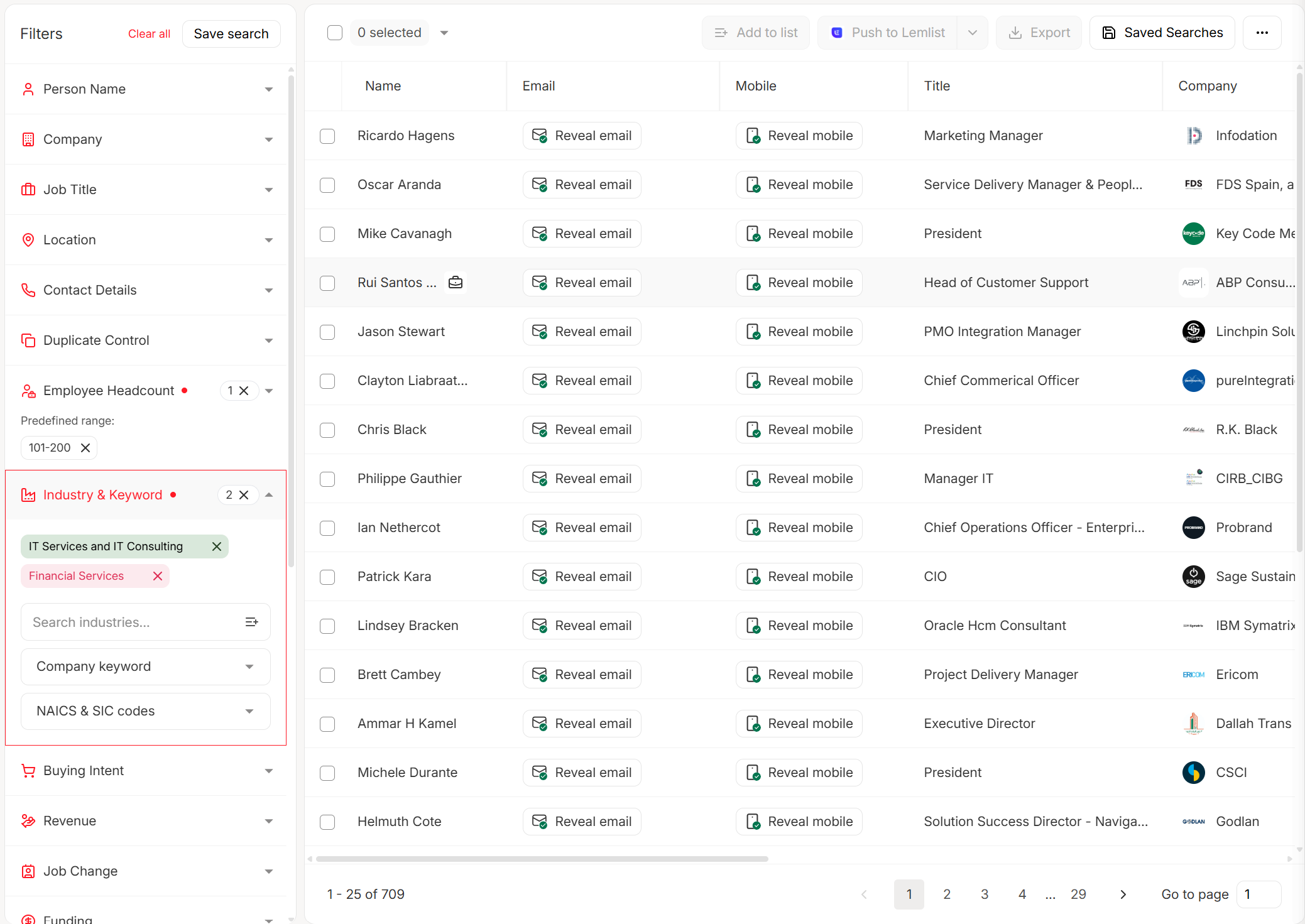
C-suite executives care about AI, cybersecurity, and business model reinvention in 2026. If you're selling into those priorities, you need the right person - not a generic info@ address. Prospeo's 30+ filters let you target by job title, buyer intent, tech stack, and company growth signals.
Reach the exact decision-maker at $0.01 per verified email.
FAQ
What's the difference between C-suite and C-level?
They refer to the same thing. "C-suite" describes the collective group of Chief-titled executives, while "C-level" describes the seniority tier an individual holds. A CFO is a C-level leader who sits in the C-suite. The terms are interchangeable in practice, and nobody will correct you for using either.
Is VP part of the C-suite?
No. Vice Presidents sit below the executive suite in corporate hierarchy. The standard ladder runs EVP, SVP, VP, Associate VP, Director. C-suite executives hold "Chief" titles and report directly to the CEO or the board. In banking especially, VP is a mid-senior title, not an executive one.
How do you get to the C-suite?
P&L ownership is the single most important credential. Cross-functional leadership, board exposure, and executive presence all matter, but owning a revenue line is what gets you in the room. Only 3 in 5 new CEOs meet performance expectations in their first 18 months - getting the title is one thing, keeping it is another.
How do you find verified contact info for C-suite executives?
Use a B2B data platform with C-level title filters and verified contact data. Prospeo lets you filter 300M+ profiles by job title, seniority, company size, and 30+ other criteria - returning 98%-accurate emails and verified mobile numbers. The free tier includes 75 email credits per month with no contract.
One more thing: Most people obsess over the CEO title, but the CFO seat is the most powerful role in the C-suite right now. In an era of uncertainty, capital allocation, and AI investment decisions, the person controlling the budget controls the strategy. If you're mapping your career to the executive suite, finance fluency matters more than charisma.