

What Is a High Ticket Closer? Salary, Skills & Truth (2026)
You just watched a 22-year-old on TikTok claim he makes $30K a month closing deals from a beach in Bali. So you Googled it. The top Reddit thread on r/sales is an experienced corporate salesperson noting that "remote closing" providers "run like the plague" when they learn he has real sales experience. Another thread on r/salestechniques has the OP asking bluntly whether these courses are a pyramid scheme.
Here's the thing: the role is real, the money is real, and the ecosystem around it is full of garbage. Let's sort it out.
30-Second Summary
- A high ticket closer sells products or services priced $3,000-$50,000+ per deal, typically on commission
- Commission rates run 10-20% per closed deal
- Median total pay: $113K/year in the US, with a likely range of $89K-$145K
- The role is legitimate - companies genuinely need people who can close complex, high-value sales
- The $1K-$5K courses promising "placement" and six-figure income are usually where the sketchiness starts
- If you want to become a closer, get an SDR job first
What Does a High Ticket Closer Actually Do?
A high ticket closer is a specialist who handles the final conversion stage of a sales process - taking pre-qualified, warm leads and turning them into paying clients on deals worth $3,000 to $50,000 or more. They don't prospect. They don't cold call. They close.
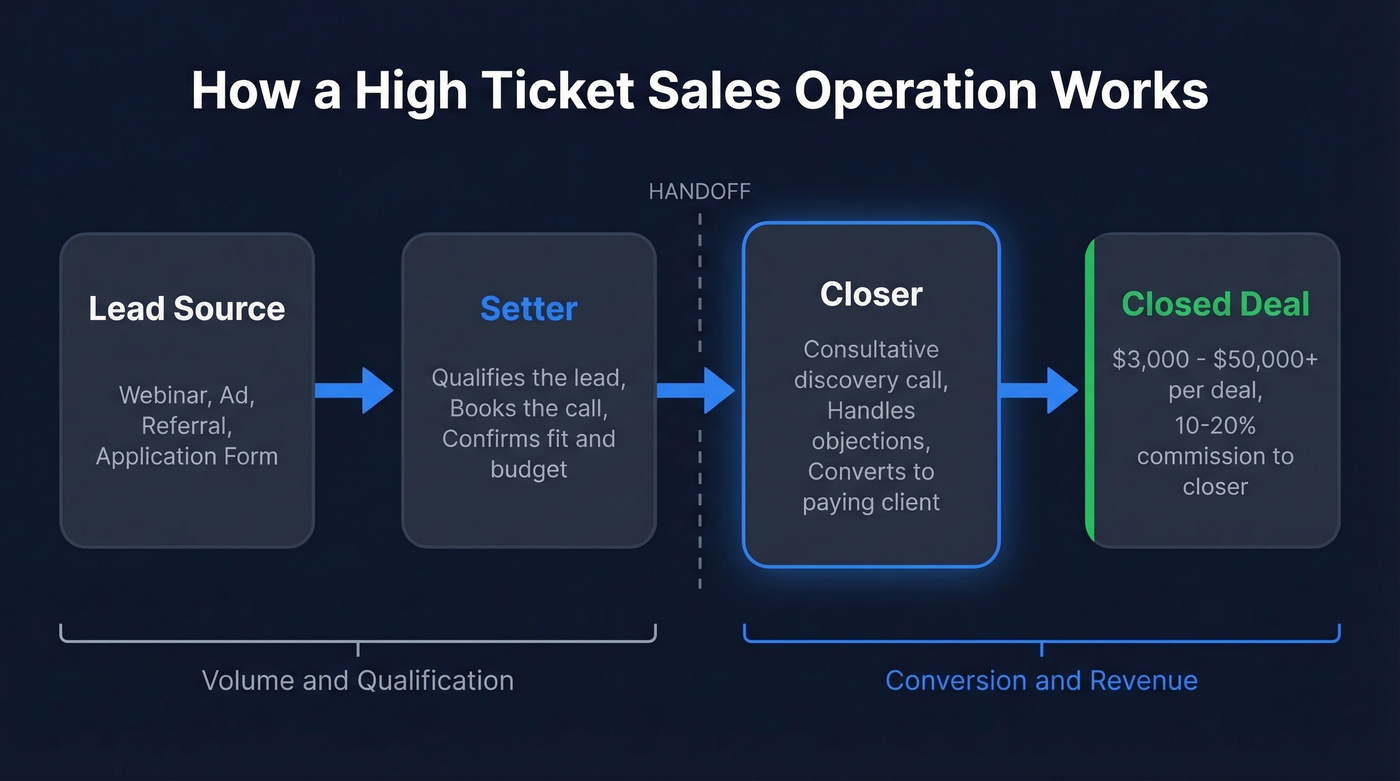
That distinction matters because it separates this role from traditional sales positions where one rep handles the entire funnel across a high volume of lower-value transactions.
| Traditional Salesperson | High Ticket Closer | |
|---|---|---|
| Funnel role | Full cycle | Final stage only |
| Lead temp | Cold to warm | Pre-qualified, warm |
| Style | Consultative, deep | Consultative, deep |
| Deal size | $50-$2,000 | $3,000-$50,000+ |
| Comp model | Base + small commission | Commission-heavy (10-20%) |
The core skill set is specific: deep active listening, expert objection handling, rapid rapport and trust building, emotional management under pressure, and genuine niche knowledge in whatever vertical you're selling. A closer who can't explain the product clearly and answer real questions won't last long.
Quick distinction worth knowing: a setter qualifies leads and books calls. A closer takes those booked calls and converts them. Most high-ticket operations split these roles deliberately so each specialist can focus on what they do best.
Is High Ticket Closing a Scam?
The role isn't a scam. The training industry around it largely is.
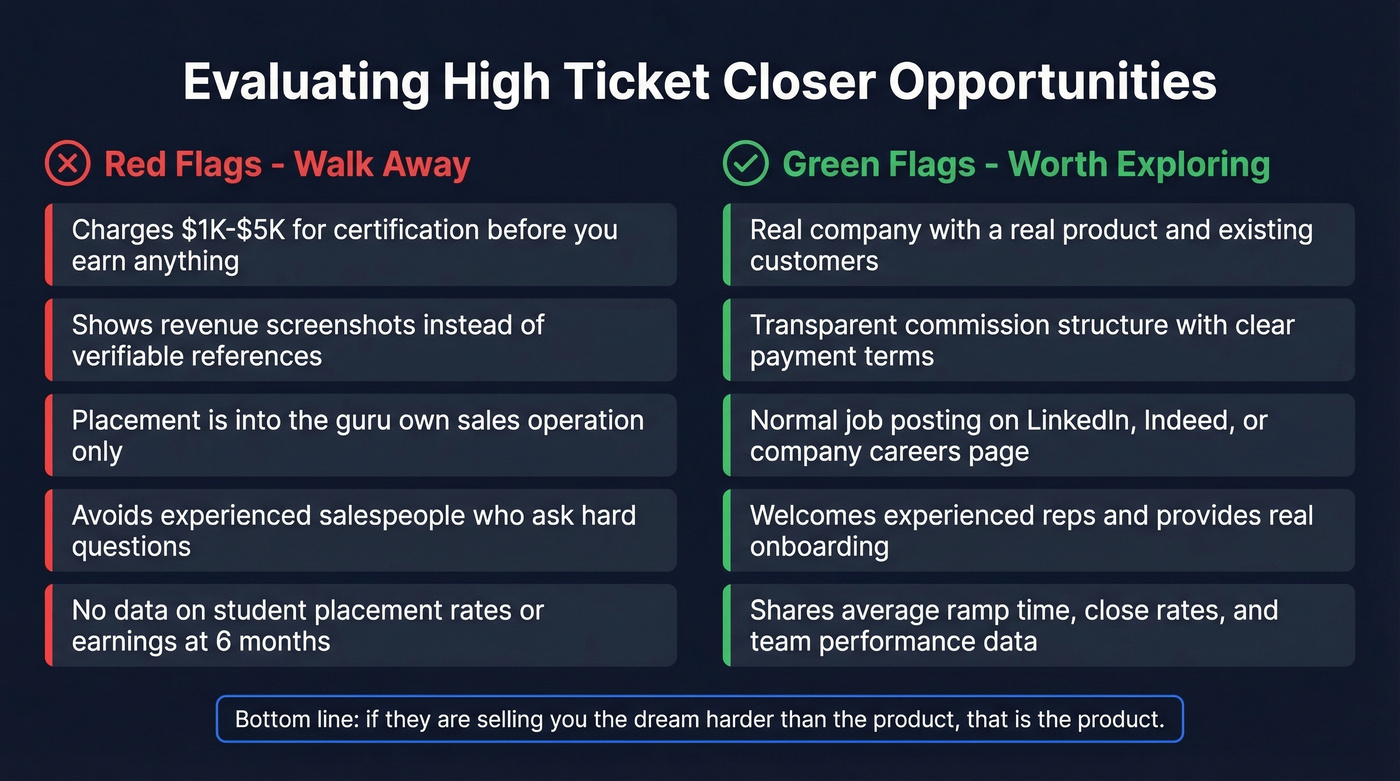
Real companies - SaaS vendors, consulting firms, financial services - hire closers through normal job postings and pay them real commissions on real products. That's legitimate. The guru-course industrial complex that charges you $1,000-$5,000 for "certification" and vague promises of "placement" is a different animal entirely.
Red flags when evaluating any closer course:
- They won't share placement rates or average student earnings at 6 months
- They avoid experienced salespeople because experienced people ask hard questions
- The "placement" is into the guru's own sales operation, not external companies
- Revenue screenshots replace verifiable references
Look, you don't need a $5,000 course. You need 100 real sales conversations, a CRM, and a verified prospect list. In our experience, the closers who succeed fastest are the ones who skip the course and get 6 months of real sales prospecting experience first. That's free, and someone's paying you to learn.

You don't need a $5K course - you need a pipeline of verified decision-makers. Prospeo gives closers access to 300M+ profiles with 98% email accuracy and 125M+ direct dials, so every booked call connects to a real buyer.
Skip the certification. Start with data that actually converts.
High Ticket Closer Salary Breakdown
The Glassdoor page for "High Ticket Sales Closer" shows a median total pay of $113K/year, with a most likely range of $89K-$145K. Base pay runs $61K-$92K, with commissions and bonuses adding $29K-$53K on top.
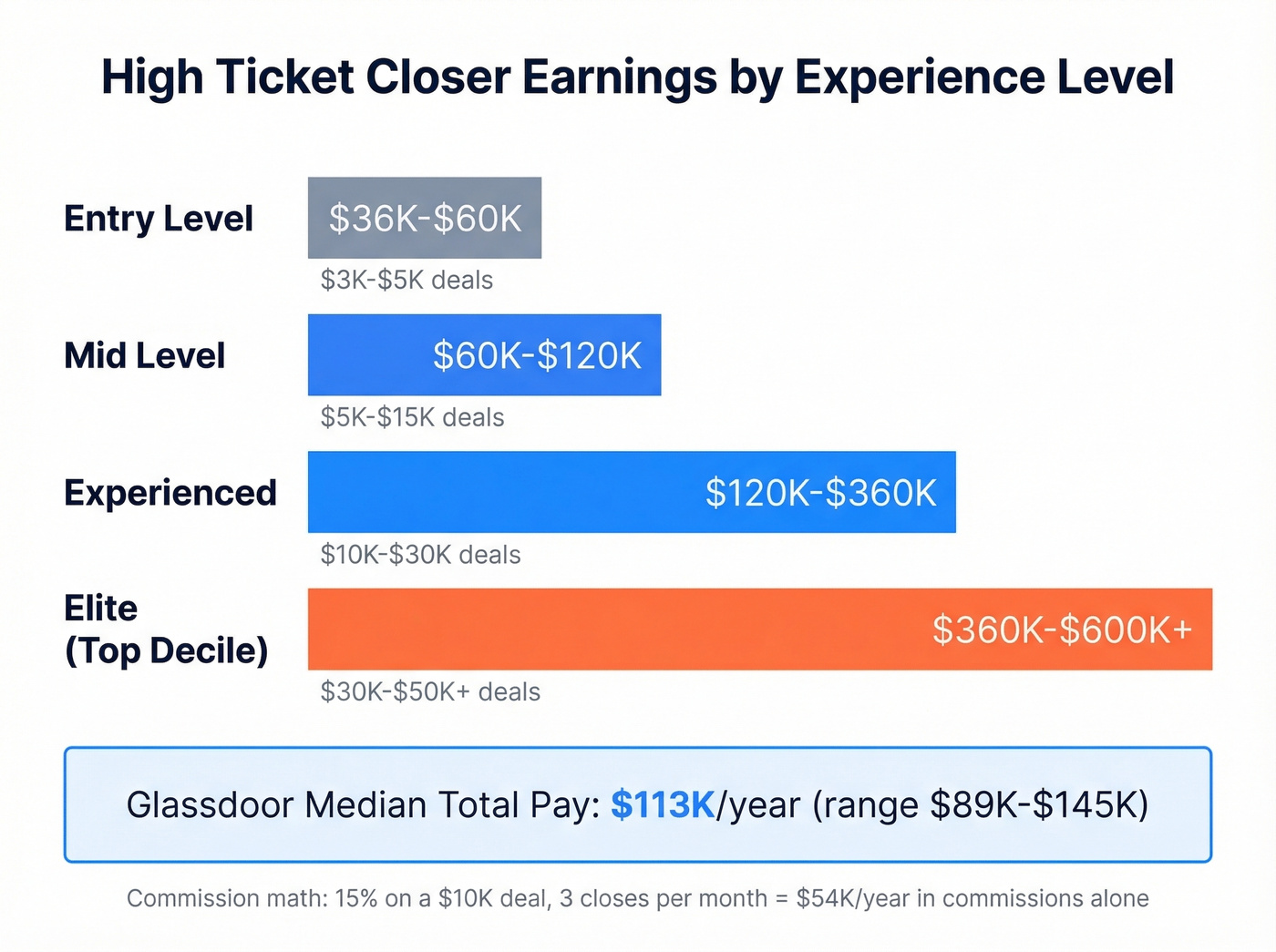
| Experience Level | Monthly Earnings | Typical Deal Size |
|---|---|---|
| Entry-level | $3K-$5K | $3K-$5K |
| Mid-level | $5K-$10K | $5K-$15K |
| Experienced | $10K-$30K+ | $10K-$30K |
| Elite | $50K+ | $30K-$50K+ |
Here's a worked example: a closer earning 15% commission on a $10,000 coaching program who closes 3 deals per month earns $4,500 in commissions - $54K/year before any base pay. Scale that to $25,000 deals at the same close rate and you're at $11,250/month.
One Reddit AMA poster reports $20K+ per month in commissions after 4 years, now selling $30K-$50K packages. The math works if they're closing 2-3 deals per month at 15-20% commission. Typical? No. That's top-decile performance. For context, average B2B win rates sit around 21%, and high-ticket B2B services run 20-30%. Expect to need 5-10 qualified calls to close one deal.
Hot take: If your average contract value sits below $8K-$10K, you probably don't need a dedicated closer. A strong full-cycle rep will outperform a specialist at that deal size because the sales cycle is too short to justify the handoff friction.
A Closer's Typical Day
Forget the laptop-on-the-beach fantasy.
A real closer's day starts with pipeline review - checking CRM for today's booked calls, reviewing prospect notes, and prepping for each conversation. Then it's 2-6 qualified calls via Zoom or phone, depending on pipeline volume and whether the operation uses a one-call or two-call close model. These leads come pre-booked from webinars, application forms, or referrals. This isn't cold calling.
Between calls, you're updating your CRM, sending follow-ups, scheduling second calls, and coordinating handoffs to onboarding. Many operations also run weekly team coaching or call review sessions where you dissect recordings and identify where conversations stalled. End of day means reviewing your own calls and figuring out what you could've done differently on the ones that didn't convert.
The patience factor is real. Sales cycles scale with deal size:
| Deal Size | Avg Cycle Length |
|---|---|
| Under $1K | 25 days |
| $10K-$50K | 75 days |
| $50K-$100K | 120 days |
A $25,000 deal often doesn't close on one call. We've seen closers burn out because they expected instant gratification on complex sales. The best closers treat patience as a competitive advantage.
Where Closers Work and How to Start
Not all niches are created equal. Ranked by stability and earning potential:
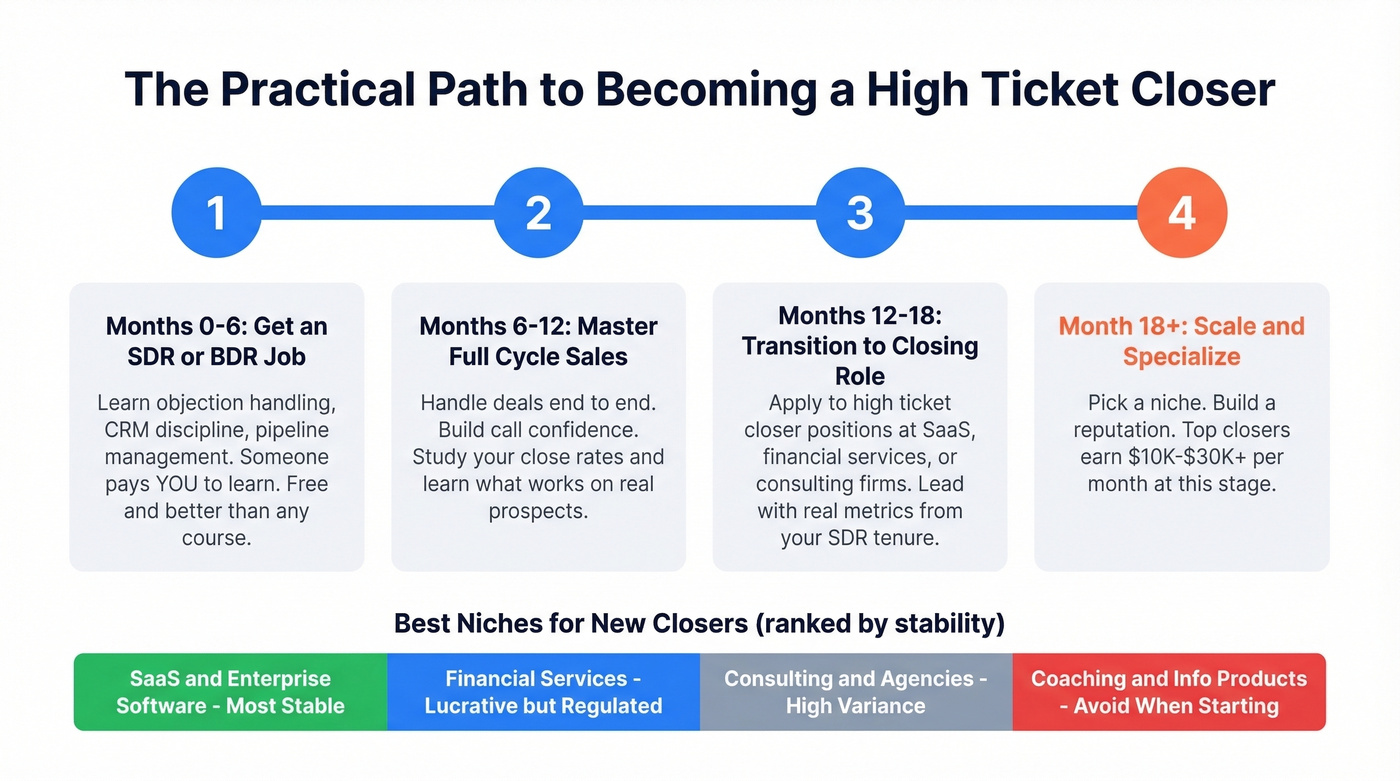
- SaaS / enterprise software - most stable, recurring revenue, predictable commission structures
- Financial services / insurance - regulated but lucrative, strong commission upside
- Consulting / agency services - project-based, higher variance, but deal sizes can be massive
- Coaching / info products - highest ceiling, lowest floor, most scam-adjacent
Skip the coaching niche if you're just starting out. The variance will crush your confidence before you build any real skill.
The practical starting path: get an SDR or BDR role at a real company. Learn sales fundamentals on someone else's dime for 6-12 months, then move into high-ticket closing roles with actual experience on your resume. This beats any course, and the consensus on r/sales backs that up overwhelmingly.
Every closer needs a core tech stack: a CRM like HubSpot or Salesforce, a video platform, a dialer for follow-ups, and email verification to make sure prospect data is clean. A bad email on a $25,000 deal is a painful mistake - tools like Prospeo verify contact data across 300M+ professional profiles with 98% email accuracy, so your closers spend time selling instead of chasing bounced messages.

High ticket closers live and die by lead quality. Bad data means wasted calls and blown deals. Prospeo's 7-day data refresh and 5-step verification keep your CRM clean - bounce rates under 4%, just like the teams closing $300K/week in pipeline.
Stop burning calls on dead leads. Get verified contacts for $0.01 each.
FAQ
Is high ticket closing fully remote?
Most closers work from home using Zoom or phone. The role is location-independent as long as you've got reliable internet and a quiet space. Some companies prefer time-zone overlap, but roughly 80% of closer job postings in 2026 list the position as remote-eligible.
Do you need sales experience to become a closer?
Not technically, but you'll ramp dramatically faster with it. Six months as an SDR gives you objection handling, CRM discipline, and pipeline management that no $3,000 course can replicate.
What's the difference between a setter and a closer?
A setter qualifies leads and books calls. A closer takes those booked calls and converts them into paying clients. Most high-ticket operations split these roles so closers focus entirely on conversion, typically earning 2-3x what setters make per deal.
How many calls does a closer take per day?
Typically 2-6 qualified calls, depending on pipeline volume and close model. This isn't a volume game - it's a conversion game. Quality of preparation matters more than call count.
What tools do closers need for clean prospect data?
At minimum, a CRM, a dialer, and a data verification platform. Pair something like Prospeo with HubSpot or Salesforce and your pipeline stays clean without manual scrubbing - 98% email accuracy and a 7-day data refresh cycle mean contact info doesn't go stale between calls.