What Is a Sales Call? Framework, Scripts, and Real Benchmarks
Stop making 100 dials a day. The math doesn't support it. Cognism's analysis of 204,000+ cold calls shows a 2.3% success rate - meaning 50 verified calls can produce the same meeting volume as about 75 unverified dials, with far less wasted time. Most articles answering "what is a sales call" tell you to "be prepared" and "listen more." This one gives you numbers from 326K+ analyzed calls, a 30-minute framework you can use today, and scripts you can adapt for your next dial block.
Sales Call Definition and Scope
A sales call is a live, real-time conversation between a seller and a prospect - by phone, video, or in person - with the explicit goal of advancing a deal. No email threads, no async messages, no "just checking in" voicemails that go nowhere. The simplest definition: any synchronous dialogue where one party is trying to move a commercial outcome forward.
Don't confuse it with a "sales meeting" or a "demo." A sales call spans the full funnel. A cold call to a stranger who's never heard of you? Sales call. A 45-minute discovery session with a VP who requested a demo? Also a sales call. The closing negotiation where you're haggling over payment terms? Still a sales call. The common thread is live dialogue with commercial intent, and the distinction matters because different call types demand different preparation, different talk-to-listen ratios, and different success metrics.
Why Sales Calls Still Matter in 2026
Reps spend only 30% of their time actually selling. The rest goes to CRM updates, internal meetings, and admin work. When you only get a third of your week for revenue-generating activity, every call carries outsized weight.
Here's the thing: only 43.5% of sales professionals hit quota, and revenue isn't distributed evenly - 17% of reps generate 81% of total revenue. Rep turnover has climbed from 22% to 36%, which means the reps who remain need to extract more value from every conversation. The gap between top performers and everyone else isn't talent. It's execution on the activities that actually move deals.
Sellers who frequently use AI tools generate 77% more revenue than those who don't, based on Gong's analysis of 7.1M opportunities. AI doesn't replace the call - it handles the prep, the notes, and the follow-up so you can focus on the conversation itself. Automation can free up about 20% of sellers' capacity, which translates directly into more live conversations per week.
Types of Sales Calls
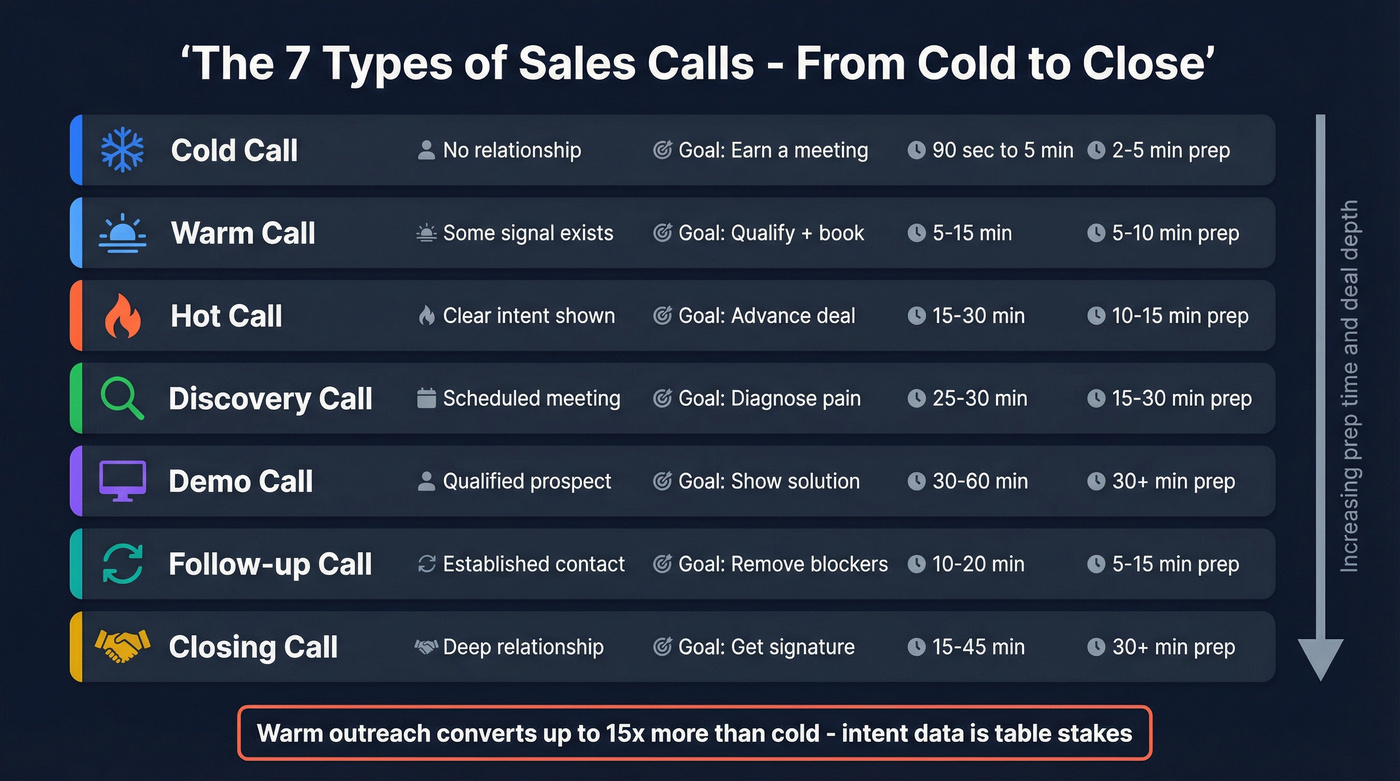
The prep, the energy, and the expected outcome shift dramatically based on where the prospect sits in the funnel.
| Type | Relationship | Goal | Duration | Prep Time |
|---|---|---|---|---|
| Cold | None | Earn a meeting | 90 sec-5 min | 2-5 min |
| Warm | Some signal | Qualify + book | 5-15 min | 5-10 min |
| Hot | Clear intent | Advance deal | 15-30 min | 10-15 min |
| Discovery | Scheduled | Diagnose pain | 25-30 min | 15-30 min |
| Demo | Qualified | Show solution | 30-60 min | 30+ min |
| Follow-up | Established | Remove blockers | 10-20 min | 5-15 min |
| Closing | Deep | Get signature | 15-45 min | 30+ min |
The jump from cold to warm is massive. Warm outreach - where the prospect has downloaded content, attended a webinar, or been referred - converts up to 15x more often than pure cold outreach. That's why intent data and trigger-based calling have become table stakes for modern outbound teams.
Hot calls are the easiest to overlook. When someone requests a demo or visits your pricing page three times in a week, that's not a warm lead - it's a hot one. The goal isn't to qualify. It's to not screw it up by over-qualifying when they're ready to buy. In-person calls still carry unique weight at this stage - showing up face-to-face for a high-ACV deal signals commitment that a Zoom link never will.
The 30-Minute Framework
Most discovery calls fail because reps wing it. They ask random questions, pitch too early, and run out of time before uncovering real pain. Here's a structured framework that fixes that - and it works whether you're following a formal process or building one from scratch.
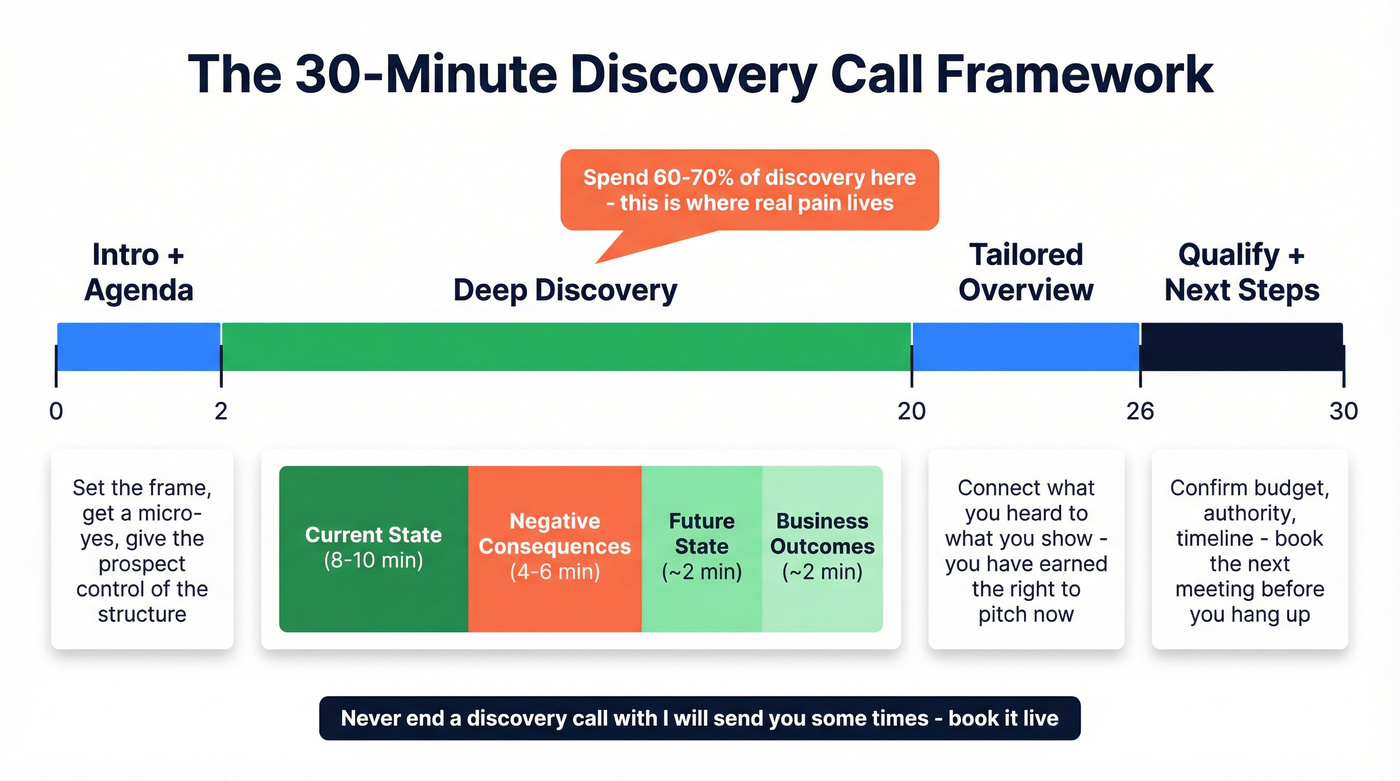
Minutes 0-2: Intro + Agenda
Set the frame. Your opener should sound something like: "Appreciate you taking the time. My plan is to spend the first part learning about your current setup, and if there's alignment, I can show you how we might help and we'll set some next steps. Sound fair?"
That last question - "Sound fair?" - is a micro-yes that gives the prospect control. It also commits them to the structure.
Minutes 2-20: Deep Discovery
This is where the call is won or lost. Move through four buckets: current state (8-10 min) to understand their tools, process, and team structure; negative consequences (4-6 min) to surface what's breaking and what the status quo costs; then future state and business outcomes (~4 min combined) to understand what "fixed" looks like and what it means for the business.
Spend 60-70% of your discovery time on current state and negative consequences. That's where real pain lives. Most reps rush to future state because it feels more positive, but you can't sell a solution to a problem the prospect hasn't fully articulated.
Minutes 20-26: Tailored Overview
Now - and only now - you've earned the right to talk about your product. Connect what you heard directly to what you're showing. "You mentioned X is costing you Y hours a week. Here's how we handle that."
Minutes 26-30: Qualification + Next Steps
Confirm budget authority, timeline, and who else needs to be involved. Book the next meeting before you hang up. Never end a discovery call with "I'll send you some times."

Warm calls convert 15x better than cold ones - but only if you're reaching the right person at a verified number. Prospeo gives you 125M+ verified mobile numbers with a 30% pickup rate, so your reps spend their 30% selling time on live conversations, not voicemails.
Stop burning dials on dead numbers. Start connecting with decision-makers.
Benchmarks That Actually Matter
Cold Call Numbers
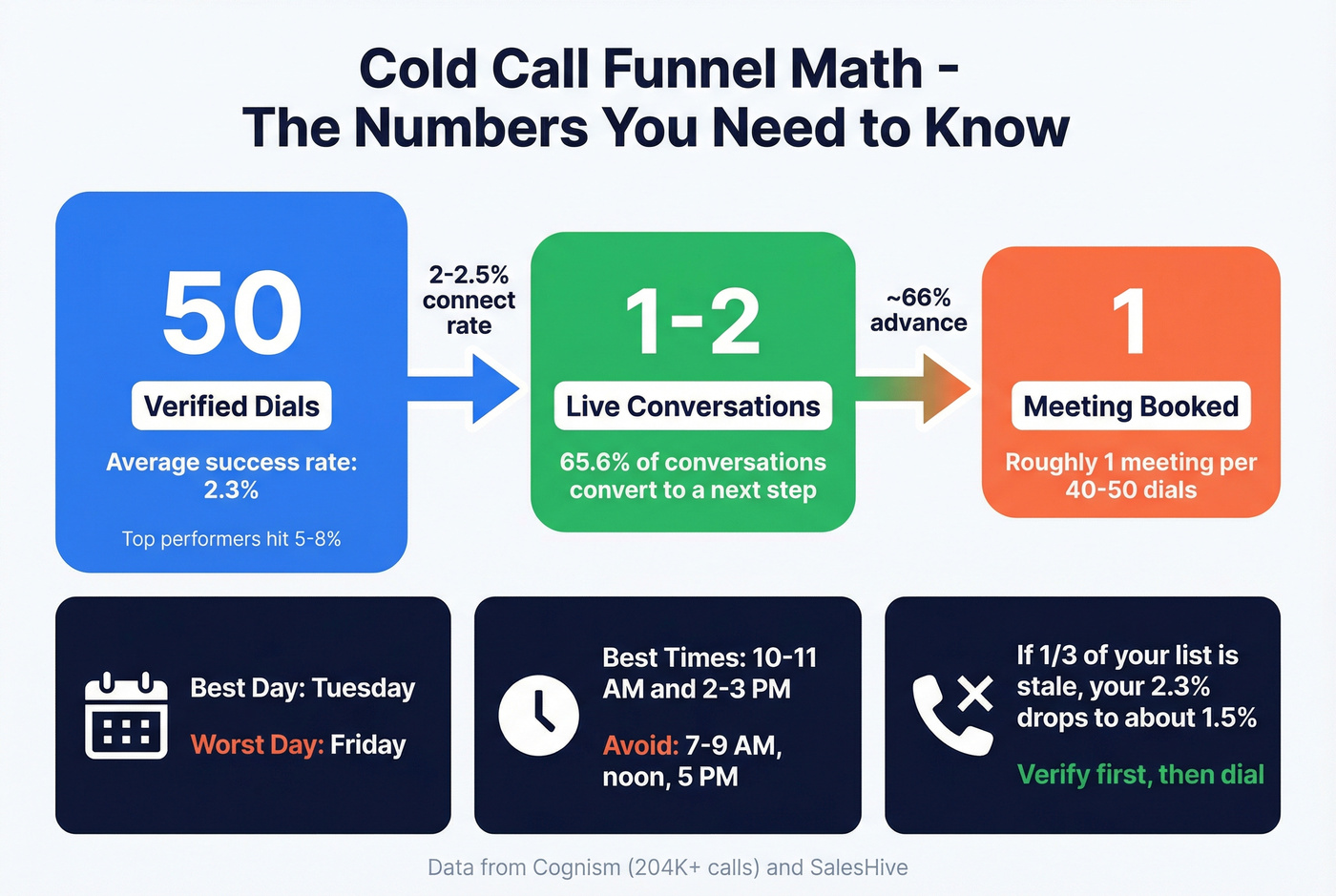
Cognism's State of Cold Calling report analyzed 204,000+ cold calls. The average cold call lasts 93 seconds. The average success rate is 2.3%. It takes 3 attempts to reach a prospect, with 93% of conversations happening by the third try and 98% by the fifth. After the fifth attempt, returns drop sharply.
Tuesdays have the highest success rate for booking meetings. Fridays are the worst. The best windows are 10-11 AM and 2-3 PM. Avoid 7-9 AM, noon, and 5 PM - you're competing with commutes, lunch, and the mental checkout.
The Golden Ratio
Gong analyzed 326K sales calls and found the golden ratio for top performers: 43% talking, 57% listening. The current baseline across all reps is 60/40 - most people talk way too much.
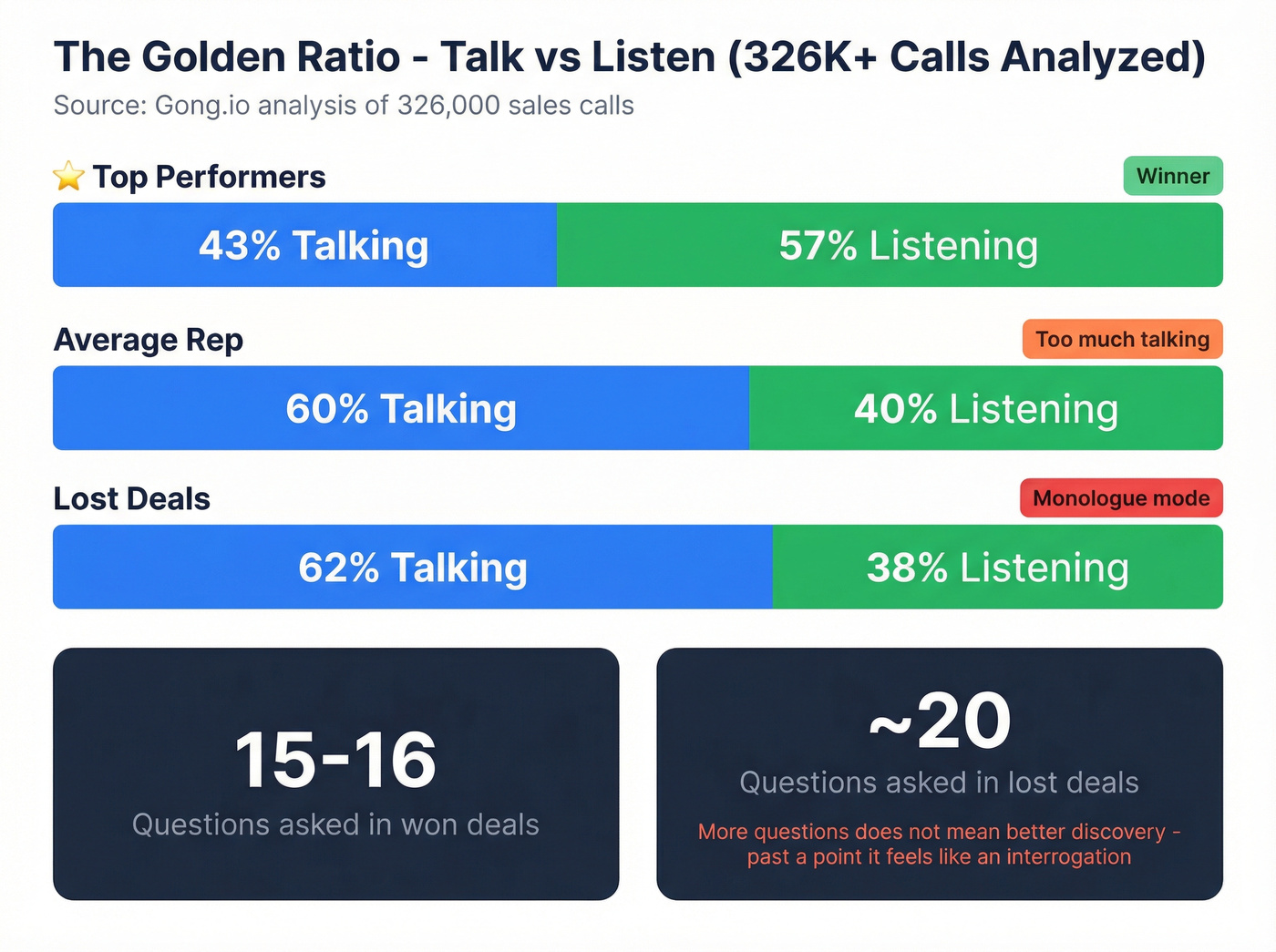
Closed-won deals average 57% talk time. Lost deals average 62%. That 5-point swing is the difference between diagnosing a problem and delivering a monologue. Won deals also ask fewer questions - 15-16 versus ~20 for lost deals. More questions doesn't mean better discovery. Past a point, it feels like an interrogation.
The Funnel Math
The average dial-to-meeting conversion runs 2-2.5%, which means roughly 1 meeting per 40-50 calls. Top performers hit 5-8%. Once you're in a live conversation, roughly two-thirds convert to a next step - aligning with Cognism's 65.6% conversation success rate. The bottleneck isn't the conversation. It's getting to one.
Let's be honest: if your average deal size is under $10K, you probably don't need a 15-touch cadence with personalized video. You need 50 verified dials a day and a tight 90-second opener. Complexity is the enemy of velocity at the lower end of the market.
And if a third of your list is stale - wrong numbers, disconnected lines, people who changed jobs - your effective success rate drops from 2.3% to about 1.5%. Verify first, then dial.
Scripts You Can Steal
Cold Call Opener
The "choose your own adventure" opener works because it gives the prospect agency instead of cornering them:
"Hi [Name], this is [Your Name] with [Company]. I know I'm calling out of the blue - I can be brief. We help [type of company] with [specific outcome]. I can explain in 30 seconds, or if you have a quick question about [relevant pain point], I'm happy to start there. What works better?"
Two options. No dead air. The prospect picks a path, and either one keeps the conversation alive.
Gatekeeper Script
Don't try to sneak past gatekeepers. Asking for help is disarming and works far better than pretending you're expected.
"Hi, I'm hoping you can help me. My name is [Your Name] - I'd like to speak with [Prospect Name] or whoever handles [specific function]. What's the best way to make that happen?"
Using their name and asking "what's the best way" signals respect for the gatekeeper's role. They route you instead of blocking you.
Voicemail Script
Keep it under 20 seconds. Most voicemails get deleted in the first five seconds, so front-load the reason, not your name. Cognism found a 26.85% callback reach rate, so a good voicemail isn't wasted effort.
"Hi [Name], quick voicemail. I'm calling because [specific reason tied to their company/role]. If that's relevant, my number is [number] - that's [repeat number]. Talk soon."
State the reason first. Name and number second. That's it.
Objection Handlers
The three objections you'll hear most often, with responses that keep the door open:
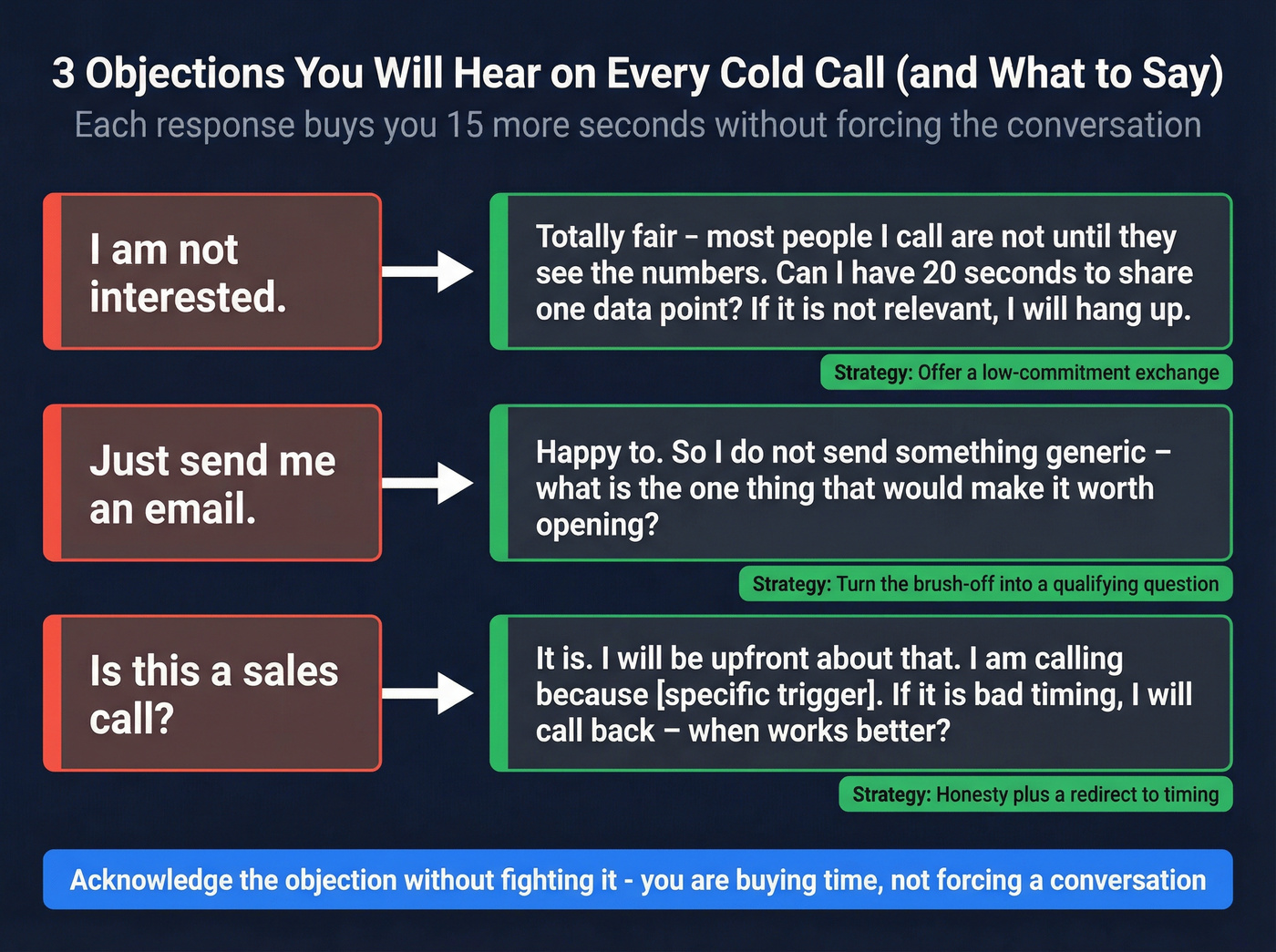
"I'm not interested." -> "Totally fair - most people I call aren't until they see the numbers. Can I have 20 seconds to share one data point? If it's not relevant, I'll hang up."
"Just send me an email." -> "Happy to. So I don't send something generic - what's the one thing that would make it worth opening?"
"Is this a sales call?" -> "It is. I'll be upfront about that. I'm calling because [specific trigger]. If it's bad timing, I'll call back - when works better?"
Each response acknowledges the objection without fighting it. You're buying 15 more seconds, not forcing a conversation.
How to Prepare Before You Dial
The difference between a rep who books 2 meetings a day and one who books zero often isn't the script - it's the 10 minutes before the call.
Before you read the prospect's bio, make sure the number is real. Ask any SDR on r/sales what kills their cold call blocks, and the answer is almost always bad data - wrong numbers, disconnected lines, people who left the company six months ago. In our experience working with outbound teams, the biggest cold-call killer isn't the script. It's the data underneath it. Your SDR made 60 dials and booked zero meetings? Before you coach the script, check how many numbers actually rang.
Once your data is clean, run through this pre-call checklist:
- Company context: What do they sell, how big are they, any recent news or funding?
- Prospect role: What do they own? What are their likely priorities this quarter?
- Recent triggers: Job change, hiring surge, tech stack shift, earnings call mention?
- Competitive landscape: Are they using a competitor? Did they recently churn from one?
Budget 5-15 minutes for SMB prospects, and 15-30 minutes for enterprise. The best sales call planning isn't about memorizing a dossier - it's about having two or three sharp observations that prove you did your homework.
Mistakes That Kill Deals
Talking More Than 45%
Lost deals average 62% talk time. When you cross 65%, conversion rates fall off a cliff. The fix isn't "ask more questions" - it's ask better questions and then shut up. Let silence do the work. Most reps fill silence with more talking, which is exactly the wrong instinct.
Pressure Tactics
Fake scarcity, aggressive urgency, exaggerated social proof - these tactics push deals into "no decision," which is worse than a clean "no." One Head of Sales documented the shift: replacing urgency CTAs with data-backed proposals and tailored value maps increased their win rate by 20% over two quarters. If you need manufactured urgency to close, the prospect doesn't have real pain.
Skipping the Buying Committee
Gong's analysis of 1.8M opportunities found that closed-won deals have 2x as many buyer contacts as lost deals. In deals over $50K, multi-threading boosts win rates by 130%. Bringing in a sales engineer at the right moment increases win rates by up to 30%. Your call isn't just with one person - it's the start of a multi-threaded campaign. If you're only talking to one champion, you're building on sand.
Measuring Call Performance
Track these four metrics before anything else:
- Dial-to-connection rate: This matters more than raw dial count. Optimize your call blocks around the 10-11 AM and 2-3 PM windows.
- Conversations per day: The leading indicator. 30% of reps make 50+ dials per day, but connections drive pipeline.
- Average call duration: Calls under 2 minutes deserve coaching scrutiny - they're likely getting hung up on or rushing the opener.
- Call disposition breakdown: Busy, no answer, hang-up, voicemail, appointment set. Track the ratios weekly.
Voicemail return rate and outbound calls by time of day round out the picture, but the four above are where I'd start for any team running outbound for the first time. Good management means reviewing these numbers weekly as a team, not just at quarterly business reviews when it's too late to course-correct.
The math bears repeating: 50 well-researched calls with verified numbers outperform 100 spray-and-pray dials. A 2.3% success rate on 50 verified dials gives you about 1.15 meetings - roughly the same output as a ~1.5% rate on 75 unverified ones - with far less wasted time and none of the frustration.
The data says 93% of prospects are reached by the third attempt. But that only works when your contact data is accurate. Prospeo's 98% email accuracy and 7-day data refresh mean your follow-up sequences hit real inboxes - not bounces that tank your domain reputation.
Every failed dial is a wasted rep-hour. Fix your data first.
FAQ
What is a sales call vs. a sales meeting?
A sales call is any live conversation with commercial intent - cold, warm, discovery, or closing. A sales meeting typically refers to a scheduled, longer-format session like a demo or proposal review. Every sales meeting is a sales call, but not every sales call is a meeting.
How long should a sales call last?
Cold calls average 93 seconds. Discovery calls should run 25-30 minutes. Demos typically go 45-60 minutes. Match duration to call type - forcing a 30-minute conversation on a cold call will get you hung up on.
How many calls should I make per day?
We've seen that 40-50 dials with verified numbers and pre-call research outperform 100 spray-and-pray dials. Focus on connection rate, not raw dial count - teams using verified mobiles report 30% pickup rates versus the 12% industry average.
What's a good cold call conversion rate?
The average cold call success rate is 2.3% dial-to-meeting. Top performers hit 5-8%. Once you're in a live conversation, roughly two-thirds convert to a next step. Below 2%, audit your data quality before overhauling your script.
What tools do I need for outbound calling?
Three essentials: a verified data source like Prospeo for accurate phone numbers and contact enrichment, a conversation intelligence platform like Gong for call recording and coaching, and a CRM that logs calls automatically so reps aren't spending half their day on admin. Skip the fancy multi-tool stack until you've nailed those three.