What Is Guided Selling - and Why Do Most Teams Get It Wrong?
You've got 47 SKUs, an undertrained sales team, and a 2% conversion rate. Guided selling is supposed to fix that. So what is it, really?
Buyers aren't stupid - they're overwhelmed. And most teams botch the implementation before it ever gets a chance to work.
The Short Version
Guided selling uses data and AI to recommend the right product, quote, or next step to buyers who'd otherwise drown in options. It works in B2C (product quizzes) and B2B (CPQ, sales playbooks, next-best-action prompts). The catch: it's only as good as the data feeding it, and most teams skip the data cleanup step entirely.
How Guided Selling Actually Works
This methodology replaces the "here's everything we offer, good luck" approach with a structured path to the right recommendation. Think of it as the difference between handing someone a 200-page catalog and asking them three smart questions.
It's not just product quizzes, though that's the most visible form. In B2B, it shows up as CPQ workflows that prevent reps from sending impossible configurations, playbooks that surface the right content at the right deal stage, and AI prompts that tell a rep "this prospect looks like your last 10 closed-won deals - here's what worked." The range is wide.
Gartner predicted that 75% of B2B sales organizations would augment their efforts with AI-guided selling by 2025. That deadline's passed, and whether the number actually hit 75% is debatable - but the direction is unmistakable. A widely cited 2025 benchmark put the share of B2B sales interactions happening in digital channels at 80%, which makes guided recommendations less of a nice-to-have and more of a baseline expectation.
The Three-Step Loop
Every guided selling system follows the same loop, whether it's a €99/month product quiz or a six-figure CPQ platform:
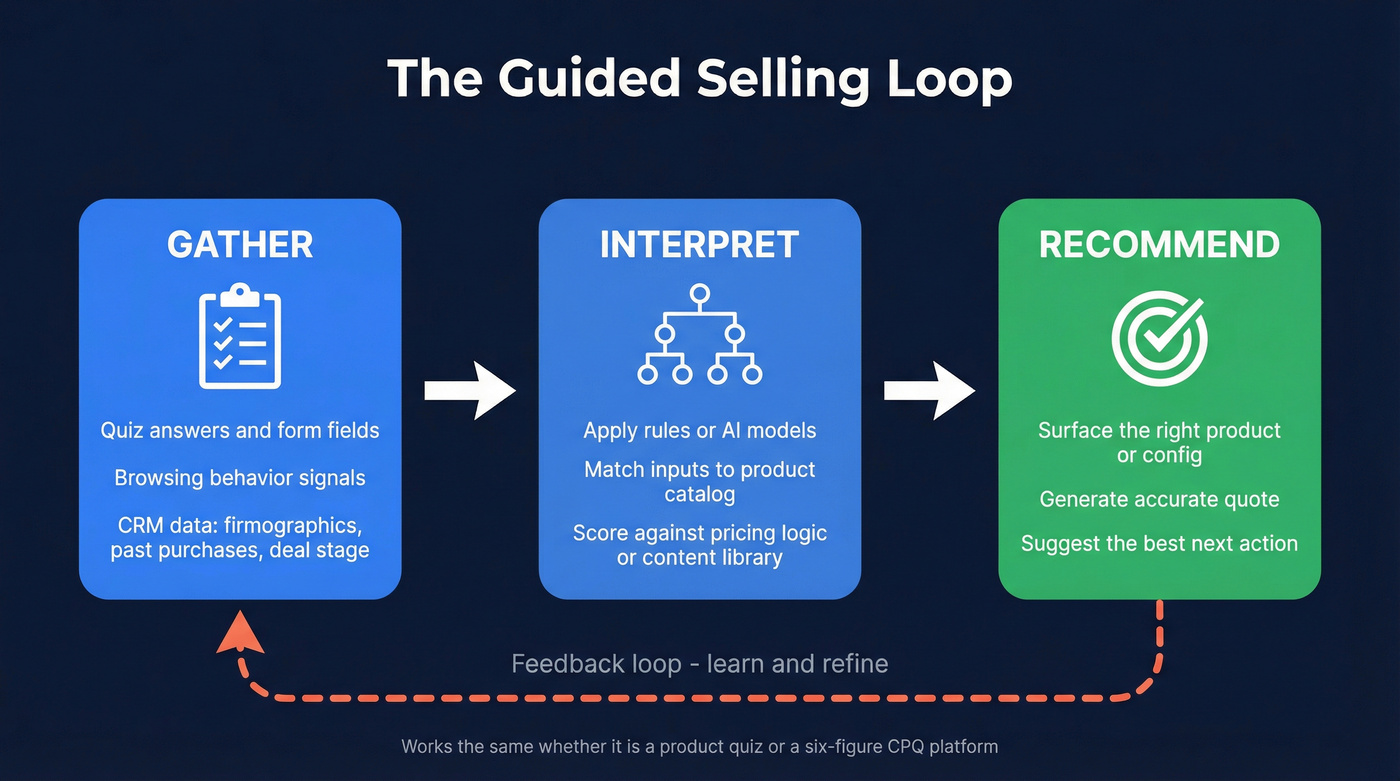
- Gather - Collect inputs from the buyer through quiz answers, form fields, or browsing behavior. Or pull from your CRM: firmographics, past purchases, deal stage.
- Interpret - Apply rules, AI models, or decision trees to match inputs against your product catalog, pricing logic, or content library.
- Recommend - Surface the right product, configuration, quote, or next action before the buyer or rep has to think too hard.
In B2B, this prevents the classic disaster: an undertrained rep quotes a product configuration that doesn't exist, and the deal dies in legal review. In B2C, it solves choice paralysis - 47 SKUs and no clear winner means the buyer bounces.
Real Results Worth Studying
Let's look at what the numbers actually say when guided selling is done right.
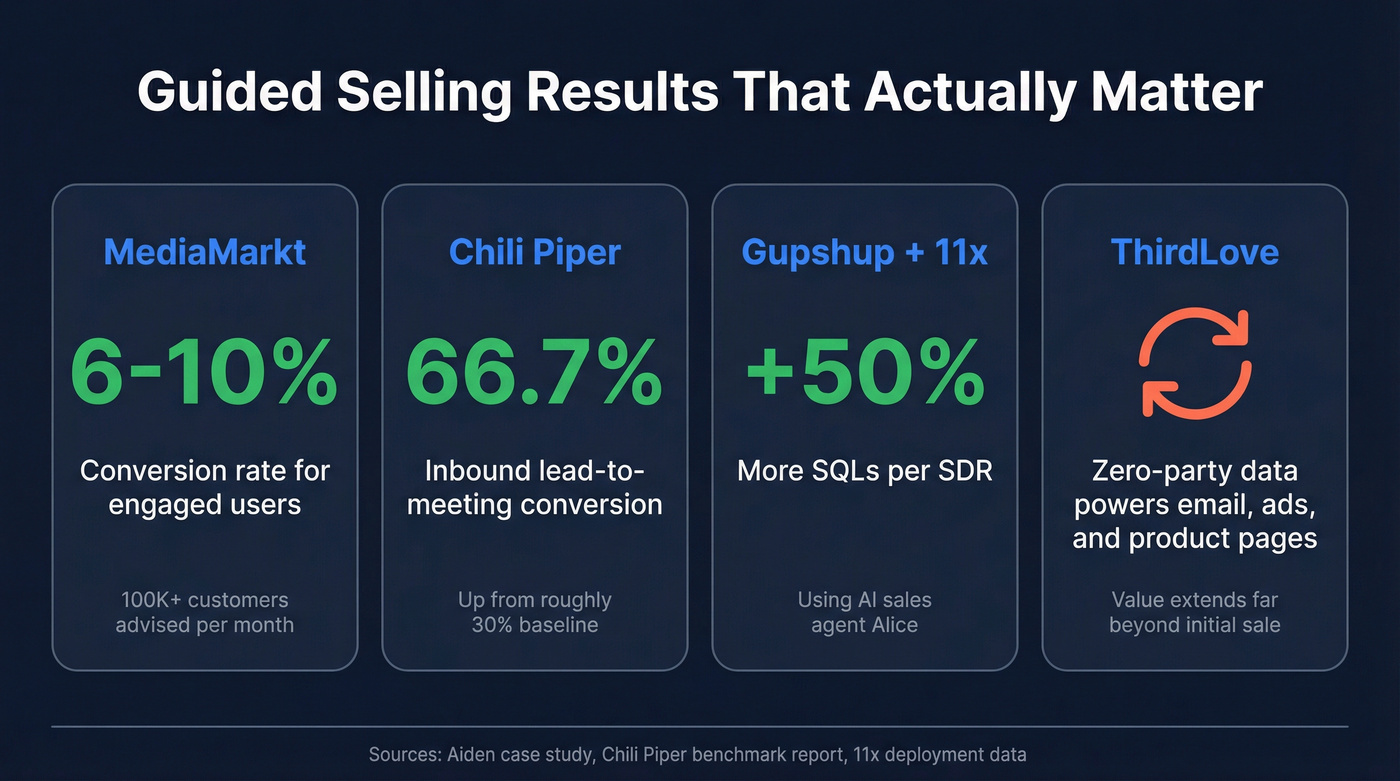
MediaMarkt rolled out 48 guided selling advisors built on Aiden across 4 countries in just 6 weeks starting December 2024. They now advise 100,000+ customers per month, with engaged users converting at 6-10%. That's not a marginal lift - it's a fundamentally different conversion profile.
On the B2B inbound side, Chili Piper analyzed roughly 4 million form submissions and found that guided scheduling - letting qualified leads book a meeting immediately after form fill - lifted conversion from ~30% to 66.7%. Same principle: reduce friction, guide the next step, convert more.
AI sales agents are showing similar lift. Gupshup saw a 50% increase in SQLs per SDR after adopting 11x Alice, a concrete sign that guided workflows aren't limited to inbound quizzes.
ThirdLove's Fit Finder quiz opens with "80% of women wear the wrong bra size" and uses guided questions to recommend the right product. The quiz collects zero-party data that powers personalization across email, ads, and product pages - a textbook example of the gather-interpret-recommend loop generating value well beyond the initial sale.

Guided selling is only as good as the data feeding it. Prospeo verifies emails with 98% accuracy and refreshes every 7 days - so your decision trees, playbooks, and CPQ workflows recommend based on real contacts, not stale records.
Stop building guided selling on a broken foundation.
B2B and B2C Examples
B2C: MediaMarkt's Aiden-powered product finders across electronics, ThirdLove's fit quiz, Atoms' shoe selector, Huel's nutrition quiz, and Supergoop's sunscreen recommender. These all use short, branching quizzes to collapse large catalogs into one or two personalized picks. Outfindo frames this as "Agentic Commerce" - shoppers increasingly expect an AI-assistant experience rather than static filters.
B2B: Hyster-Yale uses Highspot's guided selling to help reps navigate complex equipment configurations. CPQ platforms like Tacton handle scenarios where a single product has thousands of valid configurations and a rep needs guardrails to avoid quoting something that can't be built.
What It Costs in 2026
Here's the thing most articles won't tell you: the price difference between entry-level and enterprise tools is often 10x to 100x.
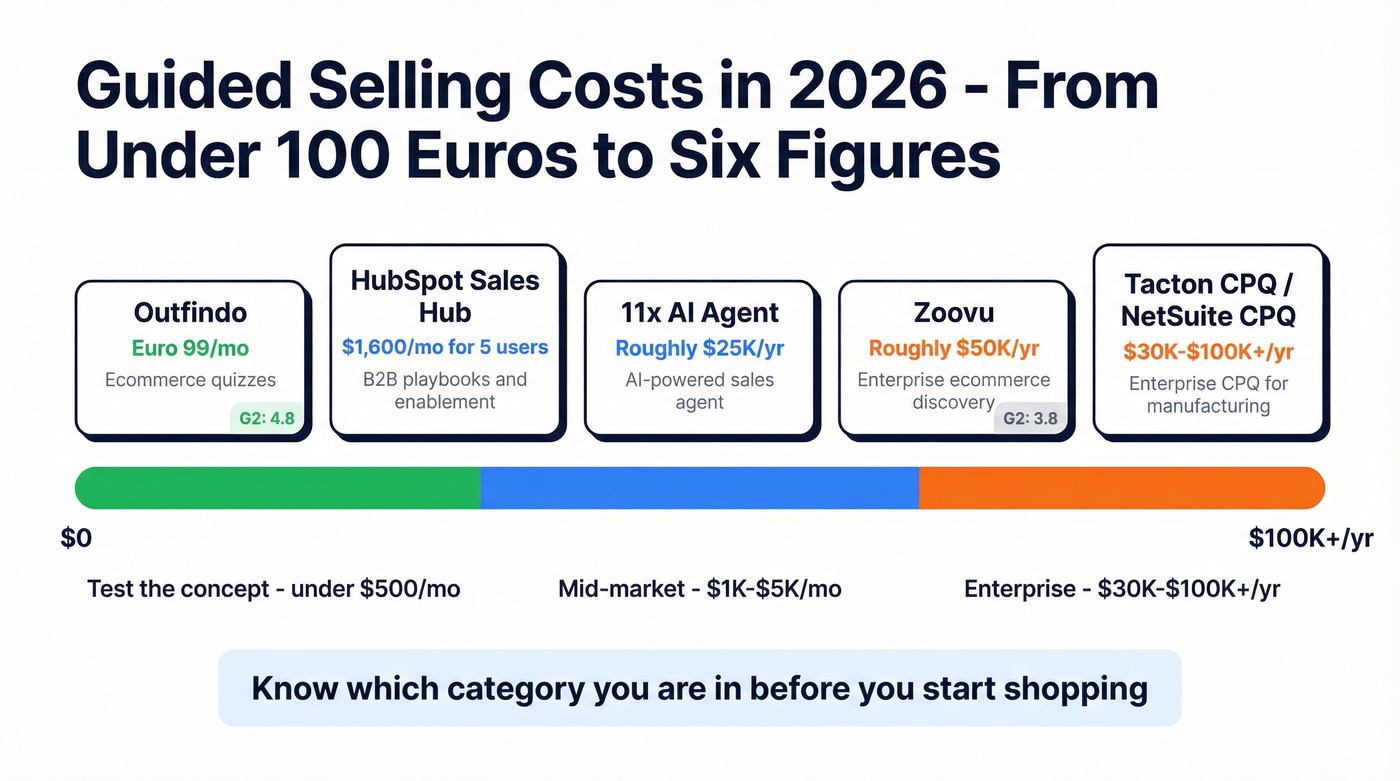
| Category | Tool | Starting Price | G2 Rating |
|---|---|---|---|
| Ecommerce Discovery | Outfindo | €99/mo | 4.8 |
| Ecommerce Discovery | Zoovu | ~$50K/yr | 3.8 |
| B2B Enablement | HubSpot Sales Hub | $1,600/mo (5 users) | - |
| B2B Enablement | HubSpot Sales Hub Enterprise | $5,000/mo | - |
| AI Sales Agent | 11x | ~$25K/yr | - |
| Enterprise CPQ | Tacton CPQ | ~$100K/yr | - |
| Enterprise CPQ | NetSuite CPQ | $30K-$100K+/yr | - |
A DTC brand testing product quizzes can start under €100/month. A manufacturing company implementing CPQ is looking at a six-figure annual commitment before integration costs. Know which category you're in before you start shopping.
Why Most Implementations Fail
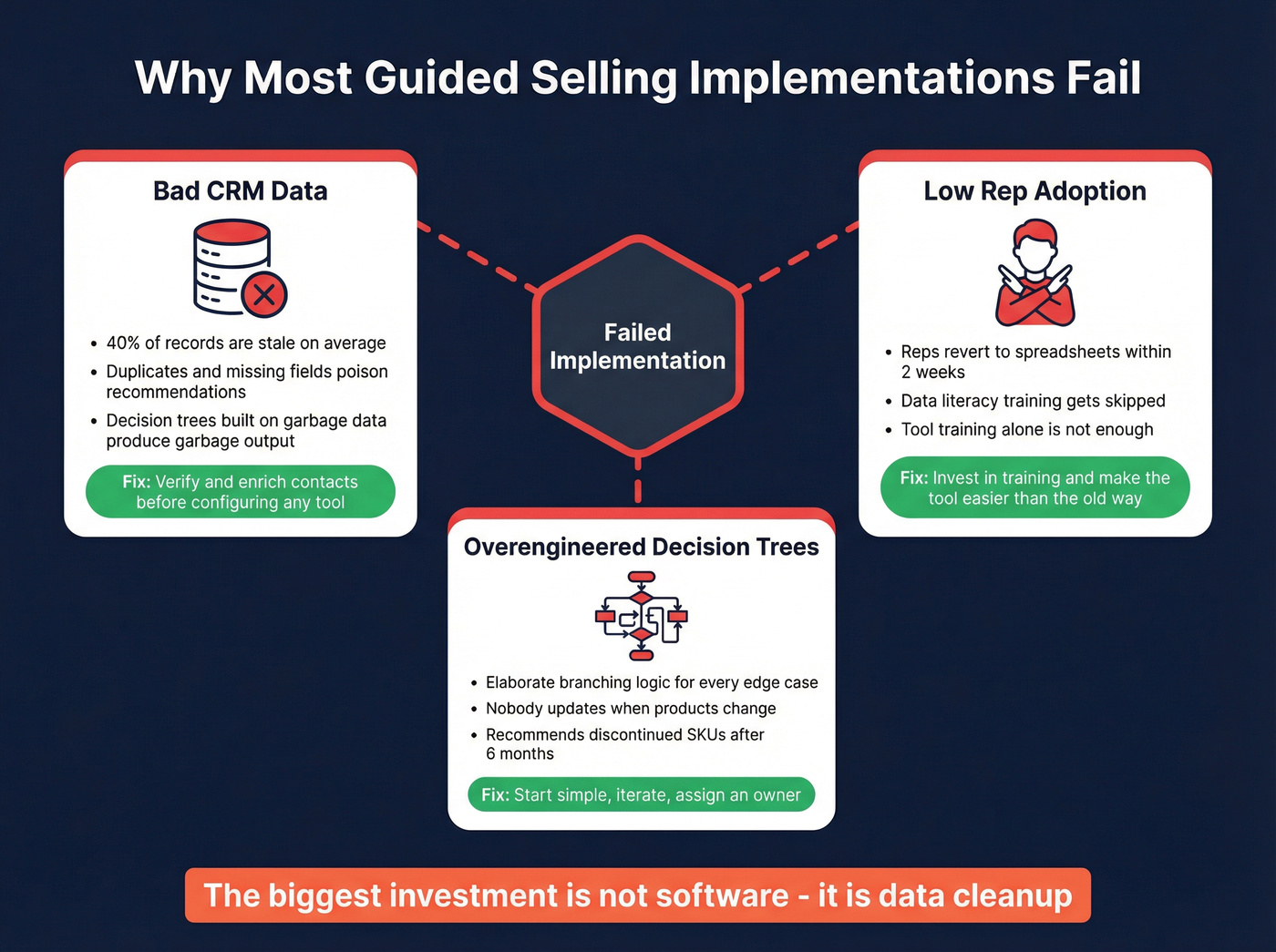
In our experience, three failure modes kill these projects repeatedly, and they're all preventable.
Bad CRM Data
This is the one we see most often, and it's the most frustrating because it's entirely within your control.
Guided selling systems pull from your CRM to personalize recommendations, route leads, and trigger playbooks. If your CRM is full of duplicates, outdated contacts, and records with no entry standards, the system's recommendations will be garbage - no matter how sophisticated the AI layer is. We've watched teams spend six months configuring decision trees only to realize the underlying data was 40% stale. Before investing in any platform, verify your prospect database. Prospeo checks emails in real time with 98% accuracy and refreshes records every 7 days, so your guided selling system starts with clean inputs instead of stale guesses.

Low Rep Adoption
You buy the tool, configure the decision trees, and reps revert to their spreadsheets within two weeks. The same Gartner guidance behind the AI-guided selling push also emphasized data literacy training - not just tool training - as a prerequisite. Skip this if you're only running B2C quizzes, but for B2B playbooks and CPQ, rep buy-in is make-or-break.
Overengineered Decision Trees
Teams build elaborate branching logic for every scenario, then nobody updates it when products change. Six months later, the tool recommends discontinued SKUs. Start simple, iterate, and assign an owner.
For CPQ specifically, integration issues between CRM, ERP, and ecommerce systems compound all three problems.
The biggest investment isn't software - it's data cleanup. Teams that skip the data audit waste most of their first-year software spend. The consensus on r/sales backs this up: threads about guided selling failures almost always trace back to dirty CRM data or zero rep training.
How to Start Without Six Figures
You don't need an enterprise CPQ to prove the concept works. Here's a practical path:
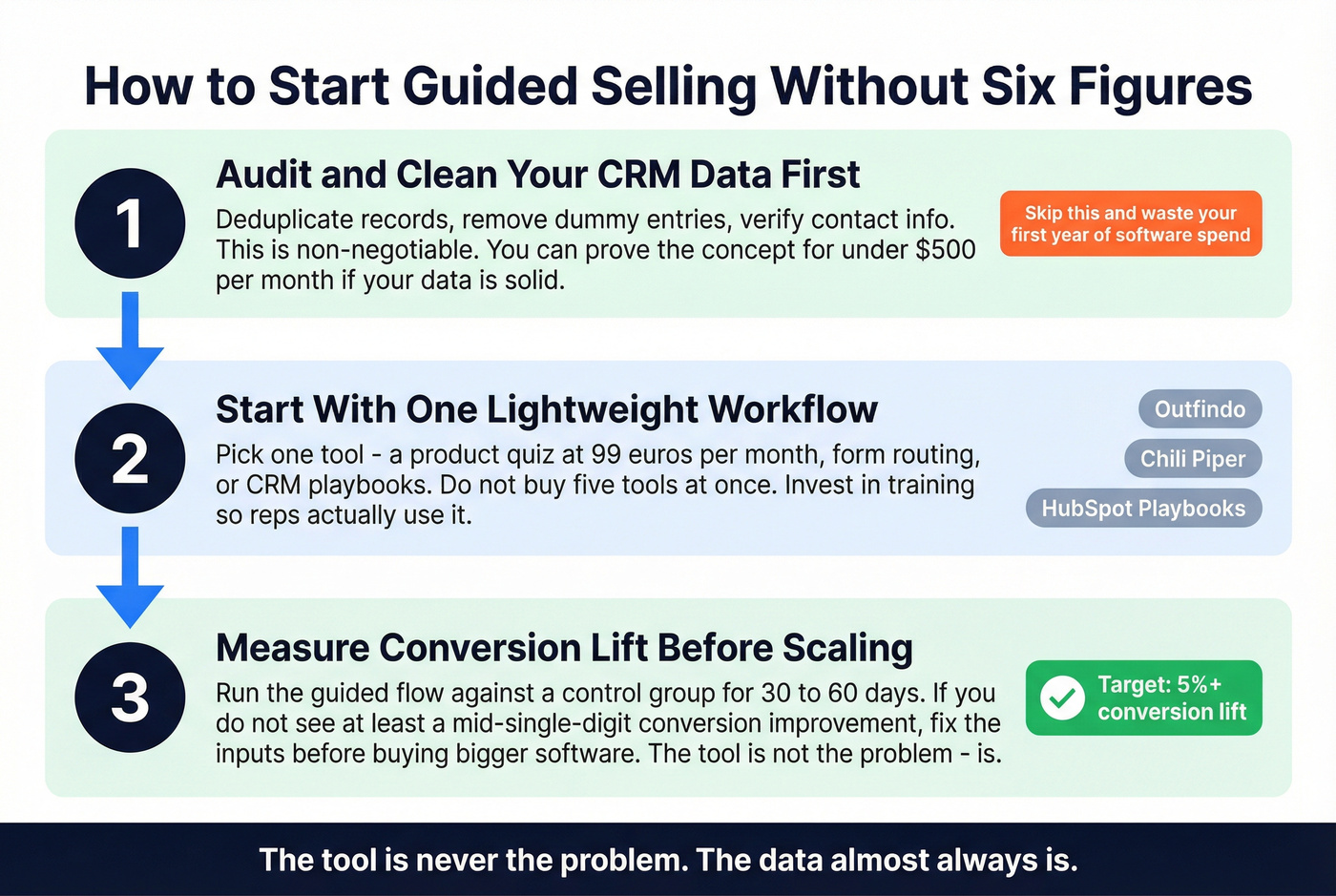
1. Audit and clean your CRM data first. Deduplicate, remove dummy records, verify contact info. This is non-negotiable. You can prove the concept for under $500/month if your data is solid.
2. Start with one lightweight workflow. A product quiz with Outfindo at €99/mo, form routing with Chili Piper, or HubSpot playbooks. Pick one, not five - and invest in training so reps actually use it.
3. Measure conversion lift before scaling. Run the guided flow against a control group for 30-60 days. If you're not seeing at least a mid-single-digit conversion improvement, fix the inputs before buying bigger software. The tool isn't the problem - the data almost always is.
If you want a benchmark-driven way to think about lift, start with your sales funnel and where drop-off happens.
Teams that skip the data audit waste months configuring logic on top of 40% stale records. Prospeo's CRM enrichment returns 50+ data points per contact at a 92% match rate - giving your guided selling system the clean inputs it needs to actually convert.
Fix the data layer before you touch the decision trees.
Guided Selling FAQ
Is guided selling the same as CPQ?
CPQ is one application of guided selling, focused on complex product configuration and pricing. The broader methodology also includes product recommendation quizzes, sales playbooks, and AI-driven next-best-action prompts. CPQ is a subset, not a synonym.
What's the cheapest way to test it?
Ecommerce quiz tools like Outfindo start at €99/month. For B2B, HubSpot playbooks start at $1,600/month for 5 users. Clean your CRM data first, then build a simple workflow to prove the concept before committing to enterprise pricing.
Does it work for small catalogs?
Less impactful when you sell 3-5 products - buyers can self-navigate. It delivers the most value with complex configurations, 20+ SKUs, or buyers who genuinely don't know what they need. Below that threshold, a well-structured product page usually outperforms a quiz.