Lead Development Representative (LDR): What the Role Actually Looks Like in 2026
You just got a job offer with "Lead Development Representative" in the title - or you spotted it on a job board and thought, "Wait, isn't that just an SDR?" You're not wrong to be confused. The LDR title is one of the most inconsistently used labels in sales, and most companies can't agree on what to call the role. Here's what actually matters.
The Quick Version
- An LDR is an inside sales role focused on inbound lead qualification. You qualify leads and hand them to AEs - you don't close.
- Only ~25% of companies formally split inbound and outbound into separate titles.
- Median OTE: ~$85K. Entry-level base runs $55K-$70K.
- Daily work: respond to inbound leads fast, qualify with a framework, book meetings, update CRM.
- AI is reshaping the role, but it isn't replacing it. LDRs who use AI tools will outperform those who don't.
What Is a Lead Development Representative?
An LDR is an inside sales professional who responds to inbound leads, qualifies them, and moves them through the pipeline - but doesn't close deals. The handoff goes to an Account Executive once a lead hits the qualification bar. Your primary metric is qualified leads passed against quota, with commission tied directly to that number.
Think of the lead development rep as quality control between marketing and sales. You make sure AEs only spend time on leads worth pursuing.
The classic distinction is that LDRs focus on inbound leads - marketing-generated MQLs, demo requests, content downloads - while BDRs handle outbound prospecting from scratch. In practice, only about 25% of companies formally split these roles. If your org calls it an LDR, you're almost certainly working inbound.
LDR vs SDR vs BDR
| LDR | SDR | BDR | |
|---|---|---|---|
| Lead Source | Inbound | Inbound or blended | Outbound |
| Focus | Qualify MQLs | Volume + qualification | Create pipeline |
| Funnel Stage | Mid-funnel (MQL to SQL) | Top-to-mid funnel | Top of funnel |
| Key Skill | Speed to lead, discovery | Multi-channel outreach | Research, personalization |
| Reports To | Often marketing (2.1x more likely than outbound teams) | 68% report to head of sales | Sales |
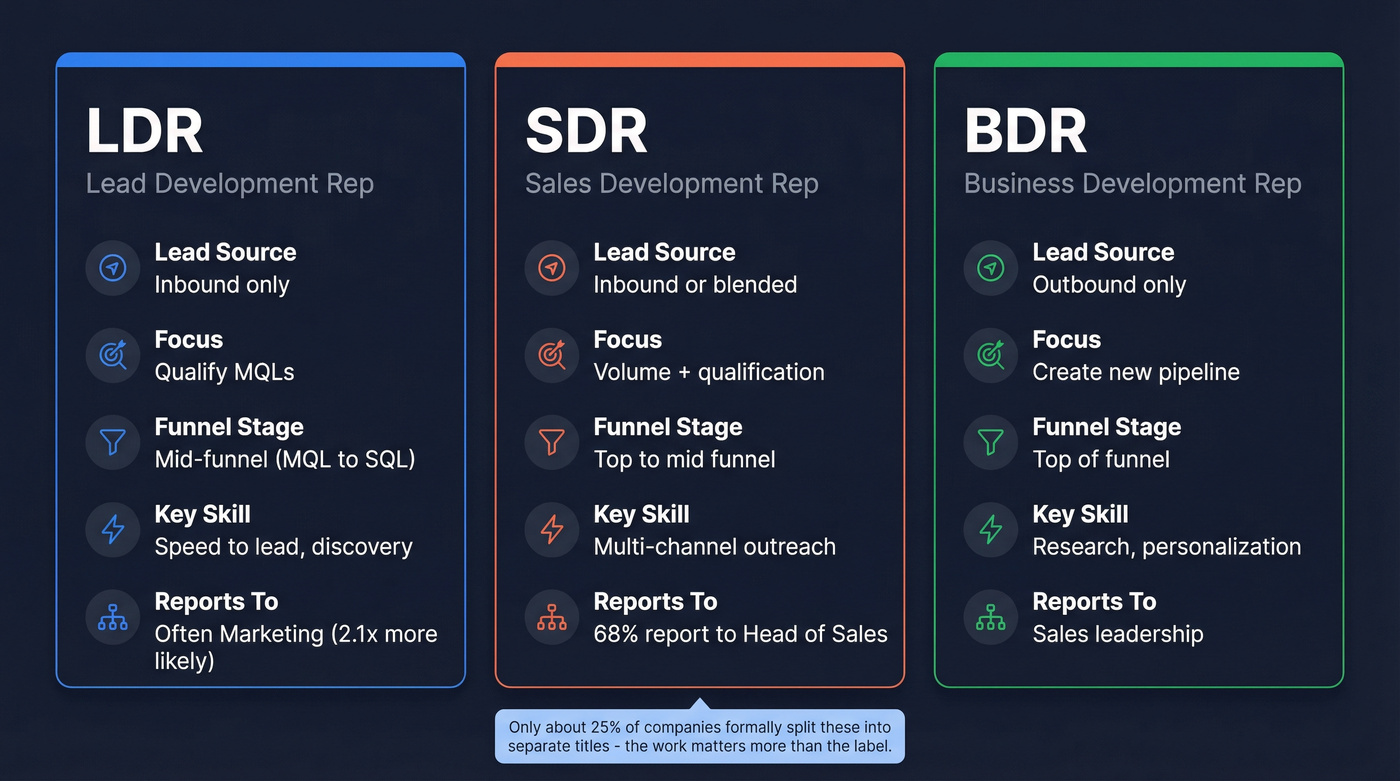
The reporting structure difference matters more than the title. Inbound-focused teams are 2.1x more likely to report to marketing than outbound teams, and that changes your KPIs, your tooling, and your career path. Don't overthink the label. Most hiring managers care whether you've worked inbound leads, outbound, or both.
A Typical LDR Day
Here's the thing about this role: it's structured, repetitive, and fast. That's a feature, not a bug.
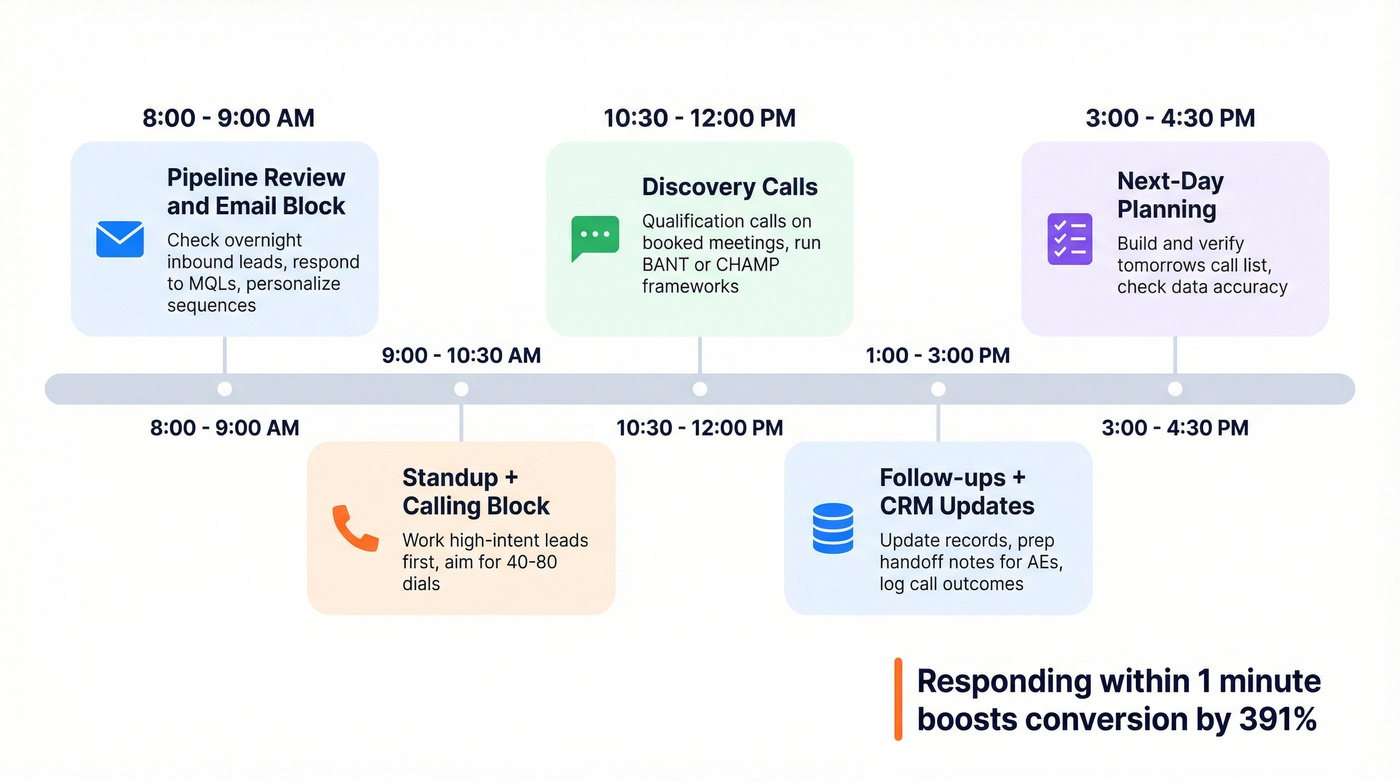
- 8:00-9:00 - Pipeline review and email block. Check overnight inbound leads, respond to MQLs, personalize sequences.
- 9:00-10:30 - Standup, then calling block. Work high-intent leads first. Aim for 40-80 dials.
- 10:30-12:00 - Discovery calls and qualification on booked meetings.
- 1:00-3:00 - Follow-ups, CRM updates, handoff prep for AEs.
- 3:00-4:30 - Next-day planning. Build and verify tomorrow's call list.
Speed matters more than most lead development reps realize. Responding within one minute boosts conversion rates by 391%. That single stat should dictate how you structure your morning. And verify your list before your calling block - bad data kills connect rates faster than anything else.


Speed to lead means nothing if the data is wrong. Prospeo gives LDRs 98% verified emails and 125M+ direct dials with a 30% pickup rate - so your morning calling block actually connects you to real buyers, not dead numbers.
Stop wasting your calling block on bounced emails and wrong numbers.
How LDRs Qualify Leads
Not every framework fits every deal.
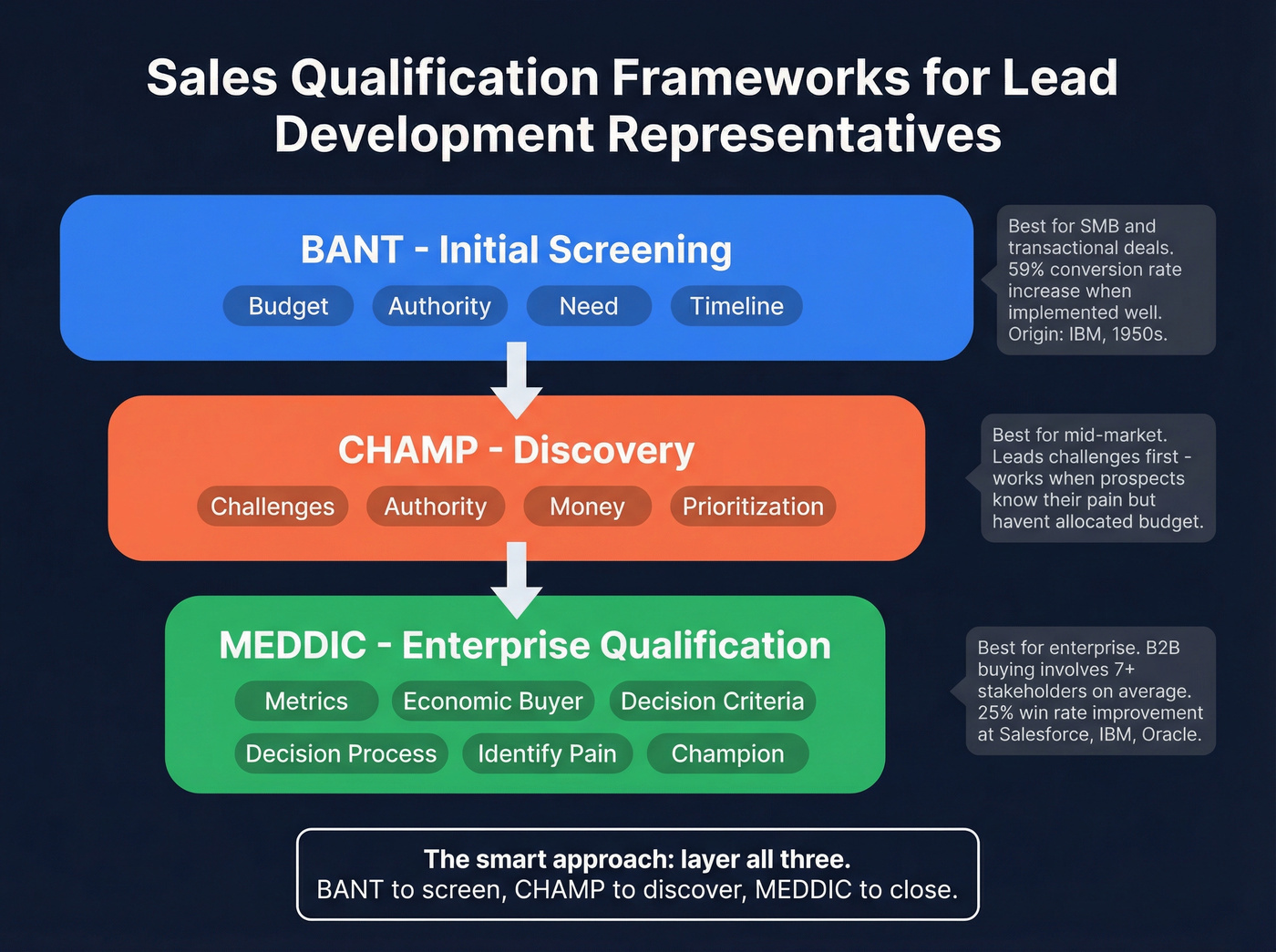
BANT (Budget, Authority, Need, Timeline) works best for SMB and transactional deals. It originated at IBM in the 1950s, and it still drives a 59% conversion rate increase when implemented well. CHAMP flips the order to Challenges first, which works better in mid-market where prospects know their pain but haven't allocated budget yet. MEDDIC is your enterprise play - B2B buying now involves an average of seven stakeholders, and MEDDIC is credited with a 25% win rate improvement at companies like Salesforce, IBM, and Oracle.
The smart approach: layer them. BANT for initial screening, CHAMP for discovery, MEDDIC for late-stage deal qualification. We've watched teams that adopt this layered approach compress their sales cycles significantly compared to single-framework shops. If you're only using one framework for every conversation, you're leaving qualified leads on the table.
LDR Salary in 2026
You'll still see ~$45K total comp figures quoted from older Glassdoor snapshots. Those are outdated. SDR/LDR salaries increased 5-10% from 2024, and the market has moved.
| Experience | Base Range | OTE Range | Notes |
|---|---|---|---|
| Entry-level | $55K-$70K | $70K-$90K | Higher in NY/SF |
| 6+ months | $60K-$75K | $80K-$100K | Up to $80K base in NY/SF |
| Top performers | $70K+ | $127K+ | RepVue top earners |
Only 57.3% of SDR/BDRs hit quota, which means the top performers earning $127K+ are a real but selective group. Variable comp ranges from 20-60% of base depending on location and company. If you're evaluating an offer, focus on the base-to-variable ratio and whether the quota is realistic - a $120K OTE means nothing if the quota is set so high that nobody's hitting it.
Career Path and Timeline
The average SDR/LDR stays in the role about 14 months before promotion. A realistic ladder:
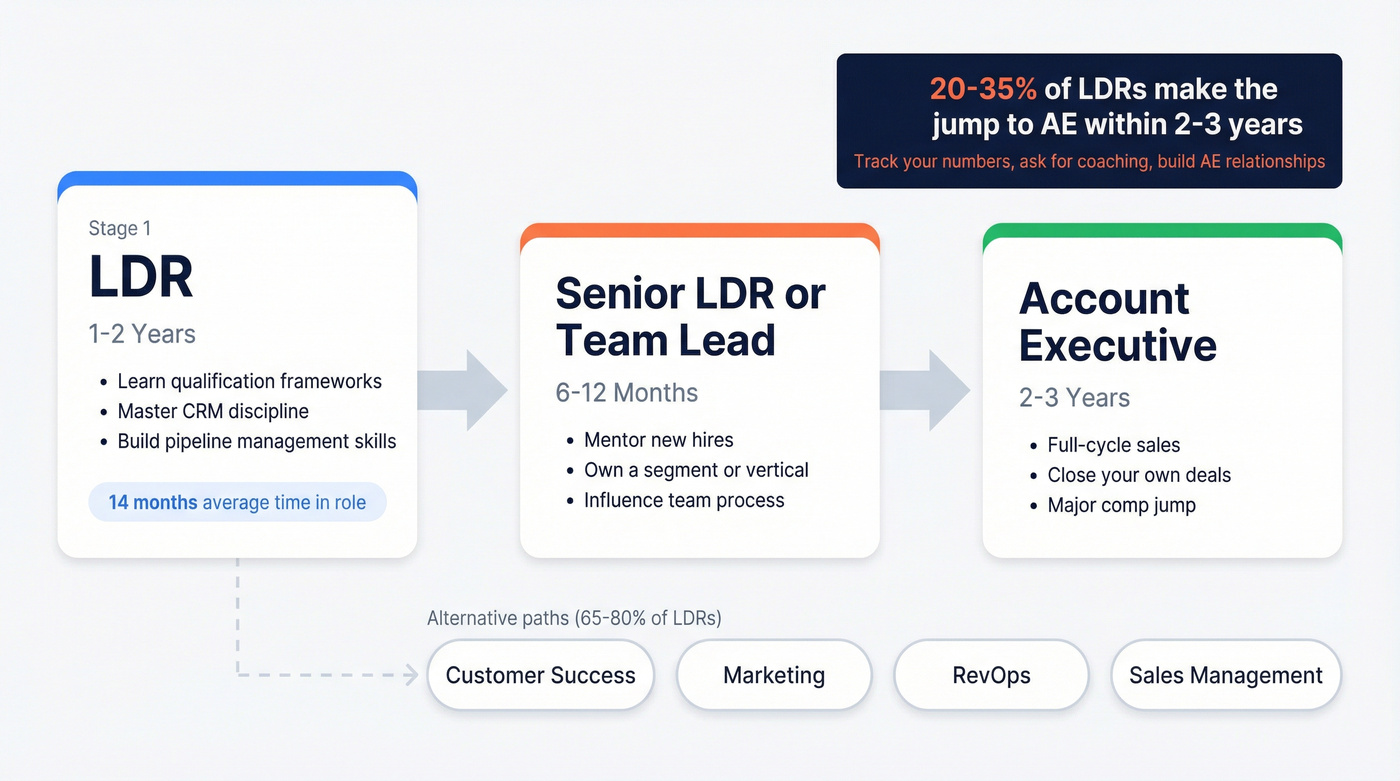
LDR (1-2 years) - Learn qualification, pipeline management, CRM discipline. This is boot camp. Roughly 20-35% of LDRs make the jump to AE within 2-3 years, and the rest move into customer success, marketing, RevOps, or management. About 65% have bachelor's degrees, but it's not a hard requirement - we've seen plenty of strong reps break in without one.
Senior LDR / Team Lead (6-12 months) - Mentor new hires, own a segment, start influencing process.
Account Executive (2-3 years) - Full-cycle sales, closing your own deals. This is where the comp jumps significantly.
Let's be honest: the LDR-to-AE path isn't guaranteed. If you're not tracking your numbers, asking for coaching, and building relationships with AEs who'll vouch for you, the promotion won't happen on autopilot.
Essential LDR Tools and Tech Stack
Your minimum viable stack is a CRM, a sequencer, and a data provider with verified contact info. Everything else is optional until you're hitting quota consistently.
CRM: HubSpot's free tier covers the basics for most LDR workflows. Salesforce starts around $25/user/month depending on edition if your company's already on it.
Sequencer: Outreach or Salesloft typically runs ~$100-$200/user/month depending on package and automates your cadences and call tasks.
Data provider: This is where most new LDRs underinvest, and it's the single biggest reason first-quarter reps miss quota. Bad phone numbers and bounced emails waste hours every week. Prospeo delivers 98% email accuracy and a 30% mobile pickup rate on 125M+ verified mobile numbers - compared to ~11-12.5% pickup rates from other providers, that gap is the difference between hitting quota and scrambling. The free tier gives you 75 verified emails per month plus 100 Chrome extension credits to test before committing budget.
Skip the $100K/year enterprise tech stack if your company's average deal size is under $15K. A free CRM, a basic sequencer, and accurate contact data will outperform an enterprise suite that nobody's configured properly. The consensus on r/sales backs this up - new reps consistently report that data quality matters more than tool sophistication.
The article says bad data is the #1 reason first-quarter LDRs miss quota. Prospeo refreshes every record every 7 days - not the 6-week industry average - so the MQLs you qualify today have contact info that actually works tomorrow. At $0.01 per email, it costs less than a single wasted dial.
Hit your qualified-lead quota with data that's never more than a week old.
Will AI Replace LDRs?
A fully loaded human LDR costs $75K-$110K/year. An AI SDR solution runs $15K-$35K/year, dropping cost-per-lead from ~$262 to ~$39. Human reps break even in about 8.7 months; AI tools hit ROI in roughly 3.2 months with clean data.
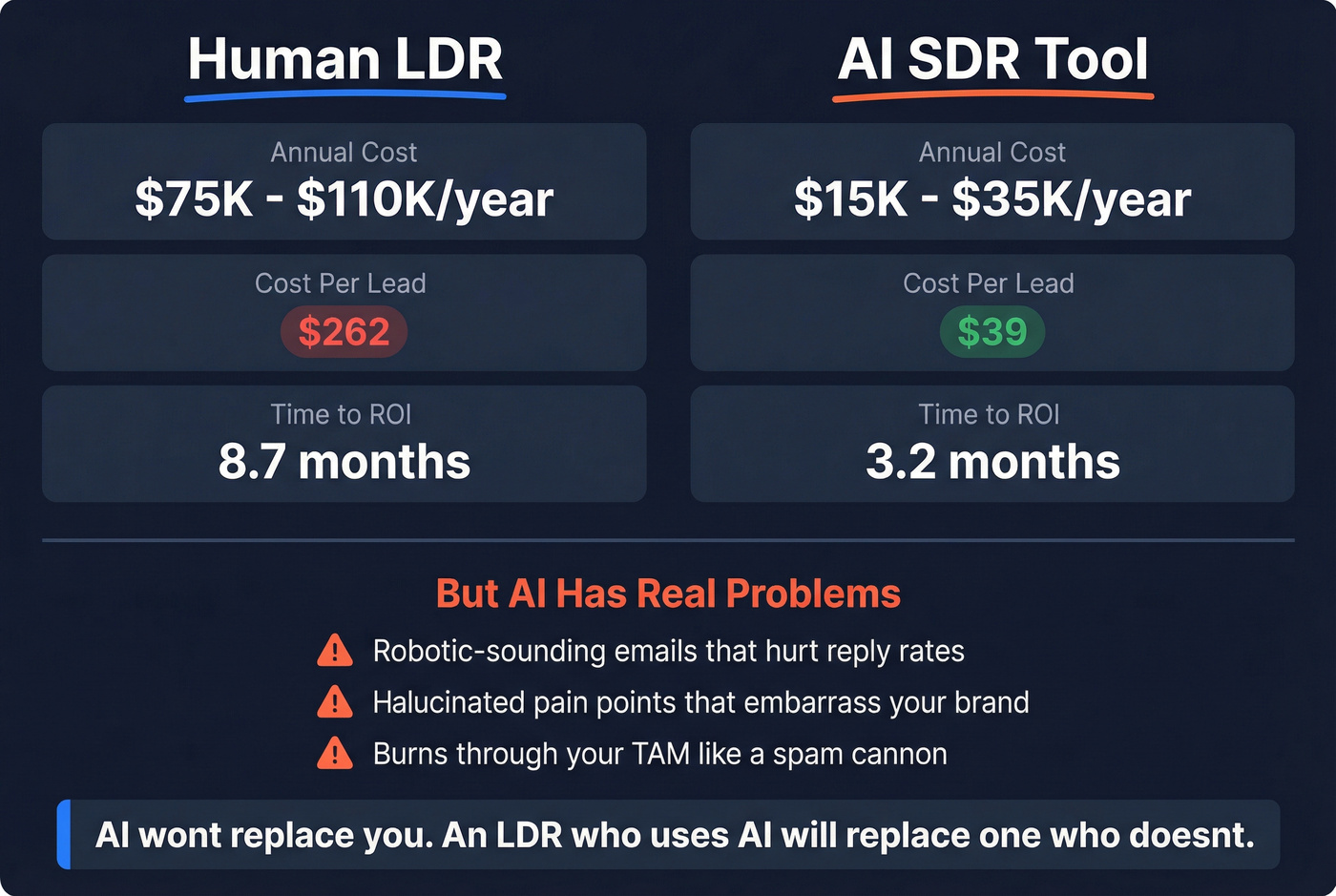
But AI outreach has real problems. AI-generated emails are often robotic, prone to hallucinating pain points, and can burn through your total addressable market like a spam cannon. Brand damage from bad AI outreach doesn't show up in the cost-per-lead math, and it's the kind of damage that takes months to undo.
Expect the role to split over the next few years - GTM Engineers handling tech-driven outreach and relationship-focused reps handling high-touch accounts. AI won't replace you. An LDR who uses AI will replace one who doesn't.
FAQ
Is an LDR the same as an SDR?
Not exactly. The classic split is that LDRs handle inbound leads while SDRs and BDRs work outbound or a blend. Only about 25% of companies formally separate the roles. What matters more than the title is whether you're working inbound, outbound, or both - and which team you report to.
What's a realistic LDR salary in 2026?
Median base is ~$60K with OTE around $85K for a lead development representative. Entry-level base runs $55K-$70K. Top performers earn $127K+. NY and SF pay 10-15% more than remote or central time zone roles.
What tools do lead development reps need?
A CRM (HubSpot free tier or Salesforce), a sequencing tool (Outreach or Salesloft), and a data provider with verified contacts. The data provider is where most new LDRs underinvest - bad contact data wastes more time than any other bottleneck.
How long does it take to get promoted from LDR to AE?
The average is about 14 months in-role. Most LDRs need 3+ months to ramp before they're fully productive, so plan on roughly 18 months total from hire date to promotion readiness. About 20-35% of reps make the jump within 2-3 years.