SDR Definition: What a Sales Development Representative Actually Does in 2026
You just got the offer email. "Sales Development Representative - $60K base, $85K OTE, unlimited growth potential." Your parents don't know what it means. Your friends think you're going to be cold-calling people about their car's extended warranty. And when you search for the SDR definition, half the results are about the International Monetary Fund's Special Drawing Rights and the other half are about Software Defined Radio.
Let's fix that.
The SDR role is one of the most common entry points into B2B tech sales - and one of the most misunderstood. It's not a call center job. It's not a dead-end. But it's also not the guaranteed rocket ship to a $200K AE role that some recruiters will pitch you. The truth sits somewhere in the middle, and the specifics matter a lot more than the job title.
What You Need (Quick Version)
What is it? An SDR is an entry-level B2B sales role focused on prospecting and qualifying leads, then booking meetings for Account Executives who close the deals. If you've been wondering what SDR stands for in sales, it's simply Sales Development Representative.
What does it pay? Median OTE is $85K per RepVue's 2026 data. Top performers hit $128K. Entry-level base starts around $60K.
Is it worth it? Yes - if you pick the right company. SDRs who perform well typically get promoted to AE within 12-18 months, where median OTE jumps to $130-175K. But "SDR purgatory" is real. If you're at a company with broken comp plans, unrealistic quotas, and no promotion path, you'll burn out before you level up.
How hard is it? It takes 18+ touches to book a single meeting in 2026. You'll make ~35 calls and send ~33 emails per day. You'll spend just 2 hours actually selling. The rest is research, admin, and fighting bad data.
What Is an SDR? The Full Sales Development Representative Definition
A Sales Development Representative is the top-of-funnel engine in a B2B sales organization. In the simplest terms: SDRs don't close deals. They find potential buyers, qualify whether those buyers are worth pursuing, and book meetings for Account Executives who handle the rest.
The AE is the surgeon. The SDR is the triage nurse - figuring out which patients actually need surgery and which ones are just browsing WebMD.
The role exists for a simple economic reason. AEs are expensive. A mid-market AE costs $130-175K in OTE. An enterprise AE runs $265K+. Having those people spend their day cold-calling prospects is like paying a lawyer to do their own filing. The average SDR-to-AE ratio is 1:2.6 - each rep feeds qualified meetings to roughly 2-3 AEs.
This isn't just organizational theory. Companies with dedicated sales development teams report 15-20% higher lead-to-opportunity conversion rates, per McKinsey's B2B Pulse survey. And 68% of high-growth SaaS companies attribute their pipeline predictability directly to specialized SDR teams.
The core job breaks down into three activities:
- Prospecting - finding the right people at the right companies using data tools, intent signals, and research
- Qualifying - determining whether a prospect matches the ideal customer profile and has real buying intent
- Booking - getting qualified prospects on the calendar with an AE for a discovery call or demo
Everything else - the call blocks, the email sequences, the LinkedIn messages, the CRM updates - is just plumbing that supports those three activities.
What Does an SDR Actually Do All Day?
The gap between what job descriptions say and what sales development reps actually do is enormous. Job descriptions talk about "building pipeline" and "driving revenue." The reality involves a lot of dialing into voicemail, writing emails that get ignored, and updating Salesforce fields.
A Typical SDR Day by the Numbers
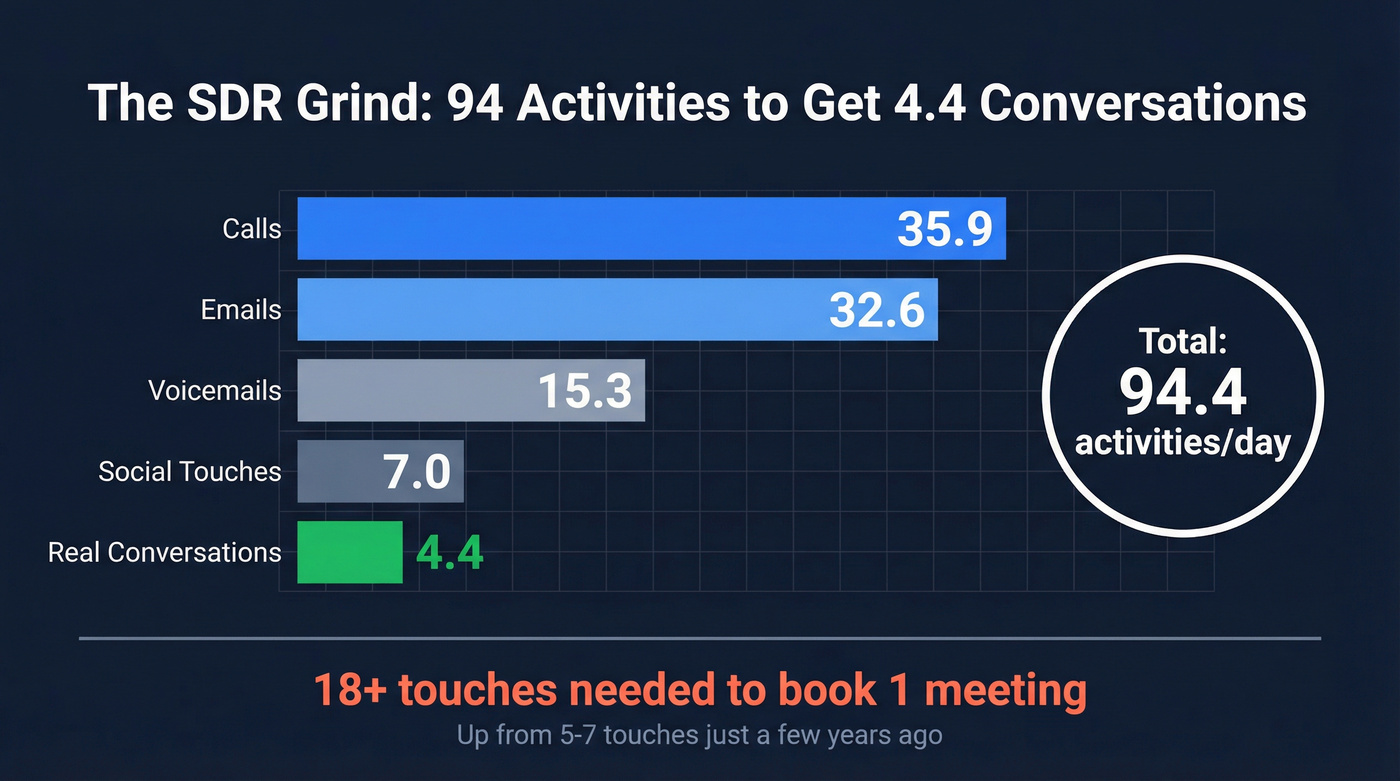
Here's what the data says about a typical daily activity breakdown:
| Activity | Daily Average |
|---|---|
| Calls | 35.9 |
| Emails | 32.6 |
| Voicemails | 15.3 |
| Social touches | 7.0 |
| Total activities | 94.4 |
| Actual conversations | 4.4 |
That's roughly 94 activities to generate 4.4 real conversations. And it takes 18+ of those touches - spread across multiple channels and days - to book a single meeting. A few years ago, that number was 5-7. The bar keeps rising.
Multi-channel outreach (email + phone + social) boosts results by 287% compared to single-channel approaches. The reps who only email or only call are fighting with one hand tied behind their back.
The Reality Nobody Tells You
SDRs spend just 2 hours per day actively selling. The rest goes to research, CRM updates, list building, and admin work. Quality conversations per day have dropped 45% since 2014 - from roughly 8 down to 4.4.
Here's the thing: half of that already-limited selling time gets wasted on bad data. Disconnected phone numbers. Bounced emails. Contacts who left the company six months ago. The average response time to a new inbound lead is 42 hours - and only 7% of companies respond within 5 minutes. That's a staggering amount of pipeline left to rot.
Smart SDRs run prospect lists through a verification tool like Prospeo before loading them into their sequencer - one bounced email can tank your domain reputation across an entire campaign. When it takes 18+ touches to book one meeting, every disconnected number compounds the waste.
The reps who consistently hit quota aren't the ones making the most dials. They're the ones making the most informed dials - with verified contact data, intent signals, and actual research behind each touch.

SDRs only get 2 hours of actual selling time per day. Bad data eats half of it. Prospeo's 98% email accuracy and 7-day data refresh mean every one of those 18+ touches lands on a real person - not a bounced inbox or disconnected number.
Stop burning dials on dead contacts. Verify before you sequence.
SDR vs. BDR - What's the Actual Difference?
This is one of the most confusing distinctions in sales, mostly because companies use the titles interchangeably. But understanding the difference matters if you're evaluating job offers or building a team.

The classic split:
| SDR | BDR | |
|---|---|---|
| Primary focus | Inbound qualification | Outbound prospecting |
| Lead source | Marketing-generated | Self-sourced |
| Daily calls | 40-60 (warm) | 60-80 (cold) |
| OTE range | $60-85K | $70-95K |
| Personality fit | Detail-oriented, responsive | Hunter mentality, self-starter |
SDRs traditionally work inbound leads - website form fills, content downloads, webinar registrations. Their job is to qualify those leads quickly and route the good ones to AEs. Speed matters here: the first vendor to respond captures 35-50% of sales, and responding within 5 minutes makes you 9x more likely to convert.
BDRs work outbound. They build target account lists, write cold outreach, and create opportunities from scratch. It's harder, which is why BDR comp tends to run slightly higher.
But here's the trend that matters: 36% of companies now run hybrid roles where reps handle both inbound and outbound. The traditional split creates handoff friction that hurts pipeline. Buyers don't experience your go-to-market as separate buckets - they experience a series of touches from your company, and they don't care which internal team sent them.
Over-specialization hurts more teams than it helps. The exception is large enterprises with high inbound volume. If you're getting 500+ inbound leads per month, you need someone whose only job is triaging them fast. For most companies under 200 employees, the SDR/BDR distinction is academic. You need reps who can do both.
SDR Salary and Compensation in 2026
Most salary guides are inflating numbers. Glassdoor tends to report higher OTE figures than rep-reported platforms. RepVue - which aggregates actual data from thousands of sales professionals - says $85K median OTE. I trust the number that comes from people who actually carry a quota.
Here's how comp breaks down by experience level:
| Experience | OTE Range | Base/Variable Split |
|---|---|---|
| Entry (0-1 yr) | $70-75K | 70/30 |
| Mid (1-3 yrs) | $80-90K | 65/35 |
| Senior (3-5+ yrs) | $90-100K+ | 60/40 |
| Top performers | Up to $128K | Varies |
The median base salary is $60K. Variable comp makes up the rest. As you gain experience, the split shifts toward more variable - higher upside but more risk.
Geography matters enormously. Seattle leads the pack at $160K median OTE. Remote roles average just $66.6K. That's a $94K gap for the same job title.
How SDR Pay Actually Works
Commission structures fall into four buckets:

- Meeting-based: ~$50 per qualified meeting booked. Simple, easy to track, but incentivizes quantity over quality.
- Quality-driven: ~$100 per SQL (Sales Qualified Lead). Better alignment with pipeline quality.
- Revenue-aligned: 1-5% of closed deal value from SDR-sourced opportunities. Highest upside, but you're at the mercy of AE close rates.
- Hybrid: Some combination of the above. Most common at mature orgs.
A healthy quota-to-OTE ratio runs 4:1 to 6:1. If your OTE is $85K and your annual quota is $340-510K in pipeline, that's reasonable. If they're asking you to generate $1M+ in pipeline for $85K OTE, the math doesn't work - and you'll be one of the 45% who misses quota.
What Top Performers Earn (and Why Most Don't Hit OTE)
Here's the number nobody wants to talk about: average quota attainment is 54-57%, depending on the source. That means most reps don't earn their full OTE. Ever.
Top performers - the ones hitting $128K - are doing something fundamentally different. They're not just working harder. They're working smarter accounts, using better data, running multi-channel sequences, and often benefiting from favorable territory assignments.
The companies with strong comp programs see 50% higher retention. And the #1 reason sales professionals want to leave? Unrealistic sales targets. If over half your team is missing quota, that's not a people problem - that's a company problem.
SDR Metrics That Matter
The metric I'd watch most closely: conversations per day. If you're having fewer than 4 real conversations daily, something's broken upstream - either your data quality, your targeting, or your messaging. Fix the input before you try to fix the output.

Activity metrics without quality metrics are a red flag. If your manager only tracks dials and emails sent, you're working at a company that values motion over results. Here are the benchmarks that actually matter:
| Metric | Benchmark |
|---|---|
| Calls/day | 40-50 |
| Emails/day | 10-40 |
| Meetings booked/month | 5-25 |
| SQLs/month | 20 |
| SAOs/month | 4 |
| Quota attainment | 56-68% |
| Pipeline generated/year | $3M median |
| Close rate (SDR-sourced) | 22% |
| Email reply rate (cold) | 1-5% |
| Email reply rate (good sequences) | ~12% |
A few numbers worth calling out:
Outbound-sourced deals are 50% larger than inbound deals. That's the business case for investing in outbound teams even when inbound is working. The deals are bigger, and the team controls the targeting.
Sales development reps generate 46-73% of pipeline conversion depending on the org. And 22% of SDR-sourced opportunities close as won deals - solid when you consider these are cold-sourced prospects who weren't raising their hand.
The TOPO Sales Development Benchmark Report set many of these benchmarks, and they've held remarkably steady - except for the touches-per-meeting number, which keeps climbing. The game is getting harder, not easier.
The SDR Tech Stack in 2026
Companies adopting advanced sales technology grow revenue 2-3x faster. But the tool doesn't matter if you don't know how to use it. We've seen teams buy $50K platforms and use 10% of the features.
Here's the recommended learning order: master your CRM first, then one outreach platform, then a prospecting data tool. Don't try to learn everything at once.
CRM: Salesforce or HubSpot. These are table stakes. If you can't navigate your CRM efficiently, nothing else matters. Every activity, every note, every stage change lives here.
Prospecting & Data: This is where the quality of your pipeline gets determined. Prospeo's 98% email accuracy and 7-day data refresh cycle solve the bad-data problem at the source - you're not calling people who left the company last quarter, a problem that plagues tools refreshing on 4-6 week cycles. The platform covers 300M+ professional profiles and 125M+ verified mobile numbers with a 30% pickup rate, and it integrates natively with Salesforce, HubSpot, Outreach, and Salesloft. There's a free tier to start with. Apollo.io is another solid option with a generous free tier and 275M+ contacts. ZoomInfo is the enterprise standard but runs $15-40K/year - overkill for most teams at growth-stage companies. Lusha, Clay, LeadIQ, and Cognism round out the category with different strengths.

As one rep on r/salesdevelopment put it: "I run lists through two verifiers minimum." That's not paranoia - it's math. When it takes 18+ touches to book one meeting, every bounced email and disconnected number compounds the waste.
Outreach & Sequencing: Outreach.io and Salesloft are the category leaders for enterprise teams. Instantly, Smartlead, and Lemlist are strong for high-volume outbound at lower price points ($30-150/month range).
Calling: Orum is the parallel dialer that's taken over SDR floors - it dials multiple numbers simultaneously so you're always talking to someone. Aircall is a solid alternative.
Intent & Signals: 6sense and Bombora help you prioritize accounts showing buying intent. This is the difference between cold outreach and warm cold outreach. (If you want to go deeper, start with intent signals and then graduate to intent data.)
Scheduling: Chili Piper routes and books meetings instantly when a prospect says yes. Eliminates the back-and-forth that kills conversion.
SDR Career Path - Where Does the Role Lead?
The sales development representative role isn't the destination. It's the on-ramp.
| Path | Timeline | OTE Range |
|---|---|---|
| Account Executive | 12-18 months | $130-175K |
| Customer Success | 15-20 months | $80-110K |
| Revenue Operations | 18-24 months | $90-130K |
| Sales Management | 24-36 months | ~$155K |
The AE Track (Most Common, Highest Earning Ceiling)
Most SDRs aim for AE. It's the obvious move - you've been booking meetings for AEs, now you want to run them yourself. High performers get promoted in 10-12 months. The average is 12-18 months, though that timeline increased 28% post-pandemic to 15-16 months at many companies.
The earning ceiling is real. Mid-market AEs hit $175K OTE. Enterprise AEs run $265K+. That's a 2-3x jump from SDR comp within a few years.
But here's what a 7-year sales veteran shared on Reddit: "In hindsight, my years as an SDR & BDR were some of the most enjoyable of my career." The camaraderie, the learning curve, the energy of an SDR floor - it's a unique experience. Don't rush through it so fast that you miss the skill-building.
Alternative Paths Worth Considering
CS and RevOps are underrated alternatives to the AE track. Not everyone wants to carry a closing quota. Not everyone thrives under the pressure of "80% of your revenue comes from 20% of your deals."
Customer Success uses the relationship skills you built as a sales development rep. RevOps uses the systems thinking - you've lived inside the CRM, the sequencer, the data tools. You understand the plumbing better than anyone.
In our experience, SDRs who were mediocre on the phones sometimes become exceptional in RevOps because they understood the data flow from lead to close better than anyone who'd never worked the top of funnel. Marketing is viable too, especially demand gen, where your prospect insight is genuinely valuable.
How to Know When You're Ready
Promotion readiness comes down to a few indicators: 90%+ quota attainment for two consecutive quarters, consistent pipeline quality (not just volume), and demonstrated ability to run discovery conversations that AEs trust.
Shadow AE meetings whenever possible. Find an AE mentor internally. Discuss your promotion timeline explicitly with your manager - don't assume it'll happen automatically.
And if you've been hitting quota consistently for 18+ months with no promotion path in sight? Start interviewing externally. Waiting a few extra months for a promotion to AE is worth it at a great company. Waiting indefinitely at a company that doesn't promote from within is a career mistake.
Will AI Replace SDRs?
Jason Lemkin - one of the most influential voices in SaaS - predicted that "most SDRs will be AI SDRs in 2026+." The data supporting his case is uncomfortable:
- AI SDRs answer technical questions correctly 87% of the time vs. 15% for human reps
- Human reps require technical follow-up on 73% of calls; AI handles it on just 22%
- Time to technical qualification: 8.3 days for humans, 2.1 days for AI
- AI SDRs handle 3-5x more conversations than human reps
- As of 2025, at least 30% of outbound messages were AI-generated - up 98% from 2022, per Gartner. That number has only climbed since.
The argument is straightforward: 95%+ of sales development reps are entry-level. They don't deeply understand what they're selling. AI can be trained on product knowledge, competitive positioning, and objection handling in ways that a 23-year-old six weeks into the job simply can't match.
But here's where the "AI replaces SDRs" narrative breaks down.
Complex negotiation, relationship building, reading a room, navigating enterprise politics, handling the prospect who's having a bad day - these are human skills. AI SDRs still need to be trained extensively and QA'd daily. There's no "set and forget."
The more accurate prediction: AI won't replace SDRs entirely, but it will replace SDRs who refuse to use AI.
The reps who'll thrive in 2026 and beyond are the ones using AI for research, personalization, first-draft messaging, and admin - then spending their human hours on actual conversations. The 2 hours of active selling per day? AI can help you make those 2 hours count for 4.
If you're entering the role today, learn AI tools the same way you'd learn your CRM. It's not optional anymore. Use ChatGPT to research accounts before calls. Use Gong or Chorus to analyze your best conversations. Use AI writing assistants to draft personalized first lines at scale. The reps who can prompt an AI to research an account, draft a personalized sequence, and summarize a call in real time will outperform the ones who can't - by a wide margin.
Mistakes That Kill SDR Careers
These aren't theoretical. They come straight from practicing reps who've lived through them.
Assuming promotion is guaranteed. "SDR purgatory is real." Not every company promotes from within. Not every manager advocates for their reps. Some companies treat the role as a permanent cost center, not a development pipeline. Ask about promotion rates and timelines before you accept the offer.
Believing in a golden pitch. There's no magic email. There's no perfect cold call script. As one experienced rep put it: "It's all about Product, Territory, and Timing." You can be the best rep on the floor and still miss quota if you're selling a mediocre product into a saturated territory at the wrong time. A mediocre rep with a hot product and a fresh territory will look like a genius.
Spray and pray in mature markets. Blasting 200 generic emails a day works when you're the first vendor in a new category. In a mature market with 15 competitors, it's noise. Strategy beats volume every time.
Underestimating politics. Top reps often win because of favorable territories, internal support, or political leverage - not just skill. This is the uncomfortable truth nobody puts in job descriptions.
Letting bad companies gaslight you. If over half your team misses quota, that's a company problem. Full stop. Don't internalize systemic failure as personal failure. (If you're seeing this pattern, it's usually one of the classic sales pipeline challenges upstream.)
Getting complacent. You can go from hero to zero in one month. Sales is streaky. The moment you stop prospecting because you had a good month, next month punishes you.
Ignoring your mental health. One 7-year sales veteran shared: "I've had a lot of colleagues end up with bad anxiety. I've seen friends manage stress badly with alcohol and drugs." The highs in sales are very high and the lows are very low. Exercise, therapy, and a life outside of sales aren't luxuries - they're infrastructure. Build those habits before you need them.
Top SDRs don't make more calls - they make more informed calls. Prospeo gives you 300M+ verified profiles with intent data, direct dials with 30% pickup rates, and emails at $0.01 each. That's how you hit quota without burning out.
Build prospect lists that actually convert into booked meetings.
FAQ
What does SDR stand for in sales?
SDR stands for Sales Development Representative - an entry-level B2B sales role focused on prospecting, qualifying leads, and booking meetings for Account Executives who handle closing. The role centers on top-of-funnel pipeline generation, not deal closure. Median OTE in 2026 is $85K, with top performers reaching $128K.
How long should you stay in an SDR role?
12-18 months is the sweet spot for most reps. High performers get promoted to Account Executive in 10-12 months. If you've hit quota consistently for two quarters with no clear promotion path after 18 months, start interviewing externally - loyalty without reciprocity is a career mistake.
What's the difference between an SDR and a BDR?
SDRs traditionally qualify inbound leads from marketing, while BDRs prospect outbound and create opportunities from scratch. BDR comp runs slightly higher ($70-95K OTE) because outbound is harder. That said, 36% of companies now combine both functions into hybrid roles, making the distinction increasingly academic.
What tools do SDRs need to be effective?
At minimum: a CRM (Salesforce or HubSpot), a sequencing tool (Outreach or Salesloft), and a prospecting data platform with verified contacts. Add a parallel dialer like Orum and intent data from 6sense or Bombora as you scale.
Will AI replace the SDR role?
AI won't fully replace sales development reps, but it will replace those who refuse to use it. AI handles technical qualification 4x faster and manages 3-5x more conversations, yet complex negotiation, relationship building, and reading a room remain human strengths. The winning approach in 2026 is using AI for research and drafting while spending human hours on real conversations.