How to Build a Competitor Landscape That Actually Drives Decisions
It's Tuesday morning. The CEO walks into the all-hands and asks, "Who are we really competing against?" You pull up the last competitive analysis - dated seven months ago, missing two new entrants, still listing a competitor's pricing from before their rebrand. Nobody trusts it. Nobody uses it.
That's not unusual. 44% of companies admit to having zero visibility into their competitor landscape. The problem isn't effort - it's that most analyses are built as one-off projects, handed off as static PDFs, and left to rot.
Let's fix that.
What Is a Competitor Landscape?
A competitor landscape is a structured view of every company competing for your buyer's attention and budget. It maps who they are, what they offer, how they position, and where they're headed.
Here's the distinction that matters: a competitor landscape analysis is a point-in-time snapshot. Competitive intelligence is the ongoing process of gathering, analyzing, and distributing that information so it stays useful. Most teams build the snapshot and skip the intelligence, which is exactly why the analysis collects dust within 30 days.
This isn't a niche concern. 90% of Fortune 500 companies actively use competitive intelligence tools and techniques. The CI market was valued at $50.87B in 2024 and is projected to hit $122.77B by 2033 at a 9.1% CAGR. The enterprise world takes this seriously. Mid-market and startup teams should too - they just need a lighter-weight approach.
What You Need (Quick Version)
Five competitor types to track: Direct, Indirect, Perceived, Aspirational, and Emerging. Cap it at 10 total.
Three frameworks that matter:
- SWOT scored 1-5 (not just bullet points)
- Porter's Five Forces rated Low/Medium/High
- Feature comparison matrix with a pricing row
Monitoring cadence: Daily for pricing pages and press releases. Weekly for blog content and reviews. Bi-weekly for everything else.
Your data starting point: A B2B data platform for contact enrichment and intent signals, plus one SEO tool for content and keyword gap tracking.
Now let's go deeper.
The Cost of Ignoring Competitors
Sellers face competitors in 68% of their deals. If your reps can't articulate why you're different - with current, specific evidence - those deals slip.
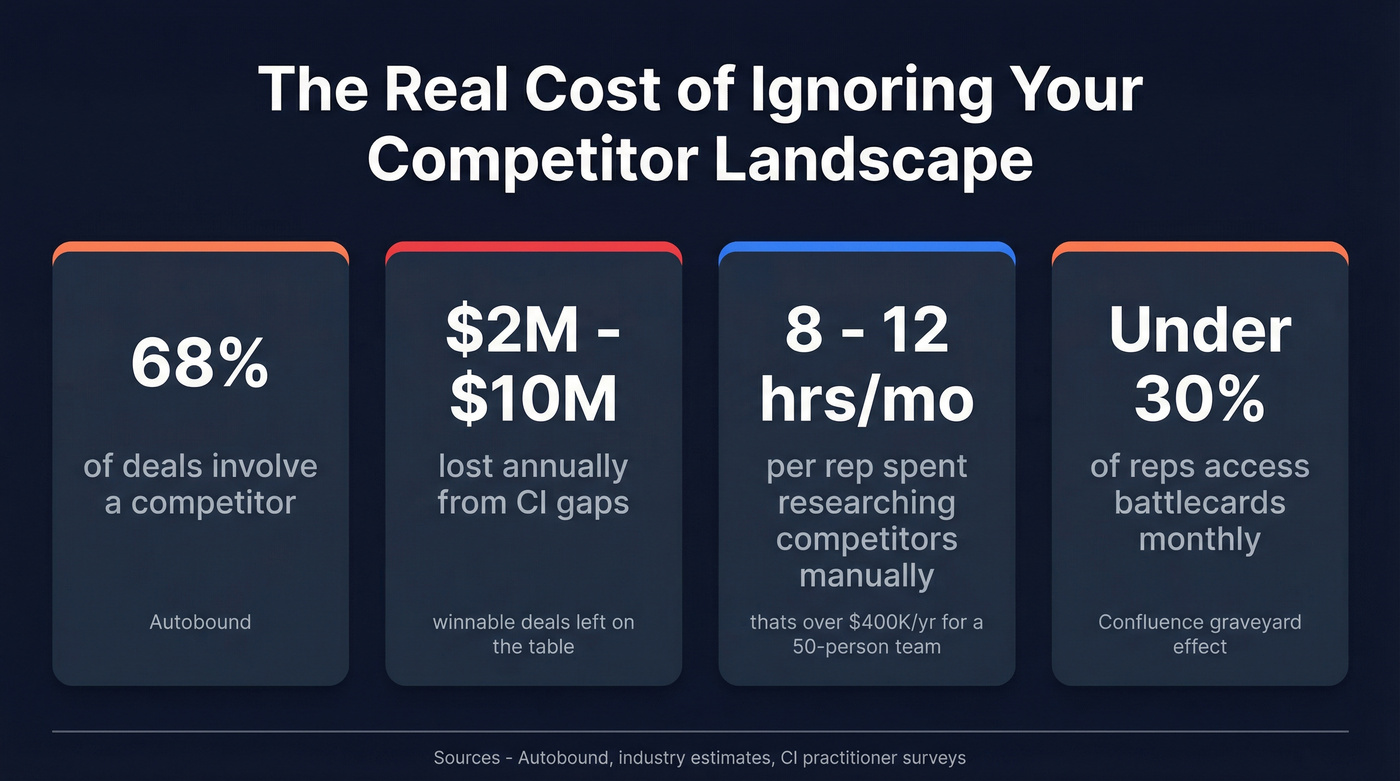
The dollar impact is real. Industry estimates peg the CI gap at $2M-$10M per year in winnable deals left on the table. One anonymized case we've seen play out: a competitor shipped a major feature update, and a 6-week lag in updating battlecards led to 7 lost deals totaling $340K in ARR. Six weeks. Seven deals. Gone.
The labor cost of doing this manually is equally painful. Sales reps spend 8-12 hours per month researching competitors on their own, and product marketing burns 30-40 hours per quarter updating battlecards. For a 50-person sales org, that's north of $400K per year in direct labor - and the output is still stale within a month. Battlecards sitting in Confluence don't help anyone when usage rates run below 30% of reps accessing them monthly. You're paying for intelligence that never reaches the people who need it.
Five Types of Competitors to Track
Most teams only track direct competitors. That's a blind spot. SurveyMonkey recommends choosing up to 10 competitors and categorizing them across multiple types.
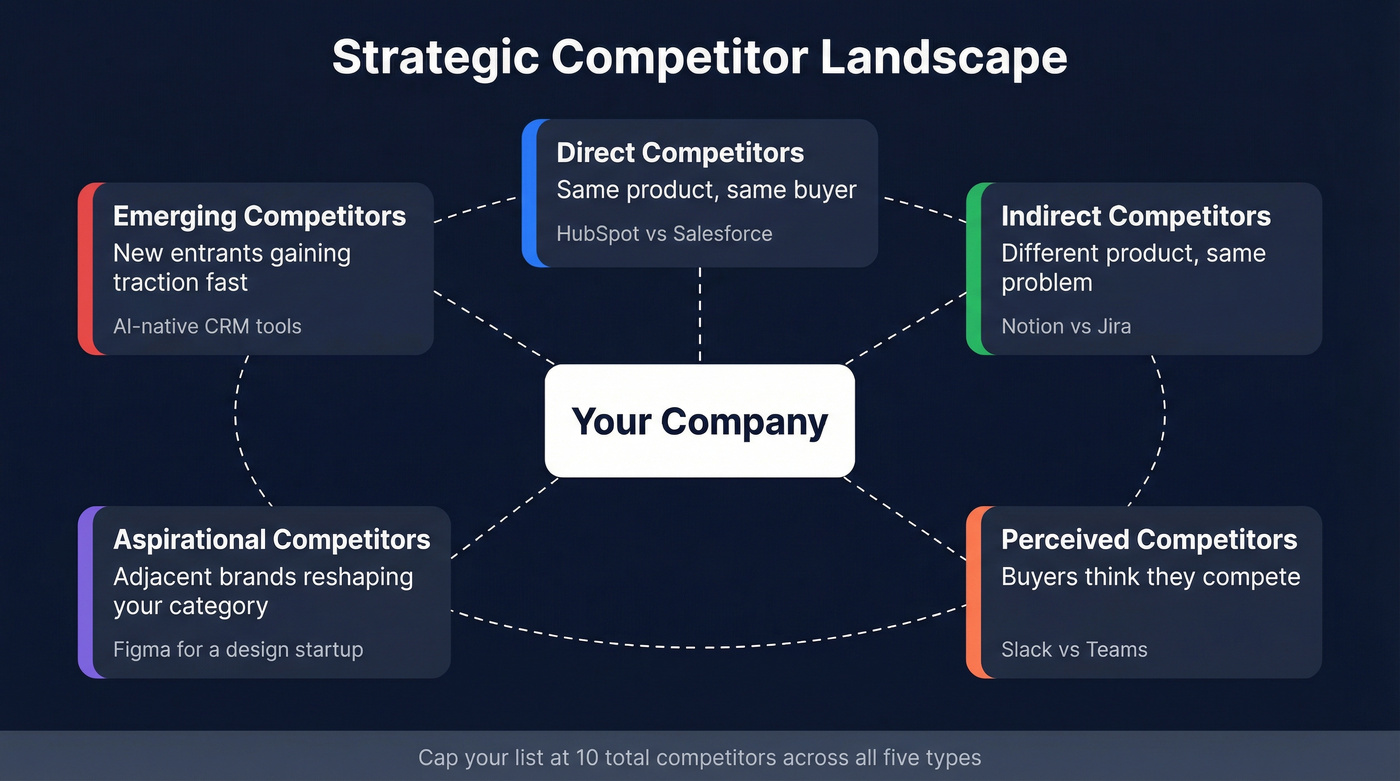
| Type | Definition | Example |
|---|---|---|
| Direct | Same product, same buyer | HubSpot vs. Salesforce |
| Indirect | Different product, same problem | Notion vs. Jira |
| Perceived | Public thinks they compete | Slack vs. Teams |
| Aspirational | Adjacent brand you admire | Figma for a design startup |
| Emerging | New entrants gaining traction | AI-native CRM tools |
Direct and indirect competitors are obvious. Perceived competitors matter because your buyers think they're alternatives - even if you don't. Aspirational competitors are adjacent brands whose moves could reshape your category.
Emerging competitors hurt most when you miss them. Netflix offered to sell to Blockbuster for $50M in 2000. The modern version is quieter: your top AE loses a deal to a startup you've never heard of, and nobody logs it in the CRM. Track emerging entrants by mining win-loss interviews and monitoring which vendors your prospects are researching. The consensus on r/sales is that most teams don't discover new competitors until they've already lost 3-5 deals to them - by then you're playing catch-up.

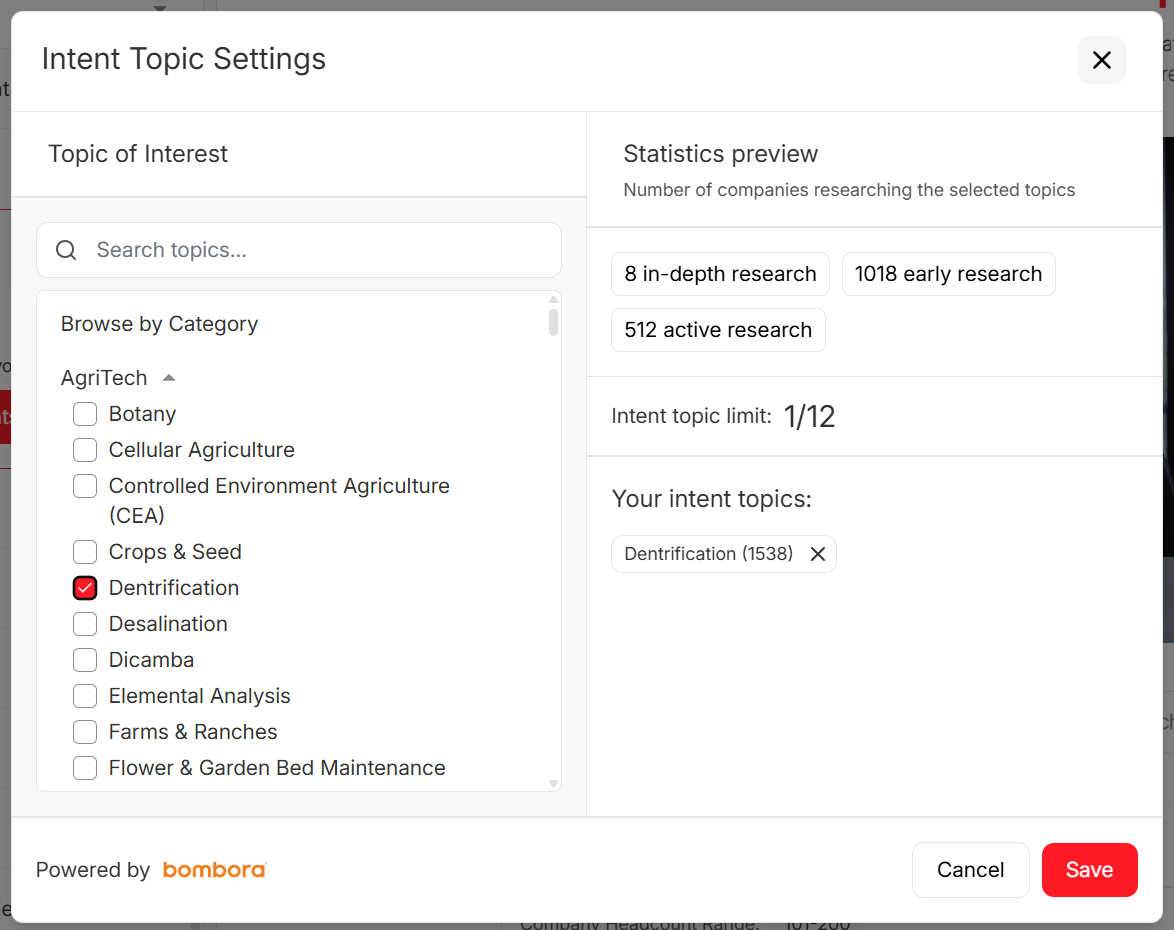
You're losing deals to competitors you haven't identified yet. Prospeo tracks 15,000 intent topics via Bombora so you can see which accounts are actively researching your rivals - before your reps lose the deal. Layer intent signals with 30+ filters like technographics, job changes, and headcount growth to build a competitor landscape that updates itself.
Stop discovering competitors after you've already lost the deal.
Step-by-Step Analysis Process
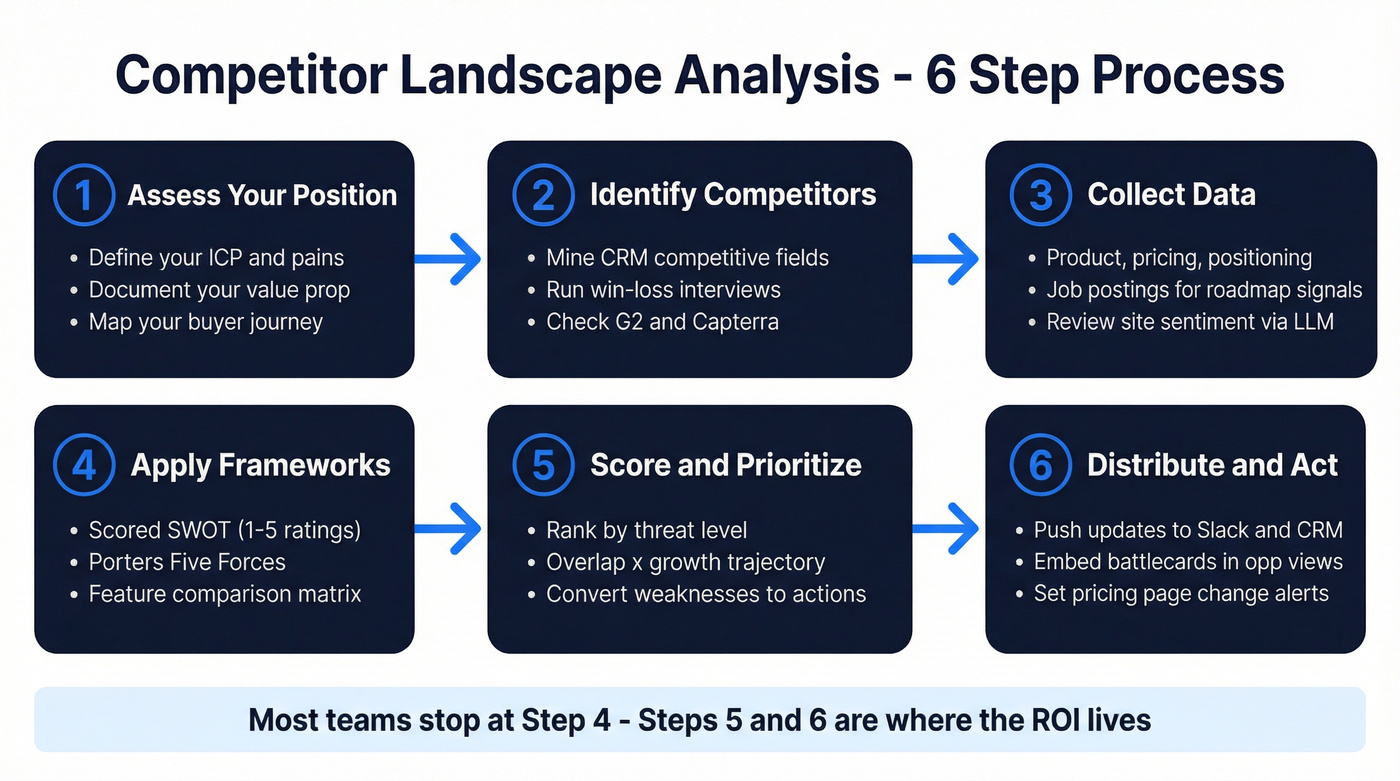
Assess Your Own Position First
Before you map competitors, map yourself. Document your ideal customer profile and the pains you solve, your core value proposition, your primary channels, and your buyer journey from first touch to closed-won. This baseline prevents the most common mistake - analyzing competitors through your own assumptions instead of your buyer's lens.
Identify and Categorize Competitors
Start with what you already have. Mine your CRM's competitive fields in Salesforce or HubSpot. Run win-loss interviews with recent churned accounts and closed-lost deals. Check G2 and Capterra for tools buyers compare you against. Scan competitor job postings - they're a 6-12 month roadmap signal. A company hiring "Senior PM, AI & Automation" is telling you exactly where they're investing.
Collect the Right Data
A 2022 survey of 1,200 CI practitioners found that 99% considered competitors' websites a valuable data source. That's your starting point, not your finish line.
Organize collection across five categories: product and features, pricing and packaging, marketing and positioning, customer experience, and strengths and weaknesses. Job postings are underrated - they reveal investment direction 6-12 months out. Use an LLM to synthesize review-site sentiment: feed it 50 G2 reviews and ask for top complaints, top praise, and positioning gaps in a structured table.
Apply Frameworks
Raw data without structure is just noise. The three frameworks that consistently produce actionable output are scored SWOT, rated Porter's Five Forces, and a feature comparison matrix. Here's the thing: frameworks without scoring are just opinions. A SWOT where every box says "strong brand" tells you nothing. A SWOT where "brand awareness" is scored 4/5 for Competitor A and 2/5 for Competitor B gives you something to act on.
Score and Prioritize
Use a 1-5 scoring system across your SWOT dimensions. Convert each competitor weakness into a specific action item - not "they have weak support" but "create a comparison page highlighting our 24/7 support vs. their business-hours-only model." Prioritize competitors by threat level: market overlap multiplied by growth trajectory. A direct competitor growing 80% YoY is a bigger threat than one growing 15%.
Visualize and Present
Different stakeholders need different formats. The board wants a 2x2 perceptual map (price vs. feature depth, or market share vs. growth rate). Sales wants battlecards they can pull up mid-call. Product wants a feature matrix with gap analysis.
Structure snapshots across three dimensions: Company Growth & Trajectory, Traffic & Social Reach, and Homepage & Positioning History. Use Similarweb or SEO visibility scores for traffic benchmarking.
Distribute and Act
This is where most competitive analyses die. 71% of teams using battlecards report improved win rates, and 93% of those see increases exceeding 20%. But those numbers only hold if reps actually use them.
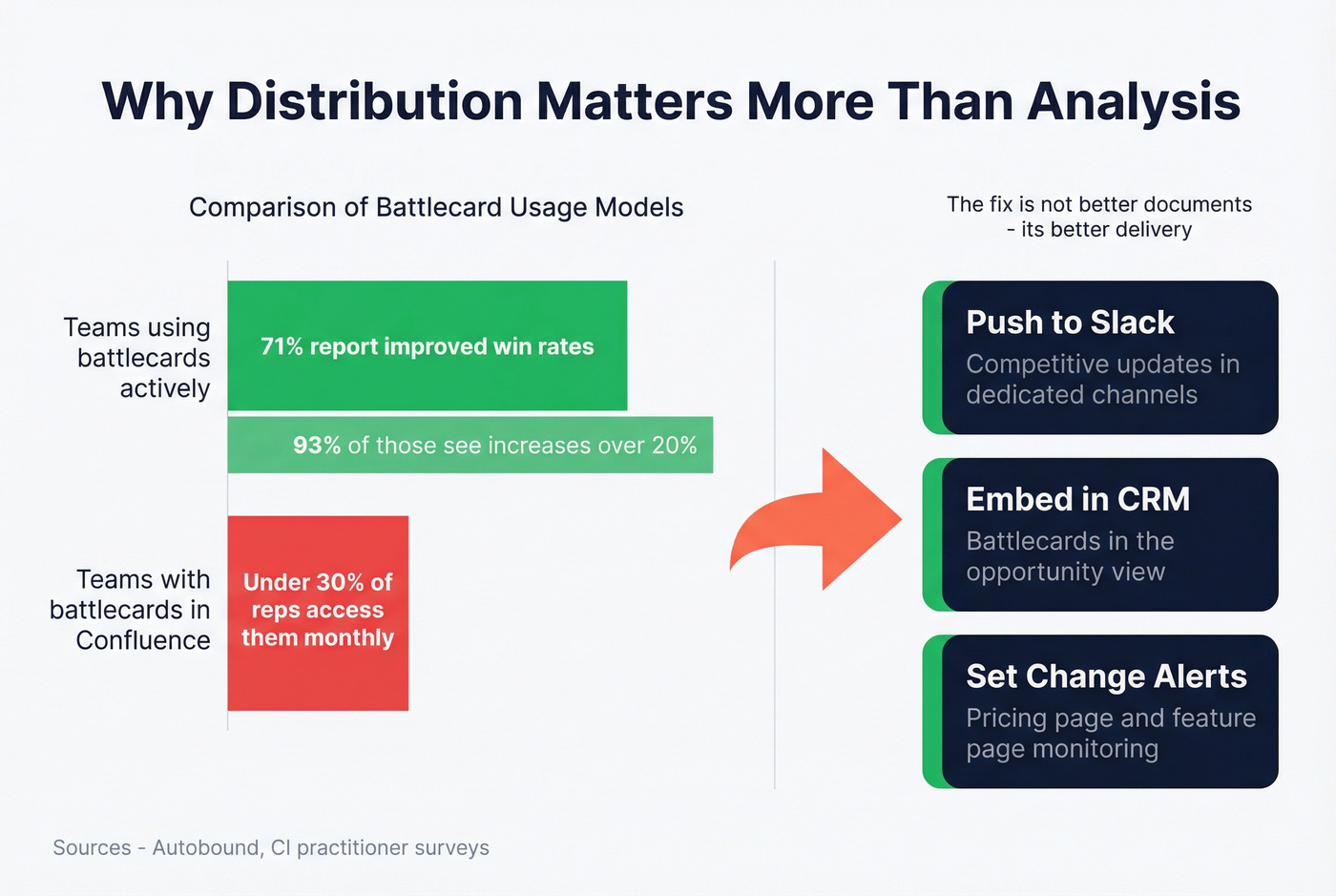
We've watched the "Confluence graveyard" pattern play out dozens of times - fewer than 30% of reps access battlecards monthly. The fix isn't better documents. It's decision triggers: push competitive updates into Slack channels, embed battlecards in your CRM's opportunity view, and set alerts when a competitor's pricing page changes. Make the intelligence come to the rep, not the other way around.
Frameworks That Actually Work
SWOT With Scoring
Plain SWOT is the most overused and least useful framework in business. Scored SWOT is genuinely valuable. The difference is a 1-5 rating system applied to every item, with cross-functional inputs to reduce bias.
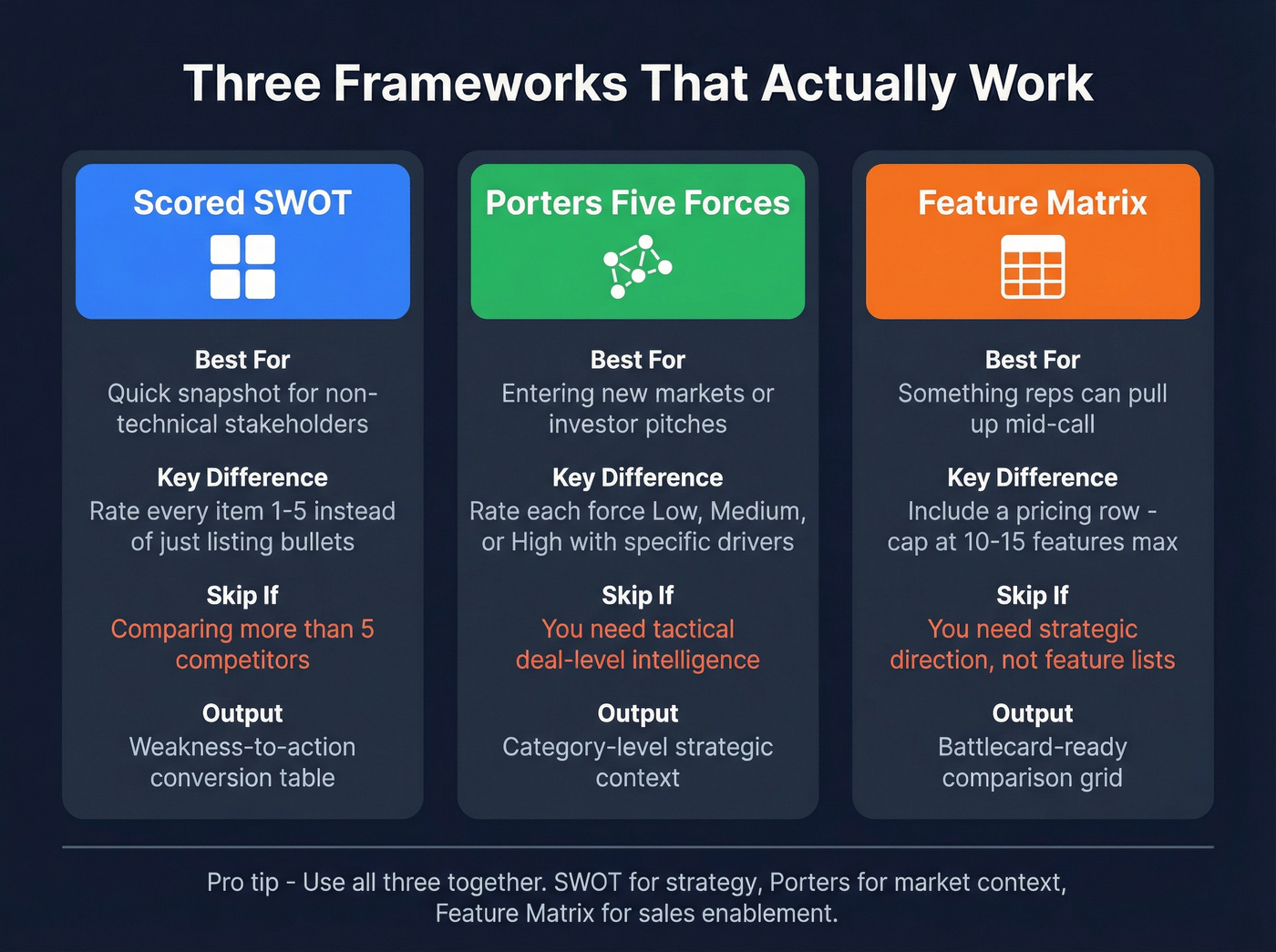
Use this if you need a quick competitive snapshot that non-technical stakeholders can digest. Skip this if you're comparing more than 5 competitors - it gets unwieldy fast.
| Competitor | Strength | Score | Weakness | Score |
|---|---|---|---|---|
| Figma | Design collaboration | 5 | Limited prototyping | 2 |
| Sketch | Plugin ecosystem | 4 | Mac-only | 3 |
Convert every weakness you identify into an action item. "Limited prototyping" becomes "position our prototyping workflow in every Figma competitive deal."
Porter's Five Forces, Rated
Rate each force Low, Medium, or High with specific drivers listed. This prevents the common failure mode of writing "moderate" for everything and calling it analysis.
Use this if you're entering a new market or pitching investors who want category-level context. Skip this if you need tactical, deal-level intelligence - Porter's is strategic, not operational.
| Force | Rating | Key Driver |
|---|---|---|
| Buyer Power | High | Low switching costs in SaaS |
| Supplier Power | Low | Commoditized cloud infra |
| New Entrants | High | AI lowers build barriers |
| Substitutes | Medium | Spreadsheets still compete |
| Rivalry | High | 50+ tools in category |
Pair Porter's with PESTEL analysis when macro forces are reshaping your category - regulatory shifts like GDPR enforcement, economic headwinds affecting buyer budgets, or technology trends like AI that lower barriers to entry across the board.
Feature Comparison Matrix
The most immediately actionable framework, and the one your sales team will actually use.
Use this for something reps can pull up mid-call. Skip this for strategic planning - a feature grid won't tell you where the market is headed.
| Feature | Figma | Sketch | Canva |
|---|---|---|---|
| Real-time collab | Yes | No | Yes |
| API access | Yes | Yes | Partial |
| Pricing | Free tier; $15/editor/mo | $12/editor/mo | Free tier; $13/mo |
Keep it to 10-15 features max. More than that and nobody reads it.
Monitoring Cadence and Signals
Treat your competitive landscape as a system, not a document. An ugly spreadsheet updated weekly beats a beautiful deck that's 60 days old.
| Cadence | What to Track |
|---|---|
| Daily | Pricing pages, homepages, press releases, job postings, ad libraries |
| Weekly | Blog content, exec team pages, help centers, reviews, social |
| Bi-weekly | T&Cs, sitemaps, Crunchbase, Wikipedia |
The daily tier sounds aggressive, but most of it can be automated with page-change monitoring tools. Pricing page changes are the highest-signal, lowest-effort thing you can track - a competitor adjusting their pricing model tells you more about their strategy than a dozen blog posts.
Here's our hot take that most CI teams won't say out loud: if your average deal size is under $10K, you probably don't need a $30K CI platform. A well-maintained spreadsheet with a named owner and a weekly 30-minute review cadence will outperform an expensive tool that nobody logs into. The most common pattern we see in CI communities is teams building a beautiful competitive deck, presenting it once, and never updating it. The fix is always the same - assign a single owner, set a recurring calendar block, and make the update process take less than 30 minutes.
Tools for Competitive Analysis
You don't need a $30K CI platform to start - but you do need accurate data and a system for tracking changes.
| Tool | Category | Starting Price | Best For |
|---|---|---|---|
| Prospeo | B2B data + intent | Free tier; ~$0.01/email | Contact enrichment + intent |
| Crayon | CI platform | ~$15K/year | Full-cycle CI automation |
| Klue | CI platform | ~$16K/year | Battlecard management |
| Semrush | SEO + content intel | $130-$500/mo | Keyword + content gaps |
| Ahrefs | SEO + backlink intel | $99-$449/mo | Backlink + traffic analysis |
| Similarweb | Traffic analytics | Free tier; ~$150/mo+ | Traffic benchmarking |
| Sprout Social | Social monitoring | $249-$499/mo/seat | Share of voice tracking |
| Google Sheets | Manual tracking | Free | Budget-friendly starting point |
Prospeo fills the B2B data layer that dedicated CI platforms miss. The free tier includes 75 emails and 100 Chrome extension credits per month with no contracts - enough to run win-loss outreach at startup scale. Paid plans run roughly $0.01 per email. The 7-day data refresh cycle means contacts you're reaching out to for competitive interviews actually get your emails, versus the 6-week industry average where half your list has gone stale.
Crayon is the heavyweight CI platform, covering the Monitor, Aggregate, Analyze, and Distribute workflow across hundreds of competitor signals. Median contract value runs ~$30K/year per Vendr data, with entry points around $15K/year. We've tested it alongside lighter setups, and the ROI only kicks in when you have 50+ reps and 10+ competitors generating enough signal volume to justify the spend.
Klue starts around $16K/year and excels at battlecard management and distribution - solving the Confluence graveyard problem. If your primary pain is getting competitive intel into reps' hands during live deals, Klue is purpose-built for that.
Semrush and Ahrefs are essential for tracking competitors' content strategy, keyword gaps, and organic visibility. We've used both extensively - the overlap is about 80%. Pick one and commit.
Similarweb replaces the discontinued Alexa Rank for traffic benchmarking. The free tier handles basic comparisons; paid plans start around $150/mo. Sprout Social covers social listening and share-of-voice tracking at $249-$499/mo per seat - expensive for a single use case, but valuable if social is a primary competitive channel.
Google Sheets is free and underrated. I've personally seen teams run effective competitive programs on nothing more than a well-structured spreadsheet and a weekly review cadence. Don't let anyone tell you that you need expensive tooling before you've nailed the process.
Your battlecards are stale because your data is stale. Prospeo refreshes 300M+ profiles every 7 days - not every 6 weeks like the industry average. When a competitor hires a new VP of Product or shifts pricing, your team knows within days, not months. Enrich your CRM with 50+ data points per contact at 98% email accuracy for $0.01 per lead.
Real-time competitive intelligence starts with data that's actually current.
Using AI for Competitive Intelligence
AI accelerates competitive intelligence, but it doesn't replace judgment. The capabilities that matter most are NLP for classifying and summarizing competitor signals, pattern recognition for connecting events like a patent filing plus a hiring spree plus an acquisition, and predictive analytics for forecasting competitor moves.
The efficiency gains are real. AI can cut evidence synthesis time by 50%+ and reduce manual labor by 75%+ compared to fully manual approaches. Here's a prompt you can copy-paste into any LLM today:
Analyze these 50 G2 reviews of [Competitor]. Extract: top 5 complaints, top 5 praise points, and 3 positioning gaps we could exploit. Format as a table with columns for Theme, Frequency, and Example Quote.
Know the limits, though. Most LLMs hit 85-90% accuracy on complex classification tasks, and performance drops to around 60% on nuanced analysis where context and industry expertise matter. Let AI surface the signals. Let your team decide what they mean.
FAQ
What's a competitor landscape example?
A SaaS feature comparison matrix is the most common example. Rows list features (API access, SSO, pricing model), columns list competitors, and cells show yes/no/partial. Add a pricing row and a "best for" summary, and you've got a snapshot any stakeholder can use in under 60 seconds.
How often should you update it?
Monthly minimum for the full analysis. Daily and weekly monitoring should run continuously - pricing pages and job postings daily, content and reviews weekly, everything else bi-weekly. The full snapshot gets refreshed monthly with whatever the monitoring surfaced.
What's the difference between a competitor landscape and competitive intelligence?
A competitor landscape is a point-in-time snapshot - who competes, how they position, where they're strong and weak. Competitive intelligence is the ongoing discipline of gathering, analyzing, and distributing that information. The landscape is the deliverable; CI is the process that keeps it current.
What tools do you need to get started?
Google Sheets plus a B2B data platform for contact enrichment and intent signals, plus one SEO tool like Semrush or Ahrefs. That covers most teams under 50 people. Enterprise teams with larger competitive sets add Klue or Crayon for automated monitoring and battlecard distribution.
How do you find competitors you don't know about?
Mine your CRM's competitive fields for names reps log during deals. Run win-loss interviews with churned accounts. Check G2 and Capterra for tools buyers compare you against. Use intent data to see which vendors your target accounts are actively researching - emerging competitors show up in buying signals before they appear in your pipeline.