

What Is a Sales Prospect - and Why Most CRMs Get It Wrong
Marketing hands over 500 "leads" from last month's webinar. Sales looks at the list and says maybe 30 are worth a phone call. The other 470? Wrong titles, no budget, companies outside your ICP - dead weight clogging the pipeline. Understanding what a sales prospect actually is versus a raw lead isn't just semantics. It's a definition problem that costs real money: sales reps already spend 60% of their time on non-selling tasks, and chasing unqualified names is a big chunk of that waste.
If you've ever watched a debate on r/marketing about whether a "lead" outranks a "prospect" or vice versa, you know the terminology is a mess. Different teams, different CRMs, different definitions. Let's fix that.
Sales Prospect Definition
Here's the cleanest definition, adapted from Salesforce's own framework:
A sales prospect is a lead who's been qualified - assessed for interest, budget, authority, and timeline - and determined to be a realistic potential customer.
The problem isn't the definition. It's that most CRMs are stuffed with records that don't meet it. Thousands of contacts sitting in "prospect" or "qualified" stages who were never actually assessed against any criteria. They got imported from a trade show scan, a content syndication vendor, or a bulk list purchase, and nobody cleaned them up.
The word "prospect" should mean something specific in your pipeline. If it doesn't, every metric downstream - conversion rates, pipeline velocity, forecast accuracy - is built on noise.
Lead vs. Prospect vs. Opportunity
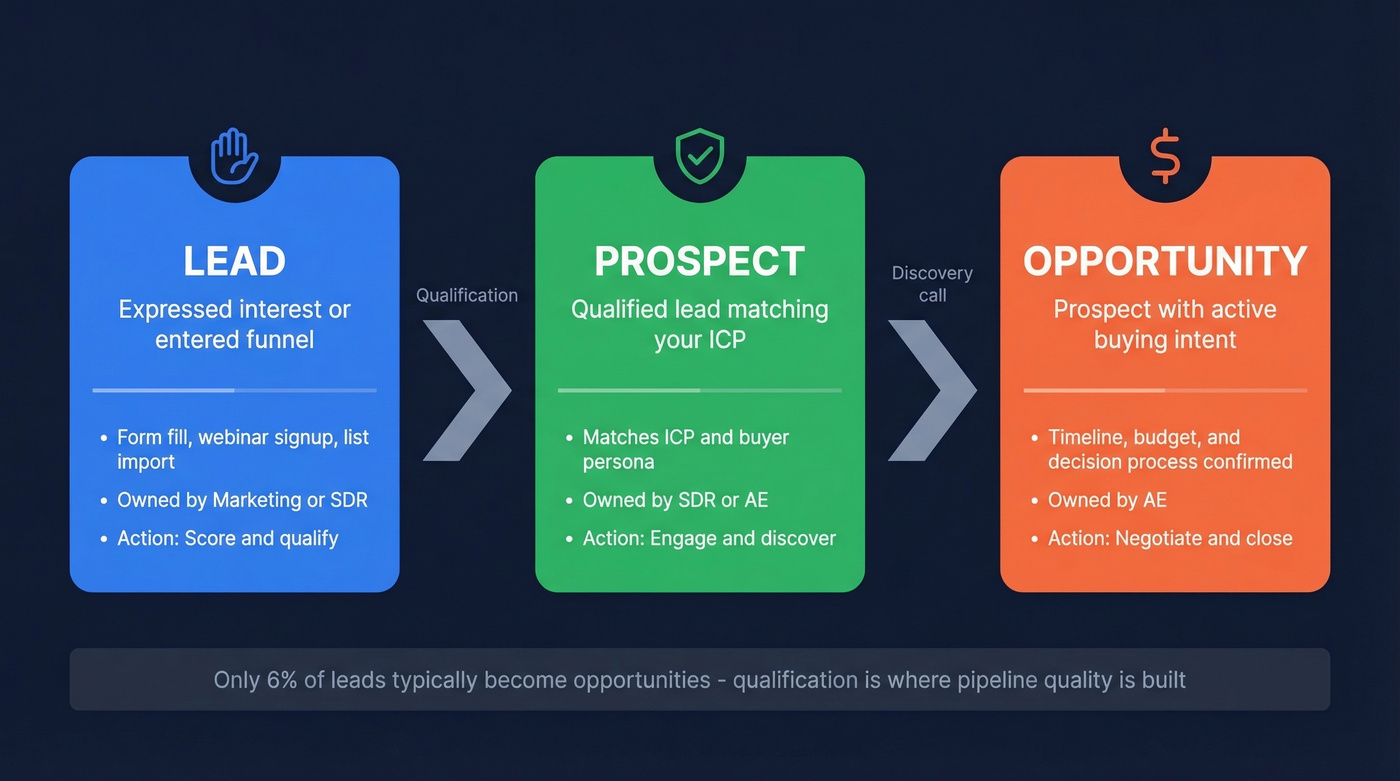
These three terms form a hierarchy, and getting it right determines who your reps spend time on.
| Stage | Definition | CRM Object (SFDC) | Who Owns It | Key Action |
|---|---|---|---|---|
| Lead | Expressed interest or entered funnel | Lead | Marketing / SDR | Score and qualify |
| Prospect | Qualified lead matching ICP | Contact | SDR / AE | Engage and discover |
| Opportunity | Prospect with active buying intent | Opportunity | AE | Negotiate and close |
A lead is anyone who's raised a hand - a form fill, a webinar registration, a cold list import. They're in your system, but you don't know if they can buy or even should.
A prospect is a lead who's survived qualification. They match your ICP, they have a plausible need, and there's reason to believe they'll become a customer. This is where sales effort should start. Not before.
An opportunity is a prospect who's moved into an active buying process - there's a timeline, a decision process, and real dollars on the table.
Let's make this concrete. Sarah, a VP of Marketing at a 200-person SaaS company, downloads your ebook on pipeline analytics. She's a lead. Your SDR checks her company against your ICP - right industry, right headcount, they use a competing tool - and confirms she has budget authority. Now she's a prospect. Two weeks later, after a discovery call, Sarah says her team needs a solution by Q3 and has $40K allocated. She's an opportunity. Ask five salespeople to define "prospect" and you'll get six answers - a pattern that plays out in every r/sales thread on the topic - but this hierarchy is the one that actually maps to revenue.
The CRM mapping matters too. In Salesforce, the Lead object is pre-qualification; once converted, it becomes a Contact tied to an Account and potentially an Opportunity. HubSpot centers everything on a Contact record, which means your lifecycle stages do the heavy lifting. Pardot uses "Prospect" as its core marketing record, which confuses things further because Pardot's "Prospect" isn't the same as a sales-qualified prospect.
73% of B2B buyers actively avoid sellers who send irrelevant outreach. If you're treating every lead like a prospect, you're training your market to ignore you.
What Makes Someone a Prospect in Business?
Two concepts do the heavy lifting: your Ideal Customer Profile and your buyer personas.
Your ICP defines the best-fit companies - firmographic, technographic, and behavioral attributes that signal a high likelihood of closing. Think industry, headcount range, tech stack, growth trajectory, and funding stage. Your buyer personas define the decision-makers within those companies - the VP of Sales who feels the pain, the CFO who controls the budget, the RevOps lead who evaluates tools.
A prospect sits at the intersection: a person matching your buyer persona at a company matching your ICP, showing some signal of need or intent.
The signals break into two categories. Hard buying signals are concrete events: a funding round, an acquisition, executive hires, office expansion, or a new tech implementation. Soft buying signals are behavioral: website visits, content downloads, job postings for roles that suggest a need, or event attendance.
86% of business buyers say they're more likely to buy when their goals are understood. Sellers who reference even one commonality see a 46% lift in InMail acceptance rates. The more signals you layer before the first conversation, the less your outreach feels like a cold call and the more it feels like a conversation worth having.

You just defined what separates a prospect from a lead - ICP fit, buyer persona match, and buying signals. Prospeo's database lets you filter 300M+ profiles by all three: industry, headcount, tech stack, funding stage, job changes, and 15,000 intent topics. Every email is 98% verified. Every record refreshed weekly. Stop manually qualifying - start with prospects who already match.
Turn your ICP criteria into a qualified prospect list in under 60 seconds.
How to Qualify a Prospect
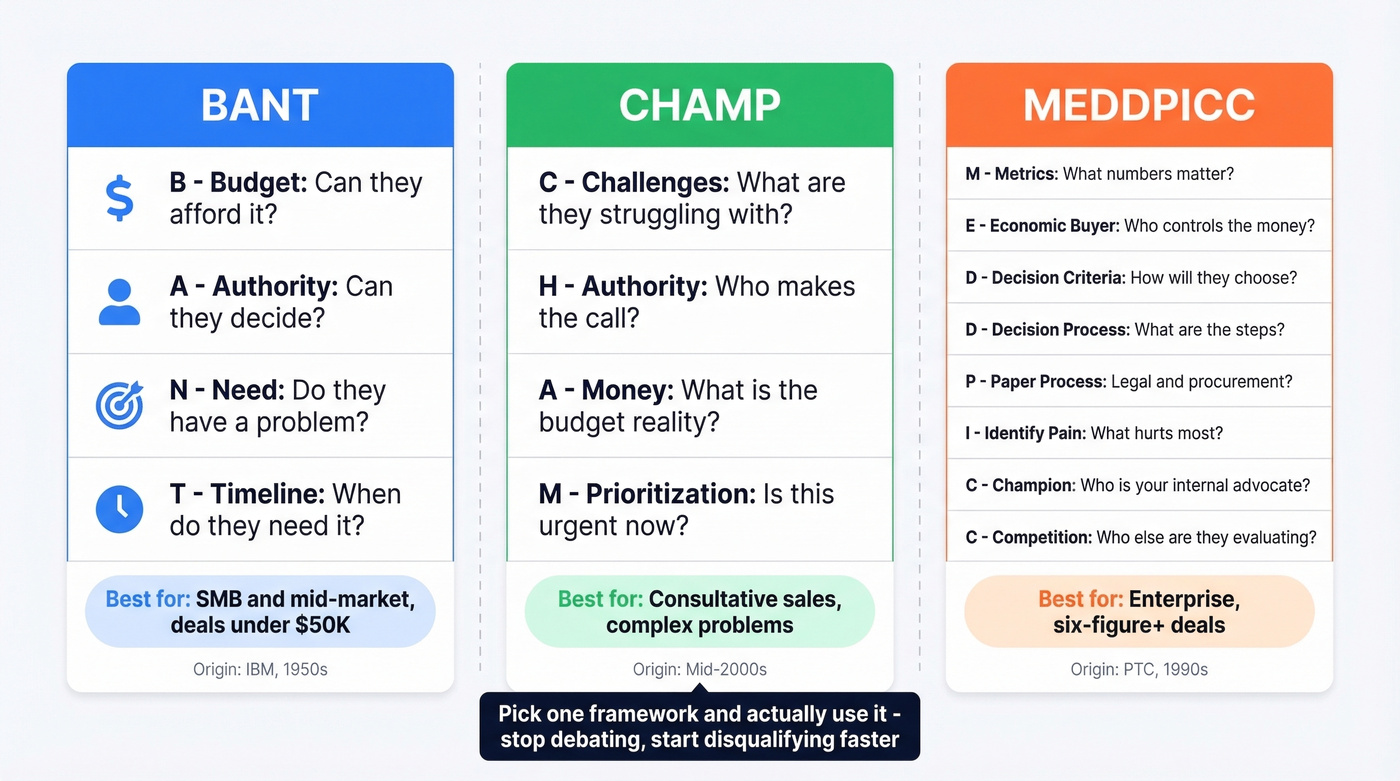
Qualification is where "prospect" stops being a label and starts being a decision. Three frameworks dominate, and each fits a different selling motion.
| Framework | Criteria | Best For | Origin |
|---|---|---|---|
| BANT | Budget, Authority, Need, Timeline | SMB/mid-market, sub-$50K deals | IBM, 1950s |
| CHAMP | Challenges, Authority, Money, Prioritization | Consultative sales | Mid-2000s |
| MEDDPICC | Metrics, Economic Buyer, Decision Criteria, Decision Process, Identify Pain, Champion, Competition + Paper Process | Enterprise, six-figure+ deals | PTC, 1990s |
BANT is the workhorse. Budget first, then authority, need, and timeline. It works for 80% of B2B teams selling deals under $50K. The knock on BANT is that it's seller-centric - you're checking boxes rather than understanding the buyer's world.
CHAMP flips the script by leading with challenges. What's the prospect struggling with? Do they have the authority to fix it? Can they pay for a solution? Is it a priority right now? It's a better fit for consultative selling where the problem isn't always well-defined.
MEDDIC is the enterprise heavyweight. After PTC implemented it in the 1990s, their revenue grew from roughly $195M to $650M in four years. The framework forces you to map the entire buying group - champion, economic buyer, decision criteria, paper process - which matters when you're dealing with 6-10+ stakeholders and 57% of sales pros say cycles are getting longer.
Look, most teams under 50 reps overthink framework selection. BANT works for deals under five figures. MEDDIC is for six-figure enterprise contracts. Pick one and actually use it. Stop debating frameworks and start disqualifying faster. The best reps don't agonize over which framework is "right" - they pick one, internalize the criteria, and run every prospect through it in the first two conversations.
How to Find and Verify Prospects
Knowing the definition doesn't help if you can't find real prospects. And finding them doesn't help if the data is wrong.
We've all seen this play out: an SDR spends two hours researching a target, writing a personalized email, crafting the perfect subject line - and it bounces. That's not just wasted effort. It's a hit to your domain reputation that makes the next 50 emails less likely to land.
The numbers back this up. 66.7% of sales reps reach out to 250 or fewer prospects per year - roughly one per business day. When each outreach attempt is that precious, sending to a bad email is a pipeline killer. Teams using intent data to prioritize prospects cut CAC by 35% and boost close rates by 28%.
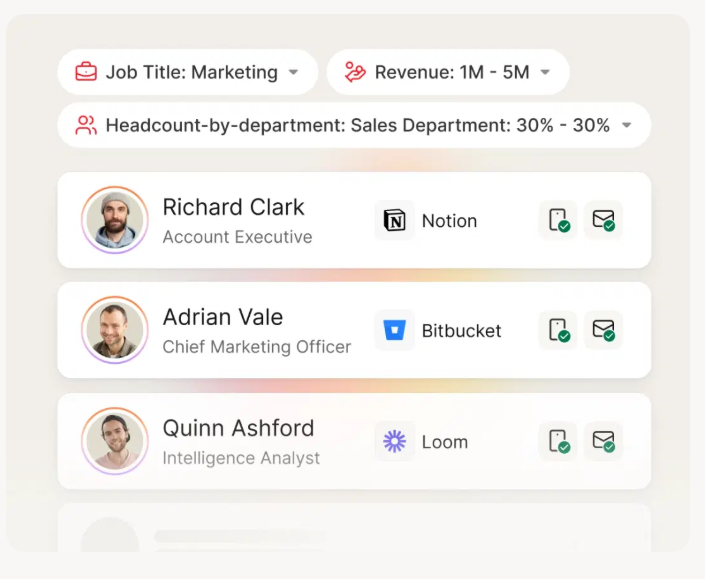
Once you've defined your ICP, you need a tool that finds matching prospects with verified contact data. Prospeo's database lets you filter across 30+ criteria - buyer intent powered by Bombora, technographics, job change signals, headcount growth, department headcount, funding, and revenue - and every email comes back verified at 98% accuracy. Data refreshes every 7 days, compared to the 6-week industry average, so you're not emailing someone who changed jobs last month.

73% of buyers ignore irrelevant outreach. The difference between a lead and a prospect is qualification - and bad data makes qualification impossible. Prospeo's 5-step verification and 7-day refresh cycle mean every contact you pull is current, accurate, and worth your rep's time. Teams using Prospeo book 26% more meetings than ZoomInfo users, at $0.01 per email.
Fill your pipeline with actual prospects, not dead-weight leads.
2026 Prospecting Benchmarks
High performers are 1.7x more likely than underperformers to use prospecting agents. AI isn't replacing prospecting - it's widening the gap between teams that adopt and teams that don't. 88% of reps with AI agents say the technology increases their odds of hitting quota.
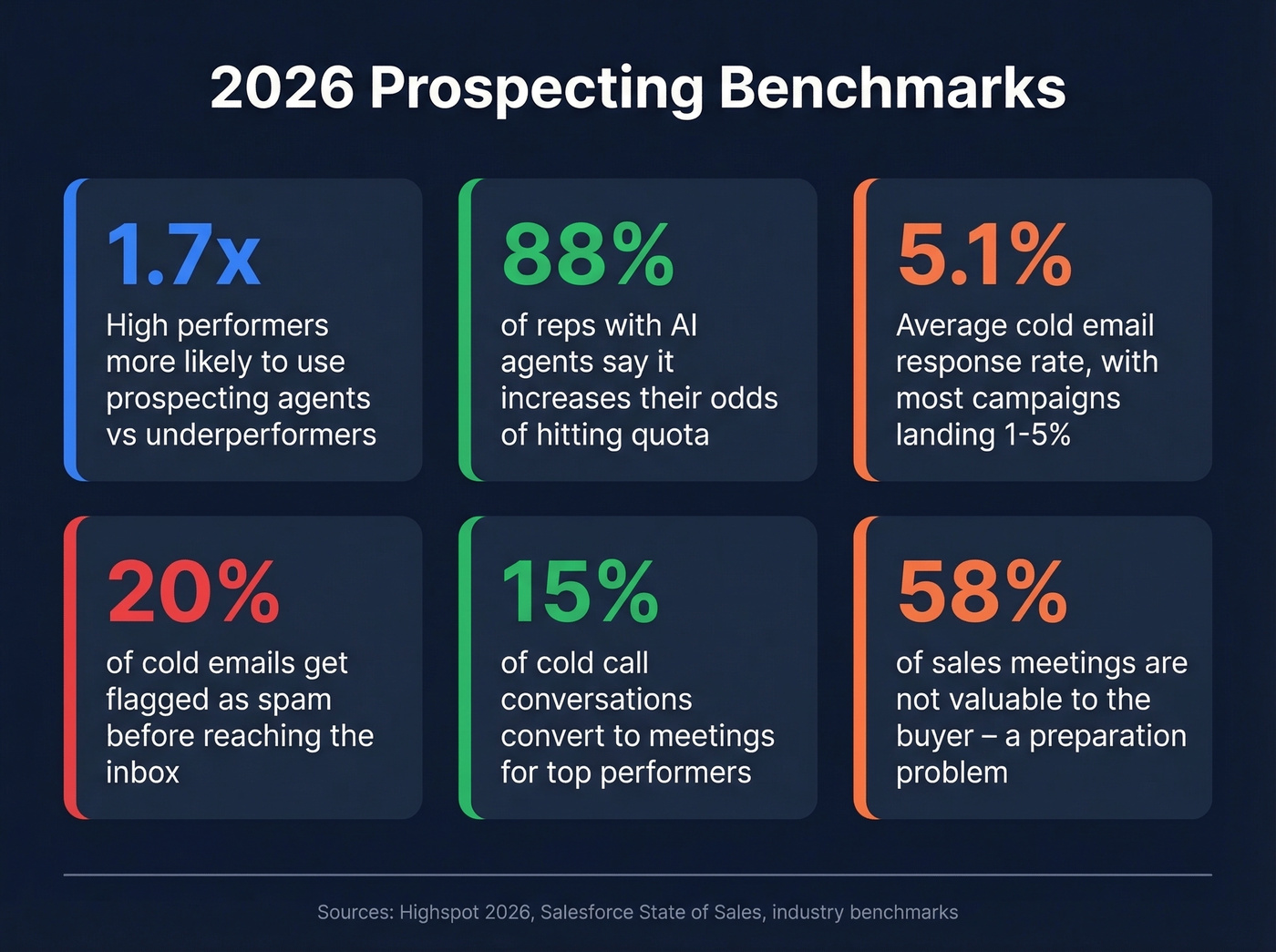
Cold email response rates sit at about 5.1% on average, with most campaigns landing between 1% and 5%. Roughly 20% of cold emails get flagged as spam before they ever reach an inbox. Top-performing cold callers convert 15% of conversations into meetings.
From Highspot's 2026 research: 43% of buyers who accept meetings say five or more contact attempts are perfectly acceptable before getting through. But 58% of sales meetings aren't valuable to the buyer - that's a preparation problem, not a prospecting problem.
Prospecting Mistakes That Kill Pipeline
1. No defined ICP. Spraying outreach at anyone with a title and a pulse isn't prospecting - it's spam with a CRM attached. Define your ICP before you buy a single contact. Firmographics, technographics, pain points, buying signals. Write it down. If your team can't describe your ICP in two sentences, you don't have one.
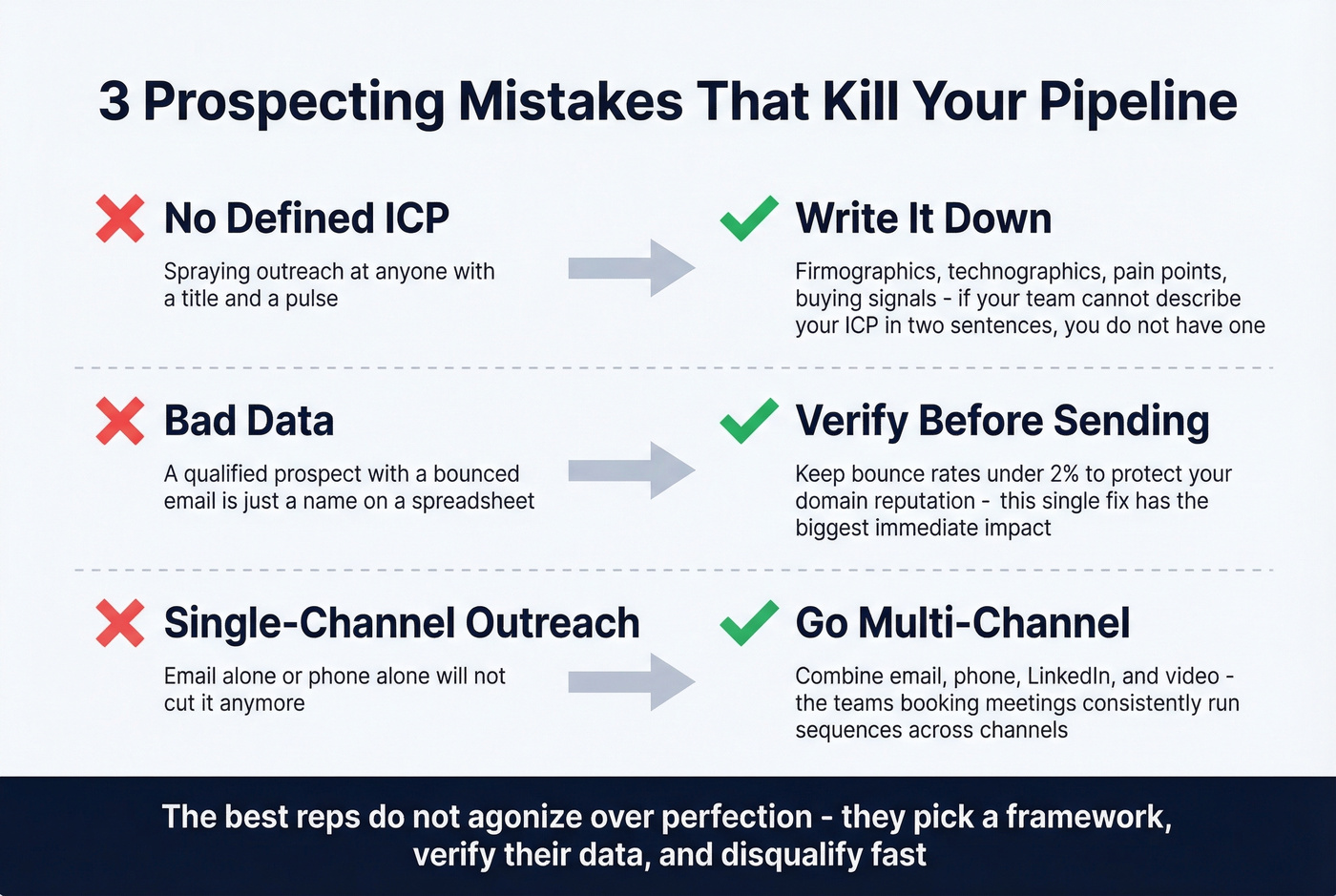
2. Bad data. A "qualified prospect" with a bounced email is just a name on a spreadsheet. Verify emails before sending and keep bounce rates under the 2% threshold that protects your domain. In our experience, this single fix - switching to verified data - has the biggest immediate impact on pipeline health.
3. Single-channel outreach. Email alone won't cut it. Phone alone won't cut it. The teams booking meetings consistently run multi-channel sequences - email, phone, social - because different buyers respond to different channels at different times.
4. Ignoring compliance. Skip this if you enjoy GDPR penalties of up to EUR 20M or 4% of global annual revenue. Beyond the legal risk, deliverability has hard thresholds: keep bounce rates under 2% and spam complaint rates under 0.01%.
5. No follow-up cadence. Remember that 43% stat? Buyers expect persistence. One email and done isn't prospecting - it's a lottery ticket. Build a cadence with 5-7 touches across channels over 2-3 weeks. Gartner's B2B buying research confirms that buying groups spend only 17% of their time meeting with potential suppliers, so you need to be present across multiple touchpoints to earn that window.
For more tactics, see sales prospecting techniques and sales follow-up templates.
FAQ
Is a prospect the same as a lead?
No. A lead is anyone who's entered your funnel - a form fill, a webinar signup, a list import. A prospect is a lead who's been qualified against your ICP for fit, budget, authority, and timeline. The distinction determines who reps spend time on and whether your pipeline metrics mean anything.
How do you turn a lead into a prospect?
Run every lead through a qualification framework - BANT for most teams, MEDDIC for enterprise. Check the lead's company against your ICP, confirm they have authority and budget, and verify their contact data is accurate. Leads that pass become prospects; leads that don't get nurtured or disqualified.
What's the fastest way to build a verified prospect list?
Define your ICP first - industry, company size, pain points, buying signals. Then use a B2B database with filters for intent signals, technographics, and headcount growth. Prospeo covers 300M+ profiles with 98% email accuracy and a 7-day refresh cycle, so you're working with current data instead of stale records.
Why does the prospect vs. lead distinction matter for revenue?
Teams that enforce a clear qualification gate between leads and prospects see higher conversion rates, shorter sales cycles, and more accurate forecasts. Without it, reps waste time on contacts who were never realistic buyers, and every downstream metric - from pipeline velocity to win rate - gets inflated by noise.