

What Is ACV in Sales? The Metric Most Teams Calculate Wrong
Your VP of Sales asks for the team's average ACV and you realize every rep is counting it differently. One includes the $15K implementation fee. Another annualizes a three-year deal but forgets the ramp. A third just uses TCV and calls it ACV. The number on the board means nothing because nobody agreed on the math.
Annual contract value is one of the simplest metrics in SaaS and one of the most consistently miscalculated. The formula takes ten seconds. The decisions around it - how it shapes your sales motion, your comp plan, your hiring, your entire go-to-market - take real thought. Let's get into all of it.
Annual Contract Value Explained
Annual contract value is the annualized recurring revenue from a single customer contract. The formula:
ACV = Total Recurring Contract Value / Number of Contract Years
A customer signs a 3-year deal worth $180K in recurring fees. That's $60K ACV. A 1-year deal at $60K is also $60K ACV. This metric normalizes contracts of different lengths so you can compare them on equal footing.
One nuance that trips people up: ACV typically excludes one-time fees like setup, onboarding, and custom implementation. Those charges inflate the first year and aren't recurring, so they distort the picture. More on this below.
Quick disambiguation - "ACV" means different things in different industries. In CPG, it's All Commodity Volume, a distribution metric. In insurance and auto, it's Actual Cash Value, or depreciated replacement cost. If you're reading this, you mean annual contract value in a SaaS or B2B subscription context.
The Short Version
- The formula: Total Recurring Contract Value / Number of Years
- The benchmark: Median ACV for private B2B SaaS is $26,265 across 1,000+ companies surveyed
- The motion mapping: Under $5K = self-serve. $5-15K = PLG + inside assist. $15-50K = inside sales with SDRs. $50-150K = field sales. $150K+ = enterprise named accounts.
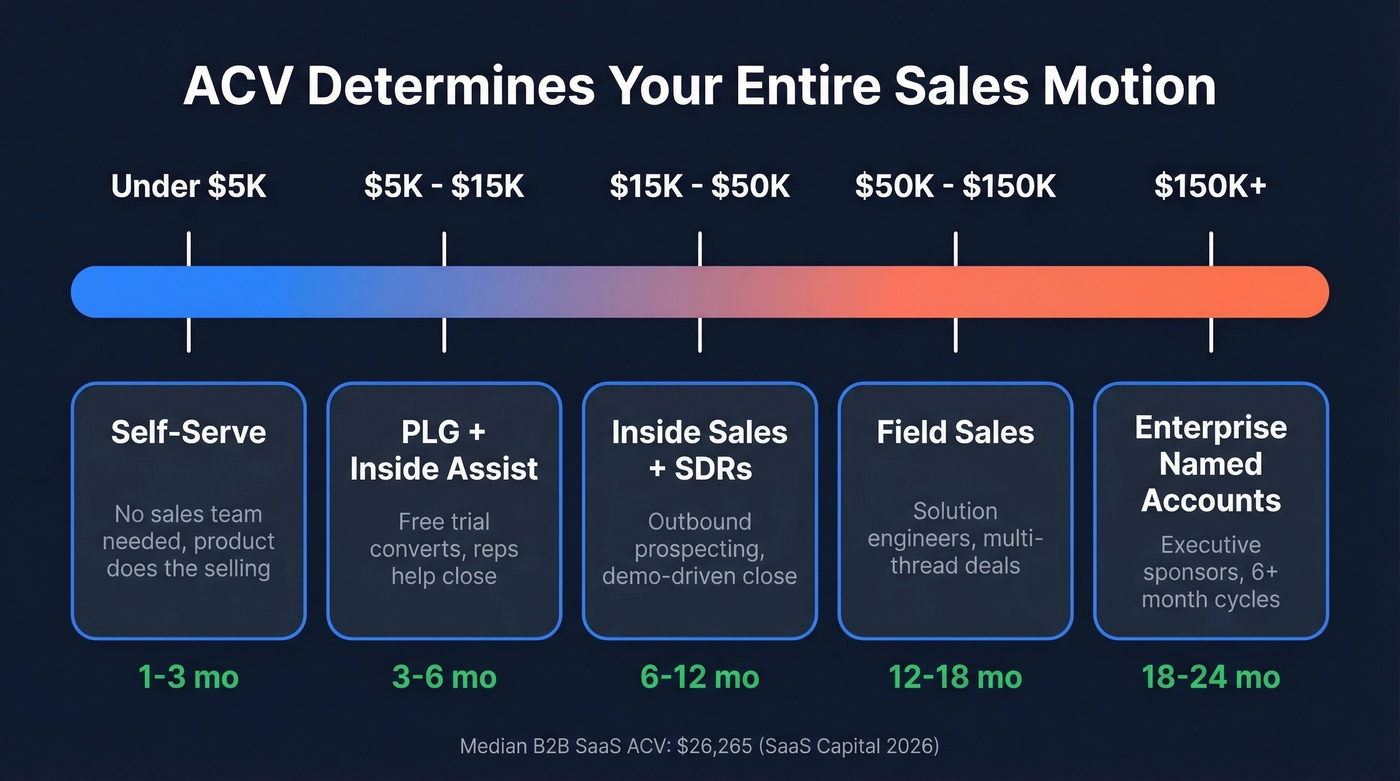
Most ACV guides stop at the formula. That's like teaching someone to read a speedometer without explaining speed limits, fuel economy, or where they're driving.
How to Calculate ACV
Basic Calculation
Single-year contracts are trivial - the contract value is the ACV. Multi-year deals are where the formula earns its keep.
A customer signs a 2-year contract at $200K total recurring value. ACV = $200K / 2 = $100K. A 3-year deal at $180K TCV gives you $60K ACV. For the portfolio-level ACV your VP actually wants, average the individual ACVs across all active contracts. Ten customers with ACVs ranging from $20K to $80K? Add them up, divide by ten. That's your average ACV, and it tells you what a "typical" deal looks like for your business.
One-Time Fees
There's no GAAP standard for ACV. It's an operational metric, not an accounting one. But the consensus is clear - exclude one-time charges. Setup fees, implementation costs, onboarding packages, and custom development don't recur. Including them makes your first-year ACV look artificially high and your renewal-year ACV look like a downgrade.
Pick a rule. Document it. Apply it consistently. What matters isn't the specific rule - it's that everyone in your org uses the same one.
Ramp Deals and Usage-Based Pricing
Here's where ACV gets genuinely tricky. A customer signs a deal that starts at $2K/month and ramps to $8K/month by month twelve. What's the ACV?
SaaStr outlines two practical models:
Model 1: Pay as it ramps. Pay a small commission at close, then ongoing commissions for up to 12 months as usage grows. The ACV crystallizes over time. This works well for early-stage companies where you don't have enough data to predict ramp behavior.
Model 2: Model and clawback. Estimate the expected annual value upfront based on historical ramp patterns, pay most of the commission at close, and claw back if actuals fall short. This becomes feasible once you've got 100+ customers to model behavior against. It's also easier for recruiting - experienced reps want to get paid at close, not wait twelve months.
We've found that modeling expected annual value works better once you have the data. Before that, pay-as-it-ramps is safer.
Real Benchmarks for 2026
ACV by Company Size
The SaaS Capital survey of 1,000+ private B2B SaaS respondents gives us the cleanest benchmark data available. The overall median ACV is $26,265, up from $22,357 the prior year.
| ARR Band | Prior Year ACV | Current ACV | Trend |
|---|---|---|---|
| $3-5M | $18,075 | $29,947 | Up 66% |
| $5-10M | $33,704 | $30,592 | Down 9% |
| $10-20M | $26,738 | $56,101 | Up 110% |
The $5-10M band is the interesting outlier - ACV actually dropped. Companies in that range are often adding a self-serve or PLG motion alongside their existing sales-led approach, which pulls the average down. Funding matters too: bootstrapped companies run a median ACV of $23,391 versus $35,761 for equity-backed companies. That gap isn't surprising - venture-backed companies tend to target larger accounts and build for enterprise from the start.
ACV by Net Revenue Retention
This is the data point nobody else is publishing. The same survey segments ACV by NRR band, and the pattern is striking:
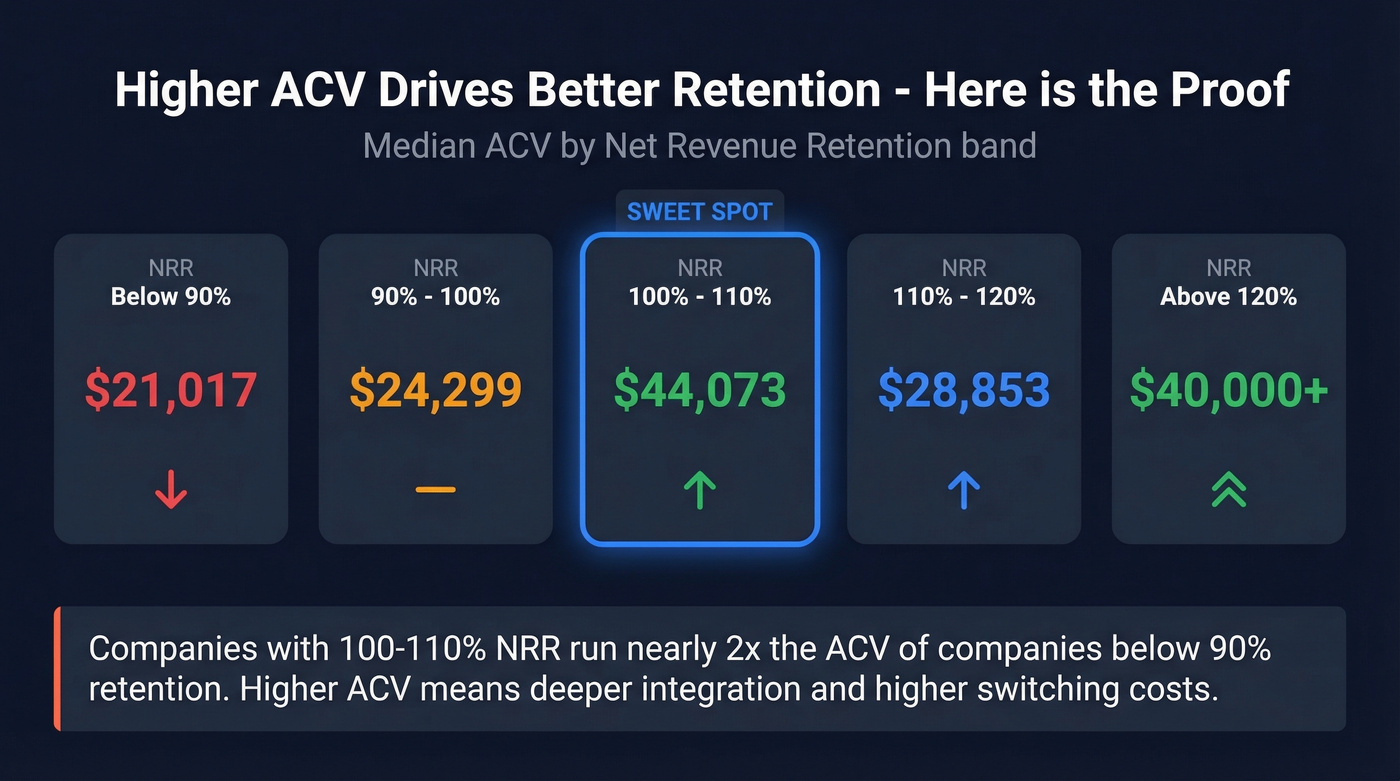
| NRR Band | Median ACV |
|---|---|
| Below 90% | $21,017 |
| 90-100% | $24,299 |
| 100-110% | $44,073 |
| 110-120% | $28,853 |
| Above 120% | $40,000+ |
The sweet spot is clear. Companies with 100-110% NRR run nearly double the ACV of companies with sub-90% retention. Higher ACV deals involve deeper integration, more stakeholders, and higher switching costs - all of which drive retention. If your NRR is stuck below 90%, your deal size might be the root cause, not your CS team.
ACV by Vertical
The Optifai Pipeline Study across 939 B2B SaaS companies breaks things down by vertical:
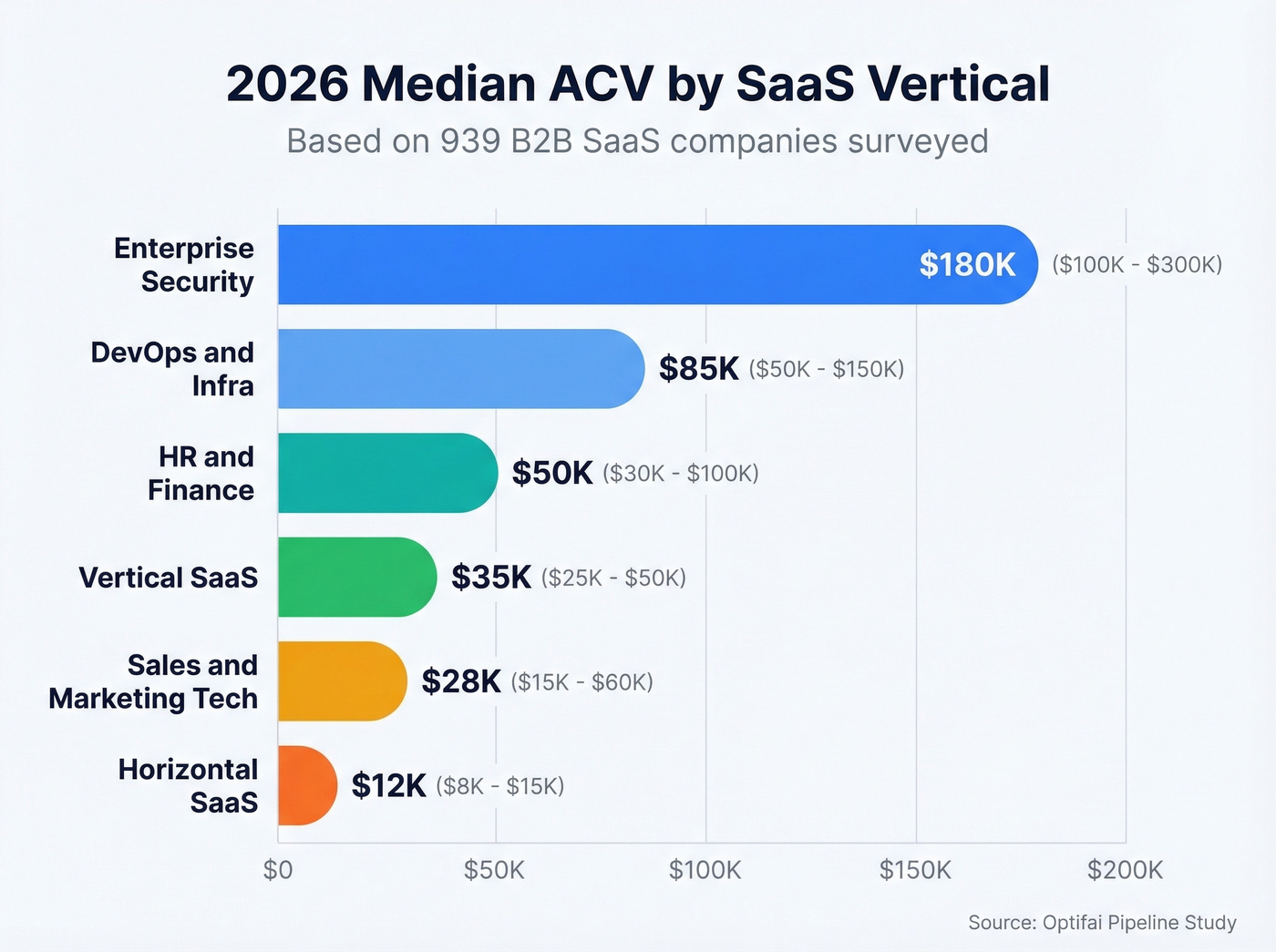
| Vertical | Median ACV | Range |
|---|---|---|
| Enterprise Security | $180K | $100K-$300K |
| DevOps/Infra | $85K | $50K-$150K |
| HR & Finance | $50K | $30K-$100K |
| Vertical SaaS | $35K | $25K-$50K |
| Sales & Marketing Tech | $28K | $15K-$60K |
| Horizontal SaaS | $12K | $8K-$15K |
Enterprise security at $180K median and horizontal SaaS at $12K are practically different businesses. They require different sales motions, different team structures, and different compensation models entirely. That's the whole point of tracking annual contract value - it tells you what kind of company you are.
ACV by Stage
| Stage | ARR Range | Typical ACV |
|---|---|---|
| Pre-seed / Seed | Below $1M | $5K-$10K |
| Series A | $1M-$5M | $10K-$20M |
| Series B | $5M-$20M | $20K-$40K |
| Series C+ | $20K-$100M | $40K-$80K |
| Growth / Pre-IPO | Above $100M | $60K-$150K+ |
Growth and Retention Sweet Spots
Here's a data point worth pinning to your wall: according to the 2026 SaaS Benchmarks Report, the fastest-growing SaaS companies cluster in the $25K-$50K ACV range, while the highest retention rates show up at $100K-$250K.
In our experience, the $25-50K band is where most teams find their stride. You're big enough to justify a real sales process but small enough to close in weeks, not quarters. At $100K+, customers are deeply integrated and switching costs are high - they don't churn easily.

Moving upmarket to hit higher ACV targets means reaching senior buyers - VPs, C-suite, department heads. Prospeo gives you 300M+ profiles with 30+ filters including headcount growth, funding, and buyer intent so you build lists that match your ideal deal size.
Stop selling $12K deals to the wrong accounts. Find enterprise buyers now.
How ACV Shapes Your Go-to-Market
Your annual contract value isn't just a number for the board deck. It dictates how you sell, who you hire, and how long you can afford to wait for payback.
| ACV Range | Sales Motion | CAC Payback |
|---|---|---|
| Below $5K | Self-serve | 1-3 months |
| $5K-$15K | PLG + inside assist | 3-6 months |
| $15K-$50K | Inside sales + SDR | 6-12 months |
| $50K-$150K | Field sales | 12-18 months |
| Above $150K | Named enterprise accounts | 18-24 months |
Look - a deal size under $5K means you shouldn't have a sales team calling prospects. The math doesn't work. At $5K ACV, even a junior SDR's fully loaded cost of $60-80K/year means they need to close 12-16 deals just to cover their own salary. Add an AE and you're underwater.
At the other end, if your average deal is $150K+, you'd better have field reps, solution engineers, and executive sponsors involved. These deals don't close over Zoom in two calls. They close over dinners, QBRs, and six-month procurement cycles.
The most common mistake we see is a mismatch between ACV and go-to-market motion. A company with $8K deals running a full enterprise sales cycle - SDR to AE to SE to VP sponsor call - is burning cash on every deal. A company with $80K deals relying on inbound self-serve is leaving money on the table.
If your average contract value sits below $10K, you probably don't need most of the sales infrastructure you're building. Kill the SDR team, invest in product-led growth, and pour the savings into B2B content marketing and self-serve onboarding. I've watched three startups ignore this advice and burn through their Series A in 14 months.
ACV vs. ARR vs. TCV vs. MRR
| Metric | What It Measures | Scope | Use Case |
|---|---|---|---|
| ACV | Annual value, one contract | Per-deal | Deal sizing & rep performance |
| ARR | Annual recurring revenue | Company-wide | Board reporting & investor updates |
| TCV | Total contract value | Per-deal, full term | Cash flow planning |
| MRR | Monthly recurring revenue | Company-wide | Ops & forecasting |
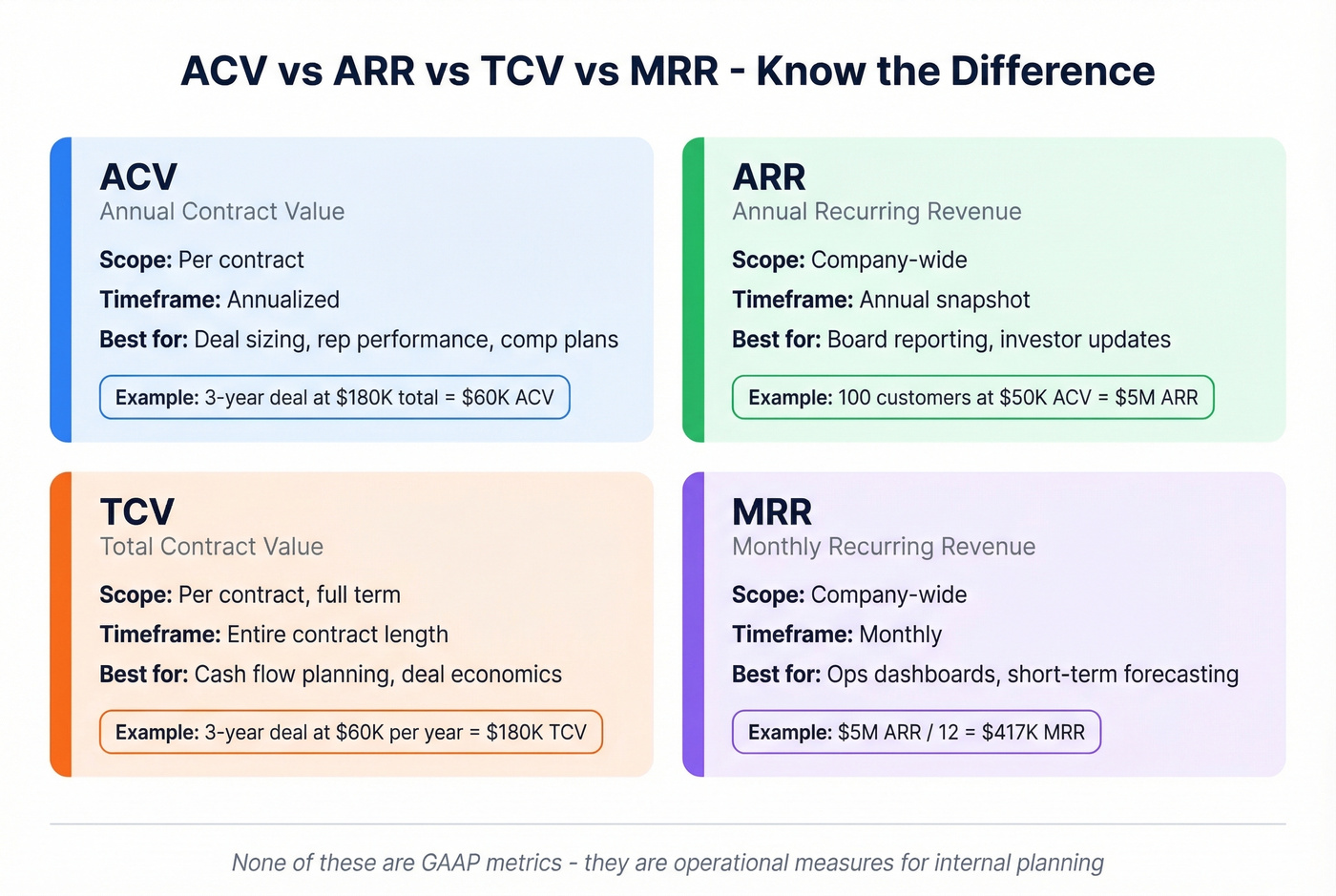
The critical distinction: ACV is per-contract, ARR is company-wide. A company with 100 customers at $50K ACV has $5M ARR. They're related but not interchangeable, and conflating them in board meetings will get you corrected by your CFO.
None of these are GAAP metrics. They're operational measures that don't map directly to revenue recognition under ASC 606. Your finance team recognizes revenue as it's earned, which can differ from how you calculate ACV for sales planning.
Bookings, Billings, and Revenue
Three more terms that get tangled with ACV. Bookings are the total value of signed contracts - the commitment. A 2-year, $24K contract is a $24K booking on the day it's signed. Billings are invoices issued - what you've asked the customer to pay. Revenue is what you've actually earned and recognized.
When someone asks for your ACV, they want the annualized contract value. Not bookings, not billings, not recognized revenue. Keep these lanes separate.
How ACV Comp Plans Actually Work
Only 21% of companies are happy with their sales compensation plans. ACV is at the center of most comp plan arguments.
The standard enterprise pattern runs about 8-10% commission on first-year ACV. For inside sales, the all-in take-home typically lands at 20-25% of ACV, meaning reps need to close 4-5x their OTE to make the math work for the company.
The ACV-vs-TCV comp tension is real. A common question on r/sales: is it normal to get comped on only the annual run rate of a multi-year deal - earning $100K comp credit on a $300K, 3-year contract? One enterprise rep put it bluntly: "I closed a $300K three-year deal and got comped on $100K. That's standard, but it stings."
The answer: yes, it's standard, and it's the right call for most companies. Comping on TCV incentivizes reps to push multi-year deals even when the customer doesn't need one, and it front-loads commission expense in a way that kills your unit economics.
SaaStr has a cautionary example worth remembering: one company copied a "BigCo" comp plan and watched revenue per lead fall by over 50%. A comp plan designed for $150K enterprise deals will destroy a team selling $20K inside-sales deals. Skip the copy-paste approach and build comp around your actual ACV band.
Tracking ACV Without Losing Your Mind
The biggest operational headache isn't calculating ACV - it's keeping it accurate across your CRM. The r/salesforce community is full of threads from RevOps teams trying to make Salesforce the single source of truth for ACV and failing because reps enter data inconsistently.
Three things that help: document your ACV definition in writing, build validation rules that enforce it at the opportunity level, and automate where possible so reps aren't doing mental math on every deal.
But even perfect CRM rules can't fix garbage inputs. If the contacts in your pipeline are wrong - bounced emails, outdated titles, people who left six months ago - the deal values attached to them are fiction. Your ACV forecast is only as reliable as the pipeline feeding it. Tools like Prospeo, with its 98% email accuracy and 7-day data refresh cycle, solve this at the source by keeping the contacts in your pipeline verified and current so the deal values attached to them actually mean something.
Your ACV determines your sales motion, and every motion depends on accurate contact data. Prospeo delivers 98% email accuracy and 125M+ verified mobile numbers - so whether you're running inside sales at $25K ACV or field sales at $150K+, your reps actually connect with real buyers.
Teams using Prospeo book 26% more meetings than ZoomInfo users.
FAQ
Does ACV include one-time fees?
Most companies exclude them. Setup, onboarding, and implementation fees inflate first-year numbers and don't recur. The standard practice is exclusion - pick a consistent rule and apply it across every contract so your comparisons stay meaningful.
Is ACV the same as ARR?
No. ACV measures a single contract's annualized value, while ARR measures total annual recurring revenue across all customers. A company with 200 customers averaging $30K ACV has $6M ARR. One is per-deal, the other is company-wide.
What's the difference between ACV and TCV?
TCV is the total value over the full contract duration; ACV normalizes that to one year. A $180K, 3-year deal has $180K TCV and $60K ACV. Use TCV for cash flow planning and ACV for comparing deal sizes and designing sales motions.
How do you calculate ACV for usage-based pricing?
Two approaches work. Pay commissions as usage ramps over 12 months - safer when you lack historical data. Or model expected annual value upfront and claw back if actuals miss. The modeling approach becomes reliable once you've got 100+ customers to base projections on.
How does ACV change when moving upmarket?
It grows, but not linearly. A common pattern on r/sales is teams jumping from $15K deals to $50K+ and discovering their entire sales motion needs rebuilding - longer cycles, more stakeholders, solution engineers in every deal. The number shift is easy; reorganizing around it is the hard part.