

What Does "Go-to-Market" Actually Mean? (And Why Every Explanation Sounds Like Corporate Word Soup)
Every definition of go-to-market reads like it was written by a committee that couldn't agree on the go-to-market meaning. Product launch plan. Revenue strategy. Cross-functional alignment framework. All technically correct, all practically useless.
There's a reason a Reddit thread was literally titled "WTF is go-to-market?" - the term has been stretched to mean everything and nothing. GTM isn't complicated. It's just poorly explained.
The Short Version
Go-to-market is the cross-functional system for getting a product into the hands of the right customers. Not marketing. Not a slide deck. A system covering who you sell to, how you reach them, what you charge, and how you measure success. If your deal sizes are under $10K, lean product-led. Over $25K, go sales-led. In between, run both.
What Go-to-Market Actually Means
So what does go-to-market mean in practice? A go-to-market strategy is the system a company uses to bring a product or service to its target customers - covering positioning, pricing, channels, sales motion, and success metrics.
The problem with most definitions is they reduce GTM to a "plan." Stephen Diorio argues in Forbes that this misses the execution complexity entirely. His framing is better: GTM is a system aligning revenue-generating functions, processes, operations, and information along the entire revenue cycle to drive profitable, scalable growth. That means Product, Sales, Customer Success, Finance, and IT all have skin in the game - not just marketing, not just the launch team.
Here's the thing: the reason GTM sounds like corporate word soup is that people keep trying to stuff a multi-department operating system into a single sentence. It doesn't fit. If you can't define your own company's GTM in two sentences, you probably don't have a strategy - you have a collection of disconnected tactics.
GTM vs. Marketing Strategy
The most common misconception: "Isn't GTM just... marketing?" No. Marketing is one channel within GTM.
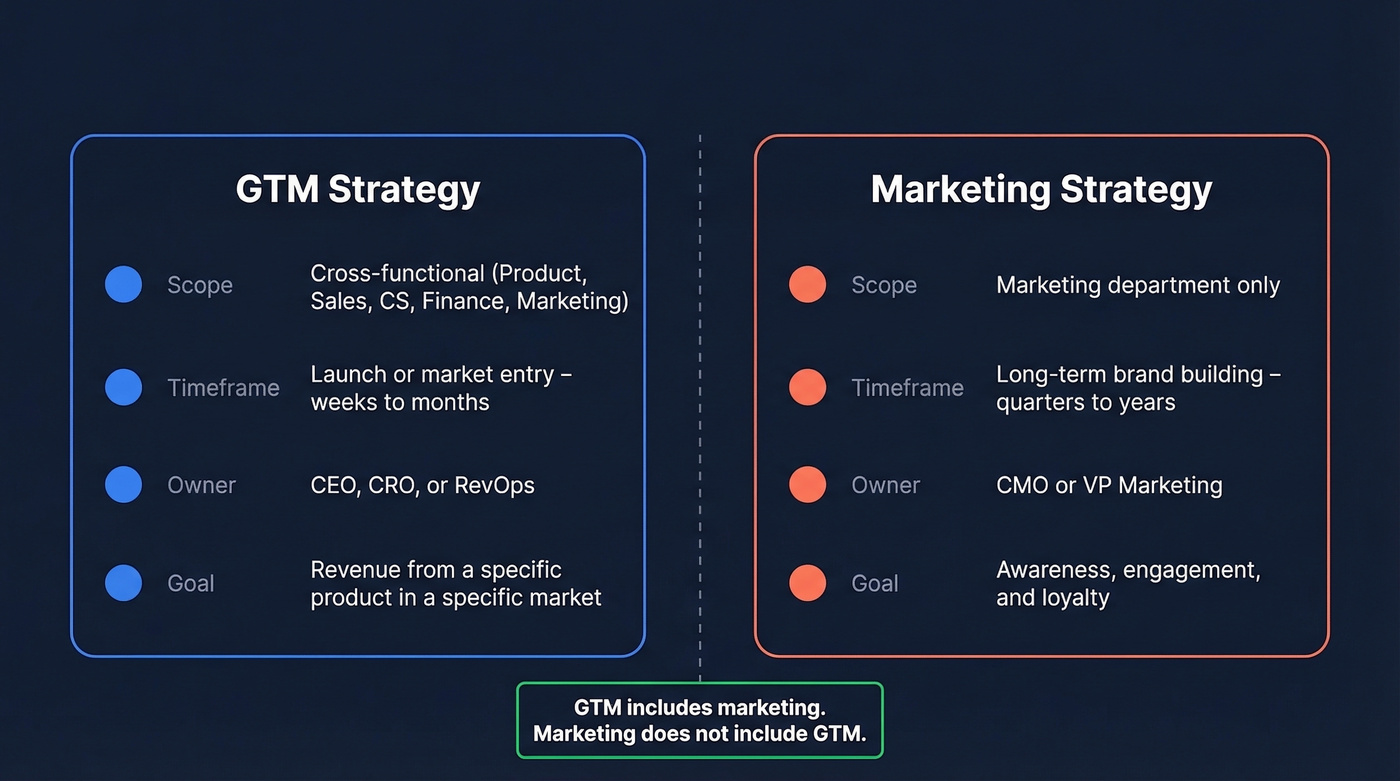
| GTM Strategy | Marketing Strategy | |
|---|---|---|
| Scope | Cross-functional | Marketing department |
| Timeframe | Launch / market entry | Long-term brand building |
| Owner | CEO / CRO / RevOps | CMO / VP Marketing |
| Goal | Revenue from specific product | Awareness, engagement, loyalty |
GTM is tactical and time-bound - it answers "how do we get this product into this market and start generating revenue?" Marketing strategy is the longer arc of brand building and demand generation. A GTM strategy includes marketing. Marketing strategy doesn't include pricing, sales motion design, or channel partner decisions.
Where the Term Came From
"Go-to-market" emerged in the 1980s as commercial models shifted from mostly human, analog selling to multi-channel systems - direct mail, call centers, EDI, and eventually the web. Companies suddenly needed a framework for coordinating how products reached customers across these new channels.
The foundational text is Lawrence Friedman's Go To Market Strategy (2002), which laid out the building blocks most practitioners still use: choose target markets, understand customer needs, decide sales channels, and articulate a value proposition. Friedman's most useful heuristic is deceptively simple - determine whether your product is a "need to have" or a "nice to have," because that single distinction shapes your entire motion, messaging, and channel mix.
Five Core Components
Every GTM strategy, regardless of industry or company size, needs these five pieces. Understanding the real meaning behind go-to-market starts here.
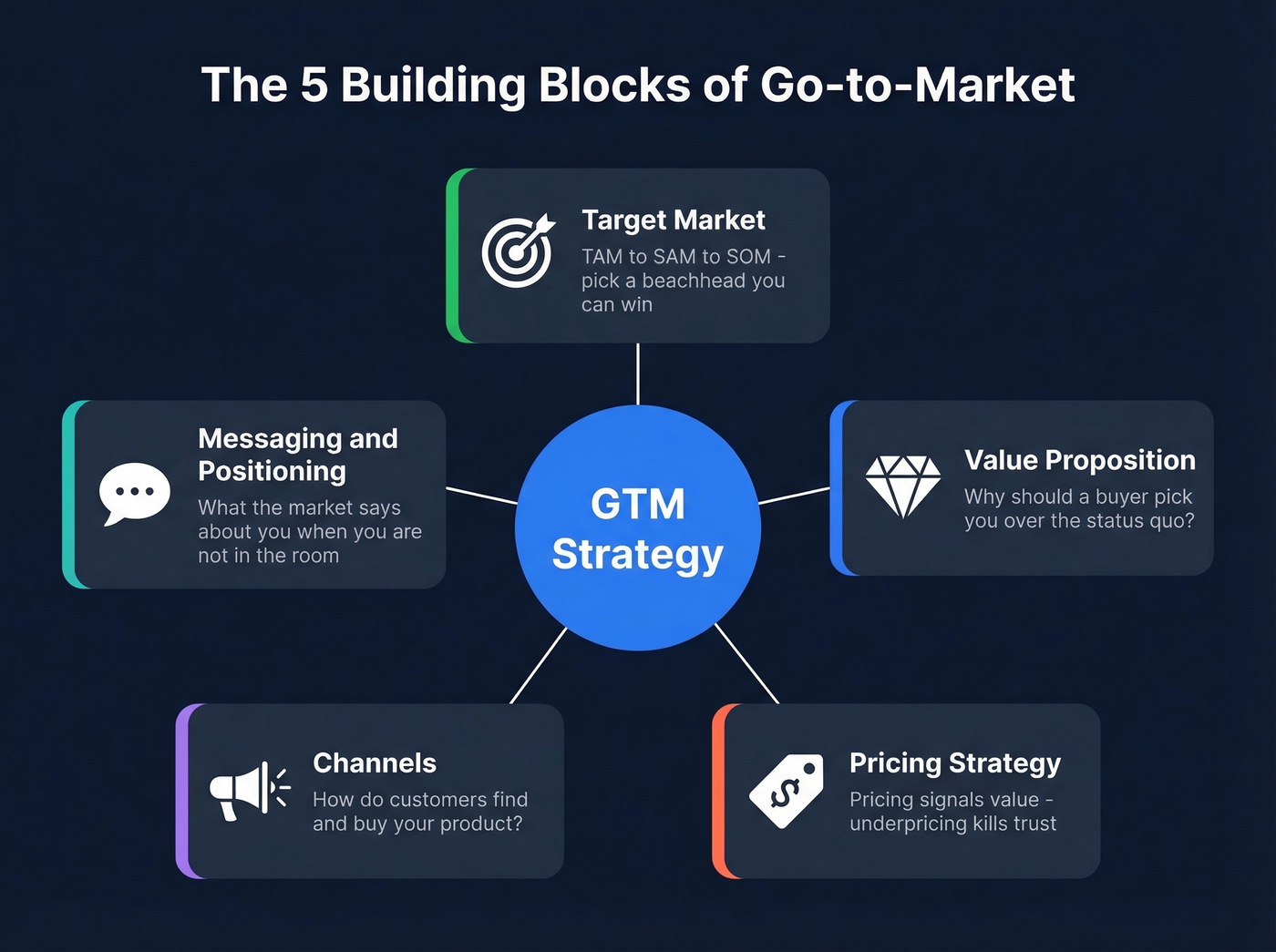
Target market. Size your opportunity using TAM - your total addressable market - then narrow to SAM and SOM, the serviceable and obtainable slices. Most teams skip SOM and end up targeting everyone, which means targeting no one. Pick a beachhead segment you can actually win. (If you want the deeper breakdown, see TAM, SAM, SOM.)
Value proposition. What problem do you solve, and why should anyone care? This isn't your tagline - it's the reason a buyer picks you over the status quo. If your value prop requires a paragraph to explain, it's not sharp enough. (If you’re tightening positioning, start with B2B brand positioning.)
Pricing strategy. Pricing signals value. Adobe's shift from Creative Suite as a one-time purchase to Creative Cloud at about $50/month wasn't just a revenue model change - it was a GTM transformation that opened an entirely new buyer segment. Slack's generous free tier serves the same function: remove friction, let the product sell itself, then monetize expansion.
Channels. How do customers find and buy your product? Direct sales, self-serve, partner/reseller, marketplace, PLG - each has different cost structures and scaling dynamics. The average company runs 10.5 simultaneous GTM efforts. Most would be better off running three well. (For channel-specific execution, see B2B lead generation solutions.)
Messaging and positioning. Not what you say about yourself - what the market says about you when you're not in the room. Messaging connects your value prop to the specific pain points of your target segment, in their language, through their preferred channels.

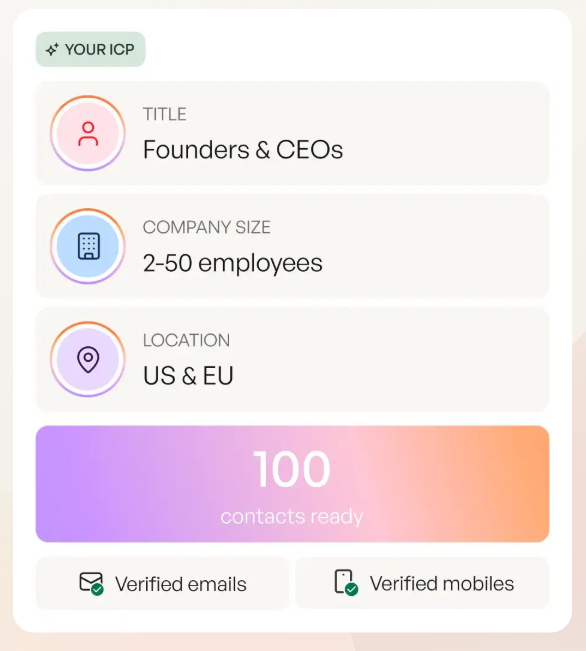
You just defined your ICP, nailed your value prop, and picked your GTM motion. Now you need to actually reach those buyers. Prospeo gives you 300M+ profiles with 30+ filters - buyer intent, technographics, headcount growth, funding - so your GTM targeting matches reality, not a spreadsheet fantasy.
Stop strategizing in a vacuum. Build lists that convert at 98% email accuracy.
GTM Motions: PLG vs. Sales-Led vs. Hybrid
A GTM motion is a repeatable, cross-functional pattern for acquiring and retaining customers. It's not a tactic - it's the operating rhythm your revenue team runs every day.
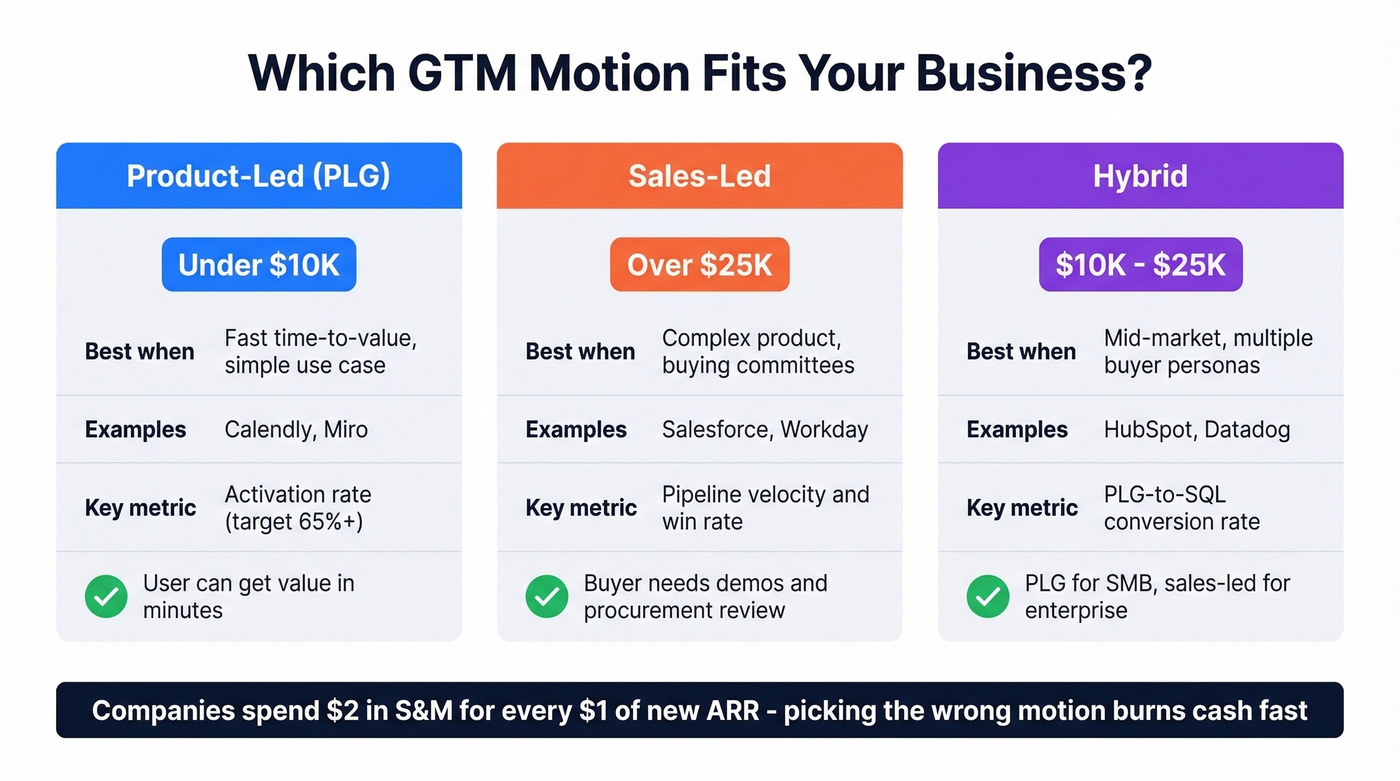
| Motion | Best When | ACV Range | Example |
|---|---|---|---|
| Product-led (PLG) | Fast time-to-value, simple use case | Under $10K | Calendly, Miro |
| Sales-led | Complex product, buying committees | Over $25K | Salesforce, Workday |
| Hybrid | Mid-market, multiple buyer personas | $10K-$25K | HubSpot, Datadog |
Skip PLG if your buyer needs a demo to understand the product. You'll waste 18 months building self-serve infrastructure nobody uses. PLG works when a user can experience value in minutes, not months. Miro grew from 5M users in 2019 to 50M+ by 2023 via freemium PLG. Calendly hit $100M ARR by 2021 because every meeting scheduled became a distribution mechanism - the product literally markets itself.
Sales-led makes sense when you're navigating procurement, legal review, and multi-stakeholder buying committees. You can't PLG your way through a 6-month enterprise sales cycle. (If you’re selling bigger deals, use an enterprise B2B sales playbook.)
The hybrid approach is increasingly dominant. We've seen companies run PLG for SMB acquisition while maintaining a sales-led motion for enterprise - same product, different GTM motions for different segments. The math is uncomfortable: companies are spending $2 in sales and marketing for every $1 of new ARR, and that ratio climbed 14% year-over-year. Picking the wrong motion doesn't just slow growth - it burns cash.
How to Build a GTM Strategy
Seven steps. None optional.
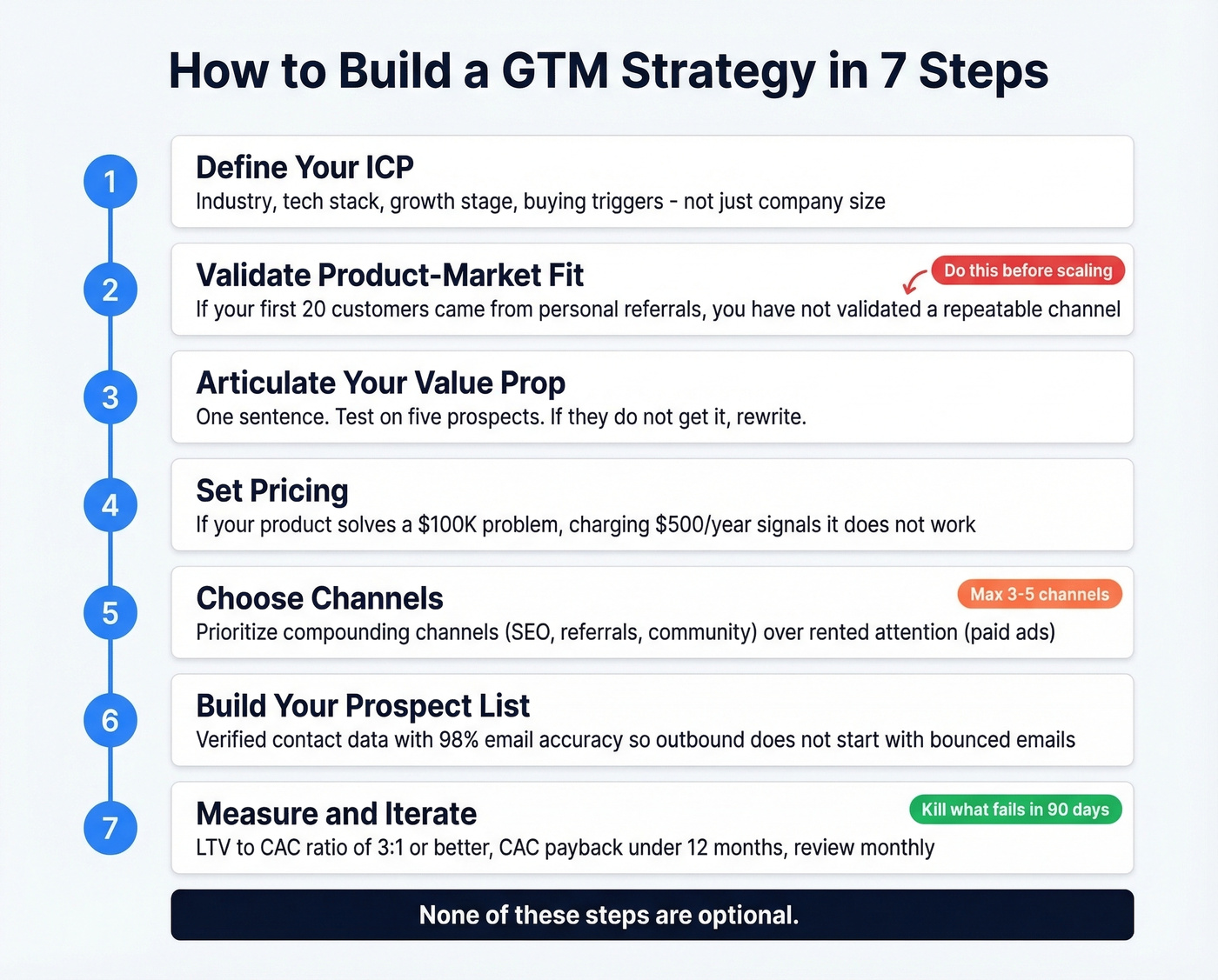
Define your ICP. Not "companies with 50-500 employees." Get specific: industry, tech stack, growth stage, buying triggers, department headcount. The tighter your ICP, the higher your conversion rates. (Use an ideal customer profile template if you need a scoring rubric.)
Validate product-market fit. Validate assumptions before scaling. If your first 20 customers all came from personal network referrals, you haven't validated a repeatable channel - you've validated that you know people. I've watched three startups burn through $500K scaling outbound before validating PMF. Don't be the fourth.
Articulate your value proposition. Write it in one sentence. Test it on five prospects. If they don't immediately get it, rewrite.
Set pricing. Underpricing doesn't just leave money on the table - it reduces trust. If your product solves a $100K problem, charging $500/year signals that it doesn't actually work.
Choose channels. Prioritize compounding channels like SEO, referrals, and community over rented attention like paid ads. That said, paid can accelerate early learning. In our experience, teams that run more than five channels simultaneously dilute all of them.
Build your prospect list. Once your ICP is defined, you need verified contact data to reach them. Tools like Prospeo cover 300M+ professional profiles with 98% email accuracy and a 7-day refresh cycle, so your outbound team isn't burning through bounced emails on day one. (If you’re comparing vendors, start with B2B company data providers.)

- Measure and iterate. Track LTV:CAC (target 3:1 or better), CAC payback under 12 months, and activation rates. Review monthly. Kill what isn't working within 90 days. (For the unit-econ math, see cost to acquire customer.)
2026 GTM Benchmarks
CAC has inflated 40-60% since 2023, and the channel you pick determines whether your unit economics work or collapse.
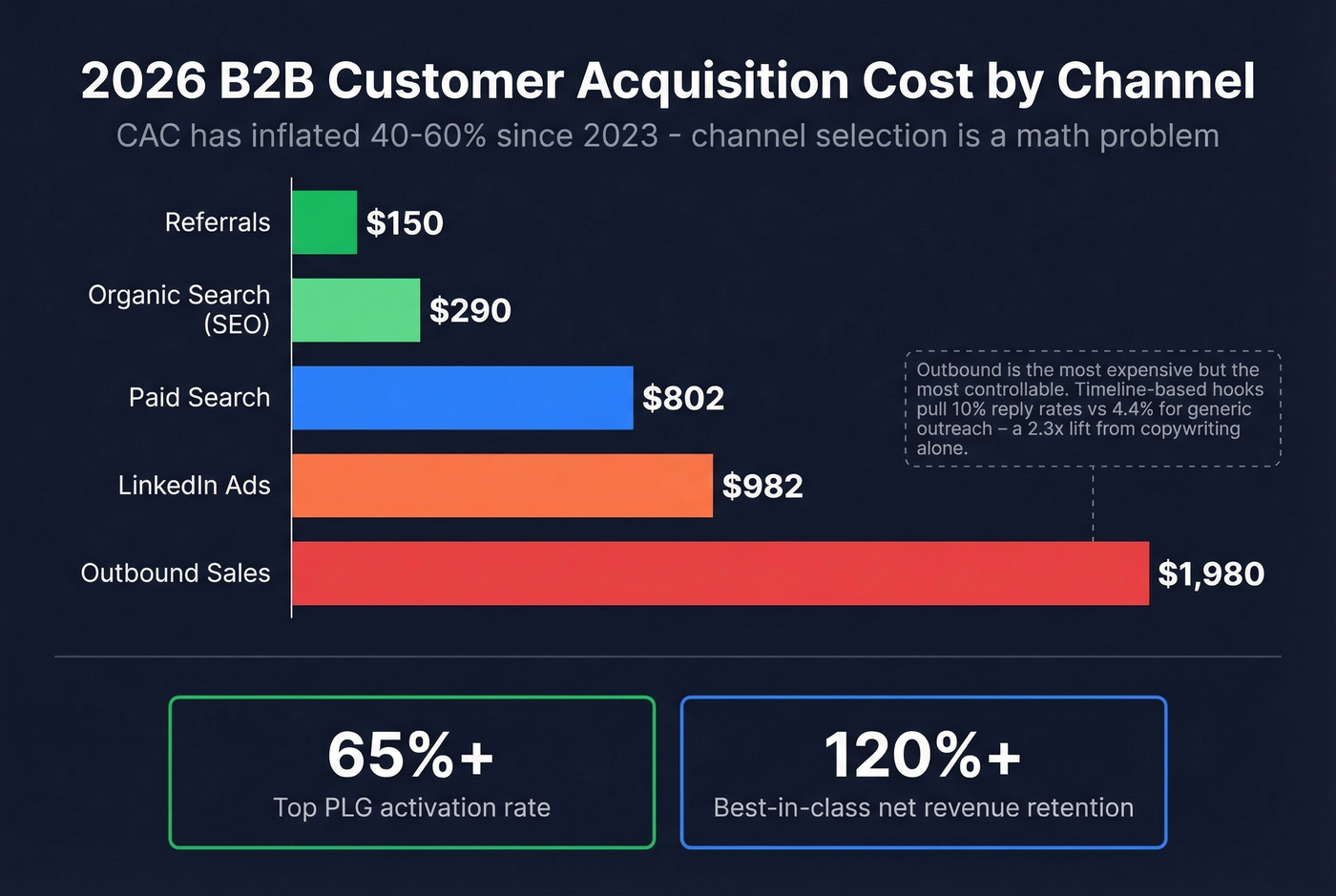
| Channel | Avg CAC (B2B) |
|---|---|
| Referrals | $150 |
| Organic search (SEO) | $290 |
| Paid search | $802 |
| LinkedIn ads | $982 |
| Outbound sales | $1,980 |
Outbound is the most expensive channel per acquisition, but it's also the most controllable. The key is execution quality - timeline-based hooks like "saw you just raised a Series B" pull a 10.01% reply rate vs. 4.39% for generic problem hooks, a 2.3x difference from copywriting alone. (If you want more levers, use these sales prospecting techniques.)
On the PLG side, top-performing companies achieve 65%+ activation rates vs. 33% average. Best-in-class net revenue retention runs above 120%. If your NRR is below 100%, your GTM has a retention leak that no amount of top-of-funnel spend will fix.
Channel selection isn't a strategy exercise. It's a math problem. Run the CAC numbers before you commit budget.
Real-World GTM Examples
Slack targeted tech-savvy SMB teams with a value prop around centralizing communication and making it searchable. The free tier was generous enough that teams adopted it organically, then expanded within organizations. By 2019, Slack had 8M daily active users and 3M paid. Salesforce acquired them for $27.7B - not because of the product alone, but because the GTM motion had built an installed base that was nearly impossible to displace.
Calendly turned every meeting into a distribution channel. When you send a Calendly link, the recipient sees the product. That's PLG at its purest - the product is the marketing. They scaled to $100M ARR by 2021 with minimal outbound spend.
Lick Paint proves GTM isn't just a B2B SaaS concept. This DTC paint brand built their motion around user-generated content, sustainability positioning with 100% recyclable packaging, and influencer collaborations. Different industry, same framework: know your buyer, pick your channels, let the product experience do the selling.
Seven Mistakes That Kill Launches
Mistake #7 is the one that kills the most companies, and it's the one founders are least willing to hear.
Confusing GTM with marketing. Campaigns are the last mile. GTM includes positioning, motion design, pricing, distribution, and timing. Fix: assign a cross-functional GTM owner.
Targeting too broadly. "All mid-market SaaS companies" isn't a segment. Fix: pick a beachhead - one industry, one company size, one pain point - and dominate it before expanding.
Not validating channels early. Your first 10 customers came from warm intros. That doesn't mean warm intros scale. Fix: test two to three channels with real budget in the first 90 days. For outbound specifically, the consensus on r/sales is that verified, regularly refreshed contact data is the difference between bounce rates of 35% and under 4%.
Neglecting pricing. Underpricing reduces trust. Overpricing kills conversion. Fix: test three price points with real prospects before launch.
Ignoring motion fit. If your buyer has a procurement team and legal review, you need a sales-led motion - not a self-serve signup page. Fix: map your buyer's actual purchasing process before designing your motion.
Focusing only on acquisition. Retention, expansion, and referrals drive more revenue than new logos in year two and beyond. Fix: build expansion metrics into your GTM scorecard from day one.
Scaling before product-market fit. Pouring money into a GTM motion before PMF just amplifies churn. Fix: don't scale spend until you can point to repeatable, unassisted purchases from your target segment.
Running sales-led, PLG, or hybrid? Every motion dies without verified contact data. Teams using Prospeo book 26% more meetings than ZoomInfo and 35% more than Apollo - because 98% email accuracy and 30% mobile pickup rates mean your reps talk to real buyers, not bounce logs.
Your GTM motion needs fuel. Get verified emails and direct dials for $0.01 each.
FAQ
Is GTM the same as marketing?
No. GTM is a cross-functional system spanning sales, product, pricing, and distribution. Marketing is one channel within it. If your "GTM plan" only covers demand gen campaigns, you're missing 80% of the picture.
What's a GTM motion?
A GTM motion is a repeatable pattern for acquiring and retaining customers - product-led, sales-led, partner-led, or community-led. Most mature companies run two to three motions simultaneously, segmented by deal size or buyer persona.
How long does it take to build a GTM strategy?
A first version takes two to four weeks. Validating it takes 90 days of real market feedback. The strategy document is the easy part - execution and iteration are where teams stall.
What tools do you need for GTM execution?
At minimum: a CRM like HubSpot or Salesforce, a data provider for verified contacts, and a sequencing tool like Instantly or Lemlist for outbound. We've found that the data layer matters most - bad emails torpedo deliverability before your messaging even gets a chance.
How does go-to-market differ for new vs. existing products?
For a new product, GTM centers on initial market entry - validating channels, testing pricing, and finding your first repeatable customer segment. For an existing product entering a new market, the focus shifts toward repositioning, channel expansion, and adapting your motion to a different buyer profile. The core framework is the same; the inputs change.