

What Is AIDA? The Marketing Framework That Still Works - If You Use It Right
Not the Verdi opera - the marketing model. AIDA stands for Attention, Interest, Desire, Action, and it's been the backbone of persuasive communication for over a century. The short answer to "what is AIDA": it's the simplest structure for writing anything that needs to persuade someone to do something.
AIDA gets used two ways - as a buying-process funnel and as a communications framework for how a single message should work. Most people get more value from the second interpretation. The original intent was to explain how an advertisement should move someone from first noticing it to taking a next step, and that lens for reviewing your copy still holds up remarkably well across cold emails, landing pages, ads, and even LinkedIn posts.
Quick Summary
- AIDA = Attention -> Interest -> Desire -> Action. It's a messaging checklist you apply to a single piece of communication.
- Use it to structure anything persuasive - a cold email, a landing page, an ad, a post. It forces you to earn attention before asking for anything.
- If your audience already knows they have a problem, use PAS instead. AIDA is for introducing something new. Learn both; use whichever fits.
The Four Stages of AIDA
Here's the thing most people get wrong: they treat these four stages as a funnel that prospects "move through" over weeks. The model can work that way, but it's far more useful as a structure for one message - one email, one ad, one page - where each stage is a beat you hit in sequence.
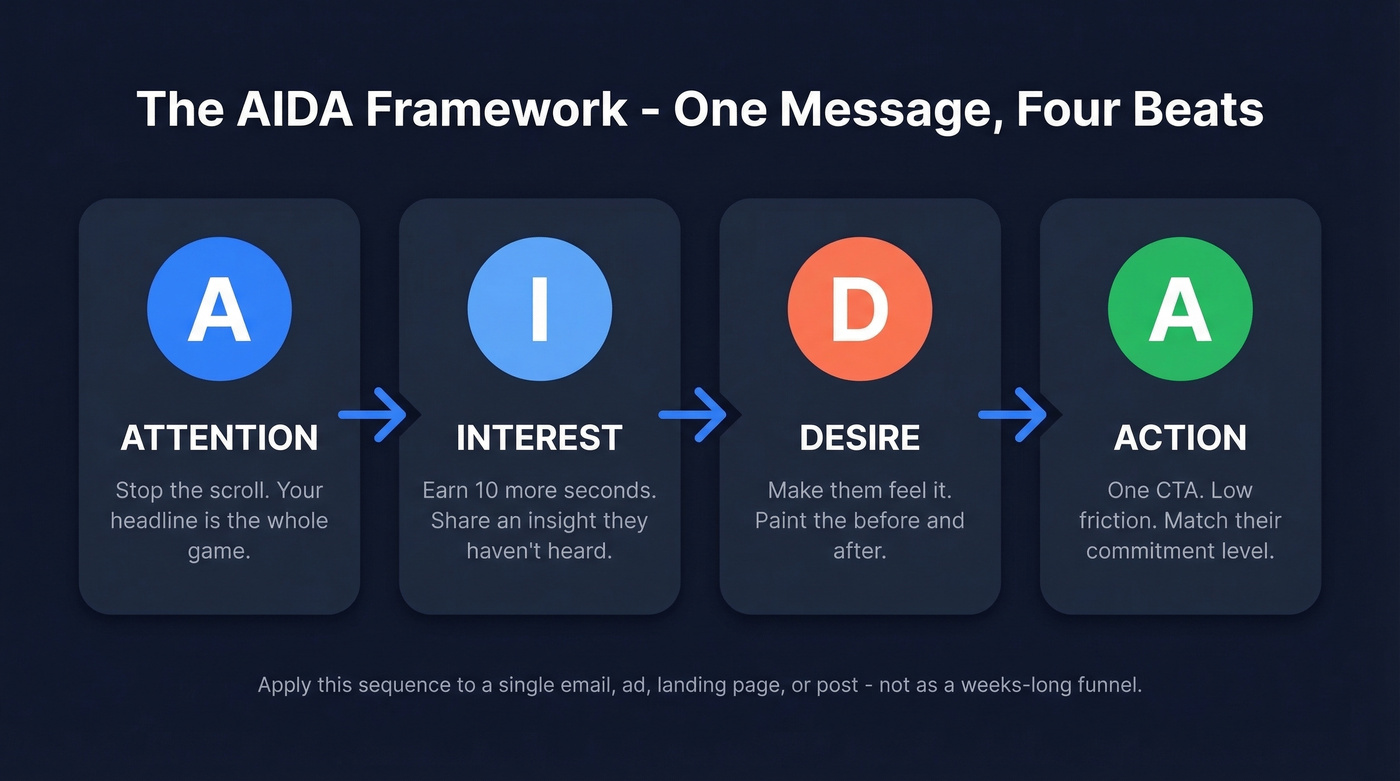
Attention
Your headline is the whole game. If nobody stops scrolling, nothing else matters.
Over 58% of Google searches now end without a click, according to SparkToro's research with Datos - which means your hook has to deliver value even if the reader never makes it past the subject line. The tactics that work are pattern interrupts, unexpected specificity, and stats that make someone pause. "Struggling with 30% cart abandonment?" beats "Improve your e-commerce performance" every single time because it names the exact pain the reader already feels.
There's an important distinction between awareness and attention. Awareness means someone knows your brand exists. Attention means they noticed this message, right now. The framework is about the second one.
Interest
Once you've got their eyes, you need to keep them. Interest is the intellectual hook - facts, stories, and "why should I care?" framing that pulls the reader deeper. What makes this different from what they've already heard? What's the insight that earns another ten seconds of reading?
The best Interest sections feel like a friend sharing something they just learned. A surprising tidbit, a counterintuitive stat, a quick story. You're not selling yet. You're earning the right to sell.
Desire
This is where 90% of marketing copy fails. Most writers jump straight from features to a CTA, skipping the emotional "I want that" moment entirely.
Interest is intellectual - "that's useful." Desire is emotional - "I want that." The before/after technique is the simplest way to nail this stage: paint the current state (messy, slow, expensive), then paint the outcome (clean, fast, cheap). Layer in social proof - roughly 95% of shoppers read online reviews before buying. Testimonials, case studies, and concrete outcomes do the heavy lifting here. Don't tell people your product is great. Show them what life looks like after they use it.
Action
One CTA. Not three. Not a menu of options.
Single-CTA emails increase clicks by 371% compared to emails with multiple competing asks. Your Action stage should be low-friction, specific, and strategically placed. "Would it make sense to send you 2-3 ideas?" is a better cold email CTA than "Book a 30-minute demo." The ask should match the commitment level the reader is ready for, and you should remove every possible reason to hesitate.
AIDA for Cold Email
This is where the framework earns its keep in 2026. A poster on r/coldemail shared that they closed $27K in two months after restructuring cold outreach around the Attention-Interest-Desire-Action sequence:
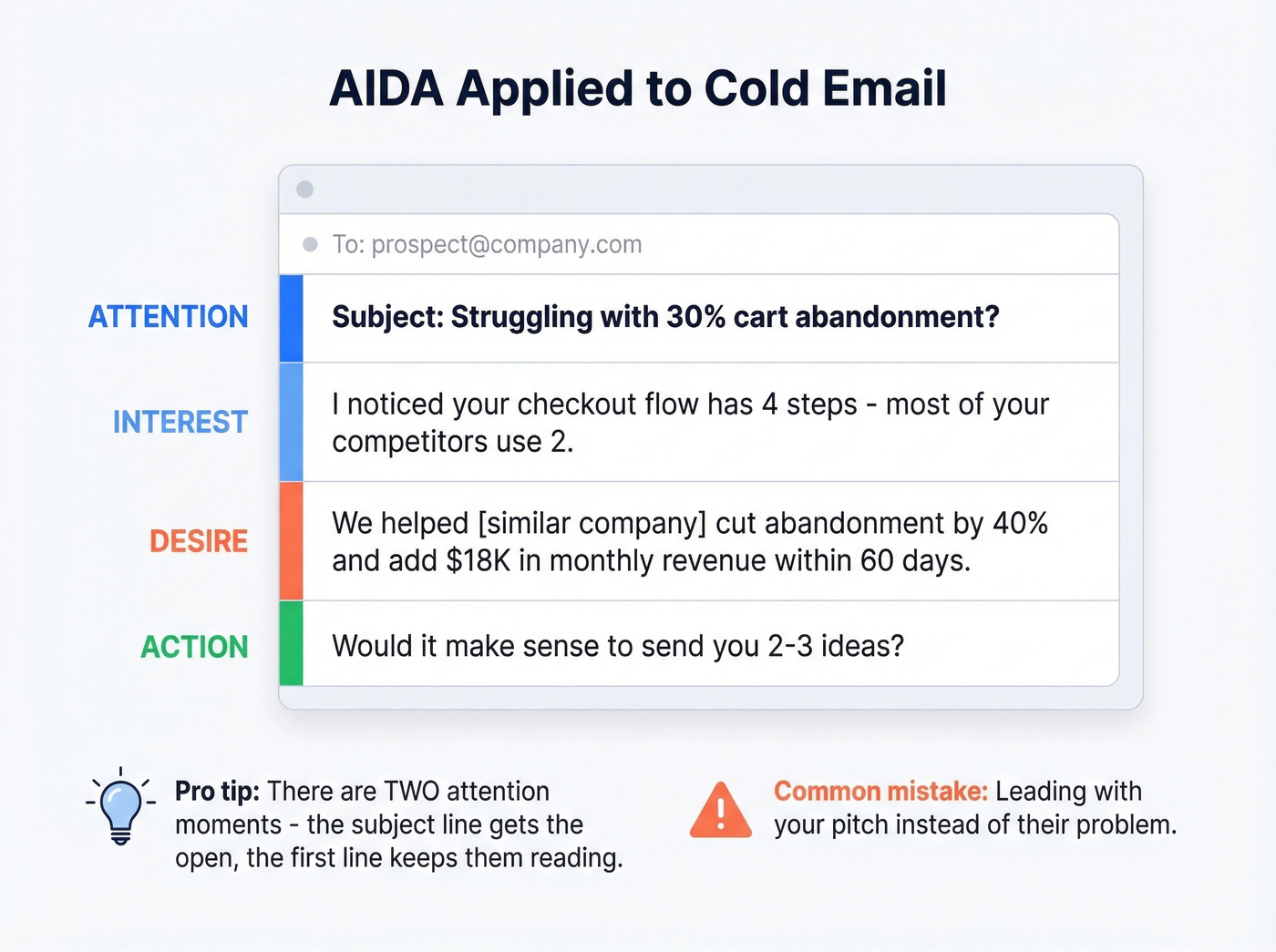
- Attention (subject line): Hyper-specific pain point - "Struggling with 30% cart abandonment?"
- Interest (opening line): A relevant observation about their business, not biographical fluff.
- Desire (body): "We helped [similar company] increase monthly revenue by 18%..."
- Action (close): Low-friction ask - "Would it make sense to send you 2-3 ideas?"
Most people miss that there are two "Attention" moments in cold email. The subject line gets the open, but the opening line determines whether they keep reading. Both need to earn their spot.
As GMass has pointed out, the best personalization isn't reciting biographical details about the prospect - it's identifying their actual problem. Too many AI cold email tools "cyberstalk" and personalize with irrelevant facts ("Congrats on 10 years at Acme!") instead of demonstrating that you understand what keeps them up at night. We've seen this pattern kill response rates across dozens of campaigns we've reviewed.
For cold email specifically, AIDA outperforms every other structure we've tested because it forces you to earn attention before asking for anything. You can't skip to the CTA or lead with your pitch - the framework won't let you. But the structure only matters if the message actually reaches a real inbox. Prospeo's real-time email verification (98% accuracy) keeps your carefully crafted outreach from bouncing into the void, and the free tier covers 75 verifications per month - enough to test the workflow before scaling.

Your AIDA-structured cold email is worthless if it bounces. Prospeo's 5-step email verification delivers 98% accuracy - so your perfectly crafted Attention hook actually reaches the inbox. 75 free verifications/month, no card required.
Don't let bad data kill your best copy. Verify before you send.
How to Write Using AIDA
Here's a fill-in-the-blank template you can use for any piece of communication:
- Attention: [Surprising stat, bold claim, or pain-point question that stops the scroll]
- Interest: [One specific insight, fact, or story that makes them think "tell me more"]
- Desire: [Before/after picture + social proof that makes the outcome feel real and personal]
- Action: [One low-friction CTA with a reason to act now]
Let's see this in action with a real example. Take Apple's iPhone SE positioning: "iPhone SE" grabs attention through brand recognition - you already know the product line, so the name alone stops the scroll. "Lots to love. Less to spend." creates interest by promising value and setting up a tension between quality and price. "Starting at $399" builds desire by making the price feel accessible compared to higher-priced flagship models. "Learn more / Buy" is the action - two options, both low-friction, neither requiring commitment. Four beats, four sentences, done.
In our experience, the Interest-to-Desire transition is where most drafts need the most revision. Most copywriters nail the hook and the CTA but rush through the middle. That's like building a bridge with strong foundations on both sides and nothing in between.
The before/after technique is the fastest fix: describe the painful "before" state, then paint the desirable "after" state. Trust builds in the gap between those two pictures.
Nailing the Attention stage means knowing your prospect's real pain point. Prospeo's 30+ search filters - buyer intent, technographics, job changes - give you the context to write opening lines that earn the click, not just fill the inbox.
Find the right prospects, then write the right message. Start at $0.01/email.
A Brief History of AIDA
The standard story goes like this: E. St. Elmo Lewis coined the model in 1898, and it's been the foundation of advertising theory ever since.
The real history is messier. An academic paper by Iwamoto argues there's weak evidence Lewis actually formulated it in that year, attributing earlier contributions to Arthur Frederick Sheldon and Frank H. Dukesmith. Strong's 1925 work cemented the Lewis attribution as conventional wisdom. The model belongs to what academics call the "hierarchy of effects" family - frameworks built on the Cognition -> Affect -> Behaviour sequence. You think, then you feel, then you act.
Does the disputed origin matter for practitioners? Not really. What matters is that the framework has survived 125+ years because it maps to something real about how humans process persuasive communication. That sequence doesn't change because we moved from print ads to TikTok.
AIDA vs. PAS
| Framework | Starts With | Best For | Weakness | Example Use |
|---|---|---|---|---|
| AIDA | Attention (hook) | Introducing new ideas | Skips known pain | Product launch email |
| PAS | Problem (pain) | Known pain points | Weak for new concepts | Cold email to aware buyer |
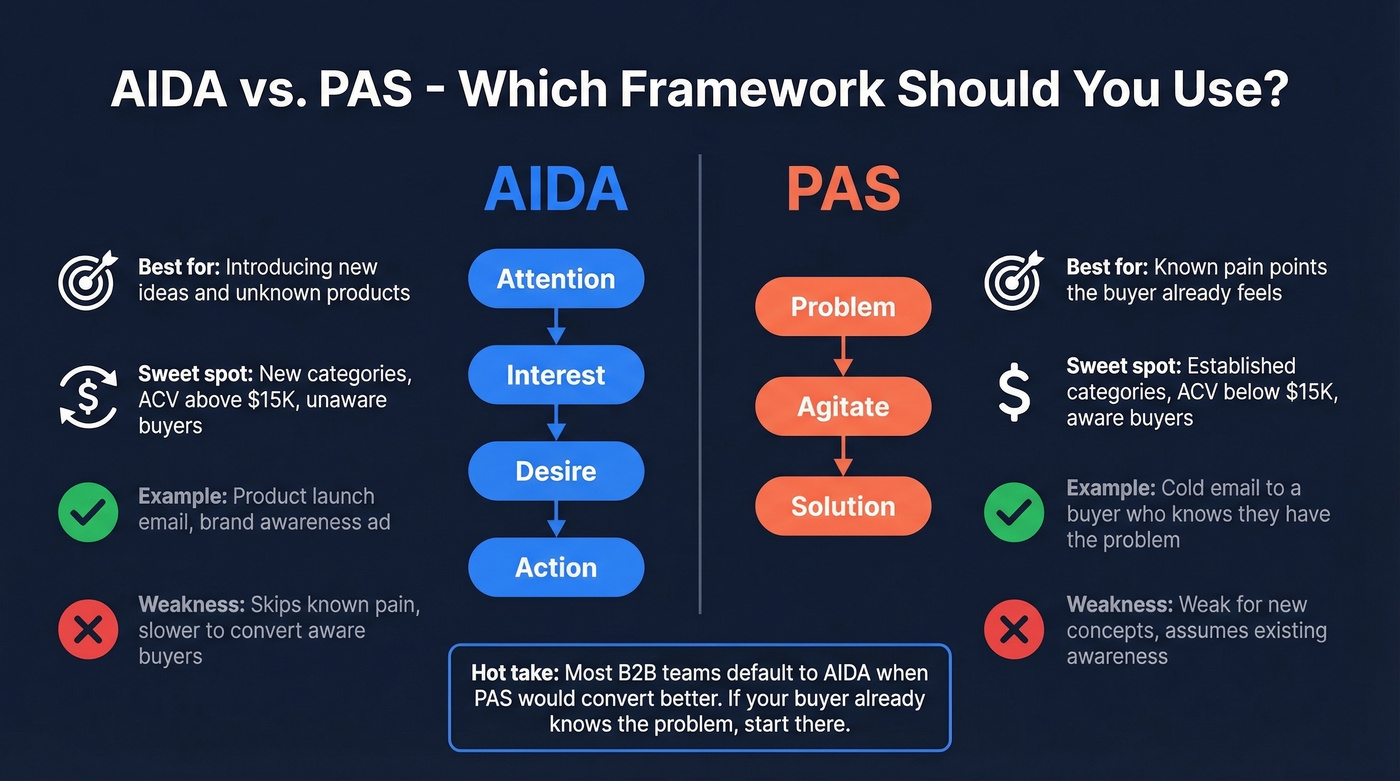
If you only learn two copywriting frameworks, make them AIDA and PAS. AIDA works when you're introducing something the reader doesn't know they need yet - you have to grab attention and build interest from scratch. PAS (Problem -> Agitate -> Solution) works when the audience already knows they have a problem and you just need to twist the knife before offering the fix.
Here's my hot take: most B2B teams default to AIDA when they should be using PAS. If your average contract value sits below $15K and you're selling into a category buyers already understand, PAS will outperform AIDA almost every time. AIDA shines when you're creating a new category or reaching someone who doesn't know you exist yet.
When the Model Breaks Down
AIDA is a messaging framework. It was never meant to model how people actually buy things. The problems start when marketers stretch it into a customer journey map.
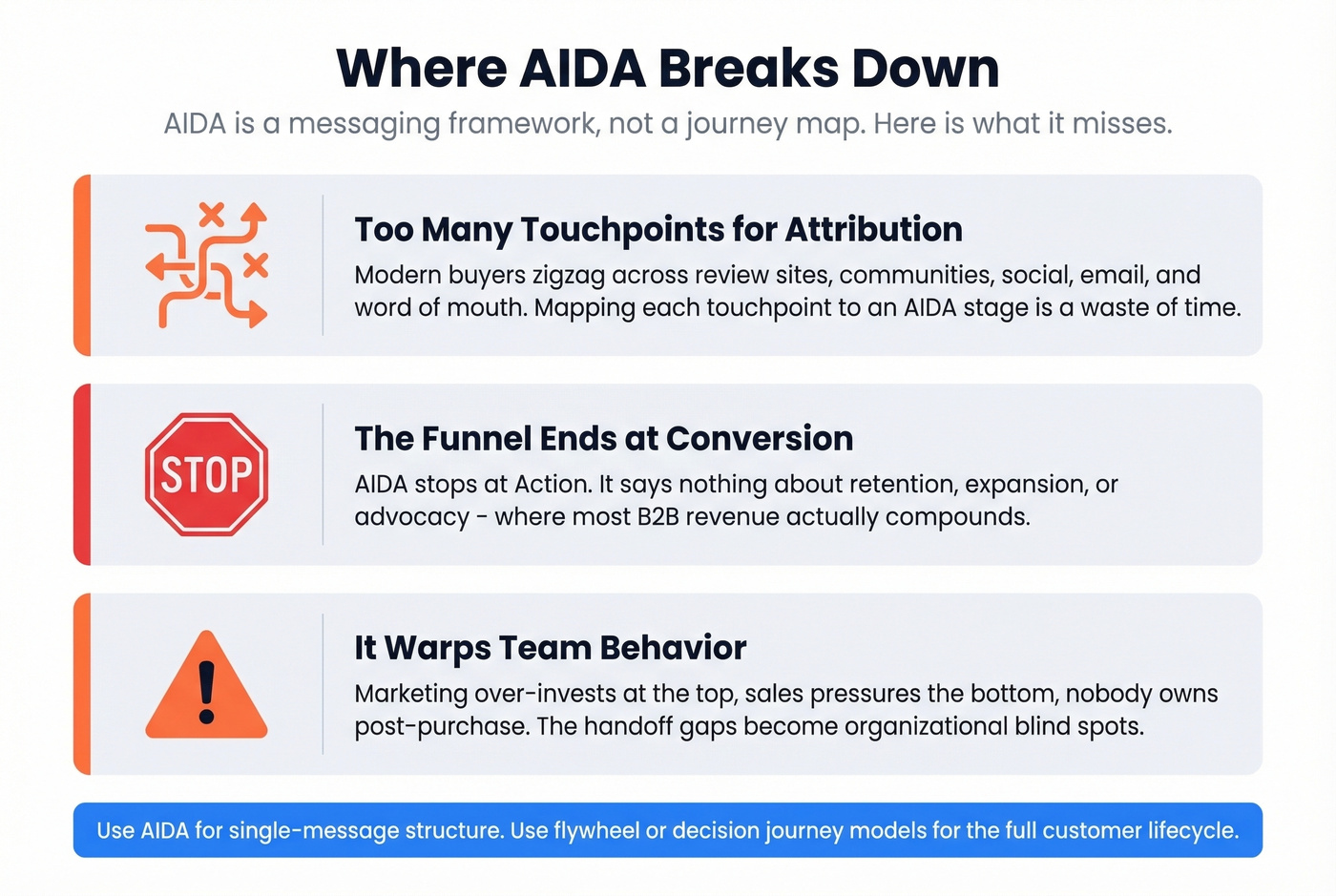
Too many touchpoints for attribution
Modern buyers zigzag across review sites, communities, social media, email, and word-of-mouth. Google's "Messy Middle" research describes shoppers looping between exploration and evaluation before taking action - sometimes for weeks, sometimes in a single afternoon. Trying to assign each touchpoint to a specific AIDA stage is a waste of your analytics team's time.
The funnel ends at conversion
AIDA stops at "Action." It says nothing about retention, expansion, or advocacy, which is where most B2B revenue actually compounds. If you're building your entire go-to-market around a model that ends at the sale, you're optimizing for the wrong thing.
It warps team behavior
When organizations build around a funnel model, marketing over-invests at the top, sales pressures the bottom, and nobody owns post-purchase. The handoff gaps between stages become organizational blind spots.
Better models for the journey: the HubSpot flywheel, McKinsey's customer decision journey loop, and the bow-tie funnel that extends through adoption, retention, and expansion. Use those for strategy. Use AIDA for writing.
AIDA Variants Worth Knowing
AIDAS adds Satisfaction - a reminder to deliver on the promise after the sale, not just close and move on. AIDAR adds Retention, explicitly building post-purchase engagement into the framework. AIDCAS adds Conviction and Satisfaction, where Conviction is the "prove it" moment between Desire and Action - testimonials, guarantees, risk reversal - followed by post-sale satisfaction.
Skip these if you're just getting started. Each variant patches a gap in the original, but none of them change the core insight: structure your message so it earns attention before it asks for anything. Master the basic four-beat sequence first, then layer in extras when you hit specific problems the original doesn't solve.
FAQ
Is AIDA still relevant in 2026?
Yes - as a messaging checklist, not a buyer journey map. Modern purchase paths are non-linear, but the Attention -> Interest -> Desire -> Action sequence still structures individual emails, ads, and landing pages better than freeform writing. Use journey models like the flywheel for strategy; use AIDA for copy.
What's the difference between Interest and Desire?
Interest is intellectual - "that's a useful insight." Desire is emotional - "I want that outcome for myself." The transition between them is where most copy falls apart. Bridge the gap with before/after storytelling and concrete social proof like case studies or revenue numbers.
What's better - AIDA or PAS?
Use AIDA when introducing something new to an unaware audience. Use PAS when your reader already feels the pain and needs agitation plus a solution. For B2B outbound into established categories, PAS typically converts better because it skips the awareness-building stage entirely.
How do I use AIDA for cold email outreach?
Structure your email in four parts: pain-point subject line, relevant insight opening, concrete outcome with social proof in the body, and a single low-friction CTA. Then verify every address before sending - bounced emails don't just waste your time, they damage your domain reputation and tank future campaigns.