

=== CURRENT ARTICLE (slug: what-is-appointment-setting) ===
What Is Appointment Setting - and How to Actually Do It Well
A RevOps lead we know spent $4,500/month on an outsourced appointment setting team. Six weeks in, they'd booked 3 meetings - all with companies that didn't match the ICP. The problem wasn't the setters. It was the targeting, the data, and the cadence.
So what is appointment setting, and why does it fail so often? It works when the fundamentals are right. Most teams skip the fundamentals.
The short version: appointment setting is the process of qualifying prospects and booking sales meetings for closers. It works when three things align - precise targeting, a multi-channel cadence of 8-12 touches over 14-21 days, and clean contact data. Without all three, you're burning budget on voicemails and bounced emails. Below: the benchmarks, costs, cadences, and tools to build or evaluate the function, whether you're hiring in-house, outsourcing, or doing it yourself.
How Appointment Setting Works
Appointment setting is the bridge between lead generation and closing. Lead gen fills the top of your funnel with potential buyers. Closing happens at the bottom. This function sits in the middle - the part where someone picks up the phone, sends the emails, qualifies the prospect, and books a meeting that a closer can run.
In B2B, this is a structured, multi-touch process. You're reaching out to decision-makers at companies that fit your ideal customer profile, confirming there's a real need, and scheduling a specific time for a deeper conversation. It's not a single cold call. It's a coordinated sequence across phone, email, and social channels - typically spanning 14-21 days.
The B2C version is simpler: shorter cadences, fewer stakeholders, lower deal complexity. A home services company booking estimates is doing appointment setting too, but the mechanics differ entirely. In B2B specifically, you're navigating org charts, qualifying budget, authority, need, and timeline, and competing for calendar time with people who get 50 cold emails a day. That's why the process matters more than the volume.
Appointment Setter vs. SDR vs. BDR
These titles get used interchangeably, and most companies don't separate them cleanly. But there's a useful distinction.
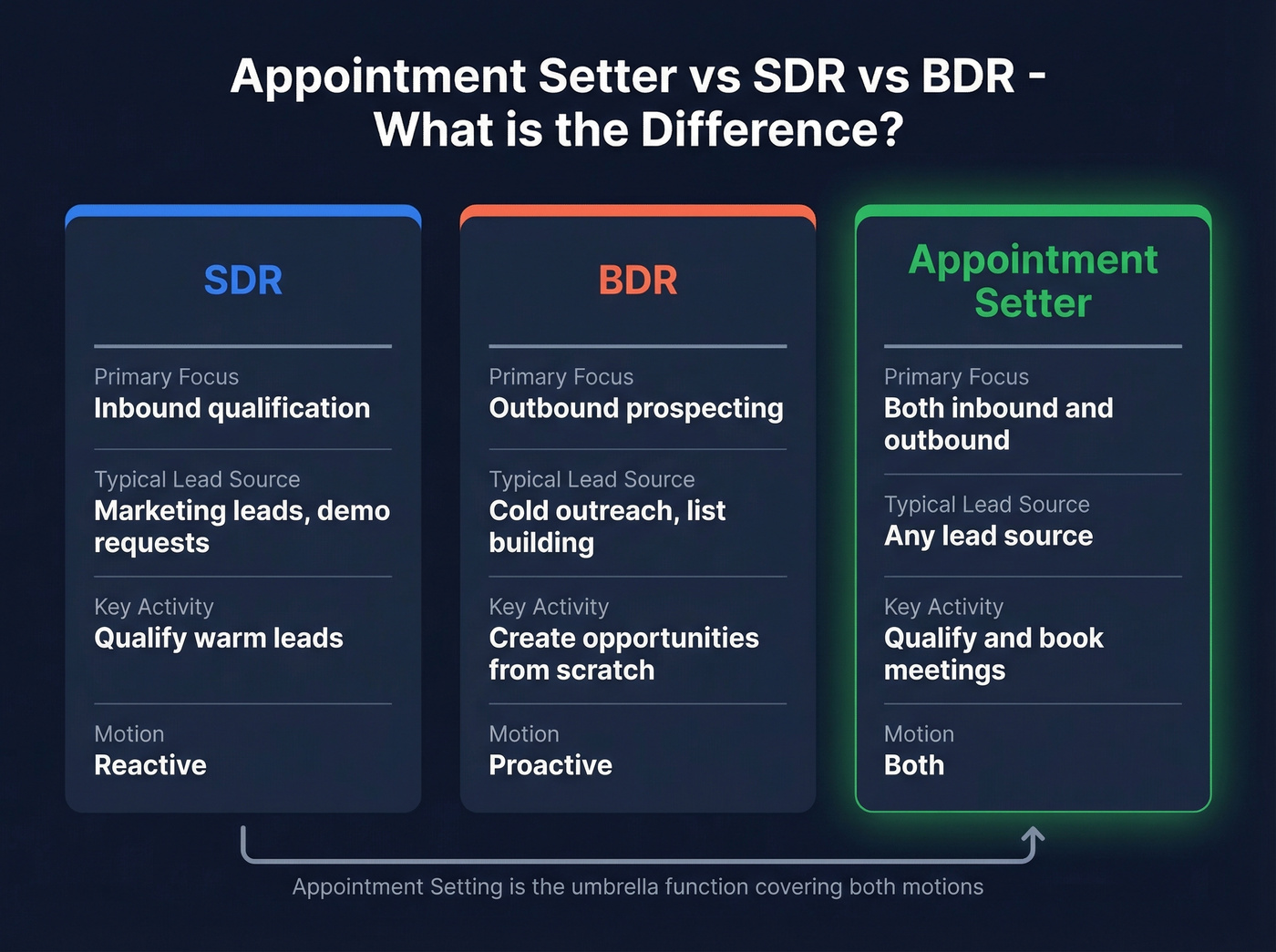
| Role | Primary Focus | Typical Source |
|---|---|---|
| SDR | Inbound qualification | Marketing leads |
| BDR | Outbound prospecting | Cold outreach |
| Appointment Setter | Both | Any lead source |
SDRs typically qualify inbound leads - the people who downloaded a whitepaper or requested a demo. BDRs go outbound, creating opportunities from scratch through cold calls and email sequences. "Appointment setter" is the umbrella term that covers both motions.
The workload is real either way. 58% of SDRs juggle more than 75 accounts per quarter, which means most are spread thin. If your team doesn't separate inbound from outbound, your setters are doing both - and that's where process and prioritization become critical. When hiring, look for candidates who can articulate their qualification framework, not just their dial count. The best setters ask sharp questions. The mediocre ones read scripts.
What Does an Appointment Setter Actually Do?
Forget the "100 dials a day" image. Modern appointment setting is targeted, multi-channel, and research-driven. Here's what a typical day looks like:
- Research prospects - identify companies that match the ICP, find the right contacts, verify their data
- Multi-channel outreach - send personalized emails, make calls, engage on social platforms
- Qualify against ICP - confirm the prospect has the budget, authority, need, and timeline before booking
- Book meetings - schedule calls between qualified prospects and account executives
- Update the CRM - log every touchpoint so nothing falls through the cracks
- Reduce no-shows - send confirmation emails and reminders before the meeting
The shift from brute-force dialing to warm, targeted engagement is the biggest change in this role over the past few years. AI SDR tools are entering the market, but they work best as supplements to human setters, not replacements - especially for complex B2B deals where qualification requires judgment.
A setter who books 3 qualified meetings from 30 well-researched touches outperforms someone who books 3 from 200 spray-and-pray dials, because those meetings actually convert.
The Appointment Setting Process
Most conversions happen after 5 or more follow-ups. The teams that quit after two touches are leaving pipeline on the table. Here's a proven 14-day multi-channel cadence:
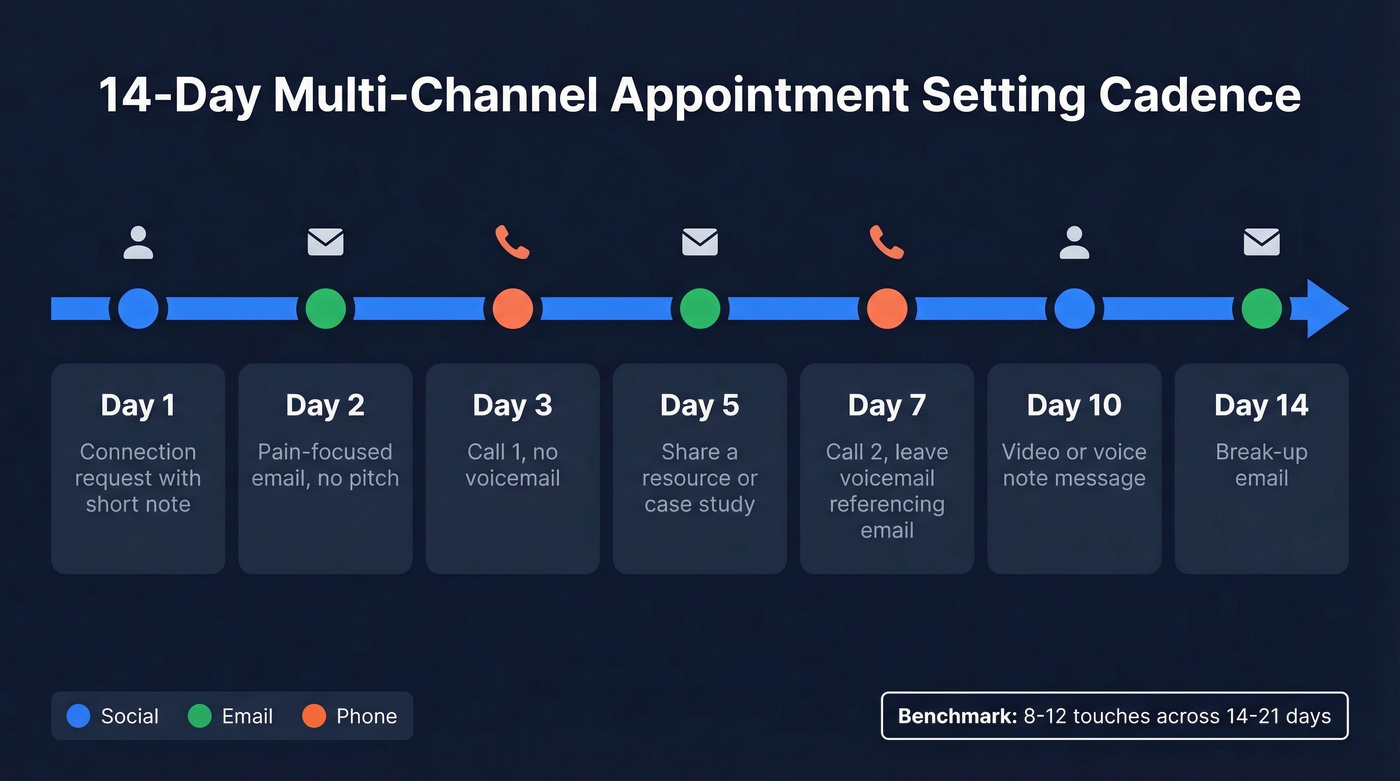
| Day | Channel | Action |
|---|---|---|
| 1 | Social | Connection request with short note |
| 2 | Email 1 - pain-focused, no pitch | |
| 3 | Phone | Call 1 - no voicemail |
| 5 | Email 2 - share a resource or case study | |
| 7 | Phone | Call 2 - leave voicemail referencing email |
| 10 | Social | Video or voice note message |
| 14 | Break-up email |
The benchmark is 8-12 touches across 14-21 days using a mix of phone, email, and social. That's not arbitrary - it reflects how long it takes to build enough familiarity that a prospect actually responds.
Agencies report 19.98% reply rates on social outreach when messages are personalized and sequenced properly. That's higher than most cold email benchmarks, which is why the multi-channel approach matters. Don't rely on a single channel.
The break-up email on Day 14 isn't a gimmick. It creates a natural decision point. Some of your best replies will come from that final touch - people who were interested but busy.

Your 14-day cadence only works if Day 2's email actually lands. Prospeo delivers 98% email accuracy with a 7-day data refresh - so your setters reach real decision-makers, not dead inboxes. At $0.01 per email, one qualified meeting pays for thousands of verified contacts.
Stop booking meetings with bad-fit prospects. Start with better data.
KPIs That Matter
Stop measuring dials per day. Measure qualified meetings booked per week. That's the metric that actually correlates with revenue.
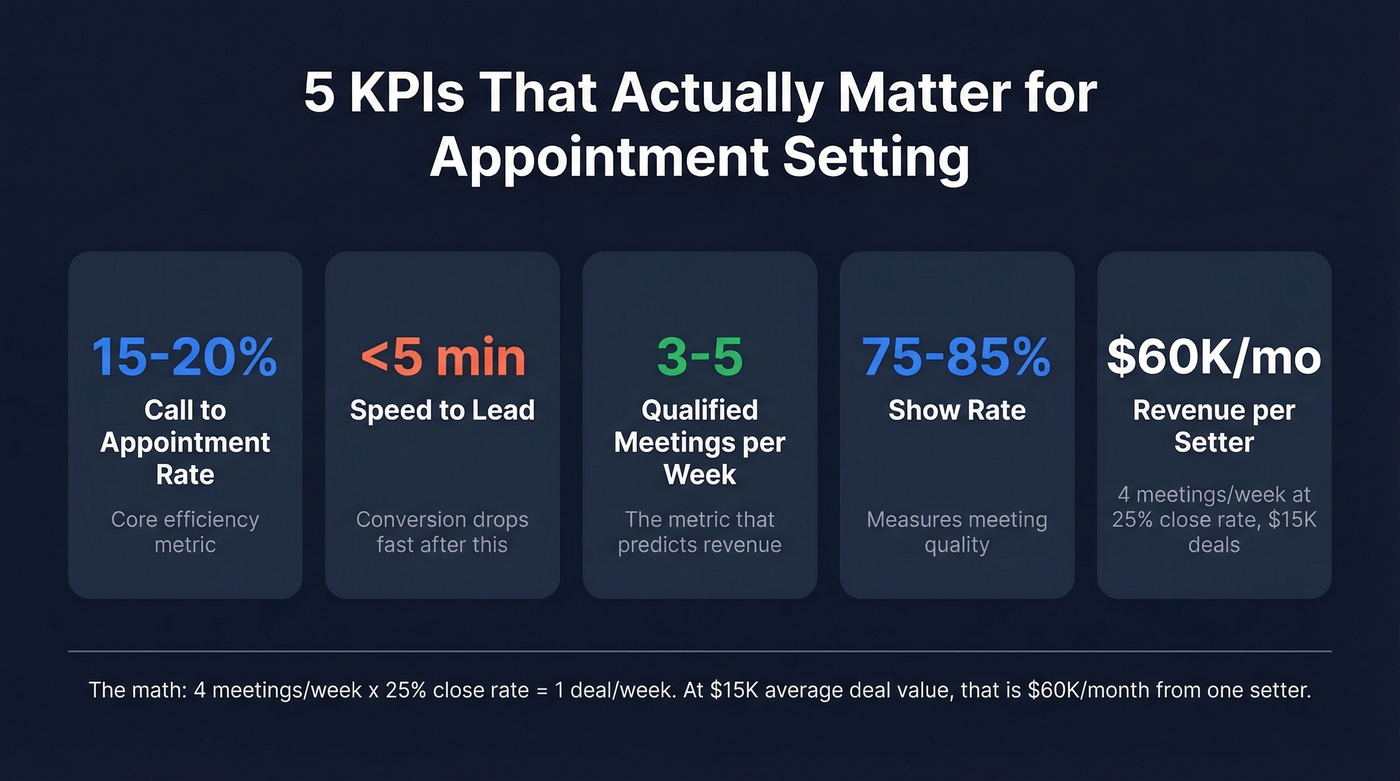
| KPI | Benchmark | Why It Matters |
|---|---|---|
| Call-to-appointment rate | 15-20% | Core efficiency metric |
| Speed-to-lead | <5 minutes | Drops fast after 5 min |
| Qualified meetings/week | 3-5 per setter | Revenue-predictive |
| Show rate | 75-85% | Measures meeting quality |
| Cost per meeting | Varies by model | ROI denominator |
Speed-to-lead is the one most teams underestimate. Responding to an inbound lead within 5 minutes improves conversion dramatically - after 30 minutes, you're competing with whoever else the prospect contacted.
Here's the math that makes this tangible: a setter who books 4 meetings a week at a 25% close rate generates one deal per week. If your average deal is $15k, that's $60k/month from a single setter. The math works when the meetings are qualified. It falls apart when you optimize for volume over quality.
How Much Does It Cost?
In-House
A fully loaded SDR costs $88,600+ annually. That's not just salary - it includes benefits, tools, training ($1,252/employee average), and management overhead. Indirect costs add $20k-$30k per person per year. The hidden cost is turnover: SDR turnover is notoriously high, and replacing one costs roughly 1.5x their annual salary.
Outsourced
| Model | Price Range |
|---|---|
| Starter package | $2,500-$4,500/mo |
| Growth package | $4,500-$8,500/mo |
| Enterprise | $8,500-$15,000+/mo |
| Hourly (offshore) | $7-$15/hr |
| Pay-per-appointment | $15-$100 each |
| Flat fee (qualified) | $25-$75 each |
The pay-per-appointment model sounds attractive, but it creates a perverse incentive. Setters push quantity over quality when their income depends on volume. If you go this route, define "qualified" with strict criteria upfront.
ROI Math
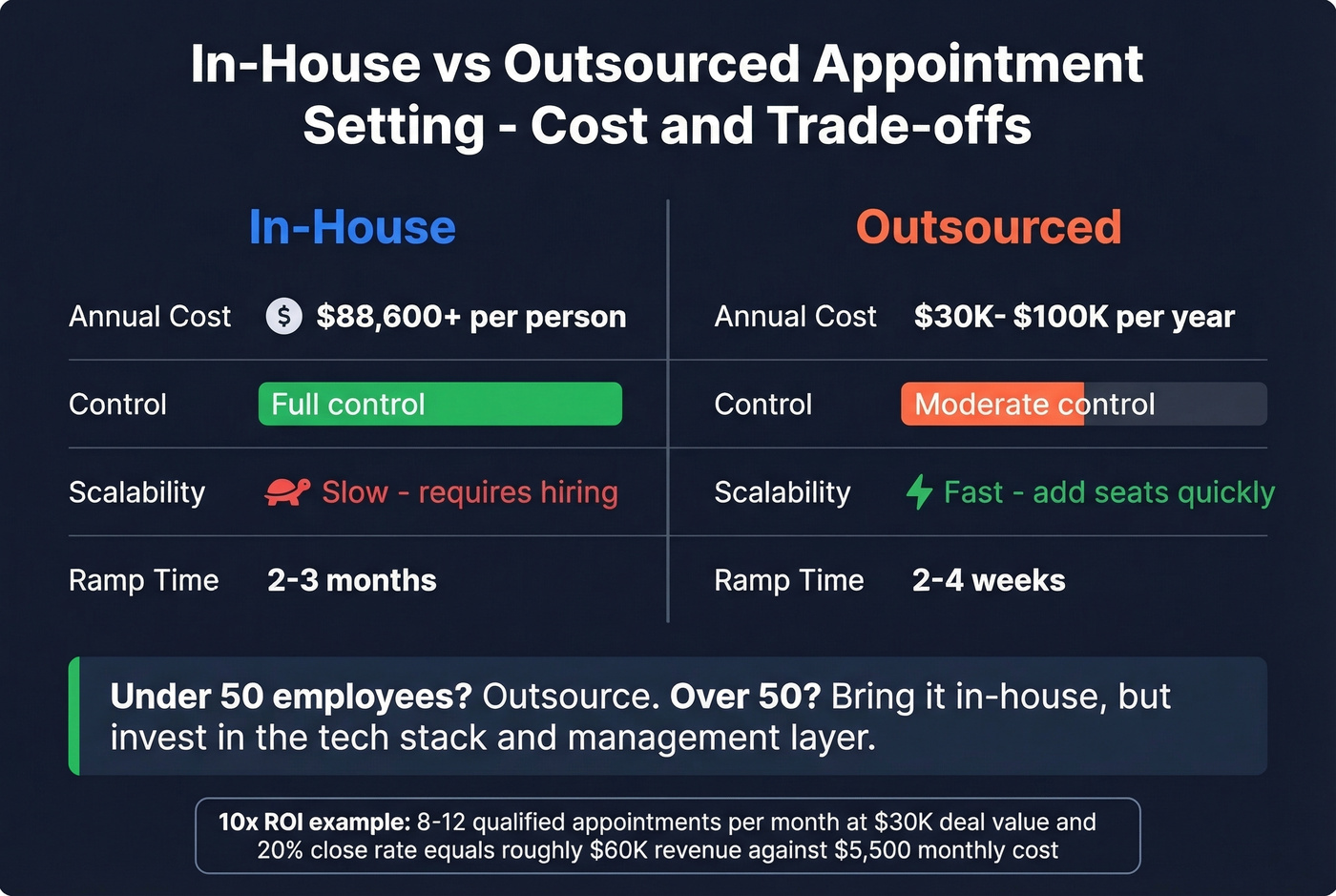
Assume a $30,000 average deal value and a 20% close rate. You need 5 appointments to close one deal. If your outsourced team books 8-12 qualified appointments per month, you're looking at roughly 2 closed deals - $60,000 in revenue against ~$5,500/month in outsourced cost. That's approximately 10x ROI.
Our take: outsourcing makes sense for teams under 50 employees who don't have the infrastructure to recruit, train, and manage SDRs. Above that threshold, bring it in-house - but invest in the tech stack and management layer. Half-measures in either direction produce mediocre results.
| Factor | In-House | Outsourced |
|---|---|---|
| Annual cost | $88,600+/person | $30k-$100k/yr |
| Control | Full | Moderate |
| Scalability | Slow (hiring) | Fast (add seats) |
| Ramp time | 2-3 months | 2-4 weeks |
Appointment Setter Compensation
The US median hourly pay for appointment setters is $16.11/hour per PayScale data, with a range from $12.18 at the 10th percentile to $21.17 at the 90th. Total annual pay including commission runs $26k-$49k, with commission typically adding $6k-$15k/year. Freelance pay-per-appointment rates range from $15-$100 per booked meeting, depending on deal complexity and industry.
Let's be honest: if you've seen YouTube videos promising "$10k/month as an appointment setter," temper your expectations. Those numbers are possible for top performers in high-ticket niches, but they're not the median. This is a legitimate sales function with real earning potential - it's just not the passive income goldmine that some creators market it as. The consensus on r/sales tends to agree: the money's real, but you earn it.
Common Mistakes That Kill Results
Mistake 1: Poor targeting. Calling companies that don't fit your ICP is the single biggest waste of time. Before you dial, know the industry, company size, tech stack, and buying triggers that define your best customers. Analyze your last 6 months of closed deals to find the patterns.
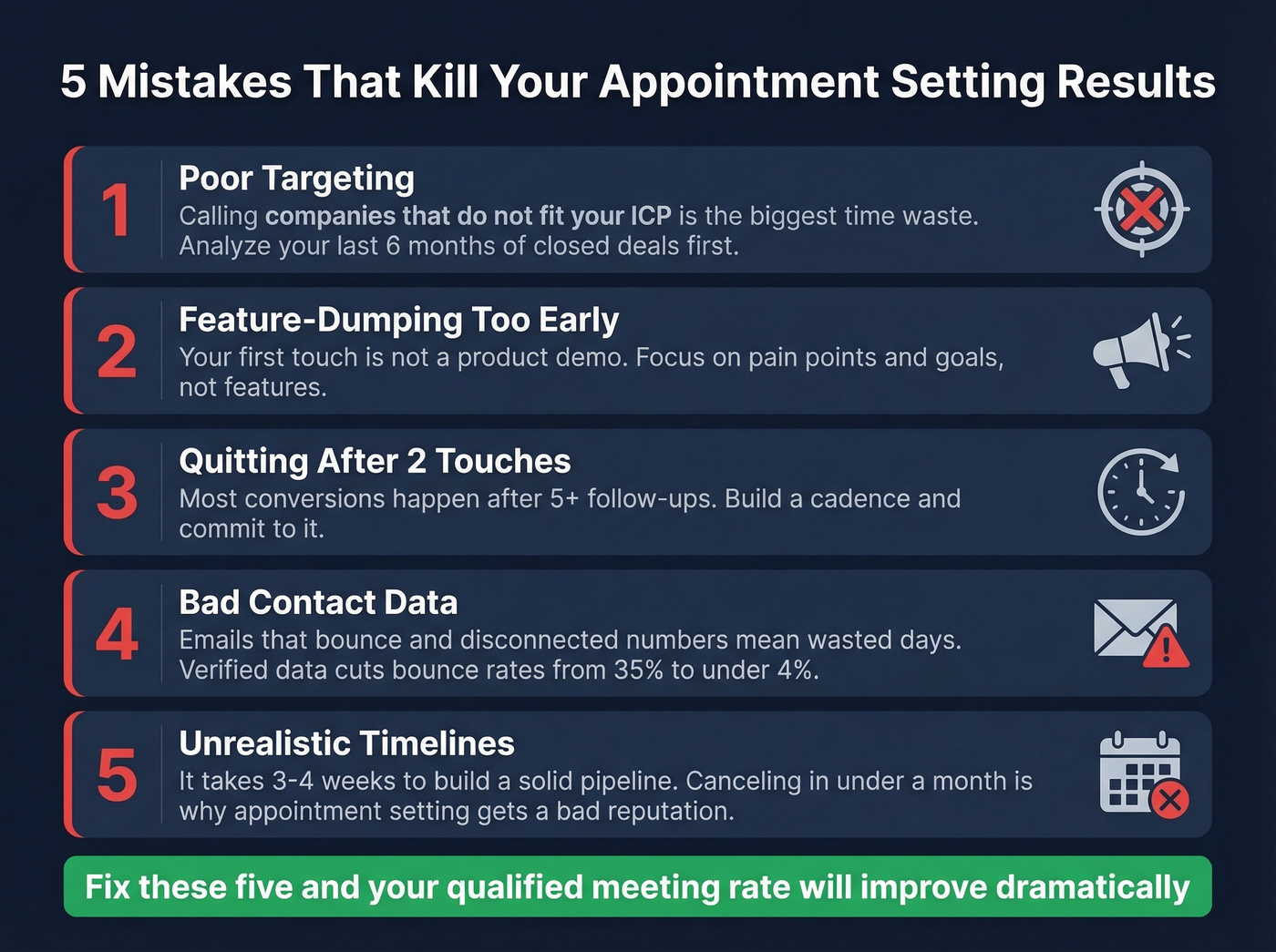
Mistake 2: Feature-dumping too early. Your first touch isn't a product demo. Focus on the prospect's goals and pain points. When you hear "send me info," don't just fire off a PDF - ask two quick questions to tailor what you send. When you hear "not interested," reframe around a common priority their peers face. These pivots keep conversations alive.
Mistake 3: Quitting after 2 touches. Most setters give up way too early. The data is clear - most conversions happen after 5+ follow-ups. Build a cadence and commit to it.
Mistake 4: Bad contact data. Here's the thing - your setters can't book meetings if the emails bounce and the phone numbers are disconnected. We've seen teams cut bounce rates from 35% to under 4% just by switching to verified data sources, and that's the difference between a productive day and a wasted one.

Mistake 5: Unrealistic timelines. As one freelance setter put it on Reddit: "It takes 3-4 weeks to build a solid pipeline - clients who cancel in under a month are the #1 reason appointment setting gets a bad reputation." Give the process time. Consistent, predictable results come in month two.
The Appointment Setting Tech Stack
You don't need 15 tools. You need four categories covered well.
| Category | Tool | Starting Price |
|---|---|---|
| Data & Verification | Prospeo | Free (75 emails/mo) |
| CRM | Pipedrive / HubSpot | $14/user/mo / Free |
| Scheduling | Calendly | Free / $12/user/mo |
| Sales Engagement | Instantly / Lemlist | ~$30/mo |
Before your setters pick up the phone, the contact data needs to be right. Prospeo gives you 300M+ professional profiles, 143M+ verified emails, and 125M+ verified mobile numbers with 98% email accuracy - refreshed every 7 days instead of the 6-week industry average. At ~$0.01 per email with a free tier, it's the most cost-effective way to build a clean prospect list.

For scheduling, 68% of customers prefer online booking. Calendly is the default, but Acuity and Cal.com are solid alternatives. The key is automated reminders - email and SMS - to reduce no-shows.
For sales engagement, enterprise teams lean toward Outreach or Salesloft. SMB teams get more value from Instantly or Lemlist, which handle email sequences and warm-up at a fraction of the cost. For phone-heavy teams, parallel dialers like Orum or Nooks multiply call volume without adding headcount. Skip the fancy tools if your team is under 5 people - a CRM, a data provider, and a scheduling link will get you 80% of the way there.
The difference between 3 meetings from 200 dials and 3 meetings from 30 targeted touches? Clean data. Prospeo gives your setters 300M+ verified profiles with 30+ filters - buyer intent, job changes, headcount growth - so every touch in your cadence hits an ICP-matched contact with a real email and direct dial.
Build appointment-ready prospect lists in minutes, not hours.
FAQ
Does appointment setting actually work?
Yes - when targeting is precise, the cadence is multi-channel with 8-12 touches, and the data is clean. A healthy call-to-appointment rate is 15-20%. Most failures trace back to bad targeting, insufficient follow-up, or quitting before the pipeline has time to build.
How long before it produces results?
Expect 3-4 weeks to build a working pipeline. Consistent, predictable results typically arrive in month two. Companies that cancel outsourced engagements in under a month are the top reason this function gets a bad reputation.
What's the difference between appointment setting and lead generation?
Lead generation identifies potential buyers and fills the top of your funnel. Appointment setting takes those leads further - qualifying them against your ICP and booking actual sales meetings. Lead gen creates awareness; appointment setting converts it into pipeline and confirmed calendar events with decision-makers.
What tools do appointment setters need?
At minimum: a CRM like Pipedrive or HubSpot, a scheduling tool like Calendly, a data platform for verified contacts, and a sales engagement tool for sequencing. Most teams can get started with free tiers across all four categories and upgrade as volume grows.