

What Is CAC in Marketing? The Complete Guide to Customer Acquisition Cost
Your CFO asks what it costs to acquire a customer. You pull up ad spend, divide by new logos, and say "$180." You're probably off by 2-3x. The real answer is deceptively simple, but nearly 70% of SaaS businesses either underestimate or miscalculate their customer acquisition cost because they leave out salaries, tools, commissions, and half a dozen other line items. That gap isn't just an accounting problem - it's a strategic blind spot that distorts every growth decision you make.
The Short Version
CAC = total sales + marketing spend / new customers acquired. Most teams undercount by 2-3x because they only include ad spend. A healthy LTV:CAC ratio is 3:1 to 4:1. The average CAC payback period across private SaaS companies is 23 months - high performers recover in 5-7. The fastest way to lower your acquisition cost? Stop wasting spend on bad data that inflates your numerator without producing customers in the denominator.
CAC Meaning in Marketing
Customer acquisition cost is the total amount your business spends on sales and marketing to win one new paying customer. Not a lead. Not a free trial signup. A customer who's actually generating revenue.
The key phrase is "fully loaded." CAC isn't just your Google Ads bill. It's every dollar that touches the acquisition process - salaries, commissions, software subscriptions, content production, event sponsorships, travel, even the recruiter fees for hiring that new SDR. If the expense exists to bring in customers, it belongs in your calculation.
One distinction worth nailing early: CAC is not CPA. Cost per acquisition measures the cost of any conversion action - a demo request, an ebook download, a free signup. Customer acquisition cost specifically measures the cost of winning a paying customer. CPA is a campaign metric. CAC is a business-level metric that encompasses your entire go-to-market operation. Confusing the two is one of the most common mistakes on r/startups, and it leads to wildly optimistic unit economics.
How to Calculate CAC
The Basic Formula
CAC = Total Sales & Marketing Spend / New Customers Acquired
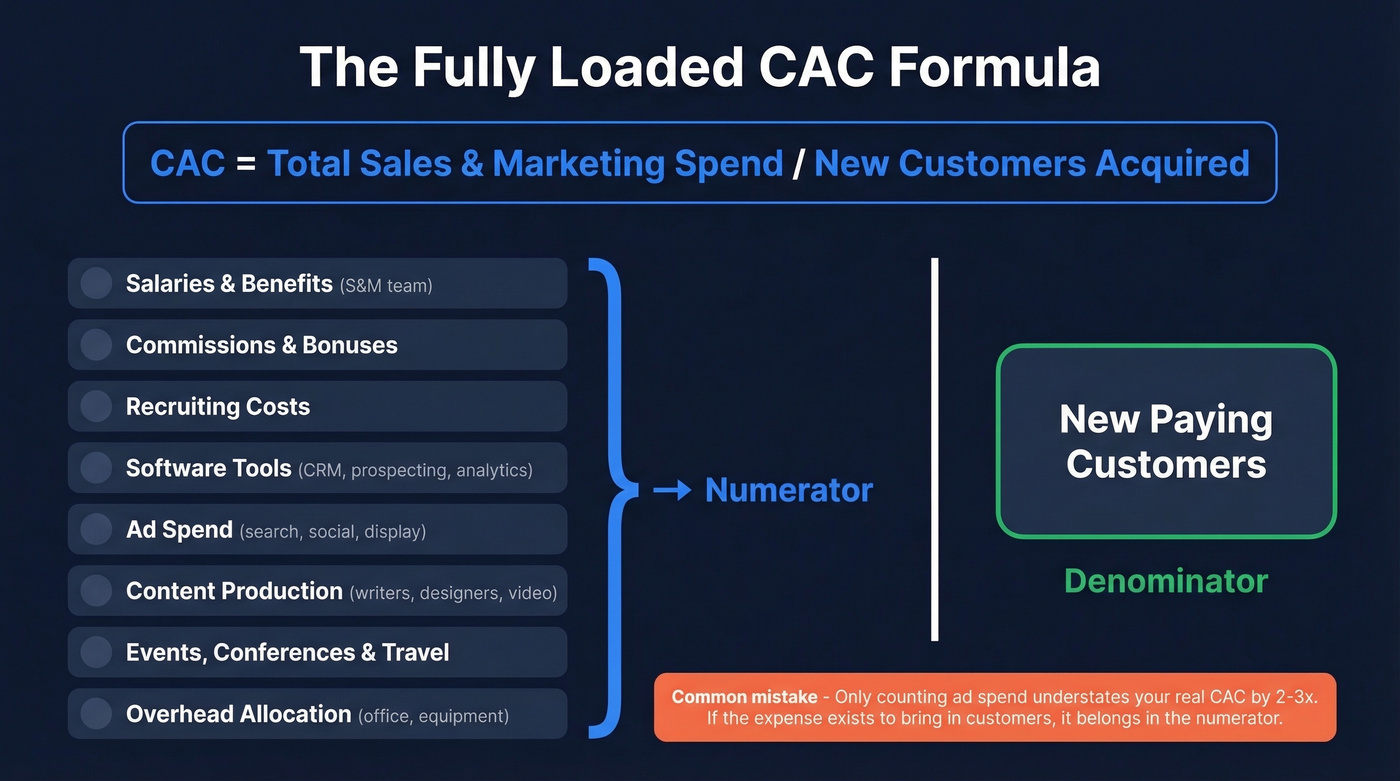
Simple in theory. The hard part is getting the numerator right. Here's what "total sales & marketing spend" actually includes:
- Salaries and benefits for everyone in sales and marketing
- Commissions and bonuses
- Recruiting costs for sales/marketing hires
- Software tools (CRM, prospecting platforms, analytics suites)
- Advertising spend across paid search, paid social, and display
- Content production - writers, designers, video
- Events, conferences, and travel
- Overhead allocation for office space and equipment used by S&M teams
Say you spent $450,000 on all of the above in Q1 and acquired 150 new customers. Your CAC is $3,000. If you'd only counted the $120,000 in ad spend, you'd have calculated $800 - a number that's technically correct for paid media but dangerously misleading for unit economics.
Three Types of CAC
Not all acquisition dollars work the same way. Tracking three variants gives you a clearer picture.
| CAC Type | Formula | What It Tells You |
|---|---|---|
| Blended CAC | All S&M spend / all new customers | Overall efficiency |
| Paid CAC | Paid campaign costs / all new customers | How paid spend impacts overall acquisition |
| Organic CAC | (Total S&M - paid costs) / all new customers | How non-paid efforts contribute |
Notice the denominator stays the same across all three. Clearbit's guidance recommends using all customers won - even for subtypes - because attribution is imperfect and paid spend influences organic traffic in ways you can't cleanly separate. Threads on r/smallbusiness regularly surface the attribution nightmare of tracking whether a customer found you through a Google ad, a local event, or a friend's recommendation. The honest answer: you often can't separate them perfectly, which is exactly why blended CAC matters most.
Referral fees, customer credits, and discounts also belong in the numerator. If it costs money and it's designed to bring in customers, count it.
2026 Benchmarks by Industry
Benchmarks vary wildly by industry, which is exactly why "what's a good CAC?" is the wrong question without context. FirstPageSage compiled data from clients between January 2022 and August 2025, published January 2026:
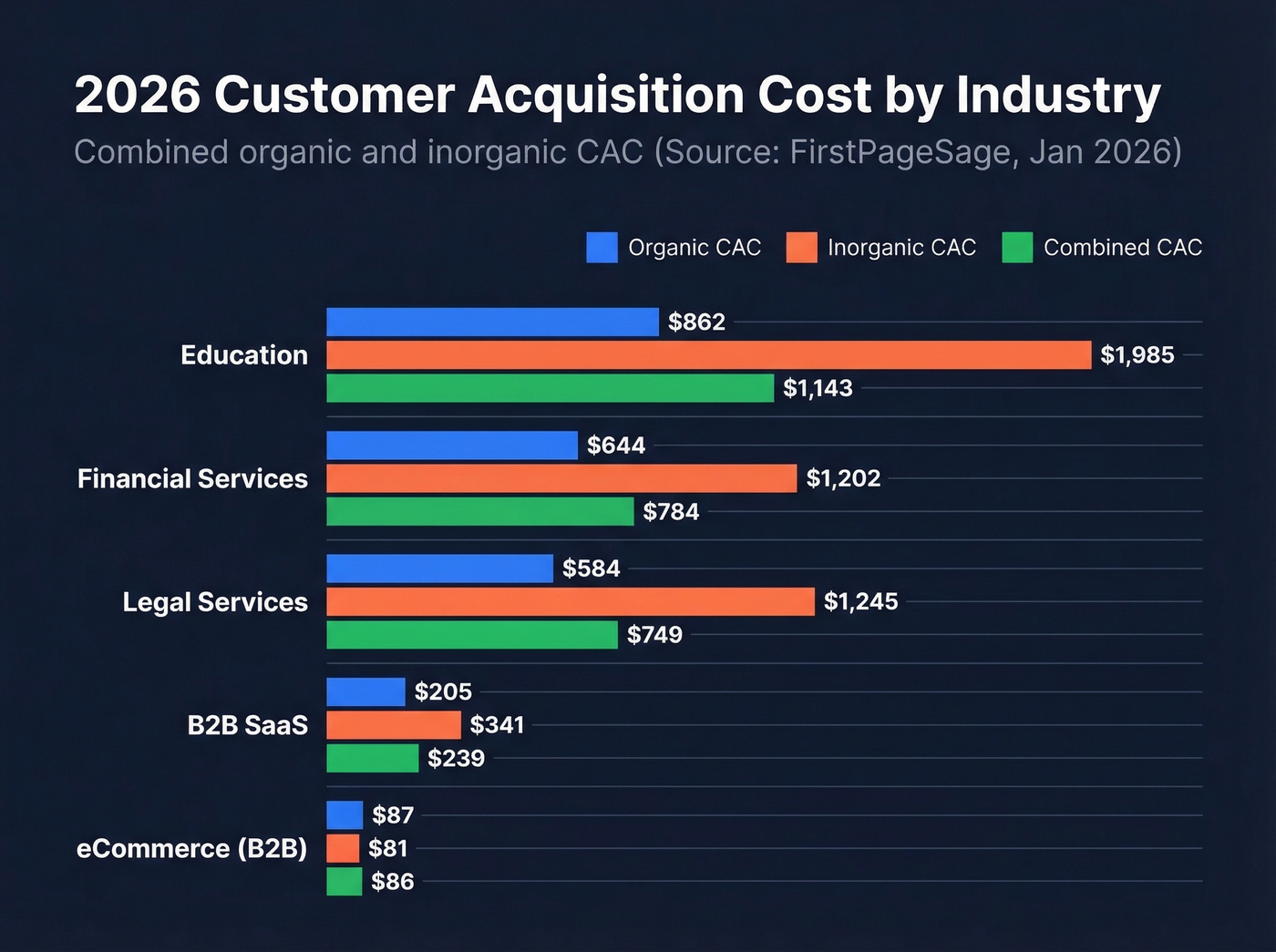
| Industry | Organic CAC | Inorganic CAC | Combined |
|---|---|---|---|
| B2B SaaS | $205 | $341 | $239 |
| eCommerce (B2B) | $87 | $81 | $86 |
| Financial Services | $644 | $1,202 | $784 |
| Education | $862 | $1,985 | $1,143 |
| Legal Services | $584 | $1,245 | $749 |
The combined column uses a 75/25 organic-to-inorganic weighting, which skews toward SEO-heavy businesses. Your mix will differ. Phoenix Strategy Group puts B2B SaaS CAC at $1,200 per customer for growth-stage companies and retail at ~$50 - a much wider range that reflects different sales motions and deal sizes.
Here's the thing: acquisition costs aren't getting cheaper. A ProfitWell study of 700 subscription businesses found CAC rose 60-75% between 2014 and 2019, and digital ad costs climbed another 5.13% in 2025. The drivers are stacking up - more advertisers competing for the same inventory, privacy changes like ATT and cookie deprecation reducing targeting precision, and buyers doing more research in dark social channels where attribution breaks down entirely.
CAC by Marketing Channel
Channel selection has an outsized impact on your overall acquisition efficiency. Retail benchmarks from Bloomreach show just how wide the gap is:
| Channel | Avg. CAC |
|---|---|
| Email marketing | $15.92 |
| SEO / organic | $30.33 |
| Online paid ads | $59.17 |
| Influencer | $73.58 |
Email delivers the lowest acquisition cost. Paid ads cost about 4x more per customer. That math should inform your channel mix.

Every bounced email inflates your CAC numerator without adding a customer to the denominator. Prospeo's 98% email accuracy and 5-step verification process means your outbound spend actually converts - not burns budget on dead addresses.
Stop paying to reach inboxes that don't exist.
LTV:CAC Ratio - What Good Looks Like
Let's be honest: an 8:1 LTV:CAC ratio isn't a flex - it's a failure of nerve. It means you're leaving growth on the table. You could be spending more aggressively on acquisition and still maintain healthy economics. Investors see a sky-high ratio and ask why you're not growing faster.
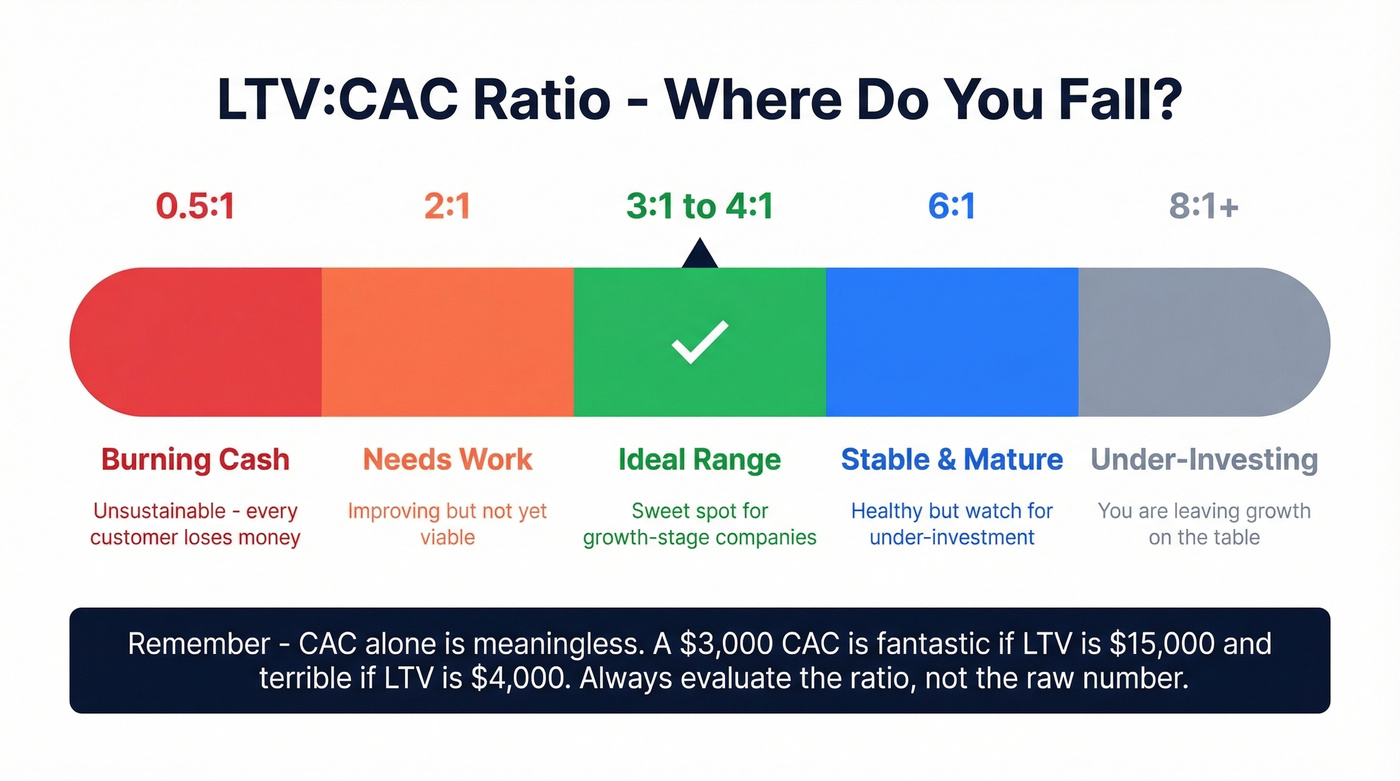
CAC in isolation is meaningless. A $3,000 acquisition cost is fantastic if your customer lifetime value is $15,000 and terrible if it's $4,000. The ratio is where the real insight lives.
| LTV:CAC Ratio | What It Means |
|---|---|
| 0.5:1 | Burning cash - unsustainable |
| 2:1 | Needs improvement |
| 3:1-4:1 | Ideal range |
| 6:1 | Stable, mature business |
| 8:1+ | Under-investing in growth |
Here's what negative unit economics actually look like in practice: if your CAC is $3,000 and your LTV is $2,000, every new customer you acquire costs you $1,000 net. Scale that to 500 customers and you've burned $500K making your business worse. Growth without healthy unit economics is just accelerated failure.
Use an annual timeframe when calculating this ratio. Monthly windows introduce too much seasonality noise, and SEO investments can take 4-6 months to show results - temporarily inflating your CAC if you measure too narrowly. FirstPageSage recommends annual measurement for exactly this reason.
CAC Payback Period
CAC payback period answers a different question than the ratio: how many months until you recover the cost of acquiring that customer? For capital-constrained teams, this metric matters more than the acquisition cost itself.
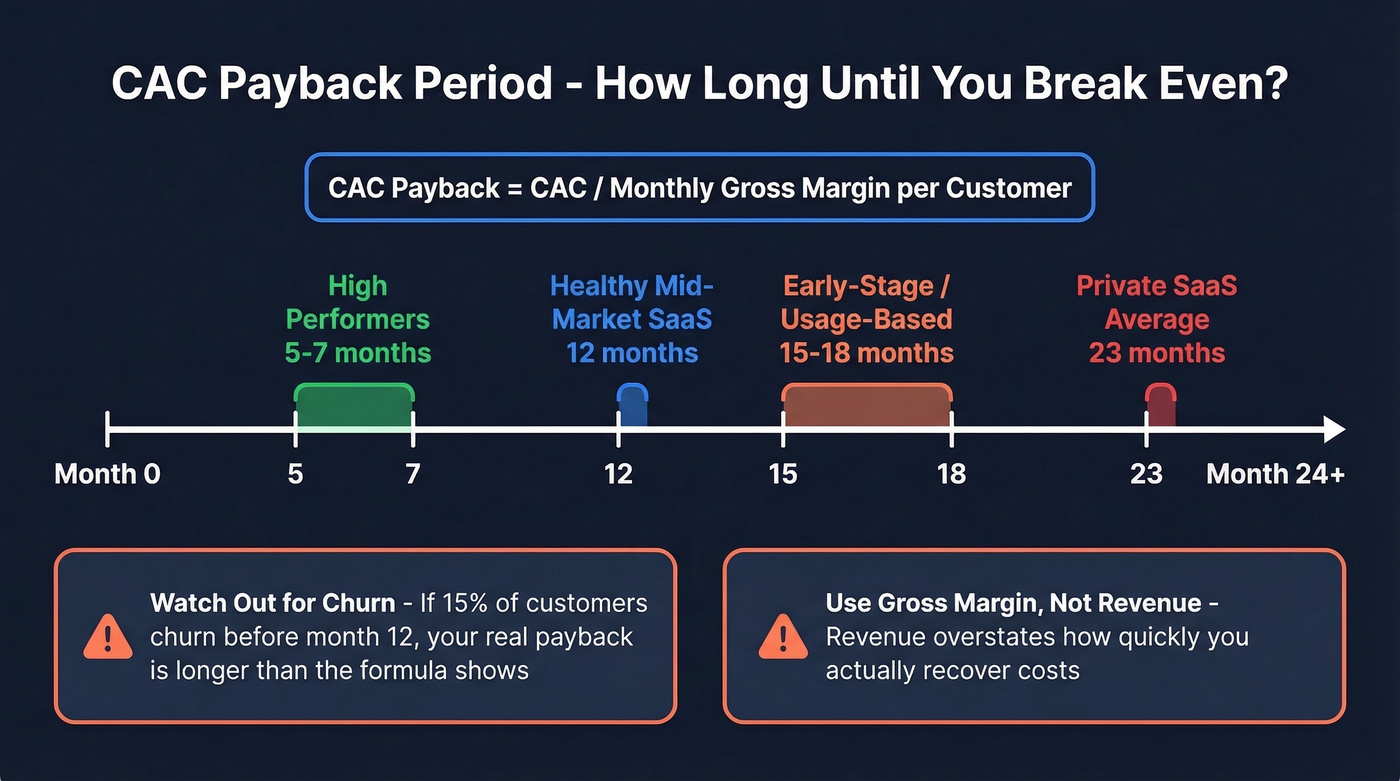
CAC Payback = CAC / Monthly Gross Margin per Customer
If your CAC is $3,000 and each customer generates $300/month in gross margin, your payback is 10 months. Benchmarks:
- 5-7 months: high-performing SaaS companies
- 12 months: healthy mid-market SaaS target
- 15-18 months: typical for early-stage usage-based models
- 23 months: average across private SaaS companies
Think of CAC as debt. Every customer you acquire with a 23-month payback ties up working capital for nearly two years before you break even. Push growth aggressively with long payback periods and you'll need significantly more capital to fund the gap.
Two things the standard formula ignores: churn and the time value of money. If 15% of customers churn before month 12, your actual payback is longer than the formula suggests. We've seen teams get burned by treating payback as a simple division problem when their churn rate quietly undermined the math. Use gross margin - not revenue - as the denominator. Revenue overstates how quickly you actually recover costs.
Five Mistakes That Distort Your Numbers
Only Counting Ad Spend
The #1 complaint on r/startups about CAC discussions? People only count ad spend. Your Google Ads bill is one slice of the true cost. Salaries, tools, commissions, content production, events - all of it belongs in the numerator. A "fully loaded" number is the only version that tells you whether your growth model actually works.
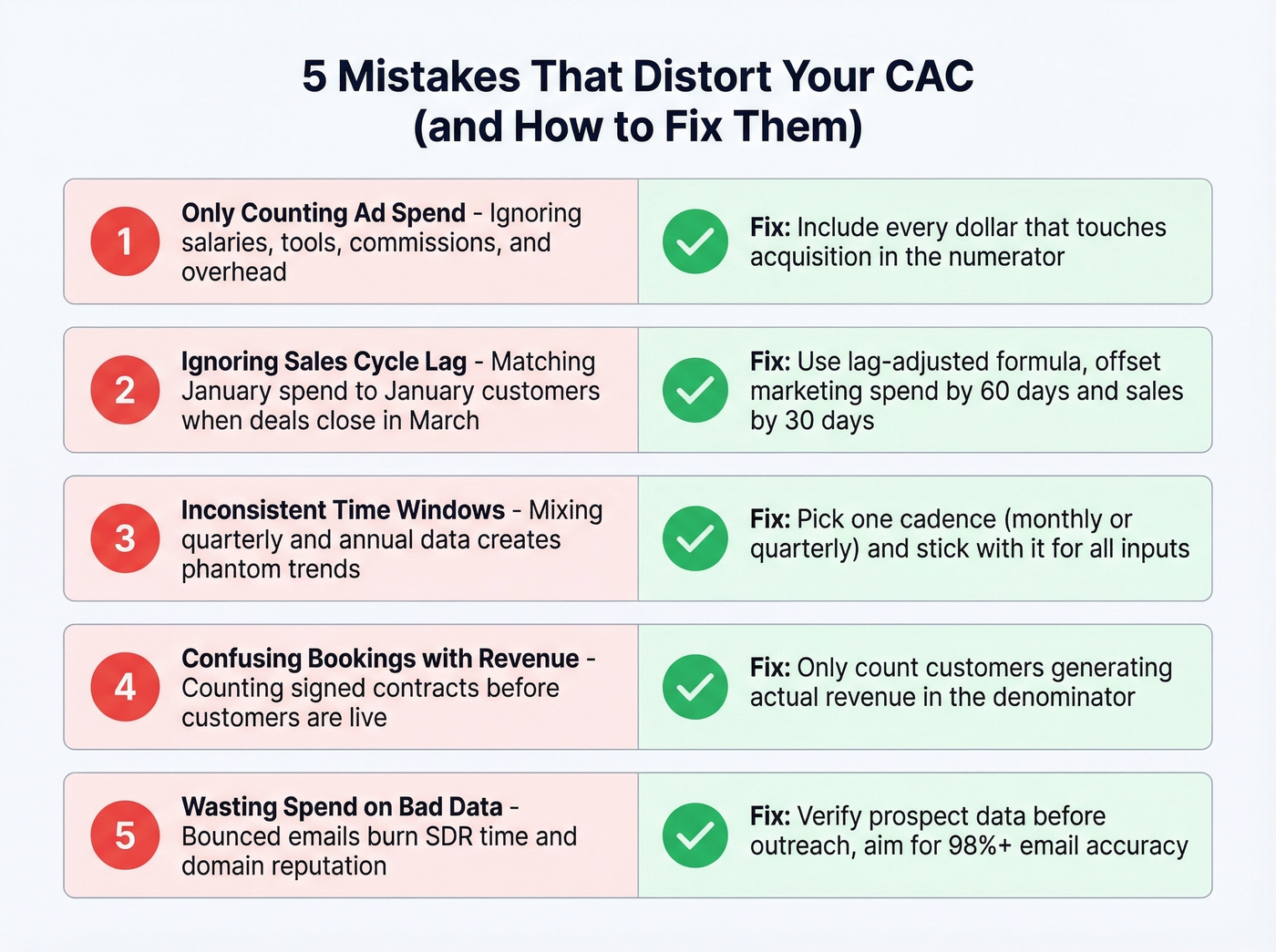
Ignoring Sales Cycle Lag
You spend money in January. The customer signs in March. If you divide January's spend by January's new customers, you're matching the wrong inputs to the wrong outputs. Andrew Chen's lag-adjusted formula handles this:
CAC = (Marketing Expenses (n-60) + 1/2 Sales (n-30) + 1/2 Sales (n)) / New Customers (n)
Skip this adjustment if your sales cycle is under two weeks. For everyone else, ignoring the lag can make month-to-month numbers look wildly better or worse than reality.
Inconsistent Time Windows
Calculating quarterly CAC using annual expense data creates phantom trends. Pick a cadence - monthly or quarterly - stick with it, and make sure every input uses the same window. Monthly tracking catches problems early. Annual smooths out noise. Just don't mix them.
Confusing Bookings with Revenue
A signed contract isn't revenue until the customer is actually live and generating it. Basing CAC on bookings rather than actual revenue makes your numbers look better than reality - especially if onboarding takes weeks or months.
Wasting Spend on Bad Data
This one's frustrating because it's so preventable. Bad data quietly inflates acquisition costs across every outbound team. If a meaningful share of your prospect list bounces, you're burning SDR time, sequencing tool costs, and domain reputation on contacts that never existed. Every bounced email is spend that goes into the numerator without producing a customer in the denominator.
We've watched teams cut their effective outbound CAC by 30%+ just by switching to verified data with a weekly refresh cycle instead of relying on databases that update every six weeks.
How to Reduce CAC
Five tactics that actually move the needle, ranked by impact:
1. Fix your data first. Run every prospect list through verification before launching a campaign. A 5% bounce rate versus a 25% bounce rate is a massive reduction in wasted outbound spend. Meritt tripled pipeline from $100K to $300K/week and cut bounce rate from 35% to under 4% by switching to Prospeo's verified data - a concrete example of data quality compressing acquisition costs.
2. Shift toward lower-CAC channels. Email marketing at $15.92 per customer versus influencer partnerships at $73.58 isn't a close call. Invest in organic content and SEO. The upfront cost is higher, but the compounding returns crush paid channels over 12-18 months.
3. Increase conversion rates. Better landing pages, faster follow-up, tighter targeting. A 2x improvement in conversion rate cuts your acquisition cost in half without spending an additional dollar. Product-led growth motions - free trials, self-serve onboarding, in-product expansion - compress costs further by letting the product do the selling.
4. Invest in retention. Lower churn increases LTV, which improves your LTV:CAC ratio and your effective acquisition economics over time. Every retained customer makes your math look better.
5. Use intent data. Target buyers who are actively researching your category instead of blasting cold lists. In-market buyers convert at 2-3x the rate of cold prospects, which directly compresses your cost per new customer.
Email marketing delivers the lowest CAC at $15.92 per customer - but only if your data connects you to real buyers. Prospeo gives you 143M+ verified emails refreshed every 7 days at ~$0.01 each, so your highest-ROI channel actually performs.
Cut your cost per customer by fixing the data underneath it.
CAC vs CPA - Know the Difference
These two metrics get conflated constantly, and using the wrong one in the wrong context leads to bad decisions.
| Dimension | CAC | CPA |
|---|---|---|
| Measures | Paying customer | Any action (lead, signup) |
| Scope | Full business | Campaign or channel |
| Costs included | All S&M spend | Campaign-specific spend |
| Use case | Unit economics, investors | Campaign optimization |
Use CPA to optimize individual campaigns. Use CAC to understand whether your business model works. A $50 CPA and a $3,000 CAC can coexist perfectly - it just means you need a lot of touches and a lot of non-converting CPAs before someone becomes a customer. Reporting CPA to your board as if it's CAC is a fast way to lose credibility.
FAQ
What's a good CAC?
It depends on your LTV. Aim for a 3:1 to 4:1 LTV:CAC ratio. In B2B SaaS, a combined CAC of $239 is average per FirstPageSage benchmarks; in eCommerce, ~$50-$86 is typical. The ratio matters more than the raw dollar figure.
How often should I calculate CAC?
Monthly or quarterly, using consistent time windows across all inputs. Annual calculations smooth out seasonality but hide emerging problems. Monthly tracking catches issues early - especially useful when you're scaling spend or testing new channels.
Does CAC include salaries?
Yes. Fully loaded CAC includes salaries, commissions, benefits, recruiting costs, tools, and overhead for everyone involved in acquisition. If the expense exists to bring in new business, it belongs in the numerator. Excluding salaries understates true costs by 2-3x.
How can I reduce CAC with better data?
Verified prospect data eliminates wasted outbound spend on bounced emails and wrong numbers, directly shrinking the numerator. Meritt cut bounce rates from 35% to under 4% and tripled weekly pipeline by switching to verified data with a 7-day refresh cycle - a concrete example of data quality compressing acquisition costs.
What's the difference between CAC and CPA?
CAC measures the fully loaded cost of acquiring a paying customer across your entire go-to-market operation. CPA measures the cost of any single conversion action - a lead, signup, or download - at the campaign level. Use CPA for campaign optimization and CAC for unit economics and investor reporting.