

What Is Channel Sales? Definition, Data, and the 2026 Playbook
A referral costs you $150 to acquire a customer. Outbound sales costs you $1,980. That's a 13x difference - and it explains why every serious B2B company is either running a channel program or building one right now.
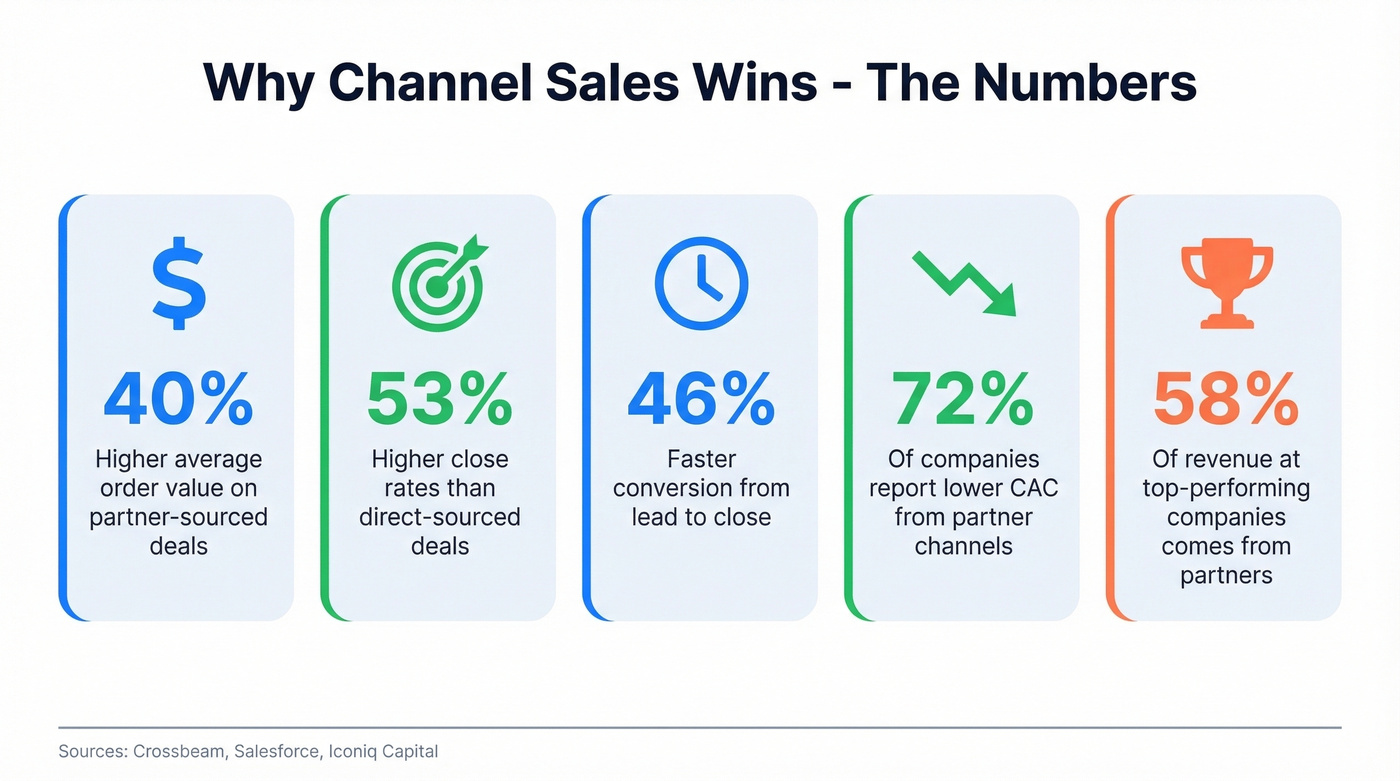
The software channel market has grown from $30B in 2019 to a projected $70B, according to IDC. Customer acquisition costs rose 40-60% between 2023 and 2025. Partner-sourced deals close 53% more often, convert 46% faster, and carry 40% higher average order values. If your CAC is climbing and your board is asking hard questions, channel isn't a nice-to-have. It's survival math.
The short version: Channel sales means selling through third-party partners instead of - or alongside - your own reps. The vendor builds the product, partners bring it to market. Done right, it's the highest-leverage growth motion in B2B. Done wrong, it's an 18-month money pit. Let's break down how to tell the difference.
Channel Sales, Defined
Channel sales is a B2B go-to-market model where you sell your product through third-party partners - resellers, VARs, distributors, affiliates, MSPs, system integrators, or consultants - instead of relying solely on your own sales team. The partner types break into three operating models: selling with partners (co-selling), selling through partners (reseller/distributor), and partners selling for you (white-label or referral). Each carries different margin, control, and enablement requirements.
The common thread is leverage. Instead of hiring 50 more reps, you activate 50 partners who already have relationships with your target buyers. Understanding how this model actually works in practice - and how a partner-driven business differs from a pure direct motion - is the first step toward building one that pays off.
Channel Sales vs. Direct Sales
The binary framing is outdated. Every serious B2B company runs both. The real question is what ratio, and for which segments.
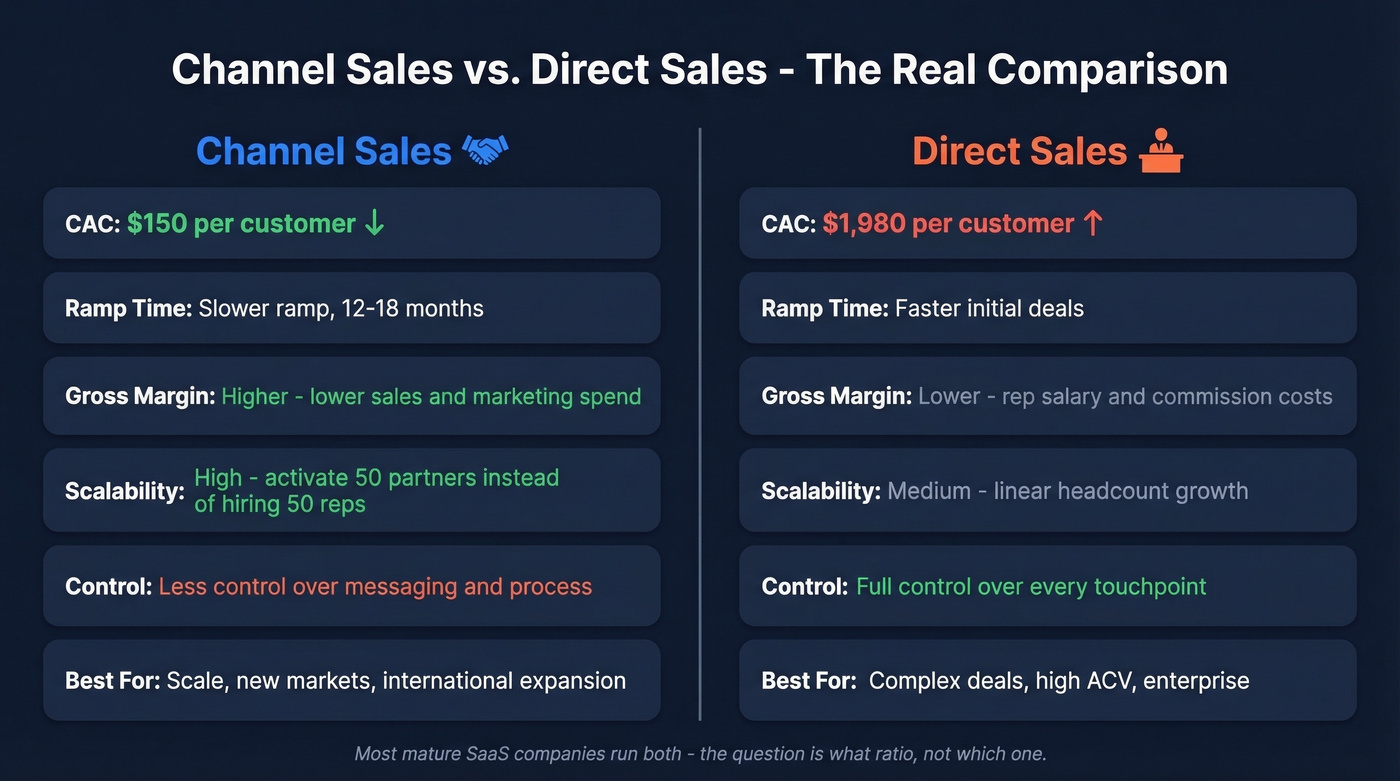
| Dimension | Channel | Direct |
|---|---|---|
| CAC | ~$150 (referral/partner, best case) | ~$1,980 (outbound) |
| Time-to-Value | Slower ramp | Faster initial deals |
| Gross Margin | Higher (lower S&M spend) | Lower (rep costs) |
| Scalability | High | Medium |
| Control | Less | Full |
| Best For | Scale, new markets | Complex, high-ACV deals |
In mature SaaS organizations, channel often contributes 30-40% of total ARR - particularly for international expansion and lower-touch products. Companies that treat channel and direct as competing motions instead of complementary ones are the ones that stall.
Why Channel Is Growing in 2026
CAC pressure is relentless. Acquisition costs jumped 40-60% from 2023 to 2025 and haven't come back down. Iconiq Capital found that surveyed B2B SaaS companies derived 20%+ of revenue from partner-sourced deals between 2023 and 2025, and that share keeps climbing. When outbound costs nearly $2,000 per customer and referrals cost $150, the economics make the decision for you.
Warm introductions crush cold outbound. Partners bring built-in trust. Over 75% of SaaS organizations now prioritize partnerships as a growth lever. Anyone who's actually carried a quota already knows this - it's simply easier to come in warm than cold.
Here's something most guides skip entirely: affiliate and channel partners also produce reviews, comparisons, and recommendation content that surfaces in AI-driven search and LLM results. Partner content is becoming a distribution channel for visibility itself, not just revenue. That's the fastest-growing reason we've seen companies invest in partner ecosystems this year.
Benefits by the Numbers
- Partner-sourced deals carry 40% higher average order value
- Close rates are 53% higher than direct-sourced deals
- Conversion happens 46% faster
- 72% of companies report lower CAC from partner channels
- Top-performing companies generate 58% of revenue from partners
The enterprise proof points are even more dramatic. 95% of Microsoft's commercial revenue flows through its partner ecosystem, which grows by 7,500 partners per month. Zoom's channel partners drove 40% of its business in Japan and over 70% with the U.S. Federal Government. Contentsquare's marketplace co-sell opportunities are 81% larger, close 11% faster, and produce a 106% increase in ACV. These aren't edge cases - they're the model, and the benefits compound over time as partners deepen their product knowledge and expand their customer relationships.

Channel programs scale when you recruit the right partners. Prospeo's 30+ search filters let you target companies by industry, tech stack, and headcount - then pull verified emails for partnership outreach. 300M+ profiles, 98% email accuracy, $0.01 per lead.
Build your partner prospect list the same way you'd build a customer one.
Commission Structures With Real Numbers
Getting the commission structure right is the difference between partners who actively sell and partners who signed up and forgot about you.
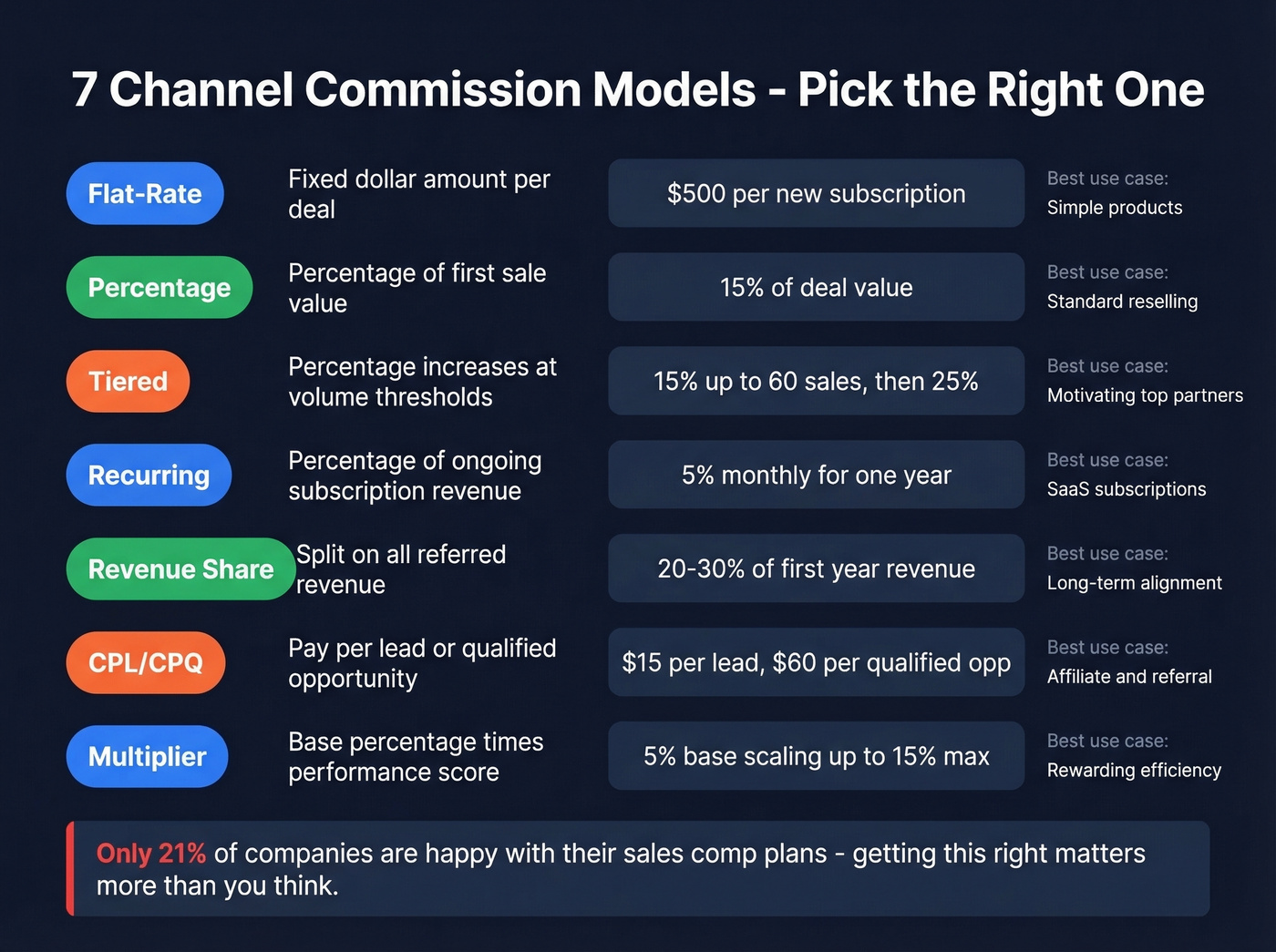
| Model | How It Works | Example | Best For |
|---|---|---|---|
| Flat-Rate | Fixed $ per deal | $500/new subscription | Simple products |
| Percentage | % of first sale | 15% of deal value | Standard reselling |
| Tiered | % increases at volume | 15% → 25% after 60 sales | Motivating top partners |
| Recurring | % of ongoing revenue | 5% for one year | SaaS/subscription |
| Revenue Share | Split on referred revenue | 20-30% of first year | Long-term alignment |
| CPL/CPQ | Per lead or qualified opp | $15/lead, $60/qualified opp | Affiliate/referral |
| Multiplier | Base % x performance | 5% base → 15% max | Rewarding efficiency |
Flat-rate and percentage structures are easy to track and explain. Tiered and multiplier models require stronger attribution systems, but they drive better behavior. Too many teams default to flat-rate because it's simple, then wonder why their top partners aren't pushing harder.
Only 21% of companies are happy with their sales compensation plans. Channel comp is harder because you're designing incentives for people who don't work for you. Get the structure wrong and partners will sell someone else's product instead.
How to Build a B2B Channel Program
AvePoint went from 20% channel revenue to 50% in two years, targeting 70% with 700 additional partners in the pipeline. Here's the playbook.
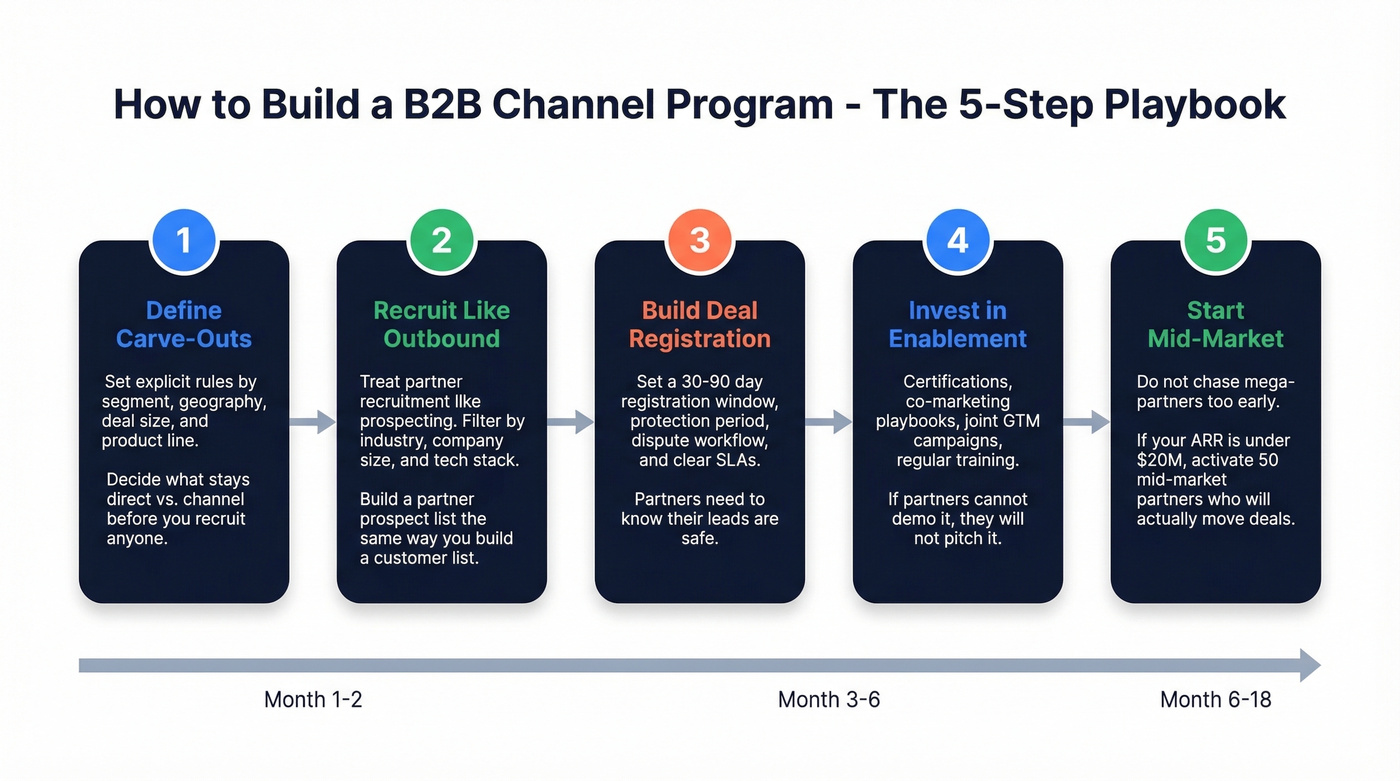
Define your channel-direct carve-outs first. Before you recruit a single partner, decide what gets sold through channel and what stays direct. Set explicit rules by segment, geography, deal size, or product line. Hybrid models create conflict when the rules aren't clear.
Treat partner recruitment like outbound prospecting. Finding the right partners is a prospecting problem, not a networking problem. You need to identify companies in adjacent industries, serving your target buyers, with complementary tech stacks. We use Prospeo internally for exactly this - filter by industry, company size, and tech stack, then pull verified emails for partnership and BD leads. You're building a partner prospect list the same way you'd build a customer prospect list.

Build deal registration from day one. Partners need to know their leads are protected. A standard process includes a registration window of 30-90 days, a protection period, a dispute workflow, and clear SLAs on follow-up. Without this, partners won't invest effort.
Invest in enablement, not just recruitment. Certifications, co-marketing playbooks, joint GTM campaigns, regular training. Partners who understand your product sell it. Partners who don't will default to whatever's easiest to explain.
I'll say something that might be unpopular: don't chase mega-partners too early. I've watched companies spend two years courting a Microsoft or Accenture partnership when they should have been activating 50 mid-market partners who'd actually move deals. If your ARR is under $20M, your best partners are companies your size or slightly larger - not the Fortune 500.
Why Channel Programs Fail
Most programs don't fail on strategy. They fail on execution. 73% of partners say parent company channel programs are too complex, and complexity is the enemy of partner adoption. Here are the patterns that kill programs:
- Spending 2+ years chasing mega-partners while ignoring mid-market partners who'd actually sell
- Letting direct reps manage partners - fundamentally different skill sets, and your reps will always prioritize their own quota
- Expecting partners to sell without training - if they can't demo it, they won't pitch it
- Unrealistic revenue timelines - channel takes 12-18 months to generate meaningful revenue, and boards that expect Q2 results from a Q1 launch will pull the plug too early
- CEO-to-CEO handshake deals that never engage the partner's actual sales team
A common failure mode we've seen is inheriting a program that was built in a back room with no market testing. The companies that fail at channel usually treated it like a side project instead of a go-to-market motion that needs its own leadership, metrics, and resources. Skip this approach entirely - if you can't commit a dedicated team and a 12-month runway, you're better off doubling down on direct until you can.
How to Measure Channel Performance
According to Gartner, 65% of B2B sales organizations are now transitioning from intuition-based to data-driven decision-making. Channel programs are where this shift matters most - without clear attribution, you can't tell which partners drive value and which just collect commissions.
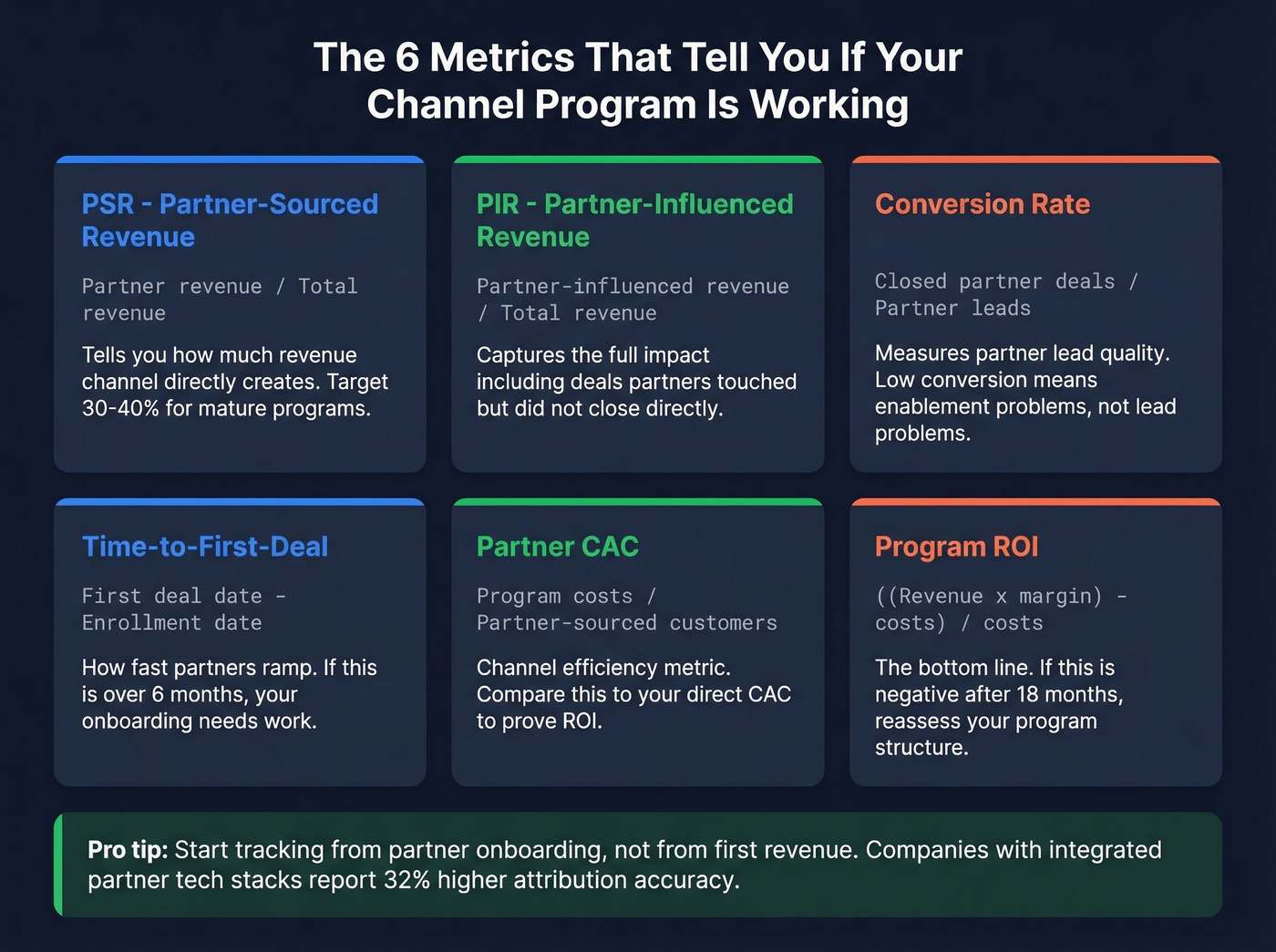
| Metric | Formula | What It Tells You |
|---|---|---|
| PSR | Partner-sourced revenue / total revenue | Channel's direct contribution |
| PIR | Partner-influenced revenue / total revenue | Channel's total impact |
| Conversion Rate | Closed partner deals / partner leads | Partner lead quality |
| Time-to-First-Deal | First deal date - enrollment date | Partner ramp speed |
| Partner CAC | Program costs / partner-sourced customers | Channel efficiency |
| Program ROI | ((Revenue x margin) - costs) / costs | Overall program health |
Crossbeam's research shows that companies with integrated partner and sales tech stacks report 32% higher accuracy in partner attribution. The biggest measurement mistake isn't picking the wrong KPIs - it's measuring too late. Start tracking from partner onboarding, not from first revenue.
Channel Sales as a Career
The consensus on r/sales is that channel gets overlooked because you're not always the person signing the order form. But the best channel professionals orchestrate more revenue than most individual closers ever will, and the ceiling is higher than people realize.
- Channel SDR/BDR - partner recruitment and activation (~$55-75K OTE)
- Channel Account Manager - managing a partner portfolio (~$85-120K OTE)
- Senior CAM / Channel Sales Manager - strategic partners, team leadership (~$120-200K OTE)
- VP of Channel/Partnerships - owning the channel P&L (~$200-300K+ OTE)
- Chief Partner Officer - C-suite, ecosystem strategy (~$300K+ OTE)
You're managing partners, not selling directly - that's a different skill set, not a lesser one. The best channel professionals think in systems, build relationships across organizations, and understand both their product and their partners' businesses deeply. For teams that want to break into channel, the SDR/BDR entry point is wide open right now as companies scale their partner programs faster than they can hire for them.
If you're mapping your own path, it helps to understand OTE benchmarks and how partner teams fit into sales leadership org design.
Partner recruitment is an outbound problem. Filter by technographics, company size, and growth signals to find businesses already serving your buyers. Prospeo refreshes data every 7 days so your outreach hits real inboxes - not dead ends.
Stop networking. Start prospecting for channel partners with verified data.
FAQ
What's the difference between channel sales and partner sales?
They're synonyms. "Partner sales" is the modern term that gained traction as "partnerships" replaced "channels" in org charts. Same mechanics, same economics - just updated branding.
How long does it take to build a profitable channel program?
Expect 12-18 months to first meaningful revenue and 2-3 years to reach maturity. AvePoint hit 50% channel revenue in two years, but they invested heavily in enablement from day one.
What percentage of revenue should come from partners?
Mature SaaS organizations typically see 30-40% of ARR from channel. Top performers push to 58%. If you're below 20%, there's likely untapped leverage in your partner ecosystem.
Is channel sales a good career path?
Yes - growing demand, strong compensation, and a clear path to VP or CPO. OTE ranges from $55K at the SDR level to $300K+ at the executive level, with mid-career managers earning $120-200K.
How do I find potential channel partners?
Treat it like outbound prospecting. Use a B2B database to filter by industry, tech stack, and company size, then pull verified emails for partnership leads. Target companies that serve your ideal customers but don't compete with your product - adjacent solutions, not overlapping ones.