

What Is Click Rate? 2026 Benchmarks and Measurement Traps to Avoid
Most guides hand you a formula, say "aim for 2-5%," and call it a day. That's useless. The real answer depends on whether you're sending a newsletter or a welcome flow, what industry you're in, and whether half your "clicks" are actually security bots pretending to be humans.
The Quick Version
- Click rate = unique clicks / delivered emails x 100
- A good click rate in 2026 is roughly 2.0-2.1% for campaigns (median across 3.6M campaigns), and 5.58% for automated flows
- If your opens look fine but clicks are flat, the problem is usually your CTA, your content-to-offer alignment, or bot-inflated opens masking real engagement
Let's unpack each piece.
Click Rate Defined
Click rate measures the percentage of recipients who clicked at least one link in your email, out of everyone who actually received it. If you've ever wondered how click-through rate works in email, it's this same core concept applied to any link inside a message.
Click Rate = (Unique Clicks / Delivered Emails) x 100
A worked example: you send a campaign to 2,050 people. 50 bounce. 2,000 are delivered. 80 unique recipients click a link. Your click rate is 80 / 2,000 = 4.0%.
The key word is "delivered," not "sent." Delivered means the recipient's mail server accepted the message - it doesn't guarantee inbox placement. Sent includes bounces, emails that never reached anyone. Using "sent" as your denominator deflates your rate and misrepresents how your content actually performed.
Note the "unique" distinction too. If one person clicks three links, that counts as one unique click, not three. You're measuring how many people engaged, not how many times they tapped.
Click Rate vs. CTR vs. CTOR
Platforms can't even agree on what these terms mean.
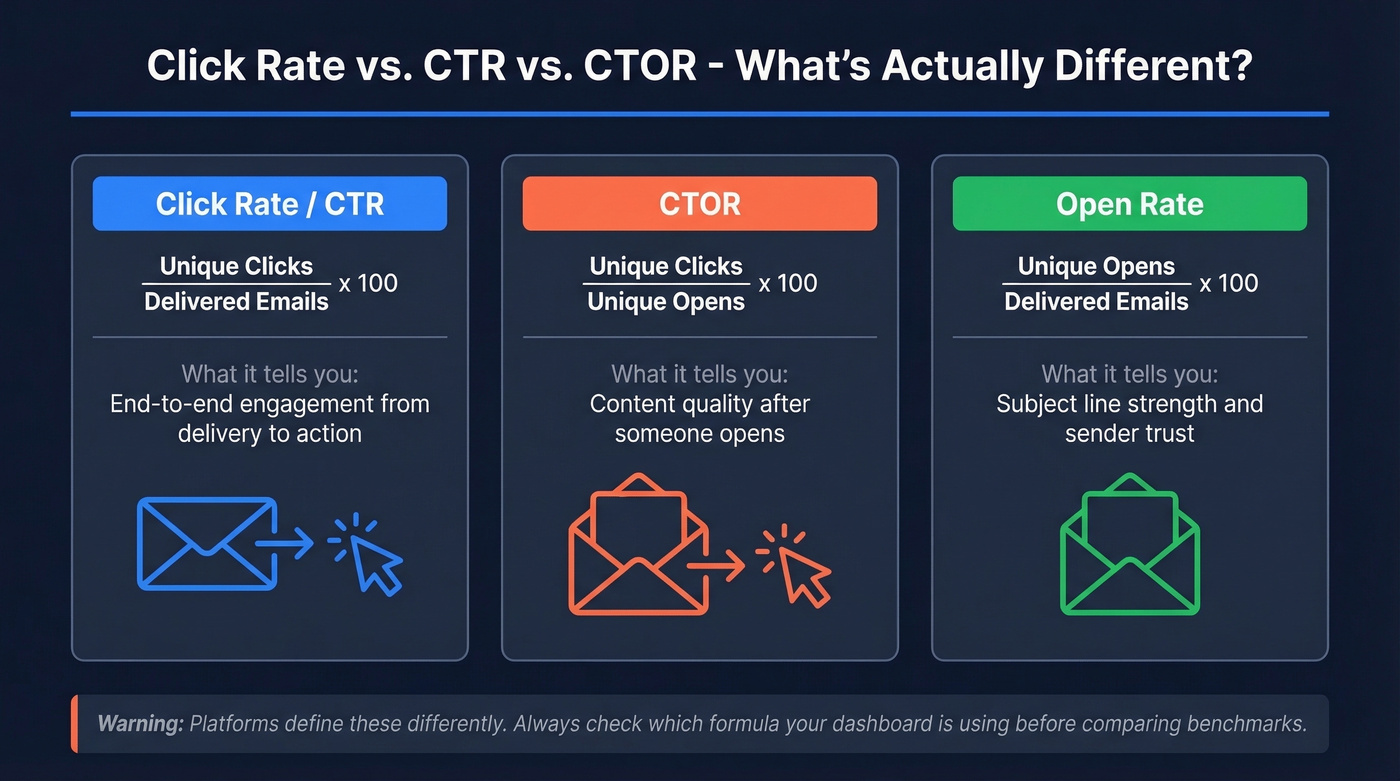
| Metric | Formula | What It Diagnoses |
|---|---|---|
| Click Rate / CTR | Unique clicks / delivered | End-to-end engagement |
| CTOR | Unique clicks / unique opens | Content quality (post-open) |
| Open Rate | Unique opens / delivered | Subject line / sender trust |
In most contexts, "click rate" and "CTR" are the same thing. But some platforms display them as separate metrics, and Mailchimp's own definitions page is a perfect example of the confusion. It says click rate and CTR are "technically the same metric" - then describes click rate as the percentage of people who "open the email," which is actually the definition of CTOR. On the same page. Helpful.
This isn't a Mailchimp-specific problem. It's an industry-wide terminology mess. Whenever you're comparing benchmarks across platforms, check which formula they're using. A "3% click rate" on one dashboard can mean something completely different on another.
CTOR isolates your email content from your subject line. Strong open rate but low CTOR? The problem is inside the email - your copy, your CTA, your offer. Both low? The problem starts earlier: deliverability, subject lines, or list quality.
2026 Benchmarks by Industry
Email CTR by Vertical
Two datasets worth anchoring to. MailerLite's benchmark report analyzed 3.6M campaigns across 181,000 accounts (Dec 2024-Nov 2025) and found a median click rate of 2.09% - up slightly from 2.0% in 2024. Their CTOR median hit 6.81%.
Mailchimp's benchmark data, based on billions of emails filtered to campaigns with 1,000+ subscribers, breaks it down by industry:
| Industry | Avg Click Rate |
|---|---|
| Non-Profits | 3.27% |
| Education & Training | 3.02% |
| Business & Finance | 2.78% |
| All Users | 2.62% |
| Ecommerce | 1.74% |
MailerLite reports medians; Mailchimp reports averages - which is why the numbers differ. MailerLite's ecommerce median is just 1.07%, nearly half of Mailchimp's 1.74% average. Medians tell you what's typical; averages get pulled up by outliers.
Flows vs. Campaigns
This is the single biggest context gap in click rate conversations. Klaviyo's 2026 benchmarks, drawn from 183,000+ ecommerce customers, show automated flows averaging a 5.58% click rate versus 1.69% for campaigns. That's more than 3x higher.
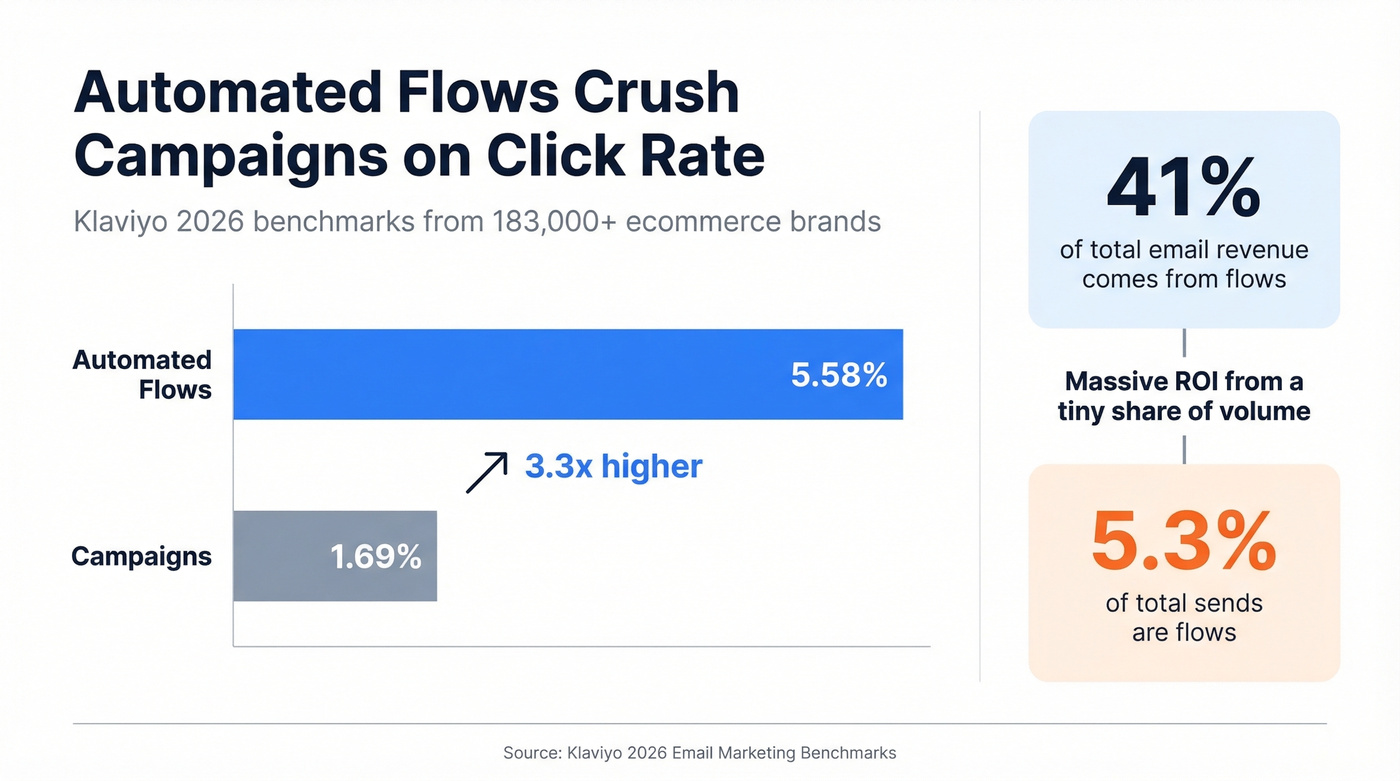
Flows also generate roughly 41% of total email revenue from just 5.3% of sends. If your numbers look low, the first question isn't "what's wrong with my emails?" - it's "am I measuring newsletters or automations?" Lumping them together produces a meaningless average.
Email vs. Paid Channels
For teams running multi-channel campaigns, here's how CTR stacks up:
| Channel | Avg CTR |
|---|---|
| Google Search Ads | 3.17% |
| Facebook Lead Gen | 2.50% |
| Facebook Traffic | 1.51% |
| TikTok | ~0.84% |
| LinkedIn Sponsored | ~0.4-0.7% |
| ~0.6% | |
| YouTube | ~0.5-0.6% |
| Google Display | 0.46% |
Format and targeting drive massive variance within each channel - a TikTok Spark Ad can hit 3%+; a generic display banner scrapes 0.1%. Compared to most paid channels, a healthy email click rate consistently outperforms display and social ads because the audience has already opted in.

Click rates tank when you're emailing bad addresses. Bounces above 5% destroy deliverability, which tanks inbox placement, which kills clicks. Prospeo's 5-step verification delivers 98% email accuracy - teams using it see bounce rates drop from 35% to under 4%.
Stop optimizing CTAs on emails that never reach the inbox.
Why Your Data Is Wrong
A meaningful chunk of your "clicks" aren't human.
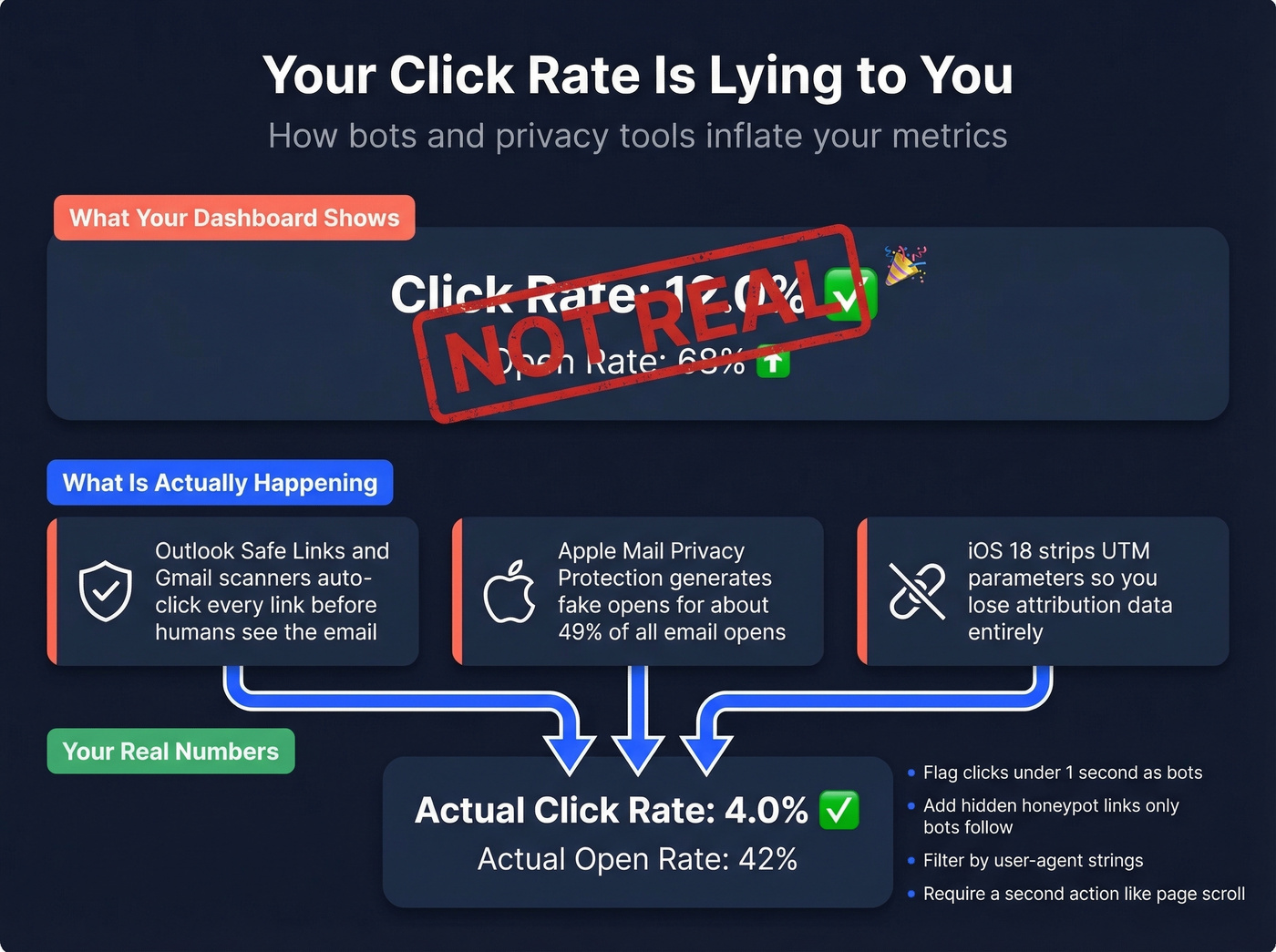
Apple Mail Privacy Protection, launched September 2021, generates machine opens for roughly 49% of all email opens as of early 2025. That inflates your open rate by 15-20+ percentage points, which makes your email tracking pixels and CTOR look artificially low since the denominator is bloated. iOS 18's Link Tracking Protection makes things worse by stripping UTM parameters in Mail and Safari, further degrading attribution data.
But it's not just opens. Security scanners like Outlook Safe Links and Gmail's link protections auto-click links before a human ever sees the email. These "dark clicks" inflate your email CTR and can trigger automations prematurely.
Most major ESPs now apply some bot filtering, but it's imperfect. To catch what slips through:
- Time-to-action threshold: any click under 1 second after delivery is almost certainly a bot
- Hidden honeypot links: invisible links that only bots follow
- User-agent filtering: security scanners often identify themselves in the user-agent string
- Confirmation clicks: require a second action like a page scroll before counting engagement
We've seen teams celebrate a "12% click rate" that dropped to 4% after proper bot filtering. The real number was still good - but the inflated one was driving bad decisions about what content "worked."
Why Click Rate Matters More Than Opens
Here's the thing: click rate is now more important than open rate. Post-MPP, it's the most reliable email engagement signal you have. Open rates are compromised. Unsubscribe rates are lagging indicators. Clicks tell you someone read your email, found something relevant, and took action.
Click rate also feeds directly into deliverability. ISPs watch engagement signals to decide whether your future emails land in the inbox or the spam folder. Low clicks combined with bounce rates above 5% actively damage your sender reputation. Bad engagement today means worse inbox placement tomorrow, which means even worse engagement next week. It compounds fast.
How to Improve Your Click Rate
Fix Your Data First
None of the tactics below matter if your emails aren't reaching real inboxes. If 5%+ of your emails bounce, your sender reputation is already degrading - and engagement metrics become irrelevant because fewer emails get delivered in the first place.
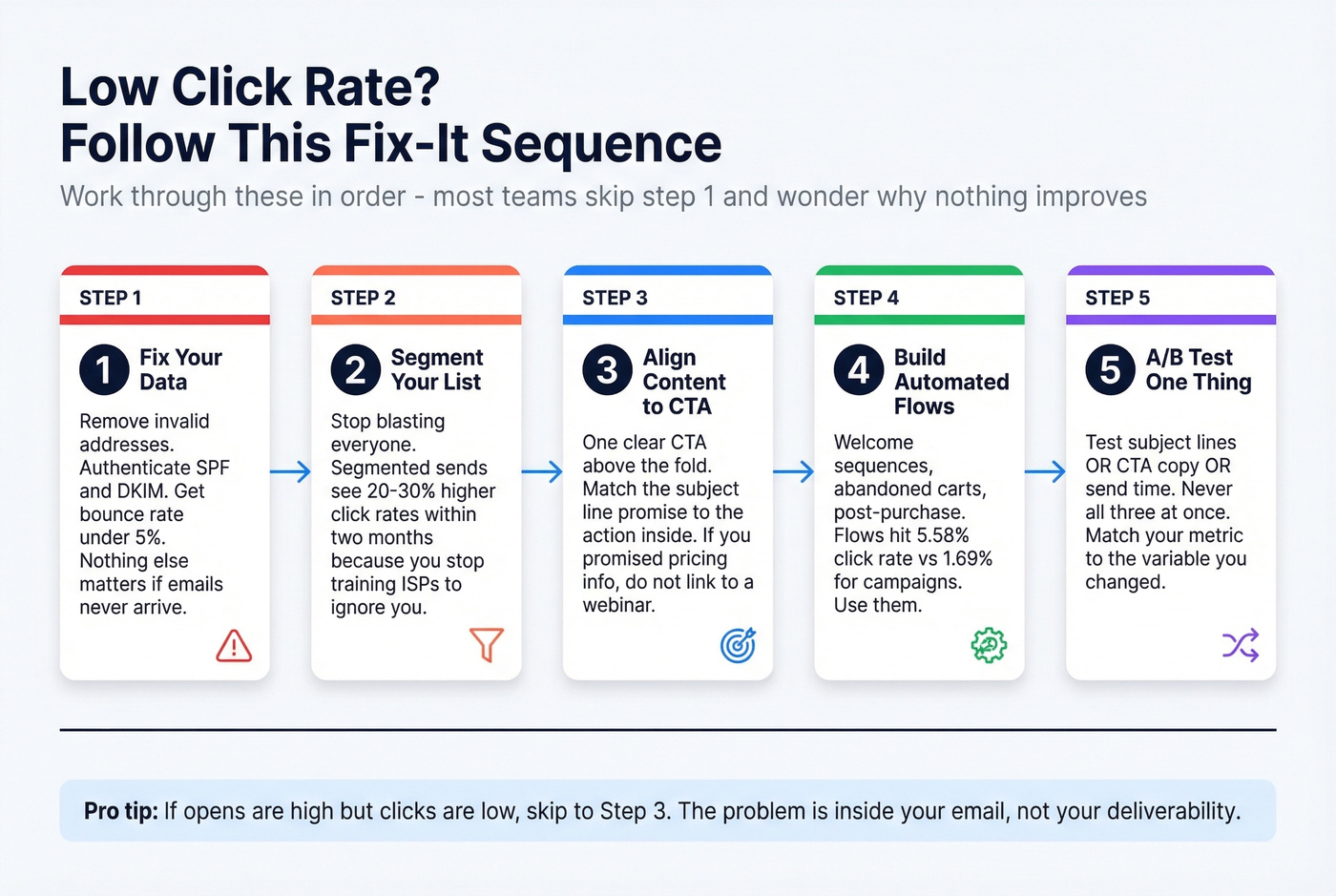
Start with list hygiene: remove invalid addresses, authenticate with SPF/DKIM, and verify your contact data before launching campaigns. Prospeo's 5-step email verification catches invalid addresses, spam traps, and honeypots before they hit your sending infrastructure - 98% accuracy means your campaigns reach real people instead of bouncing into the void.
Flows outperform campaigns 3x on click rate because they reach the right person at the right time. Prospeo's intent data tracks 15,000 topics so you can trigger outreach when buyers are actively researching - not when your calendar says it's send day.
Reach in-market buyers and watch your click rates climb.
Segment Before You Send
A classic debate on r/Emailmarketing: why not just send to everyone? One user laid out the math - sending to 10,000 people yields 375 clicks at 3.75%, while a segmented send to 5,000 gets 250 clicks at 5%. More total clicks from the blast, right?
Short-term, yes. Long-term, you're torching your sender reputation. The 5,000 people who didn't care generate spam complaints, reduce future inbox placement, and train ISPs to deprioritize your domain. In our experience, teams that clean and segment their lists before sending consistently see click rates 20-30% higher within two months - not because the emails changed, but because they're actually reaching engaged inboxes.
One CTA, Above the Fold
The #1 fix for "high opens, low clicks" is content-to-CTA alignment. If someone opens an email about pricing updates and finds a CTA for a webinar, they're not clicking. Match the promise of your subject line to the action inside the email. One clear CTA, visible without scrolling, outperforms three competing links every time.
If you want a deeper playbook, start with email call to action rules and examples.
Use Automated Flows
Remember the Klaviyo data - flows deliver 3x higher click rates than campaigns. Welcome sequences, abandoned cart reminders, post-purchase follow-ups: these emails arrive when the recipient is already primed to engage. If you're only sending broadcast campaigns, you're leaving the highest-performing email type on the table.
A/B Test One Variable
Test subject lines, CTA copy, or send time - but only one at a time. Testing three variables simultaneously tells you nothing about what moved the needle. And match your metric to the variable: testing subject lines? Watch overall engagement. Testing CTA copy or button design? CTOR isolates the in-email change better than raw click rate does.
For subject line ideas, pull from these email subject line examples.
High Opens, Low Clicks?
This is the most common complaint on r/Emailmarketing, and it usually comes down to one of five things:
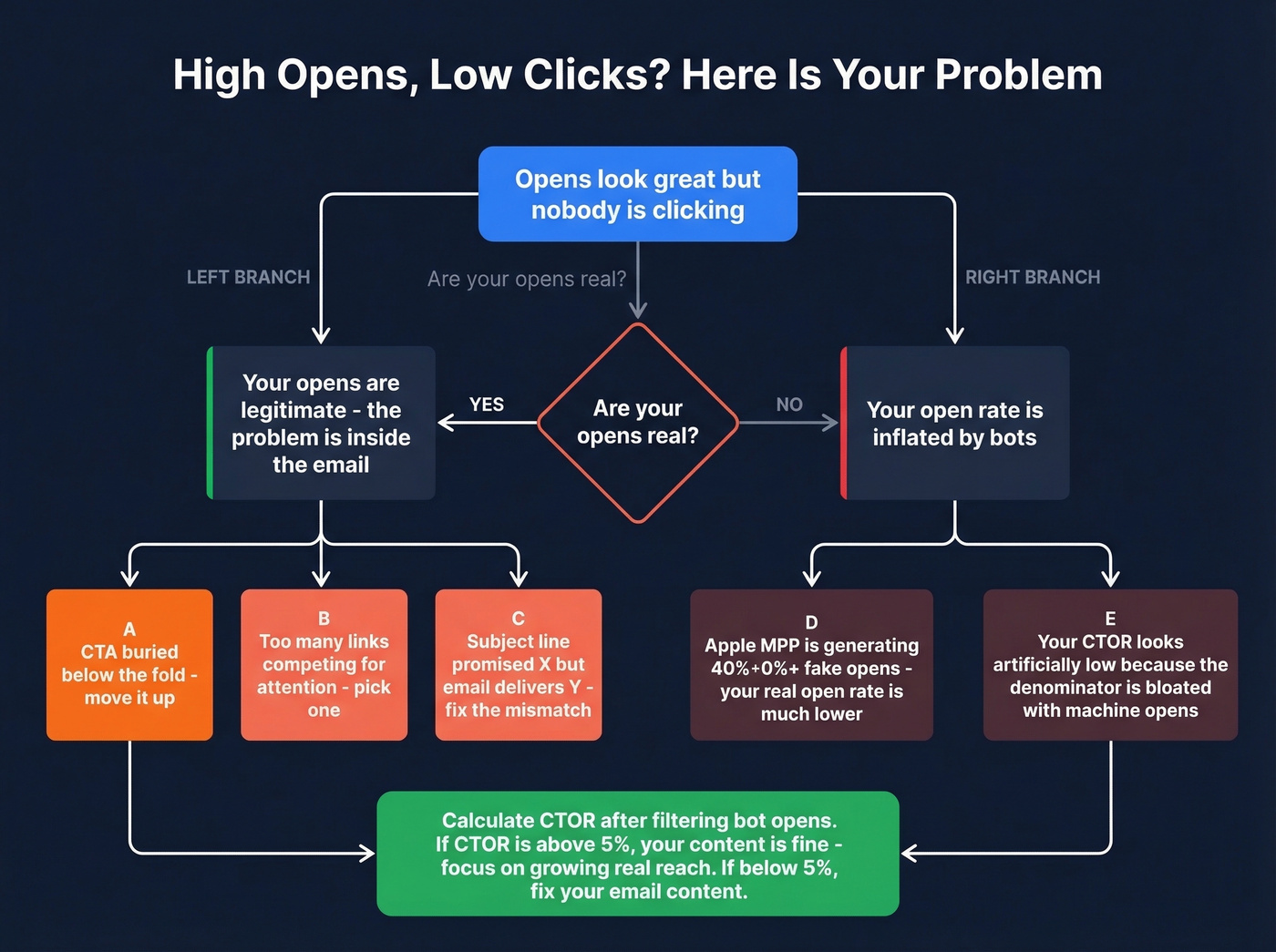
- CTA placement - is it above the fold, or buried after 400 words?
- Link count - too many links dilute attention; too few give nowhere to go
- Content-to-CTA mismatch - the subject line promised one thing, the email delivers another
- Bot-inflated opens - your "high open rate" is 40% machine opens
- Metric confusion - a 2% CTR with a 40% open rate means a 5% CTOR, which is actually decent
If your opens are genuinely high and clicks are genuinely flat, the problem is almost always inside the email. Fix the offer, not the subject line.
FAQ
Is click rate the same as CTR?
In most contexts, yes - both measure unique clicks divided by delivered emails. But some platforms display them as separate numbers, and Mailchimp's own definitions contradict themselves on the same page. Always check your ESP's documentation to confirm which formula their dashboard uses before comparing across tools.
What's a good click rate for ecommerce?
MailerLite's data puts ecommerce campaigns at a 1.07% median. Klaviyo's ecommerce-focused benchmarks show automated flows averaging 5.58%. If you're only measuring campaign sends, 1-2% is normal. Flows should be significantly higher - and they're where most of the revenue comes from.
Do bot clicks inflate my numbers?
Yes. Security scanners like Outlook Safe Links auto-click links before a human sees the email, inflating your CTR and triggering automations prematurely. Use time-to-action thresholds (under 1 second = bot) and honeypot links to identify phantom engagement. Upstream, verifying your list before sending reduces bounces that trigger extra security scrutiny from receiving servers.