

What Is Consultative Selling? (And Why Most Teams Get It Wrong)
Four vendors pitched me the same product last quarter. Same category, similar features, comparable pricing. Only one got the deal, and it wasn't the one with the best demo - it was the rep who spent 20 minutes helping me rethink a workflow I didn't even know was broken. That's what consultative selling looks like in practice. The way most teams attempt it? A pale imitation.
The short version: Consultative selling means selling by advising, not pitching. It works best for $25K-$100K deals with 3-6 month cycles where buyers face complex, multi-stakeholder decisions. But diagnosis alone doesn't win deals anymore. Winners teach, challenge, and persuade. This guide gives you the data, the questions, and the failure modes your training skipped.
Consultative Selling Definition
The term goes back to 1970, when Mack Hanan published Consultative Selling and drew a hard line between "vending" (pushing products) and consulting (improving a buyer's business outcomes). You're not selling a product. You're selling improved profits. You position yourself as a business-manager-to-business-manager peer, not a vendor begging for attention.
In practice, it isn't a personality trait. It's not "being nice" or "asking open-ended questions." It's a structured approach to understanding a buyer's business deeply enough that your recommendation carries genuine authority. The rep who helped me rethink that workflow had clearly studied our tech stack, our hiring patterns, and our competitive landscape before the call - that's the difference between a consultative sales approach and just being friendly.
Why It Matters in 2026
The B2B buying environment has shifted so dramatically that this approach isn't optional. 96% of prospects research companies and products before engaging a sales rep. 71% prefer independent research over talking to a rep at all. 81% of revenue leaders say deals are more complex than ever. Show up and recite features, and you're wasting everyone's time.
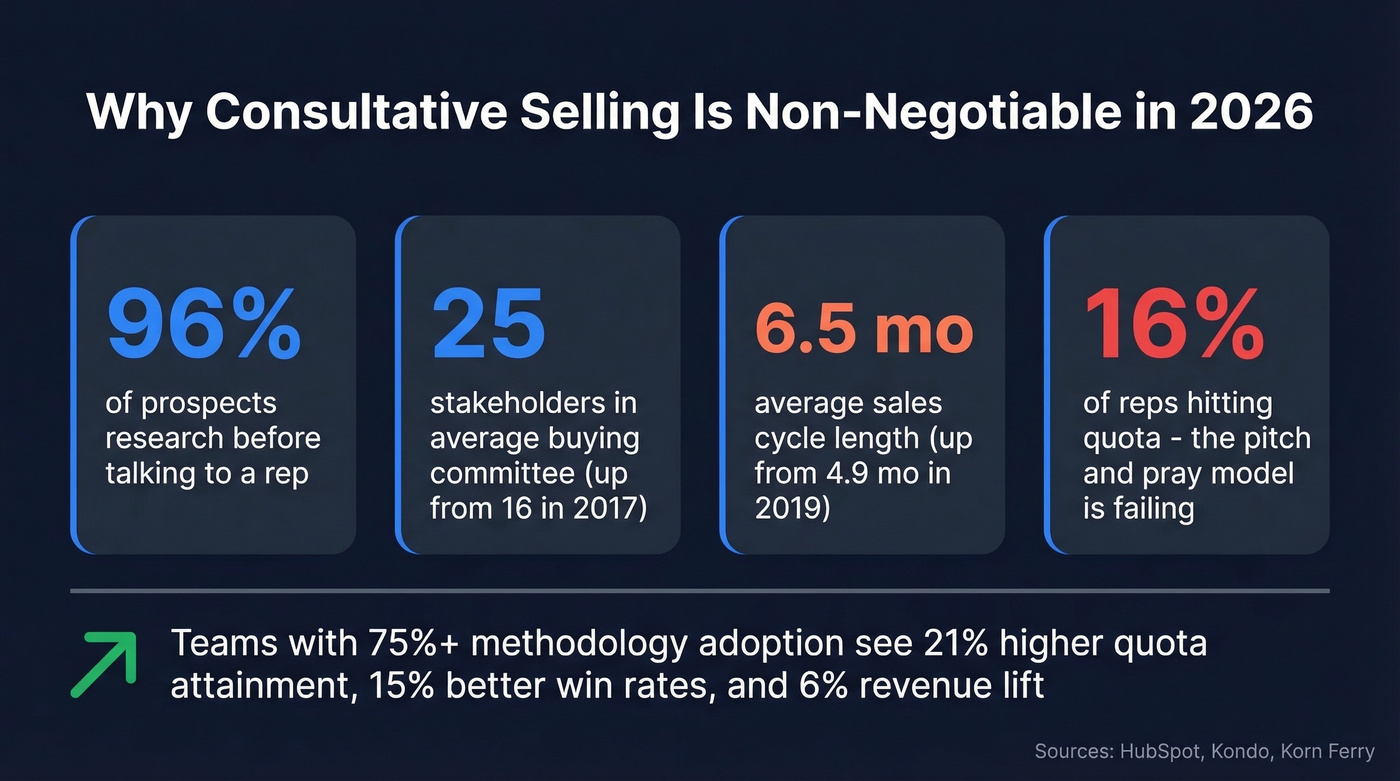
Buying committees have expanded to 25 stakeholders, up from 16 in 2017. Average sales cycles now run 6.5 months, up from 4.9 months in 2019. Only 16% of reps hit quota. That's a systemic failure of the "pitch and pray" model.
The ROI data is clear. Korn Ferry research shows that when teams reach 75%+ adoption of a structured sales methodology, quota attainment jumps 21%, win rates climb 15%, and revenue lifts 6%. Consultative and insight-led motions typically lift win rates 10-20% in complex B2B when adopted consistently. The teams treating this as a real discipline are the ones pulling ahead.
Mack Hanan's Framework
Hanan didn't just coin a term. He built a system.
His central concept was the Profit Improvement Proposal (PIP) - a document that quantified, in the buyer's own financial language, how much profit your solution would add, how soon, and how sure the outcome was. "How much, how soon, how sure" became the buyer's evaluation criteria, not feature checklists.
What made the framework genuinely different was the research infrastructure behind it. He insisted sellers build three databases: an industry database covering benchmarks, norms, and competitive dynamics; a customer database tracking the buyer's specific KPIs and performance gaps; and a customer's customer database for understanding the buyer's own clients. This wasn't CRM hygiene - it was business intelligence that let you walk into a room and speak as a peer, not a peddler. The shift from vending to business-manager-to-business-manager selling is still one of the most important ideas in modern sales methodology, 56 years later. Understanding the meaning Hanan intended - advising on profit improvement, not pitching features - remains the foundation everything else builds on.
Diagnosis Is Table Stakes
Here's where most training falls apart.
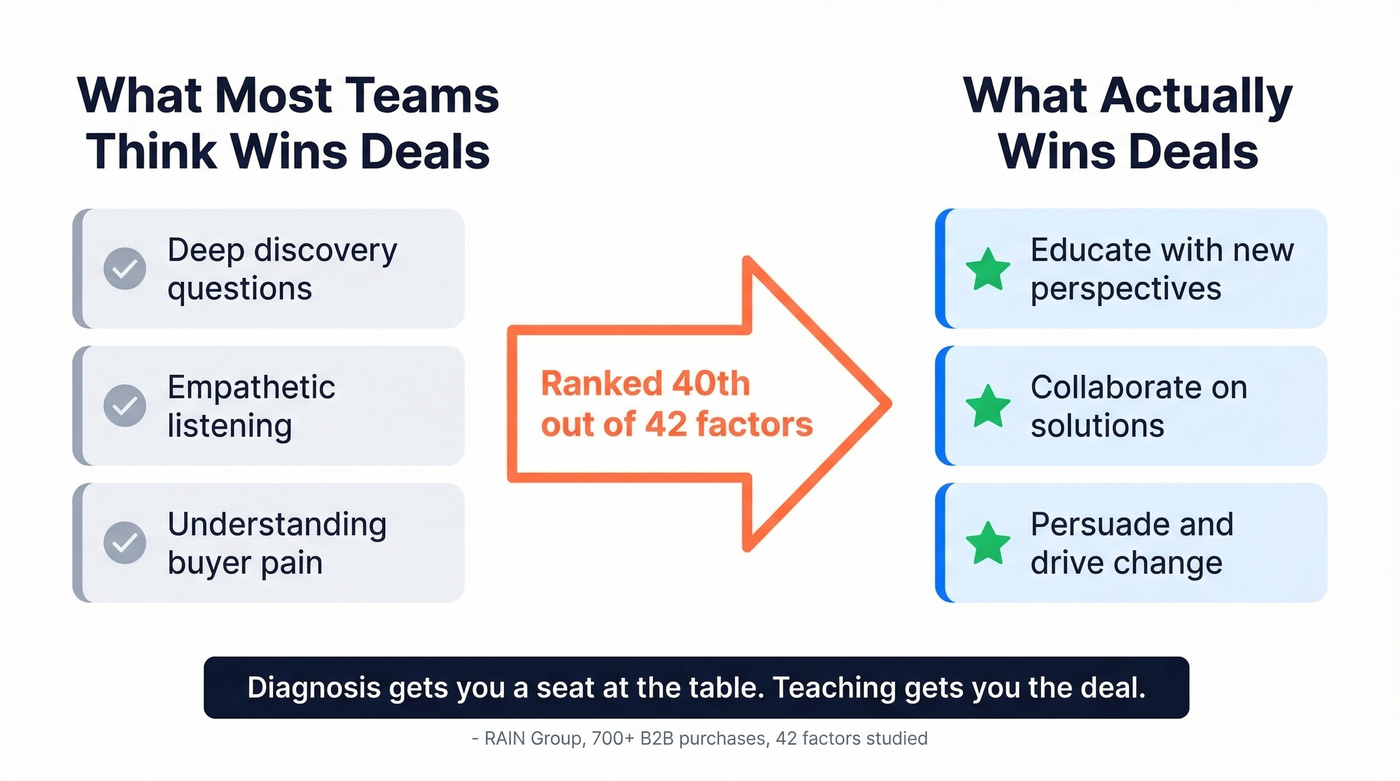
RAIN Group studied 700+ B2B purchases across 42 factors to determine what winning sellers did differently. The result should make every sales trainer uncomfortable: "deepened my understanding of my needs" ranked 40th out of 42 among what winners actually did. Let that sink in. The behavior most associated with consultative selling - deep discovery, empathetic diagnosis, understanding the buyer's pain - barely moved the needle on winning. RAIN's research also shows second-place finishers can over-index on diagnosis compared to winners, yet still lose.
Discovery is the floor, not the ceiling. Core consultative behavior has given way to what RAIN Group calls insight selling: inspiring buyers and driving change with ideas that matter. Winners don't just diagnose. They educate, collaborate, and persuade. They bring perspectives the buyer hadn't considered. Diagnosis gets you a seat at the table. Teaching gets you the deal.
The Consultative Sales Process
Research and Preparation
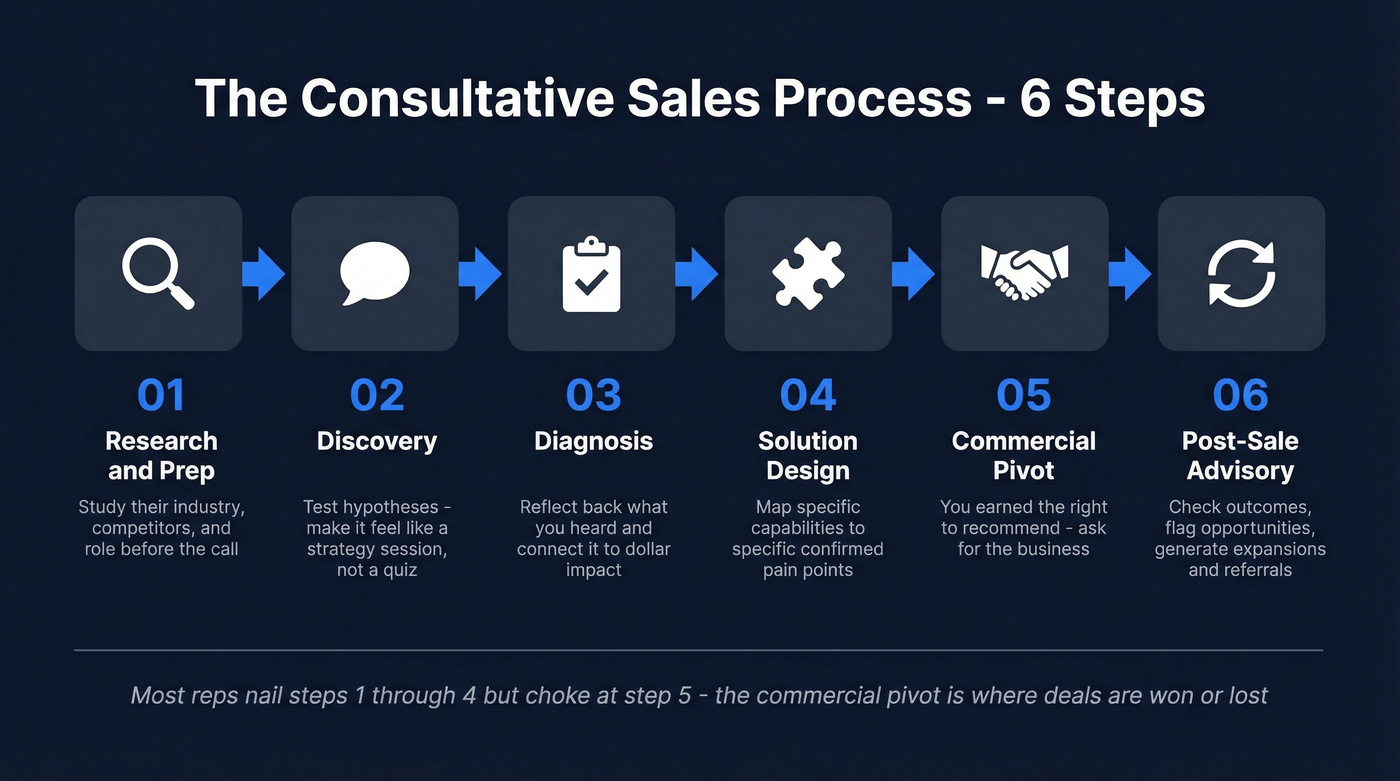
Every meaningful consultative conversation starts before the call. You need to understand the prospect's industry, competitive position, recent company moves, and the specific person's role and priorities. Gartner found that sellers who gather buyer intelligence increase account growth by 5%. Tools like Prospeo return 50+ data points per contact via enrichment and track 15,000 intent topics, so your discovery call starts with real context instead of guesswork. Showing up uninformed in 2026 is disqualifying.
Discovery
Discovery isn't an interrogation. It's a guided conversation where you're testing hypotheses formed during research. The best discovery calls feel like a strategy session, not a questionnaire. Ask about their current state, what's working, what isn't, and what's changed recently. That gap between where they are and where they want to be is the dollar figure you'll build your business case around.
Diagnosis
Synthesize what you've heard and reflect it back with added context. "Based on what you've described, your team is spending 40% of their time on manual processes that should be automated, costing roughly $200K in lost productivity per quarter." You're connecting their words to business impact using the industry knowledge you built during research.
Solution Design
Now you map your solution to the diagnosed problem. Not your full product suite - the specific capabilities that address the specific pain you've confirmed together. A CFO wants ROI and payback period. A VP of Ops wants implementation timeline and resource requirements. Tailor accordingly.
Commercial Pivot
This is where most consultative sellers choke. They've been so focused on being helpful that they can't bring themselves to actually recommend and close. Once you've confirmed the problem, the impact, and the decision process, you've earned the right to recommend. As one Reddit thread put it: "The buyer isn't stupid... At some point, offering to be too consultative is just going to come off as disingenuous and sketchy." Make the recommendation. State the terms. Ask for the business.
Post-Sale Relationship
The advisory relationship doesn't end at the signature. Checking in on outcomes, flagging new opportunities, connecting the buyer to resources - this generates expansions, referrals, and the trust that makes your next deal easier. Hanan's framework comes full circle: you're a business advisor, not a one-time transaction.

The article says it: showing up uninformed in 2026 is disqualifying. Prospeo's enrichment returns 50+ data points per contact at a 92% match rate - plus intent data across 15,000 topics so you know what buyers care about before discovery even starts.
Walk into every call like you already work there.
Discovery Questions That Work
The difference between a great discovery call and a robotic one isn't the questions - it's how naturally you ask them. We've collected the plain-language versions below from what reps actually report using on sales forums and in our own team's experience.
Needs and Pain
- "What challenges aren't being addressed right now?" - Plain: "What's broken that nobody's fixing?"
- "What prompted you to look at this now?" - Plain: "Why now?"
- SaaS variant: "What's driving churn in your top accounts?" Manufacturing variant: "Where are you seeing the most scrap or downtime?"
Impact and Implication
- "How is this challenge impacting other areas of your business?"
- "What does this cost you quarterly - in dollars, time, or missed opportunities?"
- Financial services variant: "What's the risk exposure if this stays unresolved through the next audit cycle?"
Process and Decision
- "Walk me through how you'd actually buy something like this."
- "Who else needs to weigh in before this moves forward?"
In manufacturing, the most revealing question is often about OEE. Asking what a 5-point improvement would mean in throughput forces the buyer to quantify their own pain, and that number becomes the anchor for your entire business case.
Timeline
- "What's driving the timeline for this decision?"
- "What happens if this slips to next quarter?"
Methodology Comparison
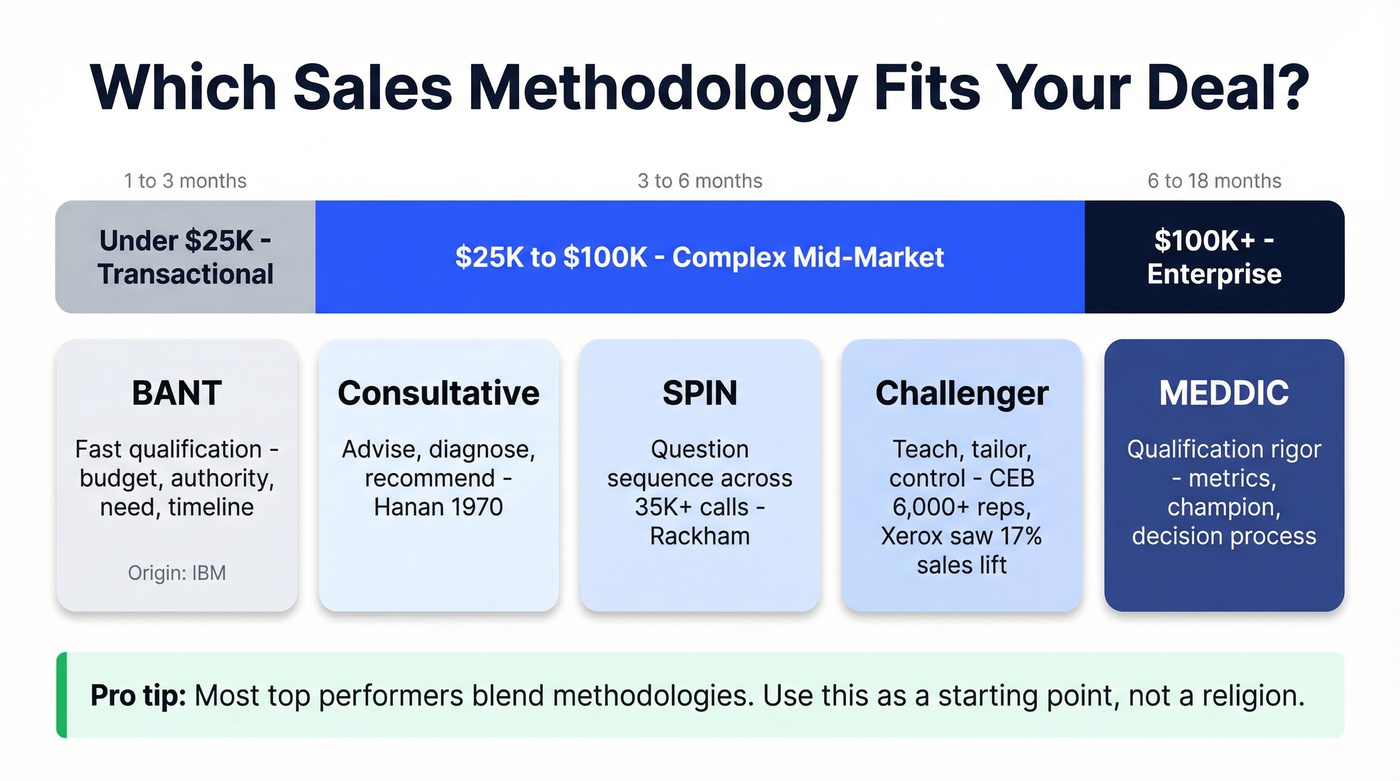
No methodology exists in a vacuum. Most top performers blend elements from several frameworks depending on the deal.
| Methodology | Core Idea | Best For | Key Behavior | Research Basis |
|---|---|---|---|---|
| Consultative | Advise, don't pitch | $25K-$100K, 3-6 mo | Diagnose + recommend | Hanan (1970) |
| SPIN | Question sequence | Mid-market complex | Implication questions | 35K+ calls, 12 yrs |
| Challenger | Teach, tailor, control | Enterprise complex | Commercial teaching | CEB, 6,000+ reps |
| MEDDIC | Qualification rigor | $100K+, 6-18 mo | Metrics + champion | PTC origin |
| BANT | Fast qualification | <$25K transactional | Budget/authority check | IBM legacy |
The deal-size heuristic is useful as a starting point. Enterprise deals over $100K with 6-18 month cycles benefit from MEDDIC's qualification rigor. Mid-market deals in the $25K-$100K range are the consultative sweet spot, where SPIN and Challenger both shine. For transactional deals under $25K, skip the deep discovery - BANT-style fast qualification is more appropriate.
Challenger deserves special attention because it directly addresses the RAIN Group finding. The CEB research across 6,000+ reps found that the "Challenger" profile outperformed relationship builders in complex sales. Xerox reported a 17% increase in sales and $65M in contract value after implementing Challenger. SPIN's research base is even deeper: 35,000+ sales calls across 20+ countries over 12 years.
Let's be honest: most top performers use a hybrid, not a religion. They use SPIN-style implication questions during discovery, Challenger-style teaching during the middle of the deal, and MEDDIC-style qualification to pressure-test whether the deal is real. The methodology wars are mostly a training-company marketing exercise.
When This Approach Backfires
Consultative selling fails in predictable ways.
Scripted discovery. A rep on Reddit described using a canned opener - "What's keeping you up at night regarding your current solution?" - and the prospect responded, "Are you reading from a script?" then hung up. The company had paid a $15K consultant to deliver this training. Their top closer's numbers dropped for two months while he second-guessed every conversation. Only 38% of teams have formal guidelines for how reps should use key tools and workflows, which means most reps are left to interpret "be consultative" on their own.
The Infinite Consultant. Some reps never pivot to selling. They keep asking questions, keep diagnosing, keep being "helpful." The buyer eventually ghosts because they can't tell if you're a vendor or a free advisor. Consultative posture without commercial courage is just expensive therapy.
No business acumen. You can't advise on problems you don't understand. If you're selling to CFOs and can't read a P&L, no amount of discovery technique will save you. The approach requires the ability to provide genuine counsel, not just ask questions and nod.
Conflict aversion. Real advisors tell clients uncomfortable truths. "Your current process is costing you $500K a year and your team knows it" is a consultative statement. If you can't say that because it creates tension, you're not consulting. You're people-pleasing.
Two common misconceptions worth calling out: "I ask good questions" doesn't equal consultative. "I don't use high-pressure tactics" doesn't equal consultative. This discipline means you have the knowledge, authority, and courage to provide professional advice and then make a recommendation.
Skip the full consultative motion if your average deal closes under $15K. A tight demo, clear pricing, and a fast follow-up will outperform a 45-minute discovery call every time. Save the deep diagnosis for deals where the buyer genuinely needs help navigating complexity.
Consultative Selling in the AI Era
The research phase is being transformed by AI faster than any other part of the process. Gartner predicts that by 2027, 95% of seller research workflows will begin with AI. Bain reports 30%+ improvement in win rates from early AI successes. Salesforce data shows sellers using AI tools are 3.7x more likely to meet quota. And 61% of sellers say admin tasks and inefficient processes slow them down most.
Reps spend only 28-30% of their time actually selling. AI handles the research and admin so humans can do the human work: nuanced discovery, creative problem-solving, and relationship building that no algorithm replicates. Prospeo's B2B database covers 300M+ professional profiles with a 7-day refresh cycle and 98% verified email accuracy, which means your first outreach actually reaches the right person and your discovery call starts with real context. Its intent data tracks 15,000 topics via Bombora, surfacing which accounts are actively researching solutions like yours before you pick up the phone. That's Hanan's three-database concept from 1970, running at machine speed.

Bain's warning is worth heeding: real gains require process redesign, not just automating existing inefficiencies. The teams winning with AI-augmented consultative selling are rethinking their entire research-to-discovery workflow, not bolting a chatbot onto a broken playbook.
Consultative sellers need deep research on industries, accounts, and contacts. Prospeo's 300M+ profiles, 30+ search filters, and 7-day data refresh give you the business intelligence Mack Hanan dreamed of - at $0.01 per email, not enterprise pricing.
Build Hanan's three databases in minutes, not months.
Bottom Line
- Consultative selling is a discipline, not a disposition. It requires research, business acumen, and the courage to recommend.
- Diagnosis is table stakes. The reps winning complex deals in 2026 are teaching, challenging, and persuading.
- Blend methodologies to fit the deal. Use SPIN for discovery, Challenger for teaching, MEDDIC for qualification. Skip the dogma.
FAQ
What's the difference between consultative selling and solution selling?
Solution selling assumes a known problem and matches a product to it. Consultative selling starts earlier - helping the buyer discover and redefine the problem before proposing anything. Both build on diagnosis, but the consultative approach shapes the buyer's understanding of their own needs rather than responding to a stated requirement.
How long does it take to learn consultative selling?
The framework takes a day; real proficiency takes 3-6 months of deliberate practice. The bottleneck isn't technique - it's building enough business acumen to ask informed questions and enough confidence to make direct recommendations. Most reps stall because they learn the questions but never develop the industry knowledge to interpret the answers.
Does it work for transactional deals?
Poorly. Below roughly $25K deal size, the time investment in deep discovery doesn't justify the return. Use BANT-style qualification for transactional sales and save consultative motions for complex, multi-stakeholder deals where the buyer genuinely needs guidance navigating 6+ month buying cycles.
What tools help with the research phase?
B2B data platforms like Prospeo provide verified contact data, company signals, and buyer intent data so you can research prospects before the first call. Conversation intelligence tools like Gong and Chorus help you analyze discovery calls after the fact, identifying which questions generated the most productive responses.
That rep who rethought my workflow? He didn't follow a script. He followed a discipline. That's the whole difference.