

What Is Customer Success in SaaS? The Operator's Guide for 2026
Your CEO just asked why 30% of last quarter's new logos churned before month four. The pipeline looked great. The reps closed well. But the revenue evaporated because nobody owned what happened after the signature. That gap - the space between a signed contract and a customer who actually gets value from your product - is exactly what customer success exists to fill.
Around 40% of SaaS revenue now comes from renewals and expansion. Customer success isn't a support team with a friendlier name. It's a revenue function, and one of the most important ones in a recurring-revenue business. Once you see that CS drives revenue just as directly as your sales team does, the investment case becomes obvious.
The Short Version
Customer success is the proactive function that protects and grows recurring revenue by ensuring customers achieve their desired outcomes with your product.
Three metrics to start with:
- Logo churn rate - what percentage of customers leave each period
- Net revenue retention (NRR) - are existing customers spending more or less over time
- Time-to-value - how fast do new customers reach their first meaningful outcome
Here's the core math: 70-95% of SaaS revenue comes from retention and expansion. If you're only investing in acquisition, you're ignoring the majority of your revenue engine.
The Real Definition
In a subscription model, the sale is just the beginning. Your customer re-buys your product every month or every year. Customer success is the discipline of making sure they keep choosing you - not because they're locked in, but because they're getting measurable value.
The distinction that matters is proactive versus reactive. Support waits for something to break. Customer success spots the warning signs before the ticket gets filed. A CSM notices that a key stakeholder hasn't logged in for three weeks and reaches out before the renewal conversation turns into a cancellation conversation.
"Proactive" doesn't mean "send more check-in emails," though. It means data-driven. It means your team has visibility into product usage, engagement patterns, and health scores - and acts on that data before the customer even realizes they're at risk. Without data infrastructure, CS is just account management with a different title.
Why CS Is Make-or-Break for Revenue
Let's run the numbers, because this is where the conversation shifts from "nice to have" to "board-level priority."
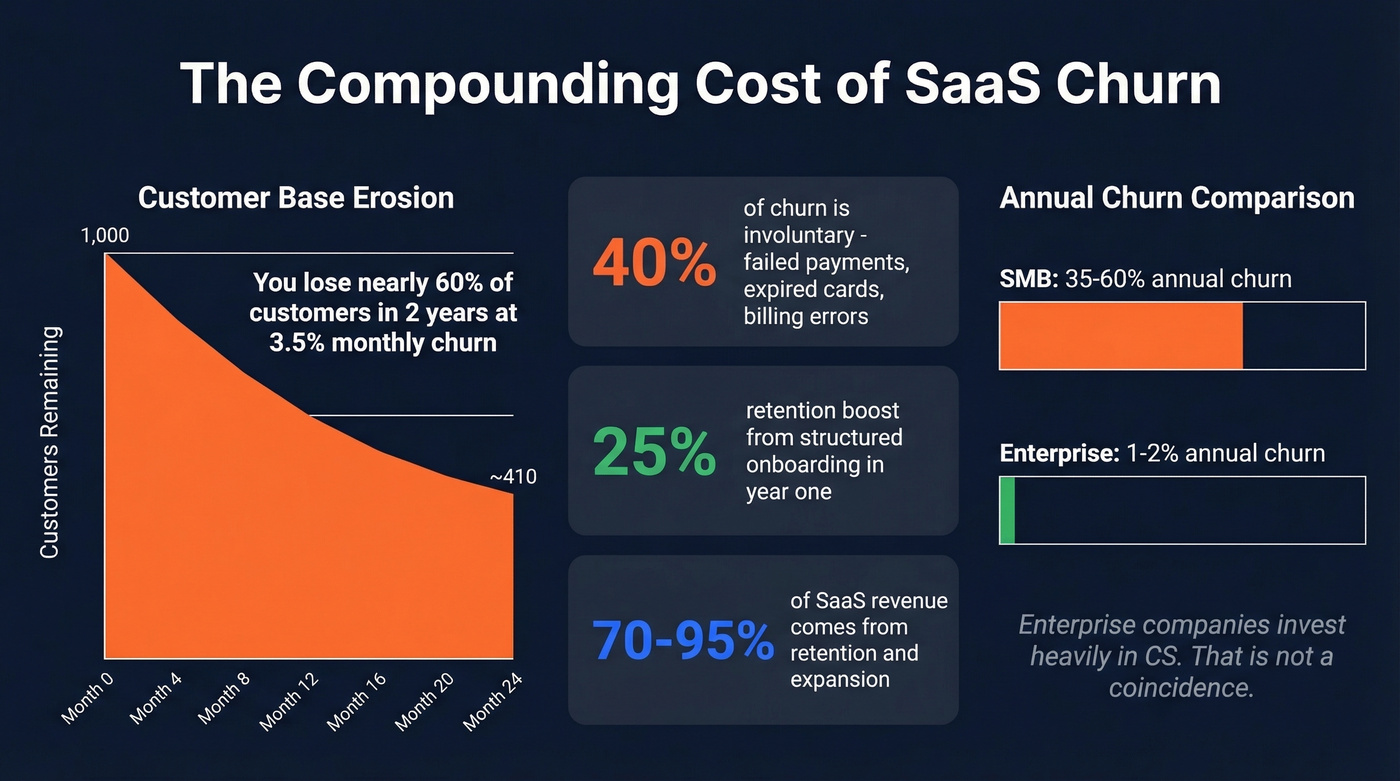
Average B2B SaaS churn runs 3.5% monthly - roughly 35% annual churn. For SMB-focused products, it's worse: 3-7% monthly, which can mean losing more than half your customer base every year. Enterprise churn is dramatically lower at 1-2% annually, and enterprise companies tend to invest heavily in CS. That's not a coincidence.
The compounding effect is brutal. Lose 3.5% of customers this month, and next month you're losing 3.5% of a smaller base. Meanwhile, your CAC stays the same or goes up. Within two years, a SaaS company with unaddressed churn is spending more to acquire customers than it retains in revenue.
One stat that surprised us: involuntary churn accounts for up to 40% of total churn. That's payment failures, expired cards, and billing errors - not dissatisfied customers. A meaningful chunk of your "churn problem" might be a dunning problem.
On the flip side, structured onboarding boosts first-year retention by 25%. That's not marginal. It's the difference between a company that compounds growth and one that plateaus. Every percentage point of churn you prevent drops straight to the bottom line, and the link between retention and revenue growth is direct: retain more customers, expand more accounts, and the topline compounds.
CS vs Support vs Account Management
These three functions get conflated constantly, and the confusion creates org-chart problems that take quarters to untangle.
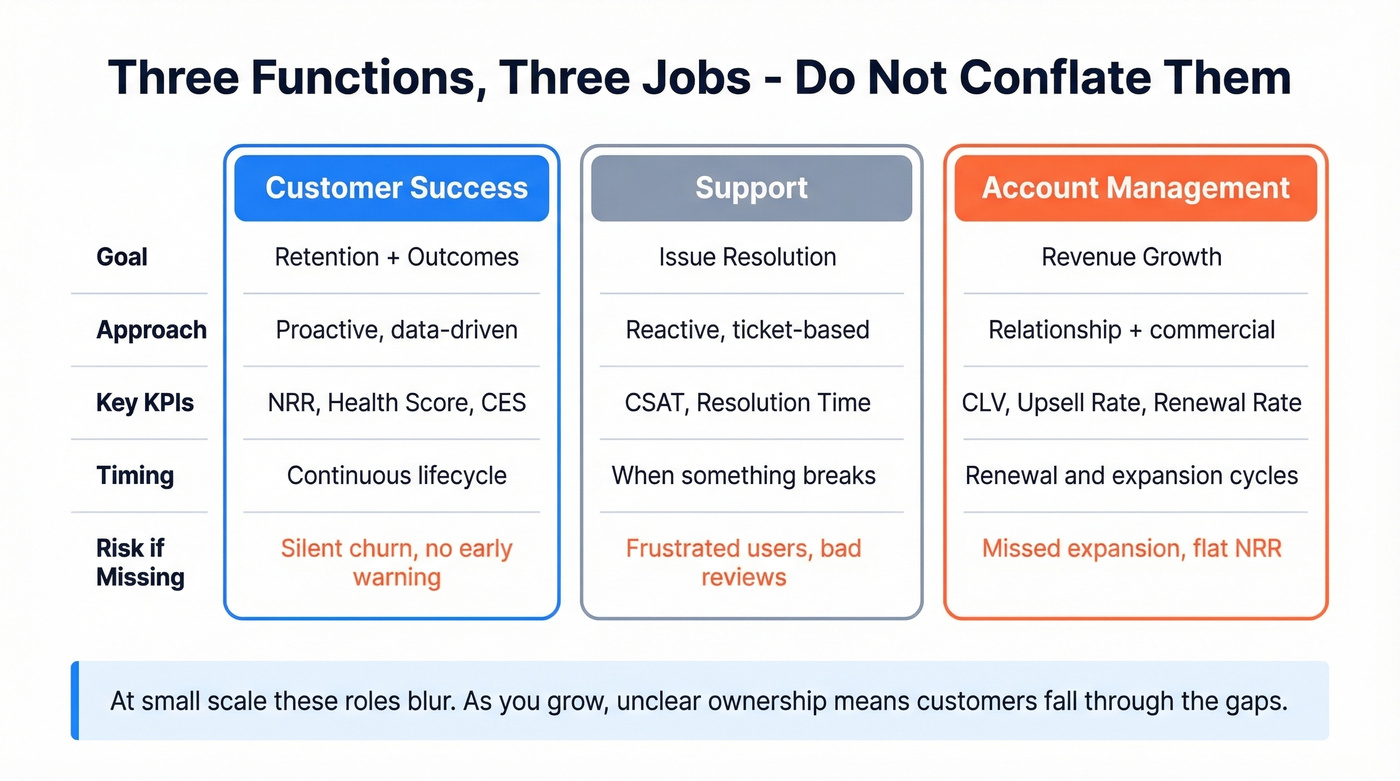
| Customer Success | Support | Account Management | |
|---|---|---|---|
| Goal | Retention + outcomes | Issue resolution | Revenue growth |
| Approach | Proactive, data-driven | Reactive, ticket-based | Relationship + commercial |
| Key KPIs | NRR, health score, CES | CSAT, resolution time | CLV, upsell rate, renewal rate |
| Tooling | CS platforms, analytics | Helpdesk, ticketing | CRM, sales enablement |
In early-stage SaaS, these lines blur. That's fine at small scale. But as your customer base grows, the lack of clear ownership creates gaps - and customers fall through them. The CSM thinks the AM is handling the renewal. The AM thinks the CSM flagged the risk. Nobody did. We've seen this exact scenario play out at three different companies we've worked with, and it always ends the same way: a surprised churned account and a painful post-mortem.
Core Responsibilities
Customer success breaks down into six pillars that follow the customer lifecycle:
Onboarding gets the customer to first value as fast as possible. This is where most churn seeds are planted. Adoption drives deeper usage across features and users - a customer using one feature is fragile, but a customer using five is sticky. Retention means monitoring health signals, intervening early, and ensuring the renewal is a non-event rather than a negotiation.
Expansion is where CS as a revenue driver becomes most visible. Your team identifies accounts with growth potential via usage patterns and trigger points like seat limits, feature gating, or usage thresholds. The best CS teams make the upgrade feel like the natural next step, not a sales pitch. A useful heuristic: CS-led expansion should capture 10-15% of the value your product delivers to the customer. Price above that, and the renewal gets harder every cycle.
Advocacy turns successful customers into references, case studies, and referral sources. And offboarding - often overlooked - makes departures graceful. Offer downgrade paths, ensure data export, and leave the door open. Customers who leave well come back. They definitely talk, too.
Expansion isn't a separate motion from retention. It's the outcome of retention done well.

Retention starts before the sale. If your CS team inherits bad contact data, onboarding stalls, stakeholders go dark, and churn seeds get planted on day one. Prospeo gives your team 98% accurate emails and verified direct dials across 300M+ profiles - so every kickoff call, QBR invite, and expansion outreach actually lands.
Stop losing customers because you couldn't reach the right stakeholders.
The First 90 Days: Onboarding Framework
For most B2B SaaS products, the customer's first 90 days determine whether they stay. The accounts that churn at month six were already disengaged by week three. The renewal conversation is just the autopsy.
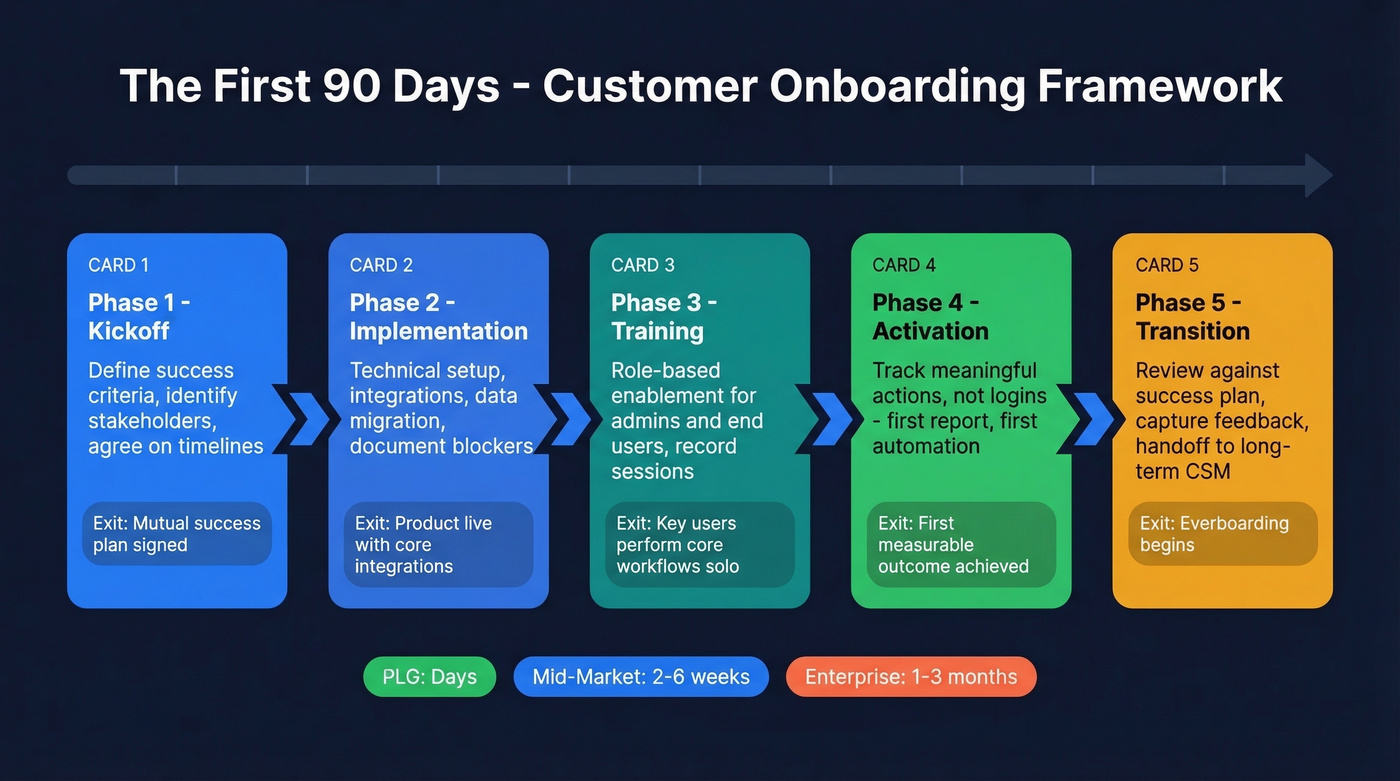
Phase 1 - Kickoff: Define what success looks like for this specific customer. Identify stakeholders, agree on timelines, and document the outcomes they're paying for. Exit criteria: mutual success plan signed off.
Phase 2 - Implementation: Technical setup, integrations, data migration. Document every blocker. Exit criteria: product is live with core integrations working.
Phase 3 - Training: Role-based enablement - an admin needs different training than an end user. Record every session for async reference. Exit criteria: key users can perform core workflows independently.
Phases 4 and 5 blend together in practice. Activation is the moment that matters most: track meaningful actions, not logins. Did they build their first report? Run their first automation? Exit criteria: the customer has achieved their first measurable outcome. Then the Transition - a formal review against the success plan, feedback capture, and handoff to the long-term CSM relationship. This isn't the end of enablement; it's the start of "everboarding," where you continuously surface new features and use cases as the customer matures.
Time-to-value varies by segment. PLG products should hit activation in days. Mid-market tools typically take 2-6 weeks. Enterprise platforms can run 1-3 months.
Metrics and Benchmarks for 2026
Net Revenue Retention
NRR is the single most important metric in SaaS. It tells you whether your existing customers are spending more or less over time.
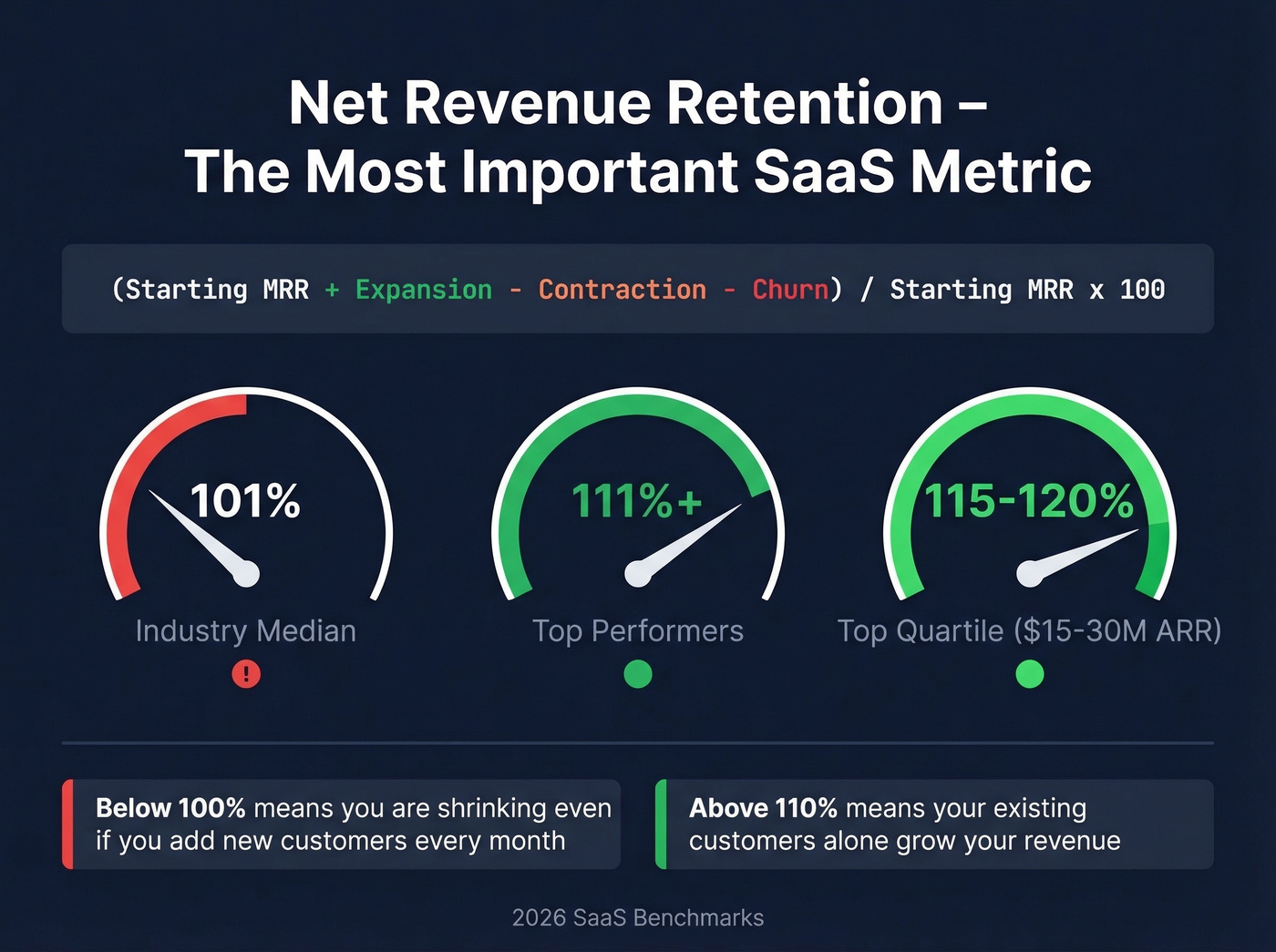
Formula: (Starting MRR + Expansion - Contraction - Churn) / Starting MRR x 100
Median NRR has compressed to 101% across the industry. Top performers maintain 111%+, and top-quartile companies in the $15-30M ARR range hit 115-120%. Below 100% means you're shrinking - even if you're adding new customers every month.
Gross Revenue Retention by Segment
| Segment | GRR Benchmark |
|---|---|
| SMB | 75-85% |
| Enterprise | 85-92% |
| Systems of record | 95%+ |
Churn and Retention Formulas
Churn Rate: (Customers at Start - Customers at End) / Customers at Start x 100
Retention Rate: (Customers at End - New Customers) / Customers at Start x 100
CAC Payback by ACV Band
| ACV | Median CAC Payback |
|---|---|
| Under $5K | 8 months |
| $5K-$25K | 14-18 months |
| $25K-$50K | 22 months |
| Over $50K | 24 months |
If your payback is longer than your average customer lifetime, you're losing money on every deal. Full stop.
Health Scores
The DEAR framework gives you a structured approach: Deployment (is the product fully implemented?), Engagement (are stakeholders active?), Adoption (are they using core features?), ROI (can they quantify the value?). A customer scoring low on any dimension is at risk - even if they seem happy on calls.
CS Economics: From Cost Center to Profit Center
CS is an investment, not a cost center. But you need to size it correctly or you'll either underserve customers or burn cash.
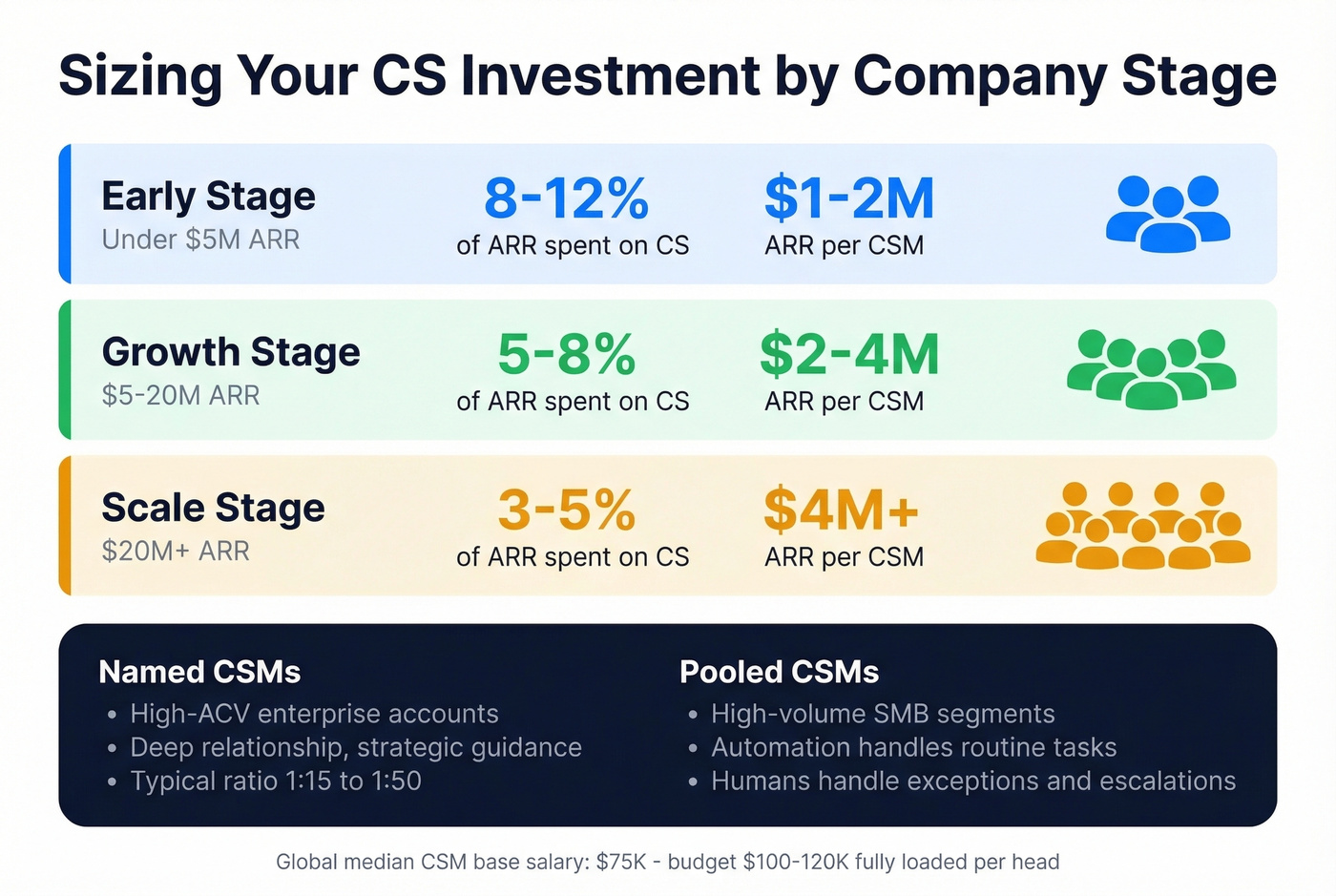
| Company Stage | CS Spend (% of ARR) | ARR per CSM |
|---|---|---|
| Early (under $5M) | 8-12% | $1-2M |
| Growth ($5-20M) | 5-8% | $2-4M |
| Scale ($20M+) | 3-5% | $4M+ |
The global median baseline salary for a CSM is $75K. With benefits, tools, and management overhead, budget $100-120K fully loaded per head.
Two models dominate: named CSMs for high-ACV enterprise accounts and pooled CSMs for high-volume segments where automation handles the routine and humans handle exceptions. The best-run teams tie compensation and targets directly to net revenue retention and expansion revenue, which is what turns CS from a cost line into a profit center on the P&L.
Tools and Platforms
CS Platforms
| Platform | Starting Price | Best For |
|---|---|---|
| Gainsight | ~$25K+/yr | Enterprise, $20M+ ARR |
| ChurnZero | ~$1,500/mo | Mid-market, $5-20M ARR |
| Planhat | ~$1,000/mo | Mid-market, flexible |
| Vitally | ~$499/mo | Growth-stage startups |
| Totango | ~$249/mo (2 users) | Budget-conscious teams |
| Custify | ~$399+/mo | SMB-focused CS teams |
In our experience, under $5M ARR, start with Vitally or Totango. Between $5-20M, ChurnZero earns its price. Above $20M, Gainsight is the industry standard, but expect a real implementation project.
Beyond CS platforms, you'll need a CRM (Salesforce or HubSpot), support tooling (Zendesk or Intercom), and onboarding tools like Userflow or GuideCX depending on your product complexity.
The Data Quality Layer
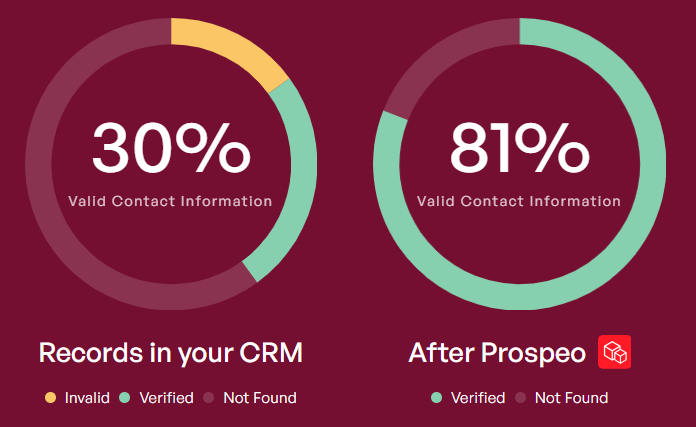
Every CS platform is only as good as the data feeding it. If your contact records are stale, your CSMs are emailing people who left the company six months ago. We've watched teams run entire QBR cycles targeting the wrong stakeholders because nobody updated the CRM after a reorg.
Prospeo keeps CRM records current with 98% email accuracy and a 7-day refresh cycle - compared to the 6-week industry average - so your team always has the right contacts and org context. It integrates natively with Salesforce and HubSpot, running enrichment automatically.
Common Mistakes
Five anti-patterns that kill CS functions before they mature:
CS as the catch-all. When CS owns onboarding, support escalations, billing questions, product feedback, and renewals, burnout follows. 77% of employees report experiencing burnout, and CS teams that own everything are prime candidates. Draw boundaries early.
Too many KPIs too early. Pick three metrics. Nail them. Add complexity later. A CS team tracking 15 dashboards in their first quarter is tracking nothing.
No dedicated CS leader. CS without executive sponsorship gets deprioritized every quarter. Someone needs to own the function at the leadership level - skip this if you want to watch your retention numbers drift sideways for a year.
Confusing CS with support. If your CSMs spend most of their time on reactive tickets, they're doing support with a fancier title. The wrong hire for this role costs roughly $240K when you factor in recruiting, ramp, and lost accounts.
Stale CRM data. Your CS team's effectiveness has a hard ceiling set by your data quality. No amount of process or tooling fixes a contact database full of ghosts.
AI in Customer Success: What's Changing
The CS role is shifting from relationship manager to what TSIA calls the "value manager" - someone with commercial confidence, data literacy, and outcome ownership. By the end of 2026, the average CSM will have 25-50% more bandwidth as AI takes over repeatable work: role mapping, drafting outreach, surfacing "next best action" recommendations, and analyzing calls for expansion signals.
The results are already showing up. QBR automation drives a 22% increase in renewal rates and lets CS teams touch 67% more accounts with the same headcount. That's not incremental - it's a structural change in how CS operates.
Here's the thing: if your average contract value sits below $10K, you probably don't need a dedicated CSM per account. AI-powered playbooks and in-app nudges will handle 80% of the work. Save your human CSMs for the accounts where relationship depth actually moves the needle. The consensus on r/CustomerSuccess threads backs this up - teams that over-index on high-touch for low-ACV accounts burn out fast and don't see the retention lift to justify it.
CS-led expansion only works when your team can identify and reach new stakeholders inside growing accounts. Prospeo's 30+ search filters - including headcount growth, department size, and buyer intent signals across 15,000 topics - let your CSMs spot expansion triggers and connect with decision-makers before the competition does.
Turn retention into revenue with data that maps entire buying committees.
FAQ
What's the difference between customer success and customer experience?
CX covers every interaction a customer has with your company - marketing, sales, product, and support. CS is the proactive function within CX focused specifically on driving outcomes and retention. Think of CX as the strategy and CS as the team executing a critical piece of it.
When should a SaaS company hire its first CSM?
Around $1-2M ARR or 20+ paying accounts - whichever comes first. Jason Lemkin's advice to make it a "single-digit hire" still holds. Before that threshold, founders can handle CS motions directly using a CRM and a simple health-score spreadsheet.
What's a good NRR for a SaaS company in 2026?
Median NRR is 101%. Top performers hit 111%+, and top-quartile companies in the $15-30M ARR range reach 115-120%. Below 100% means your existing base is shrinking - you're on a treadmill that speeds up every quarter.
How does data quality affect customer success outcomes?
Bad data leads to misaligned outreach, missed stakeholders, and higher churn. If your CRM is full of outdated contacts, CSMs waste hours chasing people who've changed roles. A 7-day data refresh cycle with 98% email accuracy gives CS teams a reliable foundation for every engagement - that's the standard we hold ourselves to at Prospeo.
Why is B2B customer success different from B2C?
B2B involves longer sales cycles, multiple stakeholders, and higher contract values - so the cost of churn per account is significantly greater. B2B CS teams manage fewer accounts with deeper engagement, focusing on business outcomes like ROI and workflow efficiency rather than individual user satisfaction alone.