

What Is Lead Acquisition? Definition, Process, and Benchmarks
Your marketing team generated 500 leads last month. Sales accepted 47. The other 453 sat in a spreadsheet - unscored, unnurtured, and eventually forgotten. That's not a lead generation problem. It's a lead acquisition problem, and it's costing you pipeline every single week.
So what is lead acquisition, exactly, and how do you fix the gap between "we got a lead" and "sales has a deal"?
The Short Version
Lead acquisition is the system that turns captured leads into revenue. Most companies fail because they over-invest in generating leads and under-invest in qualifying, scoring, and nurturing them. You need three things: a clear scoring model, a real nurture sequence, and verified contact data so your outreach actually lands. We're covering all three here - with hard numbers, a scoring template, and a 5-email sequence you can deploy this week.
Lead Acquisition Defined
Lead acquisition is the complete process of capturing, qualifying, scoring, nurturing, and converting leads into sales-ready opportunities. It starts where lead generation ends - after someone raises their hand - and covers everything required to determine whether that hand is worth shaking. That includes real-time validation, deduplication, lead scoring, consent verification, CRM routing, nurture sequences, and performance measurement across every stage.
Lead generation gets people to fill out a form. The acquisition process is what happens next.
Here's the thing: there's no single accepted definition. Some teams use the term interchangeably with lead generation, others define it as the post-capture nurture phase, and a few use it to mean buying leads from third-party vendors. The third definition is the weakest. The most useful framing treats it as the system that connects "we got a lead" to "sales has a qualified opportunity." For this guide, that's the definition we're using. Lead acquisition is the people, processes, scoring models, and tools that turn raw leads into pipeline.
Lead Acquisition vs. Lead Generation vs. Customer Acquisition
These three terms describe different stages of the same funnel. Conflating them is how teams end up optimizing the wrong metric.
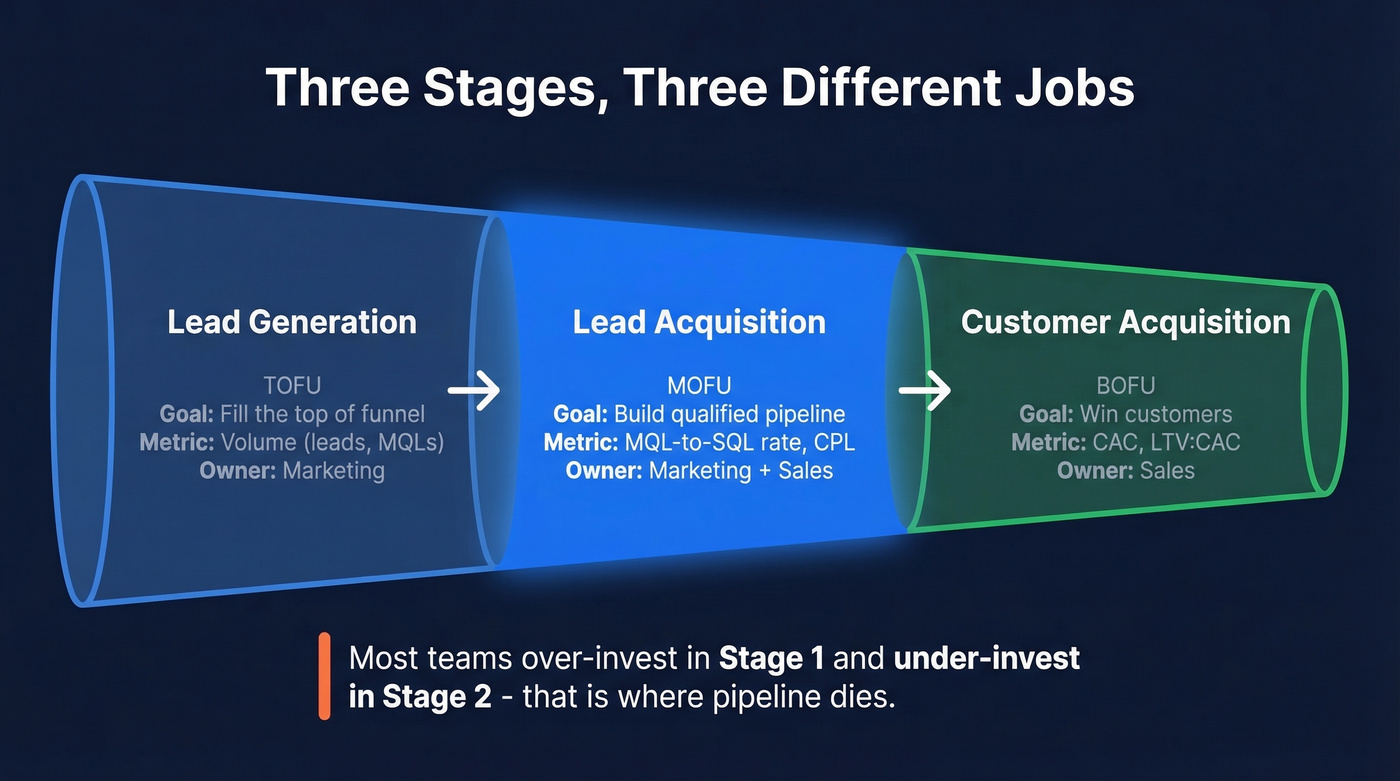
| Lead Generation | Lead Acquisition | Customer Acquisition | |
|---|---|---|---|
| Definition | Attracting interest | Qualifying + converting interest | Closing deals |
| Goal | Fill the top of funnel | Build qualified pipeline | Win customers |
| Funnel stage | TOFU | MOFU | BOFU |
| Key metric | Volume (leads, MQLs) | MQL-to-SQL rate, CPL | CAC, LTV:CAC |
| Ownership | Marketing | Marketing + Sales | Sales |
| Example tech | Ads, SEO, webinars | Scoring, nurture, CRM | CRM, proposals, CPQ |
Lead generation creates interest. Lead acquisition converts it. Customer acquisition closes it.
Most teams pour budget into generation and wonder why pipeline doesn't follow. The bottleneck is almost always in the middle - the acquisition layer where leads get scored, enriched, and routed to the right rep at the right time.
The Lead Acquisition Process
Remember those 453 dead leads from the intro? Here's where each one could've been saved. Six steps, each with a specific job. Skip any of them and leads die in your CRM.
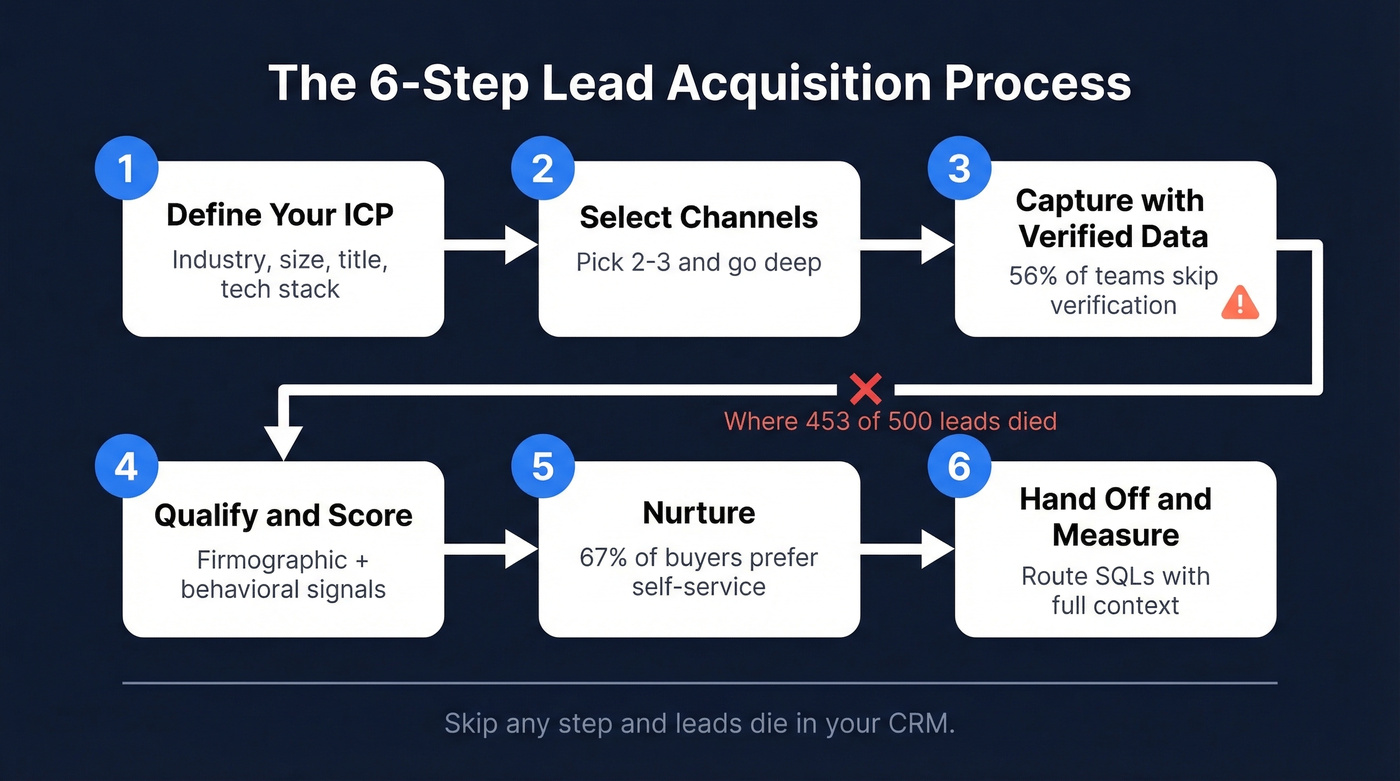
Step 1: Define Your ICP
Before you capture a single lead, nail down who you're actually trying to reach. Industry, company size, job title, tech stack, budget range. If your ICP is "anyone who might buy," your scoring model will be useless and your SDRs will waste hours on unqualified calls.
Step 2: Select Your Channels
Match channels to your ICP. B2B SaaS selling to mid-market? Outbound email, content marketing, and targeted paid campaigns. eCommerce selling to consumers? Social ads and SEO. Don't spread across eight channels - pick two or three and go deep.
Step 3: Capture Leads with Verified Data
This is where most teams introduce bad data into their funnel. Form fills give you whatever the prospect typed. Purchased lists decay fast. Only 56% of marketers verify lead quality before passing leads to sales, which means nearly half of all teams are feeding garbage downstream from day one.
A verified data source changes this entirely. Prospeo lets you build targeted prospect lists from 300M+ professional profiles using 30+ search filters like buyer intent, technographics, and funding - with 98% email accuracy on a 7-day refresh cycle. That means your nurture sequences actually reach inboxes instead of bouncing into the void.

Step 4: Qualify and Score
Not every lead deserves a sales call. Score them based on firmographic fit and behavioral signals (more on this below), then set clear MQL and SQL thresholds so marketing and sales agree on what "qualified" means.
Step 5: Nurture
67% of buyers prefer self-service over speaking to a rep. Your nurture sequence is how you let them self-educate on their terms. Leads that aren't ready to buy today might be ready in three weeks, and a structured email sequence keeps you top of mind without being annoying.
Step 6: Hand Off and Measure
Route SQLs to sales with context: score, engagement history, company intel. Then measure everything. Which channels produce SQLs that actually close? Which scoring criteria predict revenue? Review quarterly and adjust.
Lead Scoring - A Model You Can Use Today
Most scoring models fail because they're either too simple (job title only) or too complex (50 weighted variables nobody maintains). Here's a practical model that balances both.
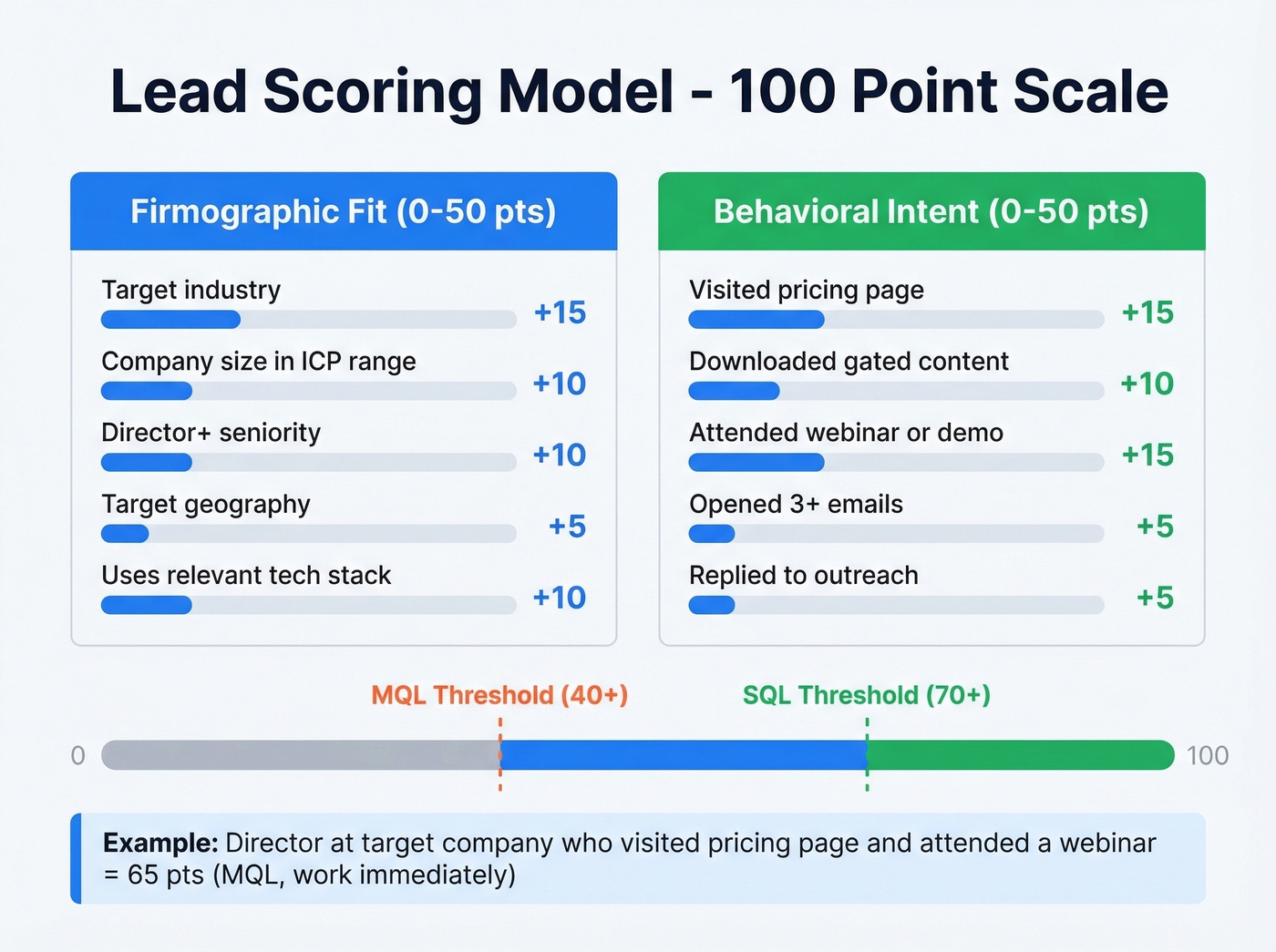
Split your score into two halves: firmographic fit (0-50 points) and behavioral intent (0-50 points).
Firmographic Fit (0-50)
| Criteria | Points |
|---|---|
| Target industry | +15 |
| Company size in ICP range | +10 |
| Director+ seniority | +10 |
| Target geography | +5 |
| Uses relevant tech stack | +10 |
Behavioral Intent (0-50)
| Criteria | Points |
|---|---|
| Visited pricing page | +15 |
| Downloaded gated content | +10 |
| Attended webinar/demo | +15 |
| Opened 3+ emails | +5 |
| Replied to outreach | +5 |
Thresholds: MQL at 40+, SQL at 70+. A director at a target company who visited your pricing page and attended a webinar scores 65 - that's an MQL your SDRs should be working immediately.
On average, only 13% of MQLs convert to SQLs, but top-performing teams hit 25-35%. The difference? A clear scoring model and marketing-sales alignment on what each threshold means. 67% of sales opportunities are lost due to poor lead qualification - not poor lead generation.
Start rule-based. Keep it transparent. Layer AI-assisted scoring after six months, once you have enough conversion data to train on. And review your model quarterly - what predicted revenue in Q1 might not hold in Q3.

Your scoring model is only as good as the data behind it. If 44% of your leads have invalid emails, no nurture sequence will save them. Prospeo gives you 300M+ profiles with 98% email accuracy, refreshed every 7 days - so every MQL your model flags actually reaches a real inbox.
Build your lead acquisition system on data that doesn't decay.
The 5-Email Nurture Sequence
Once a lead scores as an MQL but isn't SQL-ready, they need a nurture sequence - not a generic newsletter blast.
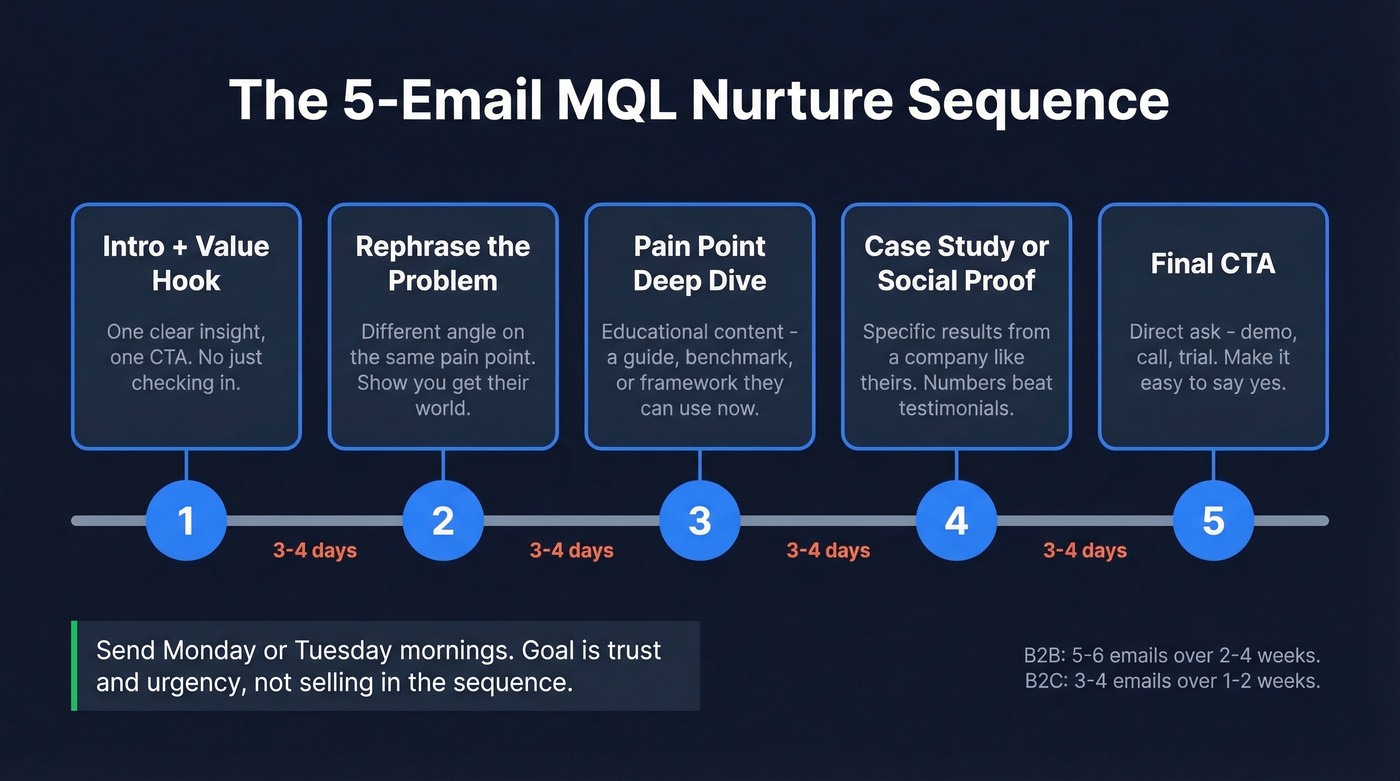
- Intro + value hook - Establish relevance. One clear insight, one CTA. No "just checking in."
- Rephrase the problem - Different angle on the same pain point. Show you understand their world.
- Pain point deep dive - Educational content. Link to a guide, benchmark, or framework they can use immediately.
- Case study / social proof - A specific result from a company like theirs. Numbers beat testimonials every time.
- Final CTA - Direct ask. Demo, call, trial. Make it easy to say yes.
Space follow-ups every 3-4 days over 2-4 weeks. Send early in the week - Monday or Tuesday mornings. The goal isn't to sell in the sequence. It's to build enough trust and urgency that the prospect self-selects into a conversation.
B2B vs. B2C: Adjust Accordingly
| B2B | B2C | |
|---|---|---|
| Tone | Educational, problem-solution | Promotional, offer-driven |
| Length | 5-6 emails | 3-4 emails |
| Cadence | 2-4 weeks | 1-2 weeks |
| Content | Guides, benchmarks, case studies | Discounts, social proof, urgency |
Why Lead Acquisition Fails
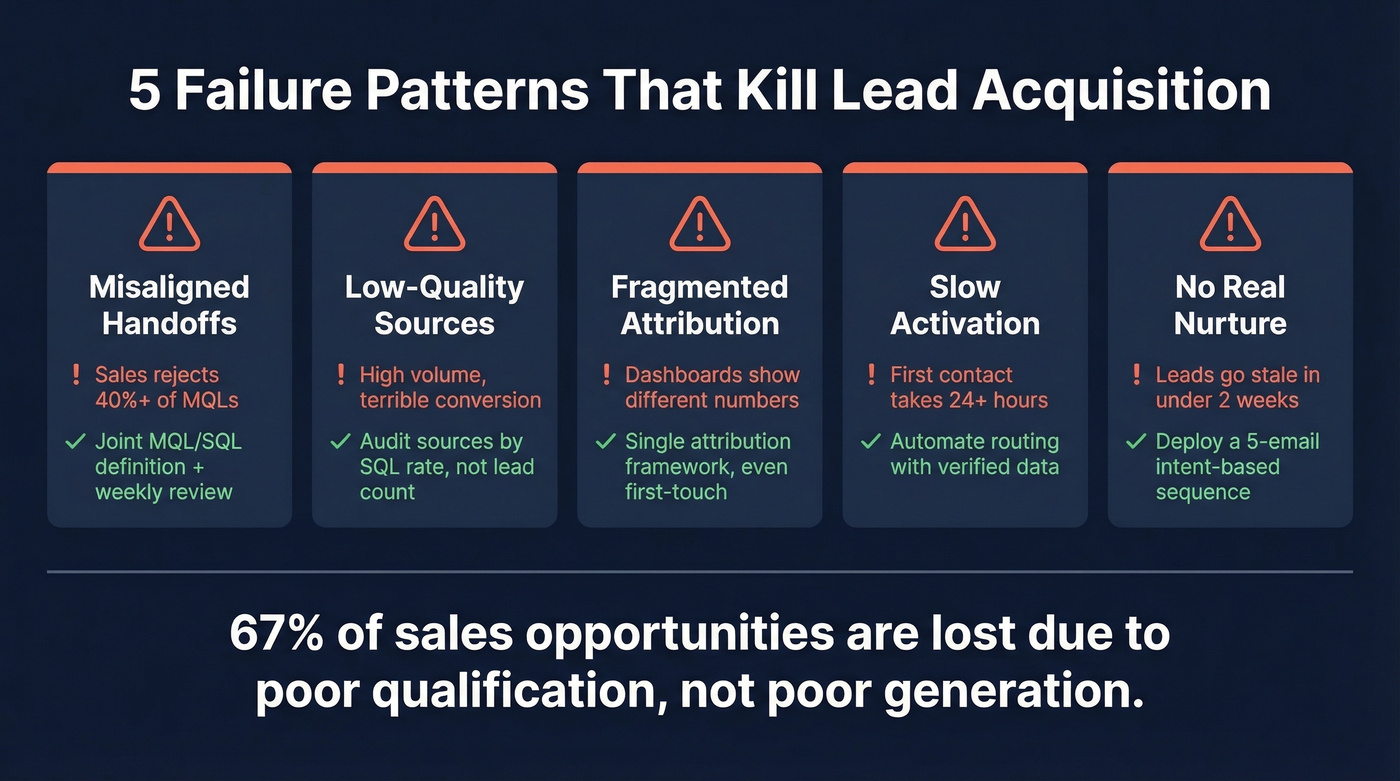
We've seen the same five failure patterns kill acquisition programs across dozens of teams. Let's be honest - most of them are fixable in a week if you know where to look.
Misaligned Marketing-Sales Handoffs
Warning signal: Sales rejects more than 40% of MQLs.
Marketing and sales don't agree on what "qualified" means. There's no shared scoring model, no SLA on follow-up timing, and no feedback loop. Fix this with a joint MQL/SQL definition and a weekly pipeline review. If your sales team is ignoring MQLs entirely, skip the scoring refinements and start with a 30-minute alignment meeting - that alone will move the needle more than any tool purchase.
Low-Quality Placements Inflating Volume
Warning signal: High top-of-funnel metrics, terrible downstream conversion.
Your content syndication partner is delivering leads that look great on a spreadsheet but have zero buying intent. Volume isn't value. Audit your sources by SQL conversion rate, not lead count.
Fragmented Attribution
Warning signal: Marketing and sales dashboards show different numbers for the same metric.
Your CRM, marketing automation, and intent tools don't connect. You can't trace a closed deal back to its original source. Without a single attribution framework - even a simple first-touch/last-touch model in GA4 - you're optimizing blind. And if you're relying solely on client-side tracking, ad blockers and cookie restrictions are silently eating your conversion data. Server-side tracking closes that gap.
Slow Lead Activation
Warning signal: Average time from lead capture to first SDR contact exceeds 24 hours.
200 webinar registrants. Three weeks later, your SDR team has contacted 30. By then, competitors have already reached out. Manual routing, bad contact data, and SDR overwhelm all contribute. Bad data compounds every other problem - if 35% of your emails bounce, your nurture sequences never land and your sender reputation tanks.
Snyk cut bounce rates from 35-40% to under 5% after switching to verified contact data and saw AE-sourced pipeline jump 180%.
No Real Nurture After Capture
Warning signal: Leads go from "captured" to "stale" in under two weeks.
You captured the lead, sent one generic email, and moved on. No intent-based follow-up, no segmented sequences, no re-engagement triggers. The 5-email sequence above exists specifically to solve this. The consensus on r/sales is that most reps give up after one or two touches - which means the rep who sends five thoughtful emails is already in the top quartile.
Lead Acquisition Benchmarks
Without benchmarks, you're guessing whether your funnel is healthy.
Conversion Rates
The average conversion rate across 14 industries is 2.9%, based on Ruler Analytics' analysis of over 100 million data points - a 1.7% form rate and a 1.2% call rate. Above 3%, you're outperforming most peers. Below 2%, there's a leak somewhere.
Cost Per Lead by Industry
These blended CPL benchmarks come from First Page Sage's 2026 report:
| Industry | Paid CPL | Organic CPL | Blended CPL |
|---|---|---|---|
| B2B SaaS | $310 | $164 | $237 |
| eCommerce | $98 | $83 | $91 |
| Financial Services | $761 | $555 | $653 |
| Cybersecurity | $411 | $404 | $406 |
| Higher Education | $1,261 | $705 | $982 |
| Healthcare | $401 | $320 | $361 |
| Legal Services | $784 | $516 | $649 |
| Real Estate | $480 | $416 | $448 |
Organic CPL is lower than paid in most industries. That's the long-term argument for content and SEO investment - but it takes 6-12 months to compound.
CAC and ROI
Customer acquisition cost = total sales and marketing spend / new customers acquired. Spend $15,000 to acquire 150 customers, and your CAC is $100. B2B SaaS combined average CAC sits at $239 - $205 organic, $341 inorganic.
ROI formula: (Revenue - Marketing Costs) / Marketing Costs x 100%. Spend $5,000, earn $20,000, and your ROI is 300%.
The benchmark that matters most is your LTV:CAC ratio. Below 3:1, you're spending too much to acquire customers relative to their lifetime value. Above 5:1, you're probably under-investing in growth. In our experience, teams that obsess over CPL while ignoring LTV:CAC are optimizing the wrong number entirely.
If your average deal size is under $15K, you probably don't need enterprise-grade data platforms or complex multi-touch attribution. A CRM, verified emails, and a disciplined nurture sequence will outperform a $40K tech stack that nobody fully uses.
Lead Acquisition Tech Stack
You don't need ten tools. For teams building from scratch, start with three: a CRM, a verified data source, and GA4.
| Category | Tools | Price Range |
|---|---|---|
| CRM | HubSpot, Pipedrive, Salesforce | Free tier to ~$150+/user/mo |
| B2B data | Prospeo | ~$0.01/email, free tier available |
| Marketing automation | Mailchimp, ActiveCampaign | From $13/mo |
| Attribution | GA4 | Free |
| Enterprise data | ZoomInfo | $15K-$40K/yr |
For teams that don't need ZoomInfo's full GTM suite - and most don't - a self-serve data tool with native integrations into HubSpot, Salesforce, Lemlist, Instantly, and Clay covers prospecting and verification at a fraction of the cost.
The most expensive tool in your stack isn't the one with the highest sticker price. It's the one feeding bad data into everything downstream. A database that bounces 30% of emails costs you more in burned sender reputation and missed pipeline than an accurate tool at a tenth of the price.
Remember the 453 dead leads from the intro? Most died because nobody could reach them. Prospeo's 30+ search filters - buyer intent, technographics, funding, headcount growth - let you capture pre-qualified leads at $0.01 per email. That's lead acquisition done right: verified contacts, scored and ready for your nurture sequence.
Turn your MQL-to-SQL rate from 13% to the top-performer bracket.
Lead Acquisition FAQ
Is lead acquisition the same as lead generation?
No. Lead generation attracts interest and captures contact information. Lead acquisition is the full process of qualifying, scoring, nurturing, and converting that interest into sales-ready pipeline. Generation fills the funnel; acquisition moves leads through it.
What's a good cost per lead?
B2B SaaS averages $237 blended, eCommerce averages $91, and financial services runs $653 per First Page Sage's 2026 data. Organic CPL is typically lower than paid across most industries. Compare your numbers to your specific vertical's benchmarks rather than chasing a universal "good" number.
How do I calculate customer acquisition cost?
Divide total sales and marketing spend by new customers acquired in the same period. A healthy LTV:CAC ratio is 3:1 - each customer's lifetime value should be at least three times what you spent to acquire them. Below that, your unit economics need work.
What percentage of MQLs become SQLs?
The average is 13%. Top-performing teams hit 25-35% through clear scoring models and tight marketing-sales alignment. Below 10%, your scoring criteria or ICP definition likely needs recalibration.
What's a good free tool for lead acquisition data?
Prospeo offers a free tier with 75 email credits and 100 Chrome extension credits per month - enough to test verified prospecting on real campaigns. HubSpot CRM (free) handles routing and tracking. GA4 (free) covers attribution. That three-tool stack covers the essentials without any upfront spend.