

What Is PitchBook? Everything the Sales Page Won't Tell You
Your first week on the job, someone says "pull the PitchBook data" and you nod like you know what that means. You don't. The confusion is fair - if you're asking what PitchBook is, it's because the word means two completely different things depending on who's talking.
A lowercase pitchbook is a sales presentation document that investment banks use to pitch services to clients. Glossy decks with deal tombstones and comparable transactions. Startups sometimes call theirs a "pitch deck" - same idea, different name.
PitchBook with a capital P is something else entirely: a Morningstar-owned SaaS platform that tracks private capital markets data - VC deals, PE buyouts, M&A activity, fund performance, and more. That's what this article covers.
The Quick Version
Here's the shortcut:
- Need private market research and deal data? PitchBook is the gold standard. Budget $12K-$70K+/year.
- Need startup and company data on a budget? Crunchbase starts at $29/user/month.
If you're here because you need to email or call actual humans at these companies, not analyze their cap tables, you're looking at a different category of tool entirely.
PitchBook Explained
PitchBook is a financial data and research platform focused on private capital markets. John Gabbert founded it in 2007 in Seattle as a way to bring transparency to an opaque corner of finance - venture capital, private equity, and M&A deal flow.
The company grew steadily until Morningstar acquired it in 2016 for $225 million. At the time, PitchBook had $31.1 million in revenue, 300+ employees, and 1,800+ clients. Gabbert remains CEO, and the Morningstar backing gave PitchBook the resources to expand its data operations significantly. Third-party estimates peg annual revenue at roughly $618M across 10,600+ accounts - a sign of just how deeply embedded it's become in institutional finance.
Today, the platform is the default research tool for VC firms, PE shops, corporate development teams, investment banks, and university finance programs. It's not a CRM and it's not a prospecting tool. It's a research terminal for people who need to understand private market dynamics - who's investing, what they're paying, and how deals are structured.
Think of it as Bloomberg for private markets. The pricing isn't far off, either.
Database Coverage
The scale of PitchBook's dataset is its core selling point.
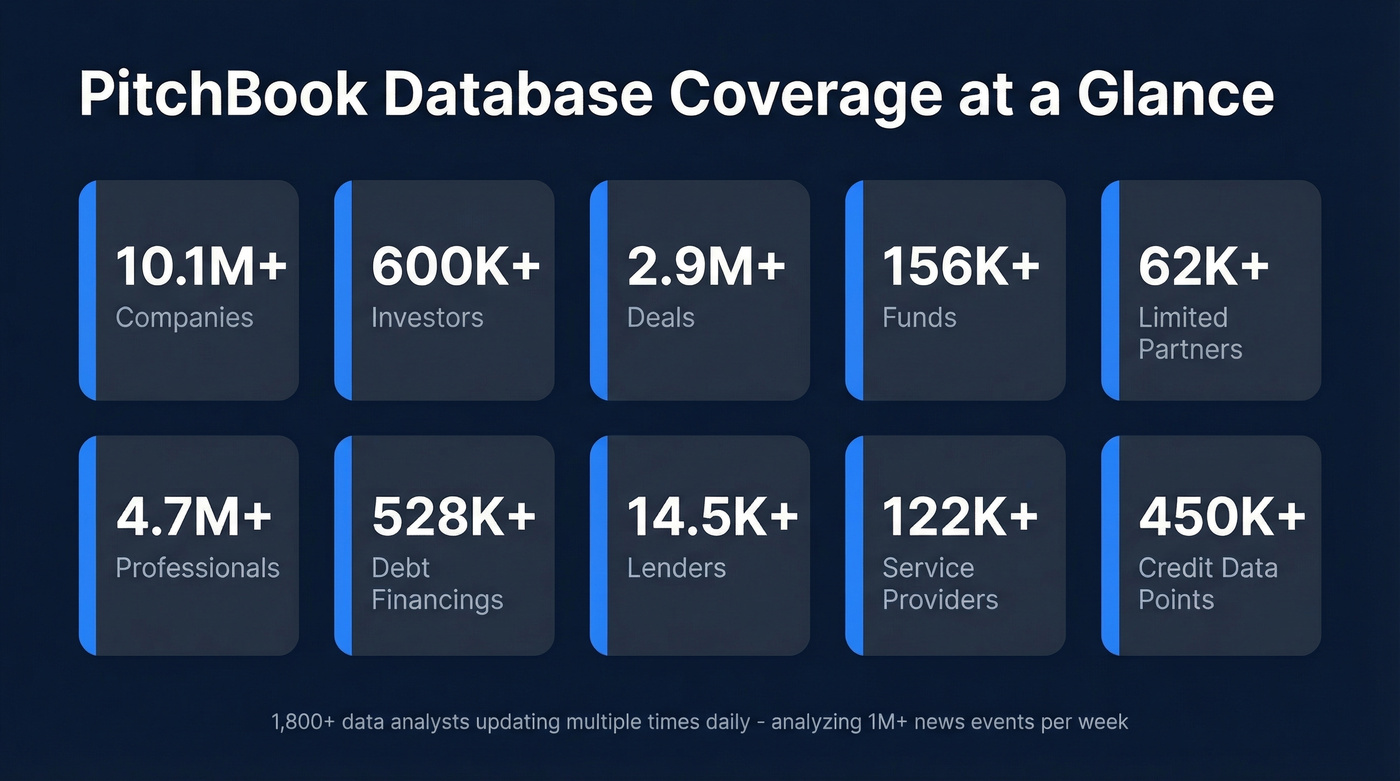
| Data Category | Count |
|---|---|
| Companies | 10.1M+ |
| Investors | 600K+ |
| Deals | 2.9M+ |
| Funds | 156K+ |
| Limited Partners | 62K+ |
| Professionals | 4.7M+ |
| Debt Financings | 528K+ |
| Lenders | 14.5K+ |
| Service Providers | 122K+ |
| Credit Data Points | 450K+ |
Behind those numbers sits a data operations team of 1,800+ professionals who vet, categorize, and analyze information from regulatory filings, survey requests, FOIA responses, and news sources. The platform updates multiple times daily, with the team analyzing over one million news events every week. For institutional investors doing due diligence on fund managers or corporate dev teams mapping acquisition targets, this depth is genuinely hard to replicate anywhere else.

PitchBook tracks 4.7M professionals but caps you at 25 downloads per month. Prospeo gives you 300M+ profiles with verified emails and direct dials - no download limits, no $12K/year commitment, and 98% email accuracy.
Research the deal in PitchBook. Reach the decision-maker with Prospeo.
Key Features and Use Cases
Use PitchBook if you're:
- A VC analyst screening deal flow
- A PE associate benchmarking fund performance
- A corporate development lead mapping M&A targets
- A university researcher studying private market trends
The platform's screening tools come with pre-built screens - Top Seed Investors, PE-Backed Companies, M&As, Recent VC Exits - that get you to useful data fast. The Market Analysis module offers analyst workspaces, market maps, and market size estimates. There's an Excel plugin, a Chrome extension, a mobile app, and a PowerPoint plugin for pulling data directly into deliverables. PitchBook also recently introduced AI Valuation Estimates, which are useful for quick directional reads on private company valuations.
University access is worth checking. Many business programs provide access through library subscriptions. If you're a student, check with your school's business library - it could save you $12K+/year. Institutional subscriptions sometimes exclude modules like Funds Analysis and Morningstar public-market reports, so confirm what your subscription covers.
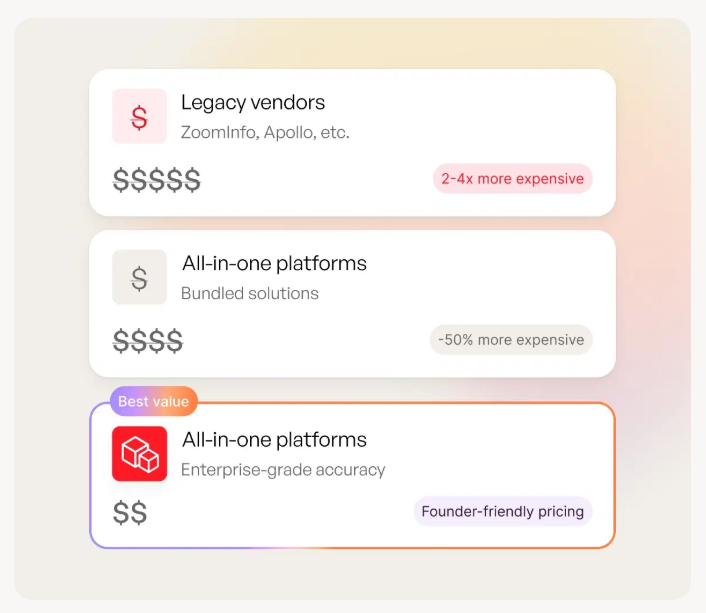
Skip PitchBook if you need contact data for outbound. You're a sales rep who needs verified emails and phone numbers. You're a founder building a prospect list. You're a marketing team running ABM campaigns. The platform has 4.7M+ professional profiles, but strict download limits - typically 10 downloads per day and 25 per month per user - make it useless for outreach at scale.
How Much Does PitchBook Cost?
PitchBook doesn't publish pricing. You have to request a trial, get contacted by an SDR, and sit through a sales call before you see a number. That alone tells you it's built for enterprise procurement, not self-serve buyers.
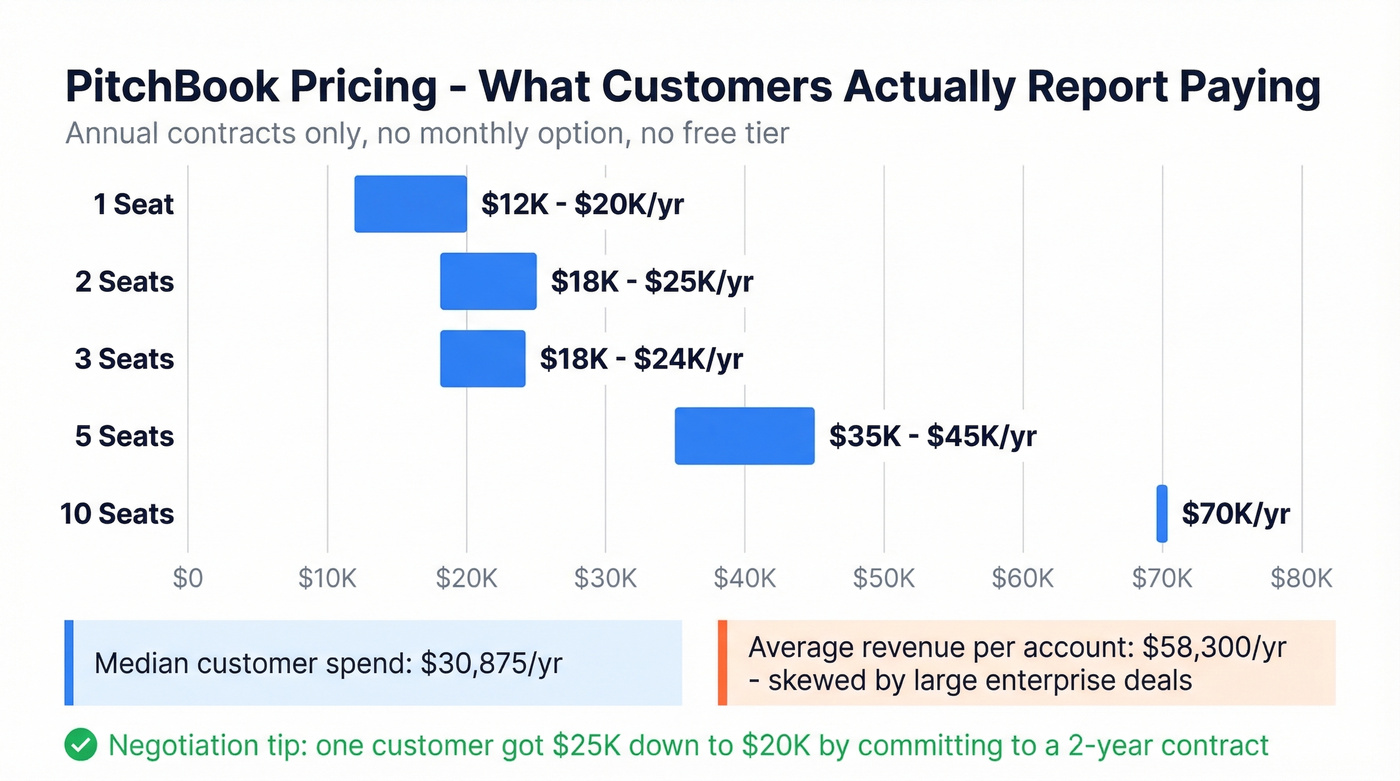
Customer-reported pricing gives us a clear picture:
| Team Size | Annual Cost Range |
|---|---|
| 1 seat | $12K-$20K/yr |
| 2 seats | ~$18K-$25K/yr |
| 3 seats | $18K-$24K/yr |
| 5 seats | $35K-$45K/yr |
| 10 seats | ~$70K/yr |
The median customer spends roughly $30,875/year, but the average revenue per account is closer to $58,300 - which shows how much the distribution skews toward large enterprise deals. One customer reported a $7K/seat rate with a 5-seat minimum, implying a $35K floor for small teams.
PitchBook offers three subscription tiers - Sole Practitioner, Standard, and Enterprise - plus an API access option. Only annual licenses are available. No monthly option. No free tier (trial only). There's room to negotiate: one customer reported getting a $25K quote down to $20K by committing to a two-year contract.
Add-ons can push costs higher. Features like the VC Exit Predictor or Morningstar Equity Research Access come at extra cost on some plans.
Here's the thing: if your average deal size is under $25K and you're not in finance, you almost certainly don't need PitchBook. The platform is built for people who make investment decisions measured in millions. For everyone else, the alternatives below will get you 80% of the value at 10% of the cost.
What Users Actually Think
PitchBook carries a 4.5/5 rating on G2 from 224 reviews, which is strong for enterprise software at this price point.
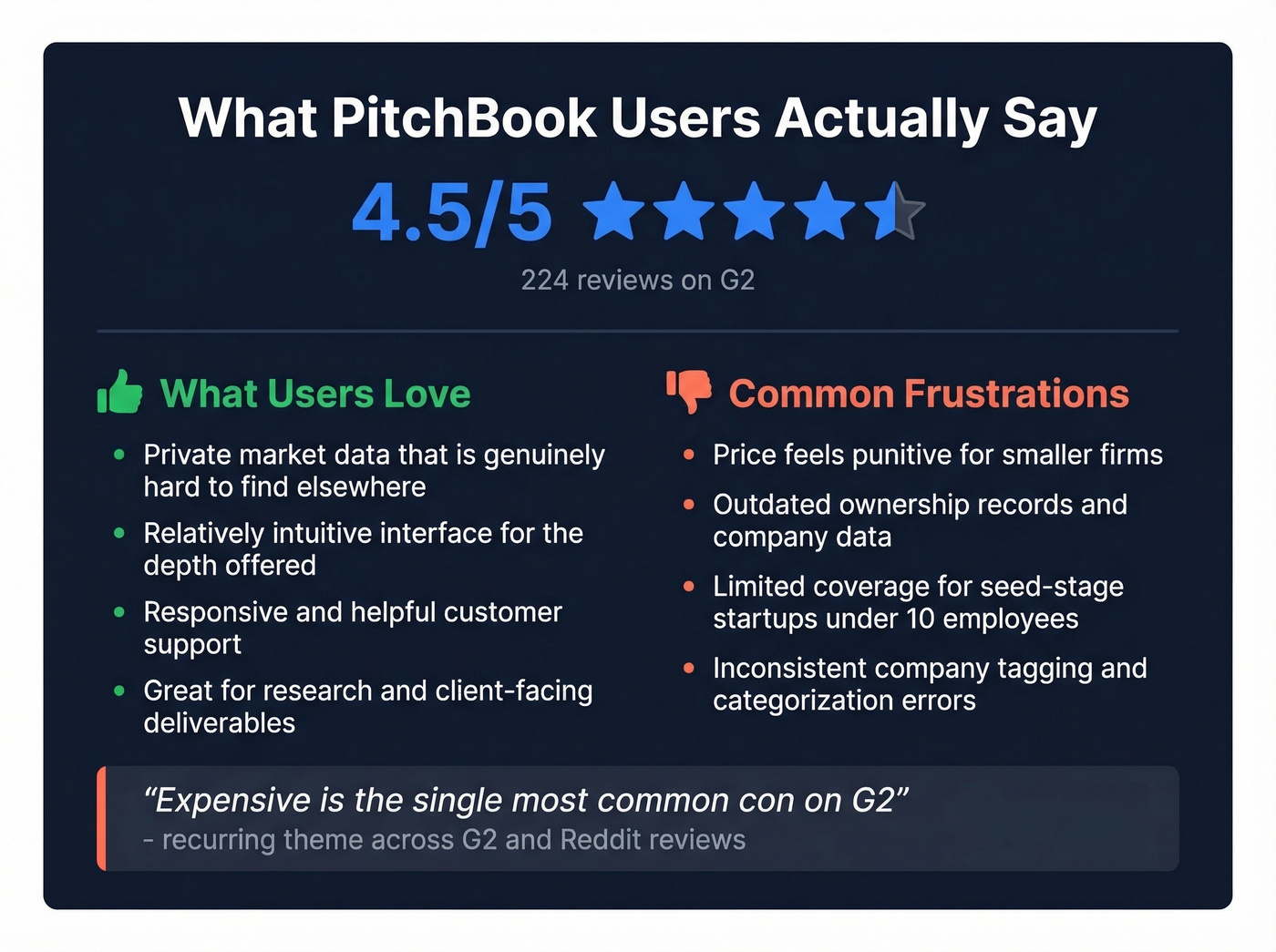
What users love:
- Private market data that's genuinely hard to find elsewhere
- Relatively intuitive interface given the platform's depth
- Responsive customer support, consistently cited as a top pro
- Useful for both research and client-facing deliverables
At $12K+ per seat, users expect perfection - and they don't always get it.
What frustrates them:
"Expensive" is the single most common con on G2. A startup founder on r/startups put it bluntly: they couldn't justify ~$20K for one-off fundraising list building. We've seen similar complaints across Reddit - the consensus on r/venturecapital is that the platform is excellent but the pricing model feels punitive for smaller firms. Users there have flagged specific issues with fund cashflow data, including cumulative contributions that decrease year-over-year and negative NAV values that don't make sense. Support wasn't particularly helpful in explaining those discrepancies.
Other recurring complaints: outdated ownership records (one reviewer noted a company's previous owner was still listed years after an acquisition), limited coverage for seed-stage startups with fewer than 10 employees, and inconsistent company tagging that leads to categorization errors in screeners.
The pattern is clear. PitchBook is excellent for institutional private market research but frustrating when you try to stretch it beyond that.
PitchBook Alternatives Worth Considering
PitchBook isn't the right fit for every team or budget. Here's how the alternatives stack up:
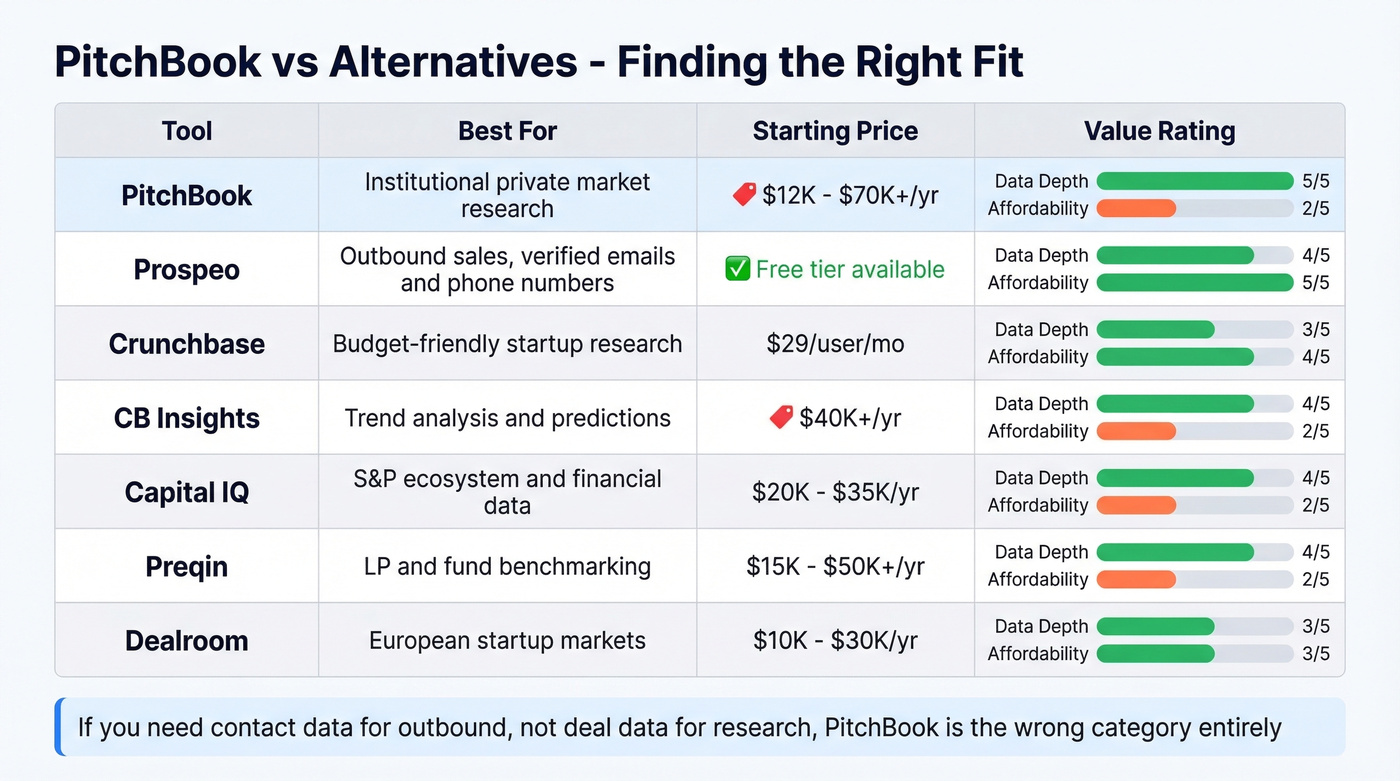
| Tool | Focus Area | Starting Price | Best For |
|---|---|---|---|
| PitchBook | Private markets | $12K-$70K+/yr | Institutional research |
| Prospeo | Contact data | Free tier | Outbound, emails, dials |
| Crunchbase | Startup data | $29/user/mo | Budget-friendly research |
| CB Insights | Market intel | ~$40K+/yr | Trend analysis, predictions |
| Capital IQ | Financial data | ~$20K-$35K/yr | S&P ecosystem users |
| Preqin | LP/fund data | ~$15K-$50K+/yr | Fund benchmarking |
| Dealroom | Startup data | ~$10K-$30K/yr | European markets |
Prospeo
Many teams search for PitchBook because they need "data" - but what they actually mean is contact data for outreach. If that's you, a private markets research terminal is the wrong tool entirely.

Prospeo covers 300M+ professional profiles with 143M+ verified emails and 125M+ verified mobile numbers, all on a 7-day data refresh cycle. The search interface offers 30+ filters including buyer intent via Bombora (15,000 topics), technographics, job change signals, headcount growth, and funding data. You can build a targeted list of VP-level buyers at Series B SaaS companies showing purchase intent for your category - and export verified contact data in minutes.
Email accuracy runs 98%, which matters enormously for deliverability. We've seen teams cut bounce rates from 35%+ down to under 4% after switching. The Chrome extension (40K+ users) pulls verified contact data from any website in one click. Everything is self-serve: no contracts, no sales calls, no annual commitments. The free tier gives you 75 emails and 100 Chrome extension credits per month, and paid plans work out to roughly $0.01 per email.
Crunchbase
Crunchbase is the most accessible alternative for startup and company research. At $29/user/month for Starter and $49/user/month for Pro, it's a fraction of PitchBook's cost. The platform covers funding rounds, company profiles, key people, and news - solid for tracking the startup ecosystem.

Where Crunchbase falls short: depth on PE/LP data, fund performance benchmarking, and detailed deal terms. If you need a fund's IRR or a deal's enterprise value multiple, Crunchbase won't get you there. But for teams that need "good enough" company intelligence without a five-figure annual commitment, it's the obvious starting point.
CB Insights
CB Insights plays in a different lane - market intelligence and predictive analytics layered on top of deal data. The platform excels at trend reports, industry analysis, and competitive mapping. It's less about raw deal data and more about understanding where a market is headed.
Pricing starts around $40K+/year, putting it in PitchBook's range. For pure deal sourcing, PitchBook is stronger. CB Insights earns its keep on the intelligence and trend analysis side - strategy teams and corporate innovation groups get the most value here.
Capital IQ
S&P Global's financial data terminal runs $20K-$35K/year per seat. Best for teams already embedded in the S&P ecosystem who need both public and private market data in one interface. Stronger than PitchBook on public company financials; weaker on private market depth. If you're already paying for S&P data, adding Capital IQ is a natural extension. If you're not, PitchBook is the better standalone choice for private markets.
Preqin
LP-focused and fund performance-centric, Preqin costs $15K-$50K+/year depending on modules. When your primary use case is benchmarking fund returns and fundraising data, Preqin competes directly with PitchBook's fund analytics. Some LP teams actually prefer Preqin's fund-level granularity - it's worth running a head-to-head trial if fund benchmarking is your core workflow.
Dealroom
European market strength is Dealroom's calling card. Custom pricing typically runs $10K-$30K/year. For deal sourcing or research focused on European startup ecosystems, Dealroom's coverage there often beats PitchBook's. Less useful for US-centric teams, but for pan-European VC and corporate development work, it's the better primary tool.
If you're spending $12K-$70K/year on PitchBook for outbound prospecting, you're using a Bloomberg terminal to send cold emails. Prospeo delivers verified emails at $0.01 each, 125M+ mobile numbers, and 30+ filters - built for sales teams, not analysts.
Stop overpaying for data you can't actually use for outreach.
FAQ
Is PitchBook free?
No. PitchBook offers a free trial but no permanent free tier. Annual licenses start around $12,000/year for a single seat. University students can often access it through their institution's library subscription - check with your school's business library before paying out of pocket.
Who owns PitchBook?
Morningstar acquired PitchBook in 2016 for $225 million. John Gabbert founded the company in 2007 and remains CEO. Headquarters are in Seattle, with offices in New York and London.
What's the difference between PitchBook and Crunchbase?
PitchBook delivers institutional-grade private market data - PE, VC, M&A, LP/fund performance - starting at $12K+/year. Crunchbase covers startup and company data at $29-$49/user/month. PitchBook is deeper and more granular; Crunchbase is dramatically cheaper and more accessible for general company research.
Can I use PitchBook to find email addresses?
PitchBook includes some contact data for 4.7M+ professionals, but strict download limits (typically 10/day, 25/month) make it impractical for outbound. Prospeo is purpose-built for this - 143M+ verified emails at 98% accuracy, with a free tier and no download caps.
What is a "pitchbook" in investment banking?
A lowercase "pitchbook" is a sales presentation document used by investment banks to pitch services to potential clients. It includes deal tombstones, comparable transactions, and the firm's credentials - completely unrelated to PitchBook (capital P), the Morningstar-owned data platform.