

ZenRows Pricing, Reviews, Pros & Cons for 2026
You sign up for ZenRows, see "250,000 results" on the Developer plan, and think you're set. Then reality hits: the sites you actually need to scrape require JS rendering and premium proxies, and that 250K shrinks to 10,000 usable requests. The ×25 multiplier changes the math entirely.
We've spent time digging through ZenRows' docs, independent benchmarks, and real user reviews so you don't have to reverse-engineer the billing yourself. Here's what we found.
30-Second Verdict
ZenRows is a capable scraping API with clean docs and a simple SDK. But its credit multiplier system means the sticker price and the real price are often very different numbers. Independent benchmarks show a 54% average success rate - below the industry average of 58.2%. It works best for teams scraping known, unprotected targets where basic credits go further. If your actual goal is B2B contact data - verified emails, phone numbers, job titles - skip scraping APIs entirely and use a purpose-built database like Prospeo instead.
What ZenRows Does
ZenRows is a web scraping API that handles proxy rotation, CAPTCHA solving, anti-bot bypass, and JavaScript rendering behind a single endpoint. You send a URL, it returns the page content as HTML, JSON, or Markdown. The platform runs 55M+ residential IPs and supports Puppeteer/Playwright via its Scraping Browser product.
The pitch is straightforward: stop managing proxy infrastructure yourself and let ZenRows deal with Cloudflare, DataDome, and the rest.
Pricing - The Real Math
ZenRows' pricing page shows clean numbers. The docs tell a more complicated story.
Plan Tiers
| Plan | Monthly Price | Basic Results | Protected Results | Concurrency |
|---|---|---|---|---|
| Trial | Free (14 days) | 1,000 | 40 | 5 |
| Developer | $69.99/mo | 250K | 10K | 20 |
| Startup | $129.99/mo | 1M | 40K | 50 |
| Business | $299.99/mo | 3M | 120K | 100 |
The pricing page rounds to $69/mo while the docs show $69.99. Small difference, but it hints at the broader theme: read the fine print. Annual billing drops prices roughly 10%, bringing the Developer plan to about $63/month.
Scraping Browser and Residential Proxies share the same balance but are metered by GB. Developer includes 12.73 GB, Startup gets 24.76 GB, Business gets 60 GB.
The Multiplier Problem
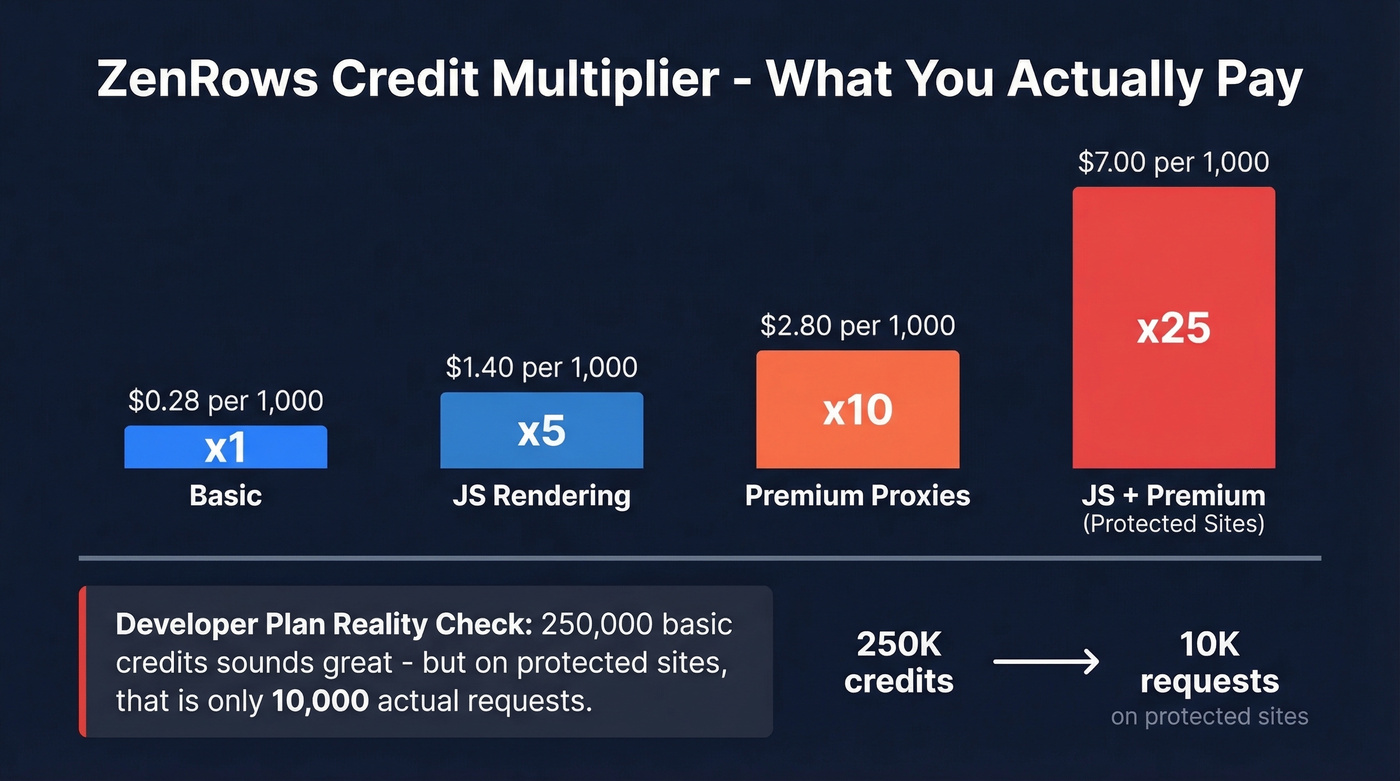
Every request starts as one basic credit. Turn on features, and the cost multiplies:
| Request Type | Multiplier | Cost per 1,000 |
|---|---|---|
| Basic | ×1 | $0.28 |
| JS Rendering | ×5 | $1.40 |
| Premium Proxies | ×10 | $2.80 |
| JS + Premium | ×25 | $7.00 |
On some domains, ZenRows' automatic/unblocker behavior escalates to using both JS rendering and premium proxies together, which forces the ×25 cost whether you asked for it or not. That means your Developer plan's 250K basic credits become just 10,000 protected-site requests. At $69.99/mo, you're paying $7.00 per thousand requests on those sites. We ran the numbers on a typical protected-site workflow, and the effective cost was 25× what the pricing page suggests at first glance.
Two more gotchas worth knowing. HTTP 404 and 410 responses count as successful requests and consume credits - the page is gone, but you still pay. And credits don't roll over month to month.

You're not paying $0.28 per request - you're paying $7.00 after multipliers kick in. Prospeo gives you 143M+ verified emails and 125M+ direct dials at ~$0.01 per email, 98% accuracy, no credit multipliers, no code.
Skip the scraping layer. Get the contact data directly.
Pros and Cons
Pros:
- Dead-simple integration. Import the SDK, write two lines of code, and you're scraping. The docs are genuinely good.
- Auto-retry on failures means you don't babysit requests. Combined with rotating proxies, it removes a lot of infrastructure headaches.
- Pay-for-success model on the Universal Scraper API - failed requests don't burn credits (though 404s and 410s do).
- Solid proxy network at 55M+ residential IPs with geotargeting support.
Cons:
- Billing confusion is the #1 complaint on Capterra. One reviewer put it bluntly: "difficult to understand exactly how you are getting charged and how it's broken down."
- Cost escalates fast at volume. The multiplier system means protected-site scraping can run 25× your expected cost.
- No credit rollover. Variable-traffic teams overpay in quiet months and run out in busy ones.
- Forced parameter combinations on certain domains remove your ability to optimize cost.
- Below-average benchmark performance - more on this below.
Reviews vs. Independent Benchmarks
ZenRows' review scores look fantastic at first glance. Capterra shows 4.8/5 across 103 reviews. G2 shows a perfect 5.0/5 - but that's from just 18 reviews, 16 of which come from enterprise companies, all based in Europe. That's a narrow sample.
Independent benchmarks tell a different story. Scrapeway's testing across 13 target sites puts ZenRows at 54% average success, 12.1-second average speed, and $5.22 per 1,000 scrapes. The industry averages? 58.2% success, 8.7 seconds, $3.00 per thousand. ZenRows underperforms on all three metrics.
If you're comparing providers, it's worth sanity-checking the cost math against other APIs too (for example, ScrapingBee alternatives that break down real cost per successful request).
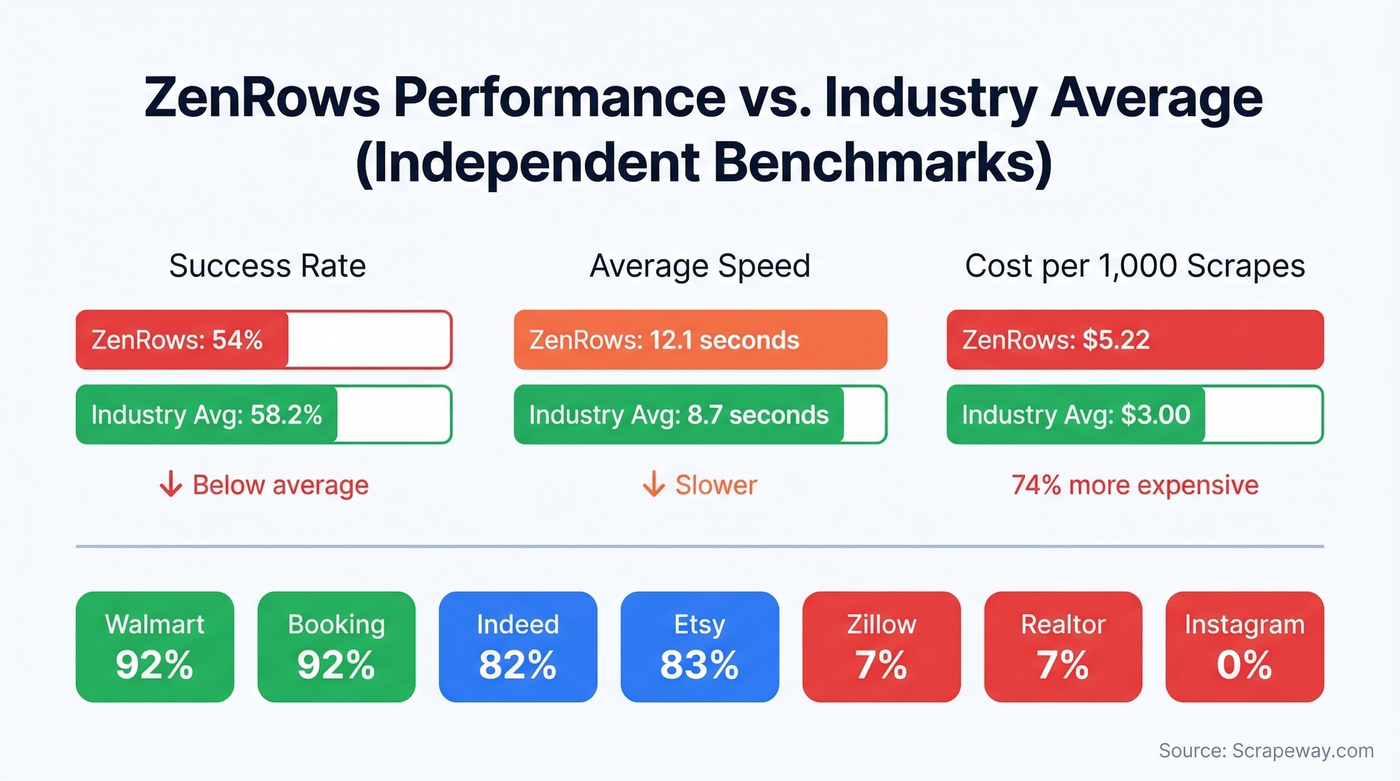
The per-target variance is wild. Walmart and Booking.com hit 92% success. Indeed hits 82%, Etsy 83%. But Zillow and Realtor.com drop to 7%. Instagram sits at 0%. A separate ScrapingDog benchmark recorded ZenRows at just 40% success on Amazon.
ZenRows claims a 99.9% success rate against Cloudflare on their own comparison pages. That doesn't match what independent testing shows. Cloudflare Turnstile has been widely deployed, and no scraping tool hits 100% across all targets - but the gap between ZenRows' marketing and third-party data is wider than you'd want. On Capterra, billing confusion is the dominant complaint theme; on Reddit, users tend to mention ZenRows alongside other scraping APIs without strong loyalty in either direction.
Let's be honest: ZenRows is a perfectly fine tool for scraping unprotected e-commerce pages. But the moment you need to hit protected sites at scale, the credit multiplier turns it into one of the most expensive options in the category. Most teams would be better off with a dedicated proxy provider and their own lightweight scraper - or, if the end goal is contact data, skipping the scraping layer entirely.
Who ZenRows Is (and Isn't) For
Use ZenRows if you're scraping known e-commerce or job board targets, want managed proxies without running your own infrastructure, and need a clean API that's fast to integrate.
If you're doing this specifically for lead gen, you'll usually get more leverage from a lead generation workflow that starts with targeting and enrichment, not raw HTML scraping.
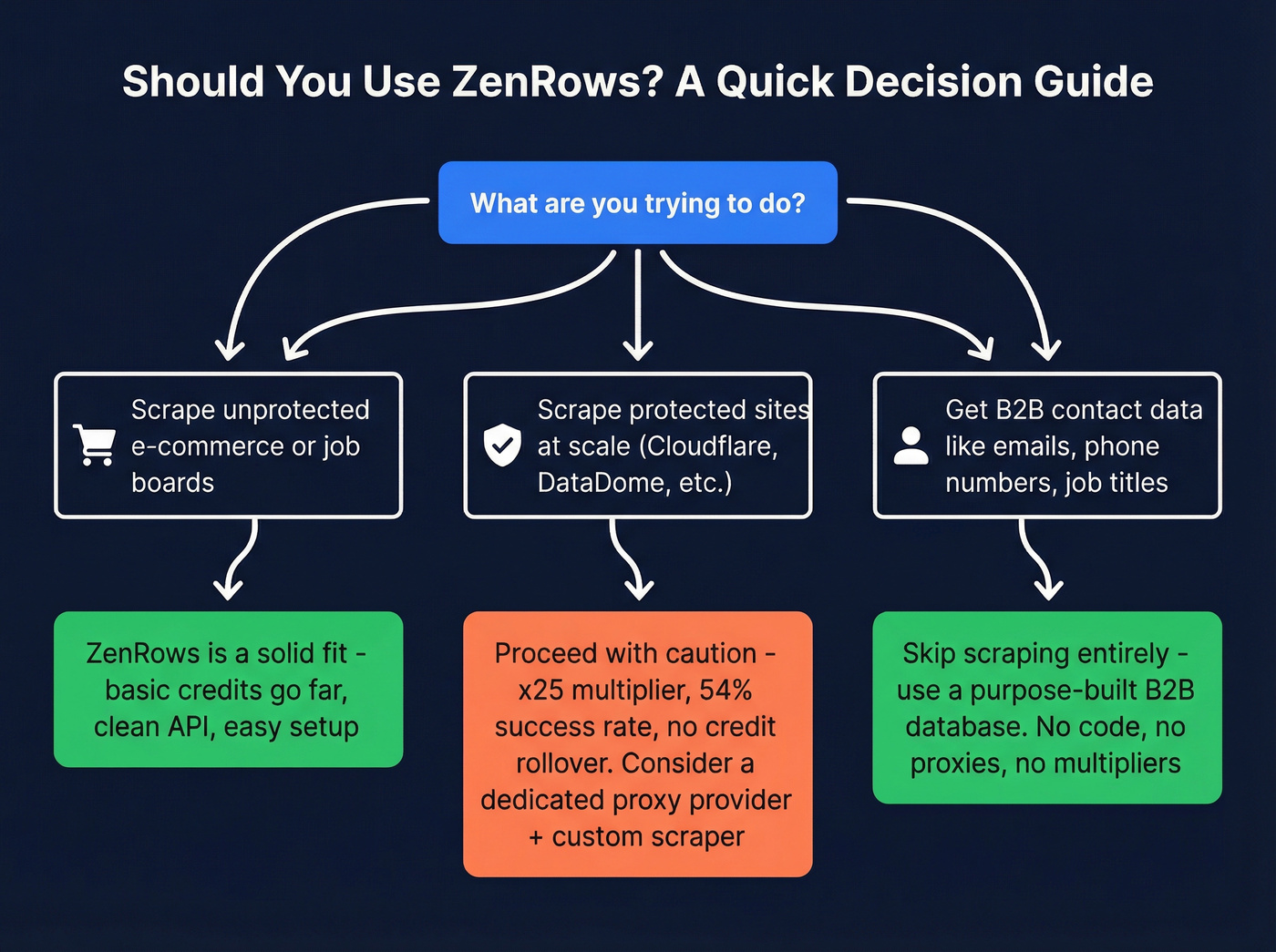
Skip ZenRows if you need broad coverage across dozens of protected domains, have unpredictable monthly volume, or are primarily scraping heavily guarded sites where the ×25 multiplier will eat your budget. For teams with variable workloads, the lack of credit rollover alone can make it a bad fit.
If your goal is B2B contact data - verified emails, direct dials, job titles - you don't need a scraping API at all. Prospeo gives you 143M+ verified emails and 125M+ mobile numbers at 98% accuracy, with a 7-day data refresh cycle. No code, no proxies, no credit multipliers. The free tier includes 75 emails per month, and paid plans run about $0.01 per email.
This is the same reason many teams switch from scraping to data enrichment services or a sales prospecting database once they need reliable coverage at scale.
ZenRows' 54% success rate means half your credits return nothing useful. Prospeo's enrichment API delivers a 92% match rate with 50+ data points per contact - verified emails, mobiles, job titles - refreshed every 7 days.
Trade a 54% success rate for 98% email accuracy.
FAQ
Does ZenRows have a free plan?
No permanent free tier exists. ZenRows offers a 14-day trial with 1,000 basic results and 40 protected results. After that, the cheapest option is the Developer tier at $69.99/month ($63/month billed annually).
What does ZenRows cost per request on protected sites?
With JS rendering and premium proxies enabled, you're paying $7.00 per 1,000 requests - a ×25 multiplier on basic credits. On the Developer plan, that turns 250K basic credits into just 10,000 protected-site results. Some domains force this combination automatically.
Is there a faster way to get B2B contact data than scraping?
Yes. Scraping APIs return raw HTML that you still need to parse, clean, and verify. A purpose-built B2B database provides verified emails and mobile numbers ready to export - with search filters, CRM integrations, and no scraping infrastructure required.