

The 6 Steps of the Sales Process: Benchmarks, Frameworks & Scripts for 2026
Your new AE reads the playbook, nods along, then asks: "Okay, but how?" That question exposes the gap between having a sales process and actually executing one. Companies with a formalized process see up to 28% higher revenue than teams winging it - yet 68% of salespeople don't follow a structured methodology at all. On Reddit threads about selling workflows, teams admit the "process" often exists only on paper.
So what are the 6 steps of the sales process? Prospecting, discovery, presentation, objection handling, closing, and follow-up. What's changed is the buyer. 75% prefer a rep-free experience, and 57% of the buying journey is done before a prospect ever talks to your rep. This guide gives you the benchmarks, frameworks, and scripts to execute each step for how B2B actually works in 2026.
Sales Process vs. Sales Methodology
A sales process is the sequence of steps - what you do. A methodology is the philosophy - how you do it. MEDDIC, Challenger, and SPIN are methodologies you layer onto a process, not processes themselves. Don't confuse the two. Your process stays constant; your methodology adapts to the deal.

Your 6-step sales process breaks at Step 1 when 35% of emails bounce. Prospeo's 300M+ profiles are verified every 7 days with 98% email accuracy - so every downstream step actually gets a chance to work.
Stop building sequences on bad data. Start prospecting on verified contacts.
The 6 Steps Explained
Step 1 - Prospecting
Before you touch a single lead, define your book of business. Who's your ICP? Which accounts are in-market? What titles are you targeting? Prospecting without this clarity is just activity for activity's sake.
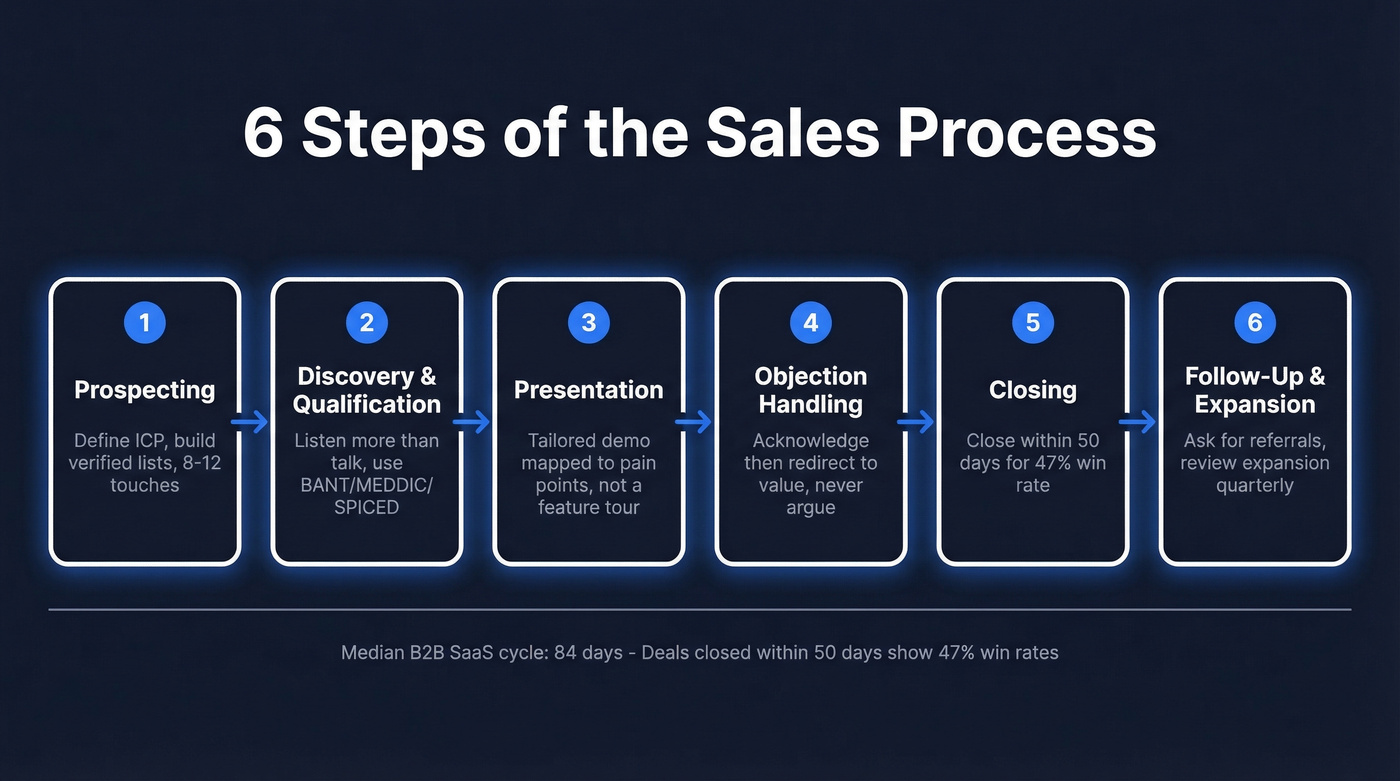
You're not closing the deal on the first touch. You're closing for a discovery meeting. Plan for roughly 8-12 touches before a prospect engages, and since buyers are already informed, your outreach needs to add value - not introduce. None of this matters if your data is bad. We've seen teams build beautiful sequences, nail the messaging, and then watch 35-40% of their emails bounce because their lists weren't verified. That kills your domain reputation and your pipeline in one shot.

Prospeo's B2B database covers 300M+ profiles with 98% email accuracy and a 30% mobile pickup rate, refreshed every 7 days instead of the 6-week industry average. When your bounce rate drops from 35% to under 4%, every downstream step actually gets a chance to work.
Common mistake: Reps skip ICP definition and jump straight into pulling lists. They end up with thousands of contacts who'll never buy and burn their sending domain in the process.
Step 2 - Discovery & Qualification
Discovery is where deals are won or lost. Not closing. Not the demo. Here.
Top closers talk 43% of the time during discovery calls - average reps hit 65%. SPIN practitioners see 57% higher prospect talk time compared to traditional approaches. The math is simple: the more your prospect talks, the more you learn, the better your proposal. On r/sales, buyers consistently praise discovery processes that feel tailored and problem-focused, with clear next steps before every meeting and side decks that support the conversation rather than replace it.
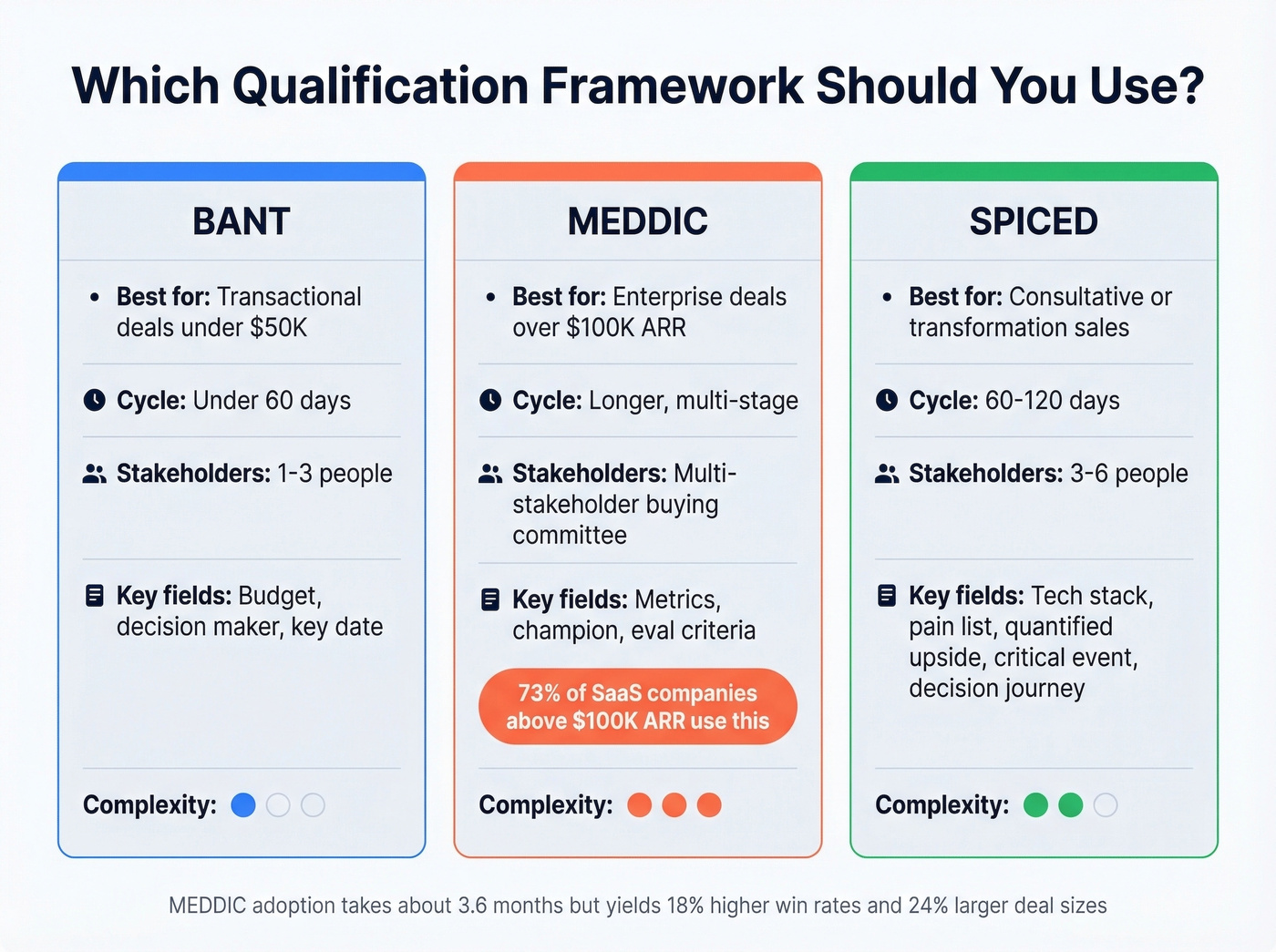
The framework you use depends on your deal complexity:
| Framework | Best For | Cycle | Stakeholders | Key CRM Fields |
|---|---|---|---|---|
| BANT | Transactional, <$50K | <60 days | 1-3 | Budget, decision maker, key date |
| MEDDIC | Enterprise, >$100K ARR | Longer cycles | Multi-stakeholder | Metrics, champion, eval criteria |
| SPICED | Consultative/transformation | 60-120 days | 3-6 | Tech stack, pain list, quantified upside, critical event, decision journey |
73% of SaaS companies selling above $100K ARR use some version of MEDDIC. Full adoption takes about 3.6 months but yields 18% higher win rates and 24% larger deal sizes compared to simplified frameworks. If you're running enterprise deals and still qualifying on BANT alone, you're leaving money on the table.
Map each framework to specific CRM fields and build exit criteria into your stages. A rep shouldn't advance a deal from Discovery to Proposal without filling in the required qualification fields - that's how you make a process enforceable, not aspirational.
Common mistake: Using BANT for complex enterprise deals. Budget, Authority, Need, Timeline works fine for transactional sales. For six-figure deals with procurement and legal, you need MEDDIC's depth.
Step 3 - Presentation
Your demo should be a direct response to what you learned in discovery - not a generic product tour. If you're showing the same 47 slides to every prospect, you skipped Step 2.
Here's the counterintuitive part: while 75% of buyers prefer a rep-free experience, Gartner found they're 1.8x more likely to complete a high-quality deal when they combine digital tools with a sales rep. Your presentation is where you earn that partnership. A demo before proper discovery is just a feature walkthrough with no context - the prospect nods politely and ghosts you.
Keep slides minimal. One team we spoke with reported a 20% win-rate increase over two quarters after replacing scarcity CTAs with data-backed proposals and tailored value maps. B2B buyers see through manufactured urgency instantly.
Use this if: Your discovery was thorough and you can map every demo section to a specific pain point the prospect raised. Skip this if: You can't articulate the prospect's top three problems before the call starts. Go back to discovery.
Step 4 - Handling Objections
Let's be honest - most objection handling training teaches reps to argue better. That's backwards.
First, understand the difference between an objection and an obstruction. An objection is a reason they won't buy: "We don't see the ROI." An obstruction is an excuse: "I don't have time to evaluate this." They require completely different responses. Most objections fall into four categories:
| Category | Common Objection | Response Script |
|---|---|---|
| Budget | "It's too expensive." | "What would a 20% pipeline increase mean in revenue? Let's map the outcomes that'd make this worthwhile." |
| Timing | "Not the right time." | "What would need to change for timing to work? Let's set a checkpoint." |
| Need | "We already have a solution." | "How's it performing against your targets? Most teams have a gap between what they have and what they need." |
| Authority | "I need to check with my boss." | "What information would help them evaluate this? Let's build that together." |
Common mistake: Arguing with the prospect. If someone says "it's too expensive," responding with "actually, it's very competitive" is a dead end. Acknowledge, then redirect to value.
Step 5 - Closing
Speed matters more than most teams realize.
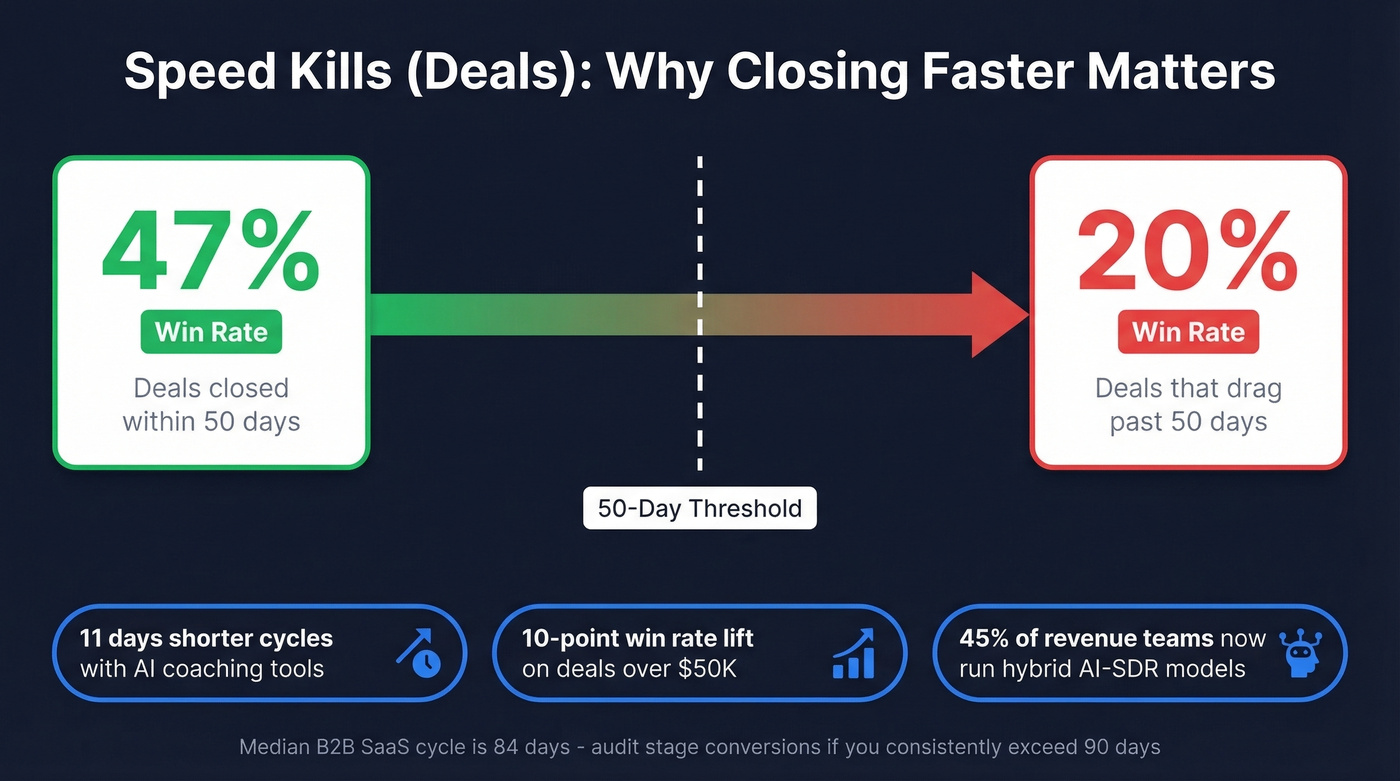
Opportunities closed within 50 days show a 47% win rate. After that threshold, win rates drop to roughly 20%. Teams using AI coaching tools report cycles 11 days shorter on average and up to 10-point win rate lifts on deals over $50K - 45% of revenue teams now run a hybrid AI-SDR model.
Two closing approaches that consistently work: the soft close ("Based on everything we've discussed, does this feel like the right fit?") and the assumptive close ("I'll send over the agreement with the terms we discussed - any changes needed before I do?"). Both respect the buyer's intelligence.
Here's the thing: stop defaulting to discounts. If you have to cut price to close, you either didn't build enough value in discovery or you're talking to the wrong buyer. Discounting trains your market to wait for better terms. The best closers I've watched never discount - they go back to Step 2 and resurface the pain.
If you want more closing frameworks beyond the basics, see steps to close a sale.
Step 6 - Follow-Up & Expansion
Follow-up is the most underinvested step in the entire process - and it's the highest-leverage one. 91% of customers say they'd give referrals, but only 11% of reps ask. That's free pipeline sitting there.
This step also has the worst data decay problem. Your champion changes jobs, their email bounces, and your expansion sequence dies silently. A 7-day data refresh cycle keeps contact records current so follow-up sequences actually reach people - compared to the 6-week refresh most providers offer, that's the difference between catching a job change in days versus missing it entirely.
Post-close checklist:
- Ask for a referral within 30 days of successful onboarding
- Review expansion opportunities quarterly - new departments, adjacent use cases
- Run NPS or feedback at 60 and 180 days
- Set a re-engagement cadence for churned or dormant accounts
- Re-verify contact data before every outbound sequence
Measuring Your Sales Process
A process without metrics is just a suggestion. Here's the formula that ties everything together:
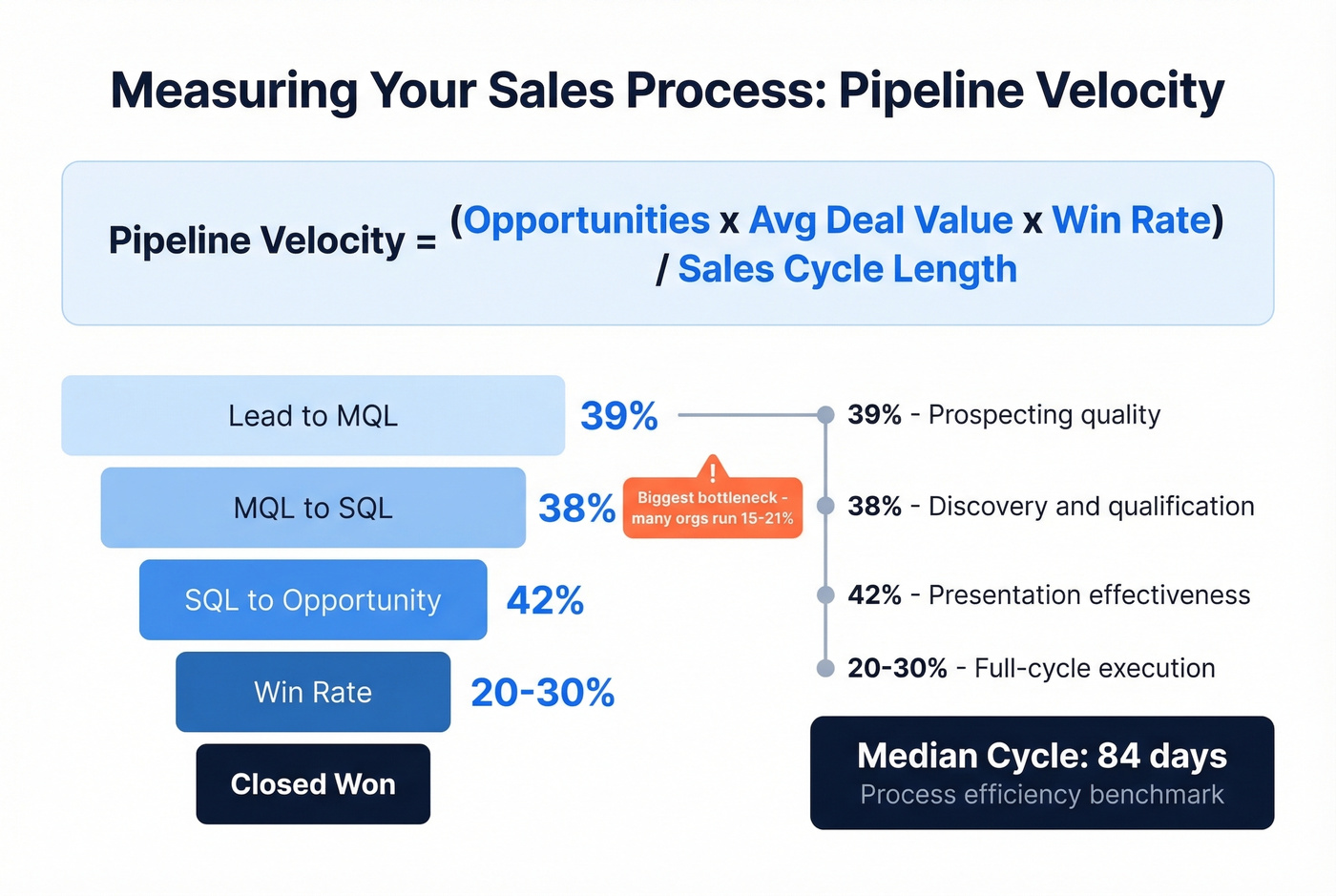
Pipeline Velocity = (Opportunities x Avg Deal Value x Win Rate) / Sales Cycle Length
Each variable maps to a step in your process. Here are the benchmarks for B2B SaaS:
| Stage | Conversion Rate | What It Measures |
|---|---|---|
| Lead to MQL | 39% | Prospecting quality |
| MQL to SQL | 38% | Discovery & qualification |
| SQL to Opportunity | 42% | Presentation effectiveness |
| Win Rate | 20-30% | Full-cycle execution |
| Median Cycle | 84 days | Process efficiency |
The biggest bottleneck in most funnels? MQL to SQL, which runs 15-21% at many organizations - well below the 38% benchmark. That's a discovery and qualification problem. If your MQL-to-SQL conversion is lagging, don't look at closing techniques. Look at Step 2.
To go deeper on stage-by-stage tracking, use a dedicated funnel metrics view and monitor pipeline health weekly.
Discovery calls don't happen when prospects never see your email. Teams using Prospeo cut bounce rates from 35% to under 4% and tripled pipeline output with the same headcount.
Book 26% more meetings by fixing the data feeding your sales process.
FAQ
What are the six steps in a sale?
The six steps are prospecting, discovery and qualification, presentation, objection handling, closing, and follow-up. Some models split or combine phases, but these six balance granularity with simplicity. Enforce each with CRM exit criteria so reps can't skip stages.
How long should a B2B sales cycle take?
The median B2B SaaS cycle is 84 days, with deals closed within 50 days showing 47% win rates. If your cycle consistently exceeds 90 days, audit stage-to-stage conversion rates to find where deals stall - that reveals the bottleneck faster than top-line pipeline reviews.
Which qualification framework should I use?
BANT works for transactional deals under $50K with short cycles. MEDDIC suits enterprise deals above $100K ARR involving procurement. SPICED fits consultative sales where the buyer's situation drives the conversation. 73% of SaaS companies above $100K ARR use MEDDIC.
How do I keep prospect data accurate across all six stages?
Use a provider with a weekly refresh cycle - stale data causes bounces that damage deliverability and stall follow-up. Prospeo refreshes records every 7 days and verifies emails at 98% accuracy, so sequences reach real inboxes from prospecting through expansion.
How do I make sure my team follows the process?
Build exit criteria into CRM stages - reps can't advance a deal without filling required fields like champion name, quantified pain, or decision timeline. Review pipeline weekly against stage criteria, not just dollar amounts, and keep contact data fresh so reps don't skip prospecting because they're working with bounced emails.