


6sense Pricing, Reviews, Pros and Cons (2026)
Your VP came back from a conference convinced 6sense would "transform the pipeline." Now you're the one figuring out what it actually costs, what it does well, and whether it's worth a six-figure commitment. We've dug through Vendr benchmarks, G2 review data, and real user feedback to give you an operations-level breakdown - so you can make the call with real numbers instead of sales deck promises.
The Short Version
- Intent data: Genuinely strong. 176 G2 users specifically praise accurate intent signals. Worth the investment if you've got $60K+ and a dedicated admin.
- Contact data: Genuinely weak. 131 G2 complaints about inaccurate emails and phone numbers. Don't buy 6sense for contact enrichment.
- Bottom line: Enterprise ABM platform with enterprise pricing and enterprise complexity. If that's not you, keep reading for alternatives.
What Is 6sense?
6sense is an AI-driven ABM platform built around intent data, predictive analytics, and account identification. It tells you which companies are researching solutions like yours before they fill out a form - combining first-party signals (like web engagement) with third-party intent sources including Bombora and G2 into a single buying-stage view.
On G2, it carries two separate listings: Revenue Marketing at 4.3/5 with 1,318 reviews, and Sales Intelligence at 4.0/5 with 892 reviews. The marketing side scores higher because intent is the core value. The sales intelligence side gets dragged down by contact data quality issues - a gap that traces back to the Slintel acquisition, which bolted on contact and technographic data that hasn't aged gracefully.
6sense Pricing Breakdown
6sense doesn't publish pricing. Frustrating, but typical for enterprise B2B sales.
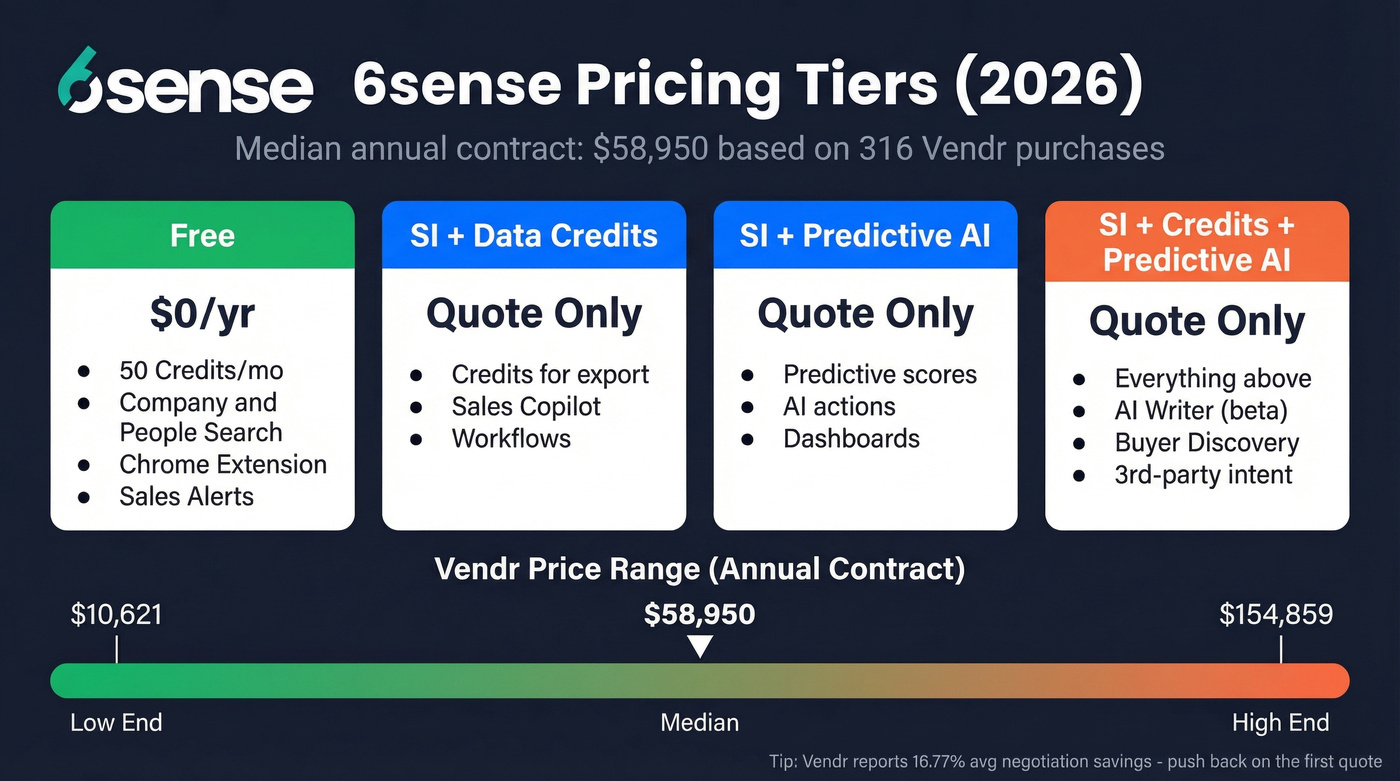
The Vendr benchmark - based on 316 purchases across 204 handled deals - puts the median annual contract at $58,950. The observed range runs from $10,621 to $154,859.
| Tier | Annual Cost | What's Included |
|---|---|---|
| Free | $0 | 50 Data Credits/mo, Company & People Search, Sales Alerts, List Builder, Chrome Extension |
| SI + Data Credits | Quote-only | Credits for export, Sales Copilot, workflows |
| SI + Predictive AI | Quote-only | Predictive scores, AI actions, dashboards |
| SI + Credits + Predictive AI | Quote-only | All above + AI Writer (beta), Buyer Discovery, 3rd-party intent |
For a mid-market deployment monitoring 5,000-10,000 accounts, expect $60K-$100K/year. Enterprise implementations with full modules run $100K-$300K+. Add $10K-$50K for implementation services, plan on 12-24 month contracts, and factor in the hidden cost that nobody puts on the slide deck: admin time. A 0.5-1.0 FTE dedicated to managing 6sense means your real first-year cost - license plus implementation plus people - can push to 2-3x the quoted license fee.
Vendr reports 16.77% average negotiation savings, so push back hard on the first quote. There's room (and it helps to understand anchor in negotiation before procurement gets involved).
How Credits Actually Work
6sense's credit system is the cost driver nobody talks about until renewal. Credits are tokens that unlock contact data - emails, phone numbers, enriched records. Every action burns them.
| Action | Credits Used |
|---|---|
| Unlock a person (email/phone) | 1 |
| Export person to CSV | 1 |
| Export Contact-Account to CRM | Up to 2 |
| AI Writer email (4 regenerations) | 1 |
| Re-enrich within 12 months | 0 |
| Export scores/segment names | 0 |
Here's the math that matters: a team of 20 reps unlocking 10 accounts per week burns 800+ credits per month. In our experience talking to teams running 6sense, most underestimate credit consumption by 20-30% in the first two quarters. Plan for that buffer or you'll be buying overages at whatever rate your CSM quotes.
Credits don't roll over. They expire on a fixed schedule with notifications at 60, 30, 15, 7, and 1 day before they vanish. The system creates natural upsell pressure: your team starts conserving credits mid-quarter, which slows prospecting, which makes the case for buying more. It's a clever flywheel - just not one that works in your favor.

131 G2 users flag 6sense for inaccurate contact data. Prospeo's 5-step verification delivers 98% email accuracy and 125M+ verified mobile numbers - refreshed every 7 days, not quarterly. Skip the $60K commitment and the credit burn.
Get the contact data 6sense can't deliver, starting at $0.01 per email.
What Users Love
G2's mention counts tell a clear story. Accurate intent data leads with 176 mentions - the platform's undeniable strength. Account-level buying signals are genuinely useful for prioritization, and combining first-party web engagement with third-party intent sources gives you a richer picture than any single-source provider (especially if you already have an intent based segmentation model in place).
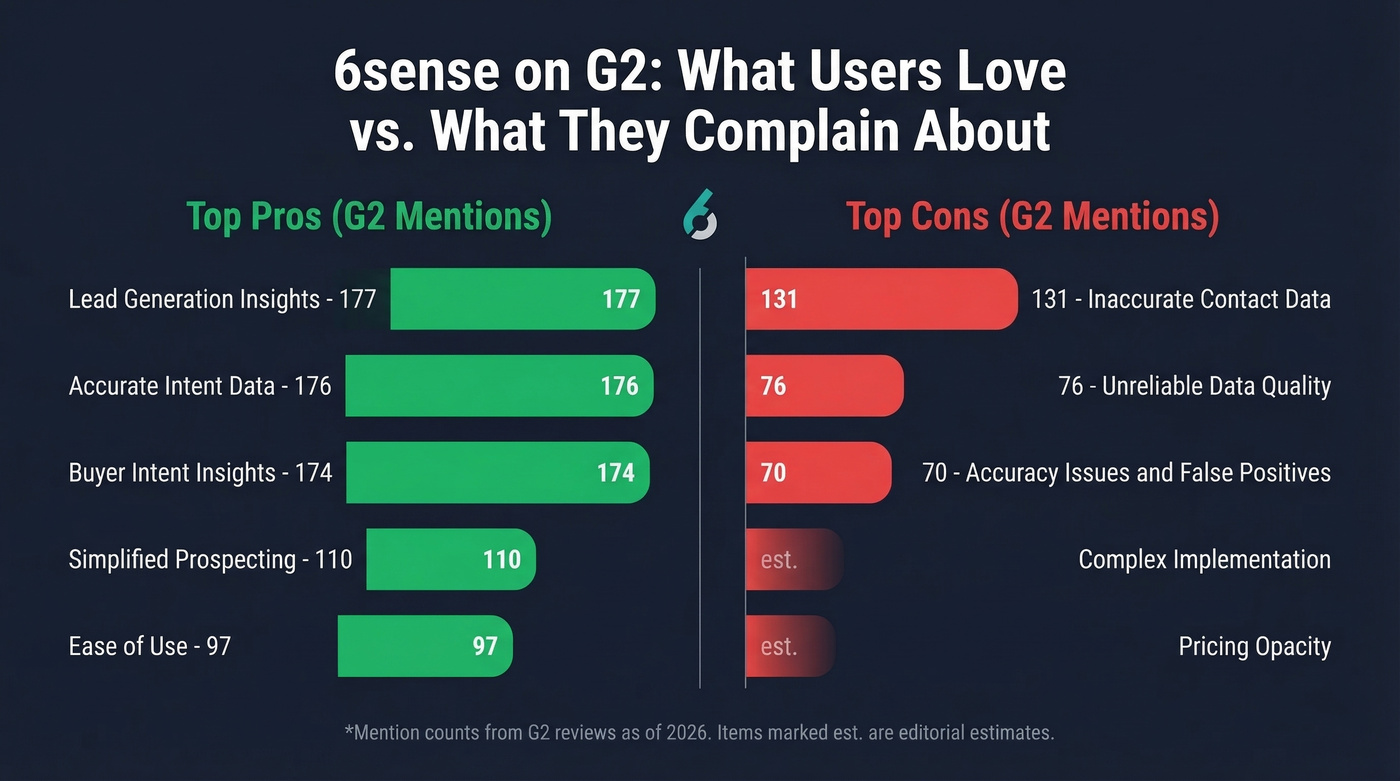
Lead generation insights (177 mentions) and buyer intent insights (174 mentions) round out the top three. Users consistently praise the ability to see buying-stage progression and allocate outbound effort toward accounts that are actually in-market.
Simplified prospecting pulled 110 mentions - once configured, the platform surfaces accounts that matter and deprioritizes noise. And ease of use surprised us at 97 mentions. Given the complexity, nearly 100 users still found it intuitive after onboarding, which says something about the UX team.
The pattern is clear: 6sense wins on account-level signals. If you're running ABM and need to know which accounts to pursue, it delivers.
What Users Complain About
The complaints are concentrated and consistent. Let's be honest - they're also predictable if you've used other platforms that bolted on contact data through acquisitions.
Inaccurate contact data tops the list at 131 mentions - wrong emails, disconnected phone numbers, outdated records. This is the gap that makes or breaks the platform for sales teams who need to actually reach the accounts 6sense identifies (and why many teams end up adding separate data enrichment services).
Unreliable data quality (76 mentions) extends beyond contacts to stale company info and slow updates. Accuracy issues and false positives (70 mentions) mean intent signals that don't translate to real buying activity - buying-stage misclassification is a recurring theme on G2 and across r/sales threads where ops teams compare notes.
Then there's the implementation burden. G2 benchmarks it at 3 months. You'll need a Primary Admin, Revenue Marketing Admin, Sales Intelligence Admin, and potentially an AI Email Admin. Four distinct admin roles for one platform.
Account identification relies on IP matching, which can be a practical constraint depending on how and where your buyers browse. And pricing opacity - no public numbers, quote-only model, credit overage costs you won't know until you ask - makes budgeting harder than it should be.
Is 6sense Worth the Price?
Here's the thing: 6sense is the best account-level intent platform on the market. But most teams don't need account-level intent at $60K+/year (and if you're still building fundamentals like lead scoring, you'll often get more ROI there first).
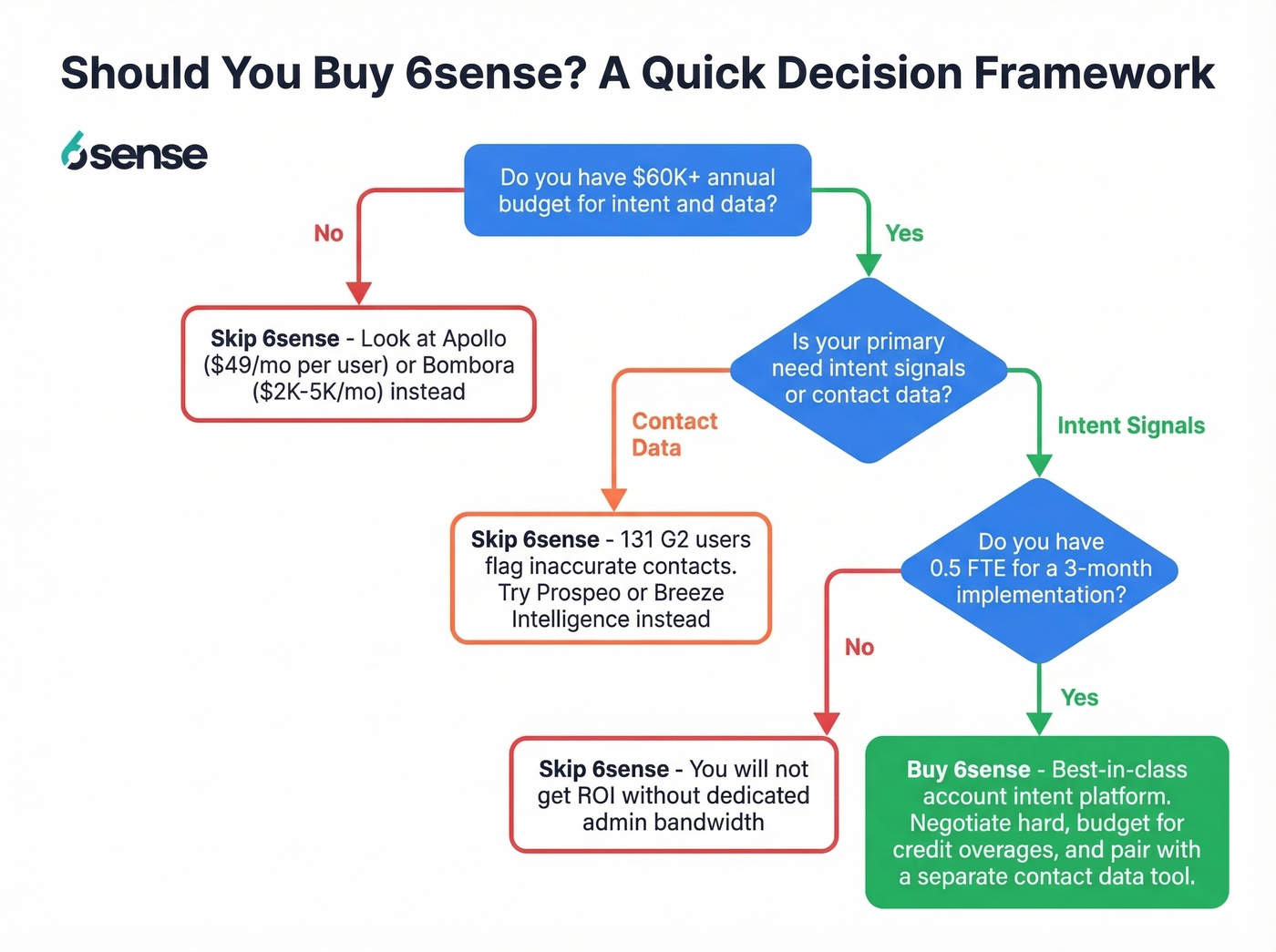
Buy if:
- You've got $60K+ in annual budget for a data/intent platform
- You're targeting 5,000+ accounts and need account-level buying signals
- You have a dedicated 0.5-1.0 FTE admin for rollout and ongoing management
- Your CRM and MAP are already integrated
- Your primary use case is knowing which accounts to pursue, not finding contact details
Skip if:
- Your budget is under $60K - you'll get a stripped version that doesn't justify the cost
- You need accurate contact data as your primary use case
- You're a small team without admin bandwidth for a 3-month implementation
- You want self-serve with transparent pricing and no annual lock-in
Alternatives Worth Considering
Demandbase is the closest enterprise ABM competitor. Comparable pricing ($60K-$150K+/year), similar intent capabilities, different UI philosophy. We've seen teams choose Demandbase when they want tighter advertising integration.
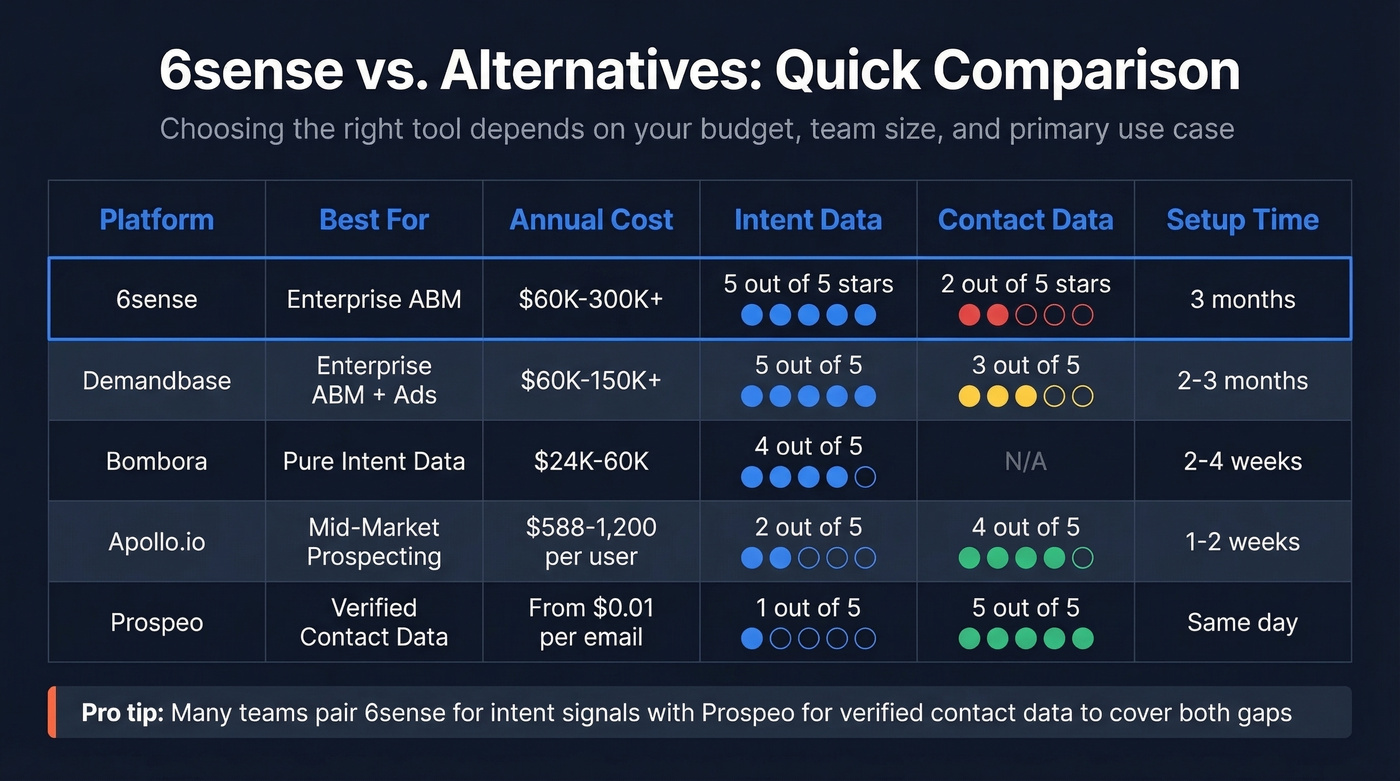
Bombora is worth considering if you only need intent data without the full ABM platform. Expect $2K-$5K/month for pure intent signals you can pipe into your existing stack.
Apollo.io serves mid-market teams that want prospecting and sequences in one platform. Plans start around $49/mo per user - a fraction of 6sense's cost, though without the intent depth (if you're evaluating stacks, start with a shortlist of SDR tools).
Breeze Intelligence (formerly Clearbit) offers credit-based enrichment starting at $30-$700/month, making it a lighter-weight option for teams that want firmographic and technographic data layered into HubSpot without a six-figure commitment (see also: firmographic and technographic data).
6sense shows you which accounts are in-market. Prospeo gives you verified emails and direct dials to actually reach them - 98% accuracy, 30% mobile pickup rate, no six-figure contract required. Pair intent signals with data that connects.
Stop burning credits on bad numbers. Verify contacts before you hit send.
FAQ
Does 6sense have a free plan?
Yes - 50 Data Credits/month with Company & People Search, Sales Alerts, List Builder, and Chrome Extension included. It's enough to evaluate the interface and test a handful of accounts, but nowhere near enough for real prospecting volume.
How long does 6sense take to implement?
G2 users report 3 months on average. Budget for multiple admin roles (Primary, Revenue Marketing, Sales Intelligence, AI Email), CRM/MAP integrations, and WebTag installation. Plan 0.5-1.0 FTE during rollout.
What are the biggest pros and cons of 6sense?
The biggest pro is account-level intent data - 176 G2 users praise its accuracy for identifying in-market accounts. The biggest con is inaccurate contact data - 131 G2 users flag wrong emails and disconnected numbers. Strong signals, weak contacts.
Can you negotiate 6sense pricing?
Absolutely. Vendr data shows 16.77% average savings across 204 handled deals. Push back on the first quote, ask for multi-year discounts, and negotiate credit overage rates upfront before signing.