

6sense vs Demandbase: Which ABM Platform Is Worth the Budget?
Two proposals on your desk - both north of $50k, both promising pipeline acceleration. One from 6sense, one from Demandbase. Both are Gartner Leaders, both have impressive sales decks, and neither will be obvious until you're six months into a contract. Here's the thing: we've watched dozens of teams agonize over this decision, and the right answer usually depends on one or two factors that neither vendor's rep will surface for you.
Let's break it down.
30-Second Verdict
Best for predictive analytics + sales alignment: 6sense. Its buying-stage models are a genuine strength, and sales teams get actionable signals earlier in the funnel.
Best for ABM advertising + ease of use: Demandbase. A native B2B DSP, higher G2 ratings (4.4 vs 4.3 on the platform view), and a noticeably smoother setup experience.
Skip both if your TAM is under 5,000 accounts or your budget is under $50k/year. You'll get more ROI from a lighter stack - verified contact data for direct outreach plus manual account-list uploads to your ad platforms. Enterprise ABM platforms need scale to justify their cost.
The median 6sense contract runs $58,617/year based on 314 Vendr transactions. Demandbase's median is $65,981/year across 175 deals. Both climb fast with advertising and enterprise modules.
The Core Difference
Both platforms are Leaders in the 2026 Gartner Magic Quadrant for ABM Platforms - their sixth consecutive year. But they got there from different directions, and that architectural DNA still shapes how each one works today.
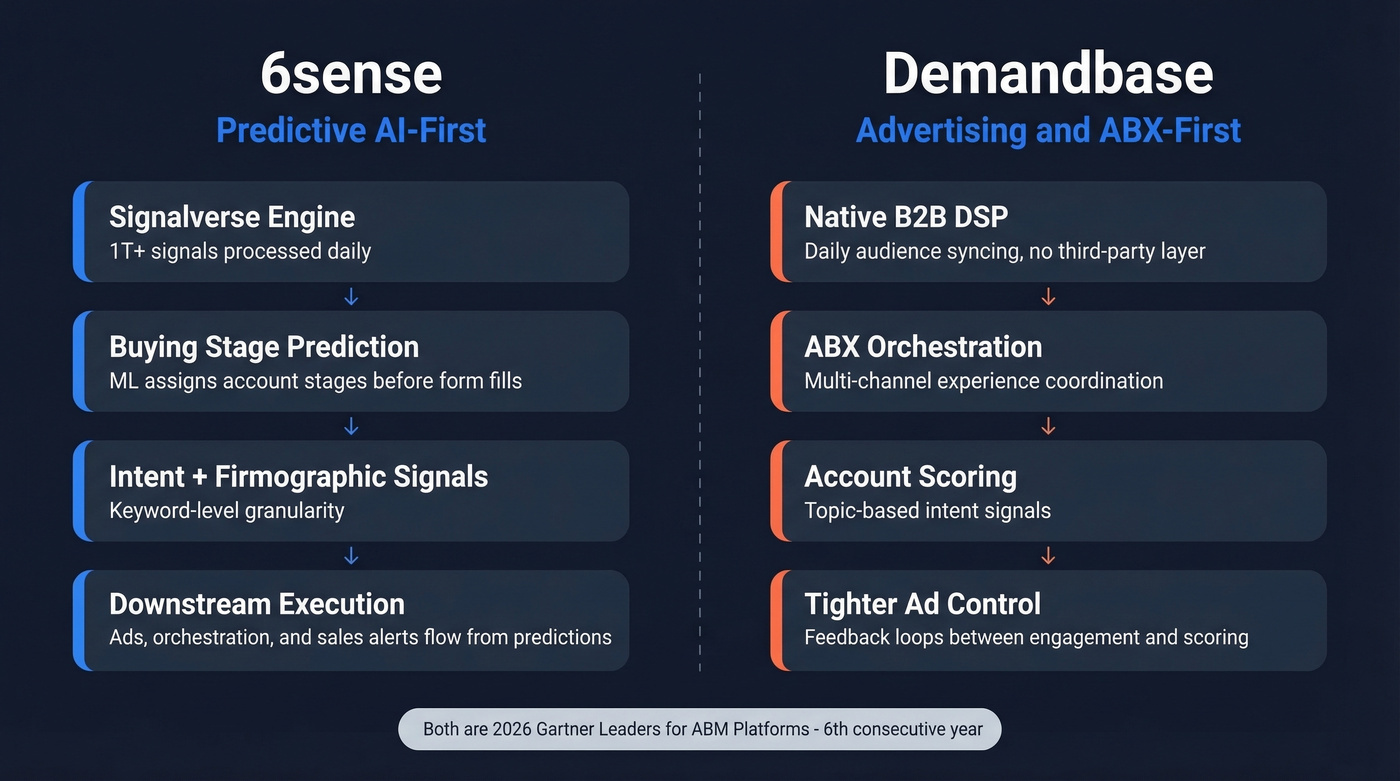
6sense is predictive AI-first. Its core bet is that machine learning can identify which accounts are in a buying cycle before those accounts ever fill out a form. The Signalverse engine processes 1+ trillion signals daily - intent data, web activity, firmographic changes - and assigns buying stages. Everything else (advertising, orchestration, sales alerts) flows downstream from that prediction layer.
Demandbase is advertising and ABX-first. Demandbase One was built around account-based experience orchestration, with a native B2B DSP that's genuinely differentiated. Where 6sense typically runs programmatic through DSP partners like The Trade Desk, Demandbase keeps DSP execution inside the platform with daily audience syncing. If your ABM strategy leans heavily on display and programmatic to warm accounts before outbound, Demandbase gives you tighter control over that spend.
Both have expanded into each other's territory. 6sense does advertising; Demandbase does predictive. But the center of gravity still differs, and that matters for which team inside your org gets the most value.
Feature-by-Feature Comparison
| Feature | 6sense | Demandbase | Edge |
|---|---|---|---|
| Intent data | Keyword-level signals | Topic-based intent | 6sense (more granular) |
| Predictive analytics | Buying-stage models | Account scoring | 6sense |
| Native DSP | No (DSP partner model) | Yes (native B2B DSP) | Demandbase |
| Orchestration | Campaign workflows | Full ABX orchestration | Demandbase |
| Sales intelligence | Free tier available | Bundled in platform | 6sense (free entry point) |
| Web personalization | Yes | Yes | Tie |
| CRM integrations | Salesforce, HubSpot | Salesforce, Marketo | Demandbase |
| Ease of implementation (G2) | 7.5 | 8.3 | Demandbase |
Three features actually tip the decision:
Advertising control. Demandbase's native DSP is a real advantage if programmatic is central to your ABM motion. Audience syncing happens daily, and you get tighter feedback loops between ad engagement and account scoring inside the platform. 6sense's partner model works, but it adds a layer between your account signals and your media execution.
Predictive depth. 6sense's buying-stage models are more granular than Demandbase's account scoring. Instead of just flagging accounts as high/medium/low, you get stage assignments that help SDRs time their outreach. In practice, this works best when reps trust the signals and actually adjust their messaging by stage - which is a bigger cultural ask than most teams realize.
Orchestration breadth. Demandbase's ABX orchestration covers more channels out of the box, including tighter Marketo integration for teams that live in that ecosystem. That's not a small consideration when your ops person is already stretched thin.
What Users Actually Say
| Metric | 6sense | Demandbase |
|---|---|---|
| G2 (Sales Intel) | 4.0 ★ (890 reviews) | 4.4 ★ (1,934 reviews) |
| G2 (Rev Marketing) | 4.3 ★ (1,317 reviews) | 4.4 ★ (1,934 reviews) |
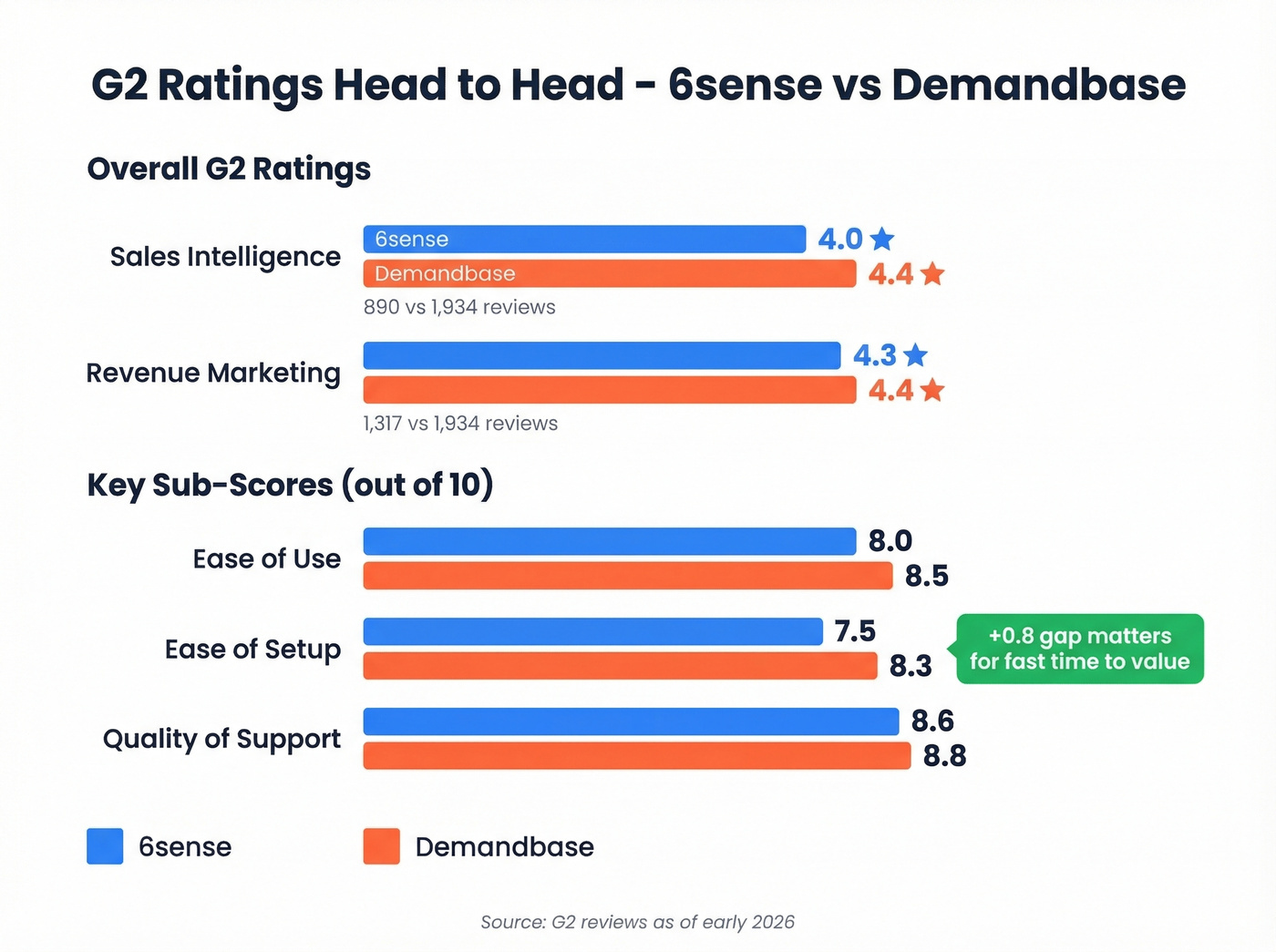
Sub-scores on the Revenue Marketing view:
| Metric | 6sense | Demandbase |
|---|---|---|
| Ease of Use | 8.0 | 8.5 |
| Ease of Setup | 7.5 | 8.3 |
| Quality of Support | 8.6 | 8.8 |
Demandbase leads every key sub-score, and it's not particularly close on setup. That 0.8-point gap matters when you're trying to show pipeline impact within a quarter.
The recurring complaint about 6sense is data quality. "Inaccurate Data" and "Data Quality" show up repeatedly in G2 cons - contacts that don't match, company data that's stale, intent signals that don't align with what sales sees on the ground. On the Demandbase side, the recurring complaint is complexity. TrustRadius reviews call out trouble integrating Demandbase One with custom Salesforce builds, plus UI friction where intent data can be harder to access than you'd expect for a tool at this price point. One reviewer summed it up well: tracking which Salesforce fields actually drive pipeline metrics "becomes a project unto itself."
In our experience, neither platform gets rave reviews for data accuracy. The difference is that Demandbase users complain about complexity while 6sense users complain about the data itself. If we had to pick a poison, we'd take complexity - you can train your way out of a steep learning curve, but you can't fix bad upstream data.

Both platforms get dinged for data quality - stale contacts, mismatched emails, intent signals that don't hold up. Prospeo refreshes 300M+ profiles every 7 days with 98% email accuracy, so when your ABM platform flags an account, you actually reach the right person. At ~$0.01 per verified email, you'll spend less on contact data than a single month of either platform's contract.
Stop paying $60K/year for data your reps can't trust.
Pricing Breakdown
| Metric | 6sense | Demandbase |
|---|---|---|
| Vendr median | $58,617/yr | $65,981/yr |
| Vendr range | $10,621-$151,709 | $22,860-$164,265 |
| Reddit real-world | $120k (year 1) on a 2-yr commit | $83k/yr |
| Free tier | 50 credits/mo | None |
| Typical contract | Annual, multi-year | Annual, multi-year |
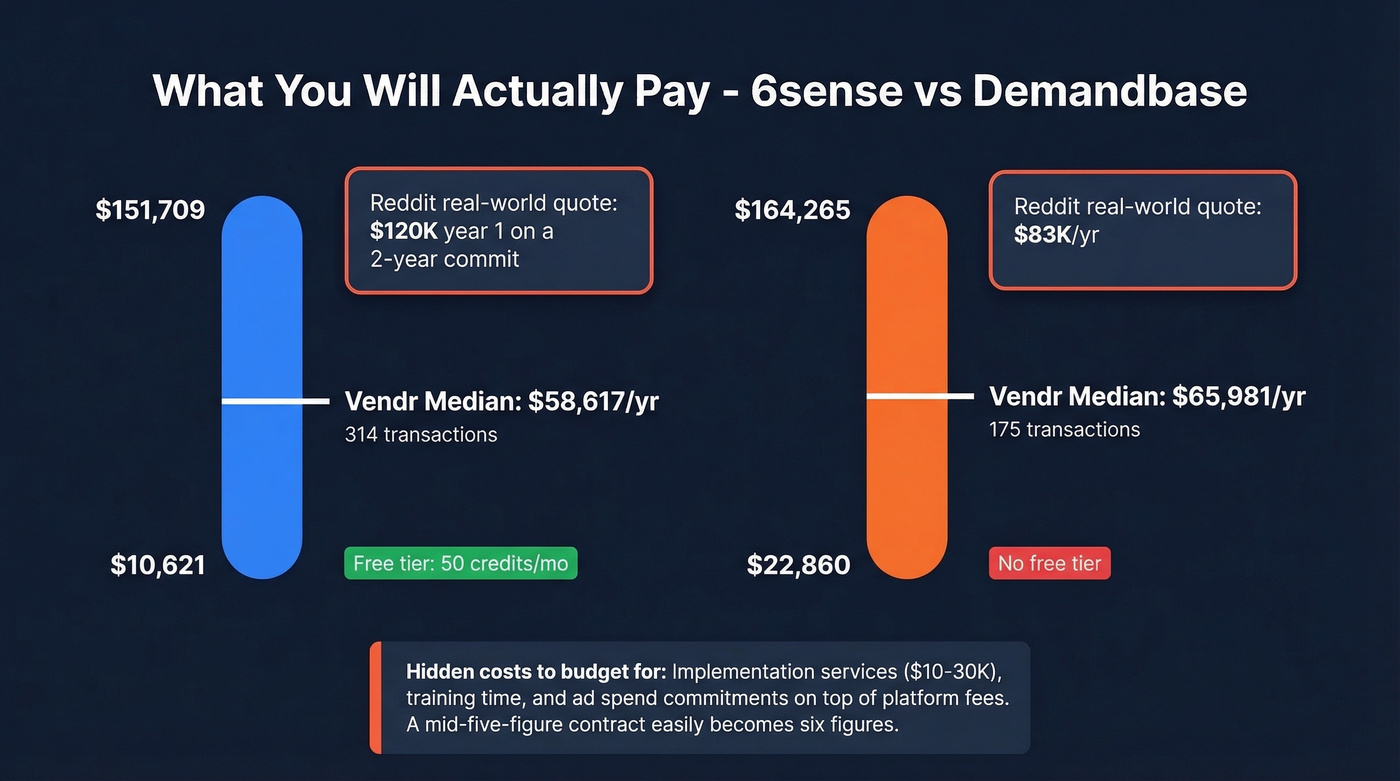
The Vendr medians suggest 6sense is slightly cheaper, but a Reddit thread tells a different story - one buyer was quoted $120k for 6sense versus $83k for Demandbase, with 6sense pushing hard for a two-year commitment. Pricing varies wildly based on account volume, modules, and how much ad spend you're committing through the platform.
6sense does offer a free Sales Intelligence tier: 50 data credits per month for emails, phone numbers, and enriched records. Credits expire monthly and don't roll over. Useful for individual reps kicking the tires, but it's not a substitute for the full platform.
Don't forget the hidden costs. Both platforms carry implementation services ($10-30k is common), training time for your ops team, and - for Demandbase especially - advertising spend commitments that sit on top of the platform fee. A "mid-five-figure" contract can easily become a six-figure total investment once you factor in ad budget minimums.
Implementation and Time to Value
Demandbase's G2 implementation time is roughly 2 months. 6sense lists a typical enterprise implementation of 4-6 weeks, but real-world timelines depend heavily on your CRM complexity and how clean your account data is going in.
Both platforms require a dedicated ABM ops resource. If you don't have someone who can own the CRM integration, build audience segments, and maintain data hygiene, neither tool will deliver value. The setup gap on G2 (Demandbase 8.3 vs 6sense 7.5) reflects that Demandbase tends to be easier to stand up - but don't assume the fastest timeline if you're running a heavily customized Salesforce instance.
When Neither Platform Fits
One practitioner on Reddit put it bluntly: ABM platforms are "incredibly expensive" and overkill for teams with small or niche TAMs. That's not wrong.
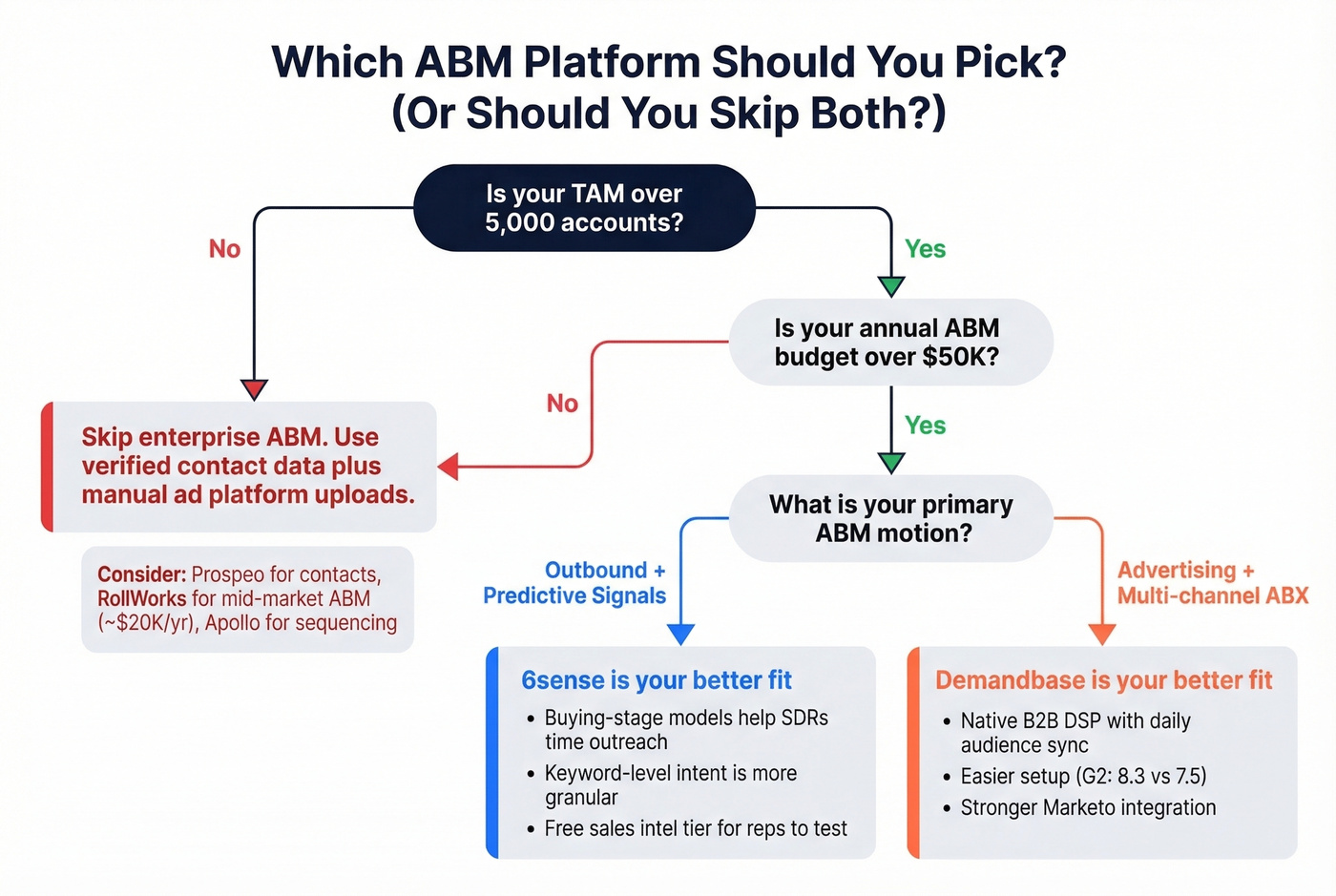
Skip both if your target account list is under 5,000 companies, your annual ABM budget is under $50k, you don't have a dedicated ops person to manage the platform, your primary motion is outbound rather than inbound/advertising-led, or you're a Series A or B company still defining ICP.
Real talk: Most B2B teams evaluating these two platforms don't actually need either one. If your average deal size is under $25k and your sales cycle is under 60 days, you'll get more pipeline from accurate contact data and disciplined outbound than from a six-figure ABM platform that takes two months to implement.
The lighter alternative works better than you'd think. Upload account lists directly to your ad platforms, use a visitor identification tool for website deanonymization, and invest in verified contact data for outbound.
RollWorks is worth evaluating as a mid-market ABM option starting around $20k/year - it covers account-based advertising and basic intent without the enterprise overhead. For pure outbound, Apollo.io has a free tier with paid plans from $49/mo and gives you a sequencer plus contact data, though email accuracy doesn't match dedicated data platforms. ZoomInfo ($15k-$30k/year for most mid-market plans) remains the data heavyweight but locks you into annual contracts and bundles features you won't always need.
Filling the Contact Data Gap
Neither ABM platform fully solves the last-mile problem: they tell you which accounts are in-market, but they don't give your reps verified emails and direct dials for the decision-makers at those accounts. 6sense's free tier offers 50 credits a month - not enough for a single SDR's weekly workflow.
Prospeo fills that gap with 98% email accuracy, 143M+ verified emails, and 125M+ verified mobile numbers with a 30% pickup rate. It also includes Bombora-powered intent data tracking 15,000 topics, so you can layer buying signals on top of contact data without a separate platform. Starts free with 75 emails per month, no contracts required. Pair it with either 6sense or Demandbase to close the contact gap, or use it standalone if you're skipping enterprise ABM entirely.
If your TAM is under 5,000 accounts, skip the six-figure ABM platform. Build targeted account lists with 30+ filters - buyer intent, technographics, funding, headcount growth - then reach decision-makers directly with 143M+ verified emails and 125M+ mobile numbers. Teams using Prospeo book 26% more meetings than ZoomInfo users and 35% more than Apollo.
Enterprise-grade ABM data without the enterprise contract.
Running Your Own Bake-Off
Don't trust vendor demos. Run a structured 30-day evaluation with both platforms using your actual data.
Test match rate first. Upload your target account list and measure coverage. The real number depends on your ICP, region, and how niche your verticals are - match rate drops sharply for APAC-heavy account lists compared to US enterprise accounts.
Validate intent signals against known pipeline. Pull your current open opportunities and see which platform correctly identifies them as "in-market." This is the fastest way to gut-check signal quality, and it's where 6sense's predictive models either shine or fall flat.
Stress-test CRM writeback. Push data into Salesforce and check field mapping, duplicate handling, and whether the integration breaks your existing workflows. This is where Demandbase's custom Salesforce issues surface - and where you'll discover whether your ops team can actually maintain the integration long-term.
Run a 30-day ad campaign through each DSP and compare pipeline influence. Demandbase's native DSP often gives tighter in-platform feedback loops; 6sense's partner model can require more stitching across systems to connect ad engagement to pipeline.
Before you start, align on the success metrics you’ll use to judge the trial - coverage, influenced pipeline, and sales adoption. If you need a baseline, use a simple lead scoring rubric and track pipeline health weekly so you can separate “more activity” from “more revenue.”
FAQ
Is 6sense better than Demandbase?
6sense has stronger predictive AI and buying-stage models that help sales teams time outreach more precisely. Demandbase is easier to use (G2 Ease of Use: 8.5 vs 8.0), has better support scores, and offers a native B2B DSP for programmatic advertising. For most teams, Demandbase is the safer pick - 6sense is better if your sales org will actually act on predictive signals.
Does 6sense have a free plan?
Yes. 6sense Sales Intelligence offers a free tier with 50 data credits per month for emails, phone numbers, and enriched records. Credits expire monthly and don't roll over. For heavier prospecting needs, Prospeo's free plan includes 75 emails per month with 98% accuracy - a stronger option for reps doing daily outbound.
How much does Demandbase cost?
Demandbase doesn't publish pricing. Based on 175 Vendr transactions, the median annual contract is $65,981. Smaller deployments start in the mid-five figures; enterprise implementations with advertising commitments reach mid-six figures and above.
Can you use 6sense and Demandbase together?
Technically yes, but it's uncommon - the overlap is too large and the combined cost often exceeds $120k/year. Pick one for account intelligence and advertising, then layer in a dedicated contact data tool for verified emails and direct dials.
What's the biggest complaint about each platform?
6sense draws recurring "Inaccurate Data" and "Data Quality" complaints on G2, with users flagging stale contacts and mismatched intent signals. Demandbase users cite a steep learning curve and UI friction, especially around Salesforce integration with custom builds where tracking pipeline-driving fields becomes painful.