

How to Plan an ABM Campaign That Actually Generates Pipeline
Most ABM programs die in planning. Not because the strategy was wrong, but because someone called it a "campaign," ran it for one quarter, and declared it didn't work. ABM isn't a campaign - it's an operating model. Proper ABM campaign planning is what separates teams that generate pipeline from teams that generate PowerPoints.
71% of B2B practitioners now run some form of ABM, yet 47% struggle to prove ROI and 43% can't get sales and marketing aligned. The teams that win treat ABM as infrastructure, not a project with an end date. Every operating model still needs a launch plan, though. Here's how to build one that works.
The 8-Step ABM Campaign Planning Framework
Work Backward From Revenue
Every account-based marketing plan starts with a number. Not impressions, not MQLs - revenue. If your target is $1M in new pipeline, work backward through your close rate, qualification rate, and average deal size to figure out how many accounts you actually need to touch. A useful benchmark from ZenABM's budget modeling: well-run ABM programs generate roughly $10 in pipeline for every $1 spent.
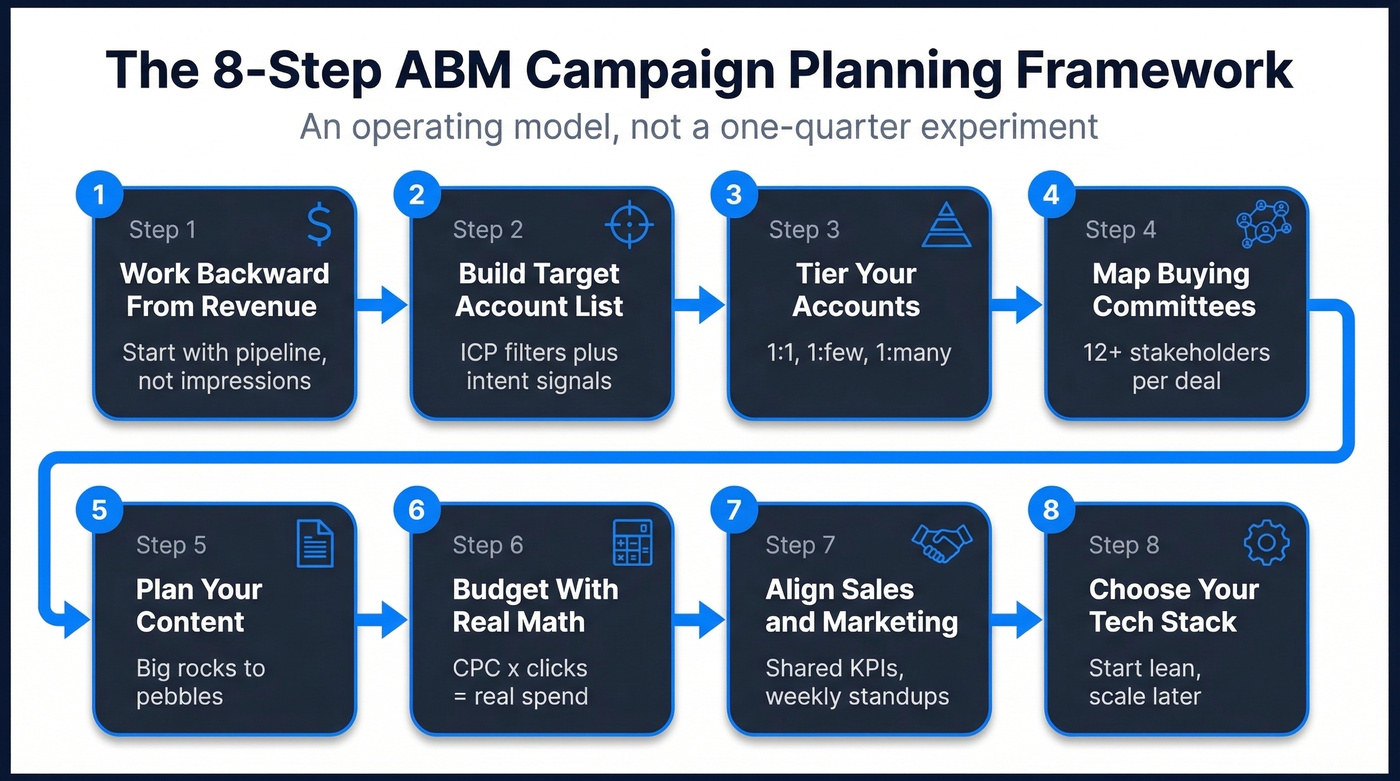
Build Your Target Account List
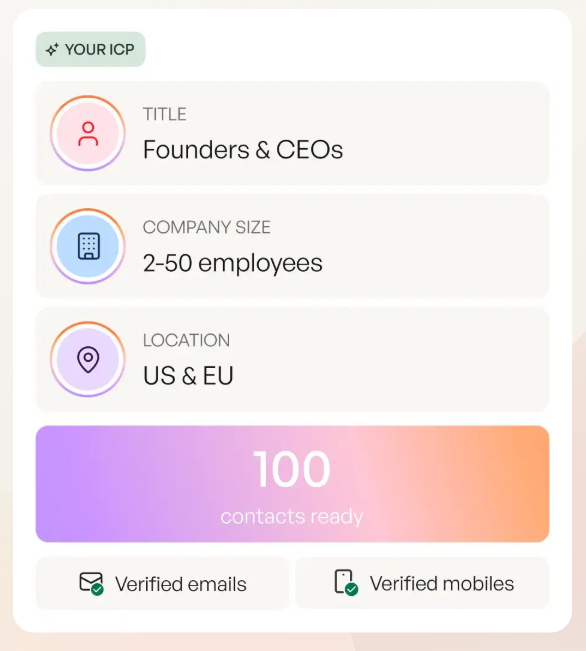
Your ICP criteria should be specific enough to filter, not vague enough to include everyone. Firmographics like industry, headcount, and revenue form the base. Layer in technographics and intent signals to find accounts actively researching your category.
Here's the thing: if 30% of your emails bounce on the first touch, your ABM program is dead before it starts. We've seen teams invest weeks in account selection and content creation, then lose all credibility because their contact data was stale. This is where data quality becomes non-negotiable - Prospeo covers 300M+ professional profiles with 98% email accuracy and a 7-day refresh cycle, so you can use 30+ search filters to match your ICP and export verified emails and mobile numbers without worrying about bounces torching your sender reputation.
Tier Your Accounts
Not every account deserves the same investment.
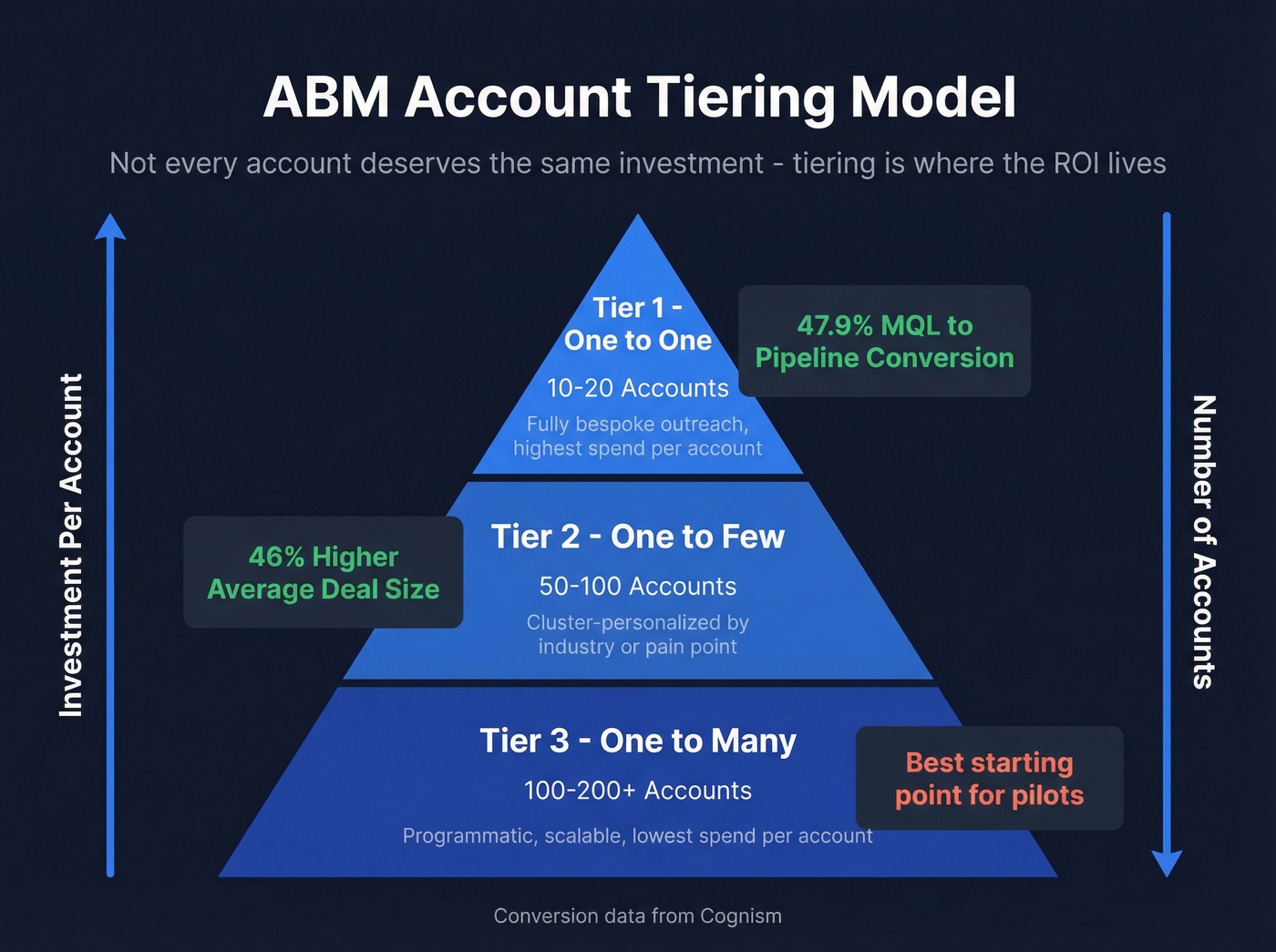
| Tier | Accounts | Approach |
|---|---|---|
| Tier 1 (1:1) | 10-20 | Fully bespoke, highest spend |
| Tier 2 (1:few) | 50-100 | Cluster-personalized |
| Tier 3 (1:many) | 100-200+ | Programmatic, lowest spend |
Cognism's internal data backs this up: teams with proper tiering saw 47.9% MQL-to-pipeline conversion and 46% higher average deal size. Tiering isn't optional. It's where the ROI lives.
Map Buying Committees
Enterprise deals involve upwards of 12 stakeholders. If you're only targeting the VP who signs the contract, you're ignoring the 11 people who influence the decision.
Map each account's buying committee by role - economic buyer, champion, technical evaluator, end user, blocker - then document each persona's pain points and situational context. It's tedious work. Also the difference between "we ran ads" and "we generated pipeline."
Plan Your Content
Demandbase's "big rocks to pebbles" model is the simplest way to think about ABM content. Start with one or two cornerstone assets like a benchmark report or an interactive assessment, then break each into derivative pieces for ads, emails, and sales one-pagers. Map every piece to a funnel stage. Five TOFU assets and nothing for mid-funnel evaluation means you'll generate awareness but lose deals in consideration. Smartsheet's free ABM planning templates can give you a starting structure for content calendars and campaign scorecards.
Budget With Real Math
Stop guessing. Here's the formula chain:
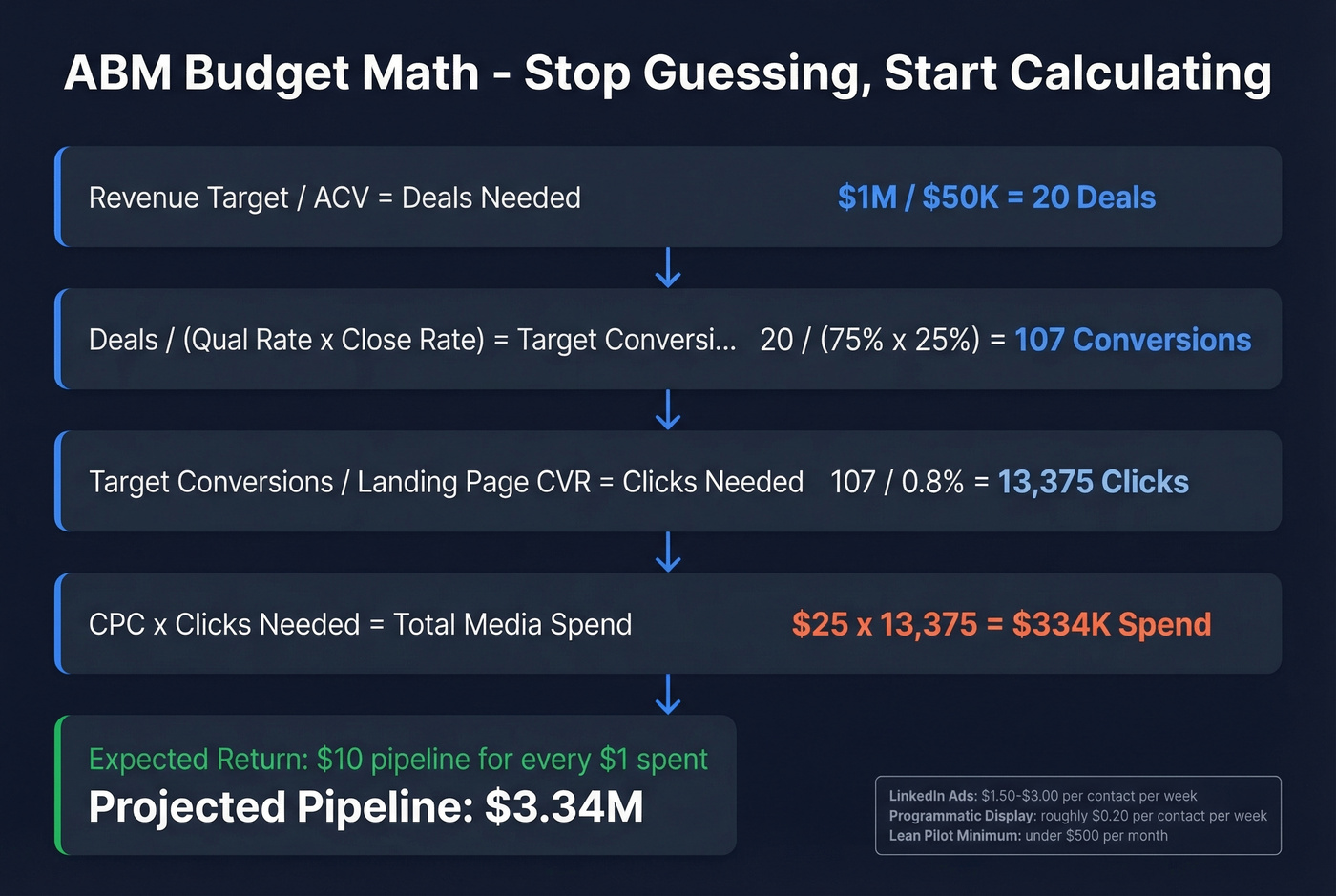
Deals Needed = Revenue Target / ACV Target Conversions = Deals Needed / (Qualification Rate x Close Rate) Clicks Needed = Target Conversions / Landing Page CVR Total Spend = CPC x Clicks Needed
Worked example: $1M revenue target, $50K ACV, 25% close rate, 75% qualification rate, 0.8% landing page conversion, $25 CPC. That's 20 deals, roughly 107 conversions, about 13,375 clicks, and approximately $334K in media spend.
Channel benchmarks to sanity-check your plan: LinkedIn ads run $1.50-$3.00 per contact per week for mid-sized audiences, climbing to $20 for tiny lists. Programmatic display is cheaper at around $0.20 per contact per week.
Running ABM on a small budget? Same framework, smaller scale: a CRM you already have, verified contact data, and $300-$400/month in LinkedIn ads.
Align Sales and Marketing
Build a joint scorecard with shared KPIs: pipeline generated, accounts engaged, meetings booked, revenue closed. Not marketing metrics. Not sales metrics. Shared metrics.
Set a weekly 30-minute stand-up, a monthly campaign review, and a quarterly strategy session to adjust tiers and budget. The consensus on r/sales and r/marketing is pretty clear on this - the ABM programs that die fastest are the ones where sales wasn't in the room when the account list was built. Sales-marketing alignment isn't a nice-to-have; it's structural.
Choose Your Tech Stack
You don't need a $100K platform to start. Here's a minimum viable ABM stack:
| Category | Tool | Starting Price |
|---|---|---|
| Contact data | Prospeo | Free / ~$0.01 per email |
| Marketing automation | HubSpot Marketing Hub | From $800/mo |
| CRM | Salesforce | From $25/user/mo |
| ABM platform | 6sense | Free plan (50 credits/month) |
| Sequencing | Lemlist / Instantly | ~$30-60/mo |
| Contact data (alt) | Apollo.io | From $49/mo |
Total cost for a lean pilot: under $500/month using a free-tier contact data plan, your existing CRM, and 6sense's free plan for basic account identification. Enterprise platforms like Demandbase (typically $3K-$15K+/mo) add value at scale, but they aren't prerequisites.
Skip ABM entirely if your average deal size is under $10K. The math doesn't work - the cost per account in a well-run program will eat your margins. ABM shines when deal sizes justify the per-account investment.
12-Week Execution Timeline
| Phase | Weeks | Deliverables |
|---|---|---|
| Foundation | 1-2 | Revenue target, ICP, tiered account list, buying committees |
| Build | 3-4 | Content live, ad creatives, sales playbook, tech configured |
| Launch | 5-8 | Ads running, sequences active, stand-ups started |
| Acceleration | 9-12 | Optimize on data, promote engaged accounts, report pipeline |
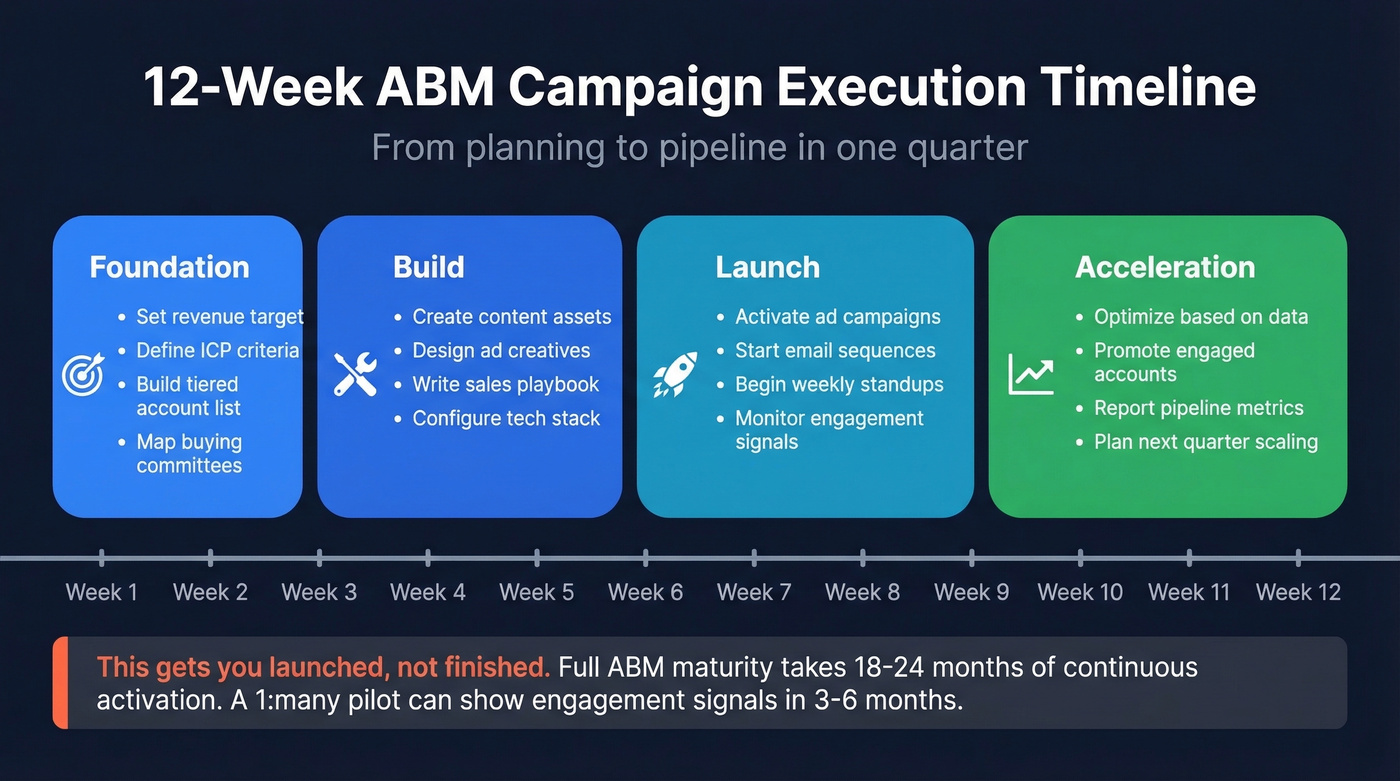
Let's be honest: this 12-week plan gets you launched, not finished. ABM takes 18-24 months of continuous activation to hit its stride - one Cognism practitioner put it bluntly: full maturity takes about three years. But a 1:many pilot can show meaningful engagement signals within 3-6 months. Start there, prove the model, then invest deeper.

Your ABM tiering model is only as good as the contact data behind it. Prospeo gives you 30+ filters - intent signals, technographics, headcount growth, funding - to build precise account lists across all three tiers. With 98% email accuracy and a 7-day refresh cycle, your buying committee outreach actually lands.
Stop losing ABM pipeline to bounced emails and stale data.
Five Mistakes That Kill ABM Campaigns
Unclear goals. "Increase brand awareness among target accounts" isn't a goal. "$500K in pipeline from 50 accounts in 6 months" is.
Treating ABM as a marketing project. ABM without sales involvement is just advertising. If reps aren't bought in on the account list and outreach triggers, you're running a parallel program nobody uses.
Under-resourcing. 37% of marketers cite lack of budget and resources as their top ABM challenge. A half-staffed program produces half-results, which gets interpreted as "ABM doesn't work." We've watched this play out repeatedly - teams get budget for the platform but not for the people to run it.
No leadership buy-in. Without executive sponsorship, the first quarter of slow results will kill the program before it has a chance to compound.
Measuring the wrong KPIs. 47% of teams struggle to prove ABM ROI, usually because they're tracking MQLs instead of pipeline generated, deal velocity, and account engagement.
What Strong ABM Results Look Like
These are published results from teams that executed properly.
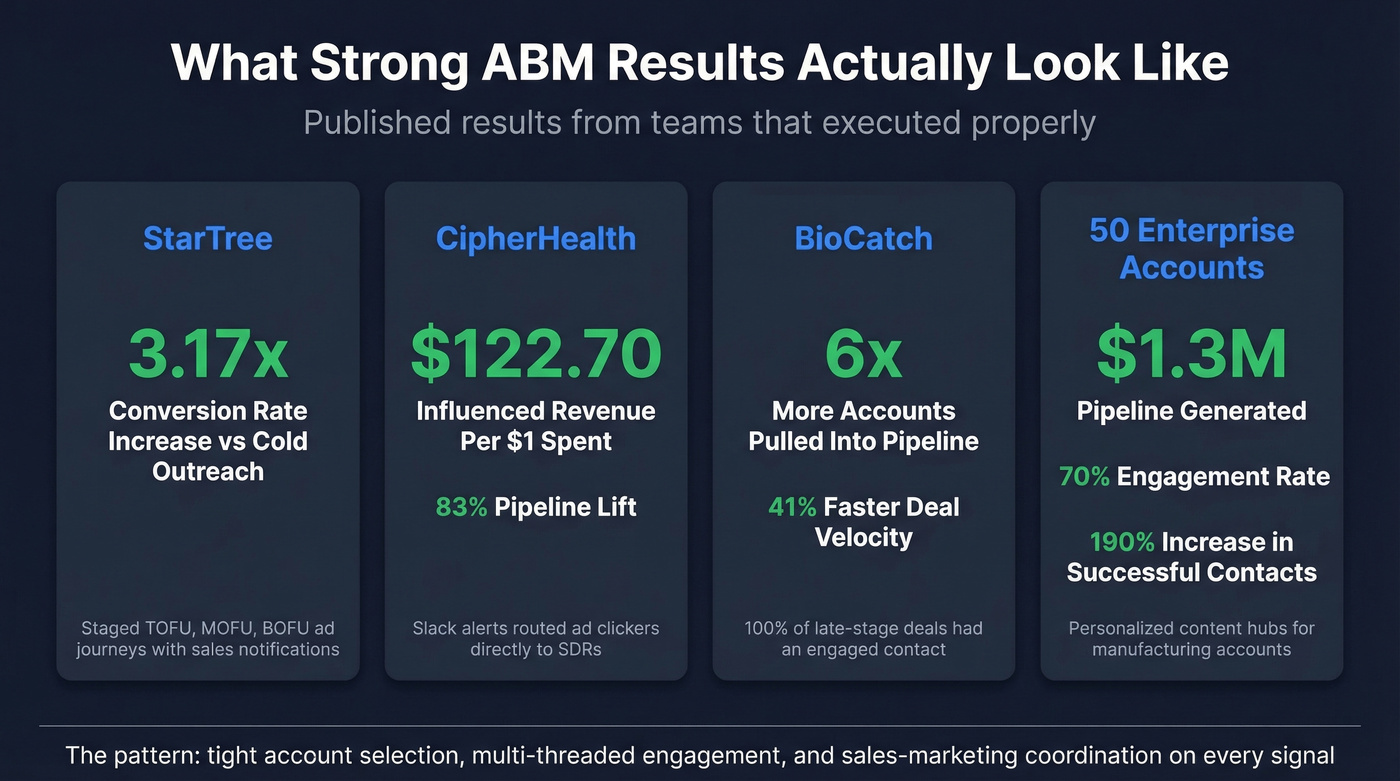
StarTree ran staged TOFU/MOFU/BOFU ad journeys with sales notifications triggered at engagement thresholds and saw a 3.17x conversion rate increase vs. cold outreach. CipherHealth integrated ad engagement alerts into Slack, routed clickers directly to SDRs, and generated $122.70 in influenced revenue per $1 spent with an 83% pipeline lift. Those numbers aren't typical - they're what happens when the planning framework is airtight and sales actually acts on the signals.
On the enterprise side, BioCatch pulled 6x more accounts into pipeline with 41% faster deal velocity, and 100% of their late-stage deals had an engaged contact. An Inverta case study targeting 50 enterprise manufacturing accounts with personalized content hubs hit a 70% engagement rate, $1.3M in pipeline, and a 190% increase in successful contacts.
The pattern across all of them: tight account selection, multi-threaded engagement across the buying committee, and sales-marketing coordination on every signal.
That 12-week ABM timeline only works if Week 1 delivers verified contacts for every buying committee member. Prospeo covers 300M+ profiles with verified emails and 125M+ direct dials - at roughly $0.01 per email. Map entire buying committees in hours, not weeks.
Launch your ABM pilot this week with data that connects to real buyers.
FAQ
How long before ABM generates pipeline?
Expect early engagement signals within 3-6 months on a 1:many pilot. Meaningful pipeline impact typically takes 12-18 months of continuous activation. Teams that treat ABM as a quarter-long experiment almost always fail - the compounding effect requires sustained investment.
What's the minimum budget for an ABM pilot?
A lean 1:many pilot targeting 100-200 accounts can run on under $500/month: a CRM you already have, verified contact data on a free tier, and $300-$400/month in LinkedIn ads. That's enough to validate the model before committing to enterprise tooling.
Do I need a dedicated ABM platform to start?
No. Start with your CRM, a contact data tool with a free tier, and one paid channel. Dedicated platforms like Demandbase or 6sense add value at scale, but most failed programs bought the platform before defining the strategy. Nail the account list, tiering, and sales alignment first - the tools are secondary.