

ABM Nurturing: The Operational Playbook Most Guides Won't Give You
68% of B2B buyers already have a front-runner vendor before they start evaluating - and 80% of the time, that front-runner wins. Only 19% of B2B marketing leaders even believe buyers form preferences that early, which is exactly why most ABM programs start too late. ABM nurturing is how you become the front-runner. And most teams are doing it wrong - running what one Reddit practitioner nailed as "a wishlist of logos with LinkedIn ads and click follow-up."
Here's the short version: account-based nurturing means orchestrated, multi-channel sequences personalized to specific accounts - not retargeting ads with a demo CTA. Success depends on data accuracy, sequence design, and sales follow-through. If your emails are bouncing, fix your data before you touch your content.
What Account-Based Nurturing Actually Is
Lead nurturing targets individuals based on behavior. Someone downloads an ebook, they get a drip sequence. ABM nurturing orchestrates touches across an entire buying committee within a target account, personalized by account context, persona, and deal stage.
That distinction matters more now than ever. Forrester predicts more than half of large B2B transactions ($1M+) will be processed through digital self-serve channels - especially as younger buyers bring 10+ external influencers into purchase decisions. Your nurture sequences aren't just warming accounts. They're often the primary buying experience.
The ABM Nurturing Framework
Every account-based nurture program needs a skeleton. Without one, you end up with what one HubSpot user described as "18 accounts, 18 separate workflows, and no idea what's working."
The 12-Week Cadence
Map your cadence to three phases:
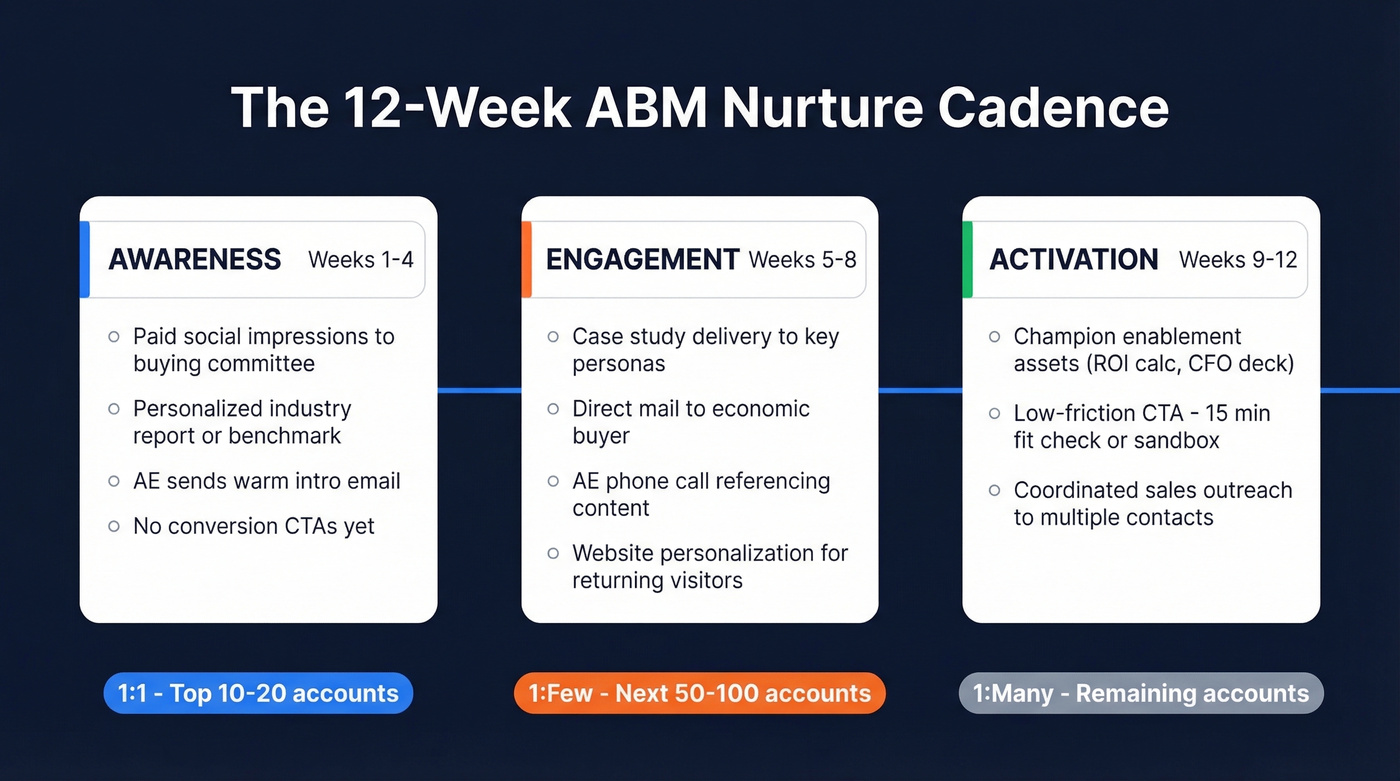
Weeks 1-4 (Awareness): Paid social impressions to the buying committee and a personalized content piece - industry report or benchmark data. The AE sends a warm intro email. No conversion CTAs yet.
Weeks 5-8 (Engagement): Case study delivery, a direct mail piece to the economic buyer, and a phone call from the AE referencing the content. Layer in website personalization through tools like Mutiny so returning visitors see account-relevant messaging. This is where personalized journeys start to diverge - each persona on the buying committee should receive content tailored to their role and specific concerns, not just their job title.
Weeks 9-12 (Activation): Champion enablement assets (ROI calculator, CFO deck), a low-friction CTA (15-minute fit check, sandbox access), and coordinated sales outreach to multiple contacts.
Tier your intensity: 1:1 for your top 10-20 accounts, 1:few for the next 50-100, 1:many for the rest. The cadence skeleton stays the same. The personalization depth changes.
Let's be honest: if your average deal size is under $25K, you don't need 1:1 nurture programs. Run 1:few with tight industry segmentation and you'll get 80% of the results at 20% of the effort. Save 1:1 for the accounts that justify the cost.
Mid-Funnel Storyline
The mid-funnel is where 80% of nurture programs stall. We've seen it over and over - buyers are asking "Will this work for my team?" and the marketing team is still sending top-of-funnel blog posts.
Use a progressive storyline across three weeks. Week 1: proof and validation - a case study from their industry, an ROI projection. Week 2: champion enablement - a business case template, a CFO-ready deck they can forward internally. Week 3: low-friction CTA - a 15-minute fit check, a pilot offer, sandbox access.
Deliver the first follow-up within 48 hours of any engagement signal. Waiting a week kills momentum.
Direct Mail as a Nurture Channel
Direct mail isn't dead - it's underused. For 1:1 accounts, run a multi-touch cadence: handwritten letter with a CTA to a personalized landing page, followed by a phone call to confirm receipt, then a follow-up email referencing both. Close with a final call addressing concerns and asking for the meeting.
Time direct mail around intent signals - new fiscal year, funding rounds, industry events. The consensus on r/sales is that direct mail works best when it's unexpected and relevant, not when it's a branded mug with a generic note.
ABM Nurture Examples That Worked
Snowflake researched 200 large accounts, ran personalized direct mail plus digital follow-up, and generated an 85% open rate and $50M+ pipeline from those accounts alone. That's not a typo.
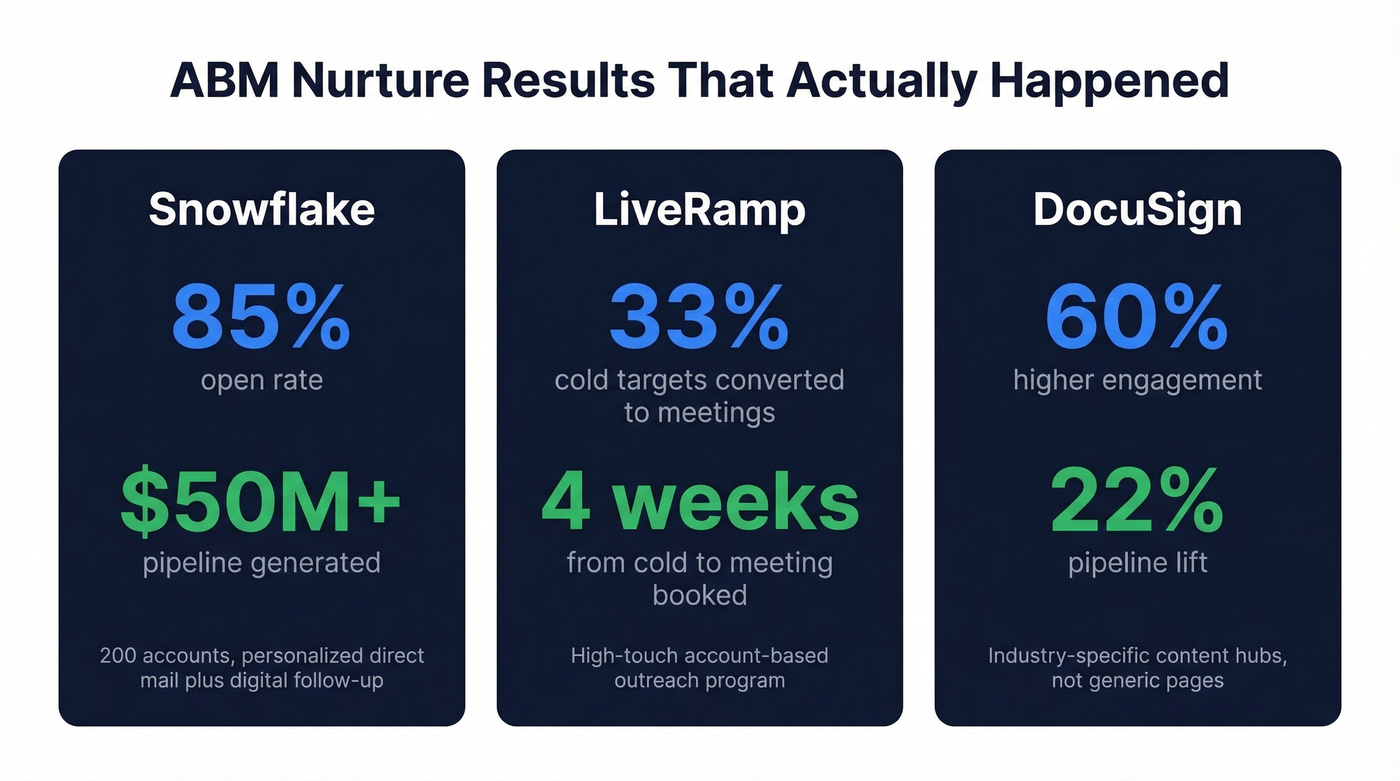
LiveRamp ran high-touch account-based programs and converted 33% of cold targets to meetings within four weeks. One in three cold accounts took a meeting in under a month.
DocuSign built industry-specific content hubs and saw 60% higher engagement and a 22% pipeline lift. Generic content doesn't move accounts. Industry-specific content does.
Why ABM Nurture Programs Fail
Five failure modes we see repeatedly:
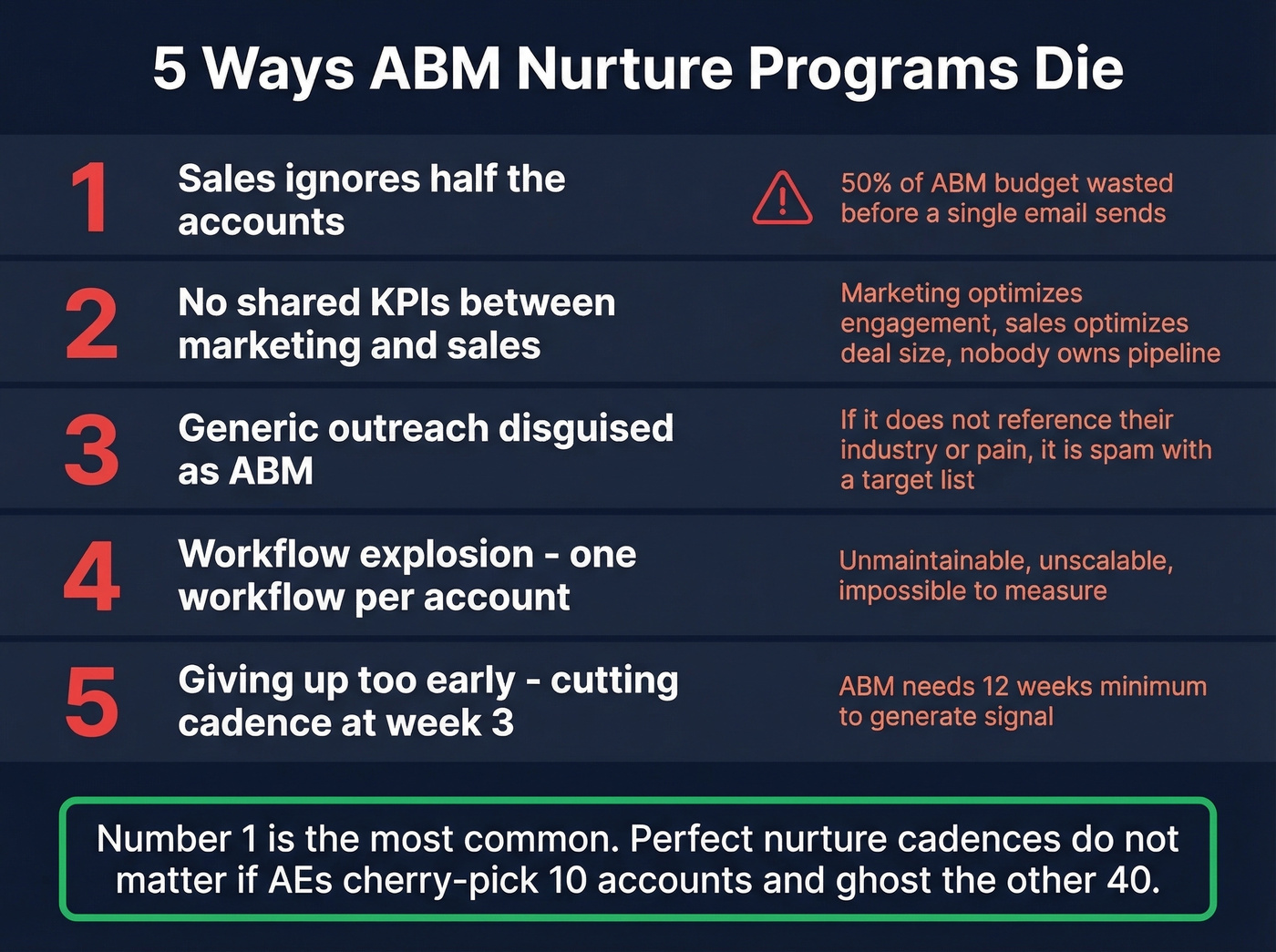
- Sales ignores half the accounts. One company found reps were skipping 50% of target accounts - meaning 50% of the ABM budget was wasted before a single email bounced.
- No shared KPIs. Marketing optimizes for engagement volume. Sales cares about deal size. Nobody owns pipeline creation from target accounts.
- Generic outreach disguised as ABM. If your nurture emails don't reference the account's industry, pain, or situation, it's spam with a target list.
- Workflow explosion. Build branching logic, not individual workflows per account.
- Giving up too early. Nurturing target accounts is a 12-week commitment minimum. Pausing paid social after three weeks or killing a sequence after one non-response guarantees failure.
Look - number one is the most common and the most frustrating. You can build a perfect nurture cadence and it won't matter if your AEs cherry-pick 10 accounts and ghost the other 40. Alignment isn't a nice-to-have. It's the whole game.

ABM nurturing fails when emails bounce and direct dials go nowhere. Prospeo delivers 98% email accuracy and 125M+ verified mobile numbers - refreshed every 7 days, not every 6 weeks. Map entire buying committees with 30+ filters including intent data, job changes, and department headcount.
Stop nurturing accounts with dead contact data.
Benchmarks: What Good Looks Like
Based on benchmarks from 211 companies across 29 countries and broader ABM analytics data:
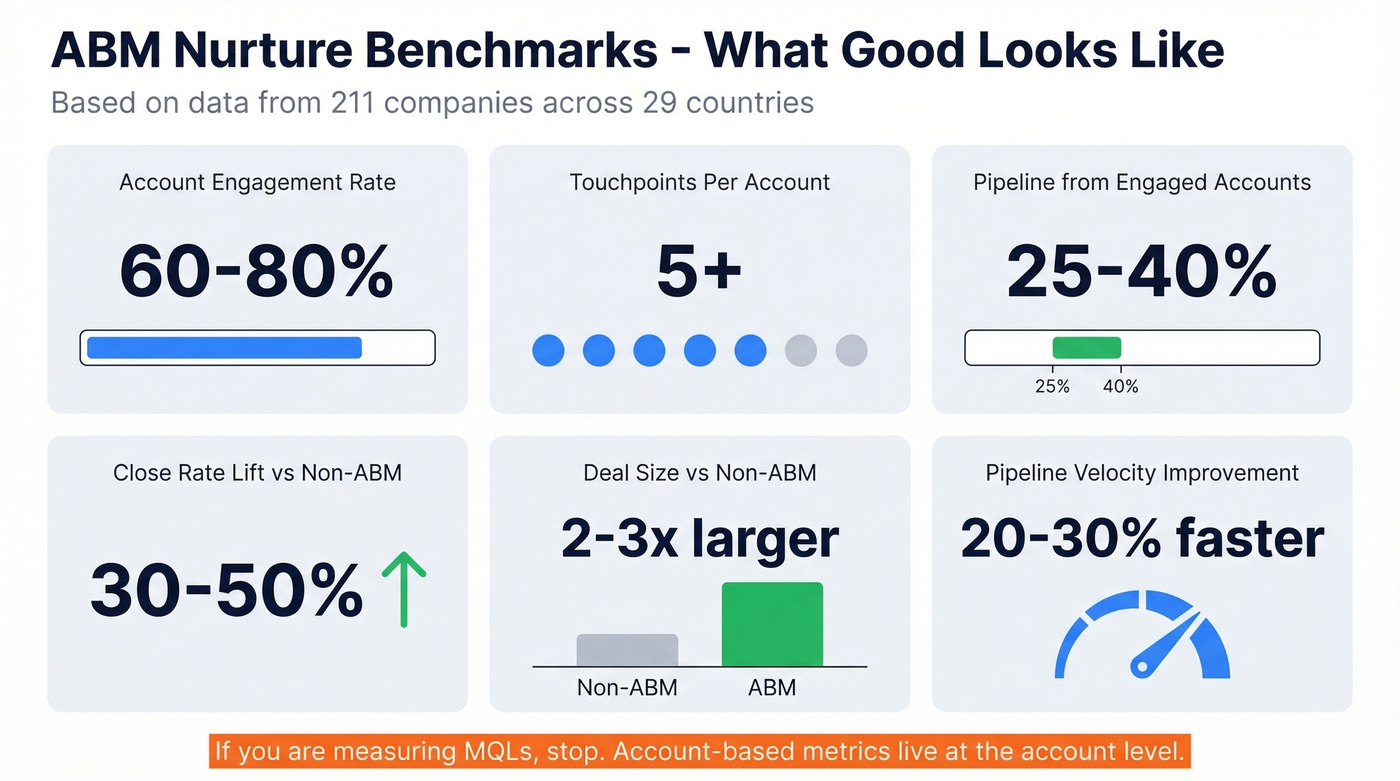
| KPI | Target |
|---|---|
| Account engagement rate | 60-80% |
| Touchpoints per account | 5+ |
| Pipeline from engaged accounts | 25-40% |
| Close rate lift vs non-ABM | 30-50% higher |
| Deal size vs non-ABM | 2-3x larger |
| Pipeline velocity improvement | 20-30% faster |
If you're measuring MQLs, stop. Account-based nurture metrics live at the account level - engagement, pipeline, and revenue.
Reengaging Stalled Accounts
Not every account converts on the first pass. When an account goes dark after initial engagement, trigger a reengagement sequence: refresh your contact data, introduce a new stakeholder angle by targeting a different persona on the buying committee, and lead with a new proof point - a fresh case study, updated ROI data, or a relevant industry shift.
Accounts that showed intent signals six months ago are warmer than net-new targets. Treat them accordingly. Skip reengagement for accounts that explicitly said "not interested" or "wrong fit" - you'll burn goodwill and waste cycles.
The Data Quality Foundation
None of this works if your emails bounce. A nurture sequence hitting dead inboxes doesn't just fail - each bounced sequence trains ISPs to deprioritize your domain, which makes your next sequence fail too. It's a compounding problem that gets worse the longer you ignore it.
Snyk's sales team of 50 AEs saw bounce rates of 35-40% before switching to Prospeo's verified data pipeline. After the switch, bounces dropped under 5% and AE-sourced pipeline jumped 180%. The sequence design didn't change. The data did. Whatever verification tool you use, verify before you send - and re-verify on a regular cycle, because B2B contact data decays at roughly 30% per year.

Half of ABM budgets get wasted on accounts that never get outreach - and bad data kills the other half. Prospeo's 5-step verification and catch-all handling keep bounce rates under 4%, so every touchpoint in your 12-week cadence actually lands. At $0.01 per email, covering an entire buying committee costs less than one bounced sequence.
Reach every stakeholder on the committee - verified.
ABM Nurture Tech Stack
| Category | Tools | Pricing |
|---|---|---|
| Data & Enrichment | Prospeo, ZoomInfo, Cognism | Free tier-$0.01/email; $15-40K/yr; $1-3K/mo |
| Intent | 6sense, Bombora, Demandbase | Free plan (50 credits/mo)-$100K+/yr; ~$25-50K/yr; custom |
| Orchestration | HubSpot, Salesforce | From ~$800/mo; custom |
| Personalization | Mutiny | ~$1K-$3K+/mo |
For teams that need intent data without a six-figure commitment, Prospeo includes intent data - useful for triggering reengagement sequences when dormant accounts start researching your category again.
ABM Nurturing FAQ
What's the difference between ABM nurturing and lead nurturing?
Lead nurturing targets individuals based on behavior - downloads, page visits, form fills. Account-based nurturing orchestrates multi-channel sequences for entire buying committees within target accounts, personalizing by account context, persona, and funnel stage rather than individual actions.
How long should an ABM nurture cadence run?
Effective cadences run 8-12 weeks with 5+ touchpoints across email, paid social, direct mail, and sales outreach. Extend to 16+ weeks for 1:1 accounts with six-month-plus deal cycles. Cutting a cadence short after three weeks is the most common reason programs underperform.
What KPIs should I track?
Account engagement rate (target 60-80%), pipeline from engaged accounts (25-40%), close rate lift (30-50% higher than non-ABM), and deal size (2-3x larger). Drop MQLs - they measure individual behavior, not account-level buying signals.
How do I keep email bounces from killing my nurture program?
Verify every email in your target account list before launching sequences. A bounce rate above 30% damages sender reputation and makes even perfect content invisible. A 7-day data refresh cycle keeps lists clean between sends - stale contacts from quarterly-updated databases are the most common culprit.