

ABM Pipeline: Why Most Programs Fail (+ Fix)
A RevOps lead audited her company's ABM program after six months. The engagement dashboards looked great - ad clicks up, content downloads steady, sales leadership nodding along in QBRs. Pipeline sourced from ABM accounts? Flat. She isn't alone. FullFunnel audited 15 companies running "standard ABM" and found account-to-opportunity conversion was consistently below 1%. In a separate webinar poll, 98% of ABM practitioners said they weren't satisfied with their strategy's results.
The problem isn't ABM as a concept. It's ABM as most teams execute it. Building real ABM pipeline requires fixing execution, not buying another platform.
What You Actually Need
Most ABM programs fail at execution, not strategy. Fix three things and pipeline moves:
- Tight target account list: 50-200 accounts maximum. Anything larger dilutes focus before you know what works.
- Verified contact data for the buying committee: The average B2B deal involves 6.8 decision-makers. If you can't reach them, your program is just expensive brand awareness.
- 48-hour sales follow-up SLA: Marketing warms an account, sales ignores it for two weeks, the moment passes. Lock in a 24-48 hour response window.
What Account-Based Pipeline Actually Means
ABM pipeline isn't a different kind of pipeline - it's pipeline measured at the account level instead of the lead level. The distinction matters because it changes what you optimize for.
The core formula is pipeline velocity:
(# Opportunities x Avg Deal Size x Win Rate) / Sales Cycle Length = $ per day
ABM's job is to improve all four levers at once: better-fit opportunities, larger deals through multi-threading, higher win rates via personalized engagement, and shorter cycles because you're reaching the right people earlier. You'll also want to track whether pipeline was "sourced" by ABM or "influenced" by it - the FAQ below breaks down that difference.
Why Most ABM Programs Fail
Four failure modes kill account-based pipeline generation. They're all fixable, but you have to name them first.
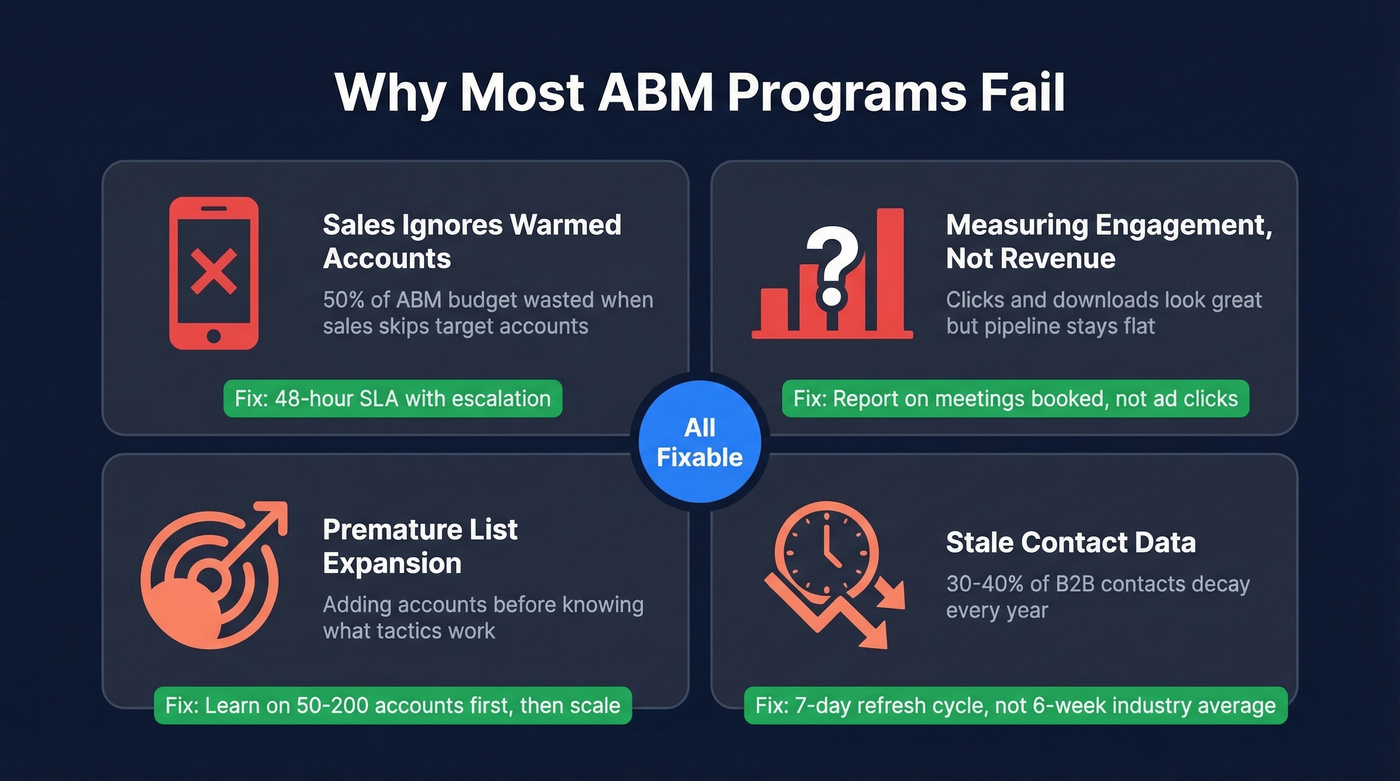
Sales Ignores Warmed Accounts
This is the most expensive failure. Trinity Nguyen at UserGems shared a telling example: after launching ABM, sales only worked half the target accounts. Marketing effectively wasted 50% of its ABM budget, and mistrust between teams stalled the entire program. The fix is a shared SLA with teeth - if an MQA isn't touched within 48 hours, it gets escalated. In our experience, the 48-hour SLA is the single highest-leverage fix for stalled programs. Nothing else comes close.
Measuring Engagement Instead of Revenue
Directive's team puts this bluntly: engagement isn't a success metric. Meetings created, pipeline influenced, and revenue accelerated are the only metrics that matter. Without proper pipeline reporting, teams default to vanity metrics and leadership loses confidence.
This echoes a recurring complaint on r/SaaSMarketing - practitioners report engagement metrics look fine while pipeline stays flat, and leadership demands revenue proof they can't provide. We've seen this pattern dozens of times. It's frustrating because the fix is straightforward: stop reporting on clicks and start reporting on meetings booked from target accounts.
Premature List Expansion
Here's the thing: the instinct to add more accounts when results are mixed is understandable. It's also backwards. Scaling before you understand which tactics drive meetings guarantees you'll waste budget at a larger scale. Learn first, expand second.
Stale Contact Data
B2B contact data decays 30-40% annually. A third of your buying committee contacts are bouncing, disconnected, or at a different company within a year. Most providers refresh every six weeks or so, which means you're already behind by the time you launch a campaign.

Stale data kills ABM pipeline before sales even picks up the phone. Prospeo refreshes every 7 days - not the 6-week industry average - so your buying committee contacts are verified when you need them. 98% email accuracy, 125M+ direct dials, and 30+ filters including buyer intent to build laser-focused target account lists.
Stop wasting ABM budget on contacts who left the company six months ago.
The Framework That Moves Pipeline
Not every account deserves the same investment. Tier your approach and set concrete targets for each level.
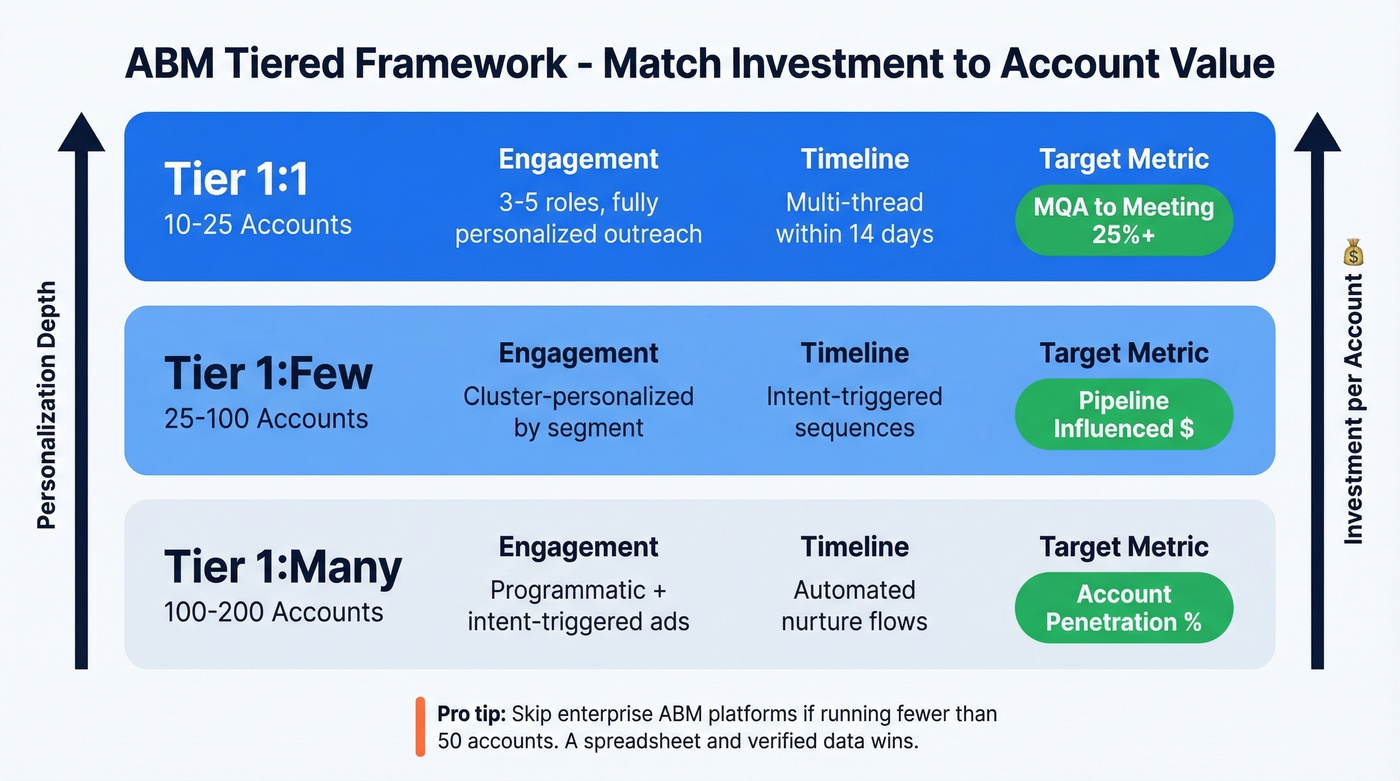
| Tier | Accounts | Engagement Depth | Key Metric |
|---|---|---|---|
| 1:1 | 10-25 | 3-5 roles, fully personalized | MQA-to-meeting >= 25% |
| 1:few | 25-100 | Cluster-personalized | Pipeline influenced |
| 1:many | 100-200 | Programmatic + intent-triggered | Account penetration |
For Tier 1 accounts, the target is multi-threading 3-5 roles within 14 days - economic buyer, end-user leader, champion, and risk owners like procurement or security. Momentum ITSMA's research found that top ABM performers use account-level insights 39% of the time versus 25% for underperformers. That 14-point gap is where pipeline lives.
Across all tiers, retargeting execution matters. Follow up within 24-48 hours on ad engagement, segment by account and buying stage, cap frequency, and use meeting-oriented offers instead of gated content. The goal is a conversation, not another download.
ABM Pipeline Conversion Benchmarks
Here's where most B2B funnels leak, based on MarketJoy's aggregated conversion data:
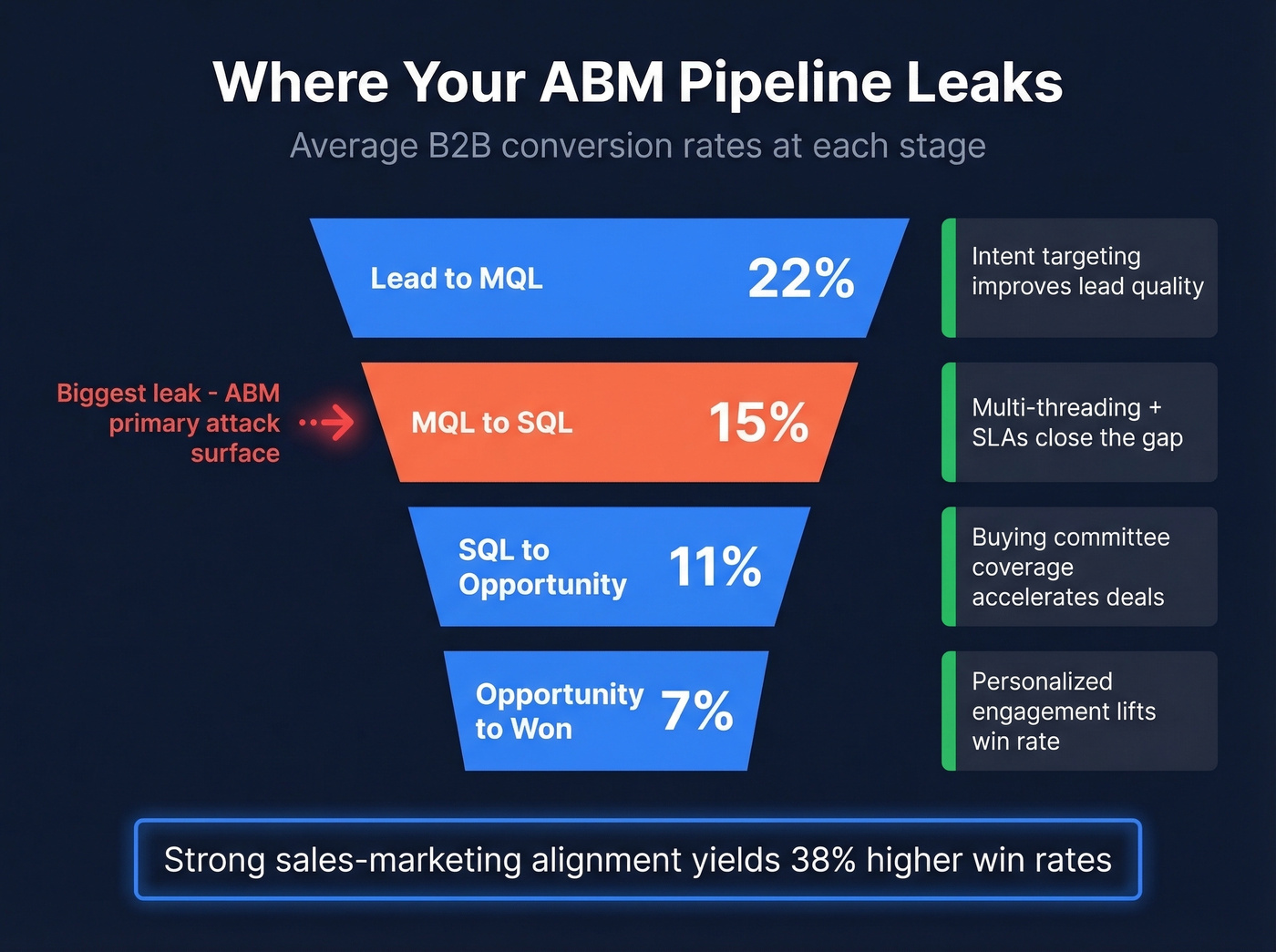
| Stage | Conversion Rate | ABM Impact |
|---|---|---|
| Lead to MQL | 22% | Intent-based targeting improves quality |
| MQL to SQL | 15% | Multi-threading + SLAs close the gap |
| SQL to Opportunity | 11% | Buying committee coverage accelerates |
| Opportunity to Won | 7% | Personalized engagement lifts win rate |
The MQL-to-SQL drop-off is the biggest leak and ABM's primary attack surface. Improving conversion at this stage requires tight sales-marketing alignment - HubSpot's data suggests strong alignment yields 38% higher win rates, and that tracks with what we've seen across client programs. With 64% of B2B teams running ABM and Forrester reporting 21-50% higher ROI, the question isn't whether ABM works. It's whether your execution captures that upside.
Let's be honest: if your average contract value is under $25K, you probably don't need a full ABM platform. A tight account list, verified contact data, and a real sales SLA will outperform a $60K Demandbase contract with sloppy execution every time.
How to Measure ABM Pipeline
39% of ABM practitioners say attribution is their top challenge, and 36% struggle to measure overall ABM success. Perfect attribution isn't the goal - directional accuracy is. Use a tiered metrics framework that makes measurement actionable rather than academic.
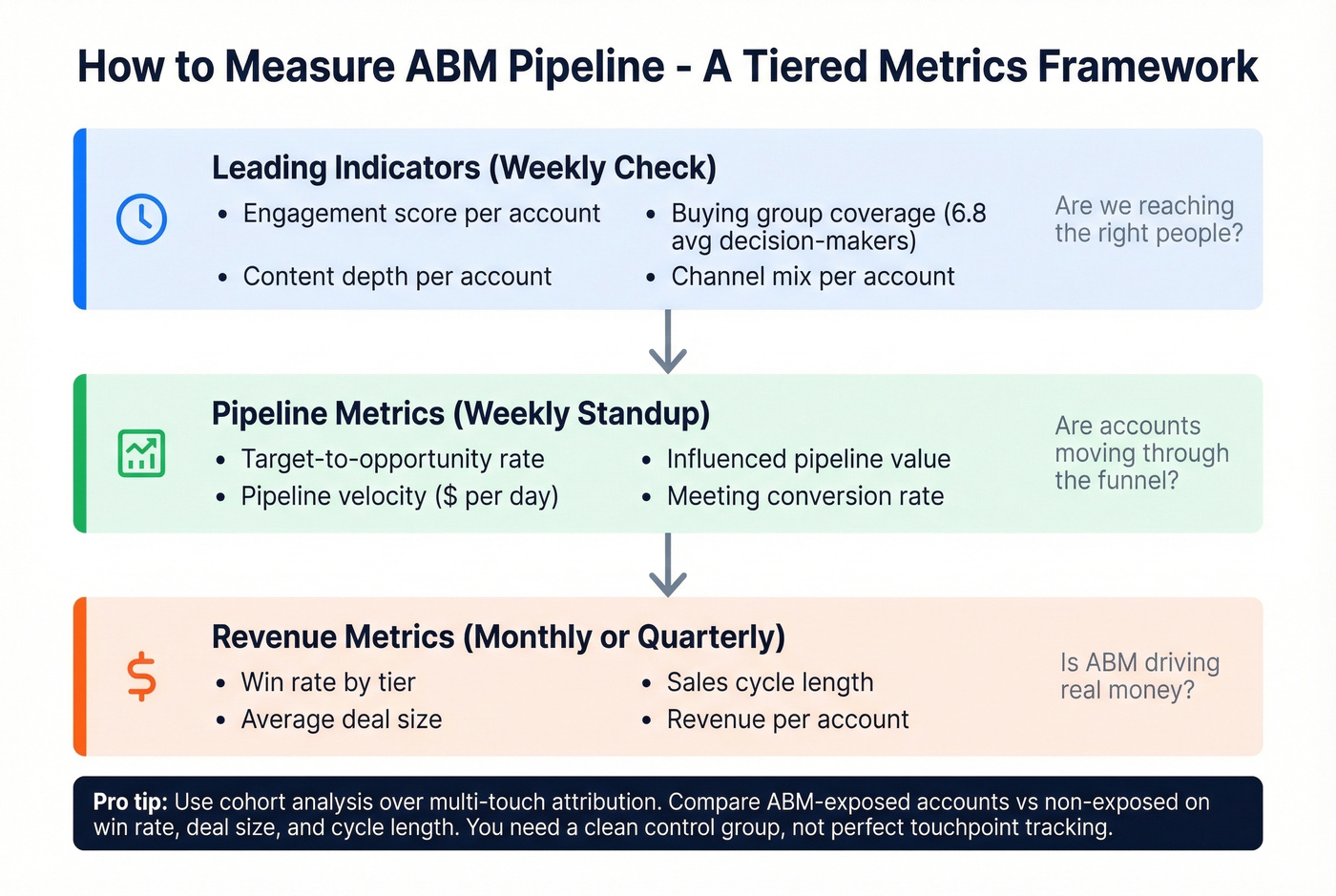
Leading indicators: Engagement score per account, buying group coverage across the 6.8 average decision-makers, content depth, channel mix per account. These tell you whether your program is reaching the right people.
Pipeline metrics: Target-to-opportunity rate, pipeline velocity, influenced pipeline value, meeting conversion rate. These are your weekly operating metrics - the numbers you bring to every standup.
Revenue metrics: Win rate, average deal size, sales cycle length, revenue per account by tier. Review monthly or quarterly.
We've found cohort analysis beats multi-touch attribution models for proving ABM's value to leadership. Compare ABM-exposed accounts against non-exposed accounts on win rate, deal size, and cycle length. You don't need perfect touchpoint tracking - you need a clean control group.
Tools to Accelerate ABM Pipeline
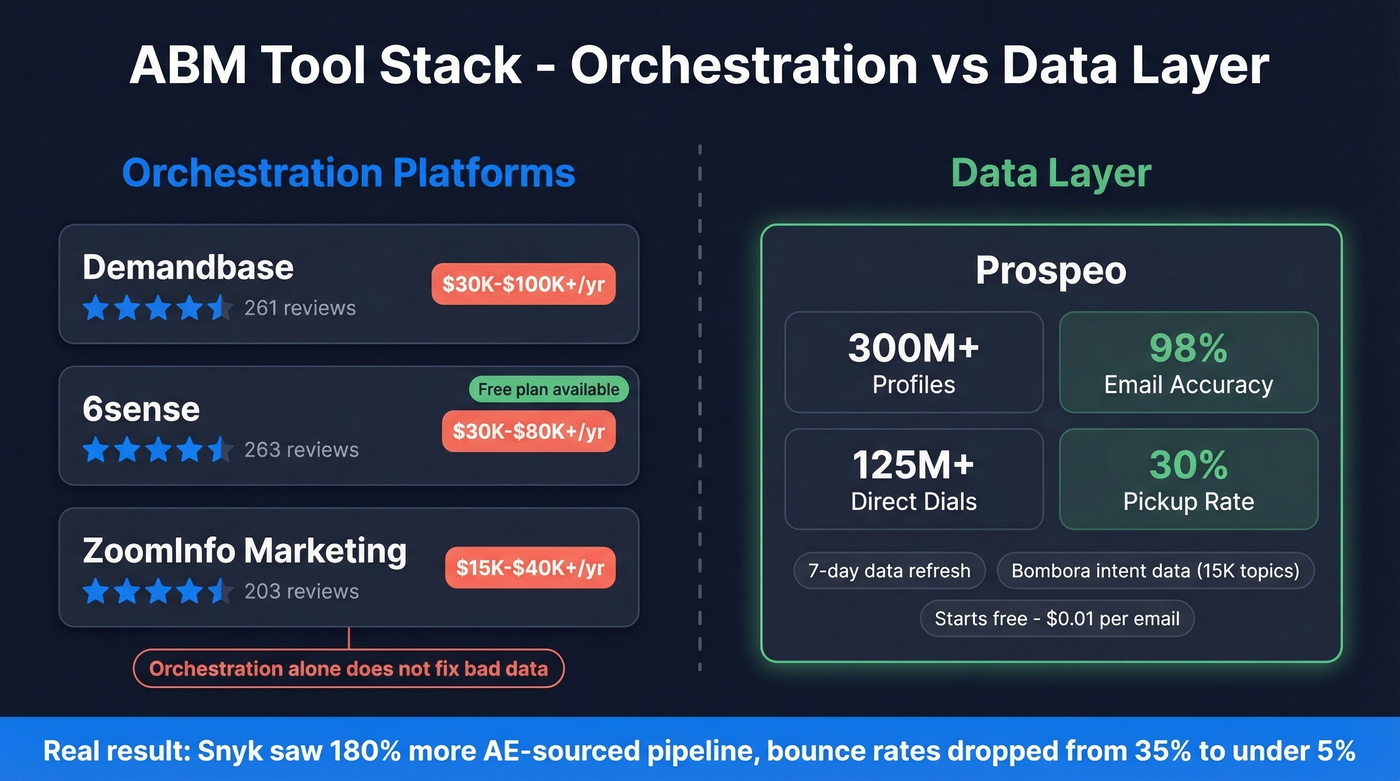
Enterprise ABM platforms handle orchestration - account identification, advertising, and cross-channel coordination. Here's how the major players stack up on Gartner Peer Insights:
| Tool | Role | Rating | Pricing |
|---|---|---|---|
| Demandbase | ABM orchestration | 4.5/5 (261 reviews) | ~$30K-$100K+/yr |
| 6sense | Intent + orchestration | 4.4/5 (263 reviews) | Free plan available; paid ~$30K-$80K+/yr |
| ZoomInfo Marketing | Data + orchestration | 4.6/5 (203 reviews) | ~$15K-$40K+/yr |
These platforms are powerful, but they don't solve the data layer underneath. You can run the most sophisticated orchestration in the world, and it won't matter if your emails bounce and your phone numbers are disconnected. That's the gap we kept running into when auditing ABM programs - the orchestration was fine, the data was rotten.
Prospeo fills that gap with 300M+ professional profiles, 98% email accuracy, and 125M+ verified mobile numbers delivering a 30% pickup rate. For ABM specifically, that mobile coverage is critical for multi-threading into buying committees where email alone won't cut it. Intent data tracks 15,000 topics via Bombora, and a 7-day data refresh cycle means your contact data doesn't decay between campaign launches. Real-world impact: Snyk's 50 AEs saw AE-sourced pipeline jump 180% after switching, with bounce rates dropping from 35-40% to under 5%. Self-serve pricing starts free, with paid plans at roughly $0.01 per email - no annual contracts required.
Skip the enterprise ABM platforms entirely if you're running fewer than 50 target accounts. A spreadsheet, Prospeo for contact data, and a disciplined follow-up process will get you further than a six-figure platform with no execution behind it.
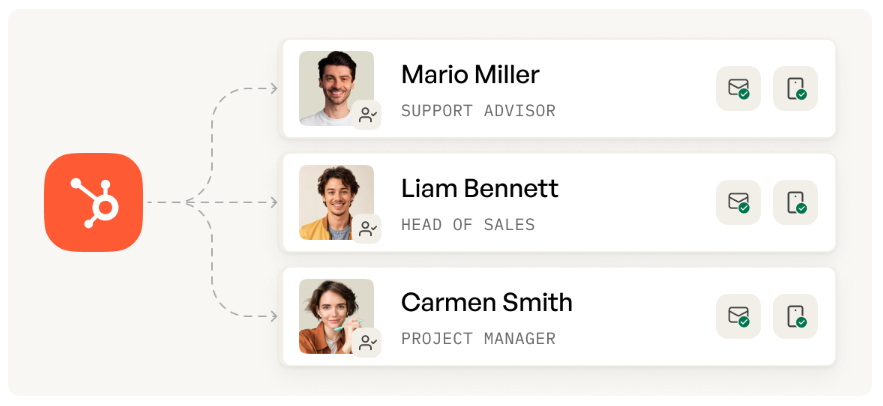
Multi-threading 3-5 roles in 14 days requires contact data that actually connects. Prospeo gives you verified emails and direct dials for the full buying committee - economic buyers, champions, and blockers - across 300M+ profiles. At $0.01 per email, you cover every tier without burning your ABM budget.
Reach the entire buying committee, not just the one contact who downloaded your ebook.
FAQ
What's the Difference Between Sourced and Influenced Pipeline?
Sourced pipeline comes from accounts where ABM was the first touch that created the opportunity. Influenced pipeline includes any deal where ABM touches occurred during the sales cycle, even if another channel opened the account. Track both - sourced shows direct impact, influenced shows full reach across the funnel.
How Many Accounts Should You Target?
Start with 50-200 accounts maximum. Tier 1 should be 10-25 accounts with the highest fit and intent signals. Expanding before you understand which tactics drive meetings is the most common failure mode. Learn what works at small scale first.
How Do You Keep ABM Contact Data Accurate?
B2B contact data decays 30-40% annually, so weekly refresh cycles are the gold standard versus the six-week industry average. Verify emails before every outreach sequence to protect deliverability and sender reputation - a single bad batch can tank your domain for weeks.
What Does Pipeline Reporting Look Like in Practice?
Effective reporting combines leading indicators like engagement scores and buying group coverage with lagging metrics like win rate and revenue per account. Build a single dashboard showing account progression from target list through closed-won, segmented by tier, so both marketing and sales share one source of truth. If the two teams are looking at different dashboards, you've already lost.