

Account-Based Marketing Checklist: 10 Steps to Launch and Measure ABM in 2026
39% of B2B marketers say their biggest ABM challenge is deciding which accounts to target. Not the tech stack. Not the budget. Just picking names. That single stat explains where most programs fall apart - they skip the foundation and buy a platform instead.
This account-based marketing checklist walks you through every step from ICP definition to measurement, with the scoring rubrics, tier structures, and KPI frameworks that actually make ABM work.
What You Need (Quick Version)
- A validated ICP with scoring built from closed-won data
- A tiered target account list - often 1,000-5,000 accounts - segmented by fit and intent
- Verified contact data for 4-6 stakeholders per account
- Sales-marketing alignment on shared KPIs like pipeline velocity, not MQLs
- A measurement framework tracking engagement depth, pipeline speed, and account penetration
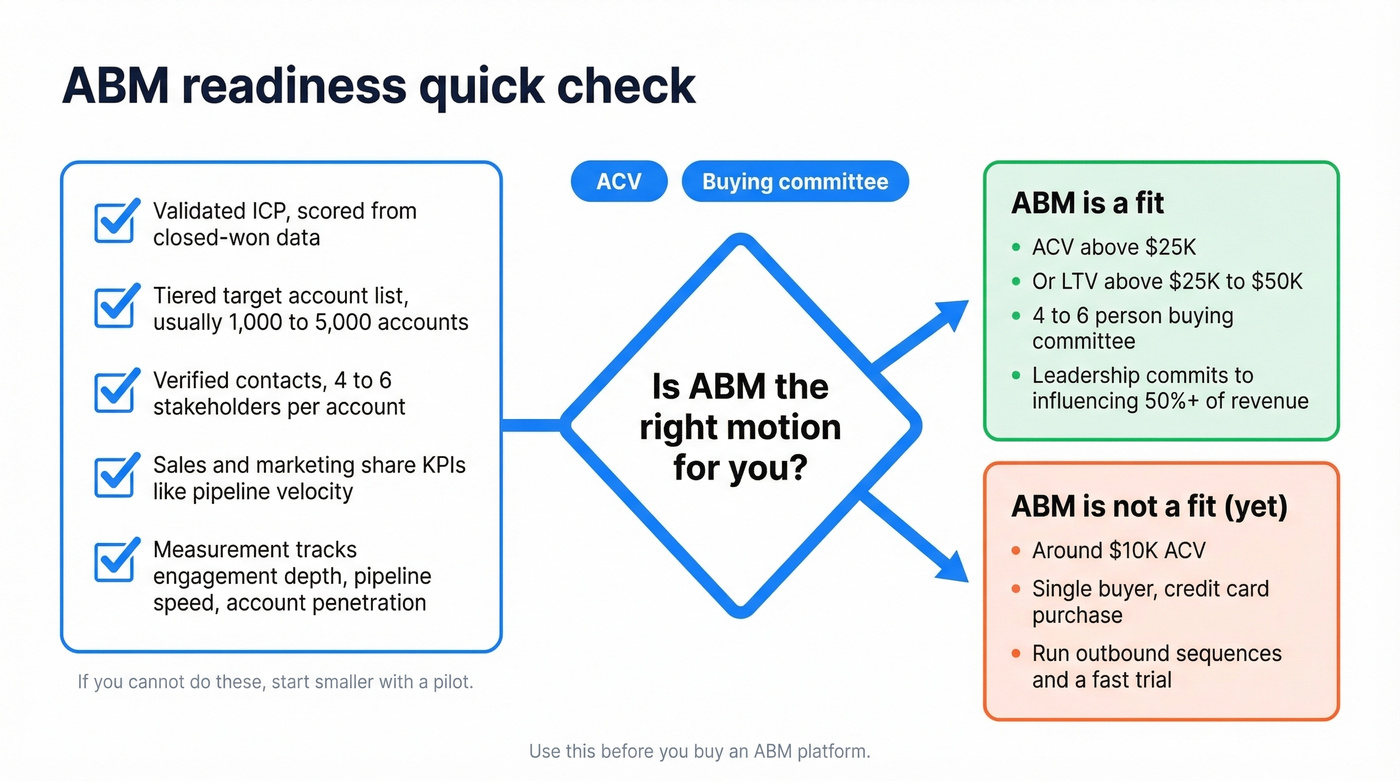
If your average contract value hovers around $10K and you sell to a single buyer, ABM usually isn't the right play. Run outbound. ABM pays off when ACV exceeds $25K or when lifetime value tops $25-50K and buying committees are involved.
Should You Even Run ABM?
ABM is a resource allocation strategy. It concentrates budget on accounts most likely to close at high value. If you're selling high-value contracts to committees of 4-6 people, it's what you should use. If you're selling $5K subscriptions to individual contributors who can swipe a credit card, you need a good outbound sequence and a fast trial - not account-level orchestration.
Here's the thing: mature ABM programs should influence at least 50% of total revenue. If leadership isn't willing to commit at that level, you'll end up with slightly personalized outbound, which is exactly what happens when you half-commit to the framework.
Contact-level ABM - reaching specific stakeholders, not just accounts - increases booked meetings by up to 74% and pipeline conversion by up to 118%. Those numbers justify the investment. Let's build the checklist.

Step 6 of your ABM checklist - data enrichment - is where most programs quietly die. Prospeo delivers 143M+ verified emails at 98% accuracy on a 7-day refresh cycle, so your buying committee outreach actually lands. Snyk ran 50 AEs on Prospeo and cut bounce rates from 35-40% to under 5%.
Stop killing your ABM program with stale data at $0.01 per verified email.
The 10-Step ABM Checklist
1. Define Your ICP with a Scoring Rubric
Pull 50-100 closed-won deals from the last 12 months. Build a 100-point scoring model: firmographics get 40 points, technographics 30, intent signals 30. Tier A accounts score 80-100, Tier B falls between 50-79, and Tier C is everything below.
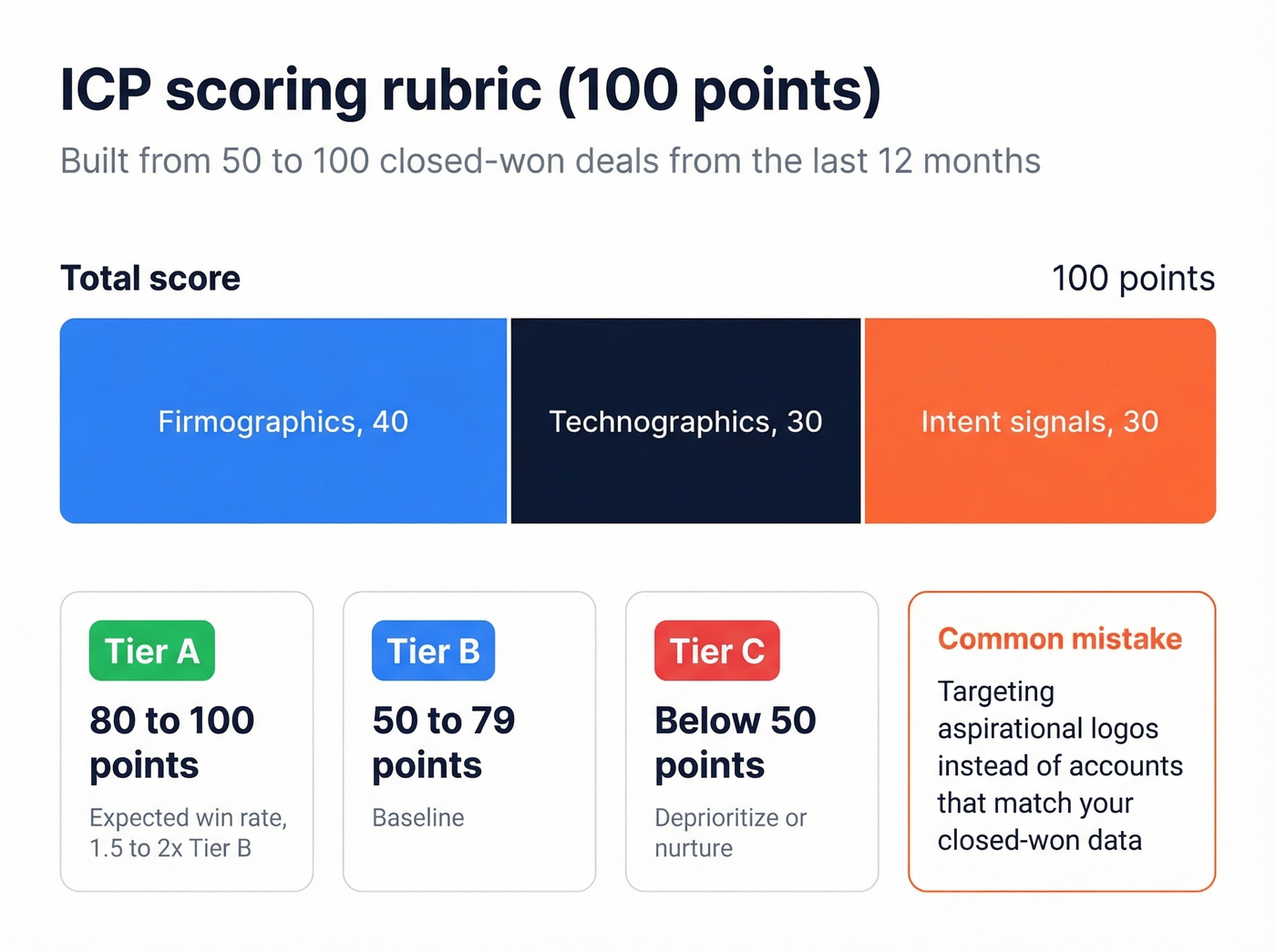
Top-performing teams see Tier A win rates at 1.5-2x Tier B with 15-20% shorter cycle times. In our experience, teams that skip the closed-won analysis end up targeting aspirational accounts - the logos they want on their website - not the ones that actually match their product.
2. Build Your Target Account List
A realistic target account list runs 1,000-5,000 accounts. Build it using firmographics, intent data, and in-market signals - not a list your VP of Sales pulled from memory over lunch. 83% of marketers use lookalike tactics to expand their TAL beyond known accounts. Start with your best customers, find structural twins, then layer intent on top.
3. Tier Your Accounts
Tier 1 is white-glove: dedicated content, personalized outreach, direct mail with QR codes or personalized URLs for tracking. Tier 2 is automated but personalized, with templated sequences and account-specific hooks. Tier 3 is programmatic.
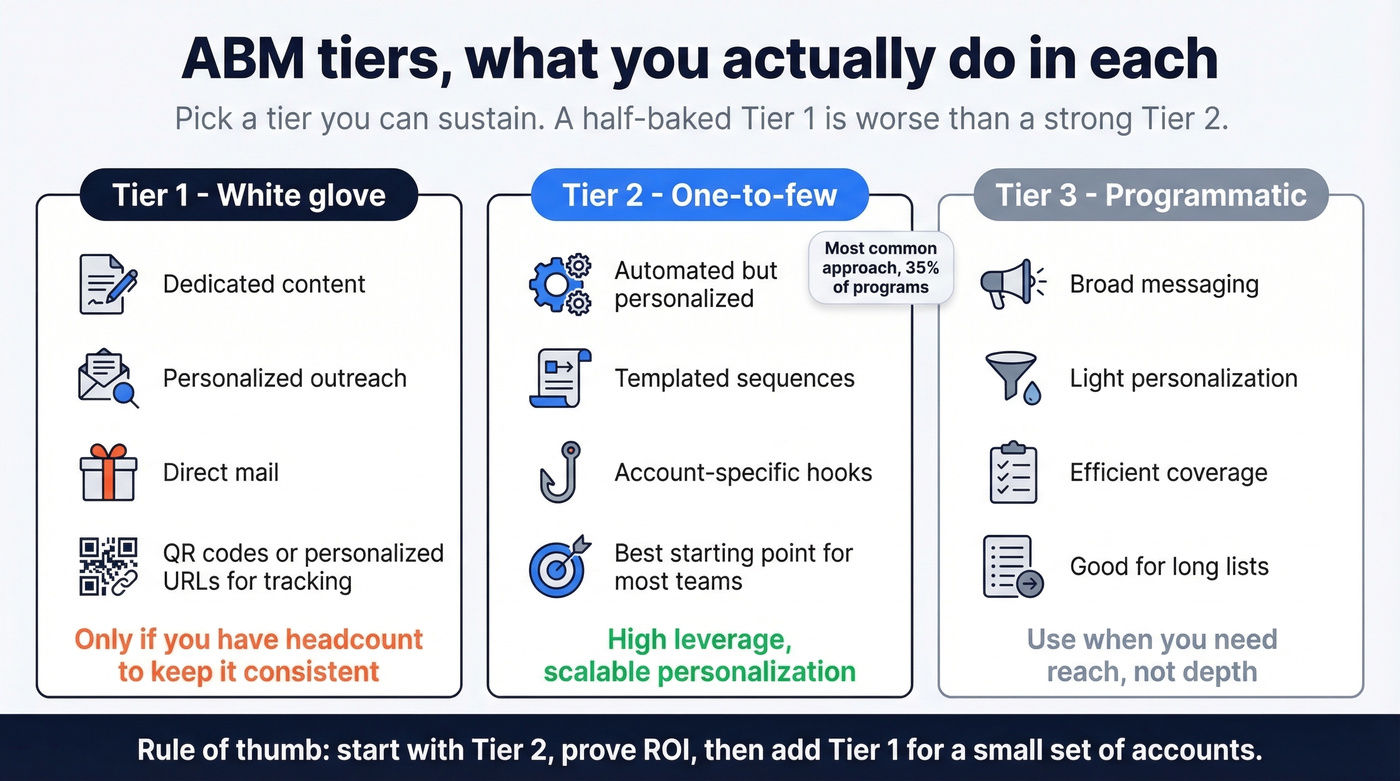
One-to-few (Tier 2) is the most common approach at 35% of programs, and it's where most teams should start. Skip Tier 1 entirely if you don't have the headcount to sustain it - a half-baked white-glove experience is worse than a well-executed Tier 2 play.
4. Map Buying Committees
Identify 4-6 stakeholders per target account. Map them by role: decision-makers, champions, end users. Save phone enrichment budget for Tier 1 contacts where a direct dial actually matters. The goal is multi-threaded engagement, not one conversation with one champion who might leave next quarter and take your deal with them.
5. Choose Your ABM Tech Stack
You don't need a $100K platform to start. A CRM, a contact enrichment tool, and shared KPIs between sales and marketing will get you through a pilot. Add dedicated ABM platforms like Demandbase, 6sense, Terminus, or RollWorks when you outgrow manual orchestration.
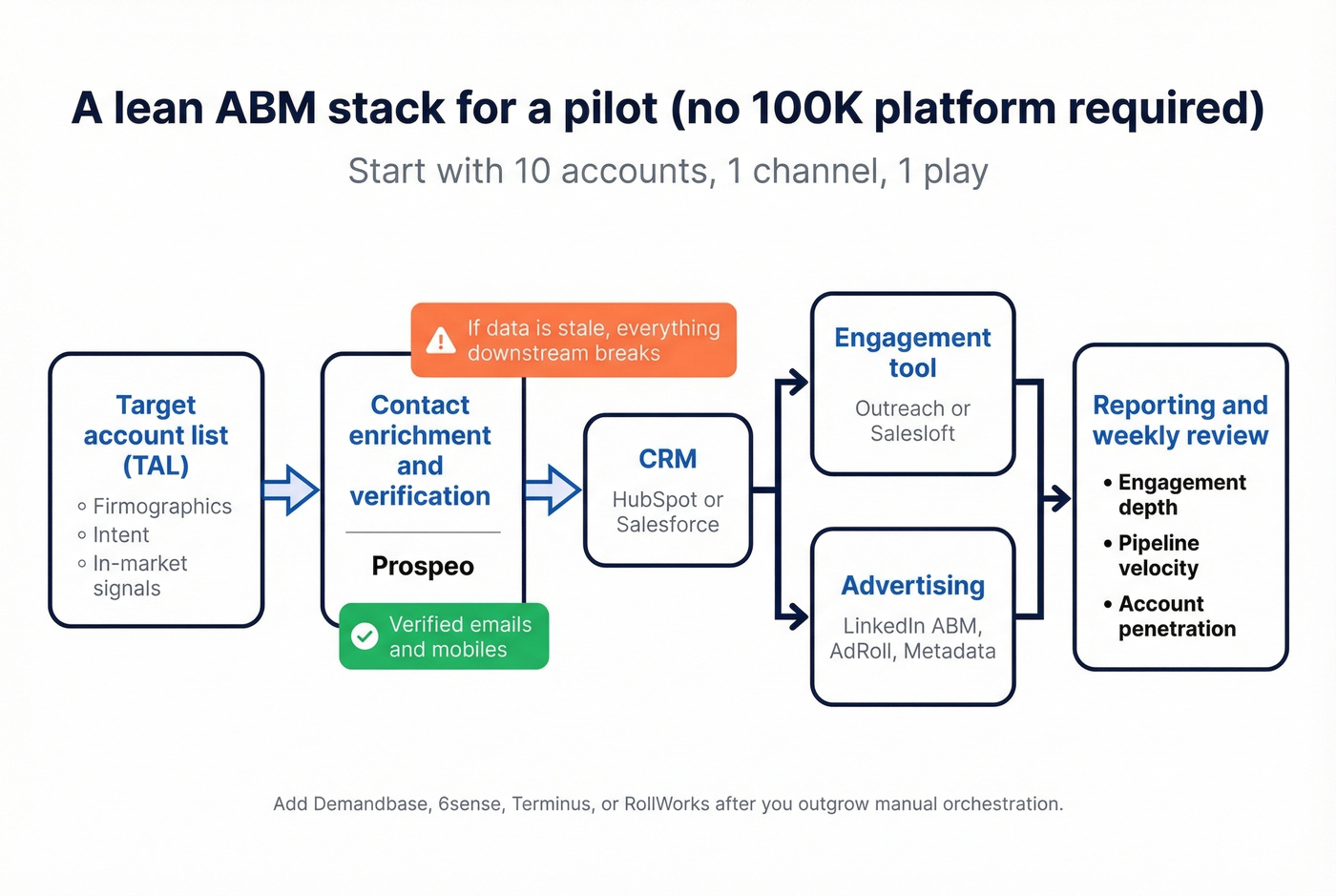
Start with 10 accounts, 1 channel, 1 play. Prove ROI before scaling.
6. Enrich and Verify Contact Data
This is where ABM programs die silently. You've built a beautiful TAL, mapped buying committees, tiered your accounts - and then a big chunk of your emails bounce because the data is stale. Your domain reputation tanks, sales loses trust in marketing's lists, and the whole program stalls before it ever gets traction.
We've seen this pattern dozens of times. Prospeo handles it with 143M+ verified emails at 98% accuracy and 125M+ verified mobile numbers on a 7-day refresh cycle. Snyk ran 50 AEs through Prospeo and dropped their bounce rate from 35-40% to under 5%, generating 200+ new opportunities per month. At roughly $0.01 per email with a free tier of 75 emails/month, there's no reason to skip verification.

7. Personalize Content by Stage and Persona
Map content to the buyer's stage. Awareness gets thought leadership. Consideration gets use cases and objection-handling. Post-purchase gets adoption content and feature announcements. Web personalization drives 50% higher form submissions and 60% longer time on site. Generic content is the fastest way to make ABM look like expensive lead gen.
The biggest personalization blockers we see aren't creative - they're structural. Siloed data between marketing automation and CRM, wrong tech stack choices, and over-reliance on third-party data that's months stale all kill personalization before it starts.
8. Launch Targeted Advertising
Paid isn't optional in ABM - it's a core channel. ABM combined with account-based advertising delivers 60% higher win rates and 72% higher engagement. A ZenABM benchmark study across 211 companies and $5.5M+ in ad spend provides a useful dataset for how teams run ABM ads at scale.
Budget accordingly. Platforms like AdRoll, Metadata, and Drift's conversational ads each serve different stages of the funnel, and mixing them is usually smarter than going all-in on one.
9. Align Sales and Marketing
Duplicate outreach and missed follow-ups aren't tool failures. They're alignment failures. Sales and marketing need shared KPIs - meetings booked, multi-contact engagement, opportunity creation. Not MQLs.
Set up joint account planning sessions, sync your CRM with your ABM data, and run a weekly review cadence. We've seen teams with perfect tech stacks fail because nobody agreed on what "success" meant. One team tracks engagement scores while the other tracks meetings booked, and both declare the program a failure at the end of Q2. Get on the same page before you spend a dollar.
10. Measure with Leading and Lagging KPIs
Track three pillars: engagement depth, pipeline velocity, and account penetration.
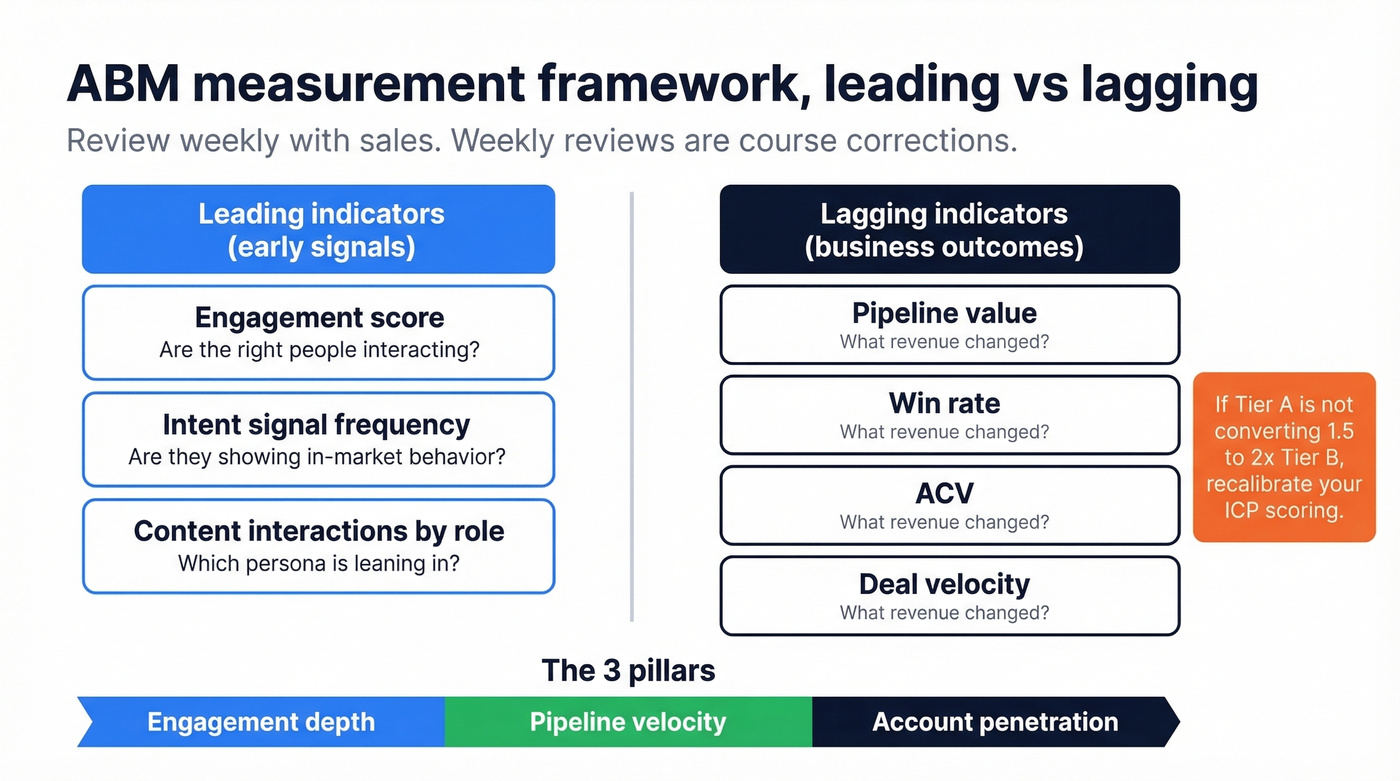
Leading indicators: engagement scores, intent signal frequency, and content interactions by role. Lagging indicators: pipeline value, win rate, ACV, and deal velocity.
If your Tier A accounts aren't converting at 1.5-2x the rate of Tier B, your ICP scoring needs recalibration. Review weekly with sales - not quarterly. Quarterly reviews are post-mortems. Weekly reviews are course corrections.
ABM Tools by Category
Pick one tool per category that matches your budget and maturity level.
| Category | Tool | Starting Price | Best For |
|---|---|---|---|
| Contact Enrichment | Prospeo | Free; ~$0.01/email | Verified emails + mobiles, data freshness |
| Contact Enrichment | ZoomInfo | ~$15-40K/yr | Full-suite intelligence |
| Contact Enrichment | Clearbit | Free tier; from ~$99/mo | Firmographic enrichment |
| Core ABM | Demandbase | ~$30-100K/yr | Enterprise orchestration |
| Core ABM | 6sense | ~$30-100K/yr | Intent-driven ABM |
| Core ABM | RollWorks | ~$10-15K/yr | Mid-market ABM |
| Core ABM | Terminus | ~$20-40K/yr | Multi-channel ABM |
| Intent Data | Bombora | ~$25-50K/yr | Topic-level intent |
| Engagement | Outreach | ~$100-130/user/mo | Multi-channel sequences |
| Engagement | Salesloft | ~$100-150/user/mo | Pipeline + engagement |
| CRM | HubSpot | Free; from ~$800+/mo | All-in-one marketing + CRM |
| CRM | Salesforce | From ~$25/user/mo | Enterprise CRM |
| Advertising | AdRoll | Self-serve, usage-based | Retargeting + ABA |
| Orchestration | Clay | From ~$149/mo | Enrichment workflows |
For teams just getting started, the CRM + Prospeo + one engagement tool combination covers 80% of what you need. If you're still evaluating vendors, start with a quick scan of data enrichment services and a shortlist of SDR tools that fit your motion. The consensus on r/sales is that most teams over-buy ABM tooling in year one and under-invest in the data quality and alignment work that actually drives results.
ABM Mistakes to Avoid
Measuring MQLs instead of pipeline. MQLs are a lead gen metric. ABM tracks account engagement, influenced pipeline, and deal velocity. If your dashboard still shows MQL counts, you're running lead gen with extra steps.
One-size-fits-all content. Sending the same case study to a CFO and a DevOps lead is lazy. Personalize by role, stage, and industry - or don't bother with ABM.
Skipping sales alignment. No amount of tooling fixes a team where marketing targets one account list and sales works another. Align on accounts, KPIs, and cadence before you spend a dollar on ads.
Using unverified contact data. A high bounce rate doesn't just waste budget - it can get your domain flagged and crush deliverability for months. Catch invalid emails, spam traps, and catch-all domains before they damage your sender reputation. If deliverability is already slipping, use an email deliverability guide and track your email bounce rate before you scale sends.
Stopping ABM at close. Post-sale personalization drives retention and expansion. Milestones, renewals, cross-sell intent signals - these are ABM plays, not just customer success tasks. Some of the best pipeline we've seen comes from expansion plays within existing accounts.
FAQ
How long does it take to see ABM results?
Expect engagement signals within the first 4-8 weeks and measurable pipeline impact at 2-3 quarters. Start with 10 accounts and 1 play - prove ROI before scaling to your full target account list.
Can you run ABM without a dedicated platform?
Yes. A CRM, a contact enrichment tool, and sales-marketing alignment on shared KPIs are enough to launch. Add a dedicated platform when you need programmatic scoring at scale.
What's the minimum budget for an ABM pilot?
There's no hard floor, but most successful pilots dedicate 30-50% of marketing resources to ABM. The biggest cost is time - building the ICP, mapping committees, personalizing content - not tooling.
How many accounts should a first ABM program target?
Start with 10-25 Tier 1 accounts for a focused pilot. Scale to 100-500 once you've validated your ICP scoring and proven pipeline impact. Jumping straight to thousands of accounts dilutes personalization and makes measurement nearly impossible.
Mapping 4-6 stakeholders per account means nothing if you can't reach them. Prospeo gives you verified emails and 125M+ direct dials with a 30% pickup rate - so your multi-threaded ABM outreach connects with real buyers, not dead inboxes.
Build verified buying committees in minutes, not weeks.