


Accutrend vs Ampliz: Two Very Different Tools Compared
Your VP told you to evaluate both. Here's the short version: they aren't competitors. One sells government-sourced business filing data for risk and compliance teams. The other sells B2B contact intelligence focused on healthcare and APAC markets. Comparing them is like comparing a county clerk's office to a sales database.
We've dug into both platforms so you don't have to spend a week on demos that lead nowhere.
30-Second Verdict
Side-by-Side Comparison
| Dimension | Accutrend | Ampliz |
|---|---|---|
| What it is | Gov-sourced business filings | APAC + healthcare contacts |
| Founded | 1989 | - |
| Primary use case | Risk, compliance, underwriting | Sales, healthcare marketing |
| Data type | UCC filings, registrations | Emails, dials, firmographics |
| Geographic focus | US + Canada/Mexico | APAC (16 countries) + US |
| Database size | 500,000+ records/month | 400M+ contacts |
| Data freshness | 24-hour (registrations) | Email status updated within 30/60/120 days |
| Pricing | Custom; ~$10K-$50K+/yr | Free / $50/mo / $480/yr |
| Contract | 5 consecutive 12-month terms, 90-day written notice | Month-to-month or annual |
| Integrations | API, CSV, dashboard; CRM/CDP connectable | Not publicly documented |
| G2 rating | No reviews | 4.2/5 (7 reviews) |
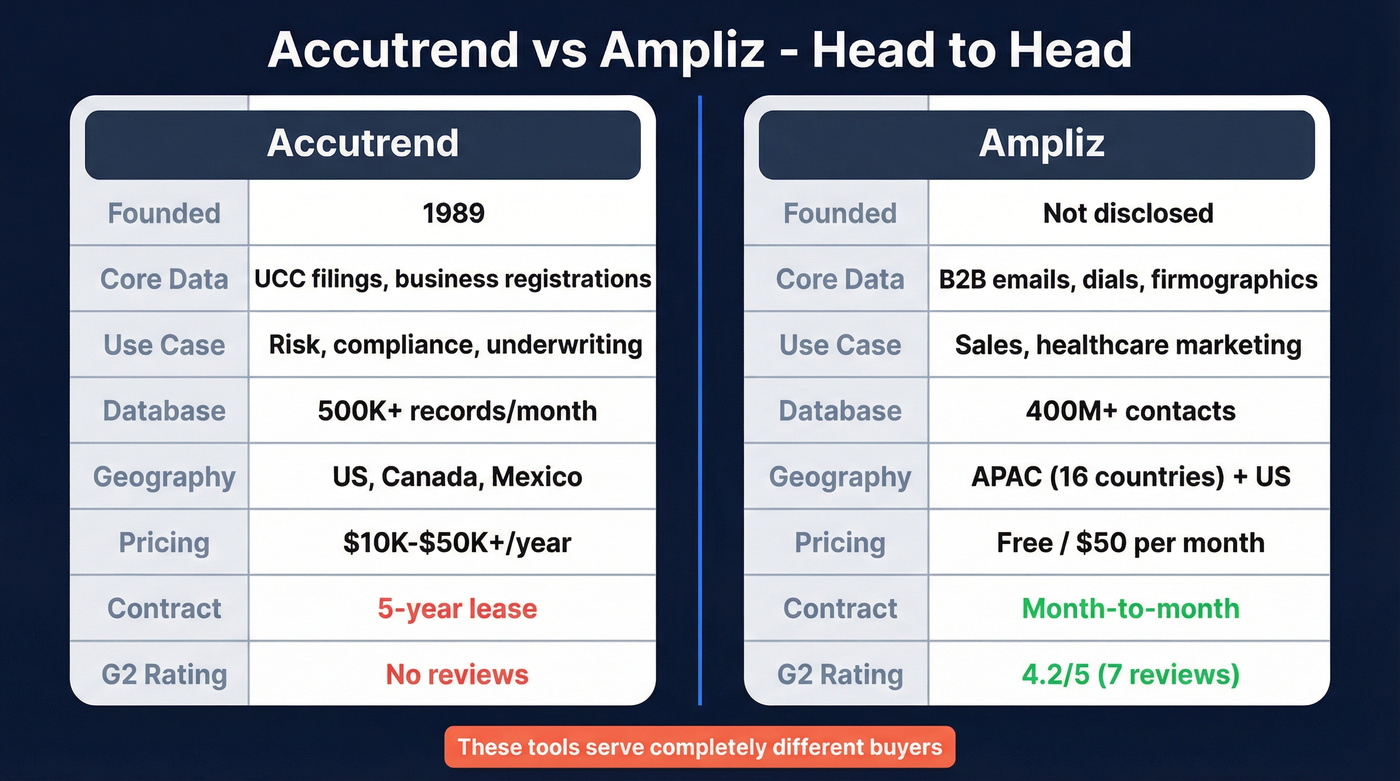
These tools serve fundamentally different buyers.
What Accutrend Actually Does
Accutrend is a roughly 15-person company that's been pulling structured data directly from government sources since 1989 - secretaries of state, county clerks, licensing agencies. Their core products are UCC filing data and new business registrations sourced from over 2,300 government entities across the US, each record parsed into 100+ structured fields. New registration data refreshes every 24 hours. Specialty datasets like liquor licenses update weekly or biweekly.
If you're evaluating vendors in the broader B2B company data ecosystem, this is a very specific (and very compliance-oriented) corner of the market.
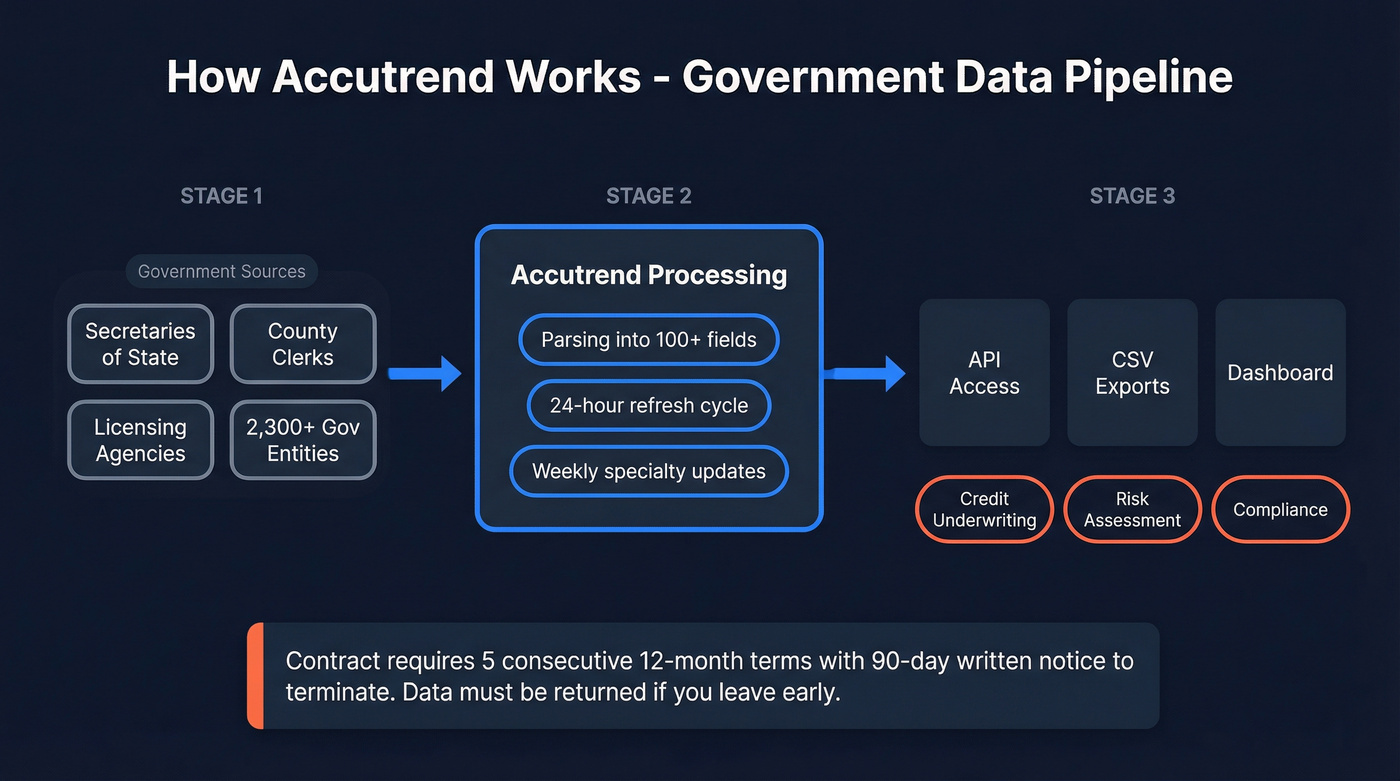
The contract structure is a relic. It's a 5-year data lease with 90-day written termination notice. Bail before completing all five terms, and you return every data file you received. Complete all five, and you get perpetual use rights. That kind of lock-in makes sense for a 1990s data vendor - less so in 2026.
Pricing isn't public. Expect $10K-$50K+/year depending on scope. There are zero independent reviews on G2, Capterra, or TrustRadius, which makes due diligence harder than it should be. The only public testimonials live on Accutrend's own site, where a Chief Risk Officer praised data quality, but there's nothing external to back that up.
Use this if you're in risk assessment, credit underwriting, or compliance and need authoritative government filing data. Skip this if you need contact emails or anything resembling sales intelligence.

Accutrend locks you into 5-year leases for compliance data. Ampliz narrows your world to healthcare and APAC. If you need verified B2B emails across industries and geographies, Prospeo covers 300M+ profiles at 98% accuracy - refreshed every 7 days, not every 30-120.
Skip the niche tools. Get emails that actually connect.
What Ampliz Actually Does
Ampliz positions itself as Asia-Pacific's largest B2B data platform, with 400M+ contacts across 16 countries and a specialized healthcare database covering 4.6 million healthcare professionals. The healthcare dataset includes CPT codes, HCPCS codes, practice affiliations, and hospital financial data - genuinely useful for healthcare marketing teams that need granular targeting. Ampliz claims data from 100+ sources validated by 800+ research experts, and is CCPA and GDPR aligned.
If you're building lists and enriching records at scale, compare this category against other data enrichment services before you commit.
Pricing is transparent. A free tier gives you 10 credits with no card required, the Global B2B plan runs $50/month or $480/year, and the Healthcare plan requires a demo - expect $5K-$25K+/year for that tier. Each credit is typically one contact export, and overages run $0.50-$2 per contact.
Here's the thing: Ampliz is solid for its niche, but that niche is narrower than the marketing suggests. One G2 reviewer put it bluntly - it "doesn't work for any other market except for healthcare." Others flag an outdated UI, clunky exports, and incomplete data for smaller companies. Reviewers do praise verified emails and strong filtering, particularly for the DACH region. For general B2B contacts in North America, though, you'll hit gaps fast.
If your main pain is deliverability, it’s worth understanding email bounce rate benchmarks and what actually causes bounces before blaming the data vendor.
Who Should Pick Which
Pick Accutrend if you need government business filings for risk, compliance, or underwriting, you're US-focused, and you can commit to a multi-year data lease at enterprise pricing.
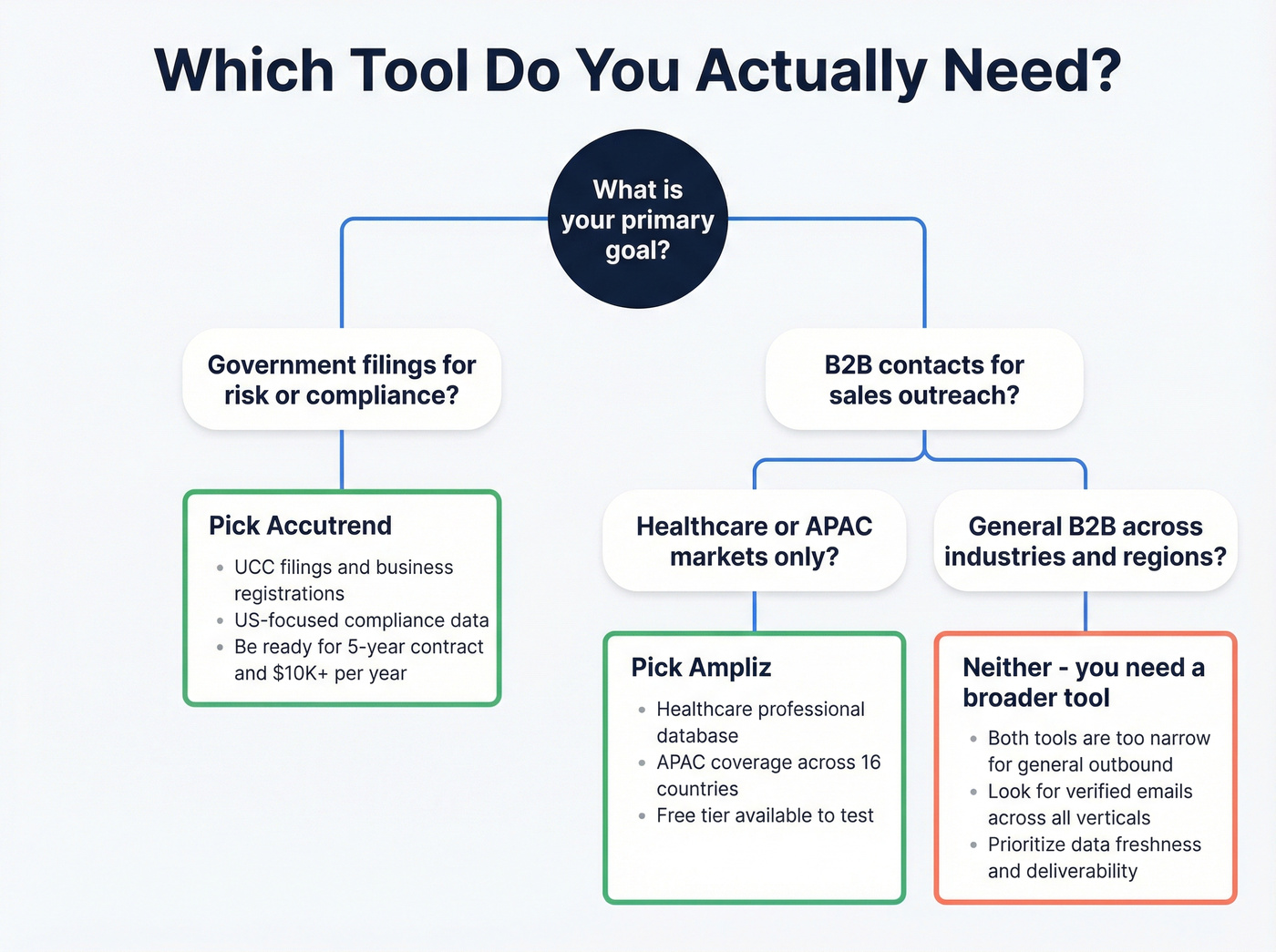
Pick Ampliz if you're targeting healthcare professionals or APAC markets specifically and want month-to-month pricing with a free tier to test.
Let's be honest - Accutrend's 5-year lease with mandatory data return belongs to a different era of data procurement. Ampliz is more accessible but narrow. Most sales teams need neither. And neither tool has meaningful community discussion - Ampliz appeared in one GTM engineering thread as a healthcare vertical provider, but we couldn't find practitioner reviews for either tool on Reddit or forums.
If you're still deciding between niche databases, you may also want to see how Accutrend stacks up in a more apples-to-apples data context: Accutrend vs Sparklane.
If Neither Fits Your Outbound Needs
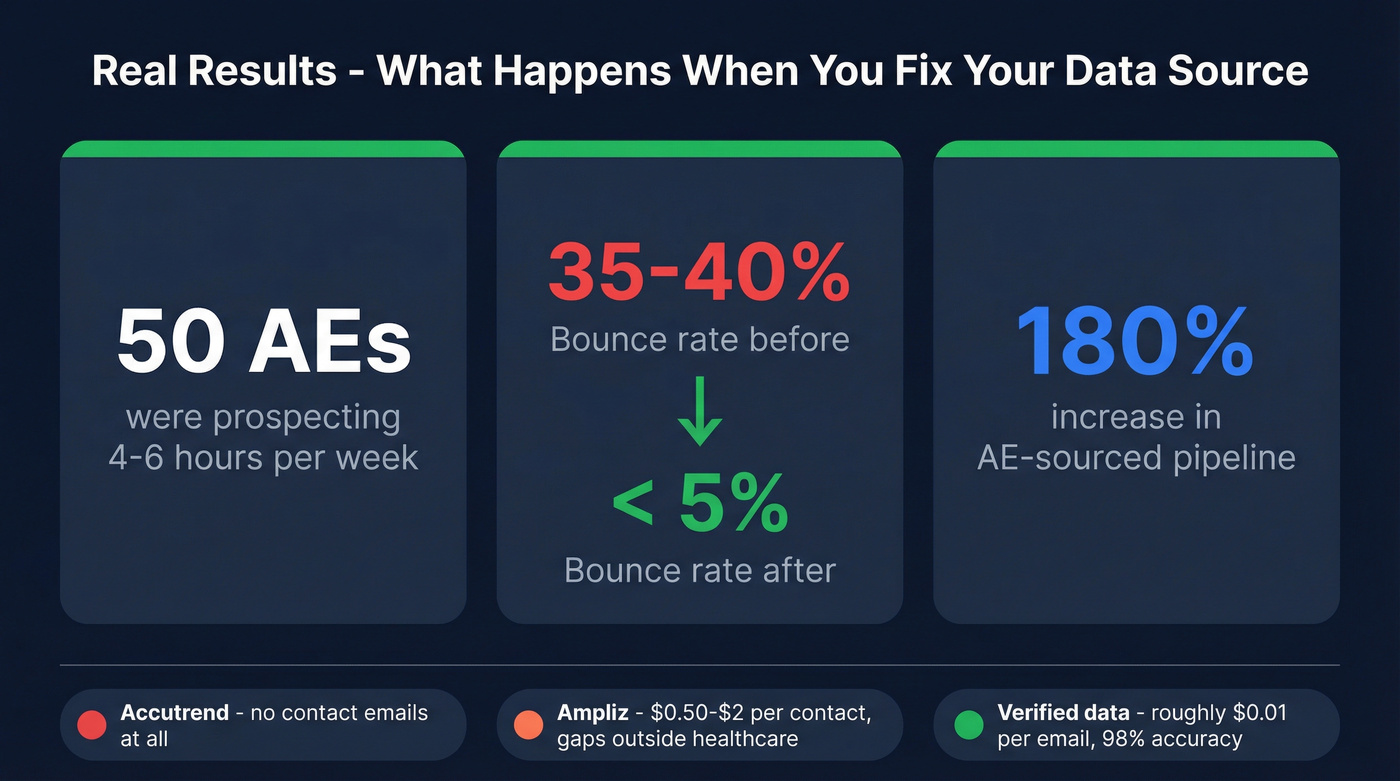
One real-world example: the team at Snyk had 50 AEs prospecting 4-6 hours per week with bounce rates around 35-40%. After switching their data source, bounce rates dropped under 5% and AE-sourced pipeline jumped 180%.
If you're trying to systematize outbound beyond just “get more contacts,” start with proven sales prospecting techniques and then pick tools that support the workflow.

Ampliz charges $0.50-$2 per contact with gaps outside healthcare. Prospeo delivers verified emails at ~$0.01 each across all industries and regions, with a 92% API match rate and 50+ data points per enrichment. Snyk's 50 AEs cut bounce rates from 35% to under 5%.
75 free emails per month. No credit card. No multi-year trap.
FAQ
Is this a fair comparison?
Not really. Accutrend provides government-sourced business filing data - UCC records, new business registrations, license data - for risk and compliance teams. Ampliz sells B2B contact data for sales prospecting. They serve completely different buyers with completely different workflows.
Does Ampliz work outside healthcare?
Technically yes. The Global B2B plan covers APAC markets broadly. But reviewers note data quality drops significantly outside healthcare verticals. If you're prospecting general B2B contacts in North America or Europe, expect incomplete records and coverage gaps.
What's the best tool for verified B2B emails?
For general B2B outbound, Prospeo delivers 98% email accuracy across 300M+ profiles with a 7-day refresh cycle. It offers a free tier of 75 emails per month, self-serve onboarding, and pricing at roughly $0.01 per email - the strongest option for teams that prioritize deliverability without enterprise contracts or multi-year commitments.