

AI Customer Insights: What Works in 2026 (and What Doesn't)
Your VP just asked for "AI-powered customer insights" because they read a McKinsey report on the plane. Now you're supposed to find a tool, prove ROI, and have something to show by next quarter. The problem? Most teams chasing AI customer insights end up with a dashboard nobody opens and a six-figure contract they can't cancel.
A blunt takeaway from a widely shared r/CRM thread: built-in AI insights from Salesforce Einstein, HubSpot AI, and Dynamics Copilot often feel useless in practice. They don't change behavior. They don't drive decisions. And that's the whole point.
Here's what actually works - and what to skip.
The Short Version
If your CRM's AI insights haven't changed a single decision in six months, stop waiting and layer in a purpose-built tool. For B2C, start with Hotjar for behavior and Thematic for feedback analysis. For B2B, start with clean, verified contact data and Gong for conversation intelligence.
Don't buy an enterprise VoC platform until you've proven ROI on a simpler stack.
What AI Customer Insights Actually Are
Traditional analytics tells you what happened - page views, conversion rates, churn numbers. AI-driven customer insights predict what will happen and surface patterns in unstructured data that humans miss. Organizations create four times more unstructured data than structured data: open-text survey responses, support tickets, call transcripts, social mentions, review comments. None of that fits neatly into a dashboard.
Modern insight tools ingest this unstructured mess, vectorize and index it, then surface themes, sentiment shifts, and predictive signals. The difference between this and a BI dashboard isn't incremental - it's a different category of analysis entirely. When applied to revenue teams, these same techniques generate signals that help reps prioritize accounts and personalize outreach at scale.
Why Most AI Insight Projects Fail
McKinsey's State of AI research shows only about 6% of organizations see meaningful financial returns from their AI investments. That's not a rounding error.
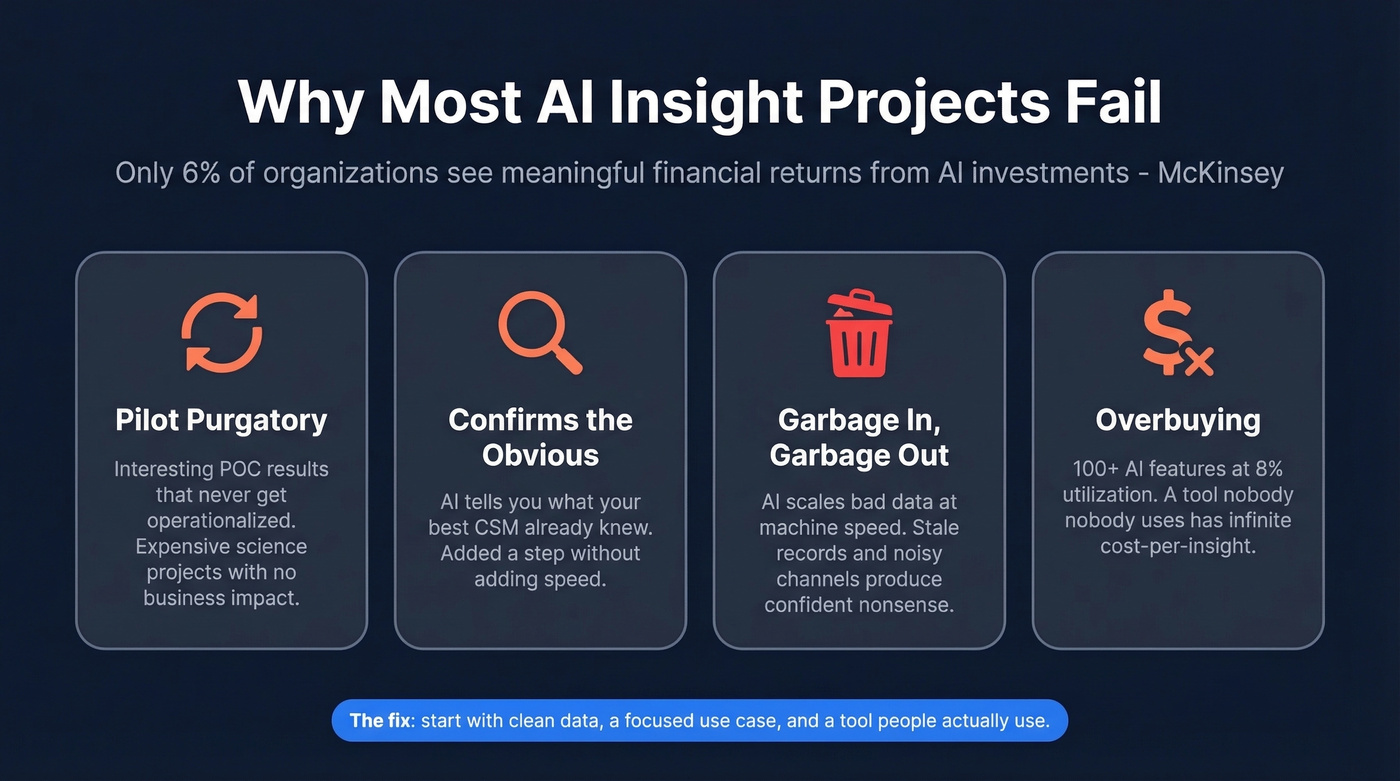
Pilot purgatory. Teams launch a proof-of-concept, get interesting results, then never operationalize it. The AI initiative becomes an expensive science project. The question should never be "what can we do with AI?" It should be "how will AI accelerate our most critical goals?"
CRM AI that confirms what you already knew. Teams feed customer feedback into Claude or GPT, get pattern summaries back, and realize the AI is telling them what their best CSM already knew. The value isn't in the insight - it's in the speed and scale. If you aren't acting on it faster, you've just added a step.
Garbage in, garbage out - at machine speed. AI doesn't fix bad data. It scales bad data. If your contact records are stale and your feedback channels are noisy, AI will confidently generate insights from garbage and present them in a beautiful chart. We've watched this happen firsthand with teams that skipped data hygiene and jumped straight to predictive modeling.
Overbuying. We've seen teams purchase enterprise VoC platforms with 100+ AI features when they needed sentiment analysis on support tickets. The tool sits at 8% utilization while the contract auto-renews. A tool nobody uses has infinite cost-per-insight.

High-Impact Use Cases
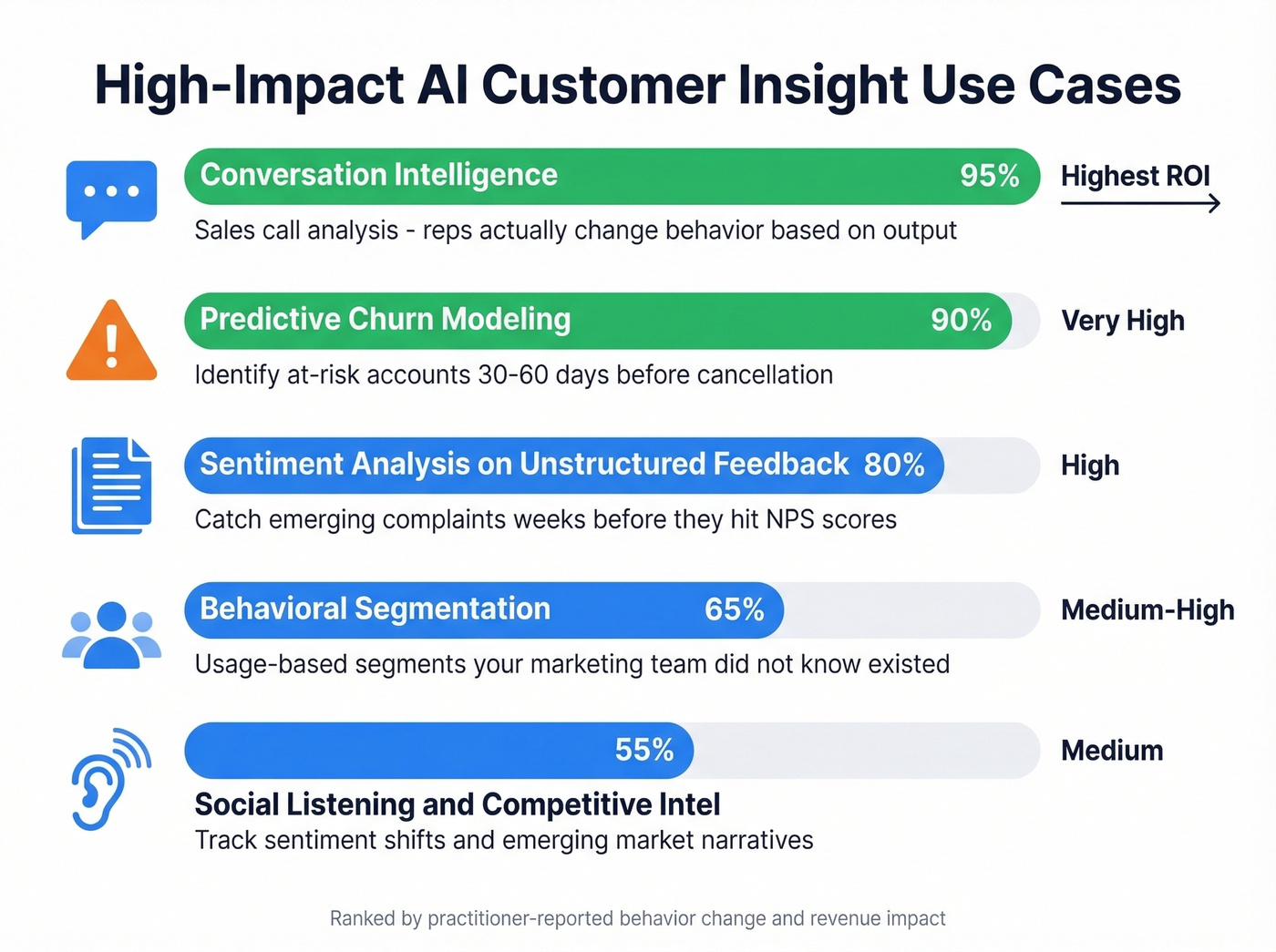
Not every application of AI-powered customer analysis delivers equal value. These five consistently move the needle.
Sentiment Analysis on Unstructured Feedback
This is the fastest win. Feed open-text survey responses, support tickets, and review data into an NLP pipeline and you'll catch emerging complaints weeks before they show up in NPS scores. The key is domain tuning - out-of-the-box sentiment models often struggle with industry jargon, product names, and context-specific language that reads as "negative" to a generic model but means something different in your vertical.
Predictive Churn and Retention Modeling
This is where the ROI math gets real. Identify at-risk accounts 30-60 days before they cancel, then trigger intervention workflows. It requires clean historical data and 3-6 months of history before the model is reliable enough to act on, but once it is, the payback is immediate. Revenue teams that pair churn models with conversation intelligence can route save offers to the right rep at the right time.
Conversation Intelligence
Tools like Gong analyze sales and support calls to surface objection patterns, competitive mentions, and winning talk tracks. In our experience, this is one of the few categories where teams consistently change behavior based on the output. Reps actually watch their call reviews. That alone makes it worth the investment.
Behavioral Segmentation and Competitive Intelligence
Grouping customers by usage patterns and engagement cadence rather than firmographics reveals segments your marketing team didn't know existed. And social listening tools like Brand24 help track sentiment shifts and emerging market narratives - useful for product and positioning decisions, though less directly tied to revenue.
If you want to operationalize these signals for outbound, tie them into your RevOps tech stack so insights actually reach the people who can act on them.

This article nails it: AI scales bad data at machine speed. Your customer insights are only as reliable as the contact records underneath them. Prospeo's 5-step verification delivers 98% email accuracy on 300M+ profiles - refreshed every 7 days, not every 6 weeks.
Stop feeding garbage into your AI. Start with data you can trust.
The ROI Question
Compiled case examples attribute big outcomes to AI-powered customer and operational insights: Starbucks is cited with a 30% ROI uplift globally and $125M in annual supply chain savings, and Netflix is cited with $1B+ saved annually through AI-driven retention. Those are enterprise-scale numbers, but the patterns scale down.
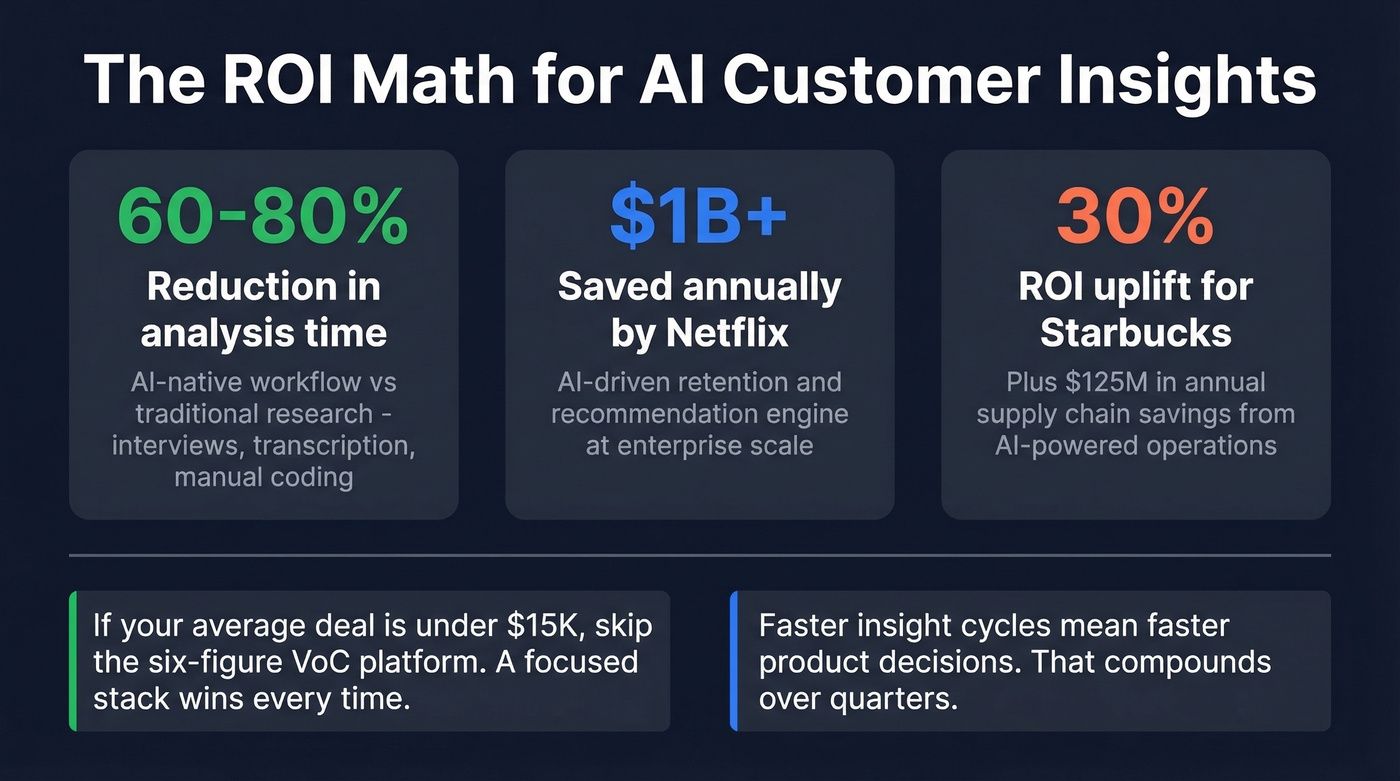
For mid-market teams, the math is simpler. The traditional research workflow - schedule interviews, transcribe, manually code themes, synthesize - takes weeks. An AI-native workflow cuts analysis time by 60-80%. Even conservatively, a 40% reduction in time-to-insight changes how often you can run the loop. Faster cycles mean faster product decisions, and that compounds over quarters.
Here's the thing: if your deals average under $15K, you almost certainly don't need a six-figure VoC platform. A focused stack of tools will outperform an underutilized enterprise suite every time.
Choosing a Platform
Before you demo anything, nail down five things: what data you need to search, how you'll analyze it, what systems it integrates with, what compliance controls are required, and whether it scales with your team. The Stravito framework adds sharing, curation, and usage tracking - all worth considering for teams larger than five.
If you're evaluating how insights will flow into your CRM, it helps to start with CRM automation so actions are triggered automatically, not manually.
Tool Landscape
| Tool | Category | Best For | Starting Price | AI Strength |
|---|---|---|---|---|
| Prospeo | B2B data quality | Verified contacts, enrichment | Free tier; ~$0.01/email | 98% email accuracy |
| Qualtrics | Enterprise VoC | Large-scale multi-channel CX | ~$30K-$100K+/yr | Experience Agents |
| Medallia | Enterprise VoC | Omnichannel CX programs | ~$40K-$120K+/yr | 100+ AI features |
| Gong | Conversation intel | Sales call analysis | ~$100-$200+/user/mo | Deal & objection insights |
| Hotjar | Behavior analytics | Budget UX tool | Free; paid ~$40-$200/mo | Heatmaps, recordings |
| Thematic | Feedback analysis | Open-text NLP | ~$1K-$3K/mo | Theme extraction |
| Amplitude | Product analytics | Behavioral cohort analysis | Free-custom | Predictive analytics |
| Brand24 | Social listening | Monitoring | $79-$399/mo | Sentiment + alerts |
| Dovetail | Research repository | Qualitative synthesis | Free; paid ~$30+/user/mo | AI-powered tagging |
A pricing warning on Qualtrics: they've shifted toward interaction-based pricing where AI features aren't included in the base platform. Request both base and AI-enabled quotes before you sign. The VoC market hit $10.6B in 2025 and vendors are monetizing AI aggressively. Budget surprises are common.
Skip Qualtrics or Medallia if you don't have a dedicated CX team to run the program. Reddit practitioners also mention Unwrap, Chattermill, and SentiSum as worth evaluating - particularly SentiSum for support ticket intelligence.
B2B Teams: Data Quality Comes First
You can't analyze customer behavior if half your records are stale. For B2B teams, AI customer insights start with verified contact data - the gap most insight platforms don't address. Without that foundation, even the most sophisticated predictive models point your reps toward dead ends.
If you're sourcing contacts, benchmark providers against the best B2B database lists and prioritize accuracy over raw volume.
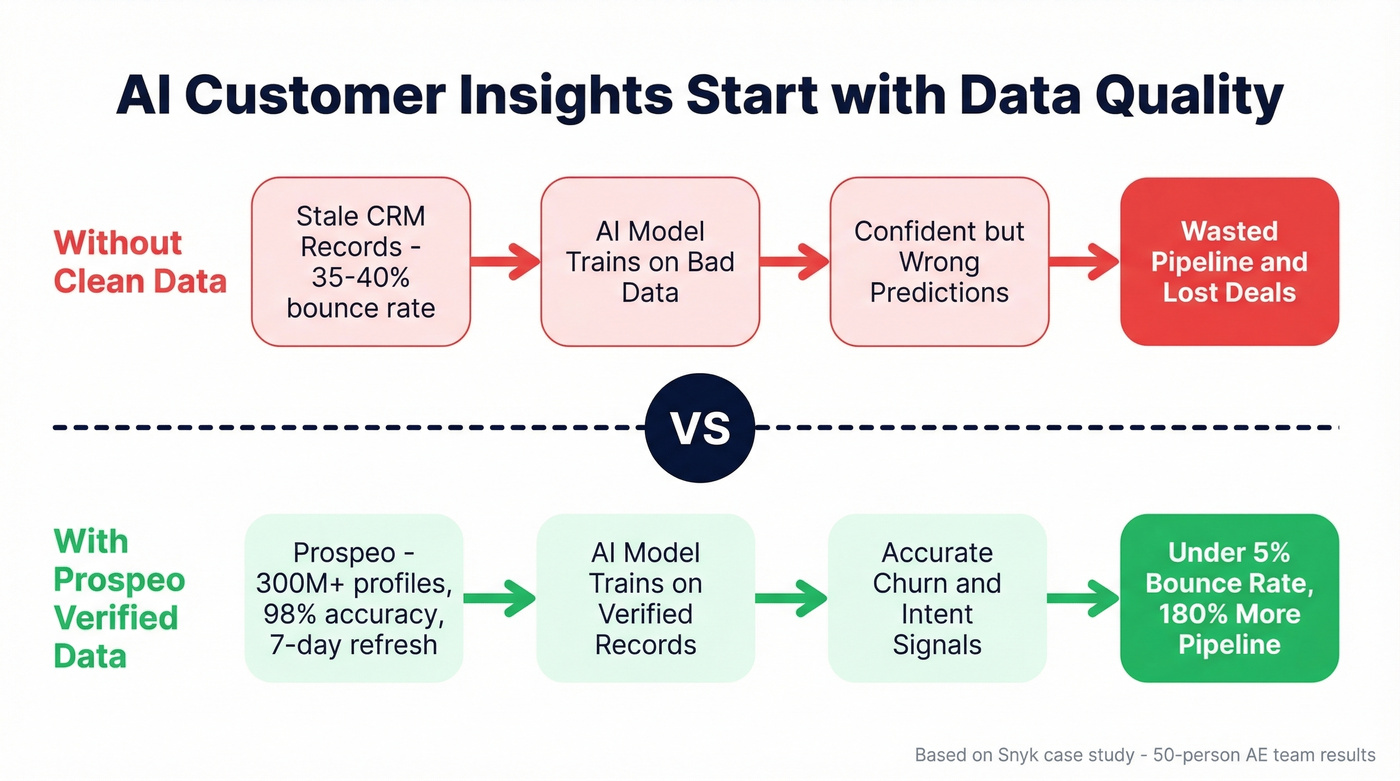
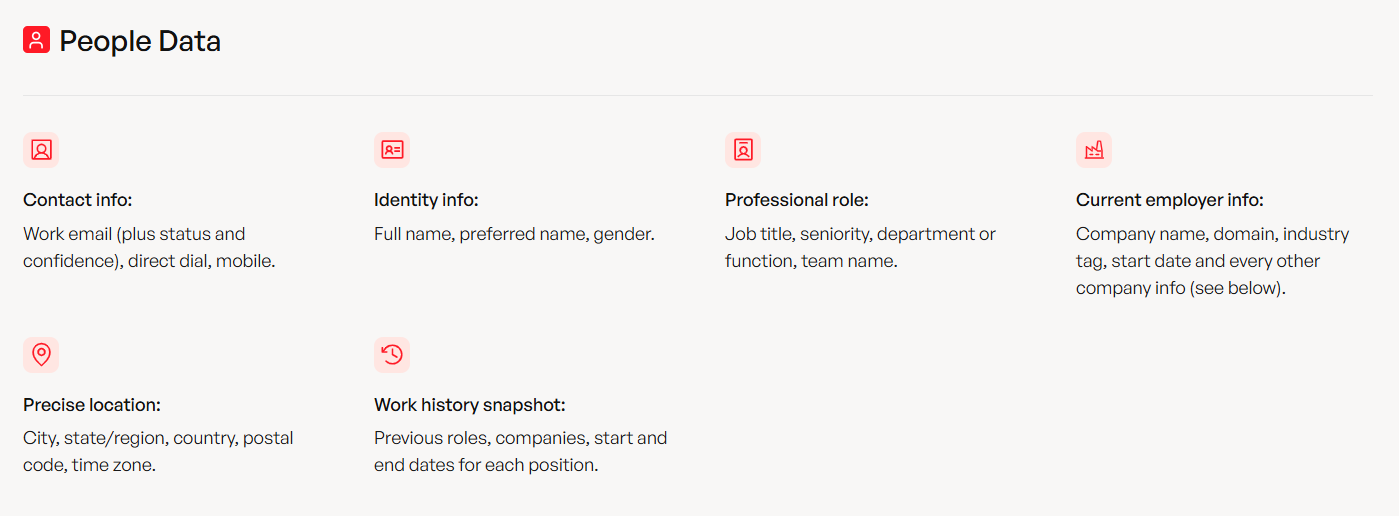
Prospeo covers 300M+ professional profiles with 98% email accuracy on a 7-day refresh cycle, compared to the 6-week industry average. When Snyk's 50-person AE team switched, their bounce rate dropped from 35-40% to under 5% and AE-sourced pipeline jumped 180%. Your models are only as good as the records feeding them.
If you're enriching existing records (not just net-new leads), compare workflows and match rates across data enrichment tools.
Governance and Compliance
Let's be honest - this is the section most teams skip until it's too late. The regulatory environment shifted materially through 2025, and 2026 enforcement is building on those foundations.
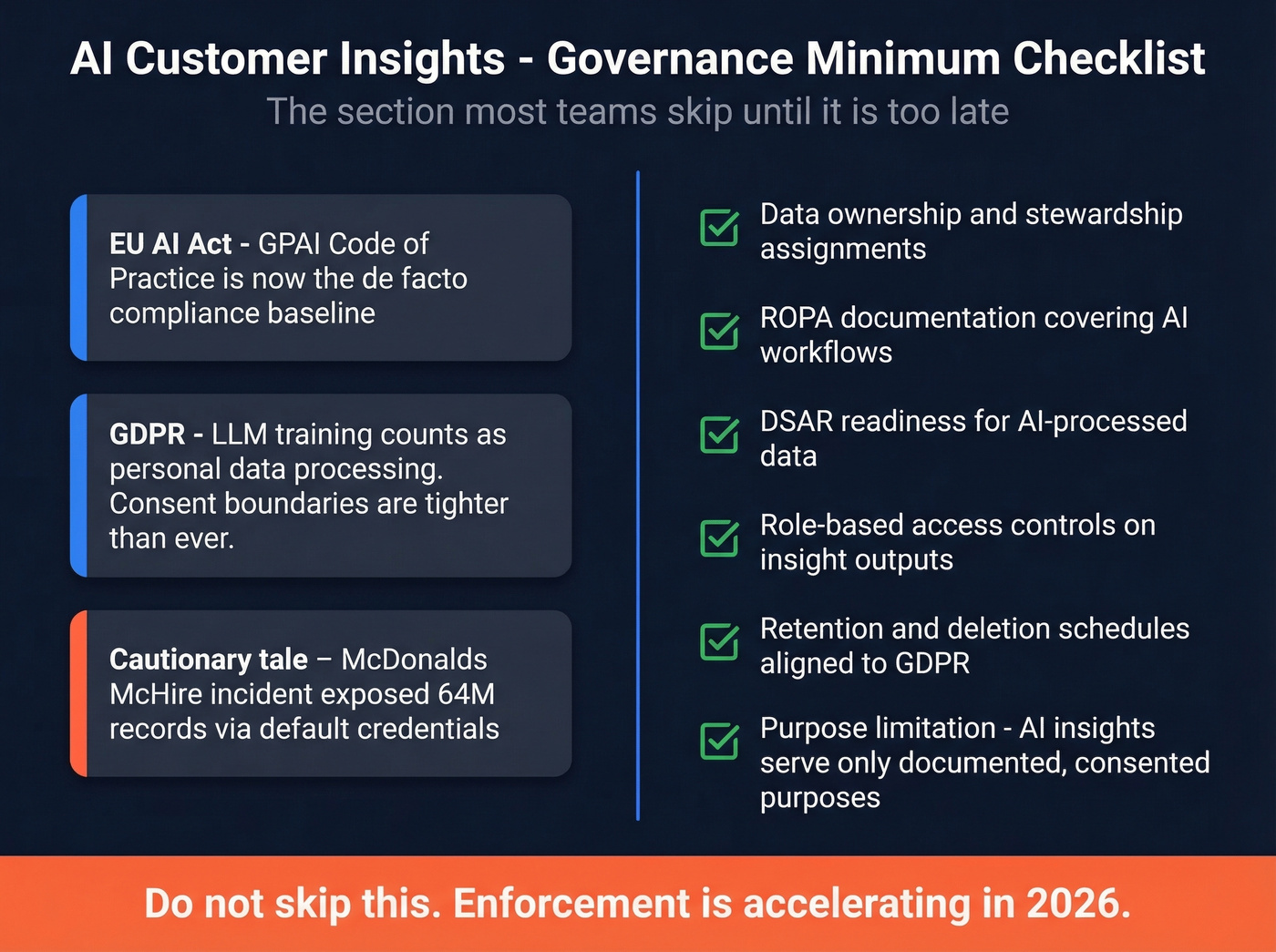
The EU AI Act's Commission guidance clarified prohibited "unacceptable risk" practices, and the GPAI Code of Practice now functions as a de facto compliance baseline. GDPR enforcement has zeroed in on LLM training as personal-data processing - the Irish DPC scrutinized Meta's training plans, Italy's Garante intervened multiple times, and the boundaries around consent for AI training are tighter than ever. The UK's Data Use and Access Act introduced "recognized legitimate interests" and new flexibility for automated decision-making.
The McDonald's McHire incident - where 64 million job application records were exposed via default credentials - is what happens when AI systems handling customer data skip basic governance.
If you're operating in B2B, align your data sourcing and enrichment with a clear B2B compliance policy before you scale AI workflows.
Your minimum governance checklist:
- Data ownership and stewardship assignments
- ROPA documentation covering AI workflows
- DSAR readiness for AI-processed data
- Role-based access controls on insight outputs
- Retention and deletion schedules aligned to GDPR
- Purpose limitation ensuring AI insights serve only documented, consented purposes
Before you layer on predictive churn models or conversation intelligence, fix the foundation. Prospeo enriches your CRM with 50+ data points per contact at a 92% match rate - for roughly $0.01 per email. No enterprise contract required.
Clean data is the insight most AI projects skip. Don't be the 94% that fails.
FAQ
How do AI insights differ from traditional analytics?
Traditional analytics reports what happened - dashboards, conversion funnels, historical trends. AI customer insights predict what'll happen next and surface patterns in unstructured data like support tickets, call transcripts, and reviews that humans can't process at scale. It's the shift from reactive reporting to proactive pattern recognition across millions of data points.
How long until you see ROI?
Quick wins like sentiment analysis and feedback synthesis show value in 2-4 weeks. Predictive models - churn scoring, behavioral segmentation - need 3-6 months of clean historical data before they're reliable enough to act on. Don't let anyone tell you it's plug-and-play.
Do you need an enterprise VoC platform?
Not unless you're running a high-volume, multi-channel feedback program with dedicated ownership and a clear operational path from insight to action. Most teams get more value from a focused stack - Hotjar for behavior, Thematic for feedback, Gong for calls - and proving ROI there first.
What about privacy and GDPR compliance?
Any AI processing customer data requires a lawful basis, a DPIA for high-risk processing, and ROPA documentation. The EU AI Act adds obligations for AI systems making decisions about people. Budget for compliance from day one - retrofitting governance costs 3-5x more than building it in.
How does data quality affect AI-driven insights for B2B?
If 35-40% of your contact records bounce, your AI is analyzing ghosts. A 7-day data refresh cycle and 98% email accuracy ensure models reflect real people at real companies. Snyk cut bounce rates from 35-40% to under 5% after switching providers, which directly improved the reliability of their account scoring and pipeline predictions.