

The Best AI Email Senders for Cold Outreach in 2026
A team we worked with last year sent 5,000 cold emails in their first week. They got 47 opens and 2 replies. The AI copy was fine - punchy subject lines, personalized openers, decent CTAs. No AI email sender could've saved that campaign. The problem was simpler and uglier: 23% of the list bounced, their domain got flagged, and the remaining 3,800 emails landed in spam.
That story plays out constantly. Open rates across B2B cold email have dropped from 36% to 27.7%, and roughly 20% of commercial emails get filtered as spam before anyone sees them. Top-performing campaigns still hit 60% open rates, but most land at 1-5% reply rates. The tools below are ranked with that reality front and center.
Our Picks (TL;DR)
| Pick | Best For | Starting Price |
|---|---|---|
| Prospeo | Verified data + email accuracy | Free (75 emails/mo) |
| Instantly | High-volume sending + agencies | $37/mo |
| Lemlist | Multichannel quality outreach | $79/mo |
Most AI sending tools fail because of bad data, not bad copy. Start with clean contacts, then pick a sender from the list below. We cover 8 tools total - three in depth, five with quick verdicts.
What Is an AI Email Sender?
An AI email sender plans, writes, sends, and adjusts outreach based on live engagement data. That separates it from an AI email writer - Lavender or ChatGPT, for example - which only drafts copy. It's also different from an AI email marketing tool like ActiveCampaign or Klaviyo, which handles opted-in newsletter audiences.
If you've seen tools like Copilot, Gemini, or Shortwave ranking for this term, those are personal productivity assistants. They help you manage your inbox. They don't run cold outreach campaigns.
A proper AI email sender combines five components into one workflow: an AI writer for subject lines, body copy, and follow-ups; email verification to catch invalid addresses before they bounce; inbox warmup to build sender reputation gradually; inbox rotation to distribute sends across multiple accounts; and campaign sequencing to automate multi-step cadences. If a tool doesn't handle at least three of those, it's a feature pretending to be a product.
Here's the thing most vendors won't tell you: the "AI personalization" in most of these tools is just web scraping piped into GPT. The AI isn't the magic. The targeting data is.
Fix the Fundamentals First
The best AI outreach tool in the world can't save a campaign built on a rotten foundation. Before you pick a tool, get the order of operations right.
1. Deliverability. Set up SPF, DKIM, and DMARC on every sending domain. Warm up new inboxes for at least two weeks. If you're sending more than 5,000 emails per day to Gmail or Yahoo, you're classified as a bulk sender and the rules get stricter - keep spam complaints under 0.3% and bounces under 2%. These aren't suggestions. They're thresholds that'll get your domain blocked.
3. Relevance. Are you emailing people who could actually buy? A tight ICP beats a massive list every time. Layer intent data so you're reaching buyers in-market, not just in-database.
4. Offer. What's in it for them? If your value prop is weak, no amount of AI personalization will fix it.
5. Personalization. This comes last, not first. A split test from a real campaign showed generic AI personalization pulling 1% reply rates versus 9% for emails triggered by a specific event like a funding round, job change, or tech adoption. The AI writing isn't the variable - the targeting signal is.

This article makes one thing clear: AI email senders fail because of bad data, not bad copy. Prospeo's 98% email accuracy and 7-day data refresh mean your campaigns start with contacts that actually exist - so your AI sender can do what it's built for instead of tanking your domain reputation.
Fix the data layer your AI email sender depends on.
Best AI Email Senders Compared
Instantly - High-Volume Sending
Here's the question that determines whether Instantly is right for you: are you sending more than 25,000 emails a month? If yes, Instantly is hard to beat on economics.
Practitioners have raised concerns about shared infrastructure risk - and they're right to think about it when you're scaling. If you're running serious volume, skip the Growth plan. The Hypergrowth tier at $97/mo gives you 25,000 contacts and 100,000 emails. Light Speed runs $358/mo for 100,000 contacts and 500,000 emails. Every tier includes unlimited email accounts and warmup.
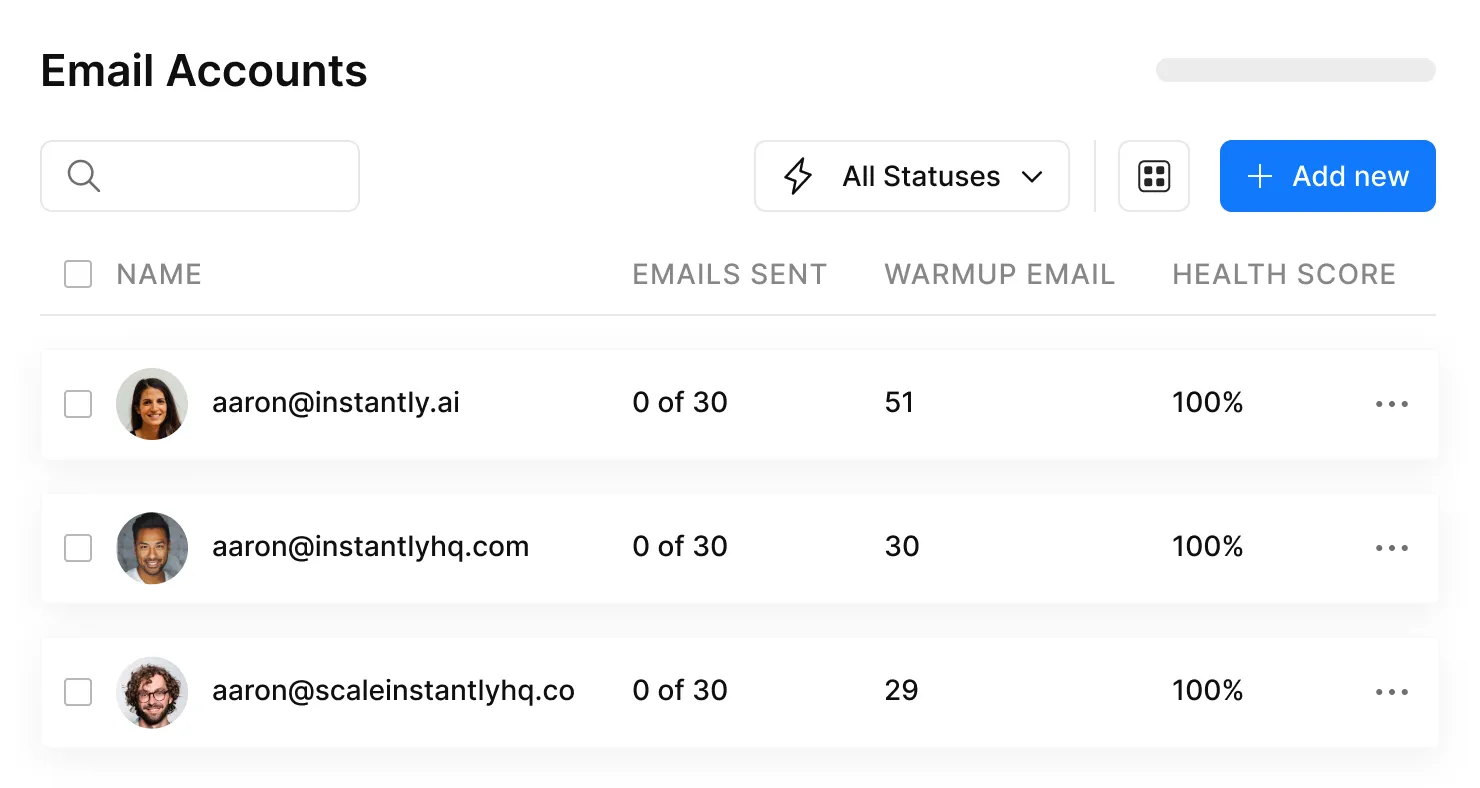
The Growth plan at $37/mo gets you 1,000 uploaded contacts and 5,000 emails per month - fine for testing, not for production. Instantly also sells a separate lead database with 450M+ contacts starting at $47/mo, but in our experience, the data quality is inconsistent compared to dedicated providers. The sending infrastructure is where Instantly excels.
Use this if: You're an agency managing multiple client campaigns or a team sending 50K+ emails monthly. Skip this if: You need multichannel outreach with social touches and calls - Instantly is primarily email-focused.
Lemlist - Multichannel Quality
The add-on pricing is where Lemlist gets expensive fast, and that's worth knowing before you commit. Extra senders run $9/mo each, domains and mailboxes $4-8/mo, and additional deliverability protection $20/mo per user. For a team of five running multichannel sequences, costs can climb past ~$600/mo depending on how many extras you stack on.
That said, the multichannel premium pays for itself if you actually use it. Multichannel outreach yields response rates roughly 3x higher than single-channel email alone. Lemlist puts email, LinkedIn automation, and a built-in call dialer in one platform, and the deliverability tooling is strong.
Email Pro starts at $79/mo - $63/mo annually - and includes 3 email senders per user, AI-powered personalization, a deliverability hub with warmup, and access to a 600M+ leads database. Multichannel Expert at $109/mo adds LinkedIn automation, a built-in call dialer, and 5 senders per user. The consensus on r/sales and r/coldemail is that Lemlist's deliverability and personalization quality are genuinely strong.
Use this if: You want email + LinkedIn + calls in one workflow and care about per-prospect quality over raw volume. Skip this if: You're purely optimizing for cost-per-email-sent at scale.
Reply.io - AI SDR Automation
Reply.io's pitch is ambitious: an AI SDR named Jason that handles prospecting, writing, and follow-up autonomously. The email volume plans start at $49/user/mo on annual billing, and multichannel jumps to $89/user/mo. The Jason AI SDR product starts at $500/mo.
Let's be honest: $500/mo for an AI SDR is premature for teams not already hitting 5%+ reply rates on manual sequences. Fix your fundamentals first. The base email and multichannel plans are solid, though - Reply's plans are capped by active contacts per month, not by the number of emails you send.
Use this if: You've maxed out manual outreach and want to test autonomous AI prospecting. Skip this if: Your reply rates are still below 3%. The AI won't fix a targeting problem.
Mails.ai - Best Free Tier
Mails.ai offers one of the most generous free plans in the category: unlimited email accounts and unlimited warmup at $0. The Startup plan at $49/mo adds 1,000 active contacts, 2,000 email verifications, AI Writer, and Spintax. Growth at $99/mo scales to 5,000 contacts and 10,000 verifications. Pro at $199/mo removes contact limits entirely.
For bootstrapped founders testing cold email for the first time, Mails.ai is the lowest-risk entry point. The AI writing and deliverability features are basic compared to Lemlist, but the economics are hard to argue with.
Use this if: You're bootstrapped and need to test cold email without committing budget. Skip this if: You need advanced multichannel sequences or enterprise-grade deliverability.
Smartlead - Deliverability Infrastructure
Smartlead competes directly with Instantly on infrastructure - warmup, rotation, blacklist monitoring - and starts around $33-39/mo. It's popular with agencies who want more control over domain and inbox management. If Instantly's shared infrastructure concerns bother you, Smartlead is a natural alternative.
Use this if: You want Instantly-style infrastructure with more granular deliverability controls. Skip this if: You need a built-in lead database. Smartlead is a sending tool, not a data provider.
Apollo - Data + Sending Combo
GMass - Gmail-Native Option
GMass turns Gmail into a cold email tool with mail merge, sequences, and a Spam Solver feature that tests inbox placement. Pricing runs $25/mo for Basic, $55/mo for Professional, or $120/mo for a team of 5. Great for solo operators who live in Gmail, but the scale ceiling is real - you'll outgrow it fast.
Saleshandy - Budget Entry Point
Saleshandy starts around $25/mo with basic AI writing and sequences. It's a reasonable first tool for solo reps testing cold email, but the deliverability infrastructure is thin compared to Instantly or Lemlist. Think of it as training wheels.
Pricing Comparison
| Tool | Price/mo | Contacts | Best For |
|---|---|---|---|
| Instantly | $37-$358 | 1K-100K | High-volume sending |
| Mails.ai | Free-$199 | Unlimited warmup to no limit | Budget-friendly entry |
| Saleshandy | ~$25+ | Tier-dependent | Solo rep testing |
| Smartlead | ~$33-39 | Tier-dependent | Deliverability control |
| Apollo | $59-$149/user | Credit-based | All-in-one convenience |
| Lemlist | $79-$109 | Unlimited | Multichannel quality |
| Reply.io | $49/user-$500/mo | Active-contact-based | AI SDR automation |
| GMass | $25-$120 | Gmail-limited | Gmail power users |
How to Pick the Right Tool
The best cold email setup isn't one tool - it's three layers working together.
Layer 1: Data + Verification. Find contacts, verify emails through a multi-step process, and export clean lists. This is the foundation. Bad data here poisons everything downstream. Prospeo handles this with 300M+ professional profiles, 30+ search filters including buyer intent powered by Bombora, and native integrations with Instantly, Lemlist, Smartlead, and HubSpot - so verified contacts flow directly into your sending tool without manual exports.
Layer 2: Sender + Sequences. Push verified contacts into your AI email sender via those native integrations. Instantly for pure volume, Lemlist for multichannel quality.
Layer 3: CRM. Replies and engagement data flow into HubSpot or Salesforce for pipeline tracking.
For a bootstrapped team, this stack costs under $100/mo total: Prospeo's free tier plus Instantly Growth at $37/mo plus HubSpot free CRM. An agency running multiple clients might spend $200-400/mo with paid verification plus Instantly Hypergrowth. Enterprise teams can layer in Lemlist multichannel and Reply.io's AI SDR for $500-800/mo.
If your average deal size is under $10k, you probably don't need a $500/mo AI SDR. Spend that budget on better data and tighter targeting instead.

The best-performing campaigns layer intent signals on top of clean data. Prospeo tracks 15,000 buyer intent topics and lets you filter by job changes, funding rounds, and tech adoption - the exact triggers that turned 1% reply rates into 9% in the split test above. At $0.01 per email, it costs less than a single wasted send.
Stop feeding your AI sender dead leads. Start with real buyer signals.
FAQ
What's the difference between an AI email sender and an AI email writer?
An AI email sender handles the full outreach workflow - writing, sending, warming up inboxes, rotating accounts, and sequencing follow-ups automatically. An AI email writer like Lavender or ChatGPT only drafts copy. You still need a dedicated sending platform to deliver, track, and manage campaigns at scale.
Do AI email senders hurt deliverability?
Sending tools don't hurt deliverability - unverified lists do. A bounce rate above 2% damages your domain reputation regardless of which platform you use. Verify every address before importing contacts, then rely on warmup and rotation features to maintain inbox placement.
How much does an AI email sender cost?
Most teams spend $37-100/mo on sending infrastructure plus $0-50/mo on data and verification. Reply.io's AI SDR tier tops out at $500/mo. Total costs for small businesses typically land between $50 and $200/mo - Prospeo's free tier plus Instantly Growth is under $40/mo to start.
Can I use these tools for marketing emails?
No. These are cold outreach tools designed for prospects who haven't opted in. They're built around deliverability protection and sender reputation, not newsletter design or subscriber management. For opted-in audiences, look at ActiveCampaign, Brevo, or Klaviyo instead.
What's the most important feature to look for?
Deliverability infrastructure - warmup, inbox rotation, and SPF/DKIM/DMARC setup - matters more than AI writing quality. The best copy in the world is worthless in a spam folder. And underneath all of that, email verification is the real foundation: clean data prevents the bounces that destroy sender reputation in the first place.