

AI Lead Qualification Agent: Cost, Setup, and How to Deploy One in 2026
The average human response time to an inbound lead is roughly 42 hours. Leads contacted within five minutes are 21x more likely to enter a sales cycle. An AI lead qualification agent now pushes MQL-to-SQL conversion rates to 40%, compared to the 13% industry average. That gap between "we need to respond faster" and "our reps are buried" is exactly where these agents live.
Here's a contrarian take worth considering before you buy anything: you might not need one at all. You might just need clean data and a scoring model inside your existing CRM. Most teams overspend on AI tooling while feeding it garbage contact records. Fix the data first, then decide if you need autonomy on top.
What Is an AI Agent for Lead Qualification?
A chatbot answers FAQs. An AI qualification agent decides whether a lead is worth your team's time, then acts on that decision.
It scores leads against your ICP, engages autonomously via email or chat, syncs with your CRM, routes hot prospects to the right rep, and disqualifies bad-fit leads before they waste anyone's calendar. That last part is the one teams undervalue - keeping noise out of the pipeline matters as much as letting signal through.
Microsoft's Dynamics 365 Sales Qualification Agent illustrates two modes that map well to the broader market. Research-only agents evaluate leads and draft outreach for a human to approve. Research and engage agents autonomously email, follow up, check BANT criteria, detect intent signals, and hand off promising leads without a rep touching anything. Most vendors fall somewhere on this spectrum, and the mode you pick should match your deal complexity and risk tolerance.
Why the Numbers Favor AI Qualification
The economics are stark. AI qualification costs roughly $39 per qualified lead versus $262 for a human SDR. AI responds in under a minute; humans average 42 hours. And 64% of businesses using AI agents report an increase in qualified leads, with a 31% bump in qualification accuracy.
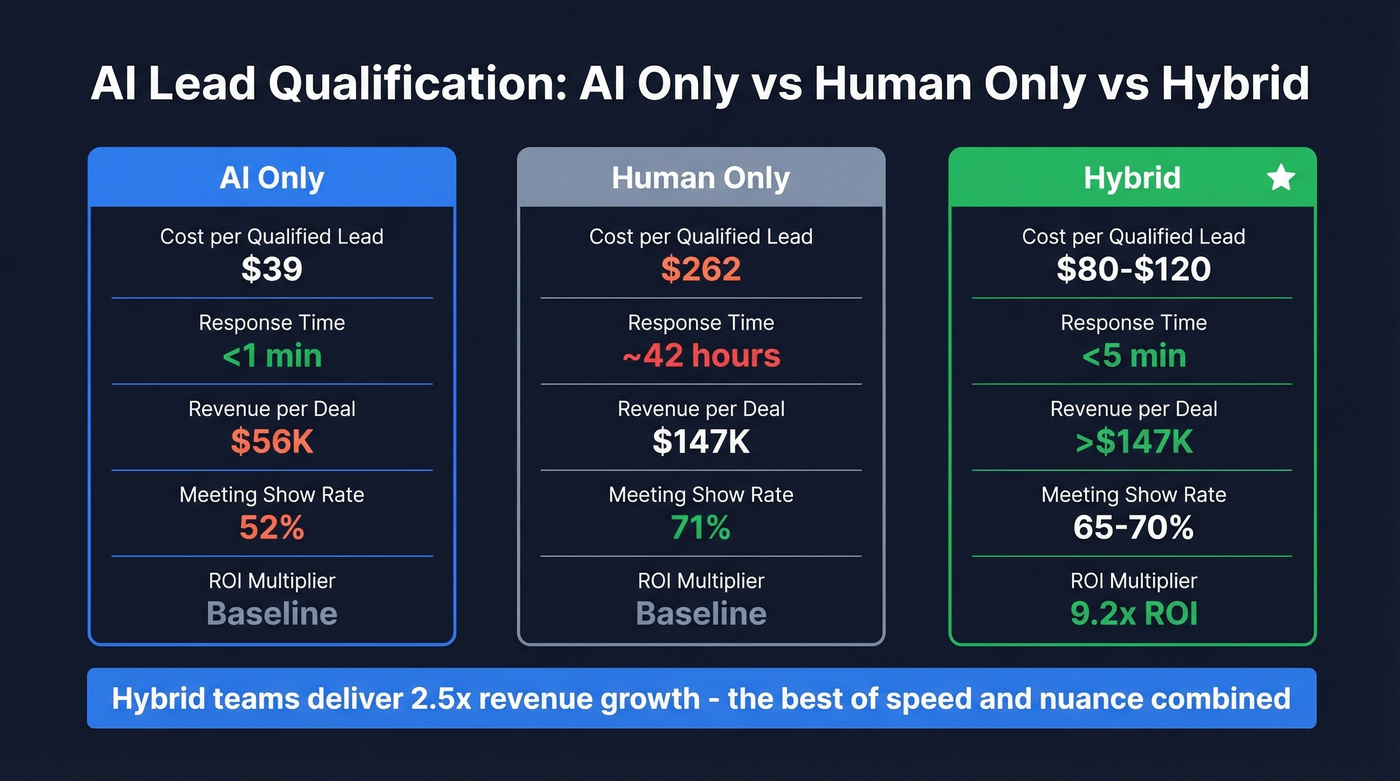
But the real story is the hybrid model. In the AI Agenix experiment, AI-only setups generated $56K revenue per deal while human SDRs hit $147K - yet hybrid teams delivered the highest revenue per deal and 2.5x revenue growth with 9.2x ROI. Let's be honest: nobody's closing a six-figure enterprise deal through a chatbot. The money is in layering both.
| Metric | AI Only | Human Only | Hybrid |
|---|---|---|---|
| Cost per qualified lead | ~$39 | ~$262 | ~$80-$120 |
| Response time | <1 min | ~42 hrs | <5 min |
| Revenue per deal | $56K | $147K | >$147K |
| Meeting show rate | 52% | 71% | ~65-70% |
| Productivity lift | Baseline | Baseline | +35% |
AI handles volume and velocity. Humans handle nuance and the deals where relationships close revenue. The teams winning in 2026 aren't picking one - they're layering both.
What They Actually Cost
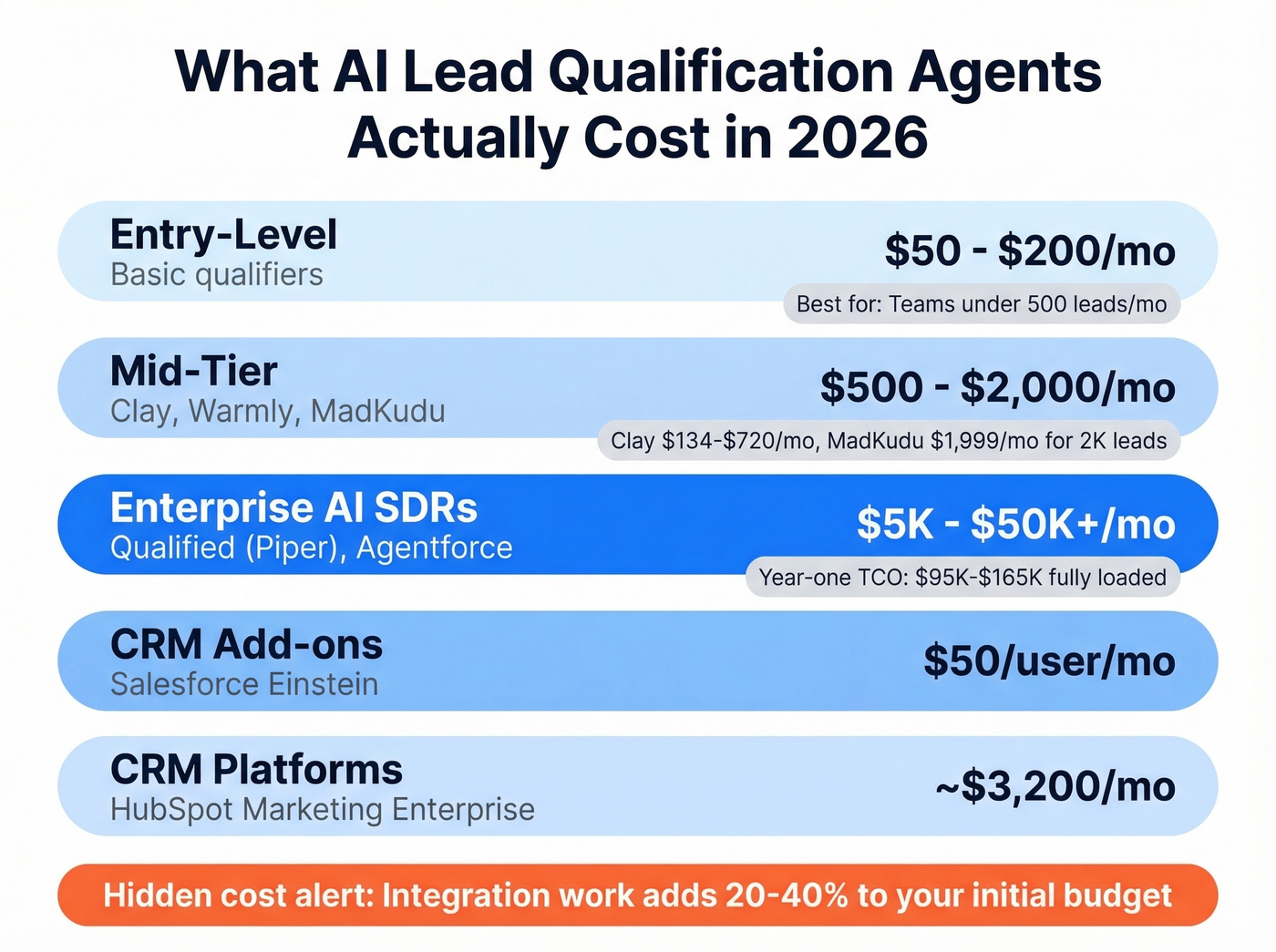
Many AI qualification vendors hide pricing behind "talk to sales" gates. Here's what we've found these agents actually charge.
| Category | Example Tools | Price Range |
|---|---|---|
| Entry-level | Basic qualifiers | $50-$200/mo |
| Mid-tier | Warmly, Clay, MadKudu | $500-$2,000/mo |
| Enterprise AI SDRs | Qualified (Piper), Agentforce | $5K-$50K+/mo |
| CRM add-ons (per-user) | Salesforce Einstein | $50/user/mo |
| CRM platforms (full suite) | HubSpot Marketing Enterprise | ~$3,200/mo |
Specific numbers: Clay runs $134-$720/mo. Warmly's AI Inbound Agent costs $16,000/year. MadKudu's Growth plan is $1,999/mo for 2,000 leads. Qualified bundles Piper into every plan - they tried add-on pricing first but found it killed adoption. Their year-one TCO for a mid-market team runs $95K-$165K fully loaded.
Implementation costs are where most teams get blindsided. Integration work tacks on 20-40% to your initial budget, and consumption-based pricing means your monthly bill fluctuates in ways vendors can't predict any better than you can. If you're running a lean team with under 500 inbound leads per month, skip the enterprise agents entirely - a mid-tier tool plus clean data will outperform an expensive agent fed bad records.

Your AI lead qualification agent scores, routes, and follows up - but it can't fix bad data. Feed it 35% bouncing emails and it qualifies leads your reps will never reach. Prospeo's 98% email accuracy and 7-day refresh cycle mean every lead your agent scores is actually reachable.
Stop qualifying ghosts. Start with data that connects.
How to Set One Up Right
Define "qualified" before you automate anything. Target industries, budget thresholds, must-have attributes, disqualifiers. If your team can't agree on what a good lead looks like, the agent will confidently route bad ones at scale.
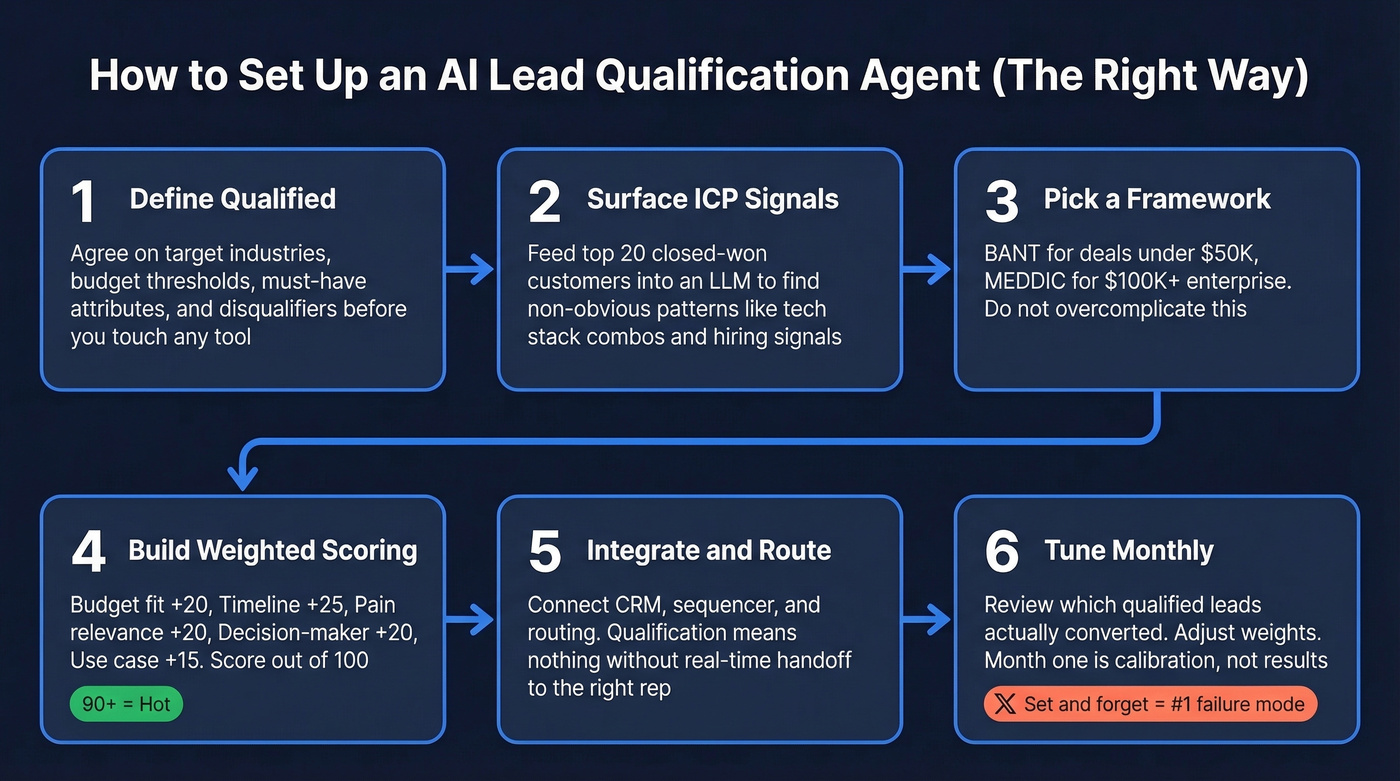
Feed your top 20 closed-won customers into an LLM to surface non-obvious ICP signals - hiring patterns, tech stack combos, funding stage. One team we spoke with found that prospects running Salesforce and HubSpot simultaneously had an 80% no-show rate, so they turned that into a negative ICP signal that lifted conversion from 2.1% to 6.8%. That's the kind of insight you don't get from a generic scoring template.
Pick a framework. BANT (Budget, Authority, Need, Timeline) is still the right call for most teams running deals under $50K. MEDDIC is built for $100K+ enterprise deals where you need to map decision processes and metrics. Don't overcomplicate this. (If you want more options beyond BANT/MEDDIC, use a deal qualification framework that matches your sales motion.)
Build a weighted scoring model. A practical template from r/SaaS practitioners: budget fit (+20), timeline within 30 days (+25), pain relevance (+20), decision-maker role (+20), use case fit (+15). Score out of 100. Leads at 90+ are hot, 70-89 go to nurture, below 70 get disqualified.
Integrate CRM, routing, and follow-up workflows. Qualification means nothing without routing. The agent needs to push hot leads into your sequencer and update your CRM in real time. (This is where CRM automation software can remove a lot of manual glue work.)
Plan human handoff for complex deals, and tune continuously. The consensus on r/SaaS is that "set and forget" is the number one failure mode for AI qualification. We've found that teams who skip monthly scoring reviews waste two to three months re-tuning later. Review which "qualified" leads actually converted, adjust weights, and treat the first month of data as calibration - not results.
The Data Problem That Kills Automated Qualification
Here's the thing most vendors won't tell you: your AI agent is only as good as the data feeding it. If 35% of your emails bounce, the agent is qualifying ghosts - scoring leads it can never reach, routing phantom opportunities to your reps, and burning your domain reputation in the process.
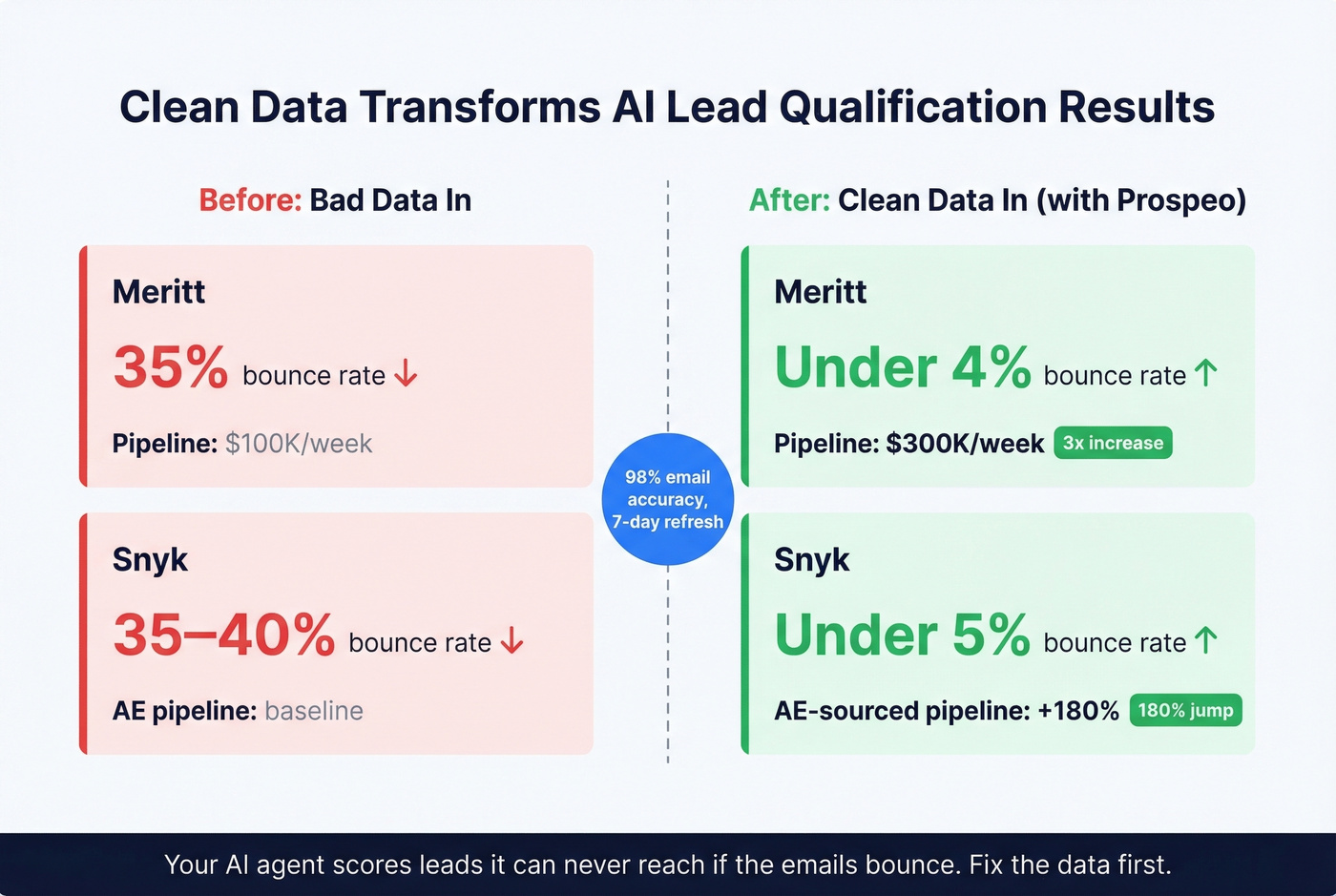
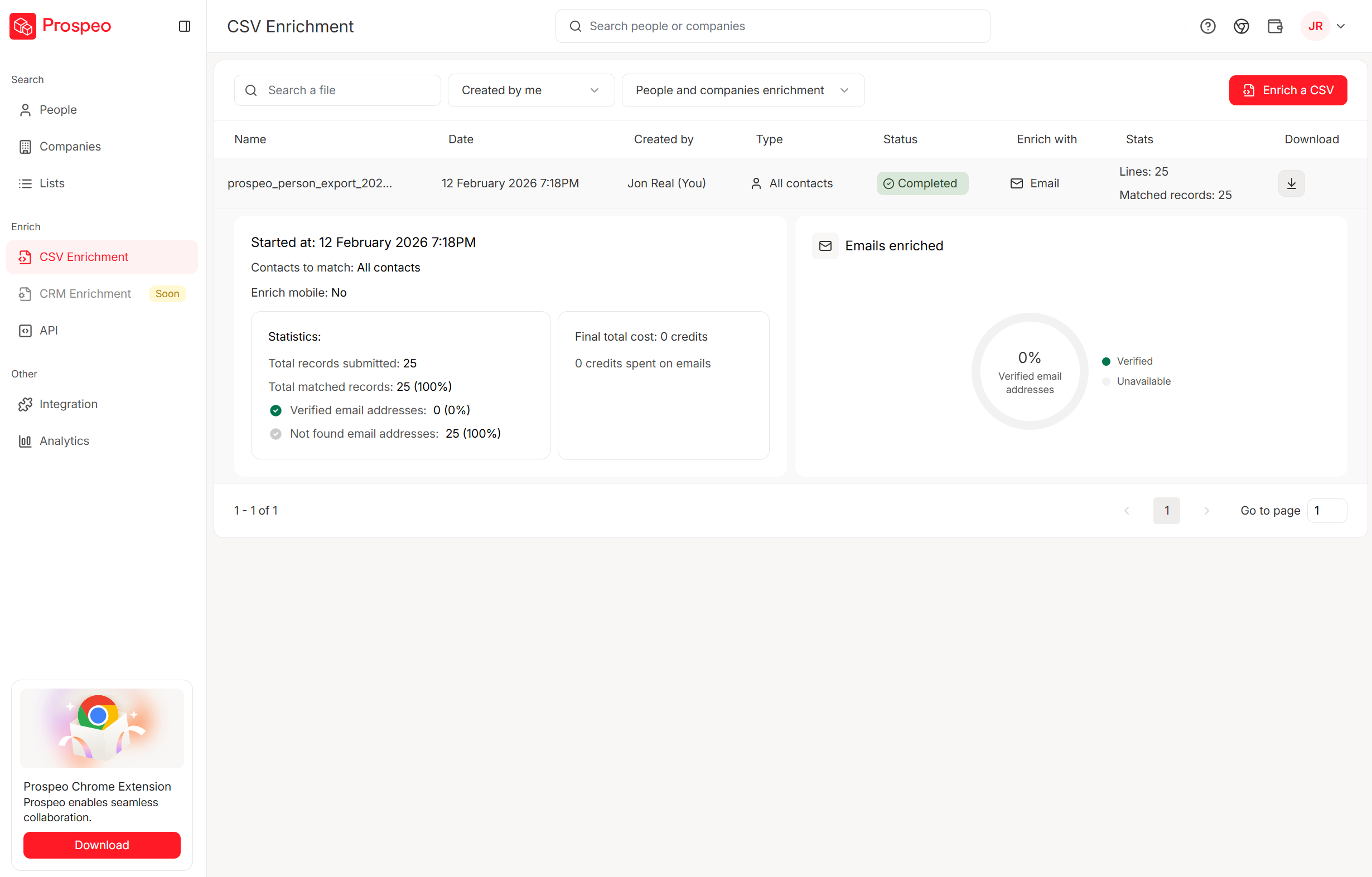
Meritt was running a 35% bounce rate. After switching to Prospeo for email verification, bounces dropped under 4% and pipeline tripled from $100K to $300K per week. Snyk had a similar story - bounce rates of 35-40% dropped under 5%, and AE-sourced pipeline jumped 180%.
With 98% email accuracy and a 7-day data refresh cycle versus the six-week industry average, Prospeo gives your AI agent clean, enriched records to work with. Native integrations with Salesforce, HubSpot, Clay, and Instantly mean enriched data flows directly into whatever qualification stack you're running - no middleware, no manual CSV uploads. (If you're evaluating options, start with the best data enrichment tools and a verified contact database before adding more AI layers.)
Meritt cut bounce rates from 35% to under 4% and tripled pipeline to $300K/week. Snyk's 50 AEs saw AE-sourced pipeline jump 180%. The difference wasn't a better AI agent - it was clean, verified contact data powering their workflows at $0.01 per email.
Your AI agent is only as smart as the records behind it.
Compliance You Can't Skip
AI qualification agents touch personal data, which means regulation applies whether you're ready or not. GDPR penalties run up to EUR 20M or 4% of global revenue. TCPA violations cost $500-$1,500 each - per call or message. The FCC's consent rule now requires prior express written consent for every lead. And 92% of consumers trust brands more when AI discloses it's a bot.
A single TCPA class action can cost more than your entire AI stack. Whether you're running a lead qualification bot or a full autonomous SDR, build opt-in consent, bot disclosure, audit logs, and data retention policies into the workflow from day one. This isn't optional. (If you need a practical checklist, use a B2B compliance framework to avoid surprises.)
FAQ
Can an AI lead qualification agent fully replace human SDRs?
Not yet. Hybrid models outperform both AI-only and human-only setups, delivering a 35% productivity boost and 2.5x revenue growth. AI handles speed and volume; humans handle nuance and the deals where relationships close revenue.
How long does setup take?
Basic agents deploy in days. Mid-tier platforms with CRM integration take two to four weeks. Enterprise implementations like Qualified or Agentforce run one to three months. Budget time for tuning after launch - the first month is calibration, not results.
What's the most common deployment mistake?
Deploying without defining what "qualified" means and without verifying your contact data. If your scoring criteria are vague and your emails bounce at 30%+, the agent will confidently route unreachable leads to your sales team at scale. Clean data solves the input side; your team needs to solve the definition side.
How much does a mid-market team spend in year one?
Expect $95K-$165K fully loaded for an enterprise-grade agent like Qualified, including implementation. Mid-tier tools like Clay or MadKudu run $1,600-$24,000/year, plus 20-40% for integration work. Entry-level qualifiers start at $50/month but lack CRM routing and autonomous engagement.