

AIDA Definition: What It Means & How to Use It in 2026
Every copywriting course starts with AIDA. Every marketing textbook gives it a chapter. The framework is more than a century old - and it's still the first thing most people reach for when they need to structure a persuasive message.
That should tell you something. It should also make you a little suspicious.
Understanding the AIDA definition is foundational for anyone writing landing pages, cold emails, or ads. But "foundational" doesn't mean "infallible," and we've found the gap between how AIDA is taught and how it actually performs in the wild is worth examining closely.
What Does AIDA Stand For?
AIDA stands for Attention, Interest, Desire, Action - four cognitive stages a person moves through on the way to a purchase decision. E. St. Elmo Lewis, an American advertising pioneer, developed the model in the late 1890s). It belongs to a family of "hierarchy-of-effects" models: the idea that persuasion follows a predictable sequence from awareness to behavior.
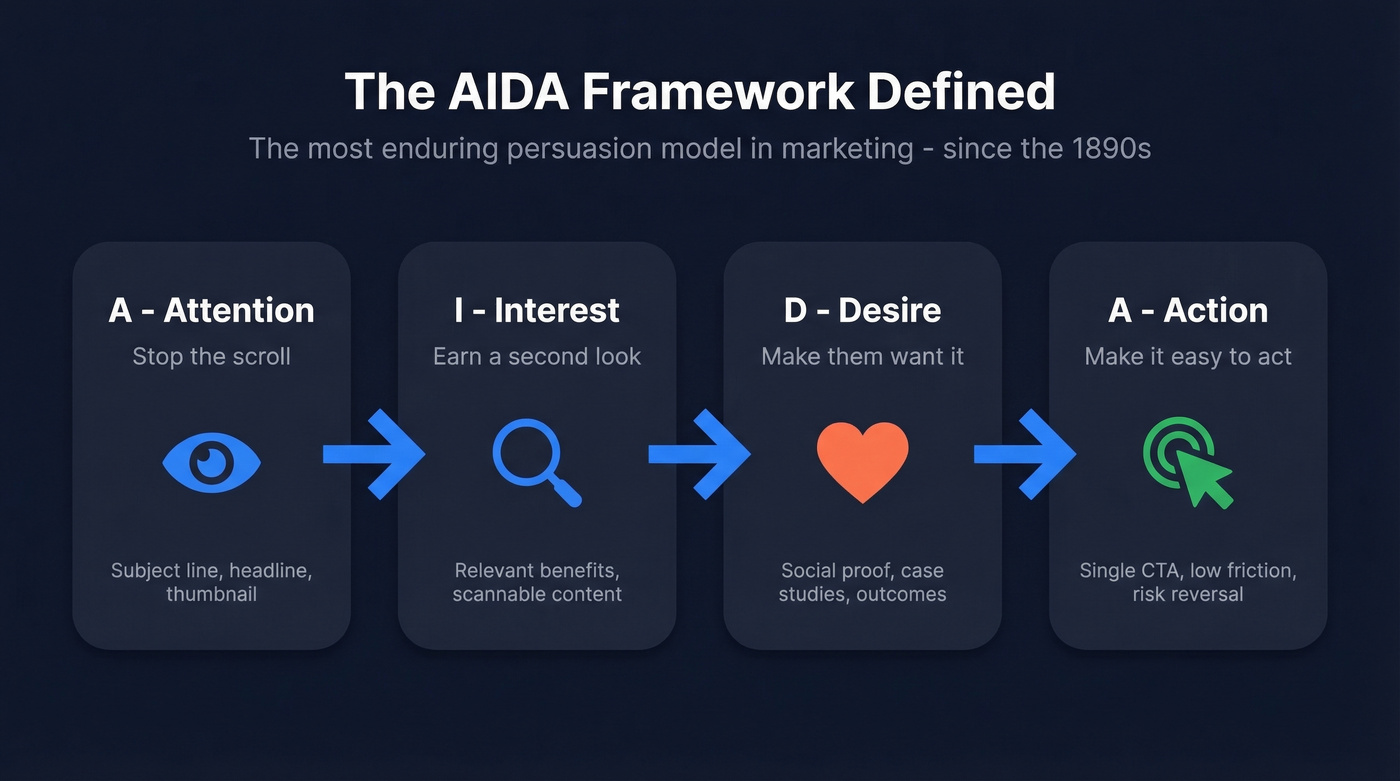
Put simply, AIDA maps the psychological journey from first impression to final conversion.
Despite its age, the model remains the default skeleton for landing pages, cold emails, ad copy, and sales presentations. It's simple enough to memorize and flexible enough to apply across channels. The AIDA definition, in a marketing context, is the most enduring persuasion model we have.
The quick version:
AIDA = Attention -> Interest -> Desire -> Action
- Attention: Stop the scroll. The billboard you can't ignore.
- Interest: Earn a second look. The article you keep reading.
- Desire: Make them want it. The product they picture owning.
- Action: Make it easy to buy. The button they actually click.
AIDA is the best starting structure for persuasive copy - but it's a heuristic, not a law. If you want templates, skip to the templates section.
The Four AIDA Stages Explained
Attention
You can't persuade someone who isn't looking at you. The Attention stage is about what the Corporate Finance Institute calls "creative disruption" - breaking the pattern of whatever your audience was doing before they encountered your message. Provocative imagery, sharp personalization, pattern interruption, even guerrilla tactics all live here.
The key constraint: attention is finite and expensive. In a feed-scrolling world, your subject line, headline, or thumbnail is your entire Attention budget. Waste it on something generic and you never get to stage two.
Interest
Attention gets them to stop. Interest gets them to stay.
This is where you prove you're worth their time by connecting your message to something they care about. Wendy's "Where's the beef?" campaign didn't just grab attention - it differentiated Wendy's from competitors and gave people a reason to keep paying attention. The campaign worked because it named a specific frustration (tiny burger patties) that fast-food customers already felt.
Tactically, Interest means making your content scannable and relevant. Subheadings, bullet points, clear benefit statements - anything that helps the reader confirm "this is for me" within the first few seconds.
The Interest vs. Desire confusion - A thread on r/copywriting nails why people struggle to separate these two stages. The clearest way to think about it: Interest is walking into a store because the window display caught your eye. Desire is picking up the item and imagining owning it. One is cognitive - "this is relevant to me." The other is emotional - "I want this."
Desire
Desire is the emotional pivot. The prospect has moved from "this is interesting" to "I want this." Your job is to help them picture the outcome - what life looks like after they buy, sign up, or switch.
Social proof is the most reliable Desire trigger. Case studies, testimonials, quantified results - anything that lets the prospect borrow someone else's confidence. Guarantees and risk reversal work here too, because they lower the emotional cost of wanting something. The Taya Agency framework distills it well: outcomes + proof + fit + offer. Compare this to the FAB formula - Feature, Advantage, Benefit - where a copywriter writes "OLED screen, realistic colors, enjoy your series." AIDA gives you the full persuasion arc; FAB zooms in on how to articulate value within the Desire stage specifically.
Action
The final stage is deceptively simple: make it easy to do the thing you want them to do.
Netflix's classic free-trial CTA is a textbook example - low friction, clear value, zero ambiguity about what happens next. The rules are straightforward: one CTA per view, specific button labels ("Start your free trial" beats "Submit"), and risk reversal language near the button like "Cancel anytime" or "No credit card required." Urgency helps when it's genuine - real deadlines or limited availability, not manufactured countdown timers. Every unnecessary form field, every extra click, every moment of confusion is a leak in your Action stage.
The full attention-to-action sequence only works if this final step is frictionless.
AIDA in Action - A Real Campaign
The Francesco Group, a UK salon chain, launched a new location using a textbook AIDA sequence. Four months before opening, they ran a PR campaign to build local awareness - pure Attention. Direct mail followed, offering a free consultation or haircut, which served as the Interest hook. Exclusive local launch events, promoted through press and social media, created buzz and a "want an invite" feeling - that's Desire. Finally, CTAs across Facebook, their website, and local advertising drove bookings: call, book online, or claim a discount.
It's not a flashy tech brand example, but that's the point. The framework works for a salon launch the same way it works for a SaaS landing page. The four stages are universal; the tactics change by channel and audience.
AIDA Templates You Can Use Today
Landing Page Template
This structure comes from the Taya Agency framework, and we've seen it work consistently across B2B and B2C pages:
- Headline (Attention): Lead with a pain point or desired outcome. "[Specific problem] is costing you [specific cost]."
- 2-3 bullets (Interest): Name the problem, introduce your mechanism, explain why it's different.
- Mini case study + quantified benefit (Desire): "Company X saw [result] in [timeframe]."
- Single CTA (Action): One button, one ask. Repeat it every two scroll-lengths on longer pages.
Cold Email - The 4-Sentence Framework
Here's the thing about most AI-generated cold emails: they "cyberstalk" with biographical details - your prospect's college, their last job title, their podcast appearance. That's not personalization. It's creepy pattern-matching. The critical distinction, as GMass's AIDA breakdown highlights, is that personalization that works identifies a specific business problem, not recites someone's professional history.
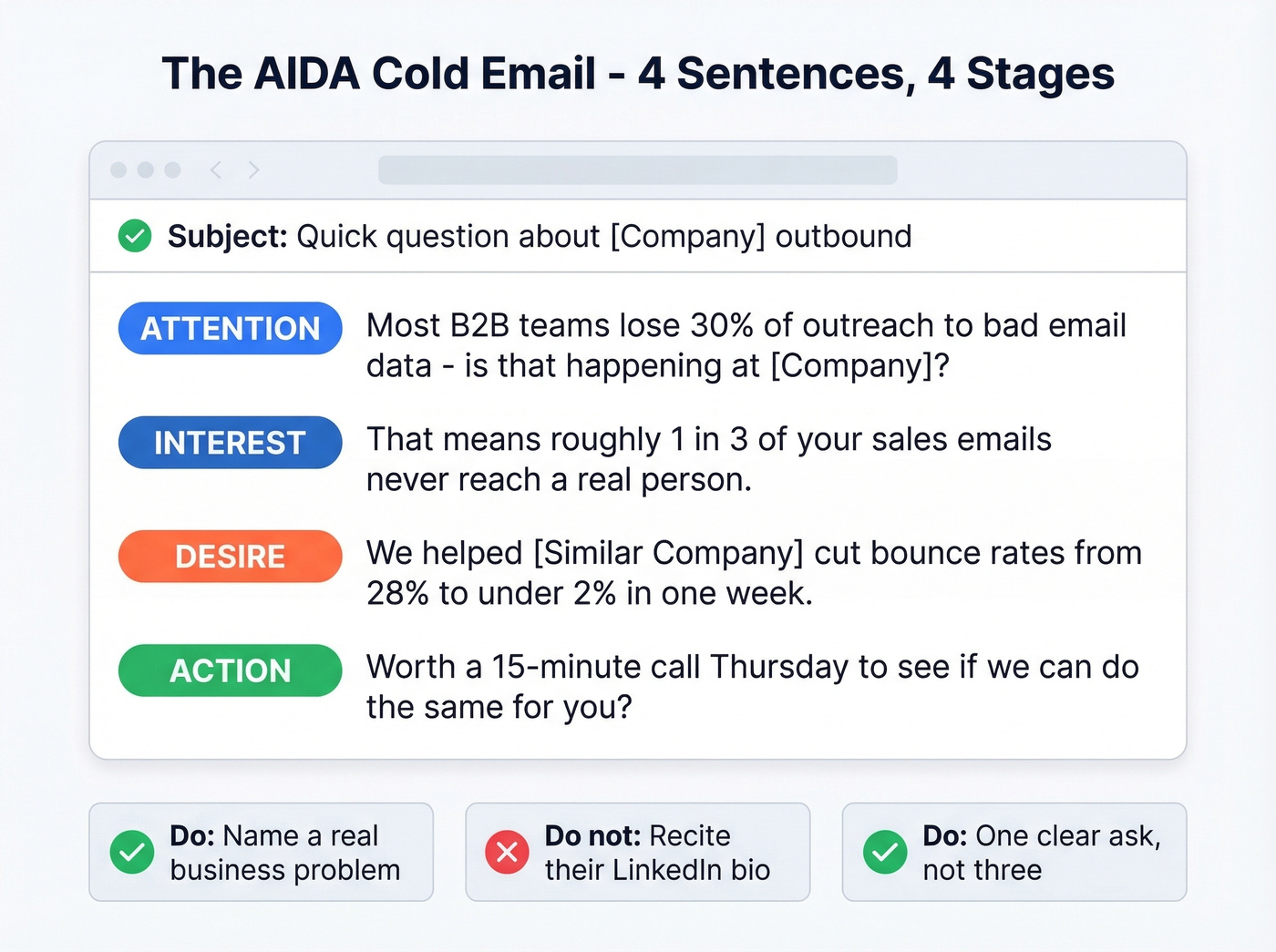
With that principle in mind, here's the four-sentence structure - one per stage:
- Attention: Open with a specific problem you know they have. A real business pain, not a compliment.
- Interest: Show you understand the problem's stakes or cost.
- Desire: Offer a concrete outcome or proof point.
- Action: One clear ask. A reply, a 15-minute call, a link.
For subject lines, what actually drives opens is personalization variables like name and company, urgency words ("now," "important"), free offers, and quick questions. A subject line like "Quick question about [Company]'s outbound" almost always outperforms "Exciting partnership opportunity." These are Attention-stage tactics that earn the click into your Interest stage. For more ideas, see these subject line examples.
Metrics Mapping
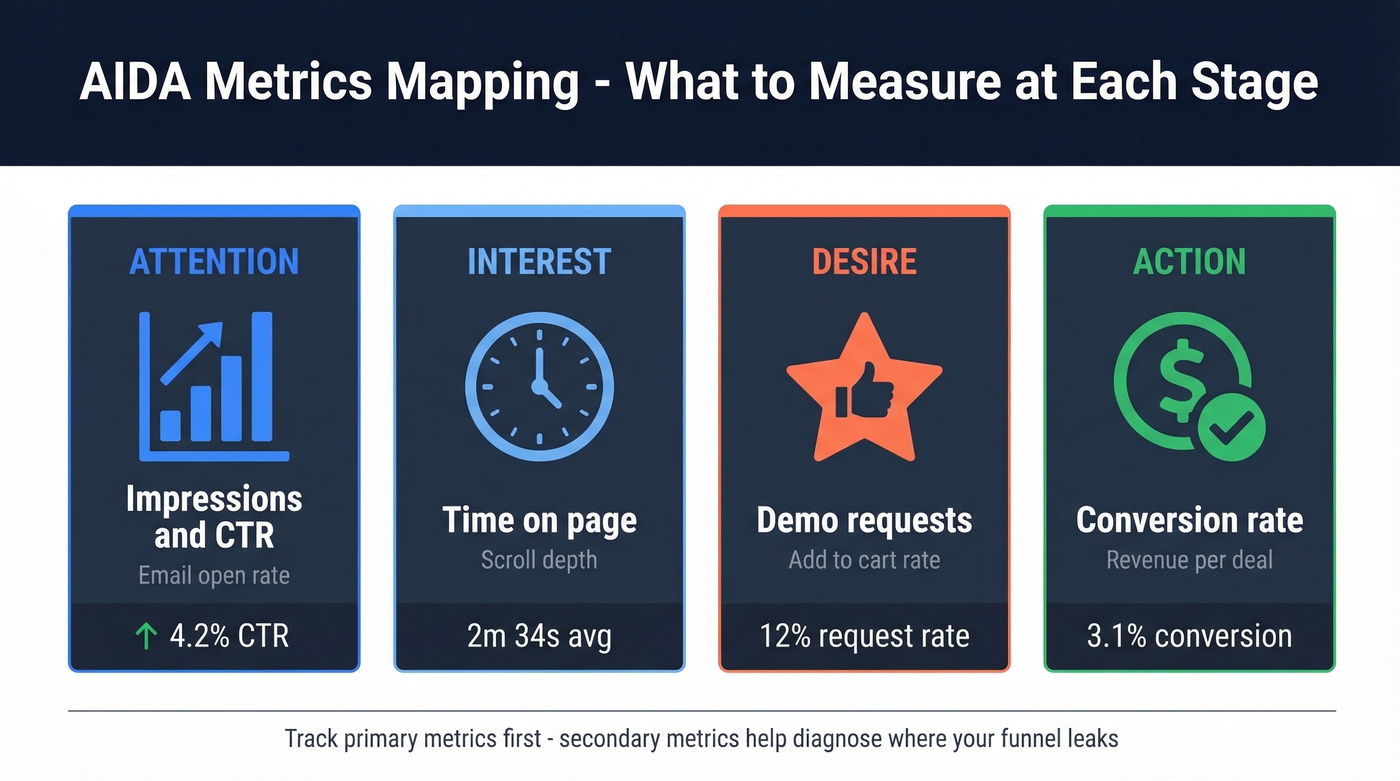
| AIDA Stage | Primary Metric | Secondary Metric |
|---|---|---|
| Attention | Impressions, CTR | Open rate |
| Interest | Time on page | Scroll depth |
| Desire | Demo requests | Add-to-cart |
| Action | Conversion rate | Revenue/deal |

Your AIDA cold email is only as good as the data behind it. A perfect Attention-Interest-Desire-Action sequence means nothing if it bounces. Prospeo's 98% email accuracy and 5-step verification ensure every carefully crafted message reaches a real inbox.
Stop perfecting copy that bounces. Start sending to verified contacts.
Does AIDA Still Work in 2026?
Let's be honest: AIDA is a useful starting structure, but the evidence base is thinner than most marketing textbooks admit. A Vakratsas & Ambler literature review found little empirical support for hierarchy-of-effects models in general. The core critique is that people don't move through neat cognitive stages in sequence. They jump around, revisit, and sometimes skip straight from attention to action.
Three specific weaknesses stand out.
First, the model assumes you can get attention - but in a world of ad blockers, skip buttons, and infinite scroll, audiences actively resist being interrupted. Second, it underweights emotional engagement and storytelling, treating persuasion as a rational staircase when buying decisions are often gut-level. Third, the linear sequence doesn't match modern behavior. By 2023, around 60% of marketing budgets were allocated to digital channels, and e-commerce crossed 22% of global retail. Buyers now research across devices, retarget loops, social proof from strangers, and comparison sites - none of which fits neatly into a four-step funnel.
Practitioners in copywriting communities on Reddit reflect this tension: they still recommend the framework as a writing structure, but emphasize that buying behavior isn't as linear as the model suggests.
Our take: AIDA is still the single best framework for structuring a single asset - one landing page, one email, one ad. But if you're using it to model an entire buyer journey, you're forcing a century-old map onto terrain it was never designed for. We've found it works best as a first-draft skeleton, not a final blueprint. Write the AIDA version, then test, iterate, and adapt to how your specific audience actually behaves.
AIDA vs Other Frameworks
AIDA vs the Modern Marketing Funnel
| Dimension | AIDA | Modern Funnel |
|---|---|---|
| Structure | Linear, 4 stages | Multi-step, non-linear |
| Focus | Messaging, psychology | Behavior, touchpoints |
| Scope | Single campaign/asset | Full customer journey |
| Lifecycle | Awareness -> Action | Awareness -> Advocacy |
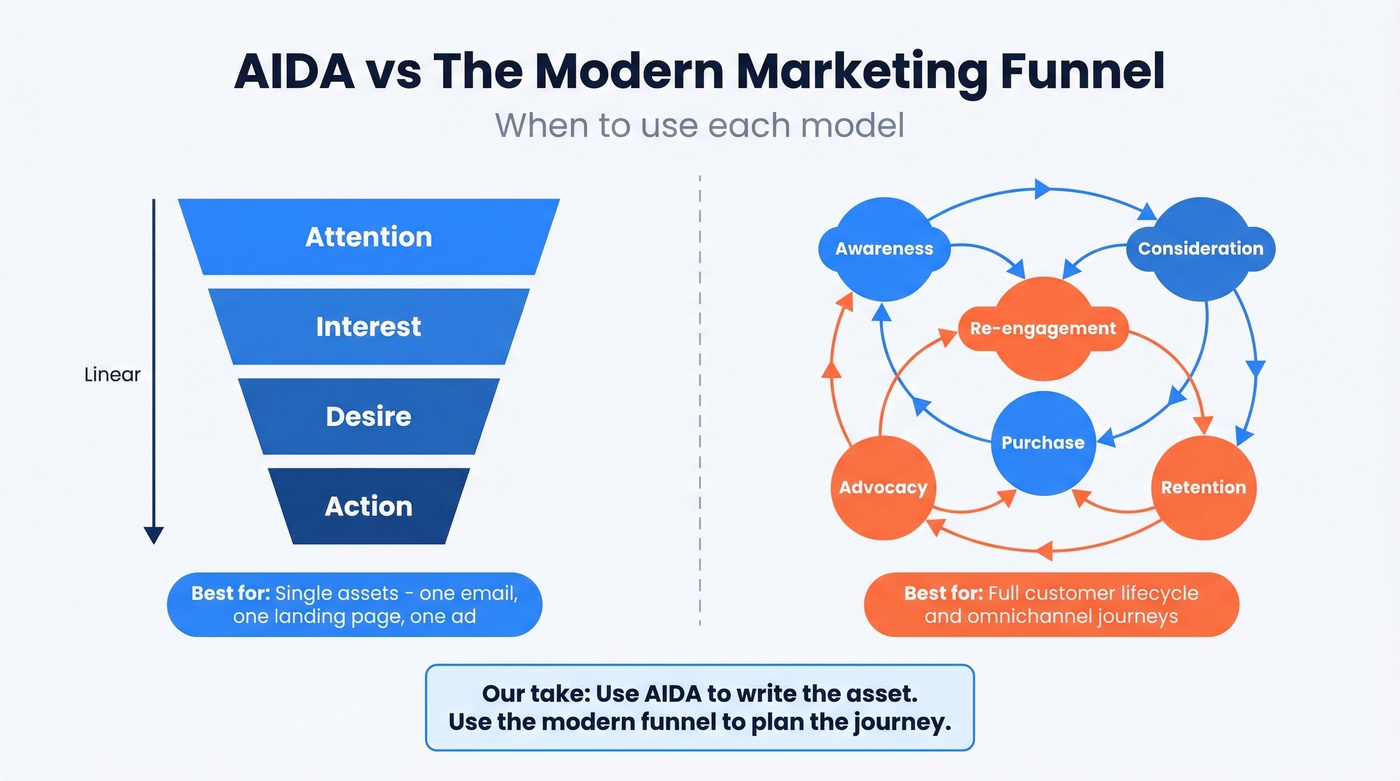
AIDA's biggest gap is what happens after the sale. There's no Retention stage, no Advocacy loop, no referral mechanism. BCG has argued that marketers should move beyond linear funnels entirely, toward "influence maps" that reflect how decisions actually happen. Omnichannel reminder systems can lift conversion rates by 15-20% - a tactic that doesn't map cleanly to any single AIDA stage.
For building a campaign asset, AIDA is the right tool. For designing a full customer lifecycle, you need something broader - like a B2B sales funnel template you can adapt.
AIDA vs PAS
PAS (Problem, Agitate, Solution) is one of the most recommended alternatives in copywriting communities, and for good reason.
| Dimension | AIDA | PAS |
|---|---|---|
| Best for | Landing pages, long-form | Cold emails, short ads |
| Stages | 4 (A-I-D-A) | 3 (P-A-S) |
| Strength | Full persuasion arc | Emotional urgency |
| Weakness | Can feel formulaic | Skips the "build interest" phase |
If you're learning one framework, learn AIDA. If you're learning two, add PAS. AIDA gives you the complete structure. PAS gives you a faster, punchier alternative for situations where you need to create urgency in under 100 words. Other practitioner favorites include FAB, the 4Cs, SLAP, and DAGMAR - but PAS is the one you'll see recommended most often on r/sales and r/copywriting.
AIDA Variants and Extensions
The original model has spawned dozens of variations. Most add a stage or two to address its gaps - particularly around post-purchase behavior.
| Variant | What It Adds | When to Use It |
|---|---|---|
| AIDAR | Retention | Lifecycle campaigns |
| AIDAS | Satisfaction | Post-purchase follow-up |
| RACE | Reach, Act, Convert, Engage | Digital-first lifecycle planning |
| REAN | Reach, Engage, Activate, Nurture | Digital-first strategies |
| NAITDASE | Need through Evaluation across 8 stages | Complex enterprise sales |
Smart Insights' RACE framework covers a similar lifecycle, especially the post-purchase "Engage" piece that the original model lacks. If you're already using RACE, you're already thinking beyond the four steps.
Applying AIDA to Outbound Prospecting
The four-sentence cold email framework above is tailor-made for B2B outbound. One sentence per stage. Problem-based personalization in the opener - remember, that means identifying a specific business pain, not reciting biographical trivia. A concrete outcome in the Desire line. A single, low-friction ask to close. If you want more outbound tactics, start with these sales prospecting techniques.
But a perfectly structured email that bounces is worth nothing.
The messaging framework is only half the equation. The other half is data quality. If your list bounces at scale, you're not just losing prospects - you're damaging your sender reputation and tanking deliverability for every email that follows. We've seen teams nail the AIDA structure and still get terrible results because 30% of their list was dead addresses. (If you're diagnosing this, use these email bounce rate benchmarks and fixes.)
Prospeo handles this layer with 98% email accuracy and a 7-day data refresh cycle, so your AIDA-structured outreach actually reaches the inbox. There's a free tier if you want to test the data quality before committing. If you're building your list from scratch, this guide on how to generate an email list pairs well with AIDA-based outreach.
The Action stage demands zero friction - and that starts before the send. Prospeo gives you 143M+ verified emails at $0.01 each, so your AIDA framework hits real decision-makers, not dead addresses. Teams using Prospeo book 35% more meetings than Apollo users.
Make your AIDA emails land where they matter - real inboxes.
FAQ
Who created the AIDA model?
E. St. Elmo Lewis, an American advertising pioneer, developed the AIDA framework in the late 1890s. It's one of the oldest models in marketing and advertising theory, predating modern digital channels by nearly a century.
What does AIDA stand for?
AIDA stands for Attention, Interest, Desire, and Action - four cognitive stages a consumer moves through before making a purchase decision. Each stage represents a shift from passive awareness to active buying behavior.
Is AIDA outdated in 2026?
AIDA remains the best starting structure for any single persuasive asset - a landing page, email, or ad. That said, modern buyer journeys are non-linear and multi-channel, so treat it as a drafting heuristic rather than a proven law of behavior.
What's the difference between Interest and Desire?
Interest is cognitive - the prospect recognizes your message is relevant and keeps reading. Desire is emotional - they shift from "this is interesting" to "I want this" and begin imagining ownership or the outcome.
What tools help execute an AIDA email campaign?
You need a copywriting framework (AIDA itself) plus verified contact data to ensure deliverability. Tools like Prospeo provide accurate emails with frequent data refreshes so your outreach actually reaches the inbox rather than bouncing.