

The ANUM Framework: A Practical Guide to Authority-First Qualification
67% of lost sales trace back to reps who didn't qualify properly. And 84% of reps missed quota last year. The pipeline isn't the problem - it's what's in the pipeline. Buyers spend just 17% of their buying time meeting suppliers, which means that sliver can't be wasted on someone who'll never sign a contract. The ANUM framework exists to fix that.
Quick version: ANUM (Authority, Need, Urgency, Money) is a lead qualification framework that puts the decision-maker first. Use it for outbound triage and mid-market deals with clear buyers. Skip it for committee-heavy enterprise deals - use MEDDIC instead. The framework you pick matters less than using one consistently.
What Is ANUM?
ANUM stands for Authority, Need, Urgency, Money. It's a lead qualification methodology commonly attributed to Ken Krogue, an early inside-sales pioneer, and it emerged as a direct evolution of IBM's BANT (Budget, Authority, Need, Timeline), which dates back to the 1950s.
The core insight is simple: budget is fluid. If you're talking to someone with real authority and a genuine need, money tends to follow. BANT's mistake was leading with budget, which disqualifies prospects who haven't allocated funds yet but absolutely would for the right solution. ANUM flips the sequence and puts the decision-maker at the top.
The Four ANUM Stages
Each stage acts as a gate. If a prospect fails Authority, there's no point digging into Need.
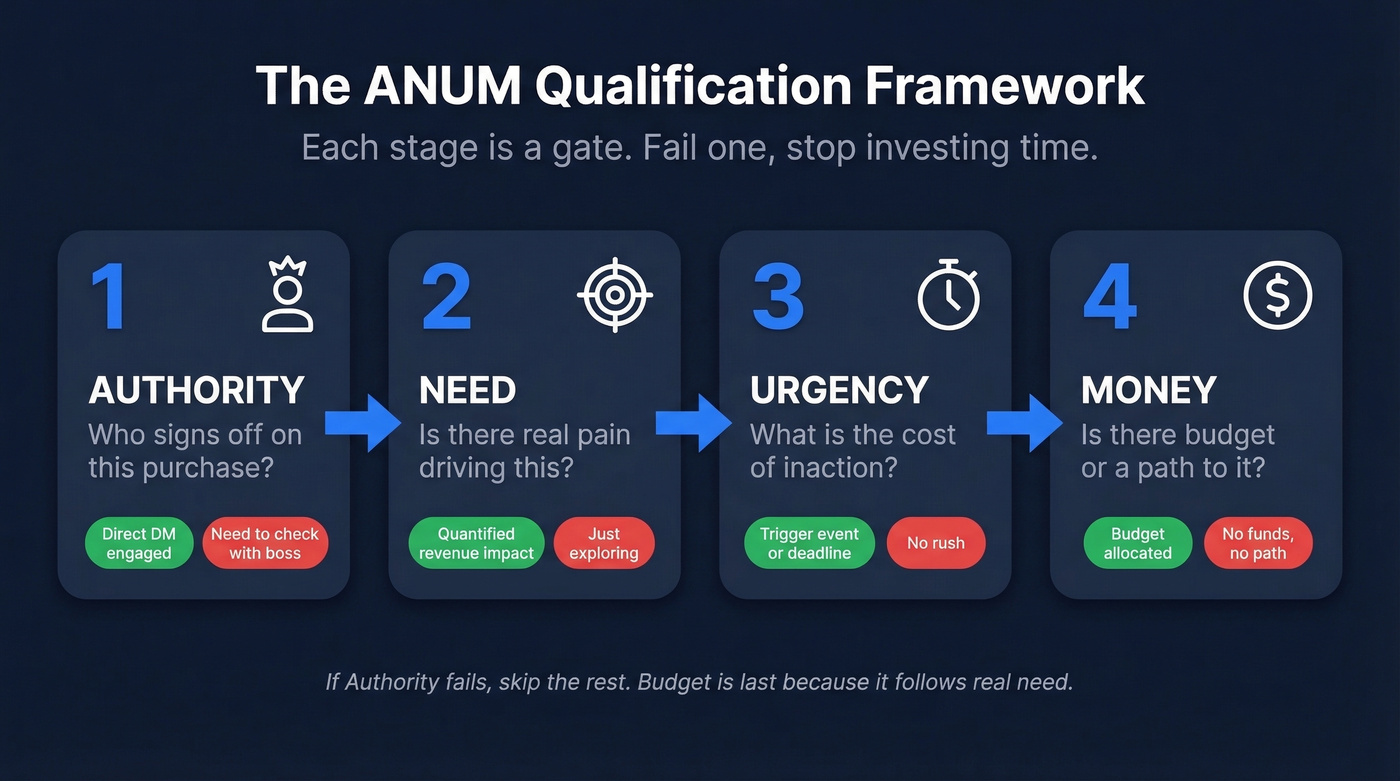
Authority
Who actually signs off on this purchase?
Ask: "Who else is involved in this decision?" and "How does your org typically handle purchases like this?"
Green light: Direct budget authority or economic buyer engaged. Red flag: "I'd need to check with my boss" - you're talking to an influencer, not a decision-maker. Don't hang up, but map a path to the real buyer before investing serious time.
Need
We've seen reps get excited about a prospect who "totally gets the product" - only to realize there's no actual problem driving a purchase. Need without pain is just curiosity.
Ask: "What challenges are you facing?" and "How is this impacting revenue or productivity?"
Green light: Quantified pain tied to revenue or operational cost. Red flag: "Just exploring." That's not need.
Urgency
The cost of inaction is the most underrated qualification signal. A prospect with a deadline will push through internal friction. One without a deadline won't.
Ask: "What happens if this isn't solved in the next few months?" and "When are you looking to implement?"
Green light: A triggering event - new fiscal year, leadership change, a lost deal that exposed the gap. Red flag: "No rush," which usually means it'll die in committee.
Money
Is there budget, or a realistic path to budget?
Ask: "Have you allocated a budget for this?" and "What's your typical spending range for similar tools?"
Green light: Ballpark aligned with your pricing. Red flag: No funds and no path to funds. But "no budget yet" isn't automatically disqualifying - that's the whole point of putting Money last. If Authority, Need, and Urgency are strong, budget often materializes.
Scoring Leads with ANUM
Most teams talk about qualification but never actually score it. 79% of marketing teams haven't established lead scoring - a persistent gap, given that implementing it can improve conversion rates by 20%+. Here's a simple 0-3 rubric you can drop into any CRM today:
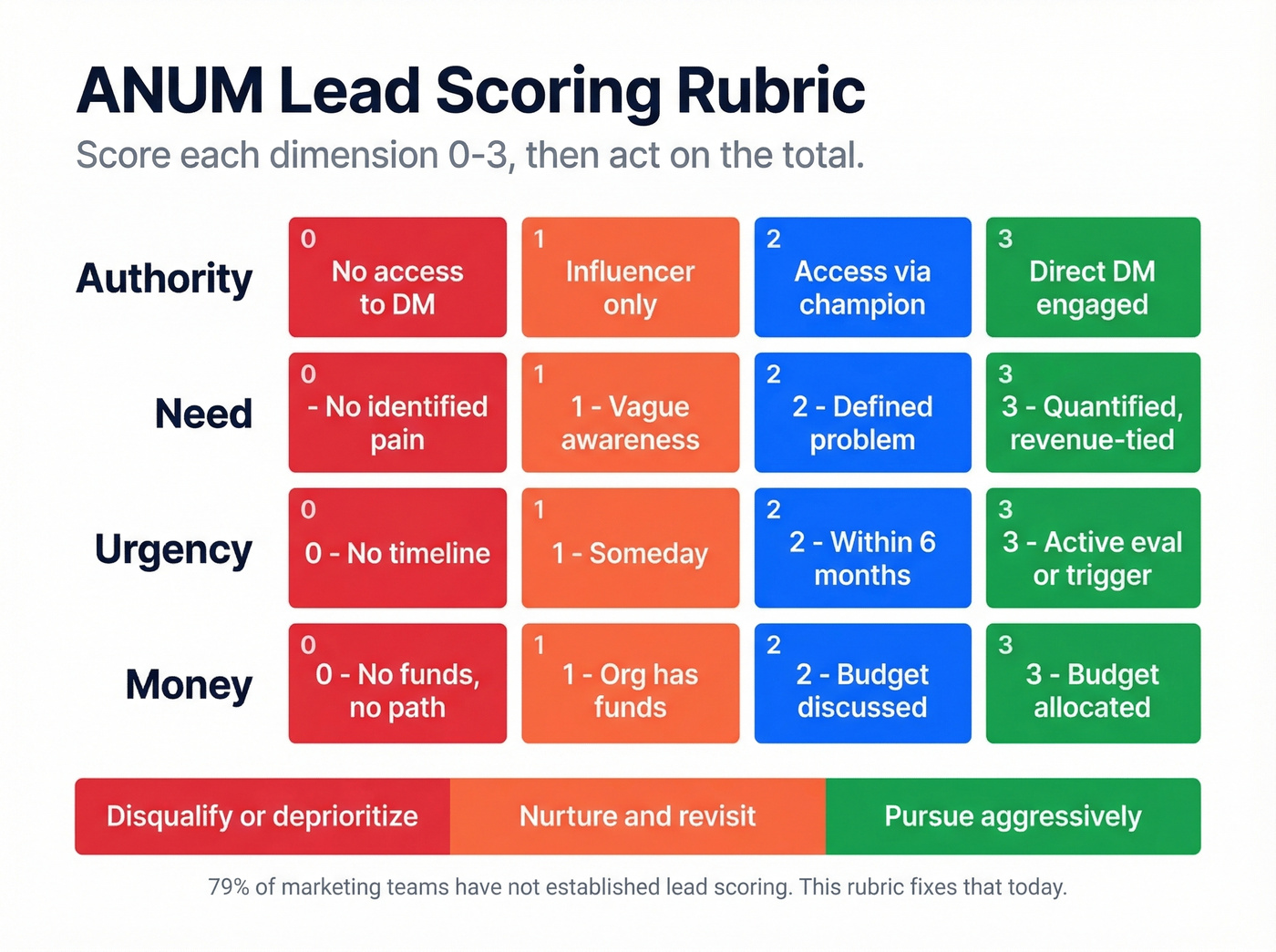
| Dimension | 0 (Disqualify) | 1 (Weak) | 2 (Moderate) | 3 (Strong) |
|---|---|---|---|---|
| Authority | No access to DM | Influencer only | Access to DM via champion | Direct DM engaged |
| Need | No identified pain | Vague awareness | Defined problem, no urgency | Quantified, revenue-tied |
| Urgency | No timeline | "Someday" | Within 6 months | Active eval / trigger event |
| Money | No funds, no path | Org has funds, no budget | Budget being discussed | Budget allocated |
Score thresholds: 9-12 = pursue aggressively. 5-8 = nurture and revisit. 0-4 = disqualify or deprioritize. The median qualified-to-booked rate sits around 62%, with top-quartile teams hitting 72%. Adjust cutoffs based on your deal size and cycle, but these are solid starting points.

Scoring leads on Authority means nothing if you can't reach the decision-maker. Prospeo gives you 98% accurate emails and 125M+ verified mobile numbers so your ANUM-qualified prospects actually pick up the phone.
Stop qualifying leads you can't contact. Start reaching real buyers.
When ANUM Breaks Down
Here's the thing: we've watched this happen to experienced reps. You spend 45 minutes on a discovery call with someone who loves your product, scores high on Need and Urgency, and tells you they have budget. Then you find out they need to run it past three more people, a procurement team, and legal. Authority-first qualification didn't prepare them for that.
The methodology's biggest weakness is buying committees. Mid-sized firms average 7 people in a buying decision. ANUM's authority-first approach can alienate influencers who aren't the final decision-maker but control access to the one who is. One workaround: qualify the technical team first, then use their endorsement to reach the economic buyer.
There's a common take on r/sales that all methodologies are basically the same - need, budget, stakeholders, timeline. That's fair. The value isn't novelty. It's sequencing. But for complex enterprise deals, you need something heavier.
If your average deal size is under $10k and you're selling to a single buyer, ANUM is probably the only qualification method you'll ever need. The teams that agonize over MEDDIC vs. ANUM vs. CHAMP usually have a qualification problem, not a framework problem.
ANUM vs Other Frameworks
No single framework fits every deal. The smart move is to mix: ANUM for outbound triage, MEDDIC once a deal enters the pipeline. One team reported forecast accuracy jumping from 62% to 89% after switching from BANT to MEDDIC for enterprise deals - not because MEDDIC is magic, but because it matched their motion.
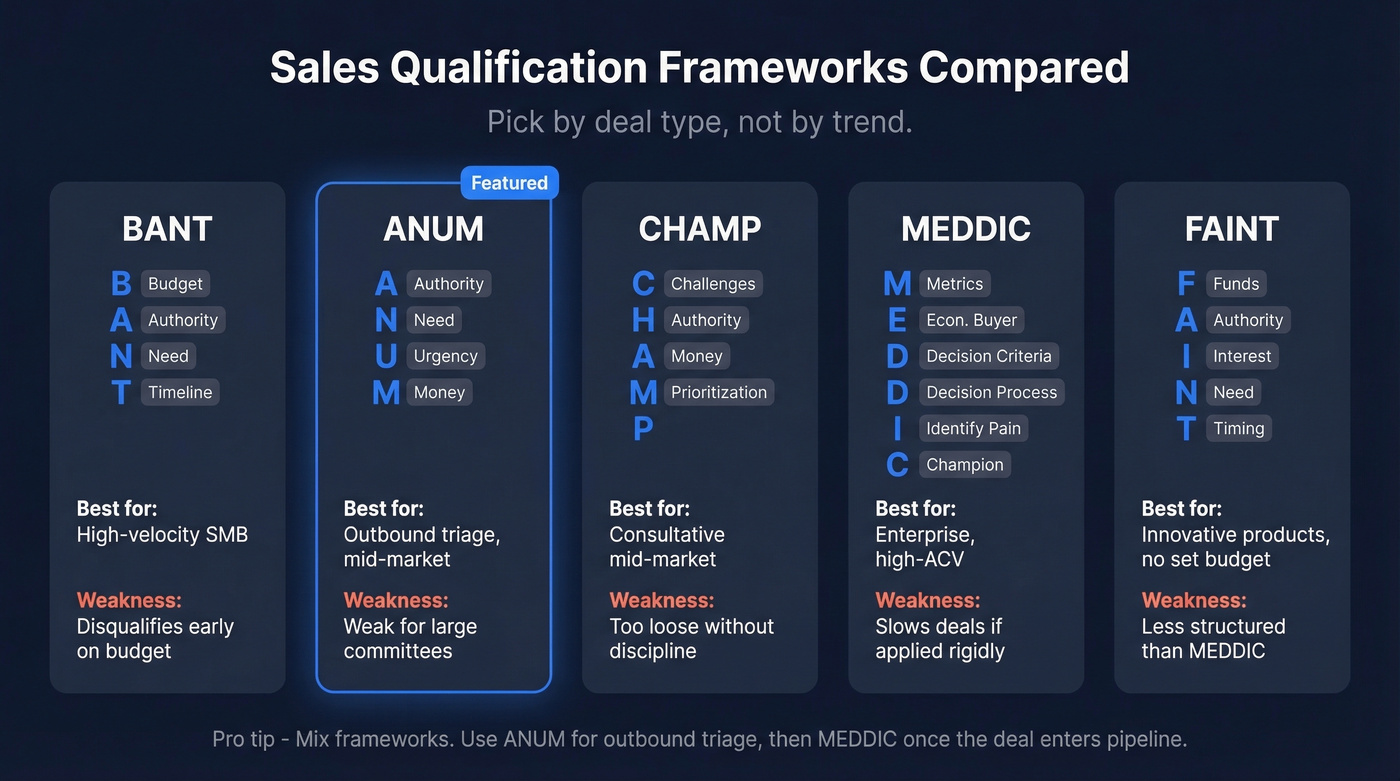
| Framework | Stands For | Best For | Weakness |
|---|---|---|---|
| BANT | Budget, Authority, Need, Timeline | High-velocity SMB | Disqualifies early on budget |
| ANUM | Authority, Need, Urgency, Money | Outbound triage, mid-market | Weak for large committees |
| CHAMP | Challenges, Authority, Money, Prioritization | Consultative mid-market | Too loose without discipline |
| MEDDIC | Metrics, Econ. Buyer, Decision Criteria, Pain, Champion | Enterprise, high-ACV | Slows deals if applied rigidly |
| FAINT | Funds, Authority, Interest, Need, Timing | Innovative products, no set budget | Less structured than MEDDIC |
FAINT, introduced by Mike Schultz at RAIN Group, deserves a spot in your toolkit. It replaces "Budget" with "Funds" - the distinction being that an org might have the financial capacity to buy even without a pre-allocated line item. Useful for disruptive products where buyers haven't budgeted for your category yet.
How to Operationalize ANUM
A framework that lives in a slide deck is worthless. Let's make it real. Step zero is ICP fit - don't run qualification on accounts outside your ideal customer profile.
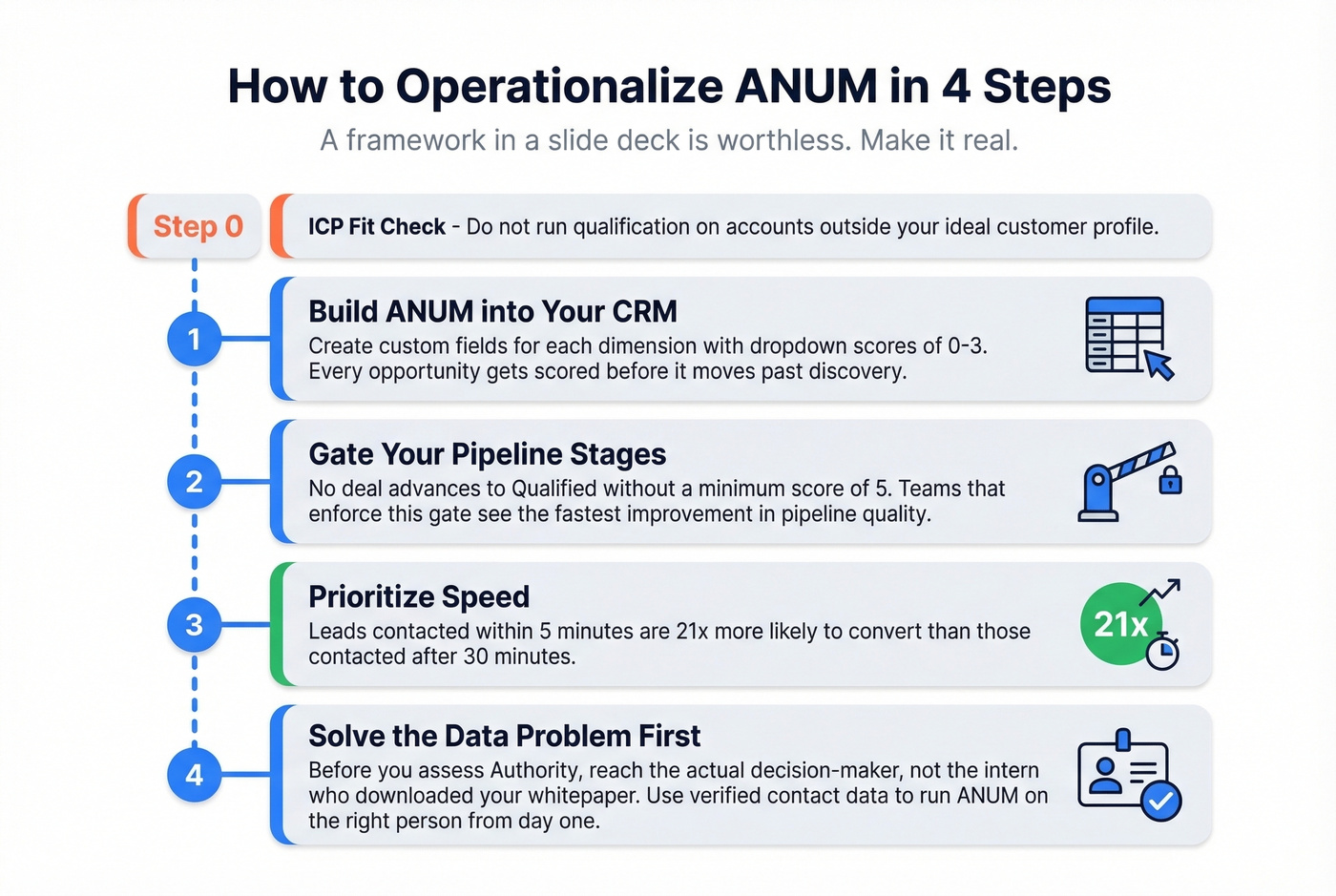
1. Build ANUM into your CRM. Create custom fields for each dimension with dropdown scores of 0-3. Every opportunity gets scored before it moves past discovery.
2. Gate your pipeline stages. No deal advances to "qualified" without a minimum score of 5. In our experience, teams that enforce this gate see the fastest improvement in pipeline quality - sometimes within a single quarter.
3. Prioritize speed. Leads contacted within 5 minutes are 21x more likely to convert than those contacted after 30 minutes. Qualification frameworks don't help if you're slow to engage.
4. Solve the data problem first. Before you can assess Authority, you need to reach the actual decision-maker - not the intern who downloaded your whitepaper. Prospeo's 30+ search filters let you target by job title, seniority, and department, then verify emails and direct dials in real time so you're running ANUM on the right person from day one.
If you’re building lists at scale, it helps to standardize your sales prospecting techniques so qualification starts with the right accounts.
Your ANUM scoring rubric is only as good as the data feeding it. Prospeo's 30+ search filters - including buyer intent, job changes, and funding signals - let you pre-qualify Authority, Need, and Urgency before the first call.
Qualify prospects before you even dial. 300M+ profiles, refreshed every 7 days.
FAQ
What does ANUM stand for?
ANUM stands for Authority, Need, Urgency, Money - a lead qualification sequence that prioritizes reaching the decision-maker before discussing budget. It evolved from BANT, reordered to reflect how modern B2B buying actually works.
Is ANUM better than BANT?
For outbound-heavy teams selling to clear decision-makers, yes - it avoids wasting time on prospects who can't buy by putting authority first. For enterprise deals with large buying committees, MEDDIC is stronger. The best teams mix frameworks by deal stage: ANUM for initial triage, MEDDIC once the deal is in pipeline.
How do I find the right decision-maker for ANUM?
Use a B2B data platform to identify and verify decision-maker contact details before your first outreach. Prospeo's 30+ search filters let you target by job title, seniority, and department, then verify emails (98% accuracy) and direct dials in real time. Authority-first qualification only works if you're reaching the right person from the start.