

How to Set Appointments Over the Phone (Scripts, Data, and a System That Works)
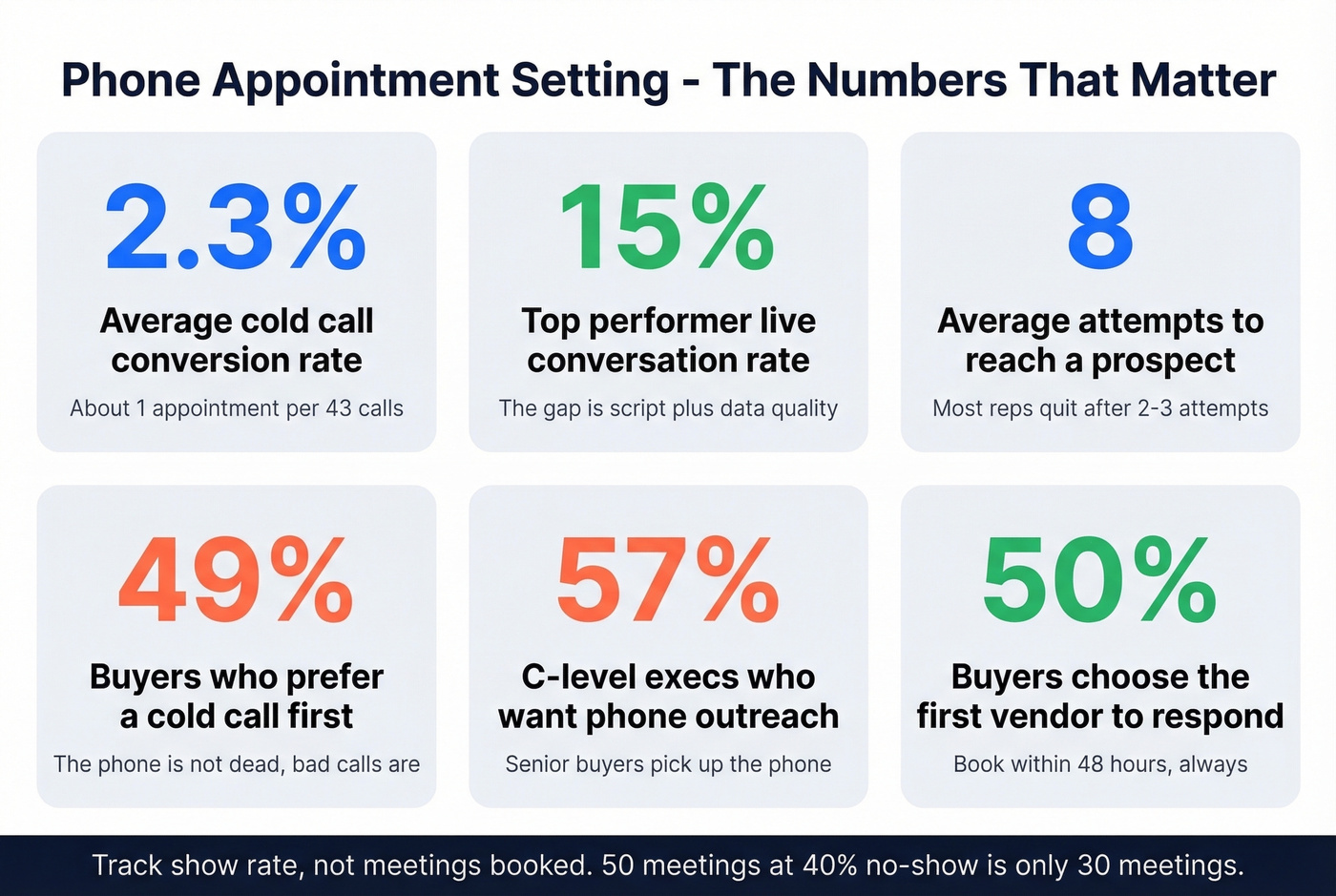
Appointment setting over the phone converts at 2.3% on average. Brutal. But here's what that stat hides: 49% of buyers actually prefer a cold call as a first touch, and 57% of C-level executives specifically want to hear from reps by phone. The phone isn't dead - most reps just don't have a system for it.
This guide is for reps and teams setting their own appointments, not outsourced answering services. We've broken it into three phases: prep, the call itself, and the post-call confirmation sequence that determines whether your "yes" actually shows up.
What You Need (Quick Version)
Before the call: Verify your data, research the prospect, dial Tuesday or Thursday mornings.
During the call: Follow a 4-part script - opener, value prop, qualifying question, close. Handle objections with listen-clarify-respond.
After the call: Send a calendar invite immediately, run a 4-step confirmation sequence, book within 48 hours.
Here's how each step works.
Prep Work Before Dialing
Most wasted call blocks die before the first ring. A rep loads a list, dials 60 numbers, and reaches maybe 8 people because half the numbers are dead. It takes an average of 8 attempts to reach a prospect. You can't burn those attempts on disconnected lines.
Start with clean data. Verify direct dials before loading your dialer. Prospeo's mobile finder covers 125M+ verified numbers with a 30% pickup rate, refreshed on a 7-day cycle so you're not calling numbers that went stale weeks ago. Upload your target list, strip out the dead numbers, and spend your call block talking to humans instead of voicemail boxes.
Tuesday and Thursday mornings consistently outperform other slots for B2B outreach. Block 90 minutes, kill distractions, and treat it like a meeting with yourself. Before each call, spend 30 seconds on the prospect - what does their company do, what's their likely pain point? You don't need a dossier. One sentence of context that proves you're not reading from a random list is enough.
The Call: A 4-Part Script Framework
Every effective cold calling appointment setting conversation follows the same arc: open, deliver value, qualify, close.
The Opener
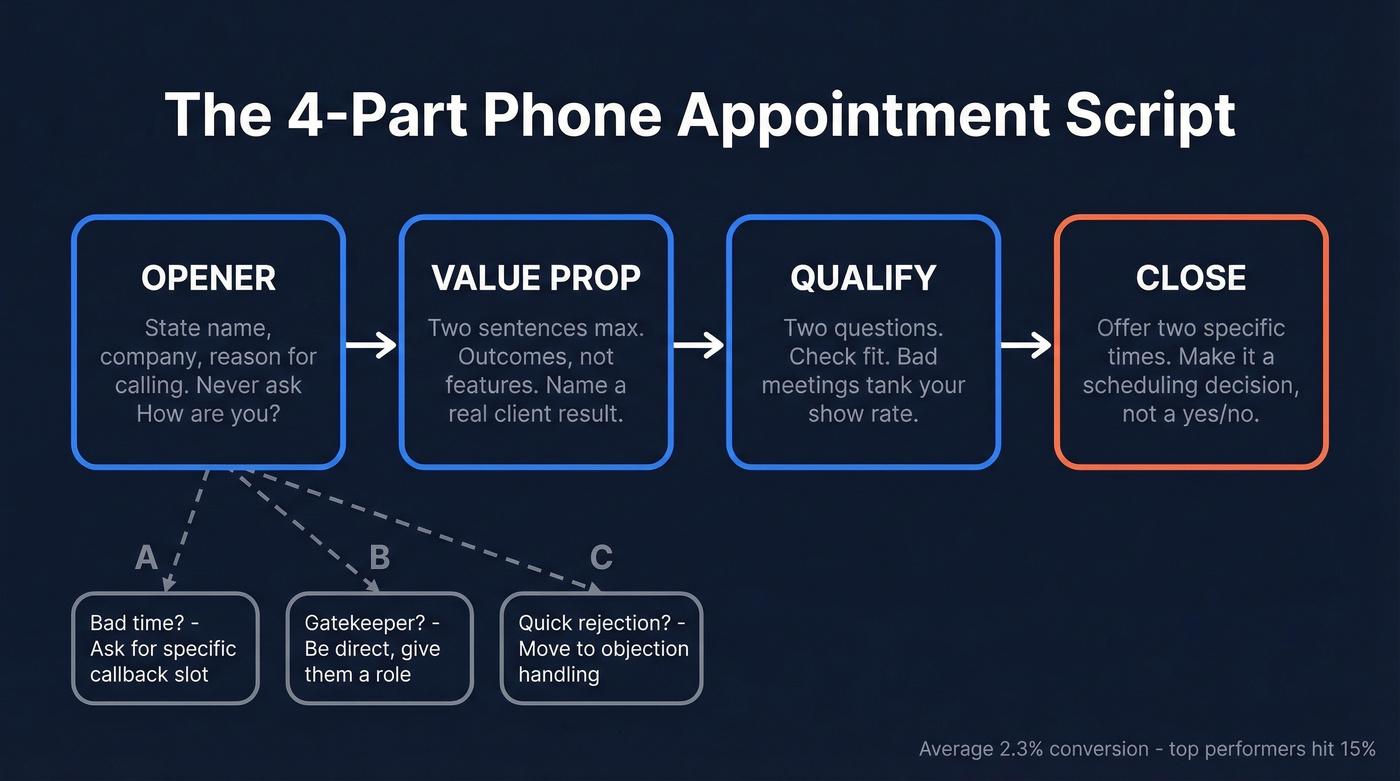
Don't ask "How are you?" and don't launch into a pitch. State your name, your company, and a reason for calling. Opening with a specific reason increases success rates by 2.1x - small on paper, compounding over hundreds of dials.
"Hi [Name], this is [Your Name] with [Company]. The reason I'm calling - we've been working with [similar role/industry] teams dealing with [specific problem]. I wanted to see if that's on your radar too."
If you use a permission-based opener and the prospect says "No," don't freeze. This comes up constantly in sales communities - a rep on r/salestechniques asked exactly this after following a popular cold-calling framework. The recovery is simple:
"Totally fair. Could I take 15 seconds to tell you why I called, and you can decide if it's worth a longer conversation?"
The prospect said no to their time being wasted, not to hearing something useful.
Branching logic: If they say "bad time," ask for a specific callback slot. If you hit a gatekeeper, jump to the gatekeeper section below. If they give a quick rejection ("we're all set"), move to objection handling.
Value Proposition
You get two sentences. Make them about outcomes, not features.
"We help [role] teams cut [specific process] time in half, which typically frees up [X hours/dollars]. [Client name] saw [specific result] in [timeframe]."
The more the prospect talks after this, the better. Ask a follow-up question and listen.
Qualifying Questions
Your goal isn't to close a deal - it's to determine fit and earn a meeting. Two questions are enough:
- "How are you currently handling [area]? Is that working the way you'd want?"
- "If we could show you a way to [outcome], would it be worth 20 minutes to explore?"
If the prospect isn't a fit, thank them and move on. A bad-fit meeting wastes everyone's time and tanks your show rate.
The Close
Don't ask "Would you like to schedule a meeting?" That's too easy to decline. Offer two specific times:
"Would Tuesday at 10 or Thursday at 2 work better for a quick 15-minute call?"
Anchoring to specific options makes it a scheduling decision, not a yes/no decision.
Follow-Up Script (Callbacks)
A lot of reps don't call back consistently. That's a mistake - the ones who follow through stand out immediately.
"Hi [Name], it's [Your Name] from [Company] - you asked me to call back on [day]. Last time we talked about [pain point]. Still worth a quick 15 minutes this week?"
Keep it short. They already gave you permission. Don't re-pitch from scratch.

You need 8 attempts to reach a prospect. Don't waste them on disconnected lines. Prospeo's mobile finder gives you 125M+ verified direct dials with a 30% pickup rate - refreshed every 7 days, not every 6 weeks.
Spend your call block talking to humans, not voicemail boxes.
Handling Objections
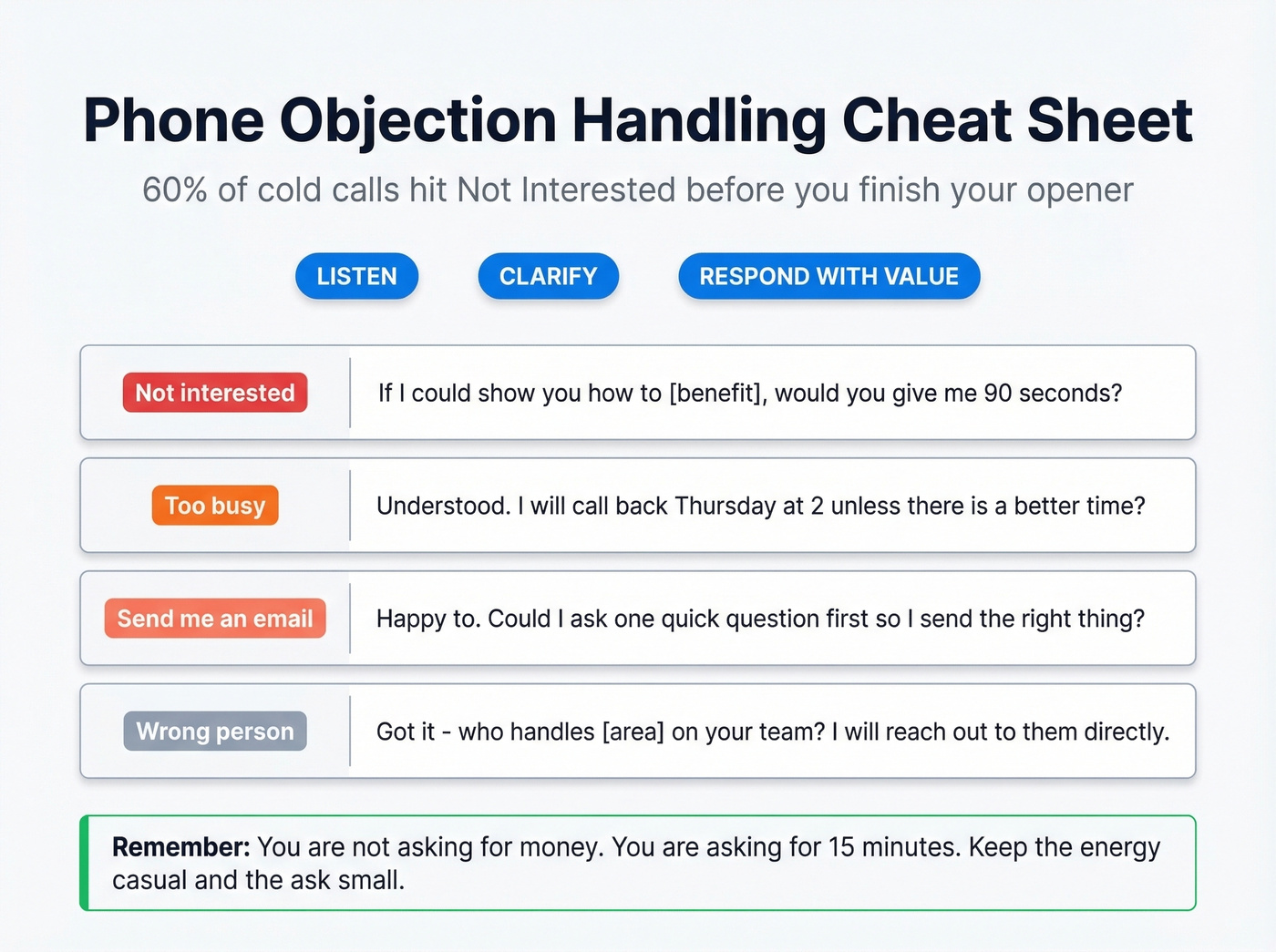
Look, about 60% of cold calls hit "I'm not interested" before you finish your opener. That's normal. The framework: listen, clarify, respond with value.
If you want a deeper breakdown of what to say when you get shut down, see our guide to cold call rejection.
| Objection | Response |
|---|---|
| "Not interested" | "If I could show you how to [benefit], would you give me 90 seconds?" |
| "I'm too busy" | "Understood. I'll call back Thursday at 2 unless there's a better time?" |
| "Send me an email" | "Happy to. Could I ask one quick question first so I send the right thing?" |
| "Wrong person" | "Got it - who handles [area] on your team? I'll reach out to them directly." |
Objections during phone-based appointment setting aren't buying objections. You're not asking for money. You're asking for 15 minutes. The bar is low, and your response should reflect that - keep the energy casual and the ask small.
Getting Past the Gatekeeper
Treat the gatekeeper as a stakeholder, not an obstacle. They control access, and they recognize a pitch instantly.
Be direct and respectful: "I need to get some information to whoever handles [area] - is that you, or would someone else be the right person?" This works because it doesn't assume, doesn't lie, and gives the gatekeeper a role in helping you. Skip the tricks. They've heard them all.
After the Call: Lock In the Meeting
Booking the meeting is half the battle. Showing up is the other half. Same-day appointments have a 2% no-show rate vs. 33% for those booked 15+ days out. And speed matters: 50% of buyers choose the vendor that responds first, so book within 48 hours whenever possible.
If you want to tighten the rest of your outreach workflow beyond calls, build a repeatable set of sales prospecting techniques around the same timing and follow-up rules.
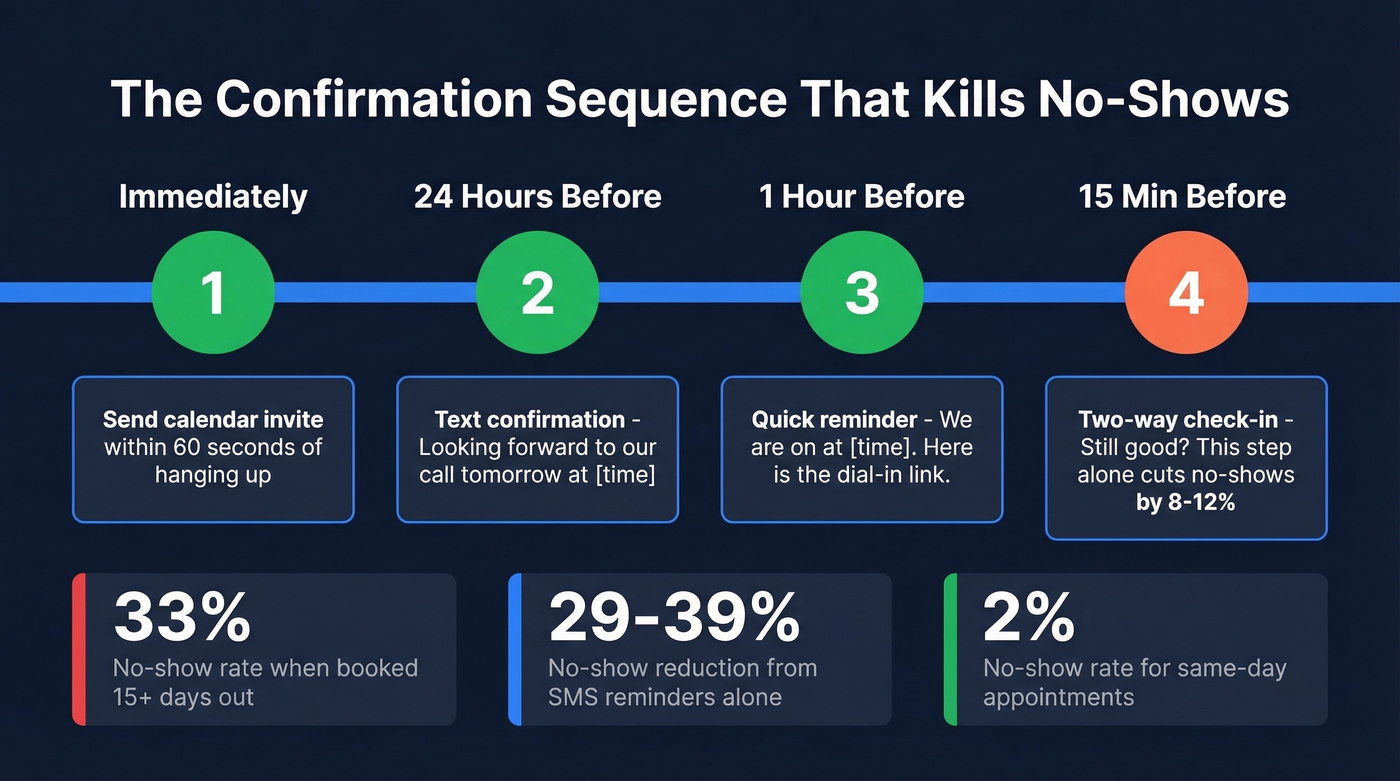
Then run this confirmation sequence:
- Calendar invite immediately - within 60 seconds of hanging up.
- Text confirmation 24 hours before - "Looking forward to our call tomorrow at [time]."
- Reminder 1 hour before - "Quick reminder: we're on at [time]. Here's the dial-in."
- "Still good?" 15 minutes prior - this two-way confirmation step cuts no-shows by an additional 8-12%.
SMS reminders alone cut no-shows by 29-39%. Don't let hard-won meetings evaporate because you skipped a text.
Telemarketing Tips That Actually Move the Needle
Calling the wrong audience. No script fixes bad targeting. Verify your list before you dial. If you're rebuilding lists from scratch, start with a few free lead generation tools and then enrich/verify before you call.
Booking too far out. Every day between the call and the meeting is a day they forget why they said yes. We've seen teams cut no-shows in half just by tightening the booking window from 10 days to 3.
Single-touch follow-up. One confirmation email isn't a system. Run the 4-step sequence above. If you need copy you can paste into your workflow, use these sales follow-up templates.
Unclear meeting expectations. Tell the prospect exactly what the meeting covers and how long it takes. Ambiguity breeds cancellations.
Tracking meetings booked instead of show rate. Fifty booked meetings at 40% no-show is 30 meetings. Track what matters. If you're standardizing reporting across the team, align on a simple set of lead generation metrics and review them weekly.
Let's be honest: if your show rate is below 70%, your problem isn't your script - it's your confirmation process. I've seen teams double their effective pipeline just by adding SMS reminders and booking closer to the call date. The script gets you the "yes." Everything after determines whether that "yes" actually shows up.
Your script doesn't matter if you're calling the wrong number. Prospeo delivers 98% accurate contact data at $0.01 per email and verified mobiles for every prospect on your list. Teams using Prospeo book 35% more meetings than Apollo users.
Clean data turns a 2.3% connect rate into a pipeline machine.
FAQ
What's a good cold calling appointment setting rate?
Top performers convert about 15% of live conversations into meetings. At 2.3% overall (including unanswered dials), expect roughly one appointment per 43 calls. Anything above 5% on total dials means your data and script are both working.
How many call attempts before giving up?
It takes an average of 8 attempts to reach a prospect, yet most reps quit after 2-3. Spread attempts across different days and times - persistence is the single biggest differentiator between average and top-performing SDRs.
How do I reduce no-shows on phone-set appointments?
Book within 48 hours, send a calendar invite immediately, and run a 4-step SMS confirmation sequence. SMS reminders alone cut no-shows by 29-39%. The closer the meeting is to the original call, the higher the show rate.
What tools help with appointment setting over the phone?
You need three things covered: data, dialing, and follow-up. For data, a verified mobile finder eliminates dead dials before your call block starts. Pair that with a parallel dialer like Orum or PhoneBurner and an SMS tool like Salesmsg for confirmations - that stack covers the full workflow from first ring to confirmed meeting.