

Average Newsletter Open Rate: 2026 Benchmarks and What Actually Matters
The average open rate for a newsletter in 2026 lands around 38-43% depending on the dataset. But here's the problem: Apple Mail Privacy Protection inflates reported opens by 15-20+ percentage points, so "open rate" isn't a clean measure of readership anymore. One newsletter-specific dataset covering 15.68 billion sends shows opens dipping from 38.7% in 2023 to 37.67% in 2024.
The metric that actually tells you if your content is working? Click-to-open rate (CTOR) - and even more importantly, unique clicks and conversions. Across major benchmark reports, CTOR commonly lands in the 5.3% to 8.62% range.
The Short Answer
Newsletters typically "open" around the high 30s to low 40s:
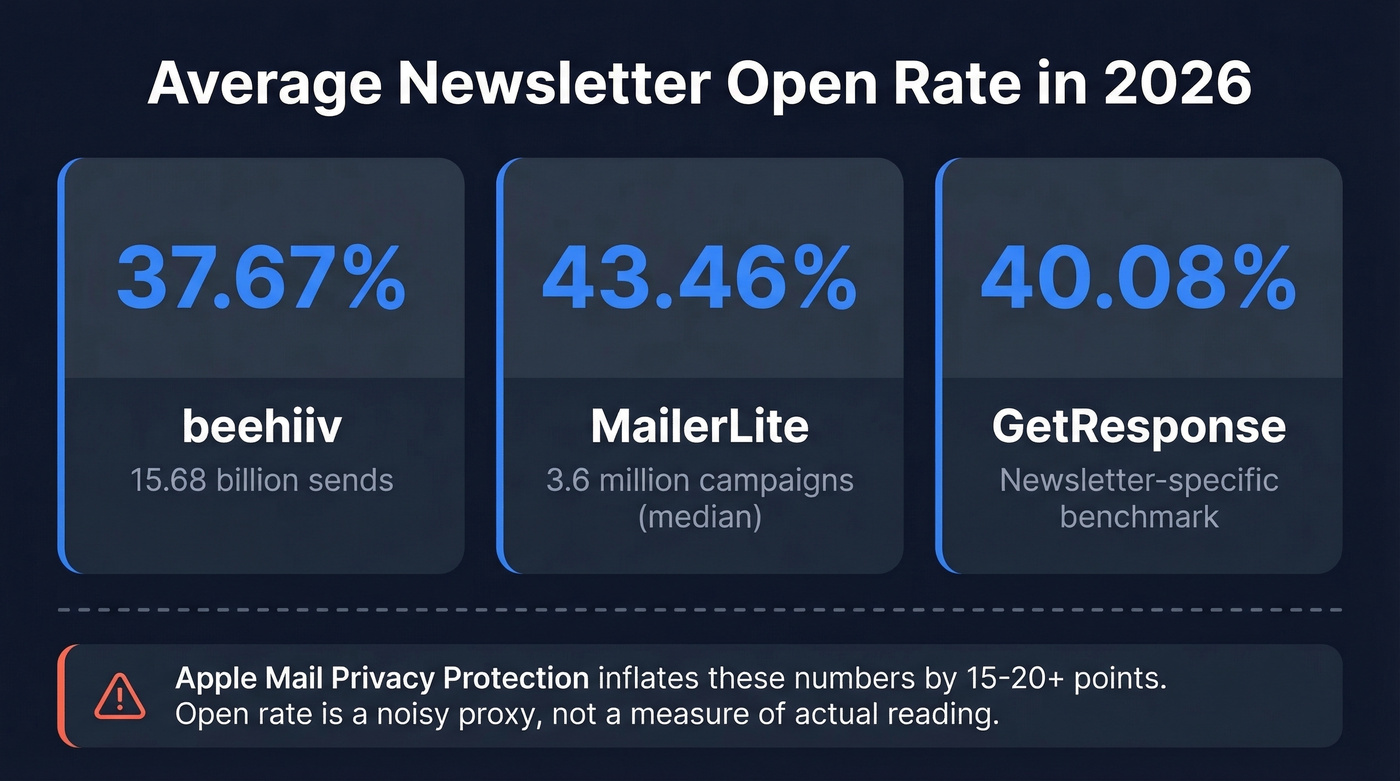
- Across 15.68B newsletters, beehiiv's dataset shows 37.67%.
- MailerLite's median across 3.6M campaigns comes in at 43.46%.
- GetResponse's newsletter-specific benchmark lands at 40.08%.
Those numbers are useful context, not gospel. Post-MPP, open rate is a noisy proxy for email deliverability and subject-line performance - not a reliable measure of actual reading.
Open Rates by Industry
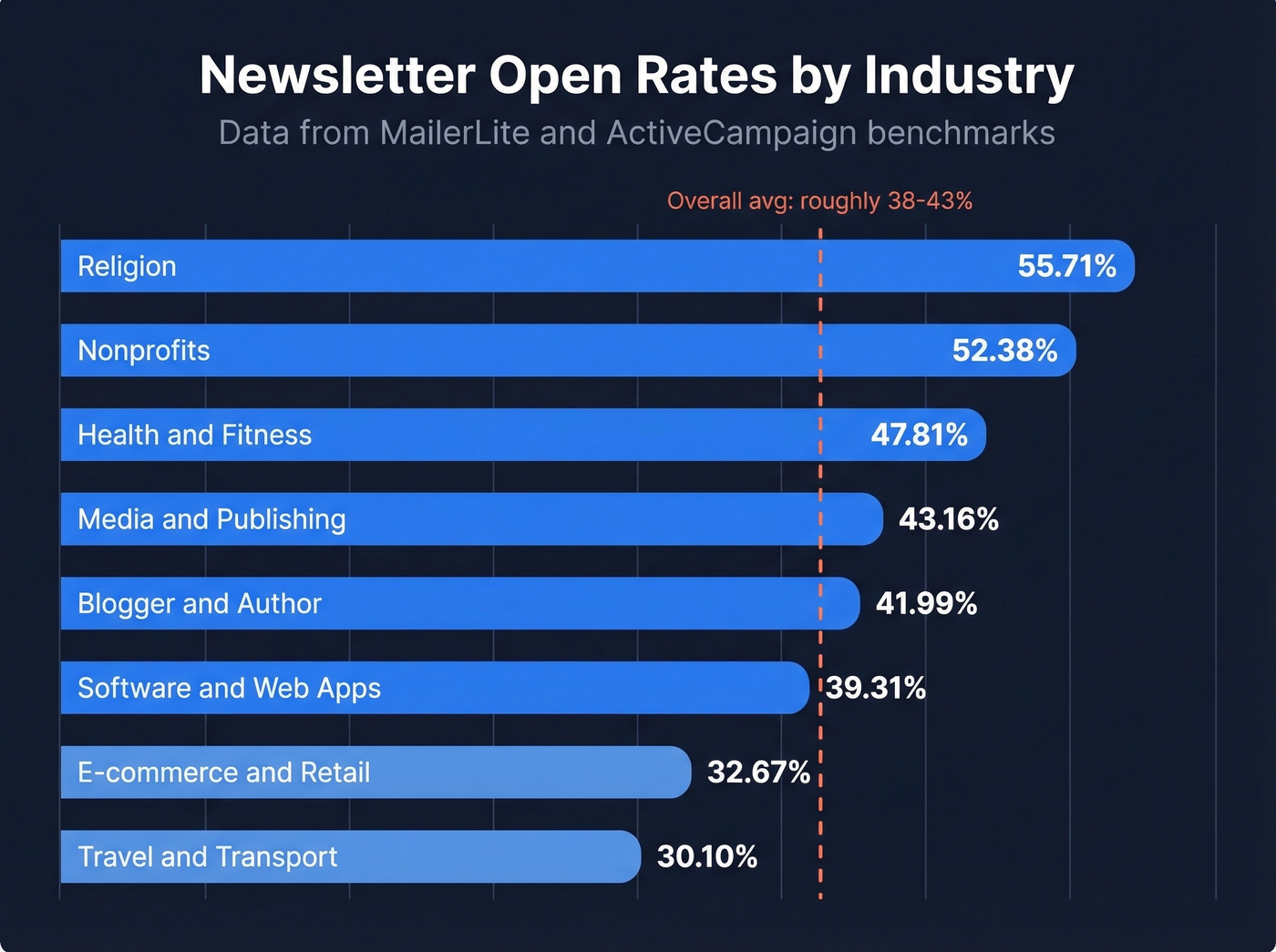
Benchmarks vary by audience and intent. Here are reference points pulled from major benchmark datasets:
| Industry | Open Rate Benchmark |
|---|---|
| E-commerce / Retail | 32.67% (MailerLite) / 35.66% (ActiveCampaign) |
| Software / Web Apps | 39.31% (MailerLite) / 36.20% (ActiveCampaign) |
| Media / Publishing | 43.16% (ActiveCampaign) |
| Nonprofits | 52.38% (MailerLite) / 42.68% (ActiveCampaign) |
| Health & Fitness | 47.81% (MailerLite) |
| Blogger / Author | 41.99% (ActiveCampaign) |
| Travel & Transport | 30.10% (MailerLite) |
| Religion | 55.71% (MailerLite) |
Nonprofits often look "unfairly good" because mission-driven audiences self-select into high engagement. E-commerce sits lower because it's competing with constant promos and heavier inbox filtering - your subscribers signed up, but so did they for 40 other brands running flash sales every week.
Why Every Source Reports Different Numbers
Benchmarking newsletter open rates is frustrating because everyone's right and everyone's wrong at the same time.
Campaign Monitor's guidance puts a "good" open rate between 17-28% and cites an average of 21.5% across all industries in 2021 - useful, but rooted in older, broader email marketing data that predates the MPP wave. Mailchimp's benchmark page shows 35.63% for "All Users," was last updated December 2023, and only includes campaigns sent to at least 1,000 subscribers. HubSpot's benchmark roundup puts the cross-industry average email open rate at 42.35%, though that's email overall, not newsletters specifically.
GetResponse reports 40.08% for newsletters versus 39.64% across all email types. That gap is the point: "newsletter" isn't a universal category, and many benchmark pages mix newsletters, promos, and automations into one number.
The biggest drivers of disagreement: dataset composition (creators vs B2B vs retail), time period, median vs mean calculations, MPP handling, and minimum list-size rules.

Every benchmark source agrees on one thing: bounces destroy sender reputation and tank your open rate. Prospeo's 5-step email verification catches dead addresses, spam traps, and honeypots with 98% accuracy - so your newsletter actually reaches the inbox.
Stop inflating your list with bad data. Verify before you send.
The Apple MPP Problem
Apple Mail Privacy Protection routes messages through a proxy and preloads tracking pixels, so the "open" fires even when nobody reads the email. One estimate puts Apple Mail at 49.29% of email opens, which explains why the inflation is so visible.
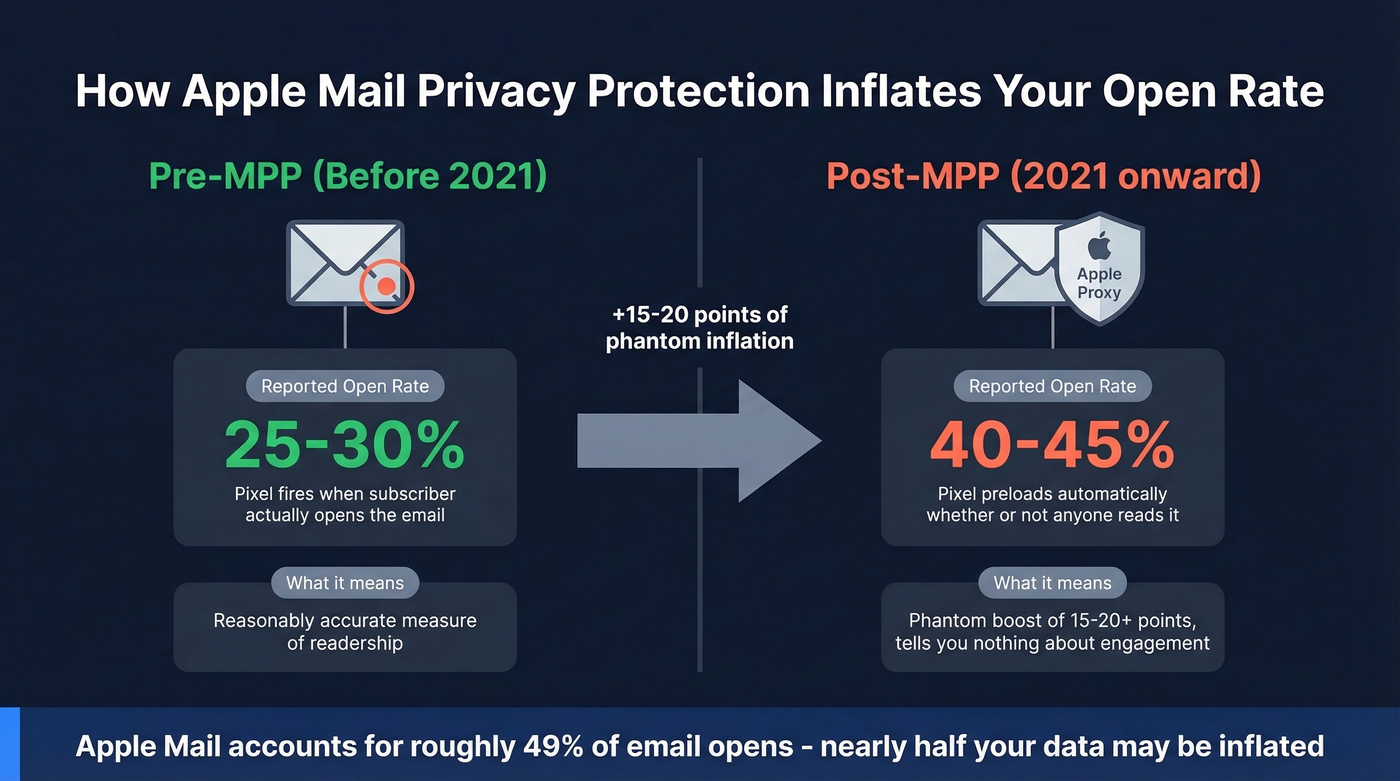
Let's put real numbers on it. A pre-MPP "healthy" newsletter open rate of 25-30% can show up as 40-45% post-MPP - a 15-20+ point phantom boost that makes your metrics look great while telling you nothing about actual engagement.
It's getting messier. iOS 18's Link Tracking Protection strips tracking parameters like UTMs, making attribution harder even when people do click. Add AI-generated previews and inbox categories, and "opened" no longer reliably means "seen." Only 15% of marketers still treat open rates as a primary success metric, and honestly, we're surprised it's that high.
What to Track Instead
Use open rate as a directional signal only - deliverability monitoring and subject line A/B tests. For real insight, shift your focus:
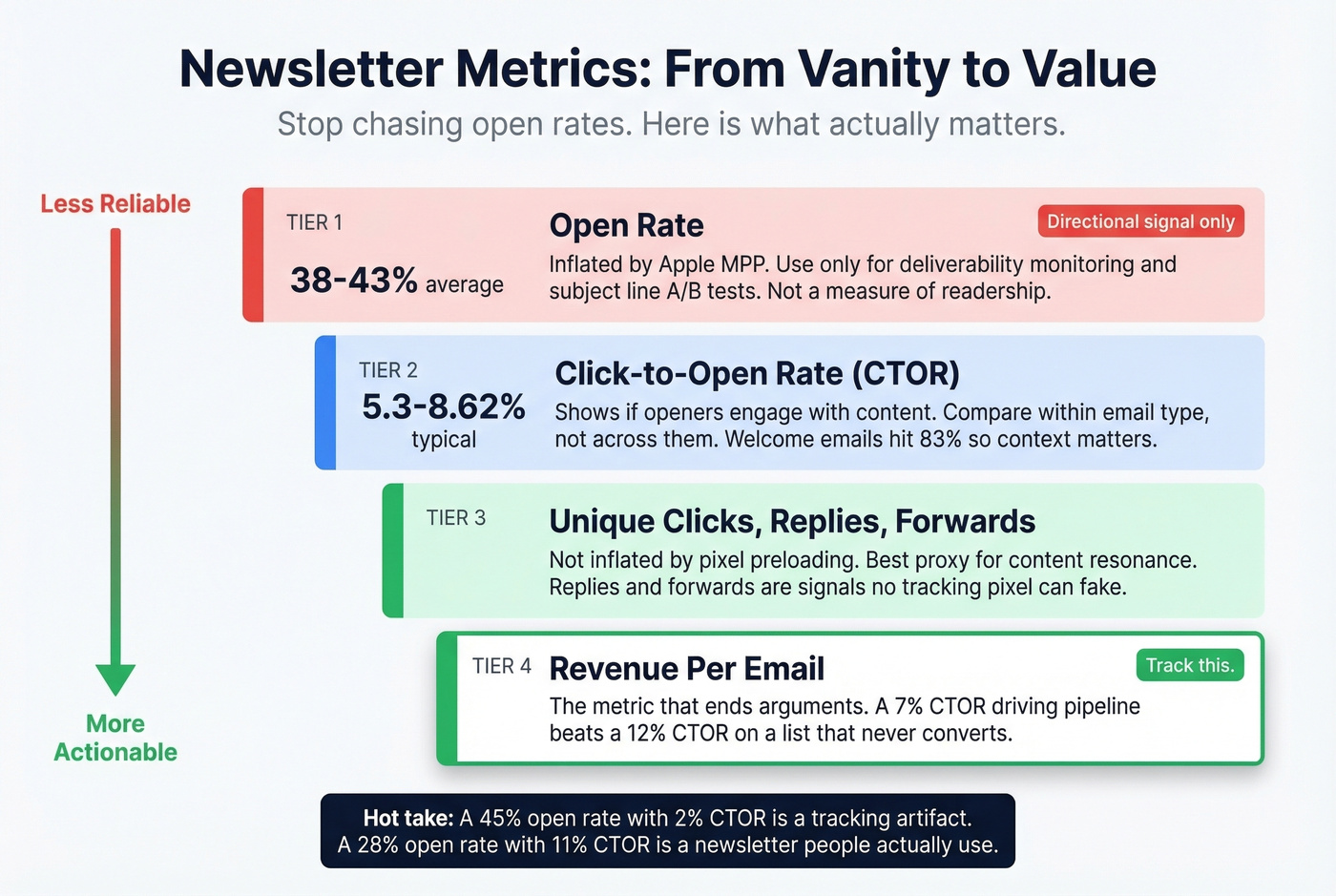
CTOR sits around 5.3% across industries in HubSpot's data and 8.62% in GetResponse's report. Compare within email type too - welcome emails can hit 83.63% CTOR, which makes your newsletter's 6% look bad until you realize they're completely different contexts.
Unique clicks are your best "content resonance" proxy. They aren't inflated by pixel preloading, and they tell you exactly which links and topics your audience cares about.
Replies and forwards matter enormously for B2B and community newsletters. These are signals no tracking pixel can fake.
Revenue per email is the metric that ends arguments. A 7% CTOR that drives pipeline matters more than a 12% CTOR on a list that never converts.
Here's our hot take: a 45% open rate with a 2% CTOR is almost always a tracking artifact. A 28% open rate with an 11% CTOR is a newsletter people actually use. Stop chasing the vanity number.
Your best benchmark is your own last 3-6 months of data. Industry averages are context, not targets.
How to Improve Your Newsletter Open Rate
Most teams obsess over subject lines and ignore the upstream mechanics that decide whether the email lands in the inbox at all.
Match your subject line to the email. Your subject line's job isn't cleverness - it's setting an accurate expectation. When content doesn't deliver on the subject, you train people to ignore you. We've seen newsletters with "boring" descriptive subject lines consistently outperform clever ones because the audience knows exactly what they're getting. (If you want a swipe file, start with these email subject line ideas.)
Does send timing matter? Tuesday shows the highest opens at 38.25% in beehiiv's dataset, and 11am UTC hits 42.87%. That's a decent starting point, but Twilio found that outside holidays, there's often no statistically significant "best time" - so test your own list instead of copying a generic playbook.
Sender name consistency matters more than most people realize. Switching between "Company," "Company Team," and "Jane from Company" tanks recognition, especially in inboxes that group by sender. Pick one and commit.
Segmentation beats blasting one list. Even basic splits - new subscribers vs long-time readers, customers vs prospects - lift opens because relevance lifts engagement, and engagement lifts inbox placement. You don't need a fancy CDP for this; most ESPs handle it natively.
List hygiene is the unsexy fix that actually works
Bad addresses cause bounces. Bounces tank sender reputation. Wrecked reputation means your newsletter lands in spam. It's a cascade, and it starts with data quality.
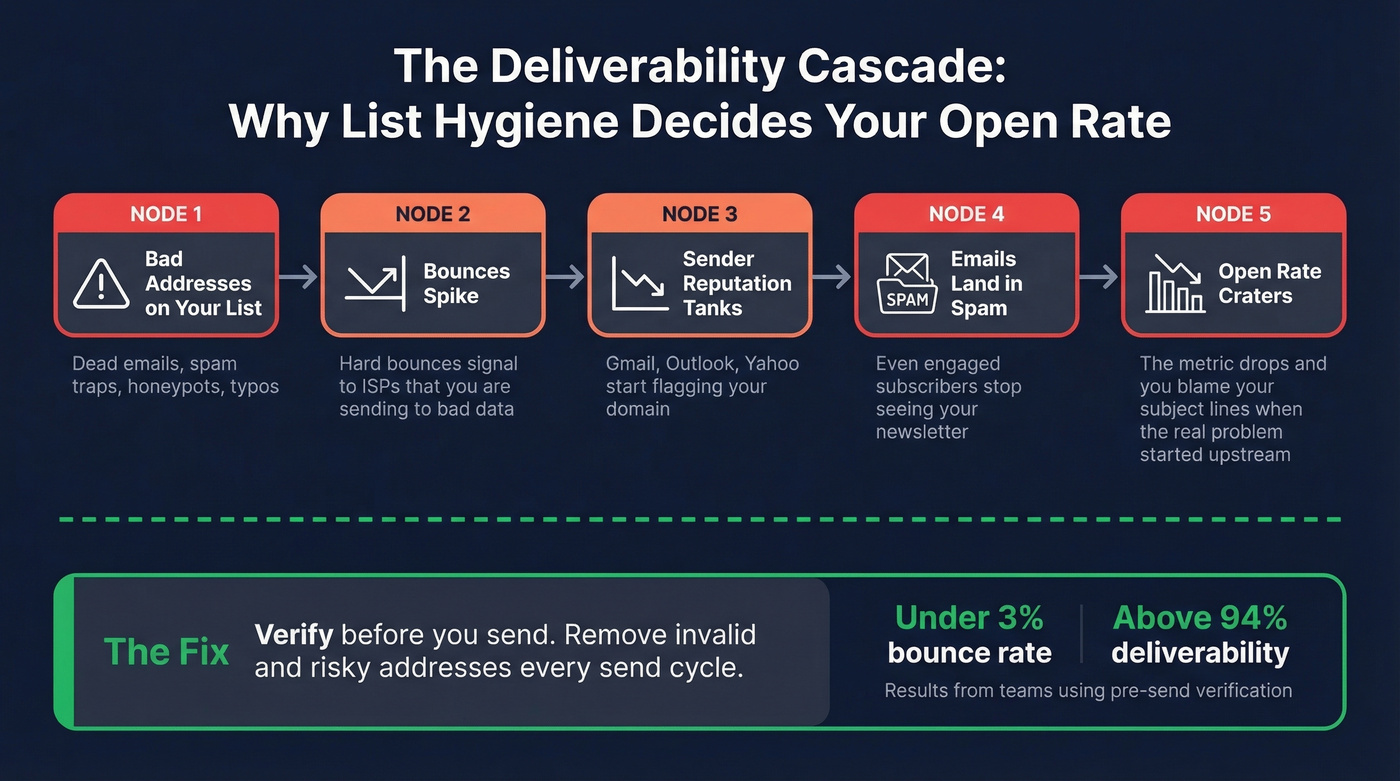
Smaller, more engaged lists consistently see higher open rates than big, stale lists, which is why hygiene matters more as you scale. Prospeo's 5-step email verification catches dead and risky addresses with 98% accuracy before they drag down your deliverability - teams like Stack Optimize maintain deliverability above 94% and bounce rates under 3% by verifying before every send. (If you're troubleshooting inboxing, this guide on how to improve sender reputation helps.)
One reality check: don't mix benchmarks. Cold outreach is a completely different game than opted-in newsletters. If you're running outbound too, compare against cold email marketing benchmarks instead. One practitioner example cites roughly 7% typical opens and 13% best-ever opens on first cold sends. If you're comparing those numbers to your newsletter, you're comparing apples to freight trains.
Stack Optimize built a $1M agency keeping client bounce rates under 3% and deliverability above 94% - all by verifying every address through Prospeo before sending. Your newsletter open rate starts with list quality, not subject lines.
Get 75 free email verifications and see the difference in your next send.
FAQ
What's a good open rate for a newsletter?
Above 40% looks strong in 2026 benchmarks, but Apple MPP can inflate opens by 15-20+ points. A more reliable gauge is CTOR - if yours consistently exceeds 6-8%, your openers are actually engaging with content, regardless of the headline open number.
Are newsletter open rates higher than promotional emails?
Yes. Newsletters typically outperform promos by 5-10 percentage points. Welcome emails crush both, with GetResponse reporting 83.63% open rates on welcome sequences. Transactional emails also skew high because recipients actively expect them.
How do I check if Apple MPP is inflating my metrics?
Segment your reporting by email client. If Apple Mail accounts for a large share of opens, your rate is likely inflated. Shift primary KPIs to CTOR, unique clicks, and conversions - these metrics aren't affected by pixel preloading.
Does list cleaning actually improve open rates?
It does, and the effect is direct. Removing invalid and risky addresses reduces bounces, which protects sender reputation and keeps you out of spam folders. The improvement isn't dramatic overnight, but over 2-3 send cycles, the difference in inbox placement becomes obvious.