

The B2B Buyer Journey: What 24,000+ Buyers Actually Tell Us
You've got a Miro board somewhere with a buyer journey map on it. Boxes, arrows, color-coded stages. Nobody's opened it since the offsite where it was created. Meanwhile, 91% of your deals are stalling and 81% of buyers end up regretting the vendor they chose - even the "successful" purchases.
The map isn't the problem. The model behind it is.
Most B2B buyer journey guides still cite the "67% of the journey happens digitally" stat from a 2013 SiriusDecisions study. That number is over a decade old. The actual data has shifted dramatically, and this article draws on 2025 and 2026 surveys covering 24,000+ real B2B buyers to show you what's actually happening now.
The Short Version
- Not a funnel - it's a loop. Gartner's six buying jobs model is closer to reality than any linear stage diagram.
- 95% of the time, the winner was on the Day One shortlist. If you're not there before the formal process starts, you've already lost.
- You can't execute a journey strategy with bad contact data. When buying committees average 13 people, every bounced email is a missed stakeholder.
What Is the B2B Buyer's Journey?
The buyer's journey in B2B is the complete process a business goes through - from recognizing a problem to selecting a vendor, implementing the solution, and deciding whether to expand or renew. It's not the same as a customer journey, which typically starts at purchase. The buyer journey includes everything before money changes hands, plus the post-sale experience that determines whether you keep the account.
What makes B2B fundamentally different from B2C isn't just "more stakeholders." It's a different species of decision-making entirely.
| Dimension | B2B | B2C |
|---|---|---|
| Decision-makers | 13 avg | 1-2 |
| Cycle length | 10.1 months avg | Minutes to weeks |
| Primary driver | ROI / business impact | Emotion / convenience |
| Channels used | ~10 | 2-3 |
| Post-purchase | Onboard, expand, renew | Use or return |
Most B2B purchases involve 2+ departments. Your "buyer" is actually a committee with competing priorities, different information needs, and varying levels of enthusiasm about changing anything at all. The distinction between buyer journey and customer journey matters operationally: marketing and sales own the buying journey, CS and product own the customer journey. When you blur the two, nobody owns the handoff - and that's where deals die or churn spikes.
Why the Buying Process Isn't Linear
Every "buyer journey" article draws a straight line from awareness to purchase. Buyers don't move in straight lines. Gartner's research shows buyers loop through six buying jobs - problem identification, solution exploration, requirements building, supplier selection, validation, and consensus creation - and they revisit each job at least once during a single purchase.
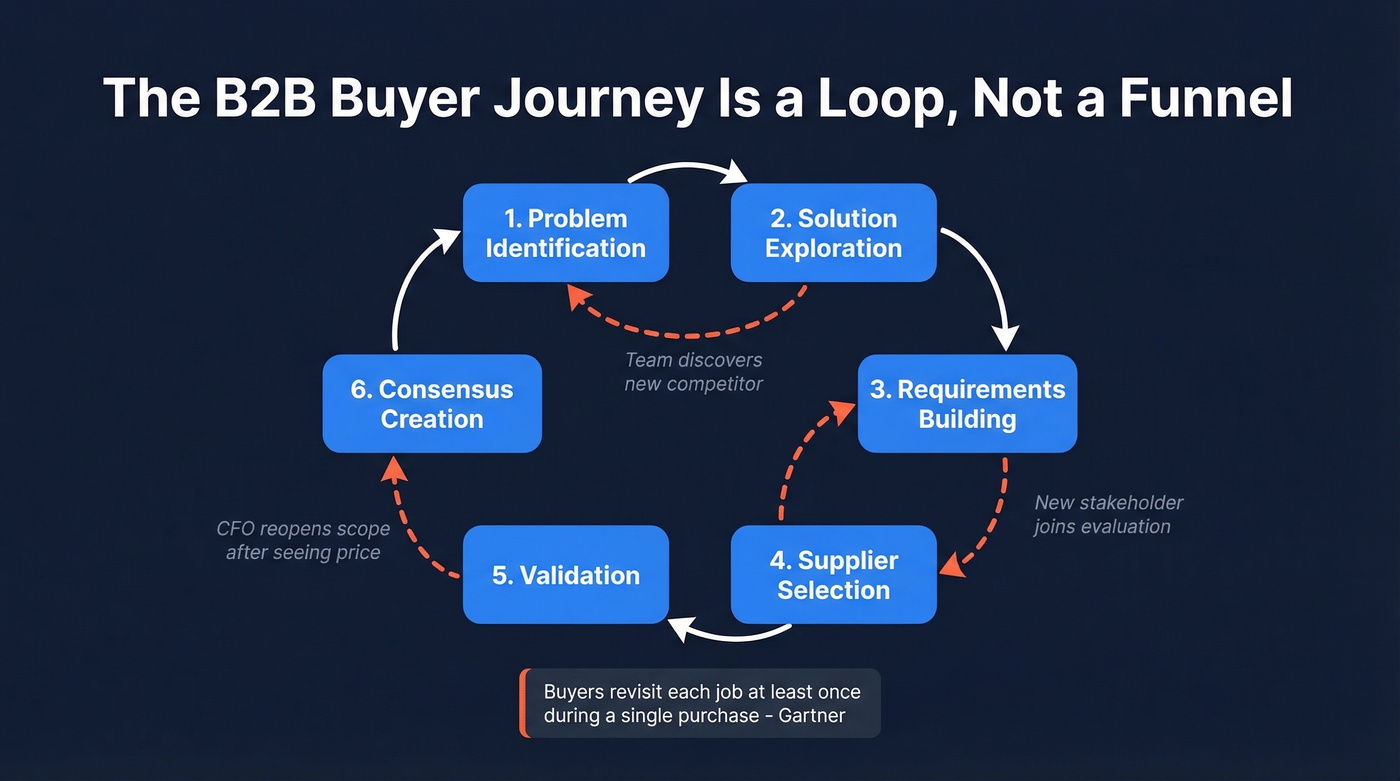
A VP of Engineering deep in supplier selection gets pulled back to requirements building when a new stakeholder joins the evaluation. The CFO reopens problem identification entirely after seeing the price tag. This looping behavior is why pipeline forecasting feels like guesswork - the deal isn't "in Stage 3," it's simultaneously in three stages depending on which stakeholder you ask.
The Day One Shortlist Problem
A 2025 Buyer Experience Report surveying nearly 4,000 buyers found that 95% of the time the winning vendor was already on the buyer's initial shortlist. The pre-contact favorite wins roughly 80% of the time.
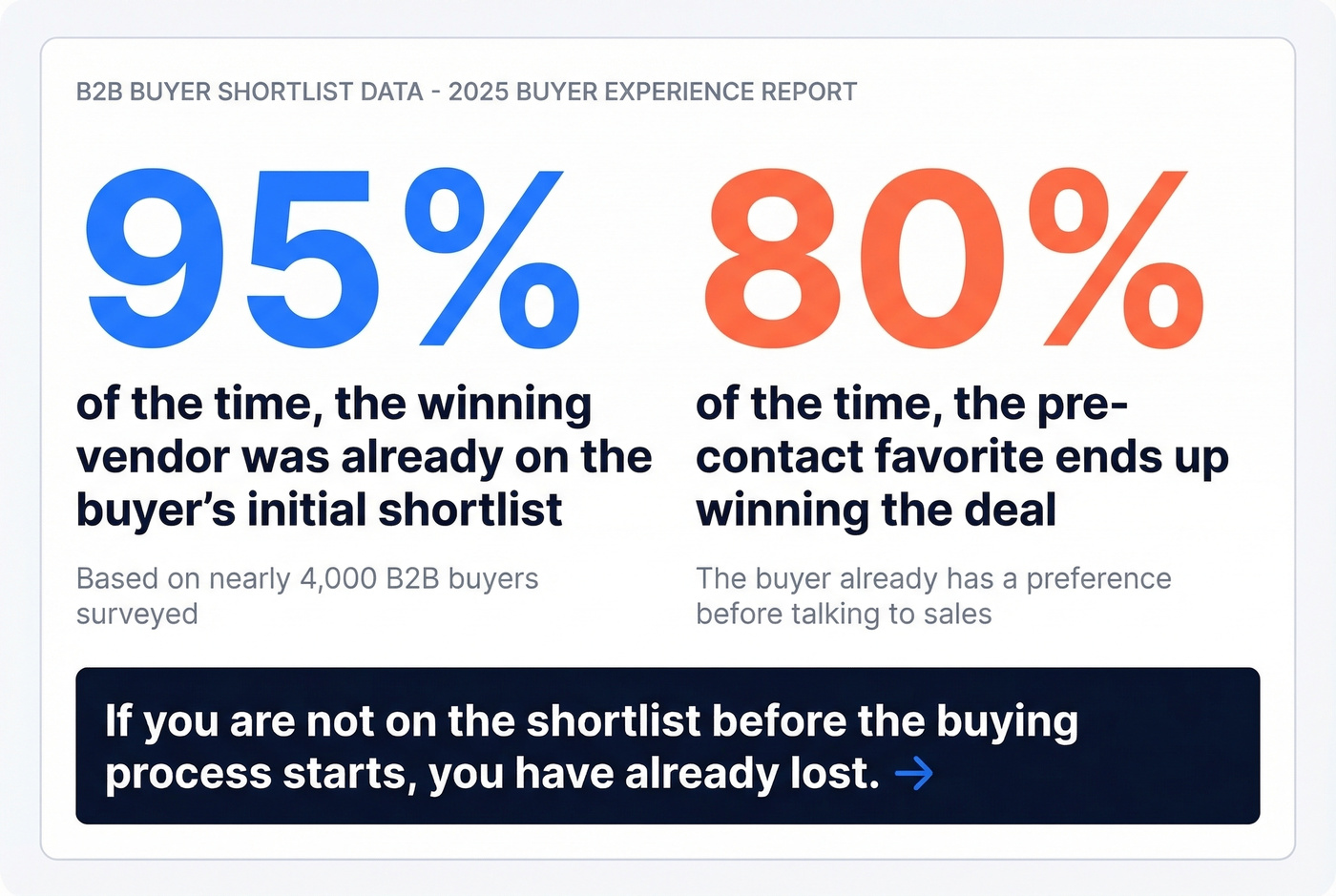
The implications are concrete and uncomfortable. If you're not building brand awareness and trust before the buying process starts, your inbound pipeline is largely made up of deals you were already going to win - or deals where you're column fodder for a competitor the buyer already prefers. Mapping the journey before prospects enter the market is what separates pipeline leaders from pipeline chasers.
The Rep-Free Myth
A Gartner survey fielded Aug-Sep 2025 of 646 B2B buyers found 67% prefer a rep-free experience - down from 75% in earlier research, suggesting the pendulum is swinging back toward human interaction. Meanwhile, 45% reported using AI during a recent purchase.
Here's the nuance most people miss: Gartner's own data shows that hybrid interactions - digital tools combined with a sales rep - produce 1.8x higher-quality deals than pure self-service. Buyers don't want no reps. They want reps who add value at the right moment, not reps who gate information behind a demo request form.
B2B Buying Journey Stages (Expanded)
The journey is non-linear, but you still need a framework for planning content, assigning ownership, and measuring progress. Here are the five stages with a SaaS purchase as the worked example.
| Stage | Buyer Actions | Content That Works | Seller Actions | KPIs |
|---|---|---|---|---|
| Awareness | Researches problem via AI, Google | Blog posts, reports, thought leadership | Brand visibility, SEO, community | Shortlist rate, branded search |
| Consideration | Evaluates 3-5 vendors | Comparison guides, ROI calcs | Multi-thread; share enablement | Demos, engagement by account |
| Decision | Negotiates; seeks consensus | Proposals, security docs, references | Champion enablement; fix blockers | Win rate, cycle length |
| Onboarding | Implements; trains team | Onboarding guides, training videos | Proactive check-ins; TTV push | Time to first value, adoption |
| Expansion | Identifies new use cases | Advanced playbooks, roadmap previews | QBRs, expansion plays | NRR, expansion revenue |
Let's make this concrete. Say you sell a project management tool to mid-market companies. In Awareness, the VP of Ops is Googling "how to reduce project delays" - not your product name. In Consideration, she's comparing you against three competitors using a spreadsheet her team built from G2 reviews and ChatGPT summaries. In Decision, she's fighting for budget against the VP of Marketing's own software request. Each stage requires completely different content and seller behavior.
The mistake most teams make is over-investing in Awareness and Decision while starving Consideration and Onboarding. Consideration is where you win or lose the shortlist. Onboarding is where you win or lose the renewal. Both are chronically under-resourced.
If your "consideration stage content" is just a features page and a generic case study, you're losing to competitors who provide ROI calculators, interactive demos, and comparison guides that address specific objections by stakeholder role. The buying committee doesn't evaluate your product as a unit - each person evaluates it through their own lens.

When 95% of deals go to the Day One shortlist vendor, you can't afford to miss a single stakeholder. Prospeo gives you 300M+ profiles with 30+ filters - including buyer intent, job changes, and department headcount - so you can multi-thread every account in the buying committee before your competitor even gets a reply.
Stop losing deals to contacts you never reached. Start multi-threading today.
Why 91% of Purchases Stall
Forrester's survey of 16,000+ buyers produced a number that should alarm every revenue leader: 91% of B2B purchases stall at some point in the process. Not "slow down." Stall. Forward momentum stops completely.
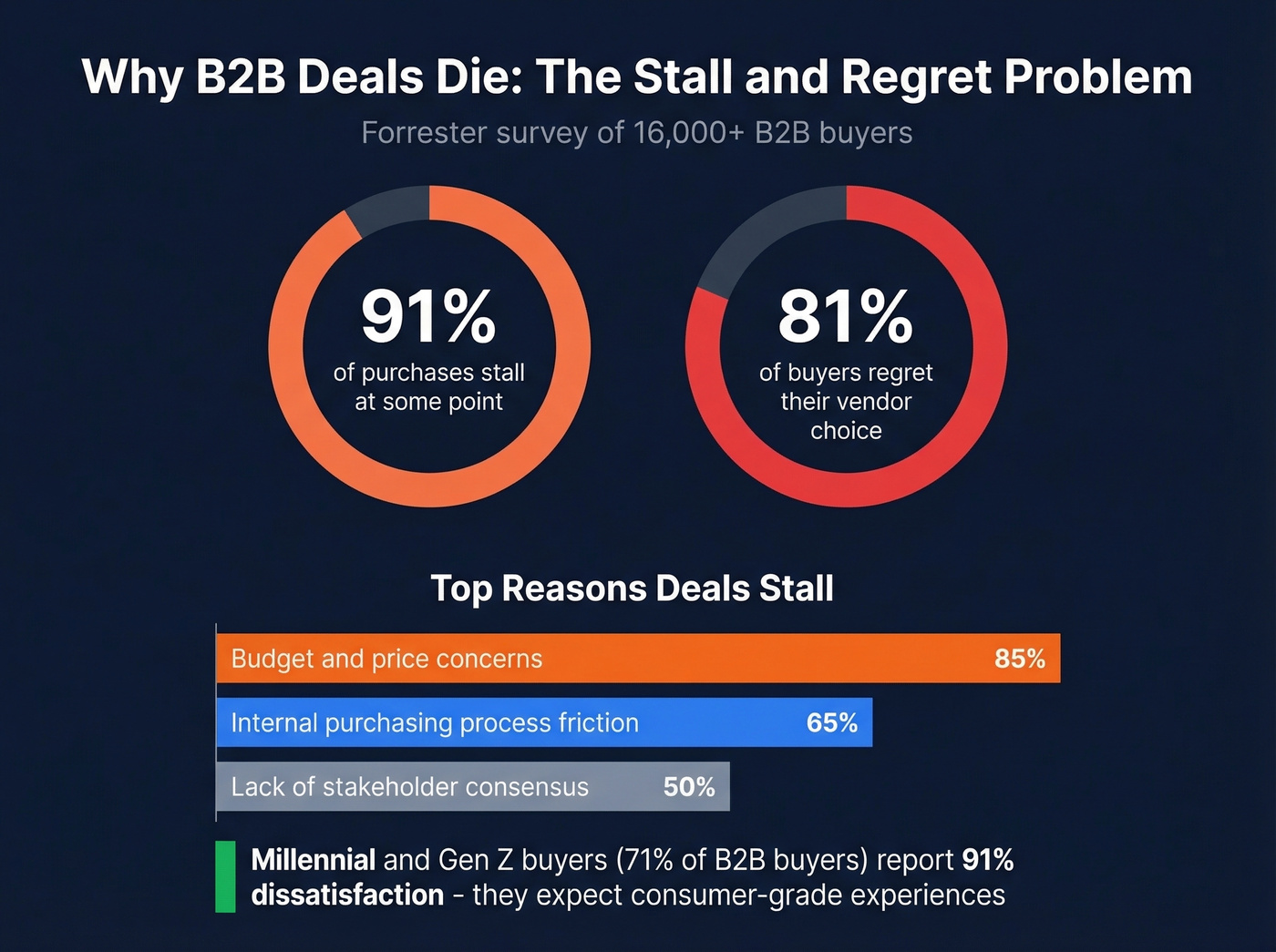
Even among deals that close, 81% of buyers end up dissatisfied with the vendor they chose.
The top stall drivers are budget and price - no surprise. But the third-most-cited reason is fascinating: "my organization's purchasing process." Buyers aren't just struggling with your product or pricing. They're struggling with their own internal machinery - procurement reviews, legal approvals, cross-departmental sign-offs, budget reallocation requests. The friction is internal.
When you layer in the generational shift, it gets worse. Millennials and Gen Z make up about 71% of B2B buyers, and their dissatisfaction rate hits 91%. These buyers grew up with consumer-grade digital experiences and they expect the same from enterprise vendors.
We've seen this pattern repeatedly: a deal stalls not because the champion lost interest, but because the economic buyer never got the TCO analysis they needed, or legal couldn't find the security documentation, or a department head who wasn't looped in early enough became a blocker late in the process. Mapping the full journey buyers actually experience - not the idealized version - is how you spot these failure points before they kill revenue.
Three Fixes That Actually Reduce Stall Rates
Consensus-building content. Not just one business case, but role-specific versions. The CFO needs TCO. The end user needs workflow impact. The CISO needs your SOC 2 report.
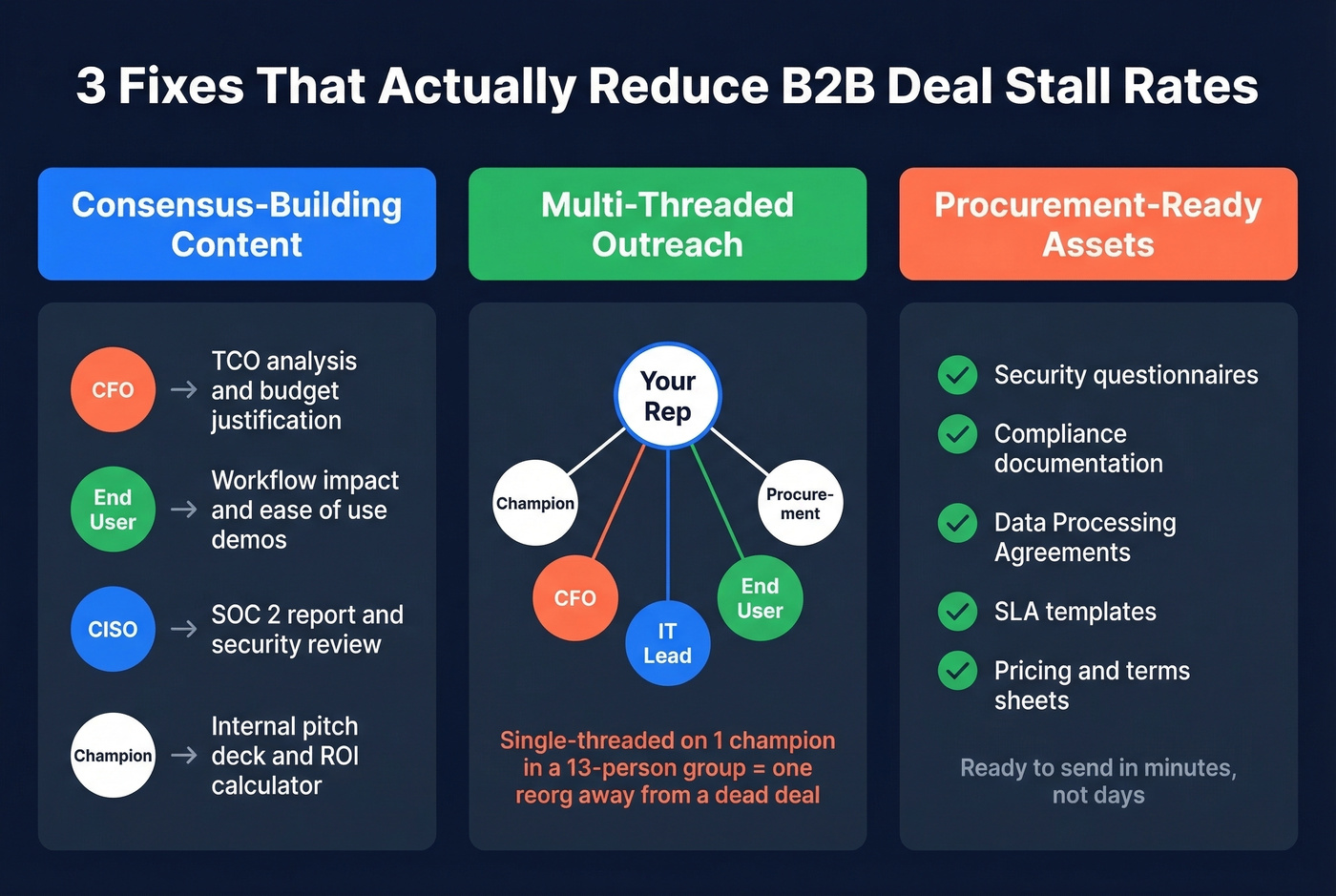
Multi-threaded outreach across the full buying committee from day one. If you're single-threaded on a champion in a 13-person buying group, you're one reorg away from a dead deal.
Procurement-ready assets prepared before they're requested. Security questionnaires, compliance docs, DPAs, SLAs - have them ready to send in minutes, not days.
How to Map Your Buying Journey
Journey mapping doesn't need to be a six-month consulting project. Here's a five-step process that gets you to a working map in a week.
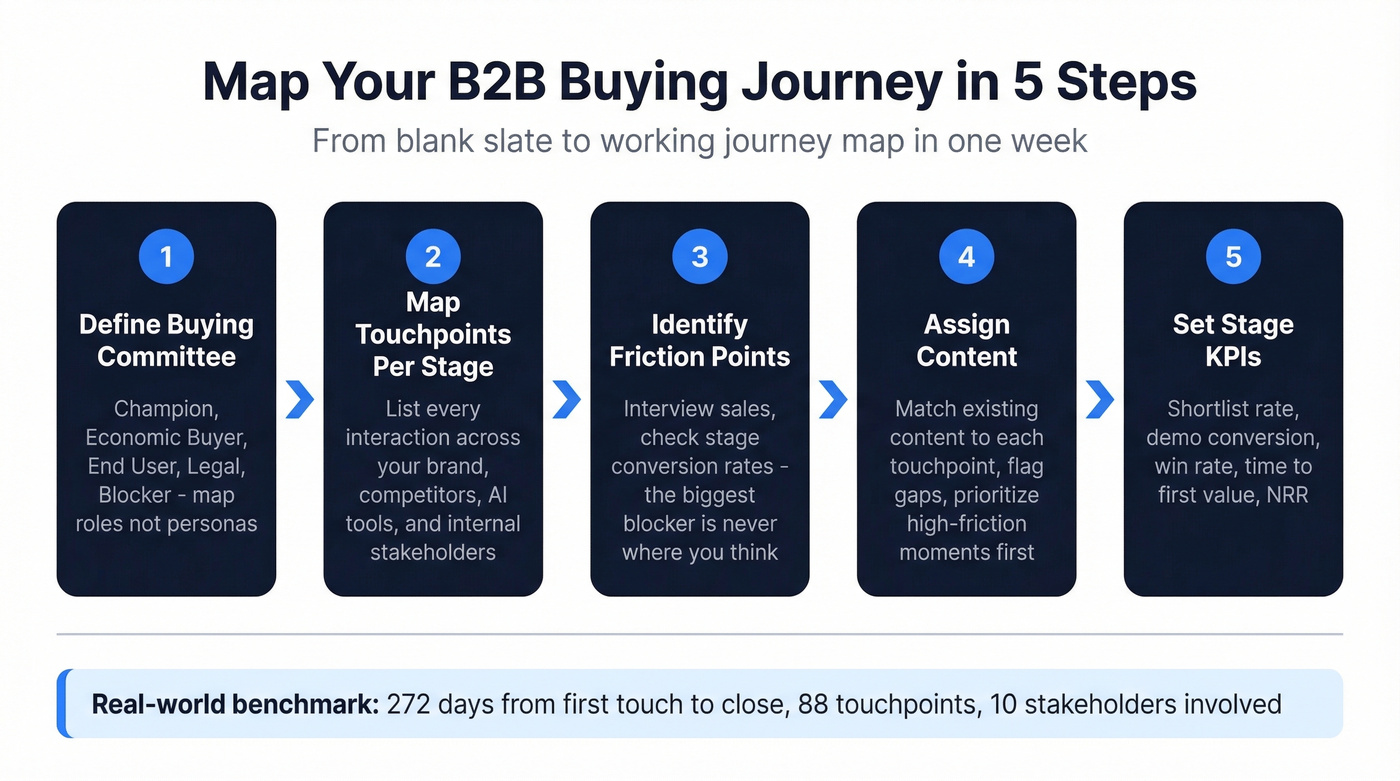
Step 1: Define your buying committee personas. Not marketing personas - buying committee roles. These are different.
| Role | What They Care About | Content They Need |
|---|---|---|
| Champion | Solving their problem | Case studies, ROI data |
| Economic Buyer | Budget justification | TCO analysis, pricing comparison |
| End User | Ease of use, workflow fit | Product demos, trial access |
| Legal/Procurement | Risk, compliance, terms | Security docs, DPA, SLA |
| Blocker | Status quo preference | Competitive displacement evidence |
Step 2: Map touchpoints per stage. For each stage, list every interaction a buyer has - with your brand, with competitors, with internal stakeholders, with AI tools. Be honest about where you have gaps. One self-reported example shared by a Dreamdata employee on Reddit: 272 days from first touch to close, 88 touchpoints, 10 stakeholders involved. That's a useful benchmark for what "complex B2B" actually looks like in the wild.
Step 3: Identify friction points. Where do deals stall? Interview your sales team. Look at stage-to-stage conversion rates. The biggest friction point is almost never where you think it is.
Step 4: Assign content per touchpoint. Match existing content to each touchpoint. Flag gaps. Prioritize creating content for the highest-friction moments first.
Step 5: Set stage-level KPIs. Shortlist inclusion rate for Awareness. Demo-to-opportunity conversion for Consideration. Win rate and cycle length for Decision. Time-to-first-value for Onboarding. NRR for Expansion.
HubSpot and Zendesk both offer free journey map templates that work as starting points. Adapt them for B2B buying committees rather than individual consumers.
The Data Problem Nobody Talks About
We've run enrichment workflows where a team uploads 200 target accounts, maps out the buying committee for each, and half the contact data bounces on the first sequence. All that journey mapping, all that stakeholder analysis - wasted because the emails were stale and the phone numbers were disconnected.
This is the gap nobody's journey map addresses.
You can have a perfect understanding of your buyer's non-linear path through six buying jobs across 13 stakeholders. But if you can't actually reach those stakeholders with verified contact data, the map is decorative. When buying committees average 13 people, you need contact data that's current - not data that was accurate three months ago. Prospeo's 7-day refresh cycle and 98% email accuracy exist specifically for this use case: reaching the right people across a sprawling buying group before the window closes.

2026 Trends Reshaping How Buyers Buy
The B2B buyer journey isn't getting longer. It's compressing.
The average cycle dropped from 11.3 months to 10.1 months year over year. First contact is happening earlier too - shifting from 69% to 61% of the way through the journey, roughly 6-7 weeks sooner. Economic pressure is accelerating decisions, not delaying them: 62% of buyers said economic pressure drove them to engage sellers earlier than planned. Teams still running playbooks designed for last year's timeline are already behind.
AI is reshaping how buyers research. In 6sense's 2025 research, 94% of buyers used LLMs during their research process, and nearly 90% said AI features were part of the solutions they acquired. Buyers are using ChatGPT to summarize vendor comparisons, generate requirements documents, and pressure-test pricing. If your content isn't structured for AI consumption - clear, factual, comparison-friendly - you're invisible in the new research workflow.
Large transactions are going digital too. Forrester projected that over 50% of $1M+ B2B transactions would be processed through digital channels. The idea that enterprise deals require in-person relationship-building for every interaction is outdated. Hybrid is the model: digital tools for research and evaluation, human interaction for negotiation and consensus-building.
With compressed cycles, contact data decays faster than your outreach cadences can keep up. Skip this section if you've already solved your data freshness problem - but the consensus on r/sales is that most teams haven't, and it's costing them deals they don't even know they lost.
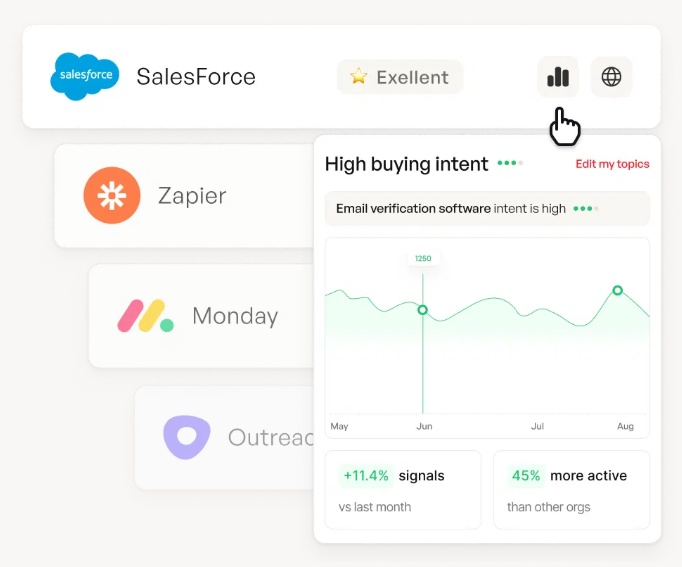
91% of deals stall because sellers lose contact with key decision-makers mid-cycle. With 13-person committees using ~10 channels, one bounced email kills momentum. Prospeo's 98% email accuracy and 125M+ verified mobile numbers mean you actually connect - across every stakeholder, every time the deal loops back.
Every bounced email is a stalled deal. Fix your data for $0.01 per contact.
FAQ
What's the difference between a buyer journey and a sales funnel?
The buyer's journey describes the process from the buyer's perspective - problem identification through vendor selection. A sales funnel describes the seller's pipeline stages. The buyer journey is non-linear with looping between stages; the funnel assumes a straight line from lead to close. Aligning both views improves forecast accuracy.
How long is the average B2B buying cycle?
The average B2B buying cycle is 10.1 months as of 2026 - down from 11.3 months the previous year. Complex enterprise deals with 15+ stakeholders and procurement involvement can still run 12-18 months.
How many stakeholders are in a typical B2B purchase?
An average of 13 people spanning 2+ departments. Complex purchases can involve up to 22 stakeholders, each with different information needs and evaluation criteria. Multi-threading across this group isn't optional - it's survival.
Do B2B buyers really prefer not talking to sales reps?
67% prefer a rep-free experience - but hybrid interactions produce 1.8x higher-quality deals. Buyers don't want bad sales interactions. They want helpful, well-timed ones that add value beyond what they can find independently through AI and peer reviews.
How do you reach a 13-person buying committee with accurate data?
Use a B2B data platform with department-level filtering and verified contact information. Prospeo's 30+ search filters let you identify committee members by role, seniority, and department across 300M+ profiles - with 98% email accuracy and a 7-day refresh cycle so contacts stay current throughout the buying process.