

How to Build a B2B Brand That Actually Gets You on the Shortlist
Your sales team just lost a deal to a competitor with an inferior product. The prospect's feedback stings: "We went with a company we'd heard of." That's brand doing its job - quietly deciding who even gets a serious look.
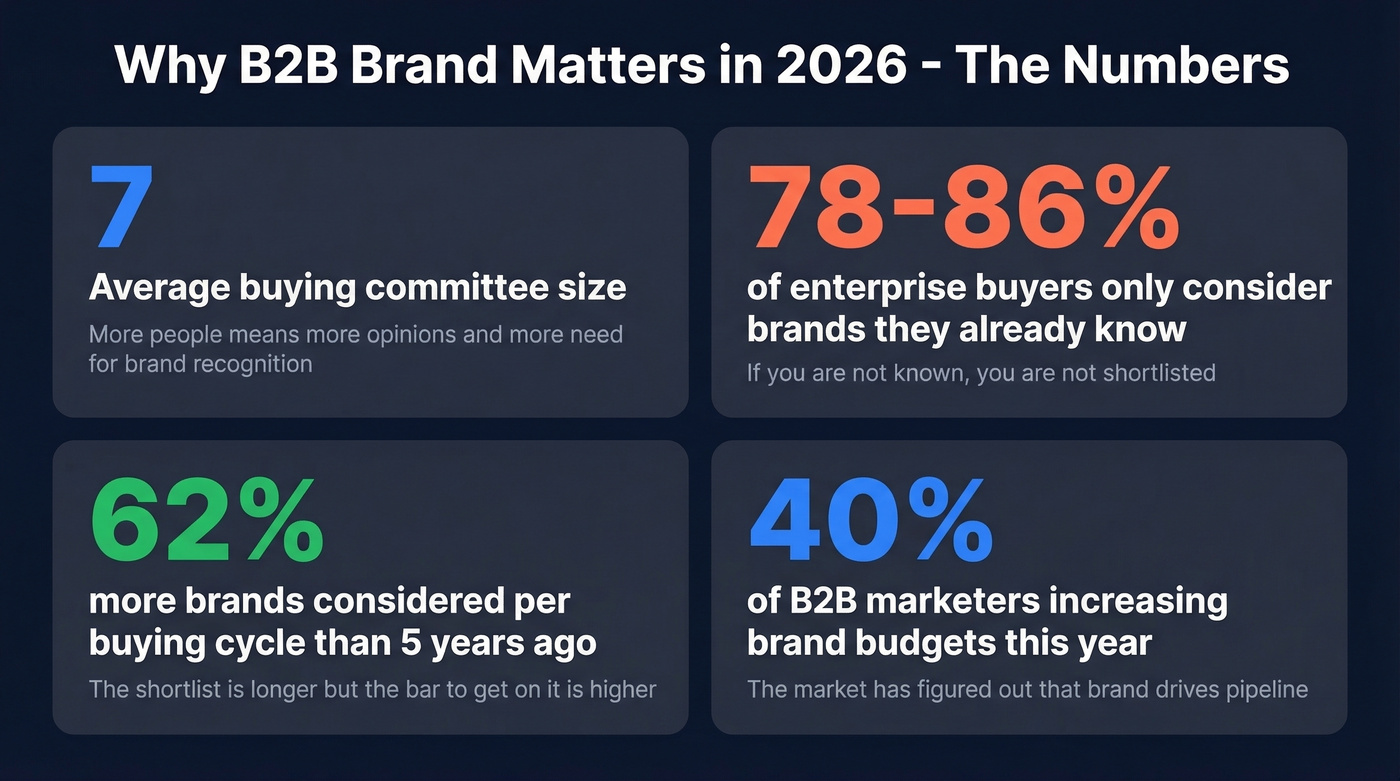
Here's the math behind that gut punch: buying committees now average seven people, buyers consider 62% more brands during the cycle than five years ago, and a TrustRadius study found 78-86% of enterprise buyers only consider brands they already know. If you're not known, you're not shortlisted. And 40% of B2B marketers plan to increase brand-building budgets this year because they've figured that out.
What You Need (Quick Version)
- Interview 10 customers, write a one-page brand memo, audit every prospect-facing touchpoint.
- Brand isn't a logo. It's positioning + proof + consistency - including outbound data quality.
- Measure with three metrics: direct traffic, branded search impressions, share of voice. Give it 6-12 months.
The 5-Minute Brand Audit
Answer Everything.design's four messaging questions: what's the product, who's it for, what does it replace, why is it better. If your team can't answer them in one breath, you don't have a brand problem - you have a clarity problem.
Early warning signals of brand drift:
- Your sales team describes the company differently than your website does.
- Prospects keep asking "so... what do you actually do?" after a demo.
- Your website sounds "enterprise" but your outbound reads like a template farm.
I've watched teams spend months on a rebrand while sales quietly keeps using their own slides. That's the tell. Your brand isn't what you publish - it's what your team actually says when nobody from marketing is in the room.

You just read it: data quality is a brand touchpoint. Every bounced email tells prospects you're sloppy before they see your homepage. Prospeo's 98% verified emails and 7-day refresh cycle keep your outbound as sharp as your positioning - so your brand impression starts clean.
Stop letting bad data undermine the brand you're building.
Building a B2B Brand Step by Step
Step 1 - Research Your Customers
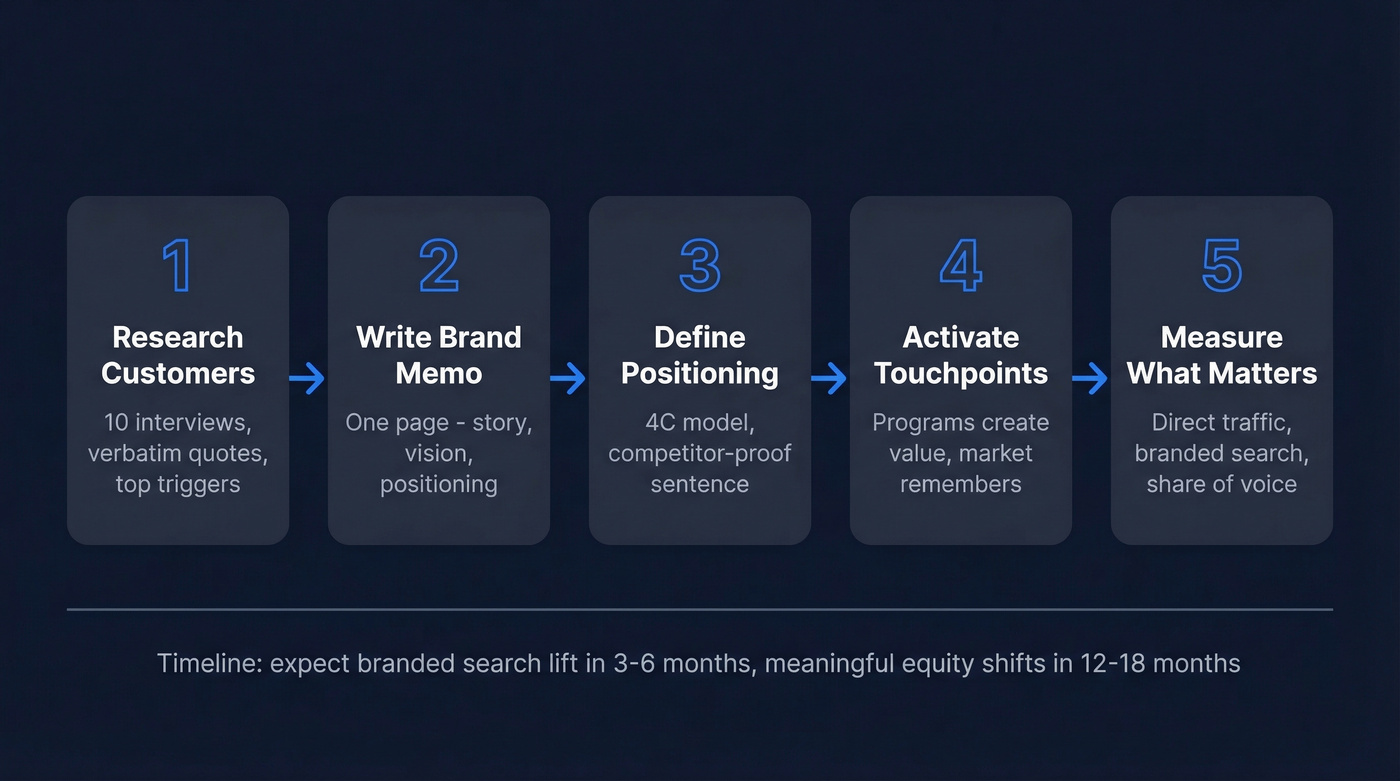
Start where Kracov starts: Product, Audience, Market - then talk to people until the story stops changing. Interview three groups: current customers about why they bought and what almost stopped them, prospective customers about who they're comparing you against, and customer-facing employees like sales reps, CS leads, and solutions engineers who hear objections on repeat.
If you're formalizing who you should (and shouldn't) build for, use an ideal customer profile to keep interviews and insights consistent.
We've watched teams skip this and jump straight to "new messaging." They end up with prettier words that don't match reality, and sales quietly rewrites everything in their own decks anyway. Any credible brand-building strategy starts with listening, not designing.
Deliverable: a 2-page insight doc with 10 verbatim quotes, top 5 "why now" triggers, and the 3 competitors you actually lose to. (If you want a repeatable way to track those rivals, build a lightweight competitive intelligence strategy.)
Step 2 - Write a Brand Memo
You don't need a rebrand. You need a brand memo. One page covering story, why now, insights, vision, mission, audience, message, and a positioning statement in one sentence plus one paragraph. The constraint forces clarity, and clarity beats cleverness every time. If it can't fit on one page, you're still thinking, not deciding.
Deliverable: a one-page memo you can paste into a doc and review quarterly.
Step 3 - Define Your Positioning
Use Fieldtrip's 4C model - Company, Category, Consumer, Culture - to pressure-test your positioning. Then run the only differentiation test that matters: if your competitor could say the same sentence, it's not positioning.
If you want a deeper framework and examples, see our guide to B2B brand positioning.
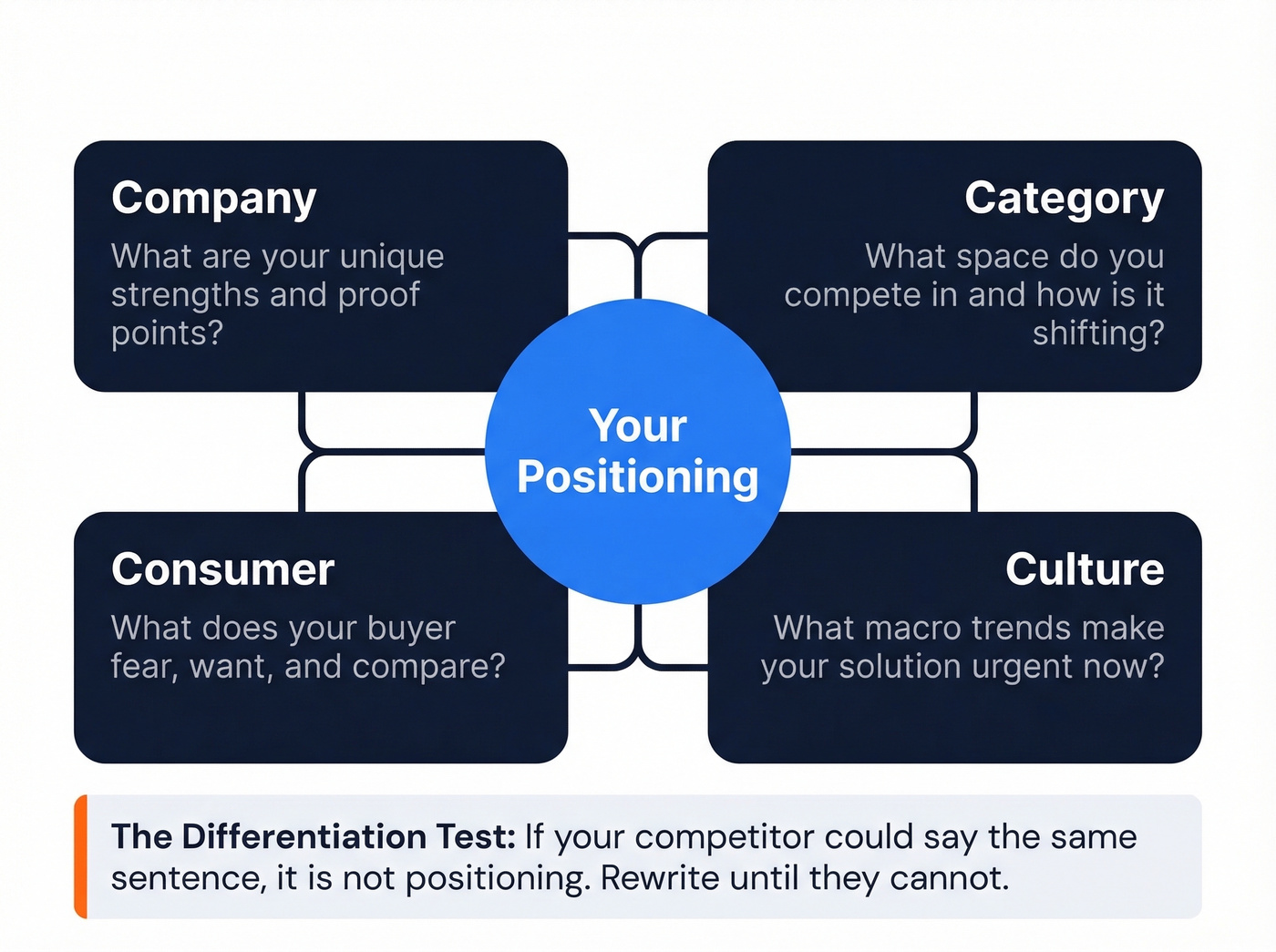
Most B2B "positioning" is a list of virtues: secure, scalable, easy, modern. That's table stakes. Your job is to pick a wedge - one problem you're known for solving - and build proof around it.
Let's be honest: most B2B brand problems are positioning problems, not design problems. You can spend $200K on a visual identity refresh and still lose deals because nobody knows what you're for. The consensus on r/startups backs this up - founders who nail positioning before touching design consistently outperform those who do it the other way around.
Deliverable: one positioning sentence, one paragraph, and 3 proof points that back it up.
Step 4 - Activate Every Touchpoint
Kracov's mental frame is right: Programs -> Touchpoints -> Brand. You don't "do brand" in a workshop. You build programs that create value, distribute them through touchpoints, and the market remembers you.
Your touchpoints aren't just marketing. They include your website, founder-led content on LinkedIn, sales materials, outbound sequences, and product moments from onboarding to support tone. The best way to humanize your brand is to let real people - founders, engineers, customer success leads - speak in their own voice across these channels instead of hiding behind corporate copy.
Here's what most teams miss: data quality is a brand touchpoint. Every bounced email , wrong title, or dead phone number tells the buyer you're sloppy before they ever see your homepage. One of our customers, Meritt, cut bounce rate from 35% to under 4% after switching to Prospeo's verified emails - exactly the kind of invisible brand win that shows up as more replies and fewer eye-rolls.
If outbound is a core touchpoint for you, it helps to standardize your sales prospecting techniques and keep sequences consistent with your positioning.
Keep your budget split sane. Binet & Field's 60/40 rule (60% brand, 40% performance) is still the simplest north star for not starving future pipeline while you chase this quarter.
Deliverable: a touchpoint checklist with owners and a one-sentence "brand standard" for each.
Step 5 - Measure What Matters
Brand measurement doesn't need a 40-tile dashboard. Firebrand recommends three proxy metrics that work: direct traffic, branded search impressions, share of voice (brand recall), branded search impressions (demand creation), and share of voice (competitive visibility). Supplement these with aided vs. unaided awareness surveys quarterly for qualitative texture.
To connect brand lift to pipeline reality, track a few funnel metrics alongside these proxies.
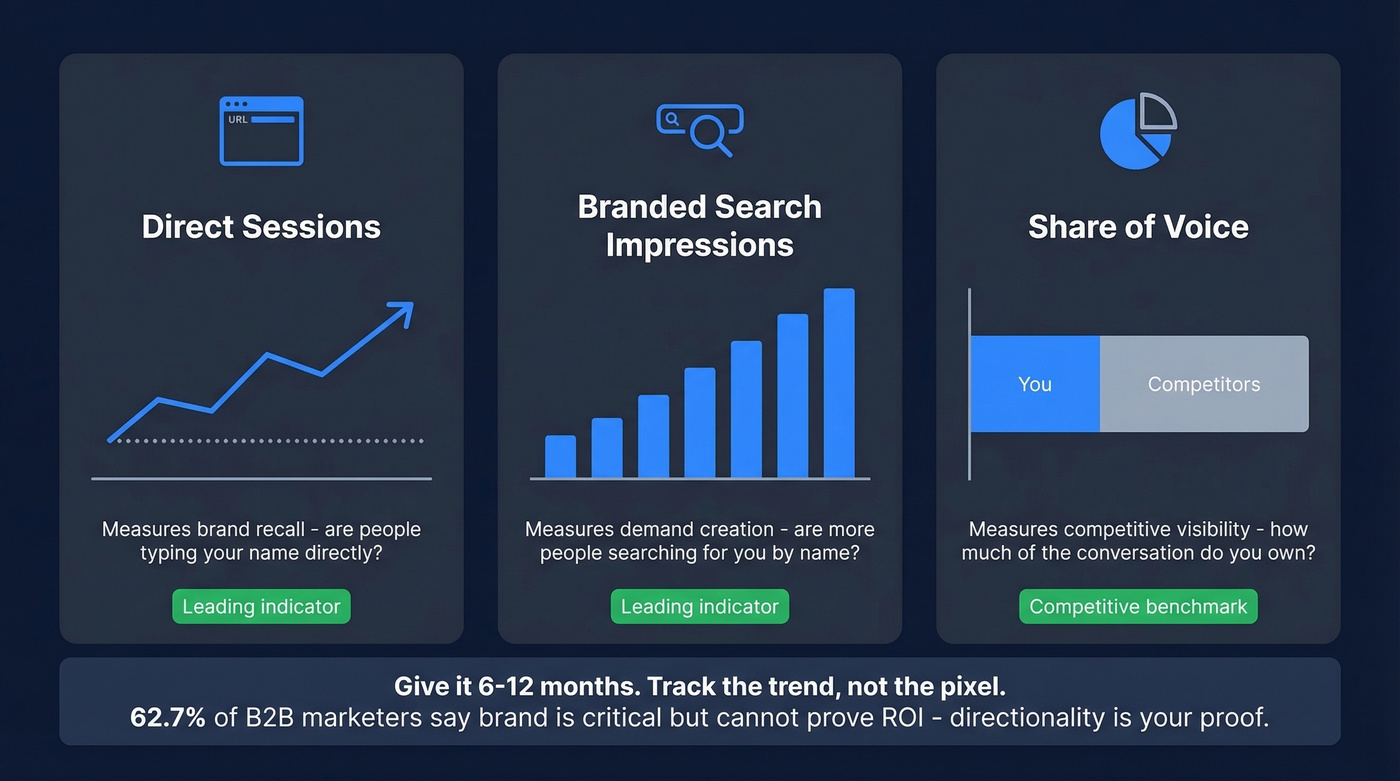
Give it 6-12 months. 62.7% of B2B marketers say brand is critical but can't prove ROI - which is frustrating, but the fix isn't better attribution software. It's proving directionality: branded impressions up, more demo-to-close efficiency, less discounting pressure. Track the trend, not the pixel.
Deliverable: a monthly "brand pulse" doc with those three charts, plus 5 sales call snippets where prospects mention competitors or say "I've heard of you."
Mistakes That Kill B2B Brands
Messaging that pleases everyone. You end up meaning nothing. Pick a wedge problem and say it in customer language, not internal jargon.
If you need a simple way to keep your story consistent in live conversations, borrow from these talk track examples.
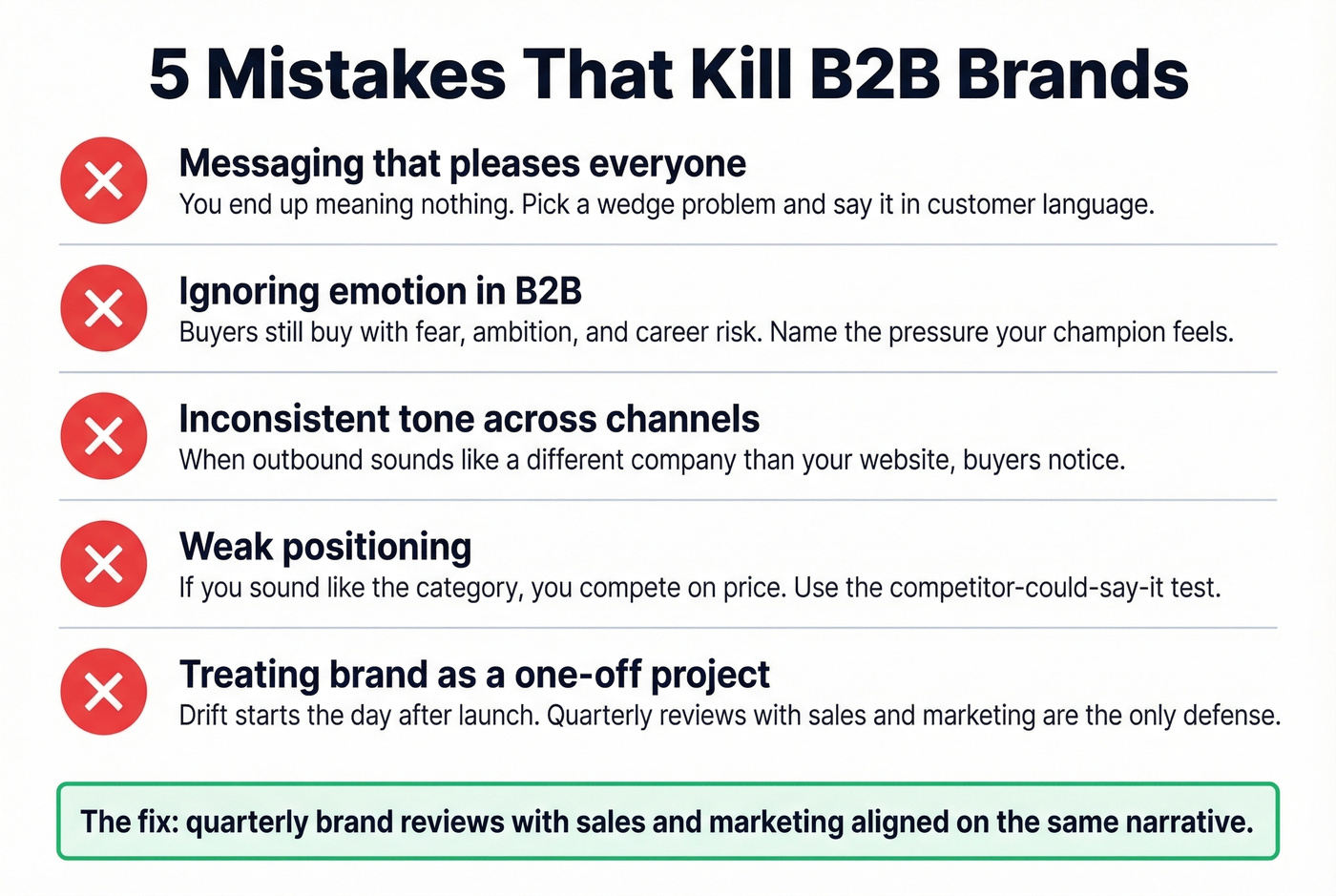
Ignoring emotion. Buyers still buy with fear, ambition, and career risk. Name the pressure your champion feels and show how you reduce it. B2B doesn't mean boring-to-boring.
Inconsistent tone across channels. Define voice rules and enforce them in decks, sequences, and product copy. When your outbound sounds like a different company than your website, buyers notice - even if they can't articulate why. (If email is a major channel, tighten your email copywriting standards so tone stays consistent.)
Weak positioning. If you sound like the category, you compete on price. Use the "competitor could say it" test and rewrite until they can't.
Treating brand like a one-off project. Drift starts the day after launch. Quarterly brand reviews with sales and marketing aligned on the same narrative are the only real defense.
Real Examples With Numbers
SAP's "Inspire the Future" campaign drove EUR 924.4M pipeline and EUR 266.15M projected revenue. That's not vibes - that's pipeline math. A SaaS content program in the same case compilation saw a 40% increase in qualified leads in 6 months, which is what brand looks like when it starts compounding.
Rebrands matter too, but mostly as systems work. Slack fixed an 11-color logo that didn't scale by moving to a consistent identity system. Zendesk's refresh signaled enterprise readiness - often the real job of brand when you move upmarket. Skip the rebrand if your positioning is still fuzzy; you'll just be putting a fresh coat of paint on confusion.
If you want to operationalize the “proof” part of brand, build a simple set of sales battle cards so reps can defend your wedge consistently.
Meritt tripled their pipeline from $100K to $300K/week and cut bounce rates from 35% to under 4%. That's what happens when every touchpoint - including outbound - reflects a brand that has its act together. At $0.01 per email, protecting your reputation costs less than one bad first impression.
Make every outbound touch reinforce your brand, not damage it.
FAQ
How long does it take to build a B2B brand?
Expect branded search lift in 3-6 months, but meaningful equity shifts - shorter sales cycles, more inbound shortlists, less price pressure - take 12-18 months of consistent execution across all touchpoints.
How much should a B2B company spend on brand vs. demand gen?
Start with Binet & Field's 60/40 split (60% brand, 40% performance). Most teams over-index on lead gen - 58.2% dedicate at least half their budget there. Shift 10-15% toward brand and track proxy metrics monthly.
What's the difference between B2B brand strategy and demand gen?
A B2B brand strategy builds long-term recall and trust so you're already on the shortlist when a buying committee forms. Demand gen converts that awareness into pipeline. Without brand, demand gen gets more expensive every quarter because you're always starting from zero recognition.
Does outbound data quality affect brand perception?
Every bounced email and wrong number erodes trust before prospects ever hit your site. Keeping your contact data fresh and verified - with a 7-day refresh cycle rather than the typical 6-week industry lag - ensures outreach stays consistent with the brand you're building.
How does a B2B marketing brand strategy differ from B2C?
B2B brand strategy targets buying committees rather than individual consumers, meaning longer consideration cycles, more stakeholders, and heavier reliance on proof points like case studies, ROI data, and peer validation. Emotional drivers still exist - career risk, trust, ambition - but they're wrapped in a rational business case that has to survive a group decision.