

Stop Describing the B2B Buying Process - Start Marketing to It
Every guide describes the B2B buying process. Yours probably has a nice linear funnel graphic and five tidy stages. Meanwhile, 86% of real B2B purchases stall and 81% of buyers end up dissatisfied with the vendor they chose. The real failure in B2B buying process marketing isn't a lack of understanding - it's that teams describe the journey instead of building campaigns that move buyers through it.
Why 86% of B2B Deals Stall
That stat isn't a fluke. Most B2B marketing teams produce content for a funnel that doesn't exist. Buyers don't move neatly from awareness to consideration to decision. They loop, stall, and ghost your champion for three weeks while legal reviews a DPA nobody prepared.
It gets worse. 67% of B2B buyers now prefer a rep-free experience, per Gartner's survey of 646 buyers. Your buyers are researching, comparing, and building requirements without you. If your content isn't enabling those activities directly, you're invisible during the moments that matter most.
The Short Version
Three things to internalize before we get into the details:
The buying process has 6 looping jobs, not a linear funnel. Map your marketing to each one. Every stakeholder in the buying committee needs a different asset to say yes - build them all. And your playbook is only as good as the contact data underneath it, because reaching 6-10 decision-makers per account requires verified emails and direct dials, not stale CRM records.
Buying Jobs, Not Funnel Stages
Gartner's buying model identifies six jobs that buyers cycle through - often revisiting the same job multiple times before a deal closes:
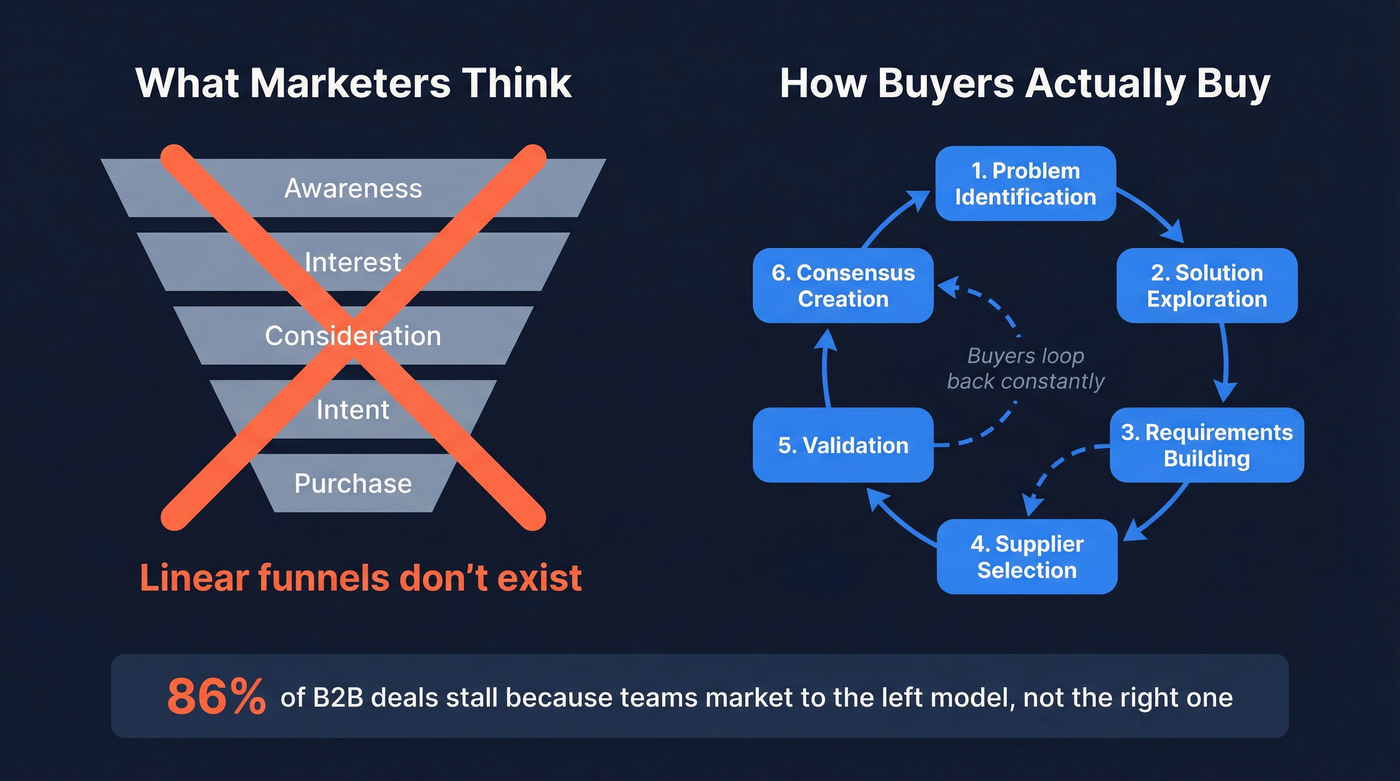
- Problem identification - "We need to do something."
- Solution exploration - "What's out there?"
- Requirements building - "What do we actually need?"
- Supplier selection - "Who makes the shortlist?"
- Validation - "Can we trust this vendor?"
- Consensus creation - "Can we get everyone aligned?"
These aren't sequential. A CFO might loop back to problem identification after seeing pricing. A security lead might reopen validation after a failed questionnaire. BCG calls this an "influence map" rather than a funnel, and the distinction matters for how you plan campaigns.
Here's the thing: that "70% of the journey happens before sales contact" stat everyone cites is outdated. 6sense's latest data shows first contact has moved from 69% to 61% of the journey. Buyers define purchase requirements 83% of the time before speaking with sales, but economic pressure is pushing them to engage sellers earlier than they used to. Your window to influence is wider than you think. And 45% of buyers are now using AI during their purchase process, so build modular, agent-ready content blocks that surface when those AI tools pull answers on your behalf.

Running parallel campaigns to every stakeholder in the buying committee only works if you can actually reach them. Prospeo gives you 98% accurate emails and 125M+ verified mobile numbers across 300M+ profiles - refreshed every 7 days, not every 6 weeks.
Stop losing deals to stale CRM data. Build your buying committee list now.
Align Strategy With the Buyer's Journey
McKinsey's Buyer Pulse Survey of nearly 4,000 respondents across 13 countries found that buyers now use 10+ channels to interact with suppliers, with time split roughly in thirds across traditional, remote, and digital self-service. Your marketing needs to show up across all three modes at every buying job.
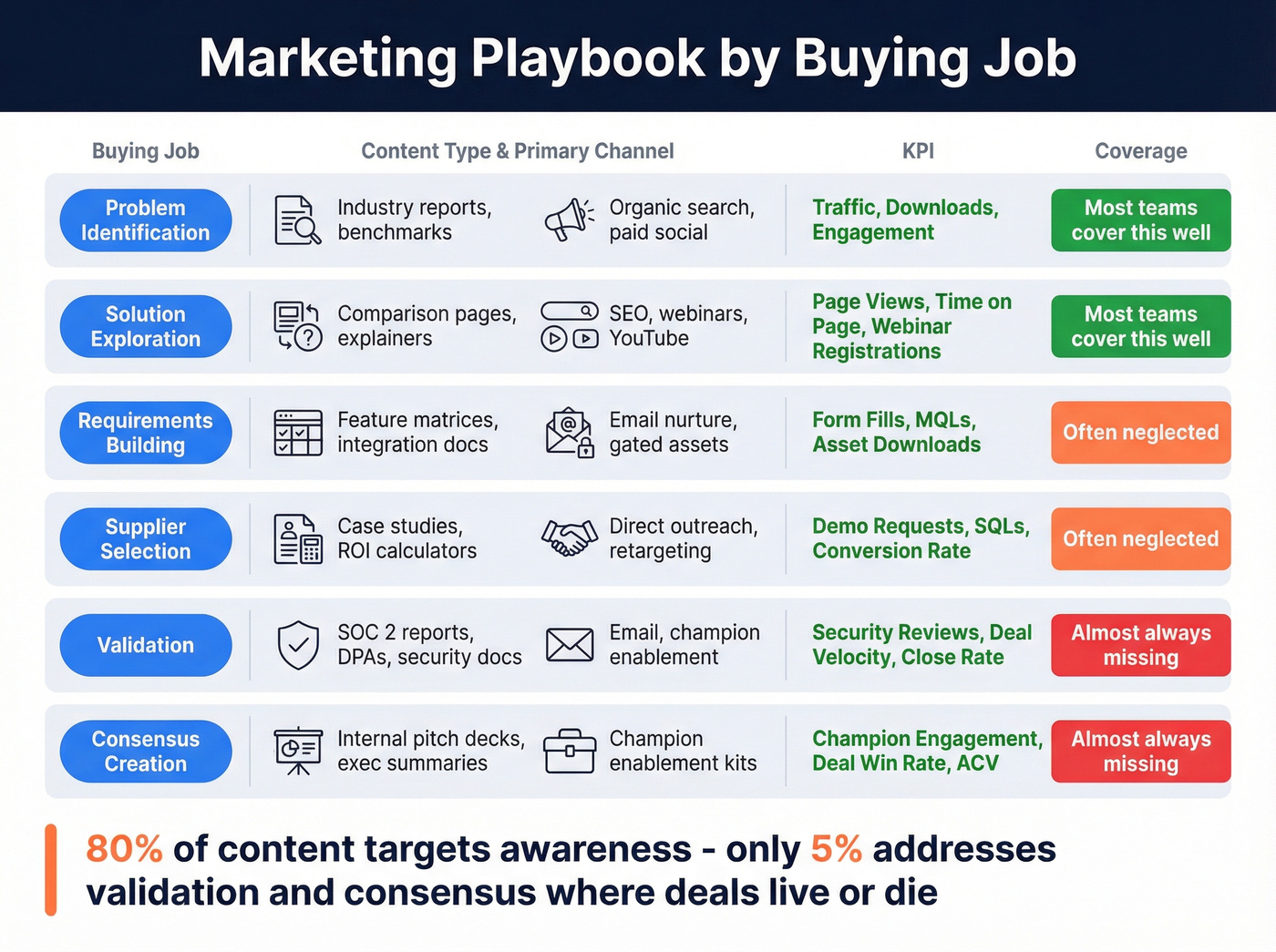
| Buying Job | Content Type | Primary Channel | KPI |
|---|---|---|---|
| Problem identification | Industry reports, benchmarks | Organic search, paid social | Traffic, downloads |
| Solution exploration | Comparison pages, explainers | SEO, webinars, YouTube | Time on page, return visits |
| Requirements building | Feature matrices, integration docs | Email nurture, gated assets | Form fills, demo requests |
| Supplier selection | Case studies, ROI calculators | Direct outreach, retargeting | SQLs, meetings booked |
| Validation | SOC 2 reports, DPAs, security docs | Email, champion enablement | Questionnaire turnaround |
| Consensus creation | Internal pitch decks, exec summaries | Champion enablement kits | Engagement breadth, velocity |
In our experience, most marketing teams only cover the first two rows well. Solution exploration gets a blog post and a webinar. Everything below that - the content that actually closes deals - gets handed to sales as a "figure it out" problem. We've audited content libraries for dozens of B2B companies, and the pattern is almost always the same: 80% of assets target awareness, 15% target consideration, and maybe 5% address the validation and consensus stages where deals actually live or die.
Content for Every Buying Committee Role
Most B2B purchases involve 6-10 decision-makers. Each one needs a different artifact to move forward.
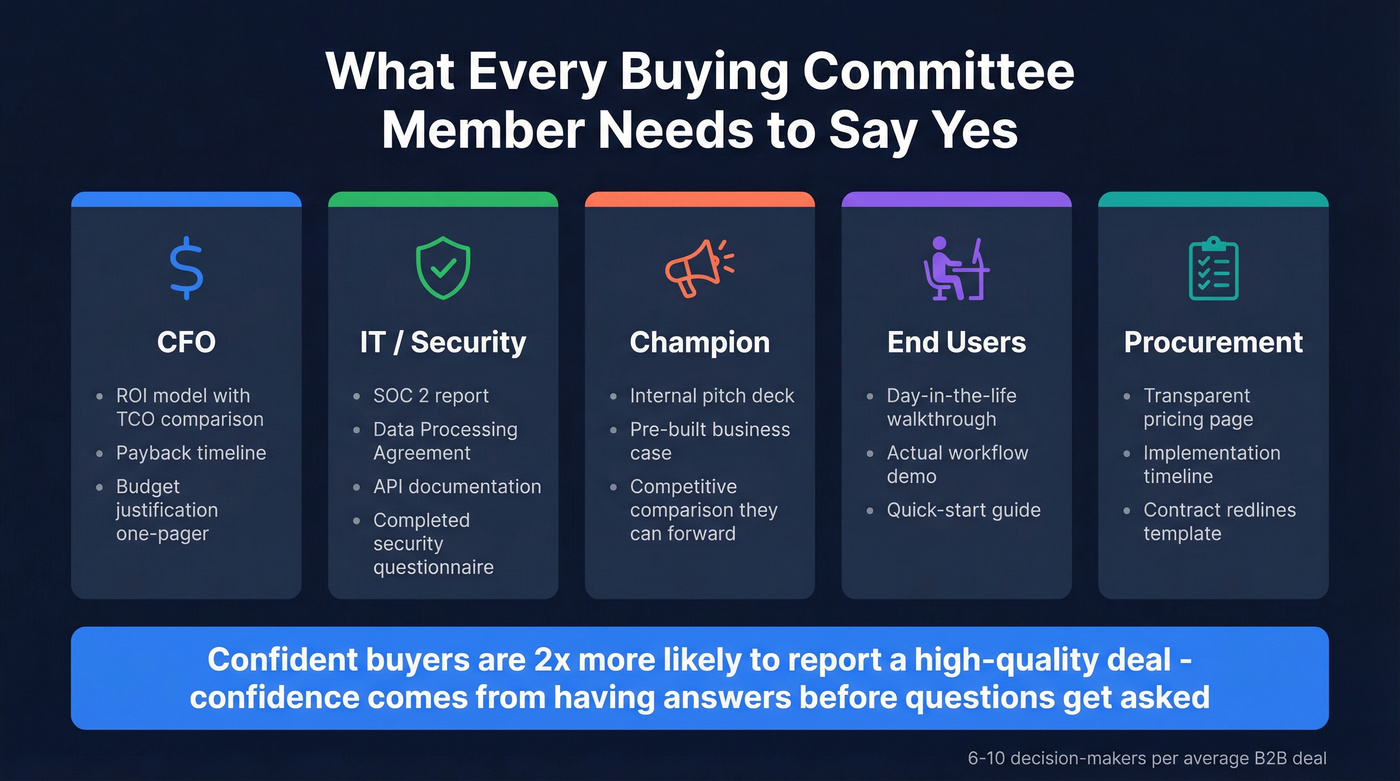
Your champion can't close the deal alone - they need ammunition. Building assets that map to every persona, not just the one who raised their hand first, is what separates pipeline that moves from pipeline that stalls. Here's what each role typically needs:
- CFO - ROI model with TCO comparison and payback timeline
- IT / Security - SOC 2 report, DPA, API documentation, completed security questionnaire
- Champion - Internal pitch deck and pre-built business case they can forward
- End users - Day-in-the-life walkthrough showing their actual workflow
- Procurement - Transparent pricing and implementation timeline
Confident buyers are twice as likely to report a high-quality deal. Confidence comes from having answers before questions get asked. Picture this: your champion sends the one-pager to the CFO at 9 PM on a Tuesday. If that one-pager doesn't exist, the deal stalls until someone builds it - and by then, momentum is gone.
Let's be honest about the biggest mistake we see. Teams run sequential outreach through a single champion and wonder why deals take six months. If you want to compress a B2B buying cycle, run parallel campaigns to every decision-maker - CIO, CFO, security, procurement - at the same time. Targeting a single thread instead of the full committee is the most common reason pipeline velocity flatlines.
The Data Layer Most Marketers Ignore
We've seen this pattern dozens of times: marketing generates 200 MQLs, sales calls them, and a huge share of the contact data is wrong. Bounced emails, disconnected numbers, wrong titles. The entire playbook above falls apart if you can't actually reach the 6-10 stakeholders in each target account.
Look - if your average deal size sits below five figures, you probably don't need a six-figure data platform. But you absolutely need accurate contact data for every persona in the buying committee, not just the one person who filled out a form. Buyers are 1.8x more likely to complete a high-quality deal when they use digital tools alongside a sales rep, and that hybrid model demands fresh, verified data across every role.
This is where Prospeo fits. It covers 300M+ professional profiles with 98% email accuracy and a 7-day refresh cycle, and you can filter by 30+ criteria - job title, department, intent signals, technographics, headcount growth - to build persona-specific lists for every stakeholder role. Snyk's team saw bounce rates drop from 35-40% to under 5% and AE-sourced pipeline jump 180% after switching. Skip it if you're only selling to single-threaded SMB deals with one buyer, but for any deal with a real buying committee, bad data is the silent killer.

Your champion needs to reach the CFO, security lead, and procurement - tonight. Prospeo's 30+ search filters let you find every decision-maker by role, department, and company, with verified direct dials that hit a 30% pickup rate.
Cover every persona in the buying committee for $0.01 per email.
Measuring What Actually Matters
If you're only tracking MQLs, you're measuring the wrong thing. MQLs tell you someone downloaded a PDF. They don't tell you whether the buying committee is progressing.
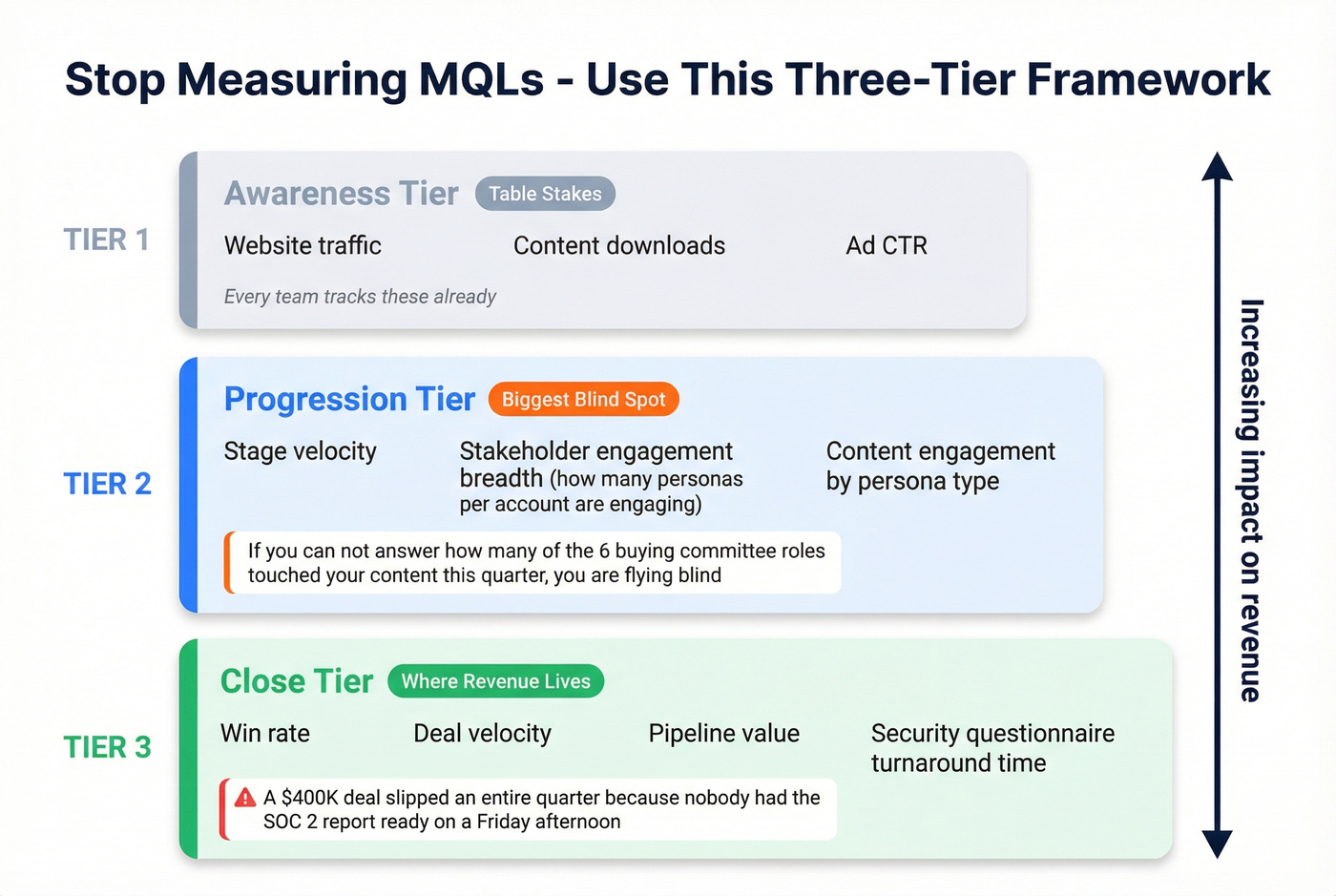
Awareness tier - Website traffic, content downloads, ad CTR. These are table stakes and every team tracks them already.
Progression tier - Stage velocity, stakeholder engagement breadth (how many personas per account are engaging), and content engagement by persona type. This is where most teams have a blind spot. If you can't answer "how many of the six buying committee roles have touched our content this quarter," you're flying blind on the metrics that predict close rates.
Close tier - Win rate, deal velocity, pipeline value, and security questionnaire turnaround time. That last one sounds weird until you realize it's where enterprise deals die quietly. I've watched a $400K deal slip an entire quarter because nobody had the SOC 2 report ready when the CISO asked for it on a Friday afternoon.
If you want a cleaner way to think about velocity and leakage, borrow a few pipeline health metrics and review them weekly with sales.
FAQ
How many stages does the B2B buying process have?
Six buying jobs that buyers loop through non-linearly - not a fixed sequence of stages. Effective marketing maps campaigns to each job rather than treating them as a straight-line funnel. Gartner's model shows buyers revisit earlier jobs multiple times before closing.
How long is the average B2B sales cycle?
About 10.1 months on average, down from 11.3 in 2024. Complex enterprise deals still stretch past 12 months. Parallel outreach to the full buying committee is the fastest way to compress that timeline.
How do you reach every stakeholder in a buying committee?
Build persona-specific contact lists filtered by job title, department, and intent signals, then run parallel campaigns to each role simultaneously. Tools like Prospeo let you segment by role, seniority, and technographics with 98% email accuracy so outreach actually lands.
How do you align marketing with the buyer's journey?
Map content and campaigns to the six buying jobs rather than a linear funnel. Audit which jobs you cover well - usually problem identification and solution exploration - and fill gaps in requirements building, validation, and consensus creation. Those are the stages where deals actually close or stall.