

B2B Content Marketing Trends in 2026: What the Data Says
Only 12% of B2B marketers rate their content marketing as highly effective. Another 47% land at "somewhat effective" - the participation trophy of self-assessment. The remaining 31% are neutral, 7% say somewhat ineffective, and 3% admit their programs flat-out aren't working.
The gap between the 12% and everyone else isn't budget or headcount. It's whether teams are chasing trends or fixing fundamentals.
A 2026 survey of 1,015 B2B marketers (conducted with MarketingProfs, sponsored by Storyblok) reinforces the bigger pattern: the teams pulling ahead aren't doing anything exotic. They're nailing relevance, aligning with sales, and measuring what matters to pipeline - then using AI and data to amplify those basics. Everyone else is stuck publishing content that technically exists but doesn't move revenue.
Three Trends Separating Top Performers
- Answer engine optimization - roughly 50-65% of searches now end without a click. If your content isn't structured for AI-generated answers, you're invisible where buyers actually look.
- First-party data activation - most teams collect first-party data. Almost none activate it. Cookie deprecation makes this urgent, not optional.
- Measurement reform - 65% of effective teams cite relevance and quality as the #1 driver. You can't improve relevance when you're measuring pageviews and social shares.
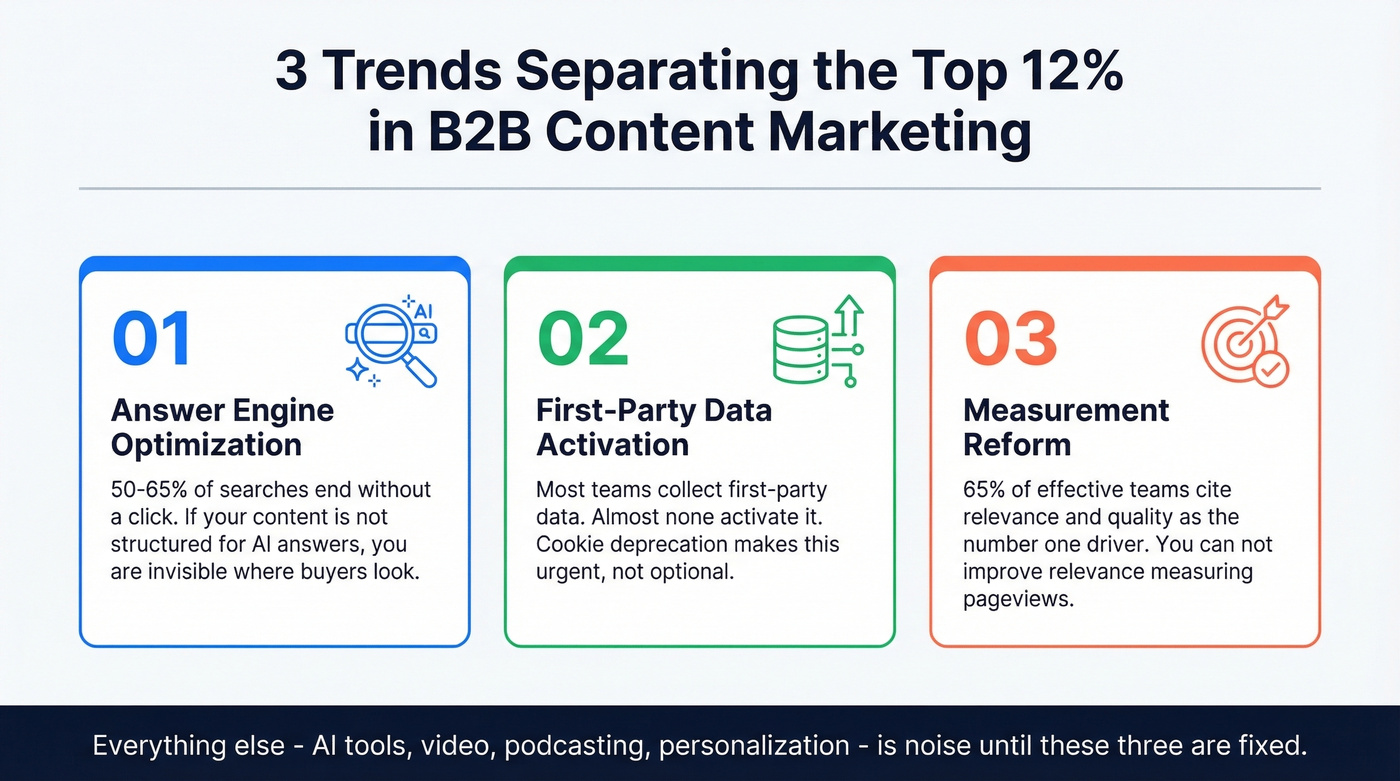
Everything else - AI tools, video, podcasting, personalization - is noise until those three are fixed.
Here's the thing: if your average deal size is under $15K and you don't have documented goals tied to buyer stages, you don't need more content. You need less content that actually works. The underperformers aren't under-producing. They're under-strategizing.
Why Most Content Strategies Underperform
When teams with underperforming strategies were asked what went wrong, the answers read like a diagnostic checklist:
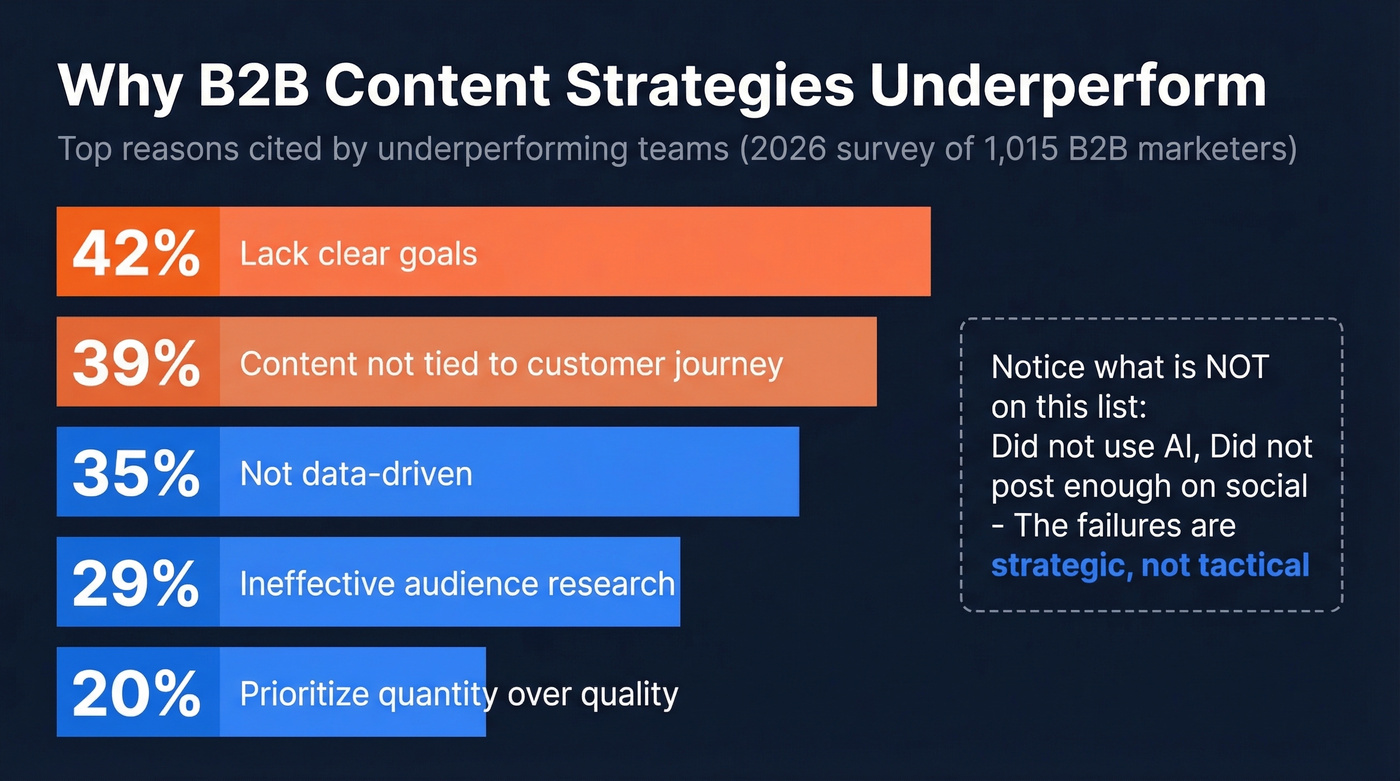
- 42% lack clear goals
- 39% haven't tied content to the customer journey
- 35% aren't data-driven
- 29% do ineffective audience research
- 20% prioritize quantity over quality
Notice what's absent: "didn't use AI" or "didn't post enough on social." The failure modes are strategic, not tactical. Teams are busy but ineffective because they're optimizing for vanity metrics - pageviews, social shares, MQL volume - instead of pipeline metrics like sales-accepted opportunities, meeting acceptance rate, and win rate on content-touched deals.
If your content strategy doesn't have documented goals tied to buyer stages, no amount of AI tooling or trend-chasing will fix it. Fundamentals first, amplification second.

42% of underperforming teams lack clear goals. The other gap nobody talks about? Bad data connecting content to pipeline. Prospeo's 300M+ profiles with 98% email accuracy and intent data across 15,000 topics let you tie every content asset to real buyers showing purchase signals - not vanity metrics.
Stop measuring pageviews. Start measuring pipeline from your content.
The B2B Content Marketing Trends That Actually Matter
AI Moves from Creation to Workflow Automation
The "AI writes your blog posts" era is already over. The teams getting results have moved past content generation into workflow automation - using AI to optimize distribution, personalize at scale, and orchestrate multi-channel campaigns.
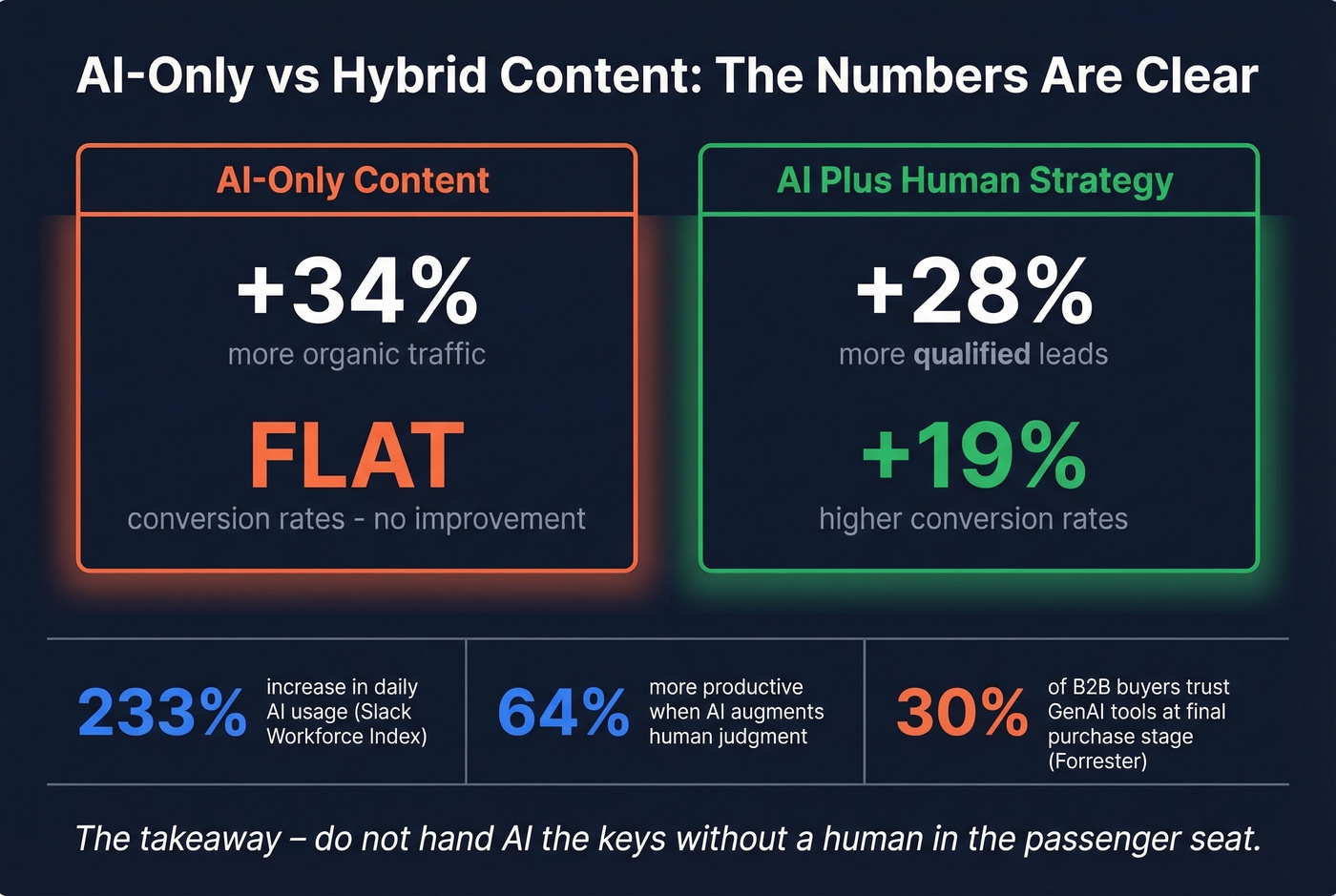
We've tested AI-only content workflows, and the conversion gap is real. One brand tripled content output with AI and gained 34% more organic traffic - but conversion rates stayed flat until they layered in human editorial oversight, which lifted conversions 15%. A B2B SaaS team running a hybrid approach with AI drafts plus human strategy saw 28% more qualified leads and 19% higher conversion rates. The Slack Workforce Index backs this up: daily AI usage is up 233%, and daily AI users report being 64% more productive, but only when AI augments human judgment rather than replacing it.
Now here's where it gets interesting. Forrester found that 30% of B2B buyers viewed GenAI tools as meaningful at the final commit stage of a purchase - compared to just 17% who said the same about product experts. Buyers are trusting AI more than your sales team at the moment of decision. Yet 19% of buyers using AI applications feel less confident in their purchasing decisions due to inaccurate GenAI information, and Forrester predicts GenAI incidents will drive over $10 billion in enterprise value loss through stock declines, legal settlements, and fines.
The takeaway isn't "avoid AI." It's "don't hand AI the keys without a human in the passenger seat." Marketing ops roles are shifting from managing tools to designing agent workflows - including the 20% of B2B sellers Forrester predicts will be forced into agent-led quote negotiations. That's the real trend, not another chatbot plugin.
Answer Engine Optimization Replaces Traditional SEO
Roughly 50-65% of Google searches now end without a click. 30% of marketers report decreased search traffic as buyers shift to AI-powered tools, and 72% of consumers plan to use AI-powered search more frequently. Gartner predicts that by 2026, 25% of organic traffic will bypass traditional search and flow to AI chatbots and virtual assistants.
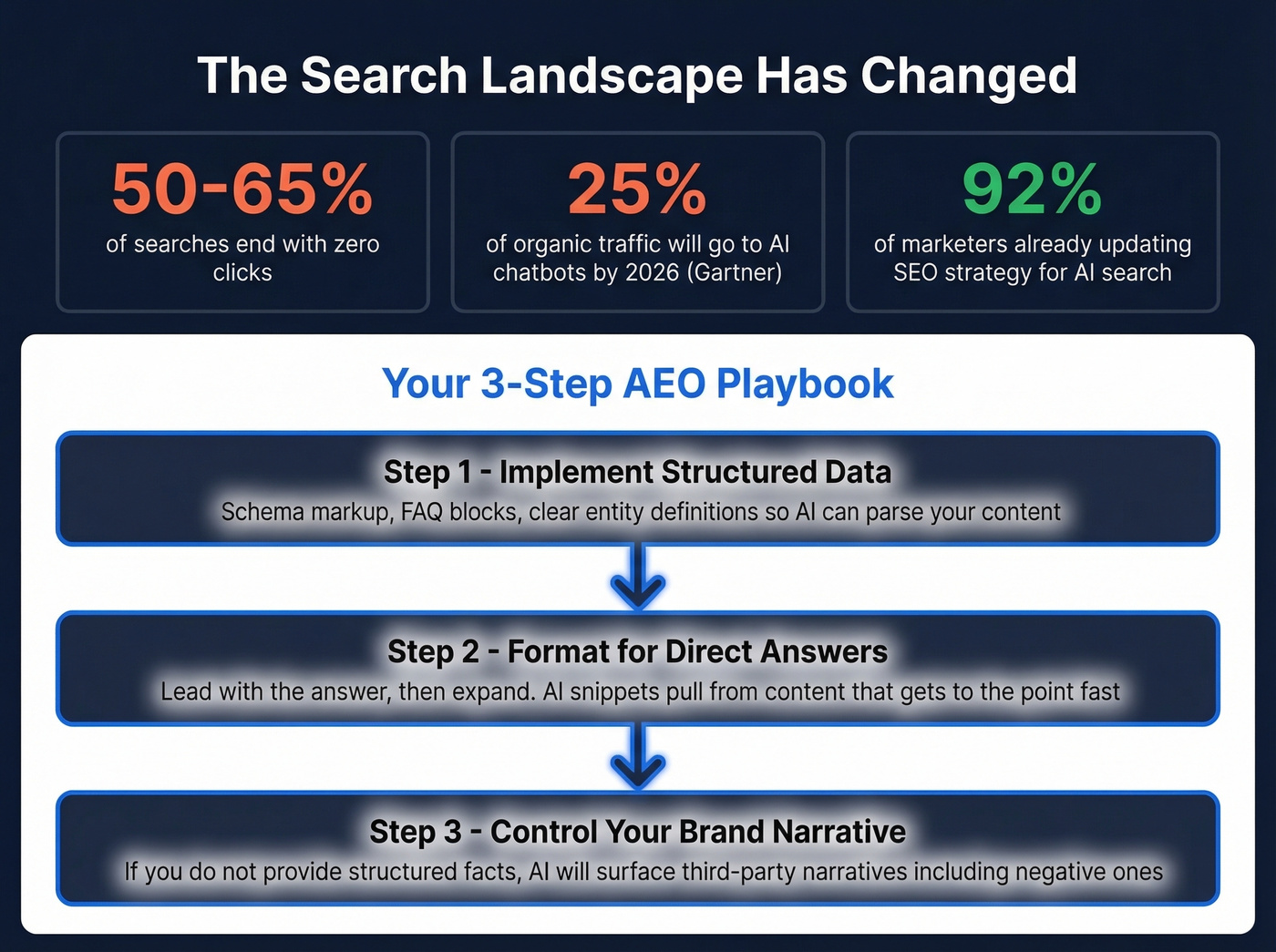
This isn't a future problem. Over 92% of marketers are already updating their SEO strategy for AI-powered search.
The practical playbook:
- Implement structured data. Schema markup, FAQ blocks, and clear entity definitions let AI systems parse your content reliably.
- Format for direct answers. Lead with the answer, then expand. AI snippets pull from content that gets to the point fast.
- Control your brand narrative. If you don't provide structured facts about your company and products, AI will surface third-party narratives - including negative ones. Brand perception now happens before the click.
First-Party Data Becomes the Foundation
Third-party cookies are dead on Safari and Firefox. Chrome's Privacy Sandbox is rolling out restrictions that make the old tracking playbook increasingly unreliable. Teams that haven't built a first-party data strategy aren't behind - they're flying blind.
Start with server-side tracking. Google Tag Manager's server-side container lets you process tracking data on your own infrastructure, making it resilient to browser restrictions. From there, the game is value exchange: gated content, interactive tools, and community access that give buyers a genuine reason to share their information. Generic PDFs behind a form don't cut it anymore. The asset has to be worth the data.
Personalization: What Works vs. What Doesn't
52% of B2B teams cite content personalization as key to improving lead nurture. But most personalization programs are still basic - first-name tokens and industry-level segmentation. That's not personalization. That's mail merge.
What actually works:
- Dynamic content blocks mapped to buying stage and intent signals
- ABM-style account personalization reflecting the prospect's tech stack and recent funding
- Triggered sequences based on content consumption patterns
Skip this if your CRM data hasn't been cleaned in six months. Even the best personalization engine produces garbage when it's working with stale records. Fix the data first, personalize second.
Thought Leadership at Scale
That 96%-produce-it, 4%-are-good-at-it stat tells you everything. It's a saturation problem, not a production problem.
The teams breaking through have operationalized thought leadership - turning it from a CEO's occasional blog post into a systematic program. Employee activation is the scaling mechanism: equip subject matter experts with frameworks, ghostwriting support, and distribution channels. One executive posting on social media isn't a thought leadership strategy. Ten domain experts sharing original perspectives across channels is.
Let's be honest - if your thought leadership reads like it could've been written by any competitor, it's not thought leadership. It's content. The distinction matters because buyers are drowning in generic takes and actively filtering for genuine expertise. Forrester predicts 75% of enterprise B2B companies will increase influencer relations budgets in 2026, a signal that even large organizations recognize internal voices alone aren't cutting through.
Video and Podcasting: Format Guide
Podcast listenership hit 584 million globally, with B2B ad spend reaching $4.46 billion. These numbers reflect a real format shift in how B2B buyers consume information.
| Format | Best For | Typical Length | Funnel Role |
|---|---|---|---|
| Short-form video | Social distribution, awareness | Under 60 seconds | Top |
| Webinars | Education, lead capture | 30-45 minutes | Mid |
| Podcasts | Trust-building, authority | 20-60 minutes | Relationship |
The mistake most B2B teams make is treating video and audio as standalone channels instead of repurposing engines. One 45-minute podcast episode yields 10+ short clips, a blog post, and a newsletter issue. That's not a content format - it's a content factory.
Data Quality: The Distribution Bottleneck
Email remains the #1 lead generation channel, used by 66% of B2B teams and 72% of high performers. But your content distribution is only as good as your data.
We've seen this pattern repeatedly: a team invests heavily in content strategy, production, and design, then distributes it to a list with high bounce rates. High bounces destroy sender reputation. Destroyed sender reputation tanks future deliverability. Within a few months, even good content stops reaching inboxes. The content was never the problem. The data was.

Before launching any content campaign, verify your list. One customer, Snyk, dropped their bounce rate from 35-40% to under 5% after switching to verified data, with AE-sourced pipeline up 180%. That's not a data quality story. That's a revenue story.
Measuring What Actually Matters
Measurement is a top-3 challenge for 33% of B2B content teams. The root cause is the wrong metrics, not the wrong tools. In our experience, the moment a team swaps pageviews for pipeline metrics, the entire content conversation changes - from "how much did we publish?" to "what moved revenue?"
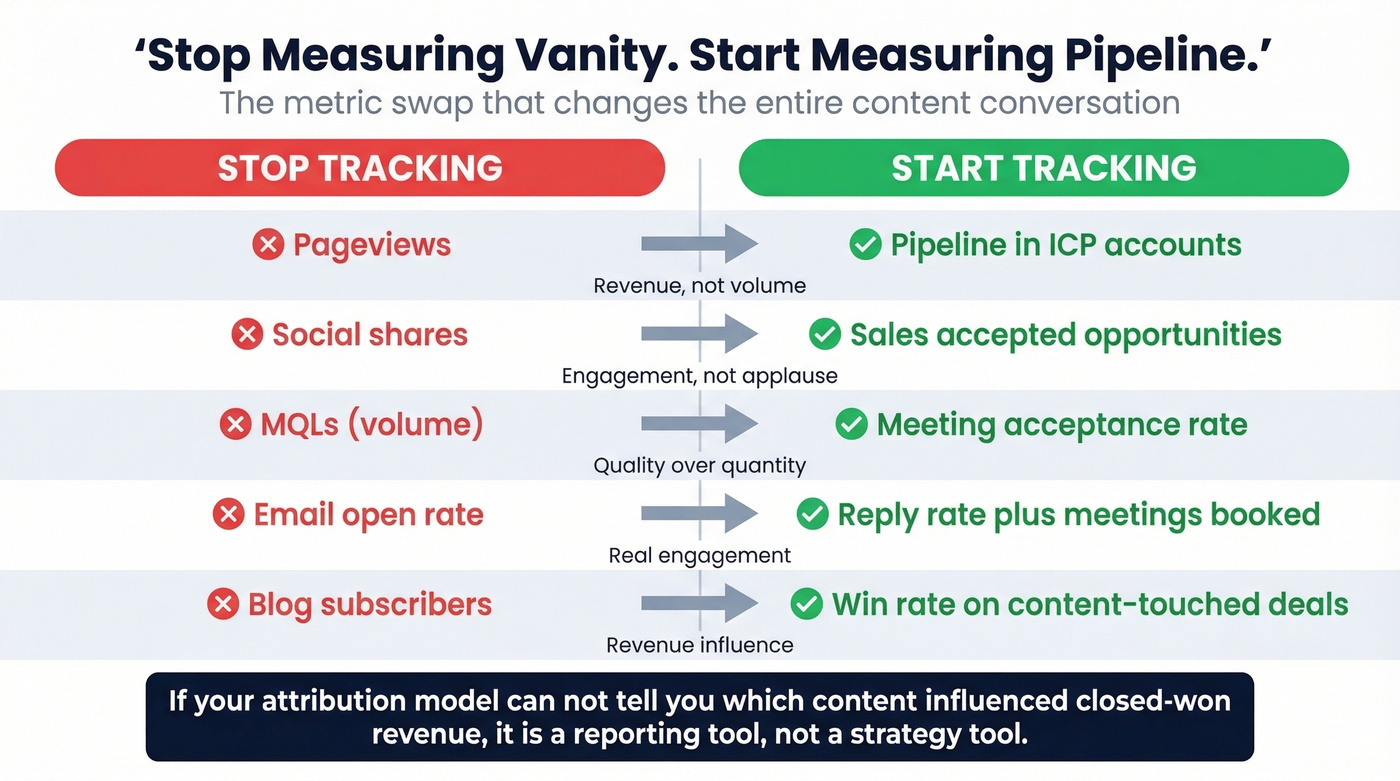
| Vanity Metric | Replace With | Why |
|---|---|---|
| Pageviews | Pipeline in ICP accounts | Revenue, not volume |
| Social shares | Sales accepted opps | Engagement, not applause |
| MQLs (volume) | Meeting acceptance rate | Quality over quantity |
| Email open rate | Reply rate + meetings | Real engagement |
| Blog subscribers | Win rate on content-touched deals | Revenue influence |
Attribution across long B2B buying cycles is genuinely hard. Buyers touch multiple pieces of content over months before a deal closes, and last-click attribution is useless in that world. Multi-touch models that weight content interactions across the full journey are the minimum viable approach. Straight talk: if your attribution model can't tell you which content influenced closed-won revenue, it's a pageview counter with extra steps.
What to Do Monday Morning
- Audit your strategy against the failure modes above. Do you have documented goals? Is content mapped to buyer stages? Are decisions data-driven? If any answer is no, fix that before chasing trends.
- Optimize your top 5 pages for answer engines. Add structured data, lead with direct answers, and make sure your brand narrative is clearly stated for AI systems to surface.
- Activate the first-party data you're already collecting. Set up server-side tracking, enrich stale CRM records with tools like Prospeo, and build value exchanges that justify data collection.
- Replace one vanity KPI with a pipeline metric. Swap pageviews for pipeline generated in ICP accounts. Just one swap. Watch how it changes the way your team thinks about content.
- Verify your email list before your next campaign. High bounce rates damage sender reputation. Clean the list first, distribute content second.
First-party data only works when you can activate it. Prospeo enriches your CRM and lead lists with 50+ data points per contact at a 92% match rate - on a 7-day refresh cycle. Layer in buyer intent, tech stack, and funding signals so your personalization actually reflects reality, not six-month-old records.
Clean data first, personalize second. Prospeo refreshes yours every 7 days.
FAQ
What's the biggest B2B content marketing trend in 2026?
Answer engine optimization is the highest-impact shift. With 50-65% of searches ending without a click and Gartner predicting 25% of organic traffic will flow to AI chatbots, optimizing content for AI-generated answers is non-negotiable. Teams that don't adapt will lose visibility where buyers actually research.
How effective is B2B content marketing right now?
Only 12% of B2B marketers rate their content marketing as highly effective, per a 2026 survey of 1,015 marketers. The majority - 47% - say "somewhat effective," and 31% are neutral. Top performers differentiate through documented strategy, sales alignment, and pipeline-focused measurement rather than higher output volume.
Should B2B teams use AI for content creation?
Yes, but with human oversight. Hybrid approaches - AI drafts plus human strategy and editing - produce 28% more qualified leads and 19% higher conversion rates compared to AI-only workflows. Meanwhile, 19% of buyers using AI feel less confident due to inaccurate GenAI information, making editorial review essential.
How do you measure B2B content marketing ROI?
Replace vanity metrics like pageviews and social shares with pipeline metrics: sales-accepted opportunities, pipeline generated in ICP accounts, and win rate on content-touched deals. Multi-touch attribution models are essential for long B2B buying cycles where last-click tells you nothing useful.
What role does data quality play in content distribution?
It's the bottleneck most teams ignore. Email is the #1 B2B lead gen channel, but high bounce rates destroy sender reputation and tank deliverability. Snyk cut bounce rates from 35-40% to under 5% after switching to verified contact data, and AE-sourced pipeline jumped 180%. Clean data isn't a nice-to-have - it's the infrastructure that makes content distribution work.